


 Скачать презентацию Semantic and syntactic processing in Chinese sentence comprehension
cb00f51857ed876e1e33f87c20459866.ppt
- Количество слайдов: 31
 Semantic and syntactic processing in Chinese sentence comprehension: Evidence from event-related potentials Zheng Ye, Yue-kia Luo, Angela D. Friederici, Xiaolin Zhou Presenter: Brian Lin
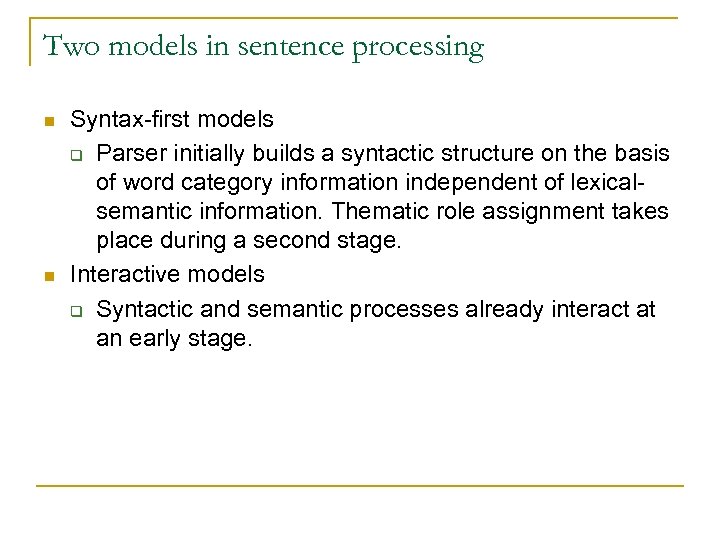 Two models in sentence processing n n Syntax-first models q Parser initially builds a syntactic structure on the basis of word category information independent of lexicalsemantic information. Thematic role assignment takes place during a second stage. Interactive models q Syntactic and semantic processes already interact at an early stage.
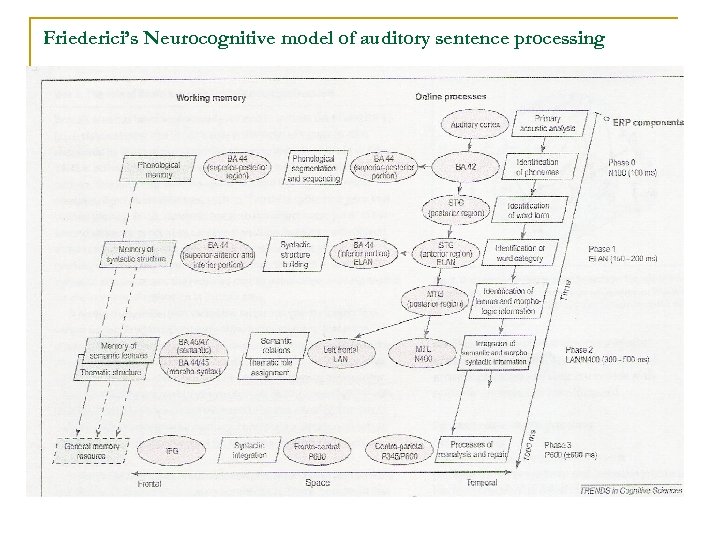 Friederici’s Neurocognitive model of auditory sentence processing
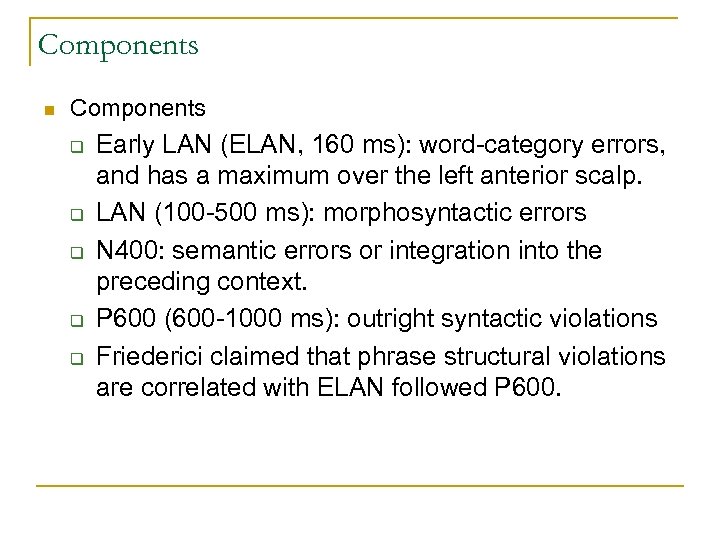 Components n Components q q q Early LAN (ELAN, 160 ms): word-category errors, and has a maximum over the left anterior scalp. LAN (100 -500 ms): morphosyntactic errors N 400: semantic errors or integration into the preceding context. P 600 (600 -1000 ms): outright syntactic violations Friederici claimed that phrase structural violations are correlated with ELAN followed P 600.
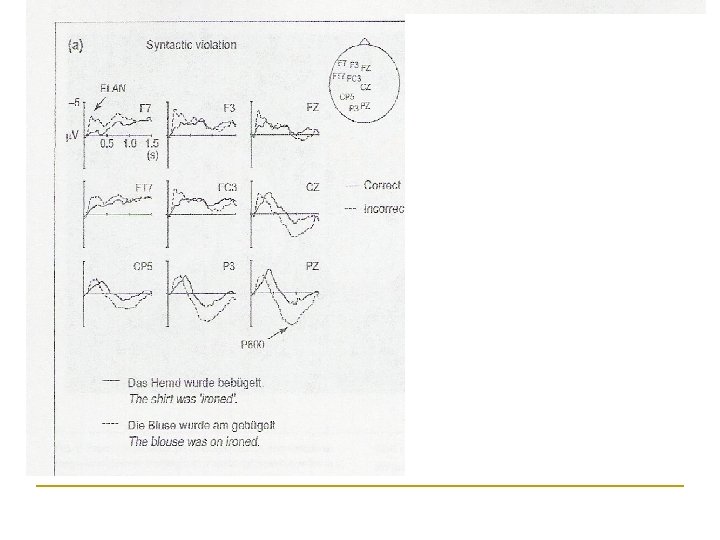 Syntactic + semantic
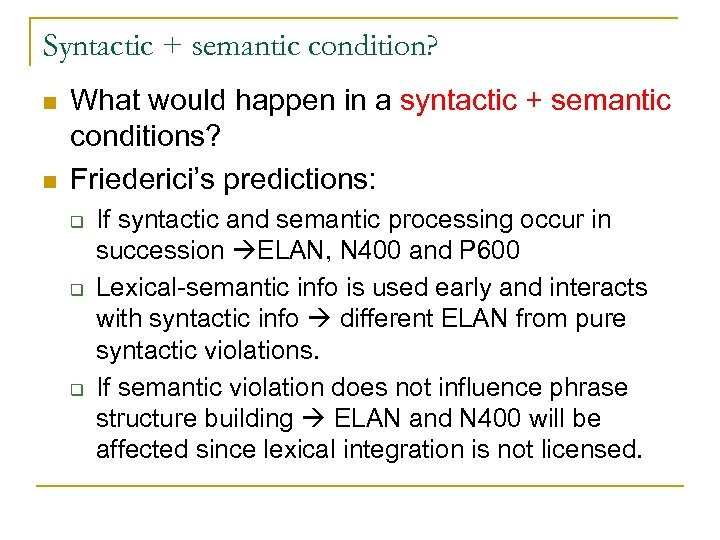 Syntactic + semantic condition? n n What would happen in a syntactic + semantic conditions? Friederici’s predictions: q q q If syntactic and semantic processing occur in succession ELAN, N 400 and P 600 Lexical-semantic info is used early and interacts with syntactic info different ELAN from pure syntactic violations. If semantic violation does not influence phrase structure building ELAN and N 400 will be affected since lexical integration is not licensed.
 Hahne & Friederici (2002) n n n Passive German sentences, auditory presented. N = 15 adult German college students Grammaticality judgment task
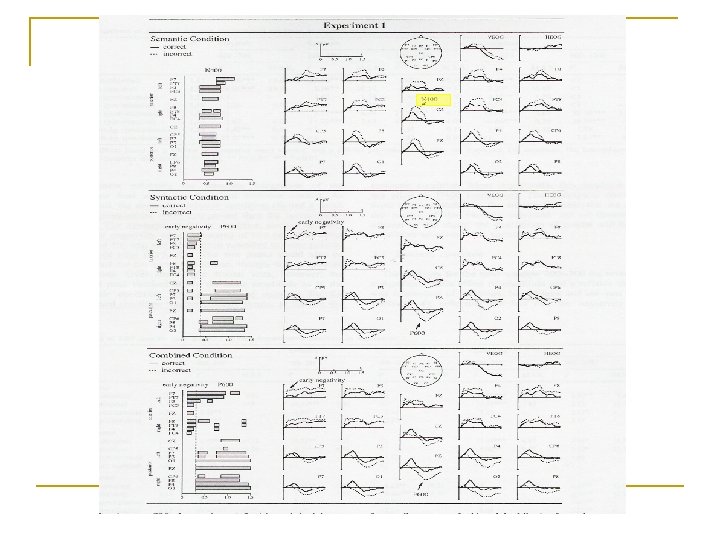
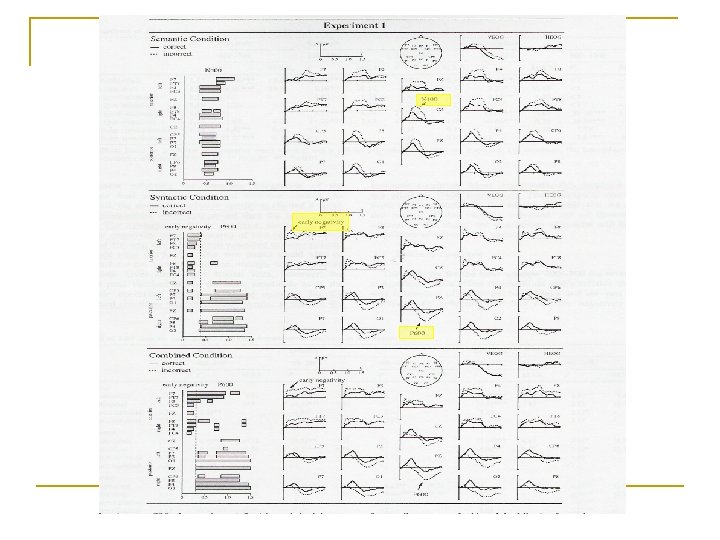
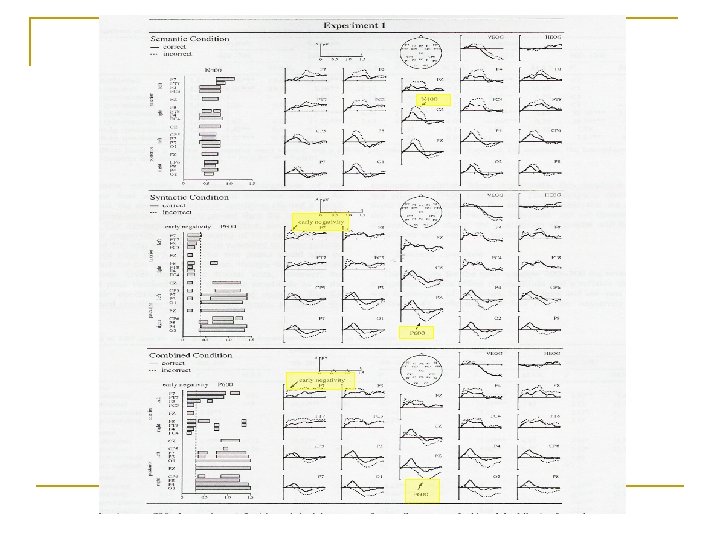
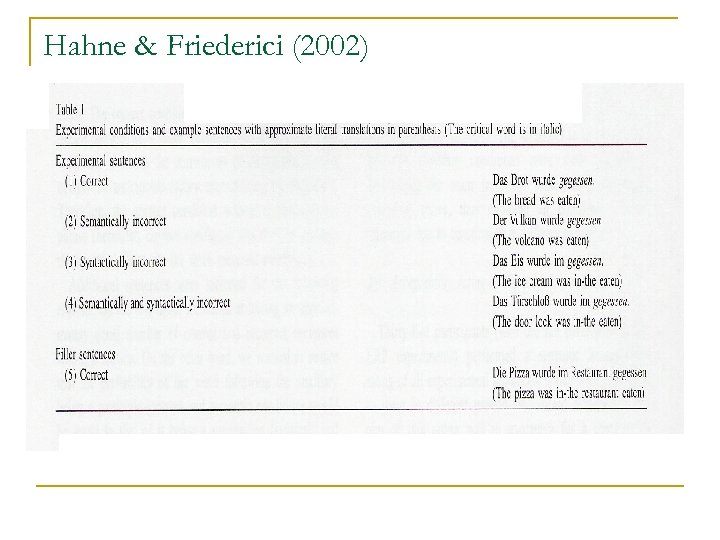 Hahne & Friederici (2002)
 Concerns about the 1 st Expt n n Studies on word-word priming effects have shown that a modulation of the N 400 component is dependent on attentional mechanisms. Thus the lack of N 400 in the combined situation might be due to attentional aspect.
 Hahne & Friederici’s Expt 2 n n N = 16 Procedures was identical to the first expt, except that subjects were told to ignore syntactic violations and focus on semantic coherence of the sentences only.
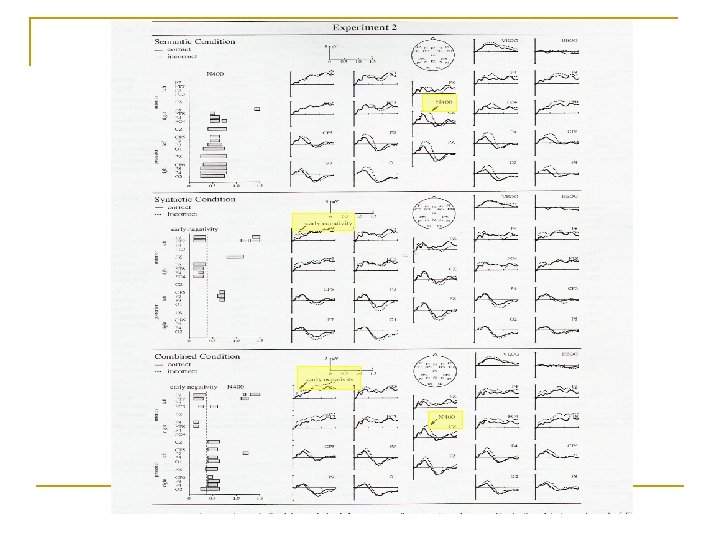
 Hahne & Friederici’s conclusions n n The task-induced emphasis on semantics did not affect ELAN. In the case of phrase structure violation semantic integration was not initiated automatically, but could still be initiated by attentional mechanisms.
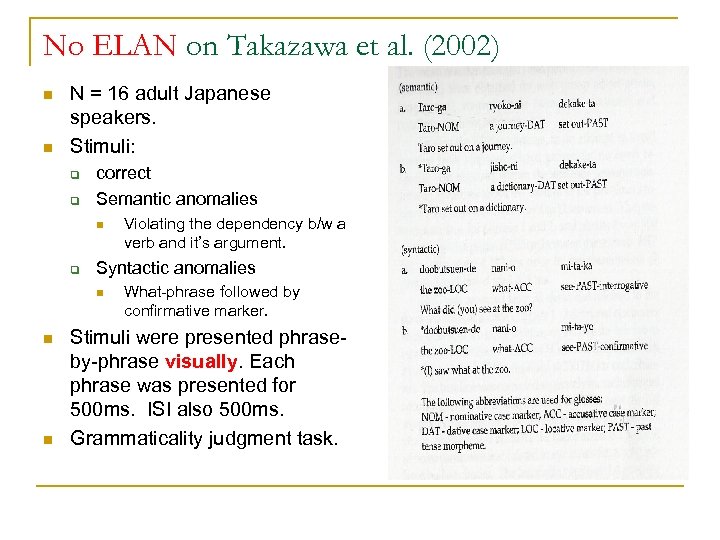 No ELAN on Takazawa et al. (2002) n n N = 16 adult Japanese speakers. Stimuli: q q correct Semantic anomalies n q Syntactic anomalies n n n Violating the dependency b/w a verb and it’s argument. What-phrase followed by confirmative marker. Stimuli were presented phraseby-phrase visually. Each phrase was presented for 500 ms. ISI also 500 ms. Grammaticality judgment task.
 No ELAN on Takazawa et al. (2002) n n N 400 for semantic anomalies and P 600 for syntactic anomalies. But NO ELAN or LAN. Why? q q Due to visual presentation. Difference in syntactic violation types n Neither phrase structure violations nor morphosyntactic violations.
 Ye et al. ’s experiment procedures n n N=12 Chinese adult speakers Auditory presented stimuli (240 experimental BA sentences and 120 filler sentences). Grammaticality judgment of experimental sentences and only trials with correct responses were analyzed. Stimuli lasted for 1000 ms.
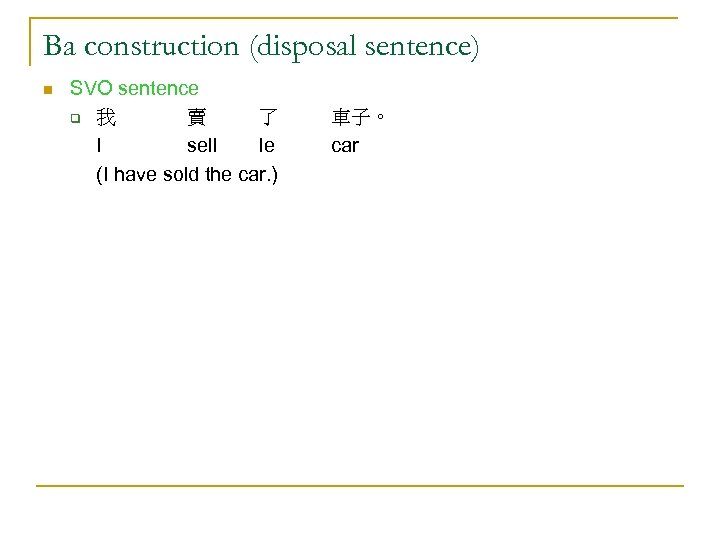 Ba construction (disposal sentence) n SVO sentence q 我 賣 了 I sell le (I have sold the car. ) 車子。 car
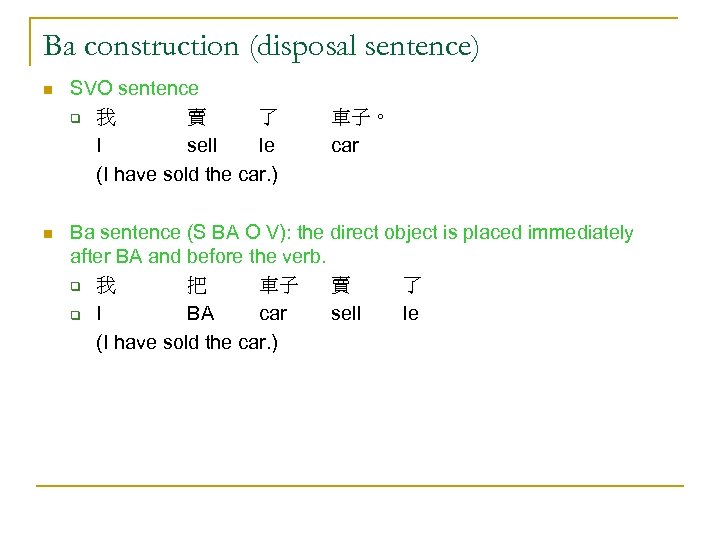 Ba construction (disposal sentence) n n SVO sentence q 我 賣 了 I sell le (I have sold the car. ) 車子。 car Ba sentence (S BA O V): the direct object is placed immediately after BA and before the verb. q 我 把 車子 賣 了 q I BA car sell le (I have sold the car. )
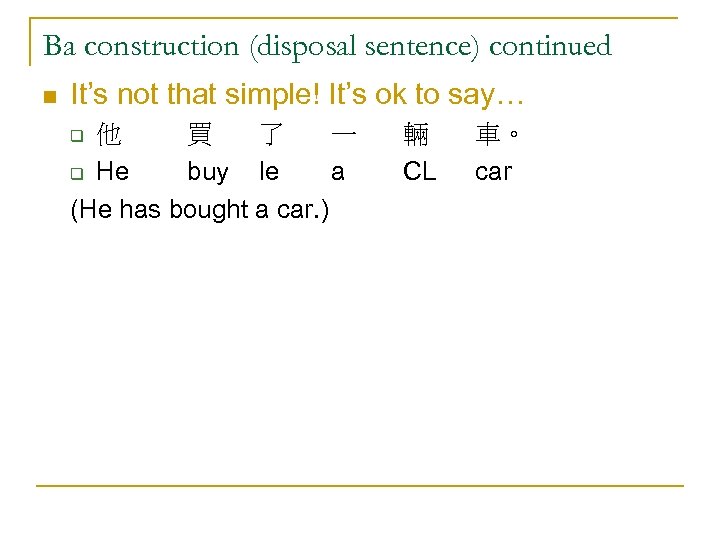 Ba construction (disposal sentence) continued n It’s not that simple! It’s ok to say… 他 買 了 一 q He buy le a (He has bought a car. ) q 輛 CL 車。 car
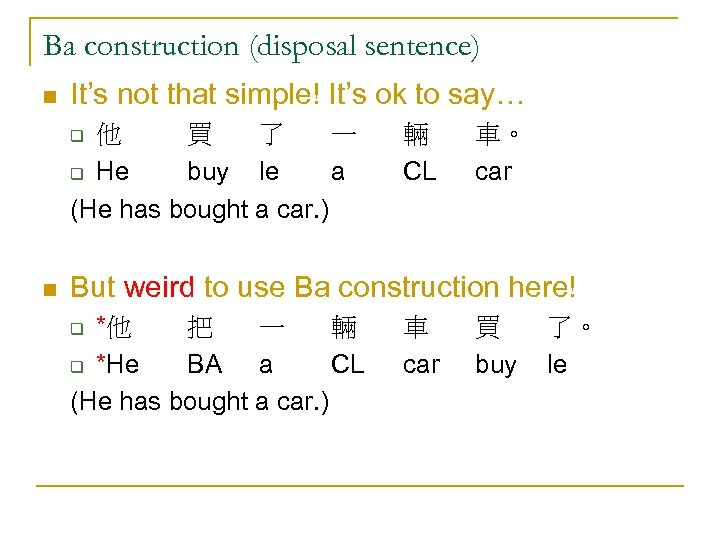 Ba construction (disposal sentence) n It’s not that simple! It’s ok to say… 他 買 了 一 q He buy le a (He has bought a car. ) q n 輛 CL 車。 car But weird to use Ba construction here! *他 把 一 輛 q *He BA a CL (He has bought a car. ) q 車 car 買 buy 了。 le
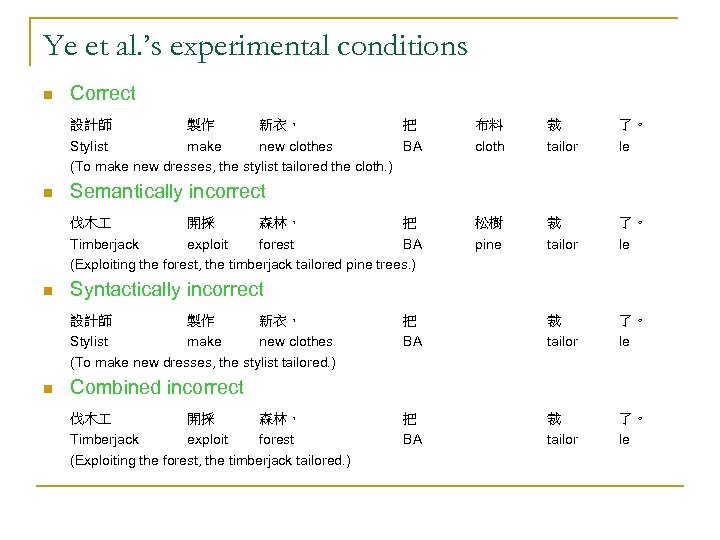 Ye et al. ’s experimental conditions n Correct 設計師 製作 新衣, 把 布料 裁 了。 cloth tailor le 松樹 裁 了。 pine tailor le 把 裁 了。 BA tailor le Stylist make new clothes BA (To make new dresses, the stylist tailored the cloth. ) n Semantically incorrect 伐木 開採 森林, 把 Timberjack exploit forest BA (Exploiting the forest, the timberjack tailored pine trees. ) n Syntactically incorrect 設計師 製作 新衣, Stylist make new clothes (To make new dresses, the stylist tailored. ) n Combined incorrect 伐木 開採 森林, Timberjack exploit forest (Exploiting the forest, the timberjack tailored. )
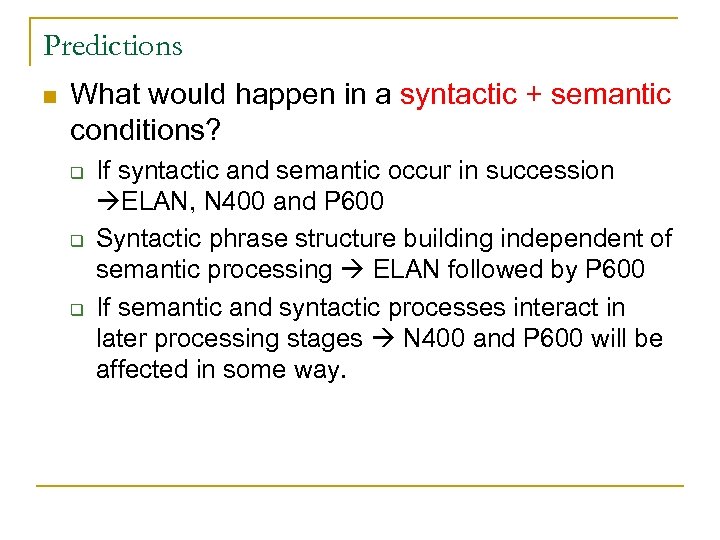 Predictions n What would happen in a syntactic + semantic conditions? q q q If syntactic and semantic occur in succession ELAN, N 400 and P 600 Syntactic phrase structure building independent of semantic processing ELAN followed by P 600 If semantic and syntactic processes interact in later processing stages N 400 and P 600 will be affected in some way.
 Ye et al. result
 Ye et al. result ELAN for syn + Combined.
 Ye et al. result ELAN for syn + Combined. P 600 ? Not sig.
 Ye et al. result ELAN for syn + Combined. Early N 400. Bigger for syn + combined P 600 ? Not sig.
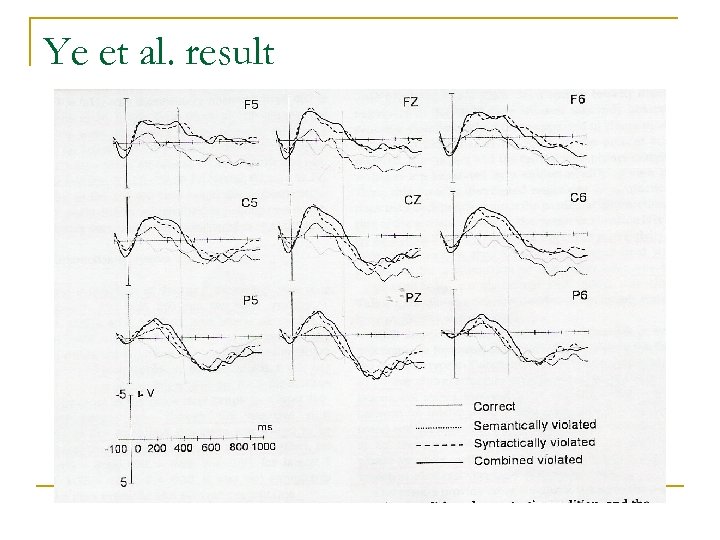
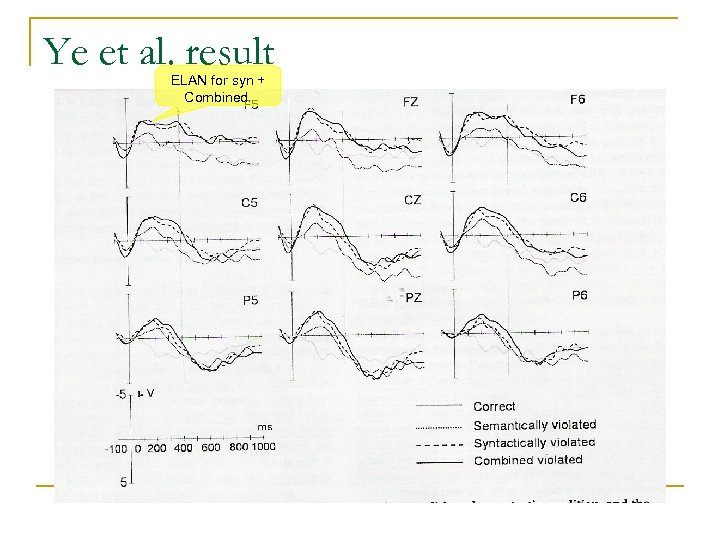
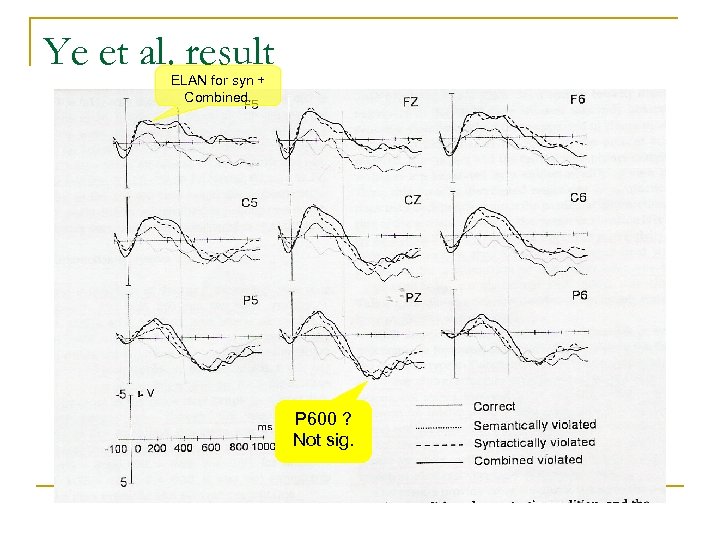
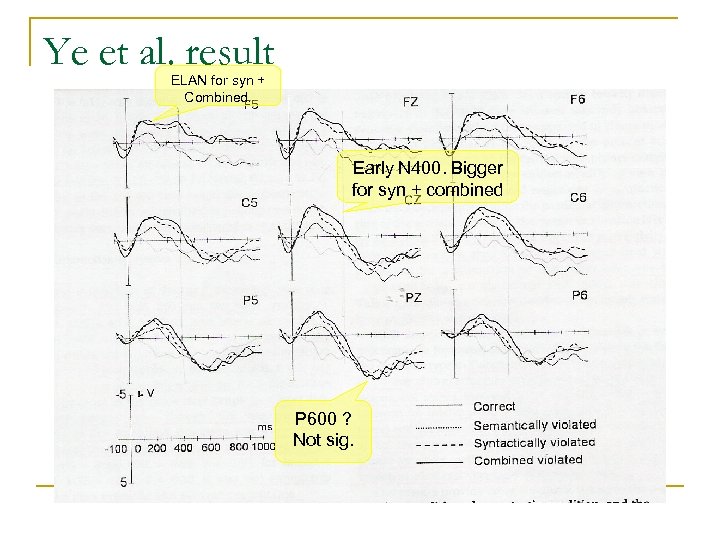
 Ye et al. results n n Syntactic violation: ELAN but no P 600 (no significant main effect, and could be due to possible overlap of largely distributed later negativity and P 600. ) Semantic violation: Early N 400 q May be due to monosyllabic words took less time to process. q Context dependency from the first clause.
 Ye et al. results. n n Combined violations: pattern similar to syntactic violation, but demonstrate a larger negativity in 250 -400 time window. q Suggest that semantic and syntactic information are processed in parallel in an early phase of comprehension! In Mandarin, semantic and syntactic processes seem to be independent in an early time window and interact in a late processing phase.
 Questions and Comments 1. 2. 3. 4. 5. The latency of a component only show the earliest time point when the machine reveals the differences but not necessarily the onset of the cognitive process! In this study, there were only 12 participants and they had all 4 conditions of each verb. Is this usual in ERP research? “It takes less time to process the semantic information in monosyllabic than in polysyllabic. ” Shorter words don't necessarily mean that they have simpler information. In both syntactic violation and combined sentences, the violation word didn't exist in the sentence. The early negativity has already detected the violation. There is no need to do further analysis. Visual vs. auditory presentation. Is it possible that the visual presentation affords some small amount of parafoveal processing, however miniscule, that may alter the timing of the phrase processing (and additionally if that is different across the languages)?