 Скачать презентацию Selling to the Public Sector in Gloucestershire WELCOME
0b843afc4b8f082ea5c2f33b9444fc37.ppt
- Количество слайдов: 73




Selling to the Public Sector in Gloucestershire WELCOME
Today’s agenda l l l l 09: 30 - Housekeeping 09: 35 – Introduction from Portfolio Holder – Gloucestershire County Council 09: 45 - Who is who and what we do 09: 55 - Portals and where tender opportunities can be found 10: 05 - An overview of tendering 10: 30 - Sustainability and Equalities 10: 45 - Question & Answer Session 10: 50 - Coffee Break & Networking 11: 15 - Frameworks and Professional Buying Organisations explained 11: 30 – Transparency 11: 45 - Case Study from Devon County Council – Tendering as a Consortia 12: 30 - Question & Answer Session 12. 40 - Break 12: 45 - Demonstration of Pro Contract (Optional)
Supplying to the Public Sector in Gloucestershire Welcome Ray Theoudoulou Cabinet Member for Finance Resources – Gloucestershire County Council
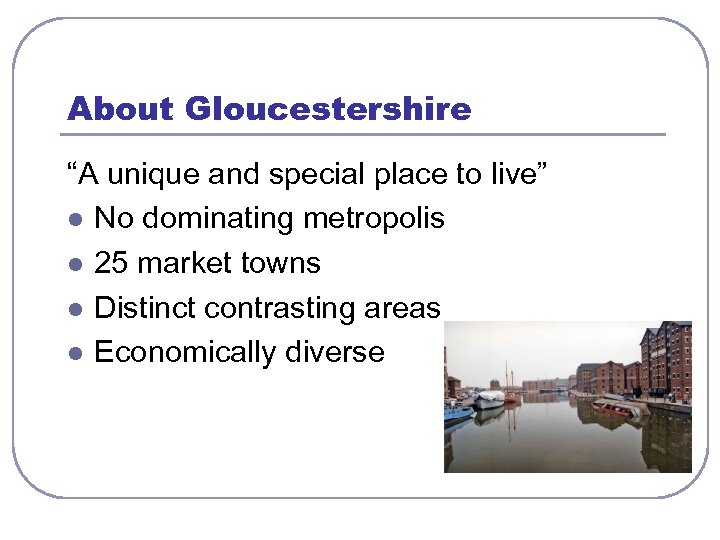
About Gloucestershire “A unique and special place to live” l No dominating metropolis l 25 market towns l Distinct contrasting areas l Economically diverse
Challenges l l l Population Climate Change Economy
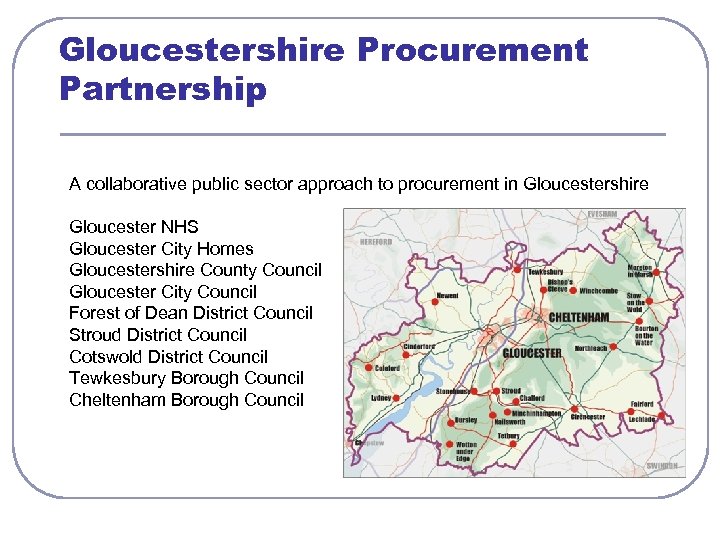
Gloucestershire Procurement Partnership A collaborative public sector approach to procurement in Gloucestershire Gloucester NHS Gloucester City Homes Gloucestershire County Council Gloucester City Council Forest of Dean District Council Stroud District Council Cotswold District Council Tewkesbury Borough Council Cheltenham Borough Council
The Efficiency Agenda • Local Government is in a very different place / position than it has ever been before • We need to be exploring every way we can for Public Sector organisations to make efficiencies • A real move for Local Authorities and other Public Sector Bodies to collaborate regionally and nationally
What does this mean for Gloucestershire l l l Partnership, innovation, collaboration Suppliers need to be aware of • Where to look for opportunities • How to tender / constraints on public sector Buyers need to be aware of importance of listening to their private sector partners.

Thank you
Who We Are and What We Buy Imogen Batton – Head of Procurement Gloucestershire NHS Procurement Shared Service Claire Smart – Director Strategic Procurement Gloucestershire County Council
NHS PROCUREMENT What we buy l Medical and Surgical products and services (equipment, consumables and maintenance etc including capital equipment and managed services) l Non Medical goods and services (laundry, legal services, IT systems, hardware and software, stationery and furniture, post and catering etc) l Estate & Facilities goods and services (Boilers, parking, cleaning and gardening, transport etc)
NHS PROCUREMENT The Team l The team in Gloucestershire manage all requirements across the county for up to 80 sites (not including energy and drugs) l The Ambulance Trust deals with all of their requirements themselves (so we don’t cover ambulances and kit in them).
Gloucestershire County Council Who we are l 1 strategic Procurement team (strategy policy, process, documentation, some corporate contracts) l 11 teams of purchasers (Sourcing Pools) – distributed across directorates
Gloucestershire County Council What we buy l l l l Social Care Highways maintenance Waste disposal Fire engines Transport Schools services Building services And much more…
Forest of Dean District Council Requirements of District Councils
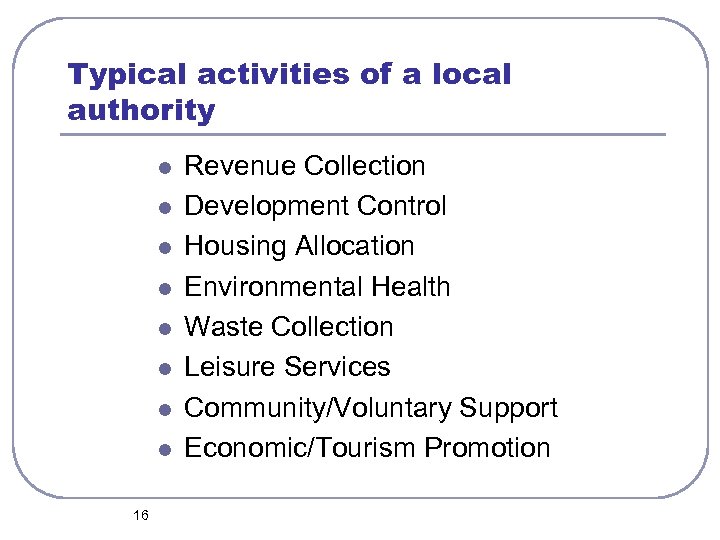
Typical activities of a local authority l l l l 16 Revenue Collection Development Control Housing Allocation Environmental Health Waste Collection Leisure Services Community/Voluntary Support Economic/Tourism Promotion
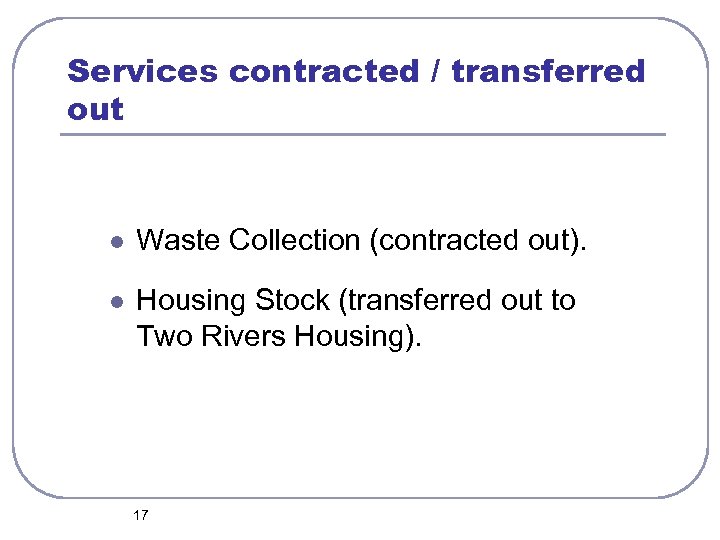
Services contracted / transferred out l Waste Collection (contracted out). l Housing Stock (transferred out to Two Rivers Housing). 17
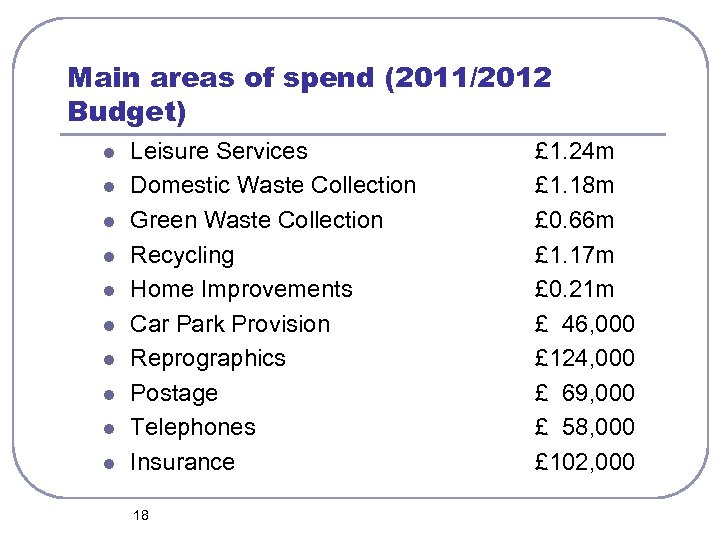
Main areas of spend (2011/2012 Budget) l l l l l Leisure Services Domestic Waste Collection Green Waste Collection Recycling Home Improvements Car Park Provision Reprographics Postage Telephones Insurance 18 £ 1. 24 m £ 1. 18 m £ 0. 66 m £ 1. 17 m £ 0. 21 m £ 46, 000 £ 124, 000 £ 69, 000 £ 58, 000 £ 102, 000
Our aspirations l Want to support Local Business but opportunities are very ad-hoc. l Urge you all to register on the SW Portal Supplyingthesouthwest. org. uk l Identify local suppliers when opportunities arise. l Achieve Value For Money. 19
Advertising and Regional Portals Steve Hodgson
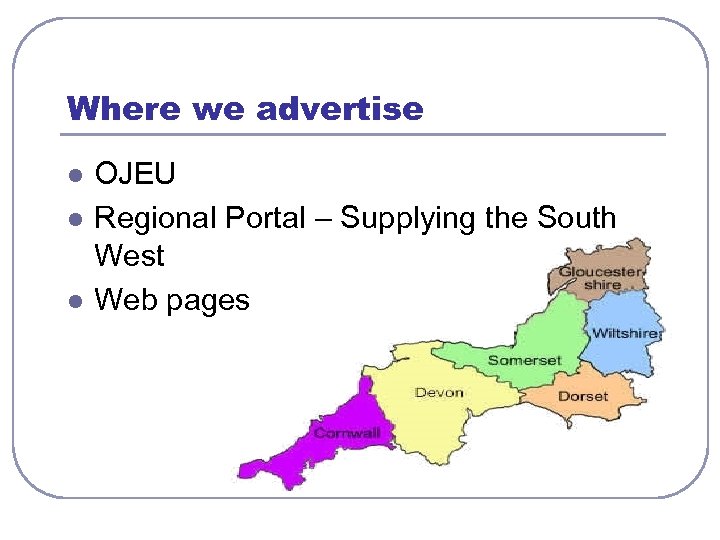
Where we advertise l l l OJEU Regional Portal – Supplying the South West Web pages
Supply 2 Gov l The Supply 2. gov. uk service is due to end in March 2011. Until 31 March 2011 you will continue to be able to access live contract opportunities through Supply 2. gov. uk. From 1 st April 2011, new public sector contract opportunities can be found on the Government’s new Contracts Finder system, which will be accessible from Business Link website
Benefits of the Portal www. supplyingthesouthwest. org. uk l l It’s Free It’s easy It’s a one stop shop – you register, it alerts you to opportunities in your business area It gives you access to multiple organisations across the South West
Demonstration l At the end of the event there will be a demonstration of the regional portal (Pro contract)
Selling to the Public Sector in Gloucestershire Tendering
Rules – Internal l Each organisation is a statutory body and has rules which cover how it is set up, the delegation of authority or reservation of powers, and tendering levels and procedures to be followed. l Each organisation has set a level at which competitive quotes or competitive tendering takes place. An example may be £ 5, 000 for quotes and £ 25, 000 for tendering.
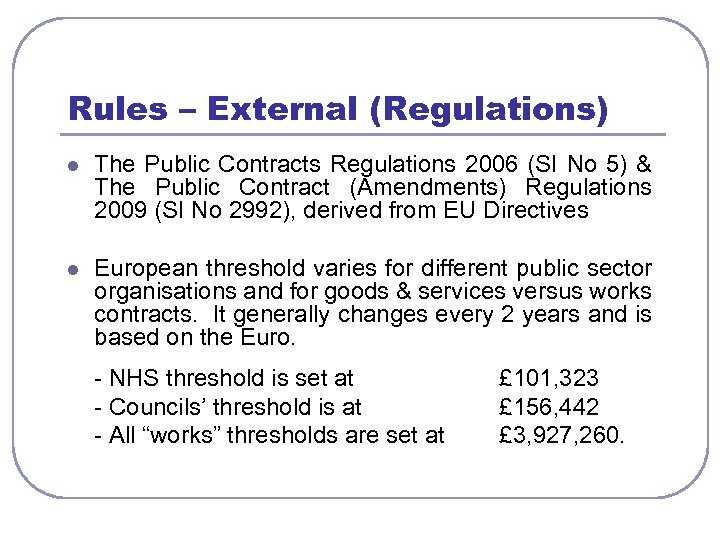
Rules – External (Regulations) l The Public Contracts Regulations 2006 (SI No 5) & The Public Contract (Amendments) Regulations 2009 (SI No 2992), derived from EU Directives l European threshold varies for different public sector organisations and for goods & services versus works contracts. It generally changes every 2 years and is based on the Euro. - NHS threshold is set at - Councils’ threshold is at - All “works” thresholds are set at £ 101, 323 £ 156, 442 £ 3, 927, 260.
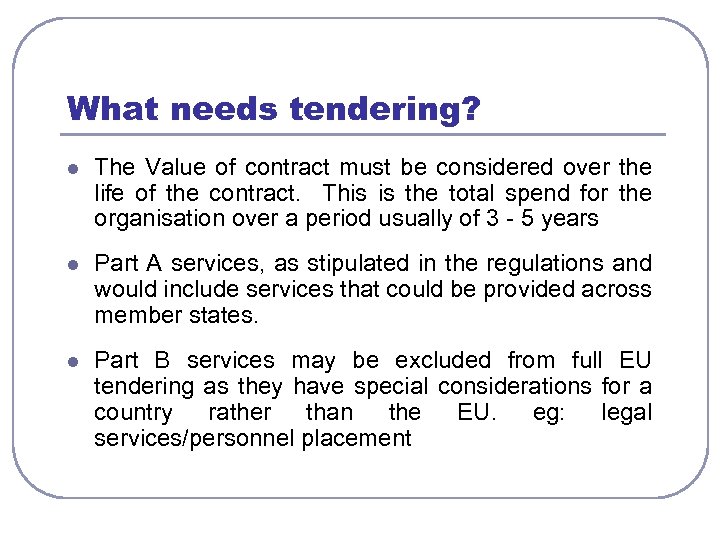
What needs tendering? l The Value of contract must be considered over the life of the contract. This is the total spend for the organisation over a period usually of 3 - 5 years l Part A services, as stipulated in the regulations and would include services that could be provided across member states. l Part B services may be excluded from full EU tendering as they have special considerations for a country rather than the EU. eg: legal services/personnel placement
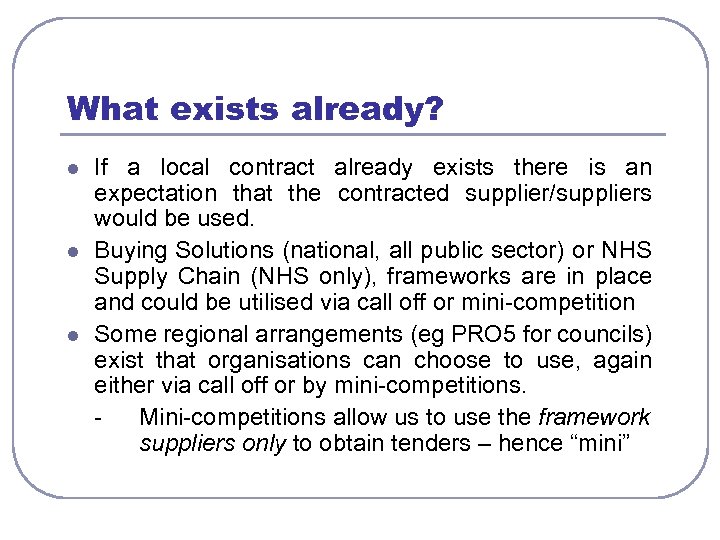
What exists already? l l l If a local contract already exists there is an expectation that the contracted supplier/suppliers would be used. Buying Solutions (national, all public sector) or NHS Supply Chain (NHS only), frameworks are in place and could be utilised via call off or mini-competition Some regional arrangements (eg PRO 5 for councils) exist that organisations can choose to use, again either via call off or by mini-competitions. Mini-competitions allow us to use the framework suppliers only to obtain tenders – hence “mini”
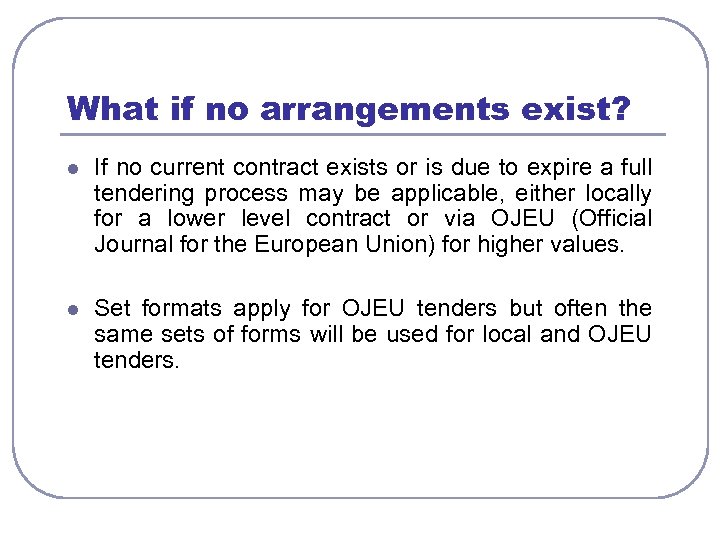
What if no arrangements exist? l If no current contract exists or is due to expire a full tendering process may be applicable, either locally for a lower level contract or via OJEU (Official Journal for the European Union) for higher values. l Set formats apply for OJEU tenders but often the same sets of forms will be used for local and OJEU tenders.
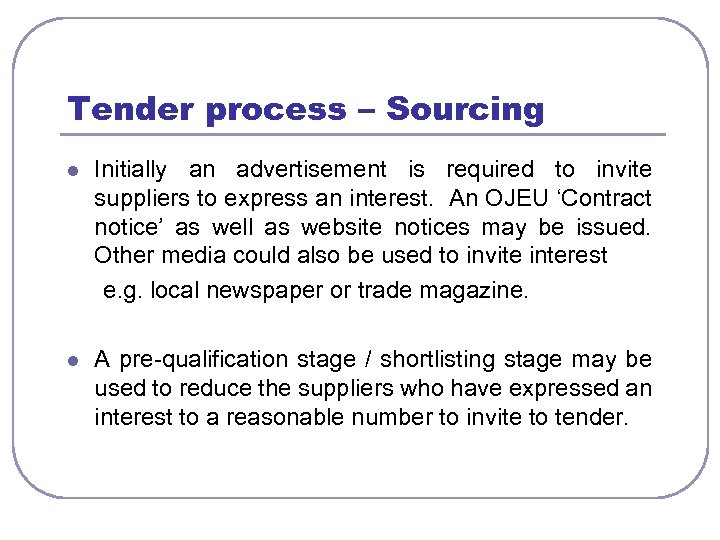
Tender process – Sourcing l Initially an advertisement is required to invite suppliers to express an interest. An OJEU ‘Contract notice’ as well as website notices may be issued. Other media could also be used to invite interest e. g. local newspaper or trade magazine. l A pre-qualification stage / shortlisting stage may be used to reduce the suppliers who have expressed an interest to a reasonable number to invite to tender.
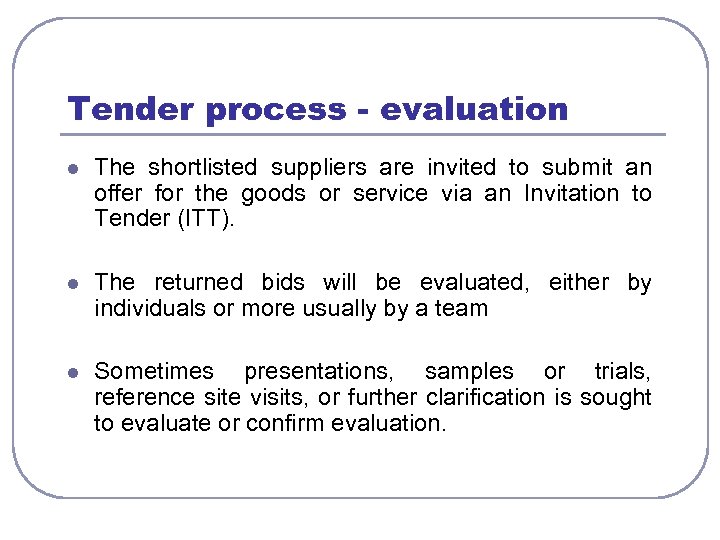
Tender process - evaluation l The shortlisted suppliers are invited to submit an offer for the goods or service via an Invitation to Tender (ITT). l The returned bids will be evaluated, either by individuals or more usually by a team l Sometimes presentations, samples or trials, reference site visits, or further clarification is sought to evaluate or confirm evaluation.
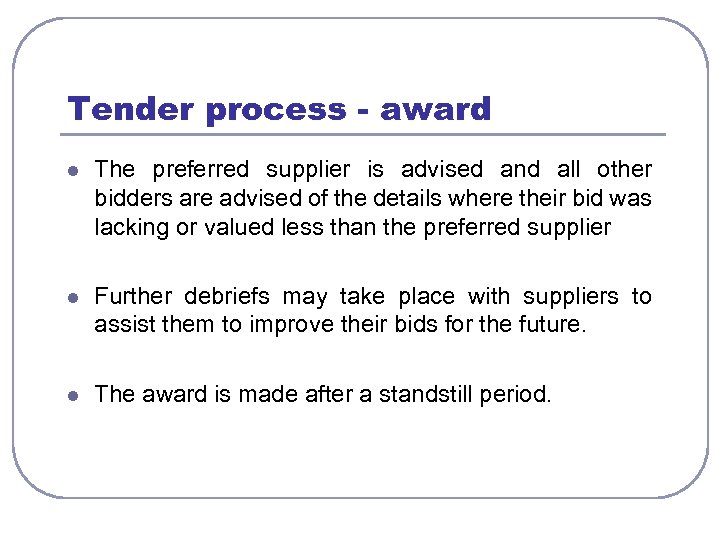
Tender process - award l The preferred supplier is advised and all other bidders are advised of the details where their bid was lacking or valued less than the preferred supplier l Further debriefs may take place with suppliers to assist them to improve their bids for the future. l The award is made after a standstill period.
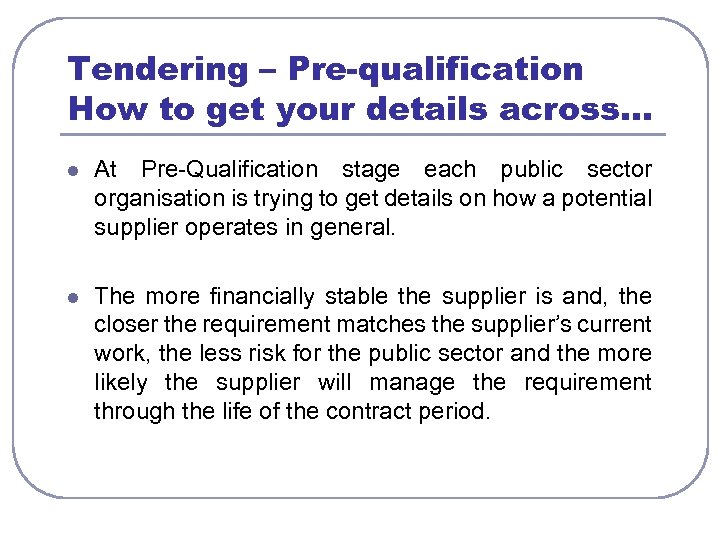
Tendering – Pre-qualification How to get your details across… l At Pre-Qualification stage each public sector organisation is trying to get details on how a potential supplier operates in general. l The more financially stable the supplier is and, the closer the requirement matches the supplier’s current work, the less risk for the public sector and the more likely the supplier will manage the requirement through the life of the contract period.
Tendering – ITT How good are you for what we need? l Answer each point as accurately as possible, with sufficient detail to explain each point without wandering off the question. l If you have supporting documentation please add this in where asked to do so, e. g. as appendices. l Send all of your responses back in the format requested and for the time needed.
Reasons you can be ‘disqualified’ (before the ITT stage) l l l l l No evidence of capability to meet specification Financial instability or where you are not deemed capable to perform a contract of the value envisaged Misleading information provided or failure to disclose Unpaid taxes or social security payments Criminal offences relevant to the contract: eg security guard with an arson conviction; Winding up order against supplier Suspension from trading: eg bankruptcy of a director Legal problems: eg patent rights Found guilty of organised crime, corruption or fraud
Reasons you can be ‘excluded’ (After submission of bid) l After evaluation of the product or service there is an unacceptable price, delivery or terms (usual evaluation criteria to assess bids) l Improper approaches: e. g. canvassing l If it is subsequently discovered reasons for disqualification that would have disqualified a bidder at the PQQ stage had the information been known.
10 common mistakes made by tenderers!
1. Late Submission The return date and time are fixed. It is vital that you get your tender to the right location and on time.
2. Open envelope Make sure your envelope is sealed. If It is opened it could be disqualified
3. The wrong information on the envelope If the envelope isn’t clearly marked as a tender it may be opened at the wrong time or place, and can then be disqualified.
4. Canvassing individuals in the tendering organisation The tender process has to be fair and transparent. If you try to influence staff or try to obtain information outside the process your bid could be disqualified.
5. Alternative bids “We can’t do what you’re asking but we can do this…” Unless we specifically ask for alternatives we cannot accept them.
6. Qualified bids “We can give you this price, but only if…. . ” Unless we specifically ask for qualified bids we cannot accept them
7. Wrong information supplied Don’t tell us what you want us to know, tell us what we ask for, or anything that relates directly to the tender.
8. Gaps in information We are not allowed to make it up or guess, so please make sure that all information needed is supplied
9. Don’t assume we know you We have to assess you on the information that you supply for an individual tender, not on what we may know about you.
10. Be realistic about what you can actually achieve.
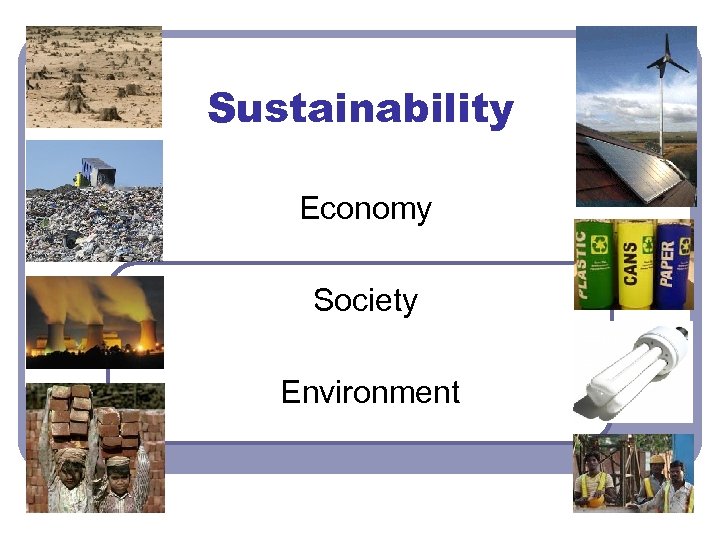
Sustainability Economy Society Environment
Sustainable Procurement l Sustainable Procurement Policy • “We will integrate the economic, social and environmental strands of sustainability into our procurement and commissioning decisions in a manner which supports the UK Government’s approach to sustainable development. ” l It’s our responsibility l It makes business sense
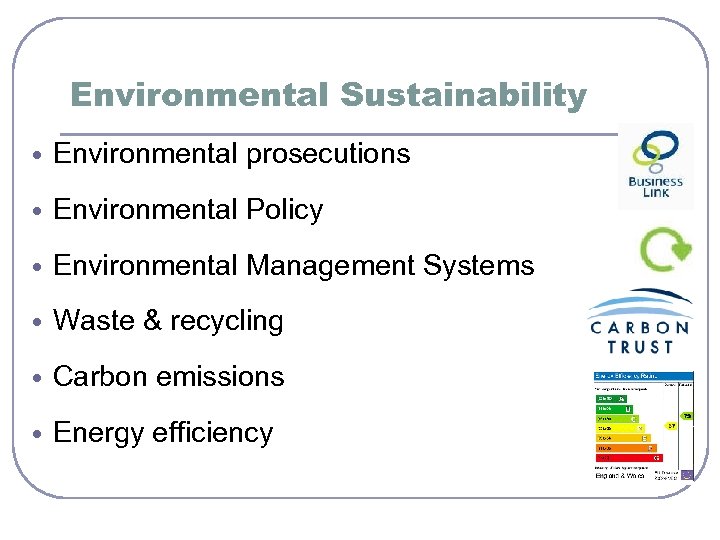
Environmental Sustainability Environmental prosecutions Environmental Policy Environmental Management Systems Waste & recycling Carbon emissions Energy efficiency
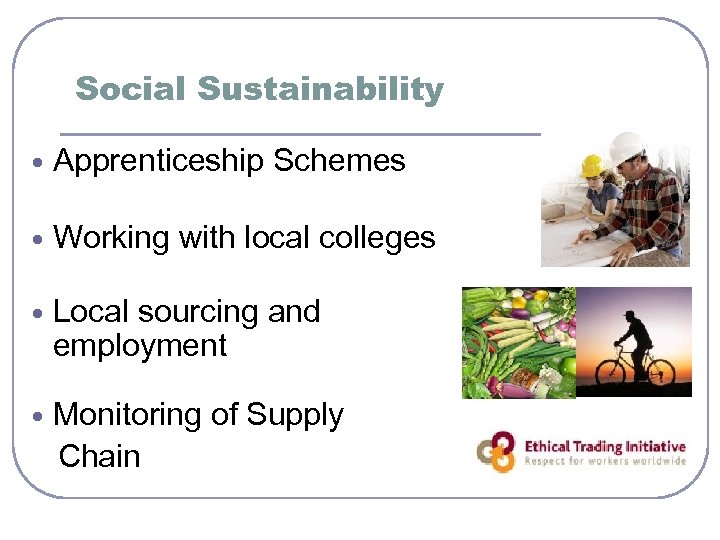
Social Sustainability Apprenticeship Schemes Working with local colleges Local sourcing and employment Monitoring of Supply Chain
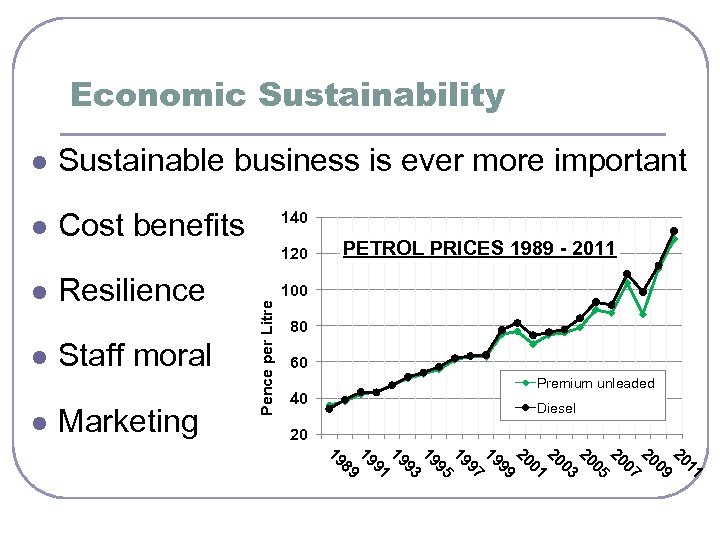
Economic Sustainability l Sustainable business is ever more important l Cost benefits 140 120 l l Resilience Staff moral Marketing 100 Pence per Litre l PETROL PRICES 1989 - 2011 80 60 Premium unleaded 40 Diesel 20 11 20 09 20 07 20 05 20 03 20 01 20 99 19 97 19 95 19 93 19 91 19 89 19
Examples: Edwards & Ward: Schools catering contractors who source locally and sustainably certified fish. MK Wildin: Family run construction company, work closely with the local college & take on apprentices. EG Carter: Recognised at the Considerate Constructors scheme 2010, for the consideration of the public, the workforce and the environment.
Equalities Implications of the public sector EQUALITY DUTY
Implications to GCC and our Contractors l l GCC are legally responsible for complying with the Equality Duty in the undertaking of procurement. External contractors may be subject to the Equality Duty if carrying out a public function on behalf of the public authority. • Eliminate unlawful discrimination, harassment and victimisation and other conduct prohibited by the Act • Advance equality of opportunity between people who share a protected characteristic and those who do not • Foster good relations between people who share a protected characteristic and those who do not.
Pre-Qualifying suppliers on Equalities GCC as a public authority must have due regard to equality considerations in order to meet our obligations under the Public Sector Equality Duty. [This will be relevant and proportional to subject matter] Contractors are therefore likely to be asked about: • Possessing an Equalities Policy • Provide training on equal opportunities • Comply with Equality Act • Any unlawful discrimination? • Steps taken http: //www. equalityhumanrights. com/advice-and-guidance/newequality-act-guidance/equality-act-starter-kit/

QUESTIONS & ANSWERS

COFFEE BREAK
A Quick Guide to Frameworks Claire Smart
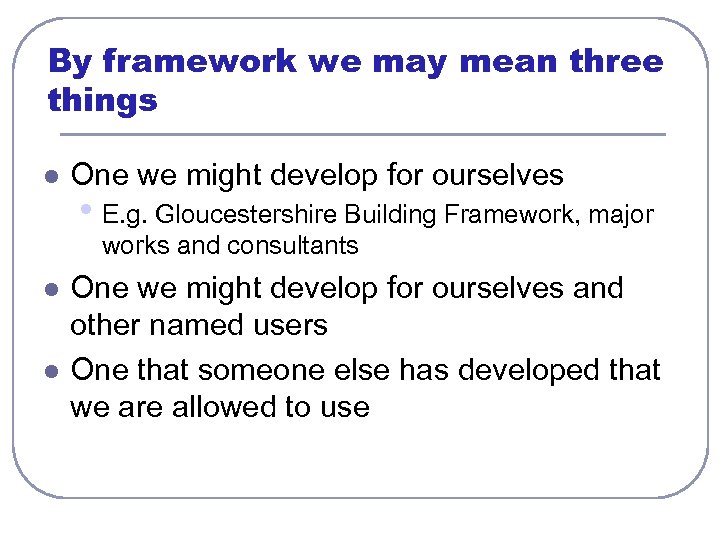
By framework we may mean three things l One we might develop for ourselves • E. g. Gloucestershire Building Framework, major works and consultants l l One we might develop for ourselves and other named users One that someone else has developed that we are allowed to use
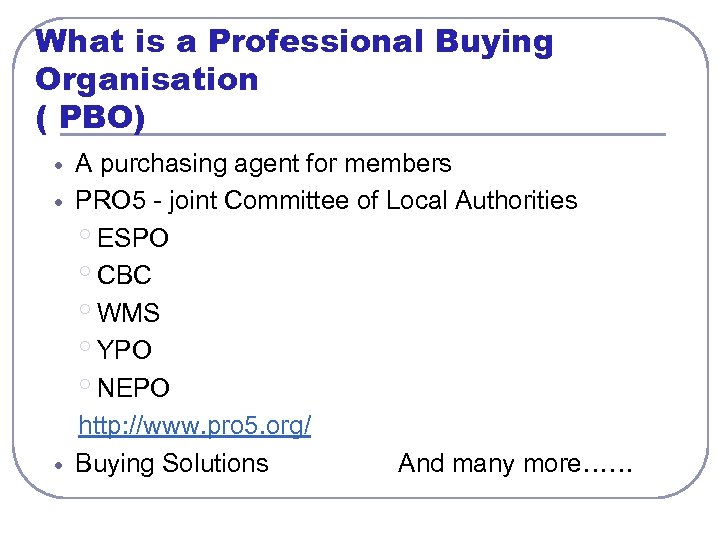
What is a Professional Buying Organisation ( PBO) A purchasing agent for members PRO 5 - joint Committee of Local Authorities ◦ ESPO ◦ CBC ◦ WMS ◦ YPO ◦ NEPO http: //www. pro 5. org/ Buying Solutions And many more……
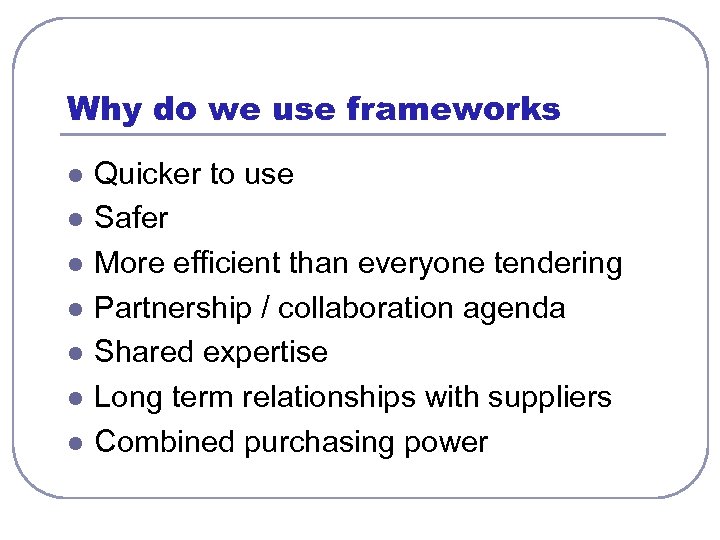
Why do we use frameworks l l l l Quicker to use Safer More efficient than everyone tendering Partnership / collaboration agenda Shared expertise Long term relationships with suppliers Combined purchasing power
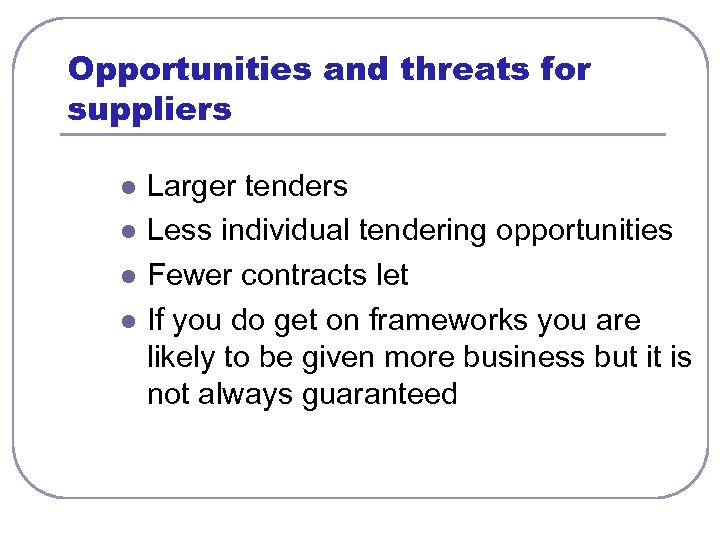
Opportunities and threats for suppliers l l Larger tenders Less individual tendering opportunities Fewer contracts let If you do get on frameworks you are likely to be given more business but it is not always guaranteed
What to do? l l l Know where to look for opportunities Understand the tendering requirements Consortia
Transparency Cheryl Chambers Head of Business Service Centre
Business Service Centre – a shared service centre delivering: l l l l l HR administration & payroll Specialist payroll Recruitment CRB checks Temporary Staff register SAP system support Teachers Pensions Income Payments
Governments Transparency Agenda
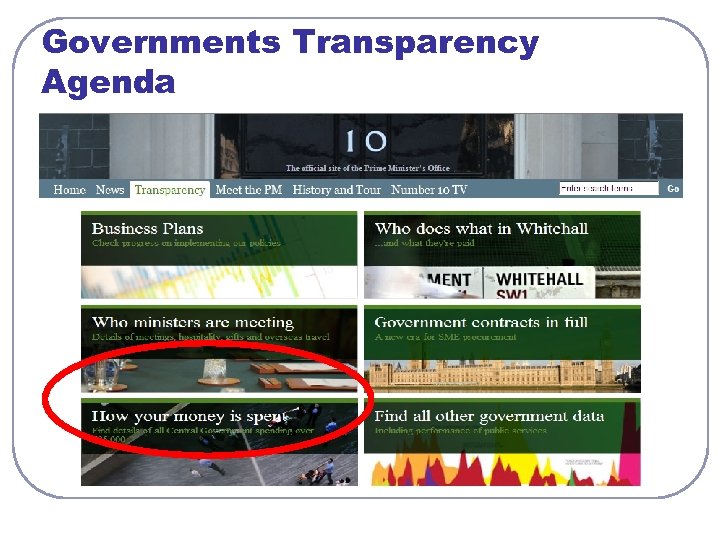
Letter from Eric Pickles – Secretary of State for Communities & Local Government l. In June 2010 local authorities were asked to publish items of spending over £ 500 including tenders, contracts and actual payments and also publish contract information by January 2011
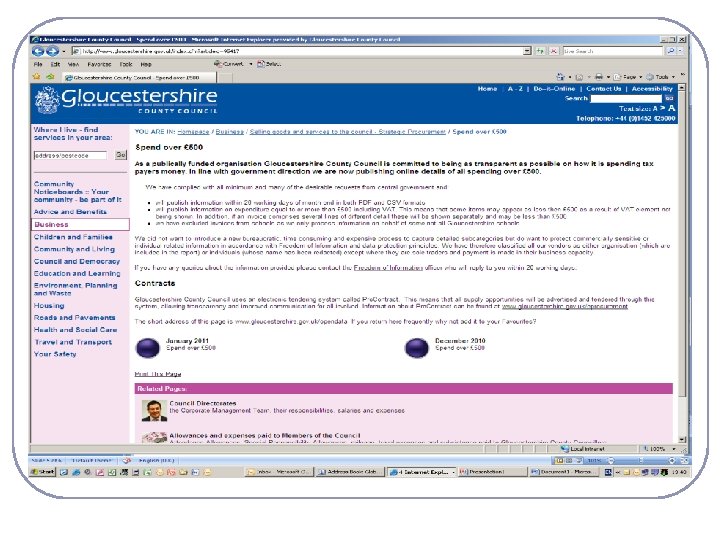
Gloucestershire County Council l. October - detailed, draft guidance produced by Local Gov’t group l. Interpreted in order to identify a streamlined approach using current processes & keeping costs to a mnimum l£ 500 spend information published January 2011 l. Will be posted onto GCC website within 20 working days of month end l. Meets minimum and many optional requirements set out in October (incl. redaction of individuals information)
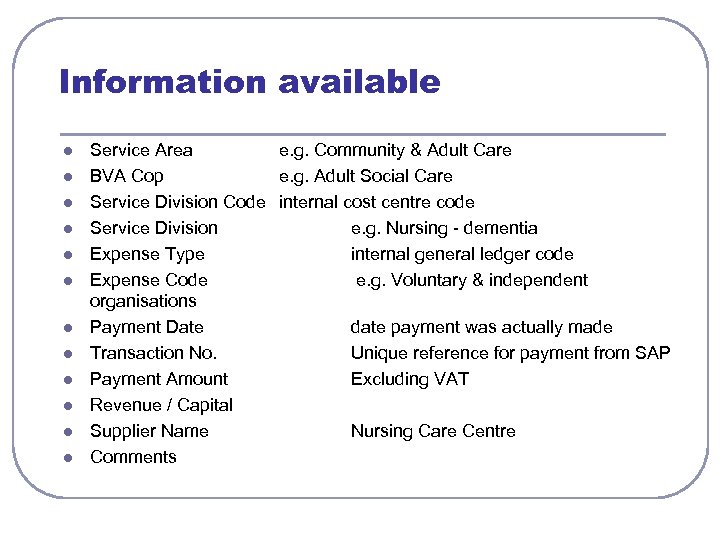
Information available l l l Service Area e. g. Community & Adult Care BVA Cop e. g. Adult Social Care Service Division Code internal cost centre code Service Division e. g. Nursing - dementia Expense Type internal general ledger code Expense Code e. g. Voluntary & independent organisations Payment Date date payment was actually made Transaction No. Unique reference for payment from SAP Payment Amount Excluding VAT Revenue / Capital Supplier Name Nursing Care Centre Comments
Next steps & Benefits “Armchair experts” may analyse but more importantly, let us have your feedback & let us know if you need help understanding the data More changes to come with regards to transparency (not least for £ 500 spend receiving the final guidance!) Information is transparent and available nationwide in a way it never has been previously so this is good news for all
Скачать презентацию Selling to the Public Sector in Gloucestershire WELCOME
0b843afc4b8f082ea5c2f33b9444fc37.ppt