 Скачать презентацию Selfish Caching in Distributed Systems A Game-Theoretic Analysis
c8955ea8e6bf788b4c11e530fb806ffe.ppt
- Количество слайдов: 27



Selfish Caching in Distributed Systems A Game-Theoretic Analysis B. Chun K. Chaudhuri H. Wee M. Barreno C. Papadimitriou J. Kubiatowicz Tutor: Prof. Gerhard Weikum Odysseas Papapetrou odysseas@mpii. de
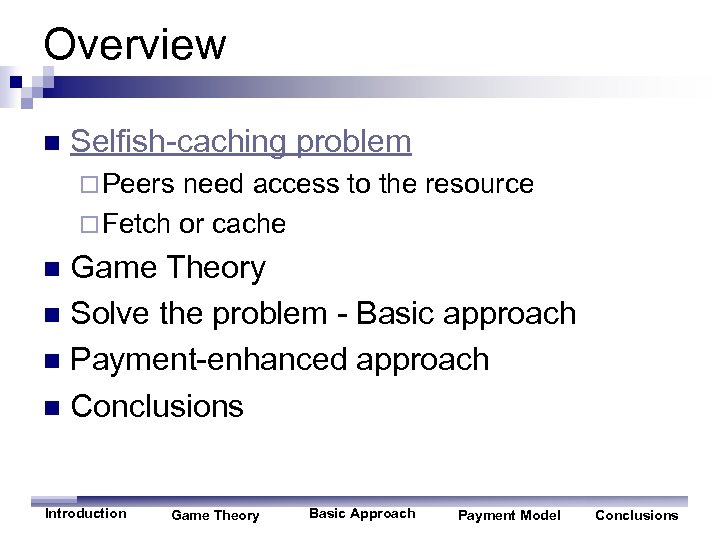
Overview n Selfish-caching problem ¨ Peers need access to the resource ¨ Fetch or cache Game Theory n Solve the problem - Basic approach n Payment-enhanced approach n Conclusions n Introduction Game Theory Basic Approach Payment Model Conclusions
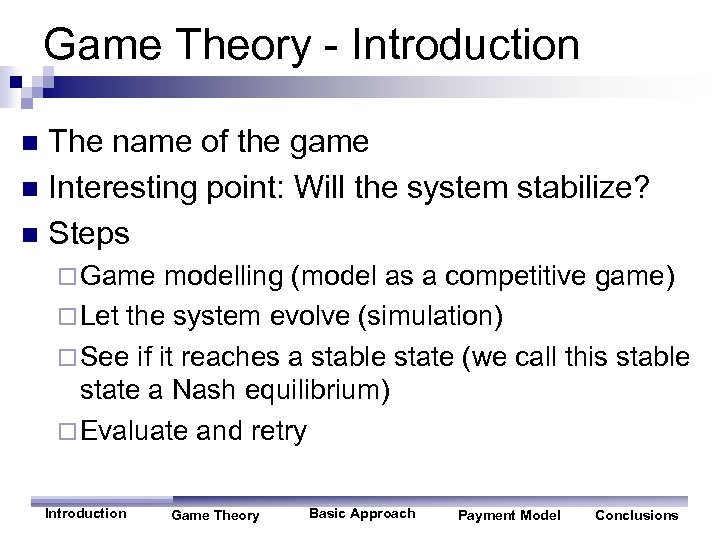
Game Theory - Introduction The name of the game n Interesting point: Will the system stabilize? n Steps n ¨ Game modelling (model as a competitive game) ¨ Let the system evolve (simulation) ¨ See if it reaches a stable state (we call this stable state a Nash equilibrium) ¨ Evaluate and retry Introduction Game Theory Basic Approach Payment Model Conclusions
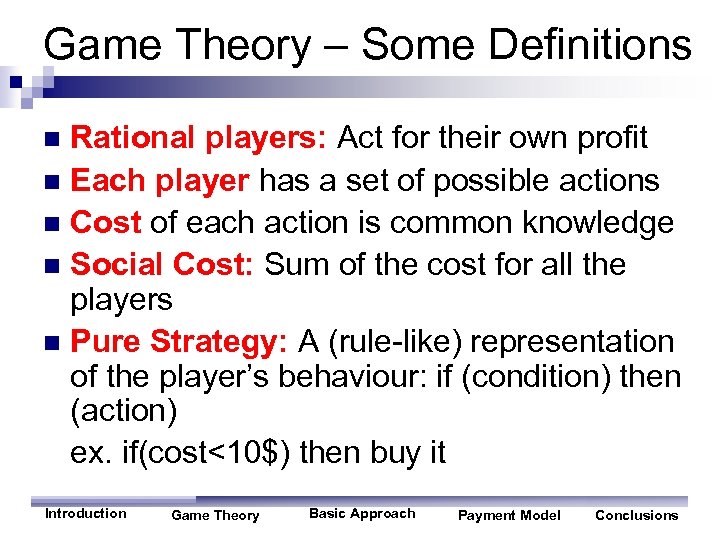
Game Theory – Some Definitions Rational players: Act for their own profit n Each player has a set of possible actions n Cost of each action is common knowledge n Social Cost: Sum of the cost for all the players n Pure Strategy: A (rule-like) representation of the player’s behaviour: if (condition) then (action) ex. if(cost<10$) then buy it n Introduction Game Theory Basic Approach Payment Model Conclusions
Game Theory – Some Definitions n Pure Strategy Nash Equilibrium: No player can benefit by altering his strategy (if the others keep their strategies unchanged) n Optimal Solution OR Social Optimum: The set of strategies that minimize the social cost (or maximize the social payoff) Introduction Game Theory Basic Approach Payment Model Conclusions
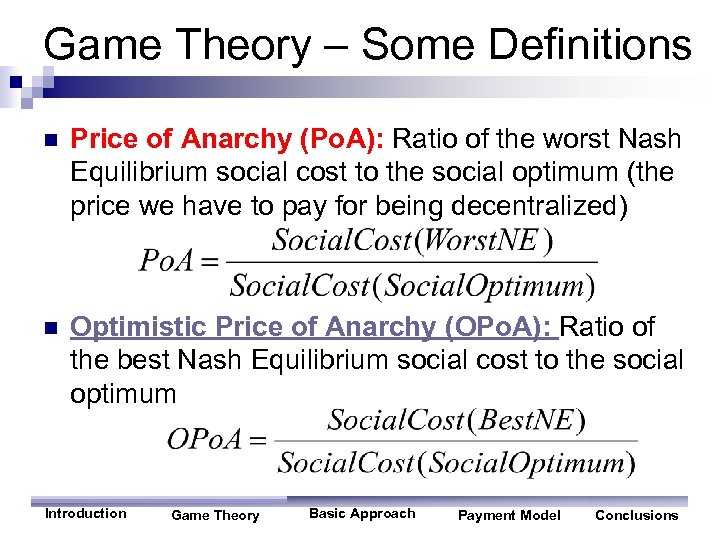
Game Theory – Some Definitions n Price of Anarchy (Po. A): Ratio of the worst Nash Equilibrium social cost to the social optimum (the price we have to pay for being decentralized) n Optimistic Price of Anarchy (OPo. A): Ratio of the best Nash Equilibrium social cost to the social optimum Introduction Game Theory Basic Approach Payment Model Conclusions
Basic Approach n Modelling the system as a (1 -resource) game ¨Players: Peers, Resources: Documents ¨Possible Functions: Caching or Fetching ¨Configuration of a doc: The peers that cache the doc. ¨Strategy of a peer: The documents it will cache ¨Personal Cost: The cost to Fetch or Cache a doc. ¨Social players Introduction Cost: The sum of personal costs for all Game Theory Basic Approach Payment Model Conclusions
Basic Approach Selfish behaviour: Each peer only cares about minimizing its own cost (or maximizing its own payoff) n See if and where the system stabilises (Nash Equilibrium) n Evaluate the Nash Equilibrium (compare to the optimal solution) n How can the Nash Equilibrium be improved n Introduction Game Theory Basic Approach Payment Model Conclusions
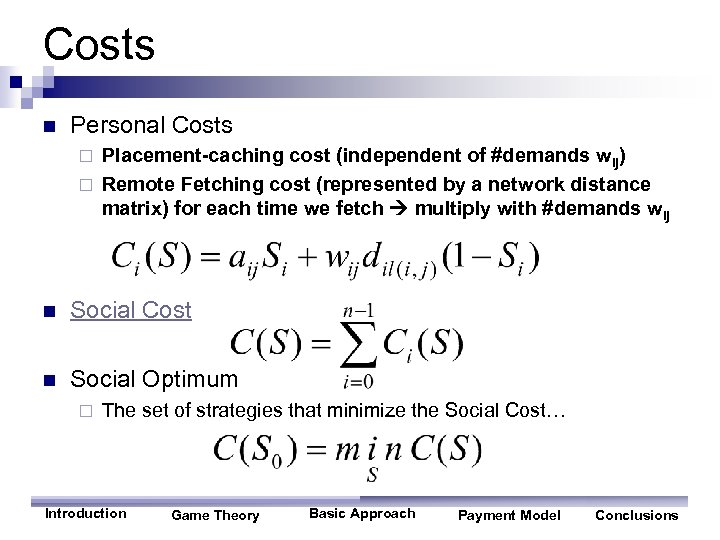
Costs n Personal Costs Placement-caching cost (independent of #demands wij) ¨ Remote Fetching cost (represented by a network distance matrix) for each time we fetch multiply with #demands wij ¨ n Social Cost n Social Optimum ¨ The set of strategies that minimize the Social Cost… Introduction Game Theory Basic Approach Payment Model Conclusions
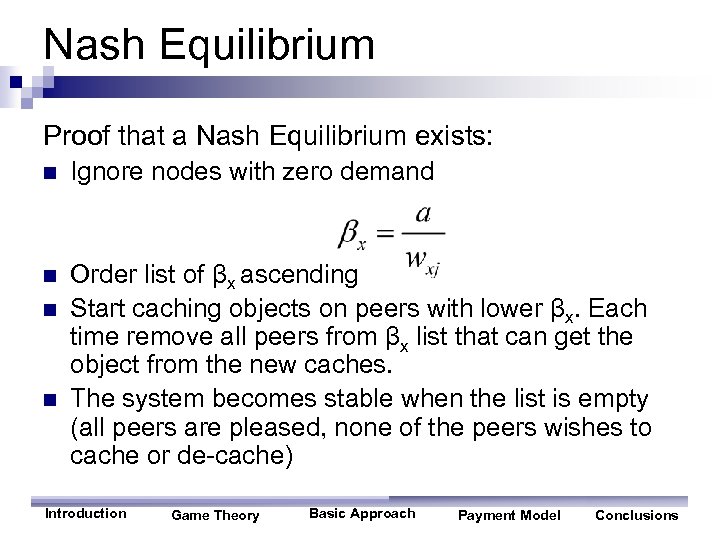
Nash Equilibrium Proof that a Nash Equilibrium exists: n Ignore nodes with zero demand n Order list of βx ascending Start caching objects on peers with lower βx. Each time remove all peers from βx list that can get the object from the new caches. The system becomes stable when the list is empty (all peers are pleased, none of the peers wishes to cache or de-cache) n n Introduction Game Theory Basic Approach Payment Model Conclusions
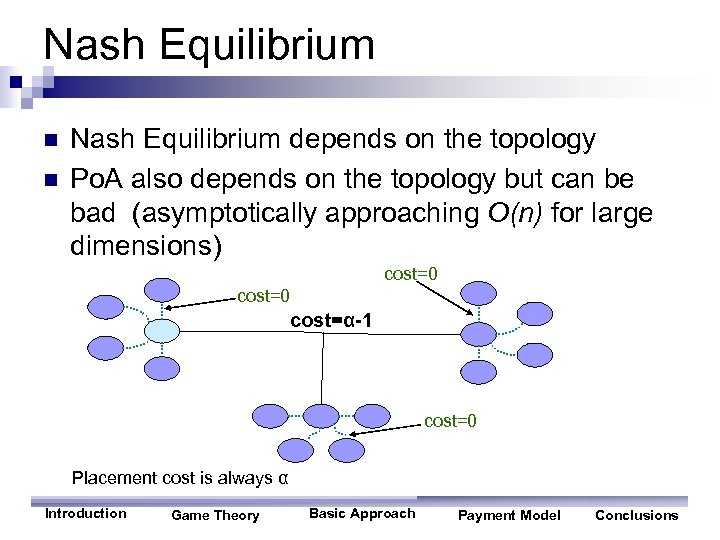
Nash Equilibrium n n Nash Equilibrium depends on the topology Po. A also depends on the topology but can be bad (asymptotically approaching O(n) for large dimensions) cost=0 cost=α-1 cost=0 Placement cost is always α Introduction Game Theory Basic Approach Payment Model Conclusions
but… n Nash Equilibrium may seem good for the peers, but is not good for the system n Intuition: Force the peers to cooperate Find a way so that the peers share the placement cost (cost of caching)… Introduction Game Theory Basic Approach Payment Model Conclusions
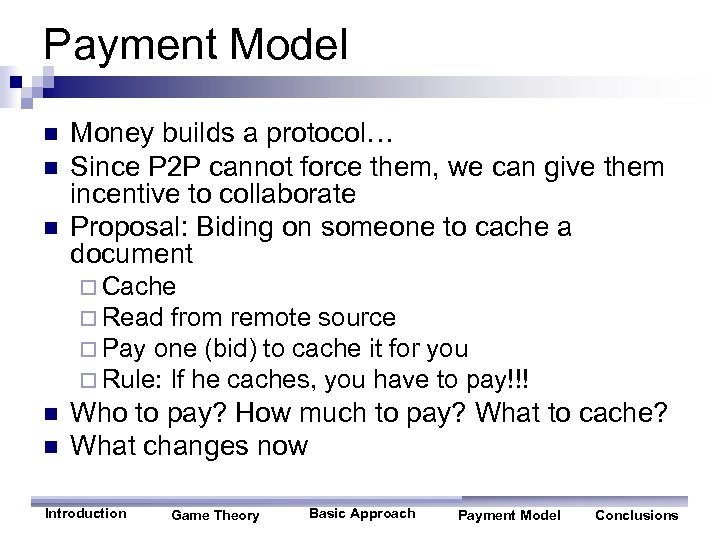
Payment Model n n n Money builds a protocol… Since P 2 P cannot force them, we can give them incentive to collaborate Proposal: Biding on someone to cache a document ¨ Cache ¨ Read from remote source ¨ Pay one (bid) to cache it for you ¨ Rule: If he caches, you have to pay!!! n n Who to pay? How much to pay? What to cache? What changes now Introduction Game Theory Basic Approach Payment Model Conclusions
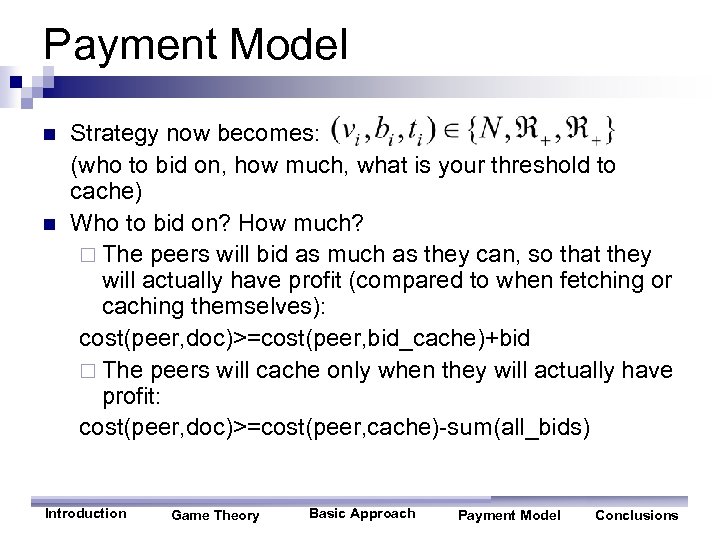
Payment Model n n Strategy now becomes: (who to bid on, how much, what is your threshold to cache) Who to bid on? How much? ¨ The peers will bid as much as they can, so that they will actually have profit (compared to when fetching or caching themselves): cost(peer, doc)>=cost(peer, bid_cache)+bid ¨ The peers will cache only when they will actually have profit: cost(peer, doc)>=cost(peer, cache)-sum(all_bids) Introduction Game Theory Basic Approach Payment Model Conclusions
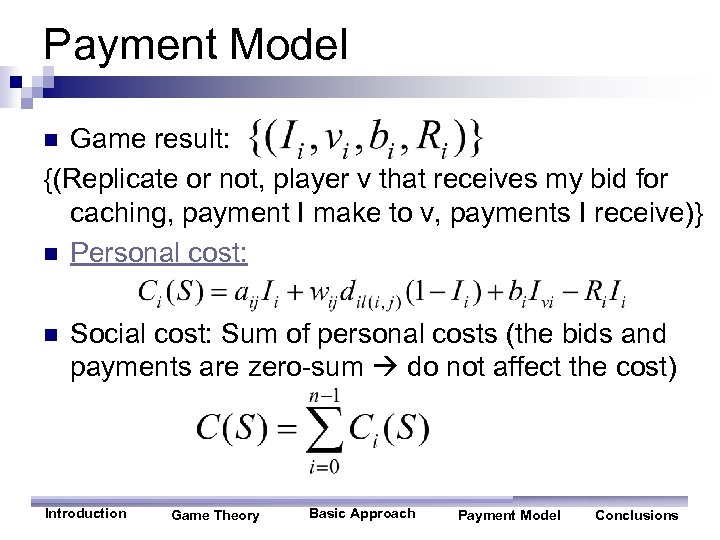
Payment Model Game result: {(Replicate or not, player v that receives my bid for caching, payment I make to v, payments I receive)} n Personal cost: n n Social cost: Sum of personal costs (the bids and payments are zero-sum do not affect the cost) Introduction Game Theory Basic Approach Payment Model Conclusions
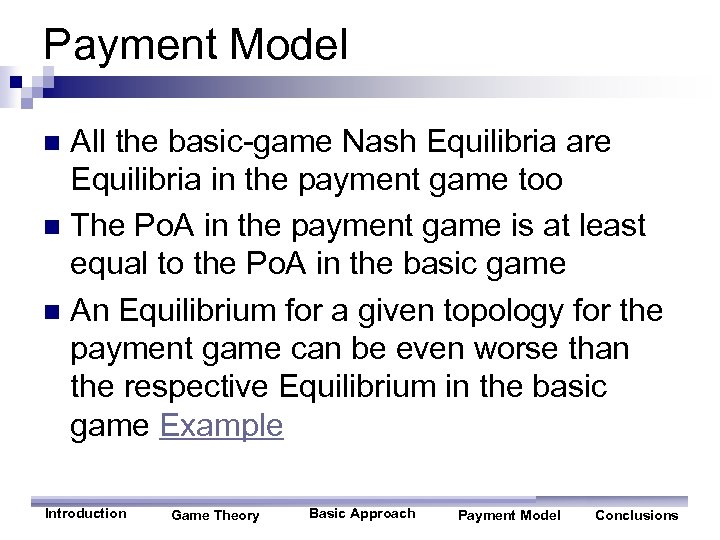
Payment Model All the basic-game Nash Equilibria are Equilibria in the payment game too n The Po. A in the payment game is at least equal to the Po. A in the basic game n An Equilibrium for a given topology for the payment game can be even worse than the respective Equilibrium in the basic game Example n Introduction Game Theory Basic Approach Payment Model Conclusions
Payment Model The optimistic Po. A in the payment game is always 1 (social optimal configuration is always a Nash Equilibrium) n Proof: Find a set of thresholds t and bids b that stabilise the social optimal configuration ¨ Get the optimal configuration ¨ Distribute threshold cost for each peer that caches the object to the peers that read the object from it Introduction Game Theory Basic Approach Payment Model Conclusions
Payment Model n Payment Model Vs Basic Model ¨ Payment gives players intensives to cache generally leads to better solutions ¨ In some cases the basic model can reach a better Nash Equilibrium than the payment model ¨ Payment model has always optimistic price of anarchy = 1 promising Introduction Game Theory Basic Approach Payment Model Conclusions
Conclusions Defined the Selfish Caching Problem as a game n Solved it n Enhanced it with Payments n Optimistic Po. A lower in payment model but NE is not always better compared to the basic model n Introduction Game Theory Basic Approach Payment Model Conclusions
Future work n Work on different configurations: ¨ Capacitated game ¨ Peers with different demand-rate for docs. ¨ Peers with different placement costs ¨ Aggregation effect ¨ Server congestion n Large scale simulations with realistic weights and different topologies Introduction Game Theory Basic Approach Payment Model Conclusions
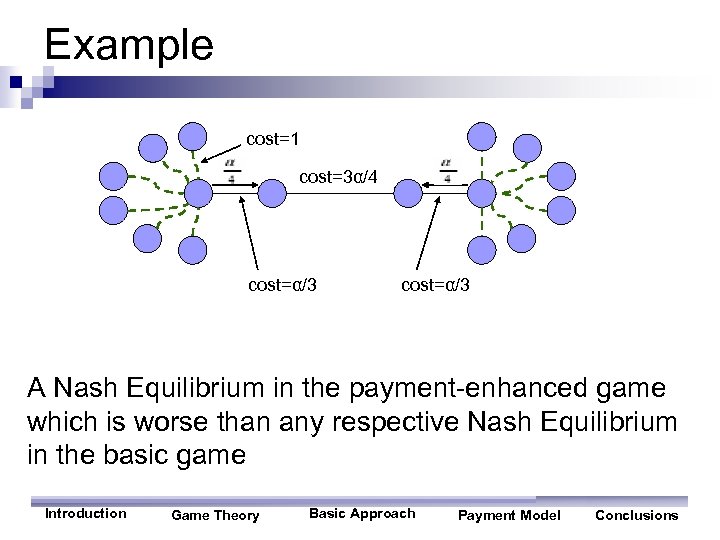
Example cost=1 cost=3α/4 cost=α/3 A Nash Equilibrium in the payment-enhanced game which is worse than any respective Nash Equilibrium in the basic game Introduction Game Theory Basic Approach Payment Model Conclusions
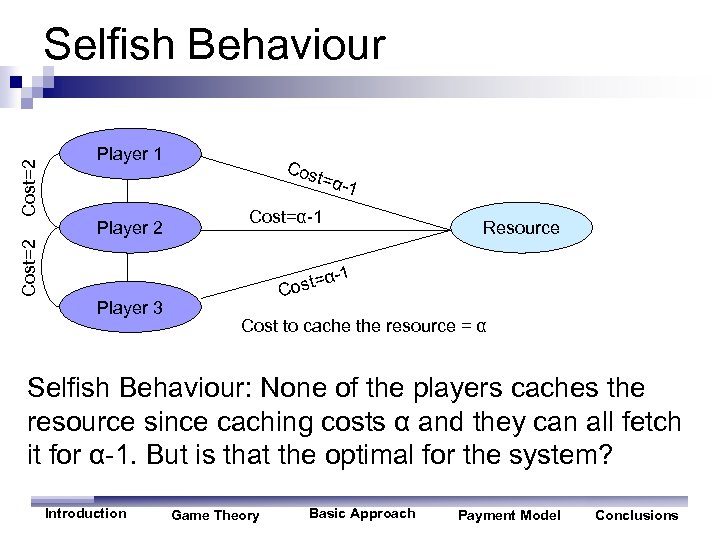
Cost=2 Selfish Behaviour Player 1 Cos t=α 1 Cost=α-1 Cost=2 Player 3 =α Cost Resource -1 Cost to cache the resource = α Selfish Behaviour: None of the players caches the resource since caching costs α and they can all fetch it for α-1. But is that the optimal for the system? Introduction Game Theory Basic Approach Payment Model Conclusions
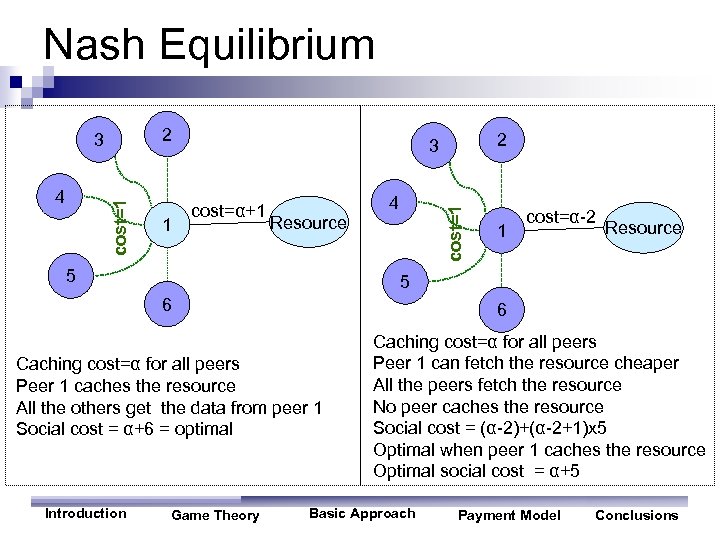
Nash Equilibrium 2 cost=1 4 1 cost=α+1 Resource 5 4 1 cost=α-2 Resource 5 6 6 Caching cost=α for all peers Peer 1 caches the resource All the others get the data from peer 1 Social cost = α+6 = optimal Introduction 2 3 cost=1 3 Game Theory Caching cost=α for all peers Peer 1 can fetch the resource cheaper All the peers fetch the resource No peer caches the resource Social cost = (α-2)+(α-2+1)x 5 Optimal when peer 1 caches the resource Optimal social cost = α+5 Basic Approach Payment Model Conclusions
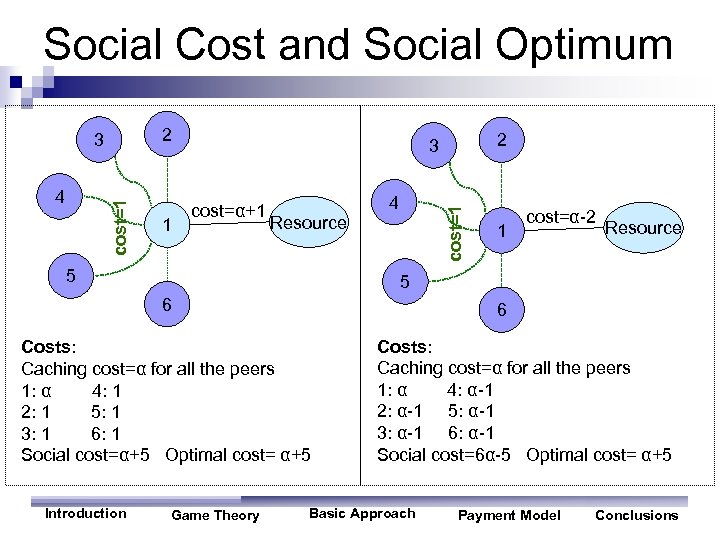
Social Cost and Social Optimum 2 cost=1 4 1 cost=α+1 Resource 5 4 1 cost=α-2 Resource 5 6 6 Costs: Caching cost=α for all the peers 1: α 4: 1 2: 1 5: 1 3: 1 6: 1 Social cost=α+5 Optimal cost= α+5 Introduction 2 3 cost=1 3 Game Theory Costs: Caching cost=α for all the peers 1: α 4: α-1 2: α-1 5: α-1 3: α-1 6: α-1 Social cost=6α-5 Optimal cost= α+5 Basic Approach Payment Model Conclusions
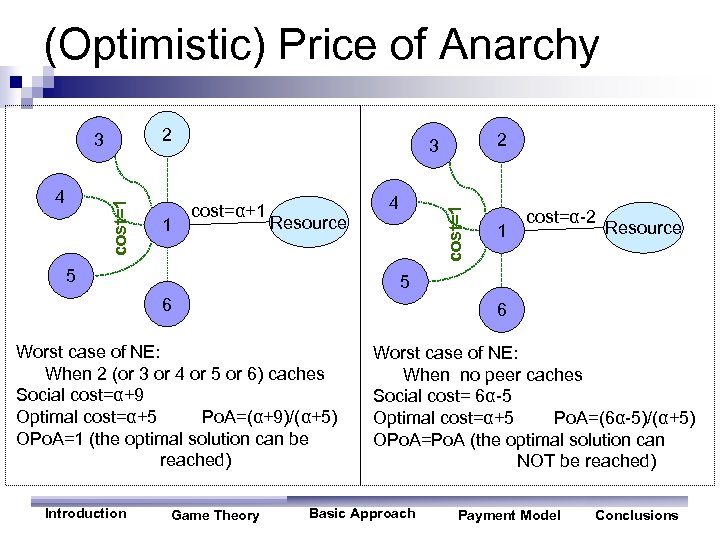
(Optimistic) Price of Anarchy 2 cost=1 4 1 cost=α+1 Resource 5 4 1 cost=α-2 Resource 5 6 6 Worst case of NE: When 2 (or 3 or 4 or 5 or 6) caches Social cost=α+9 Optimal cost=α+5 Po. A=(α+9)/(α+5) OPo. A=1 (the optimal solution can be reached) Introduction 2 3 cost=1 3 Game Theory Worst case of NE: When no peer caches Social cost= 6α-5 Optimal cost=α+5 Po. A=(6α-5)/(α+5) OPo. A=Po. A (the optimal solution can NOT be reached) Basic Approach Payment Model Conclusions
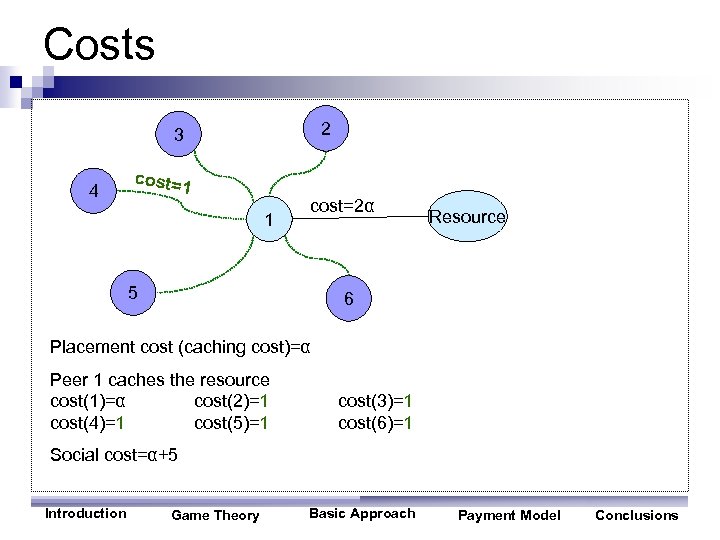
Costs 2 3 4 cost= 1 1 cost=2α 5 Resource 6 Placement cost (caching cost)=α Peer 1 caches the resource cost(1)=α cost(2)=1 cost(4)=1 cost(5)=1 cost(3)=1 cost(6)=1 Social cost=α+5 Introduction Game Theory Basic Approach Payment Model Conclusions
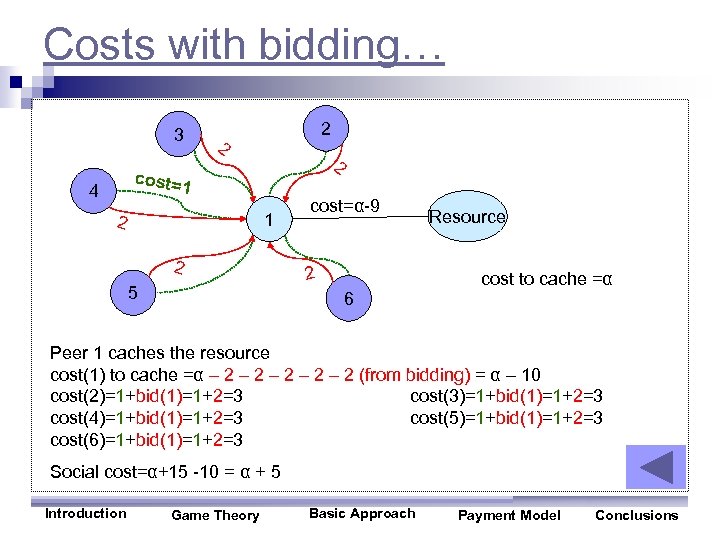
Costs with bidding… 3 2 2 2 cost= 1 4 1 2 2 5 cost=α-9 2 6 Resource cost to cache =α Peer 1 caches the resource cost(1) to cache =α – 2 – 2 – 2 (from bidding) = α – 10 cost(2)=1+bid(1)=1+2=3 cost(3)=1+bid(1)=1+2=3 cost(4)=1+bid(1)=1+2=3 cost(5)=1+bid(1)=1+2=3 cost(6)=1+bid(1)=1+2=3 Social cost=α+15 -10 = α + 5 Introduction Game Theory Basic Approach Payment Model Conclusions
Скачать презентацию Selfish Caching in Distributed Systems A Game-Theoretic Analysis
c8955ea8e6bf788b4c11e530fb806ffe.ppt