 Скачать презентацию Self-tuning DB Technology Info Services from Wishful
08d20173ef96f2ab36df77a2261dabc9.ppt
- Количество слайдов: 26



Self-tuning DB Technology & Info Services: from Wishful Thinking to Viable Engineering Gerhard Weikum, Axel Moenkeberg, Christof Hasse, Peter Zabback Teamwork is essential. It allows you to blame someone else. Acknowledgements to collaborators: Surajit Chaudhuri, Arnd Christian König, Achim Kraiss, Peter Muth, Guido Nerjes, Elizabeth O‘Neil, Patrick O‘Neil, Peter Scheuermann, Markus Sinnwell 1
Outline Auto-Tuning: What and Why? The COMFORT Experience The Feedback-Control Approach Example 1: Load Control Example 2: Workflow System Configuration Lessons Learned Where Do We Stand Today? - Myths and Facts Where Do We Go From Here? - Dreams and Directions 2
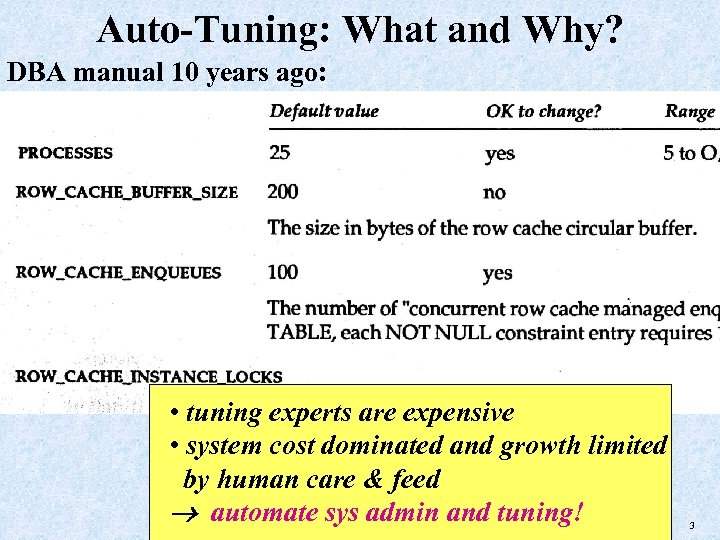
Auto-Tuning: What and Why? DBA manual 10 years ago: • tuning experts are expensive • system cost dominated and growth limited by human care & feed automate sys admin and tuning! 3
Auto-Tuning: What and Why? DBA manual today: 4
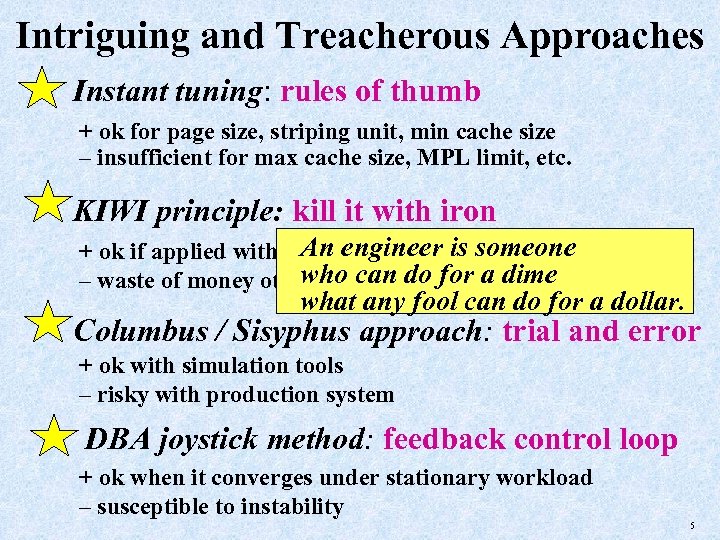
Intriguing and Treacherous Approaches Instant tuning: rules of thumb + ok for page size, striping unit, min cache size – insufficient for max cache size, MPL limit, etc. KIWI principle: kill it with iron An + ok if applied with care engineer is someone who – waste of money otherwisecan do for a dime what any fool can do for a dollar. Columbus / Sisyphus approach: trial and error + ok with simulation tools – risky with production system DBA joystick method: feedback control loop + ok when it converges under stationary workload – susceptible to instability 5
Outline Auto-tuning: What and Why? The COMFORT Experience The Feedback-Control Approach Example 1: Load Control Example 2: Workflow System Configuration Lessons Learned Where Do We Stand Today? - Myths and Facts Where Do We Go From Here? - Dreams and Directions 6
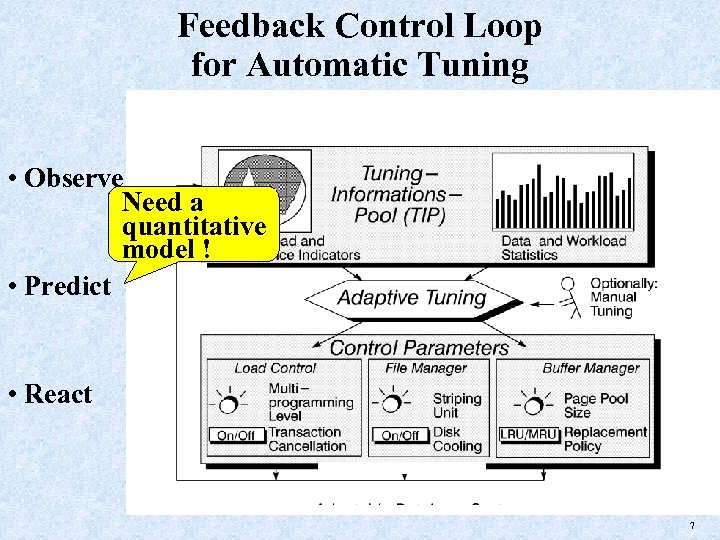
Feedback Control Loop for Automatic Tuning • Observe Need a quantitative model ! • Predict • React 7
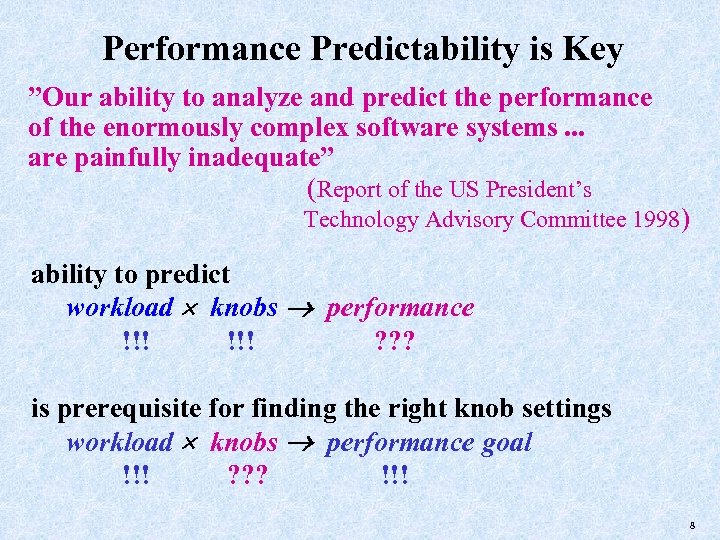
Performance Predictability is Key ”Our ability to analyze and predict the performance of the enormously complex software systems. . . are painfully inadequate” (Report of the US President’s Technology Advisory Committee 1998) ability to predict workload knobs performance !!! ? ? ? is prerequisite for finding the right knob settings workload knobs performance goal !!! ? ? ? !!! 8
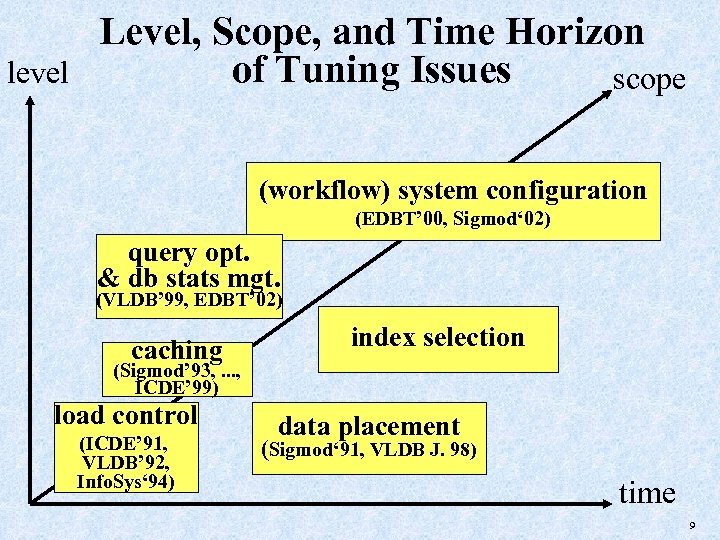
level Level, Scope, and Time Horizon of Tuning Issues scope (workflow) system configuration (EDBT’ 00, Sigmod‘ 02) query opt. & db stats mgt. (VLDB’ 99, EDBT’ 02) caching index selection (Sigmod’ 93, . . . , ICDE’ 99) load control (ICDE’ 91, VLDB’ 92, Info. Sys‘ 94) data placement (Sigmod‘ 91, VLDB J. 98) time 9
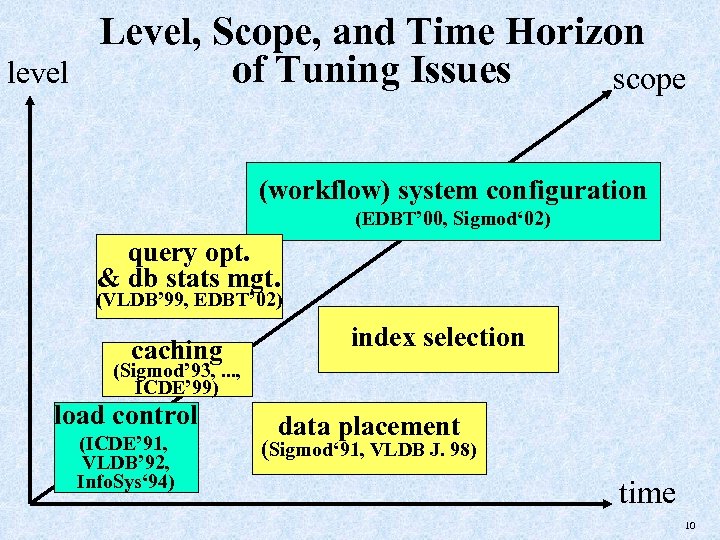
level Level, Scope, and Time Horizon of Tuning Issues scope (workflow) system configuration (EDBT’ 00, Sigmod‘ 02) query opt. & db stats mgt. (VLDB’ 99, EDBT’ 02) caching index selection (Sigmod’ 93, . . . , ICDE’ 99) load control (ICDE’ 91, VLDB’ 92, Info. Sys‘ 94) data placement (Sigmod‘ 91, VLDB J. 98) time 10
Load Control for Locking (MPL Tuning) uncontrolled memory or lock contention can lead to performance catastrophe 11
![How Difficult Can This Be? arriving transactions response time [s] 1. 0 trans. queue](https://present5.com/presentation/08d20173ef96f2ab36df77a2261dabc9/image-12.jpg "How Difficult Can This Be? arriving transactions response time [s] 1. 0 trans. queue")
How Difficult Can This Be? arriving transactions response time [s] 1. 0 trans. queue 0. 8 active trans, 0. 4 0. 6 0. 2 DBS 10 typical Sisyphus problem 20 30 40 50 MPL 12
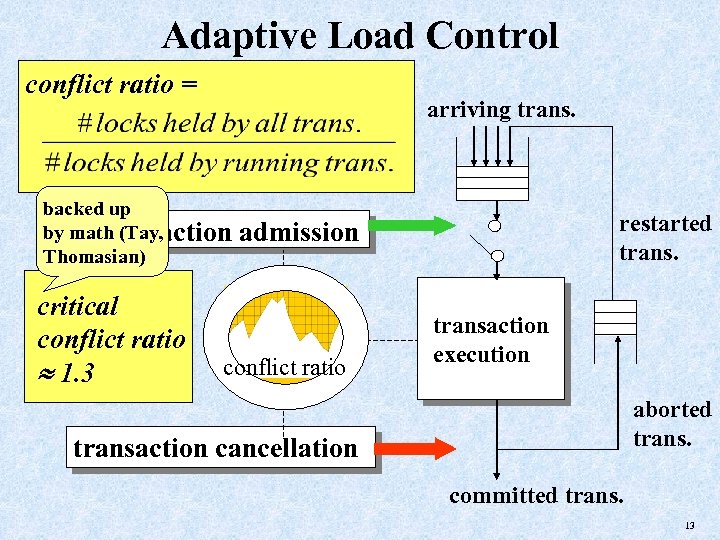
Adaptive Load Control conflict ratio = arriving trans. backed up by math (Tay, transaction Thomasian) critical conflict ratio 1. 3 restarted trans. admission conflict ratio transaction execution aborted transaction cancellation committed trans. 13
![Performance Evaluation: It Works! avg. response time [s] Creative redefinition of problem: replace one](https://present5.com/presentation/08d20173ef96f2ab36df77a2261dabc9/image-14.jpg "Performance Evaluation: It Works! avg. response time [s] Creative redefinition of problem: replace one")
Performance Evaluation: It Works! avg. response time [s] Creative redefinition of problem: replace one tuning knob (MPL) by another – less sensitive – knob (CCR) Robust solution requires • math for prediction and • great care for reaction 14
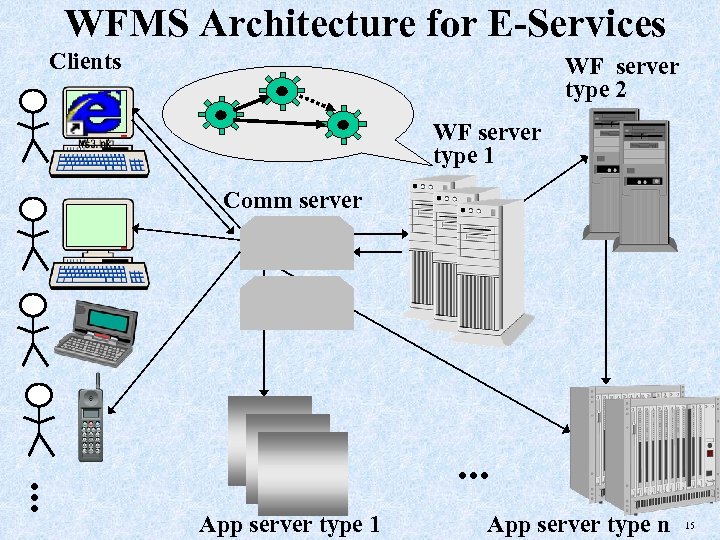
WFMS Architecture for E-Services Clients WF server type 2 WF server type 1 Comm server . . . App server type 1 App server type n 15
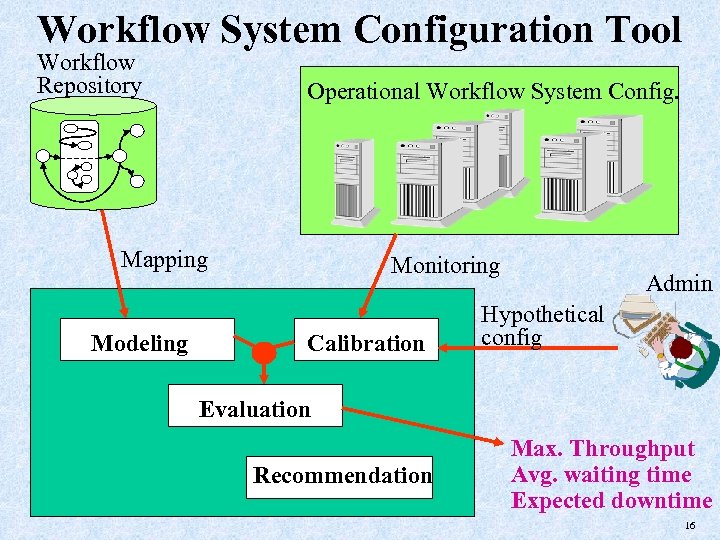
Workflow System Configuration Tool Workflow Repository Operational Workflow System Config. Mapping Modeling Monitoring Calibration Admin Hypothetical config Evaluation Recommendation Max. Throughput Avg. waiting time Expected downtime 16
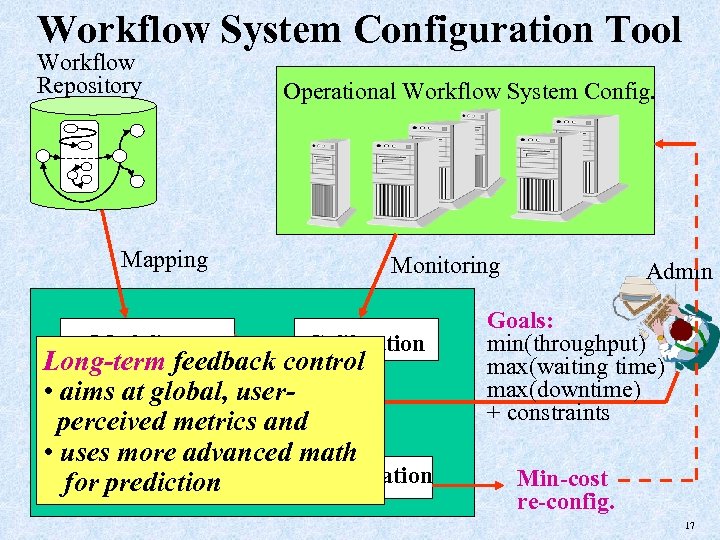
Workflow System Configuration Tool Workflow Repository Mapping Modeling Operational Workflow System Config. Monitoring Calibration Long-term feedback control • aims at global, user. Evaluation perceived metrics and • uses more advanced math for prediction Recommendation Admin Goals: min(throughput) max(waiting time) max(downtime) + constraints Min-cost re-config. 17
Outline Auto-Tuning: What and Why? The COMFORT Experience The Feedback-Control Approach Example 1: Load Control Example 2: Workflow System Configuration Lessons Learned Where Do We Stand Today? - Myths and Facts Where Do We Go From Here? - Dreams and Directions 18
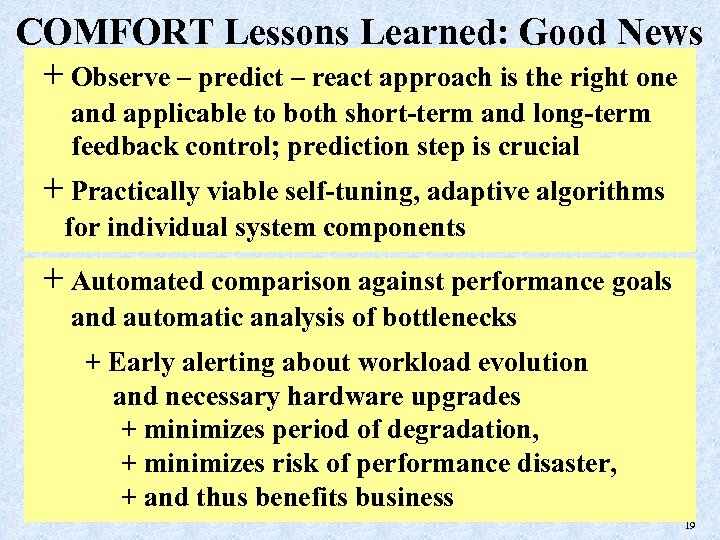
COMFORT Lessons Learned: Good News + Observe – predict – react approach is the right one and applicable to both short-term and long-term feedback control; prediction step is crucial + Practically viable self-tuning, adaptive algorithms for individual system components + Automated comparison against performance goals and automatic analysis of bottlenecks + Early alerting about workload evolution and necessary hardware upgrades + minimizes period of degradation, + minimizes risk of performance disaster, + and thus benefits business 19
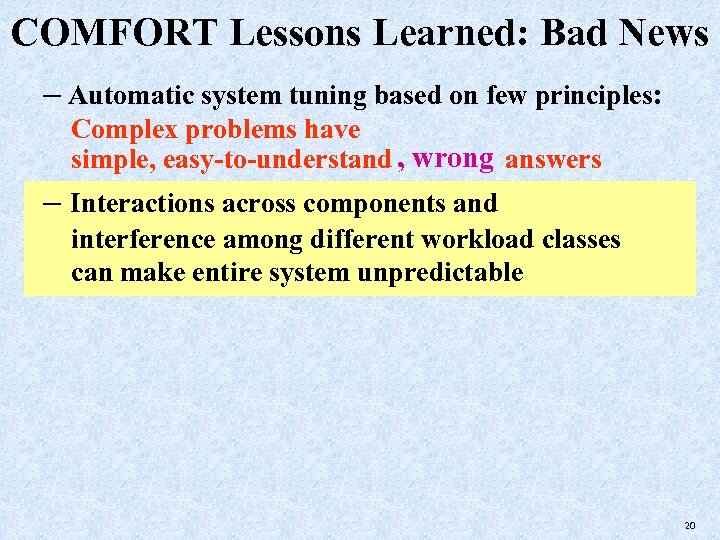
COMFORT Lessons Learned: Bad News – Automatic system tuning based on few principles: Complex problems have simple, easy-to-understand , wrong answers – Interactions across components and interference among different workload classes can make entire system unpredictable 20
Outline The Problem – 10 Years Ago and Now The COMFORT Experience The Feedback-Control Approach Example 1: Load Control Example 2: Workflow System Configuration Lessons Learned Where Do We Stand Today? - Myths and Facts Where Do We Go From Here? - Dreams and Directions 21
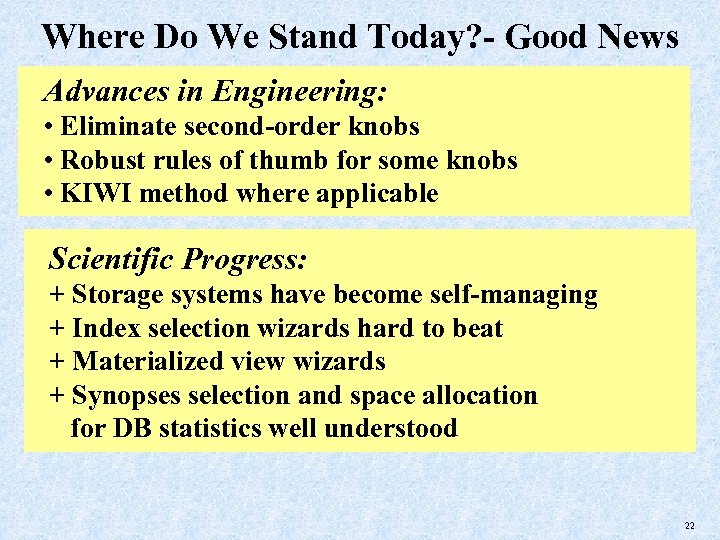
Where Do We Stand Today? - Good News Advances in Engineering: • Eliminate second-order knobs • Robust rules of thumb for some knobs • KIWI method where applicable Scientific Progress: + Storage systems have become self-managing + Index selection wizards hard to beat + Materialized view wizards + Synopses selection and space allocation for DB statistics well understood 22
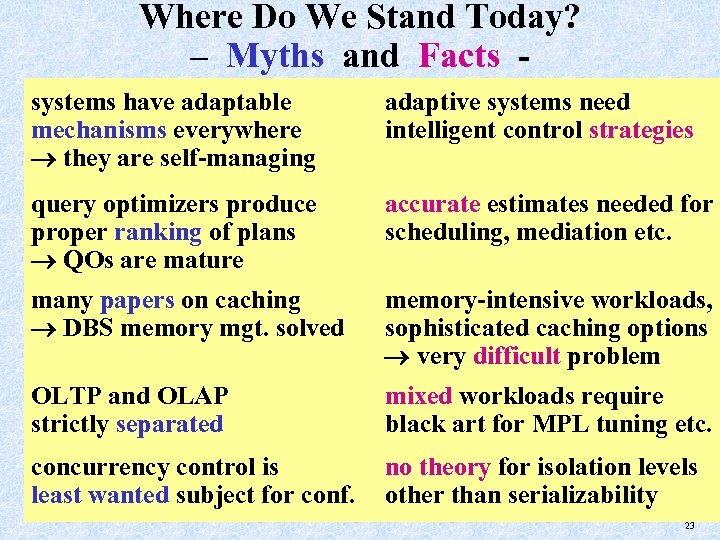
Where Do We Stand Today? – Myths and Facts systems have adaptable mechanisms everywhere they are self-managing adaptive systems need intelligent control strategies query optimizers produce proper ranking of plans QOs are mature accurate estimates needed for scheduling, mediation etc. many papers on caching DBS memory mgt. solved memory-intensive workloads, sophisticated caching options very difficult problem OLTP and OLAP strictly separated mixed workloads require black art for MPL tuning etc. concurrency control is least wanted subject for conf. no theory for isolation levels other than serializability 23
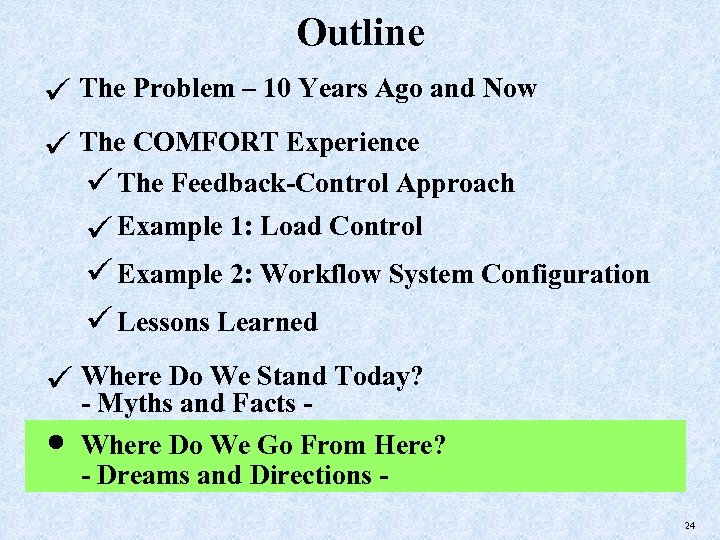
Outline The Problem – 10 Years Ago and Now The COMFORT Experience The Feedback-Control Approach Example 1: Load Control Example 2: Workflow System Configuration Lessons Learned Where Do We Stand Today? - Myths and Facts Where Do We Go From Here? - Dreams and Directions 24
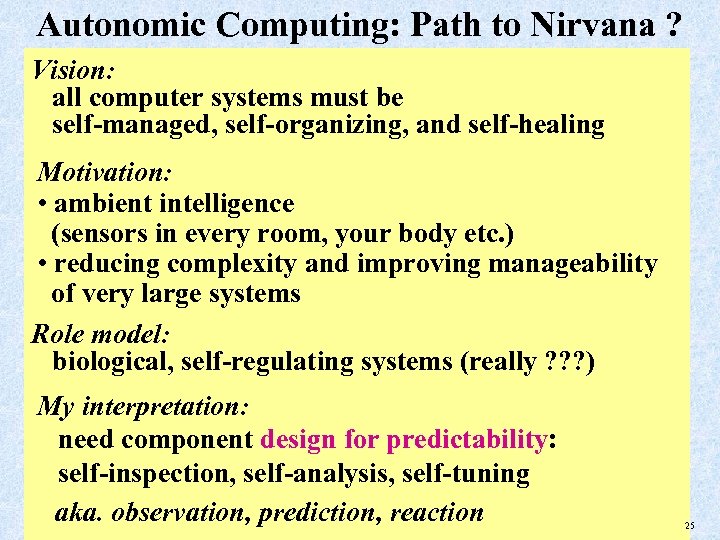
Autonomic Computing: Path to Nirvana ? Vision: all computer systems must be self-managed, self-organizing, and self-healing Motivation: • ambient intelligence (sensors in every room, your body etc. ) • reducing complexity and improving manageability of very large systems Role model: biological, self-regulating systems (really ? ? ? ) My interpretation: need component design for predictability: self-inspection, self-analysis, self-tuning aka. observation, prediction, reaction 25
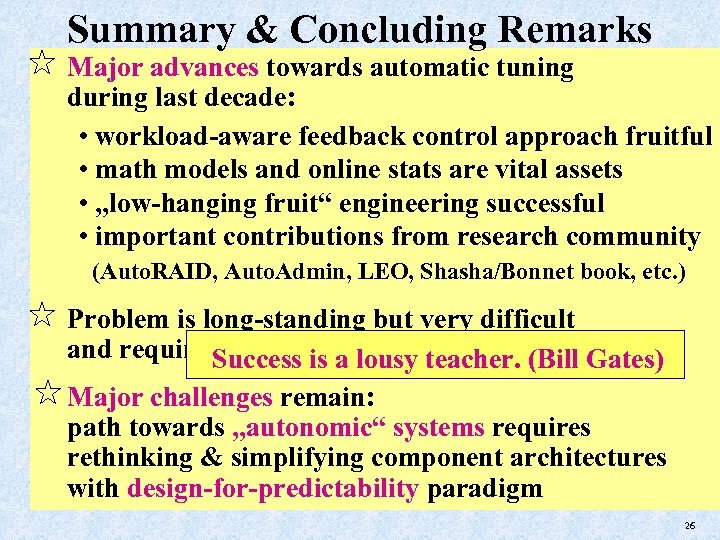
Summary & Concluding Remarks Major advances towards automatic tuning during last decade: • workload-aware feedback control approach fruitful • math models and online stats are vital assets • „low-hanging fruit“ engineering successful • important contributions from research community (Auto. RAID, Auto. Admin, LEO, Shasha/Bonnet book, etc. ) Problem is long-standing but very difficult and requires good research stamina (Bill Gates) Success is a lousy teacher. Major challenges remain: path towards „autonomic“ systems requires rethinking & simplifying component architectures with design-for-predictability paradigm 26
Скачать презентацию Self-tuning DB Technology Info Services from Wishful
08d20173ef96f2ab36df77a2261dabc9.ppt