


 Скачать презентацию Self-Organization in Autonomous Sensor Actuator Networks Self Org Dr
6dd5f18d3969dd114a77430c2ea20a2e.ppt
- Количество слайдов: 24
![Self-Organization in Autonomous Sensor/Actuator Networks [Self. Org] Dr. -Ing. Falko Dressler Computer Networks and](https://present5.com/presentation/6dd5f18d3969dd114a77430c2ea20a2e/image-1.jpg "Self-Organization in Autonomous Sensor/Actuator Networks [Self. Org] Dr. -Ing. Falko Dressler Computer Networks and") Self-Organization in Autonomous Sensor/Actuator Networks [Self. Org] Dr. -Ing. Falko Dressler Computer Networks and Communication Systems Department of Computer Sciences University of Erlangen-Nürnberg http: //www 7. informatik. uni-erlangen. de/~dressler/ dressler@informatik. uni-erlangen. de [Self. Org] 2 -4. 1
Self-Organization in Autonomous Sensor/Actuator Networks [Self. Org] Dr. -Ing. Falko Dressler Computer Networks and Communication Systems Department of Computer Sciences University of Erlangen-Nürnberg http: //www 7. informatik. uni-erlangen. de/~dressler/ dressler@informatik. uni-erlangen. de [Self. Org] 2 -4. 1
 Overview q Self-Organization Introduction; system management and control; principles and characteristics; natural self-organization; methods and techniques q Networking Aspects: Ad Hoc and Sensor Networks Ad hoc and sensor networks; self-organization in sensor networks; evaluation criteria; medium access control; ad hoc routing; data-centric networking; clustering q Coordination and Control: Sensor and Actor Networks Sensor and actor networks; coordination and synchronization; innetwork operation and control; task and resource allocation q Bio-inspired Networking Swarm intelligence; artificial immune system; cellular signaling pathways [Self. Org] 2 -4. 2
 Data-Centric Communication Flooding / Gossiping / WPDD q Rumor routing q Directed Diffusion q Data aggregation and data fusion q [Self. Org] 2 -4. 3
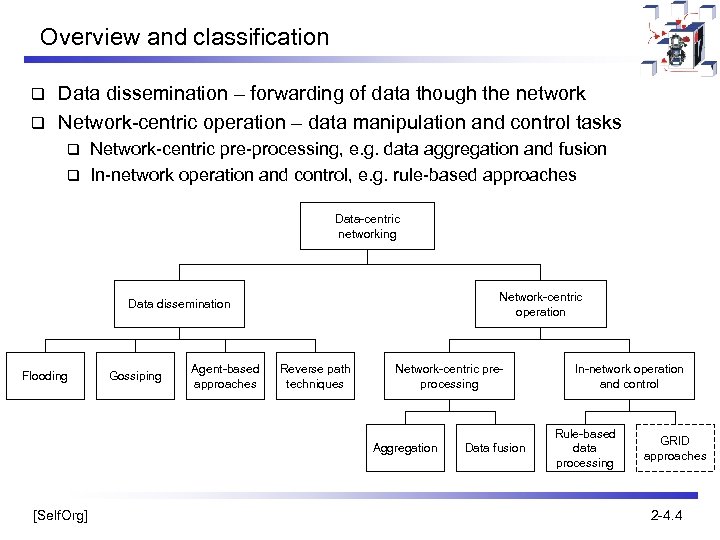 Overview and classification Data dissemination – forwarding of data though the network q Network-centric operation – data manipulation and control tasks q Network-centric pre-processing, e. g. data aggregation and fusion q In-network operation and control, e. g. rule-based approaches q Data-centric networking Network-centric operation Data dissemination Flooding Gossiping Agent-based approaches Reverse path techniques Network-centric preprocessing Aggregation [Self. Org] Data fusion In-network operation and control Rule-based data processing GRID approaches 2 -4. 4
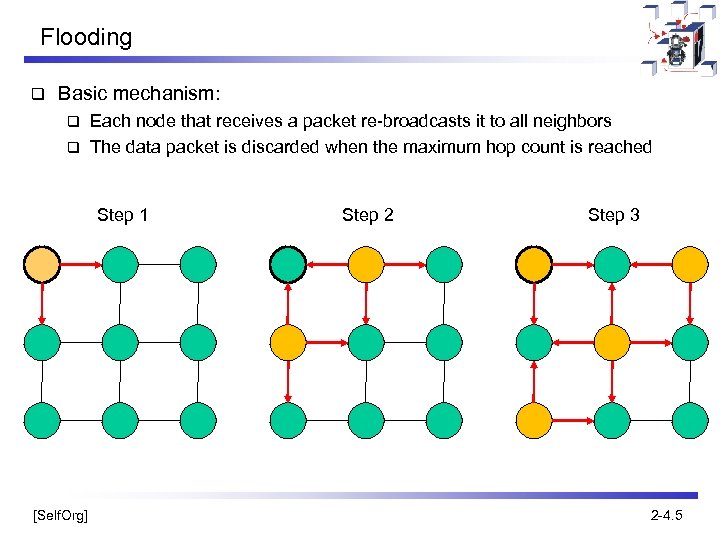 Flooding q Basic mechanism: Each node that receives a packet re-broadcasts it to all neighbors q The data packet is discarded when the maximum hop count is reached q Step 1 [Self. Org] Step 2 Step 3 2 -4. 5
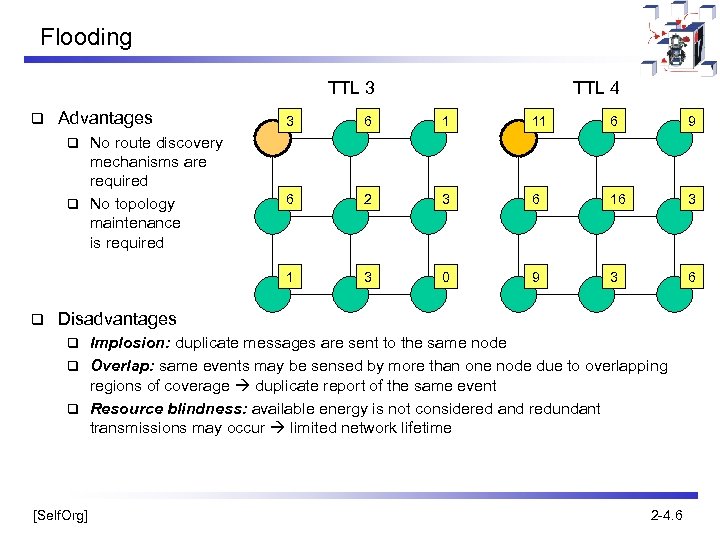 Flooding TTL 3 q Advantages TTL 4 6 1 11 6 9 6 2 3 6 16 3 1 No route discovery mechanisms are required q No topology maintenance is required 3 3 0 9 3 6 q q Disadvantages Implosion: duplicate messages are sent to the same node q Overlap: same events may be sensed by more than one node due to overlapping regions of coverage duplicate report of the same event q Resource blindness: available energy is not considered and redundant transmissions may occur limited network lifetime q [Self. Org] 2 -4. 6
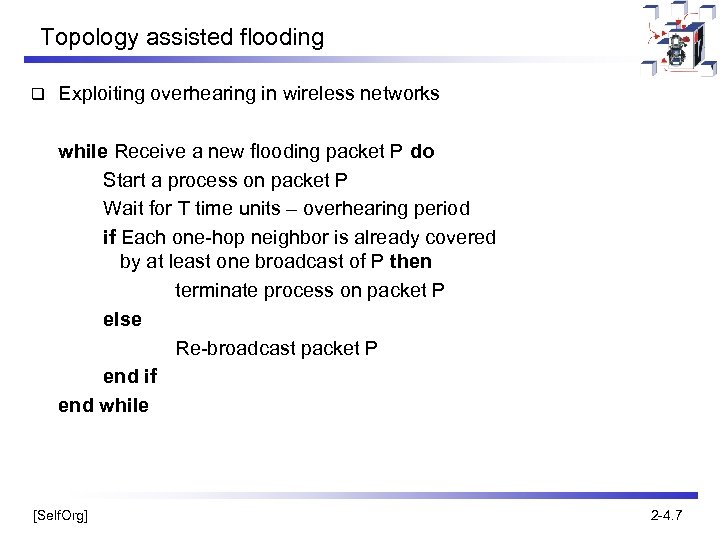 Topology assisted flooding q Exploiting overhearing in wireless networks while Receive a new flooding packet P do Start a process on packet P Wait for T time units – overhearing period if Each one-hop neighbor is already covered by at least one broadcast of P then terminate process on packet P else Re-broadcast packet P end if end while [Self. Org] 2 -4. 7
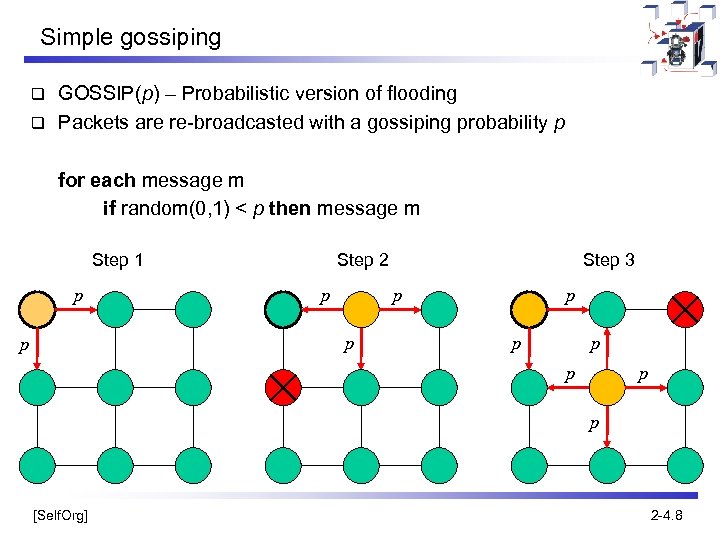 Simple gossiping GOSSIP(p) – Probabilistic version of flooding q Packets are re-broadcasted with a gossiping probability p q for each message m if random(0, 1) < p then message m Step 1 p Step 2 p p Step 3 p p p [Self. Org] 2 -4. 8
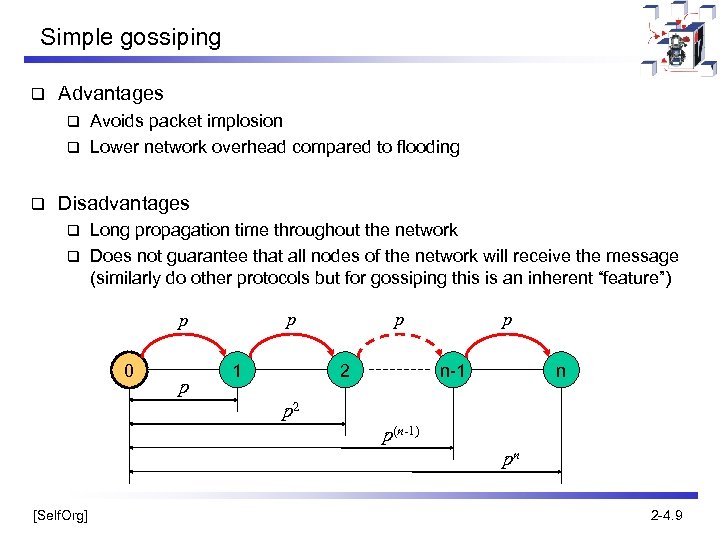 Simple gossiping q Advantages Avoids packet implosion q Lower network overhead compared to flooding q q Disadvantages Long propagation time throughout the network q Does not guarantee that all nodes of the network will receive the message (similarly do other protocols but for gossiping this is an inherent “feature”) q p p 0 p 1 p 2 p n-1 n p 2 p(n-1) pn [Self. Org] 2 -4. 9
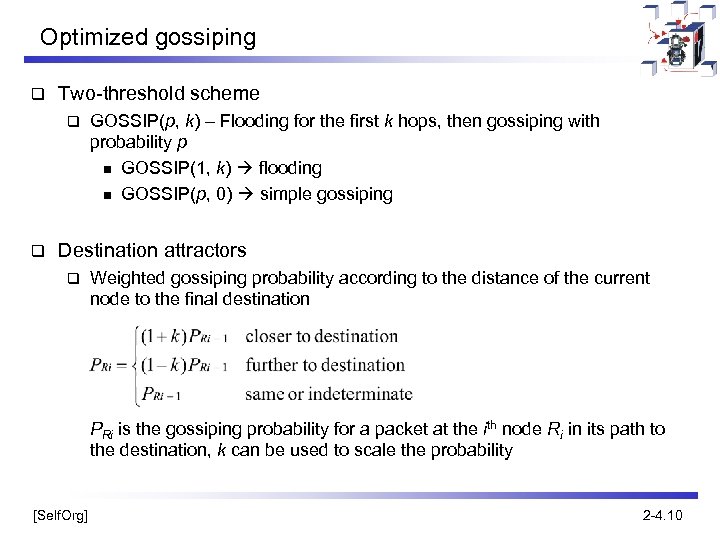 Optimized gossiping q Two-threshold scheme q q GOSSIP(p, k) – Flooding for the first k hops, then gossiping with probability p n GOSSIP(1, k) flooding n GOSSIP(p, 0) simple gossiping Destination attractors q Weighted gossiping probability according to the distance of the current node to the final destination PRi is the gossiping probability for a packet at the ith node Ri in its path to the destination, k can be used to scale the probability [Self. Org] 2 -4. 10
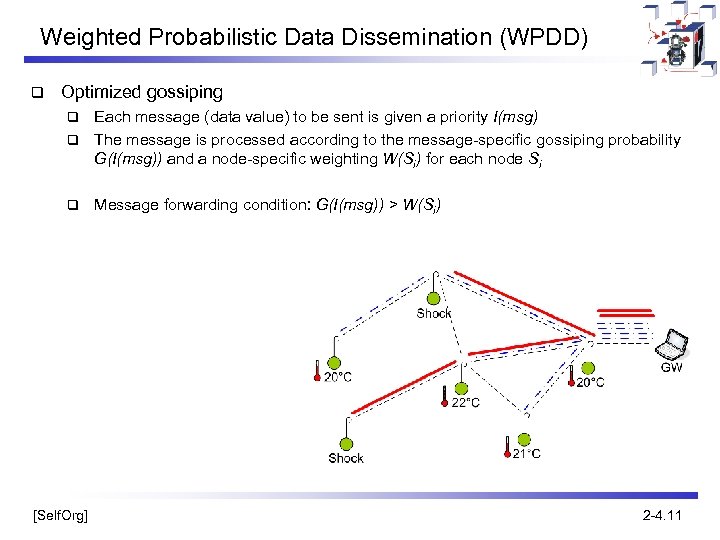 Weighted Probabilistic Data Dissemination (WPDD) q Optimized gossiping Each message (data value) to be sent is given a priority I(msg) q The message is processed according to the message-specific gossiping probability G(I(msg)) and a node-specific weighting W(Si) for each node Si q q [Self. Org] Message forwarding condition: G(I(msg)) > W(Si) 2 -4. 11
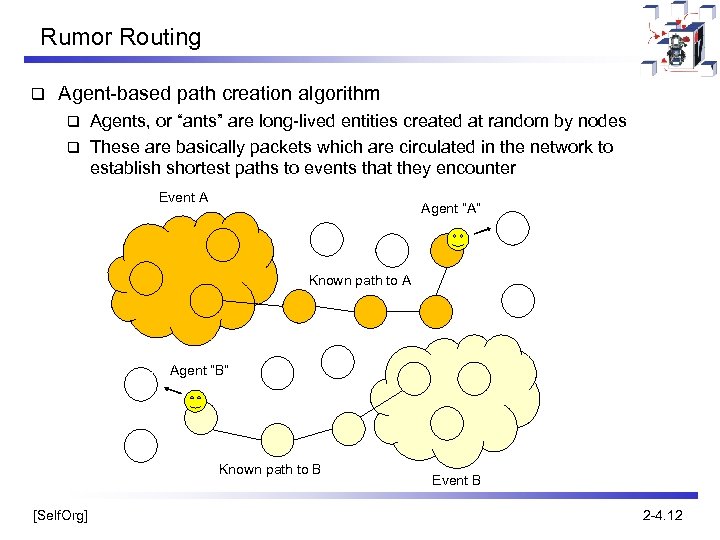 Rumor Routing q Agent-based path creation algorithm Agents, or “ants” are long-lived entities created at random by nodes q These are basically packets which are circulated in the network to establish shortest paths to events that they encounter q Event A Agent “A” Known path to A Agent “B” Known path to B [Self. Org] Event B 2 -4. 12
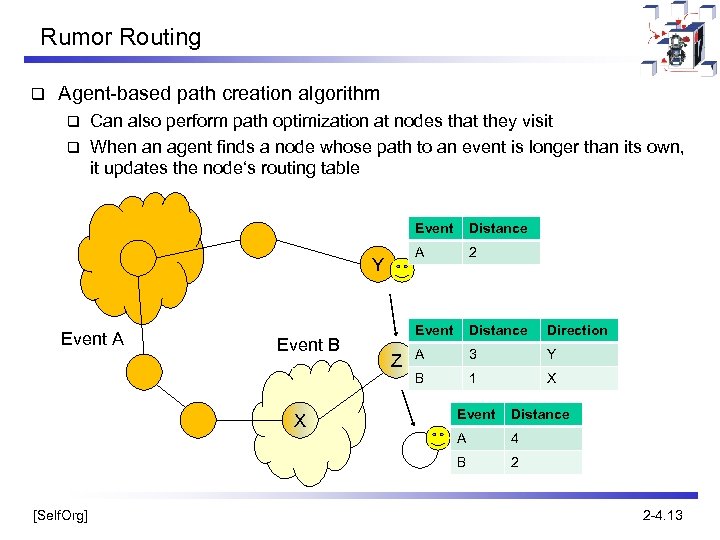 Rumor Routing q Agent-based path creation algorithm Can also perform path optimization at nodes that they visit q When an agent finds a node whose path to an event is longer than its own, it updates the node‘s routing table q Event A Event B Z Distance Direction A 3 4 Y X B Event A 2 Event Y Distance 1 X Distance 4 B [Self. Org] Event A X 2 2 -4. 13
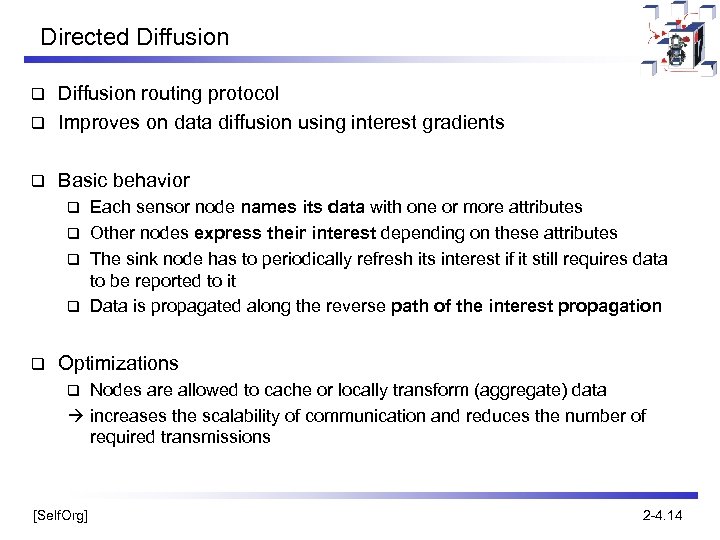 Directed Diffusion routing protocol q Improves on data diffusion using interest gradients q q Basic behavior Each sensor node names its data with one or more attributes q Other nodes express their interest depending on these attributes q The sink node has to periodically refresh its interest if it still requires data to be reported to it q Data is propagated along the reverse path of the interest propagation q q Optimizations Nodes are allowed to cache or locally transform (aggregate) data increases the scalability of communication and reduces the number of required transmissions q [Self. Org] 2 -4. 14
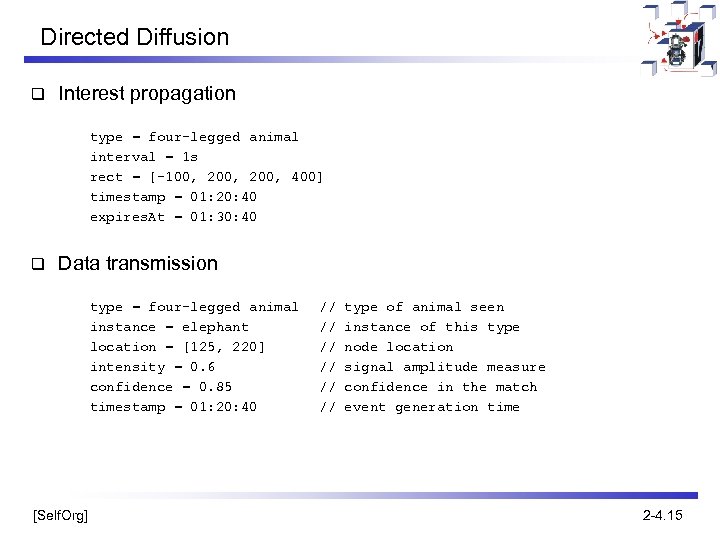 Directed Diffusion q Interest propagation type = four-legged animal interval = 1 s rect = [-100, 200, 400] timestamp = 01: 20: 40 expires. At = 01: 30: 40 q Data transmission type = four-legged animal instance = elephant location = [125, 220] intensity = 0. 6 confidence = 0. 85 timestamp = 01: 20: 40 [Self. Org] // // // type of animal seen instance of this type node location signal amplitude measure confidence in the match event generation time 2 -4. 15
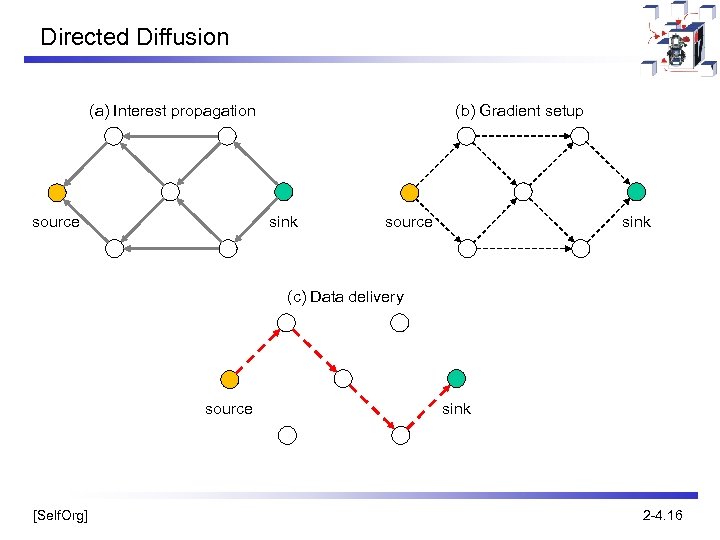 Directed Diffusion (a) Interest propagation source (b) Gradient setup sink source sink (c) Data delivery source [Self. Org] sink 2 -4. 16
![Directed Diffusion – Performance Aspects Average Dissipated Energy [Self. Org] Node Failures – Event](https://present5.com/presentation/6dd5f18d3969dd114a77430c2ea20a2e/image-17.jpg "Directed Diffusion – Performance Aspects Average Dissipated Energy [Self. Org] Node Failures – Event") Directed Diffusion – Performance Aspects Average Dissipated Energy [Self. Org] Node Failures – Event Delivery Ratio 2 -4. 17
Directed Diffusion – Performance Aspects Average Dissipated Energy [Self. Org] Node Failures – Event Delivery Ratio 2 -4. 17
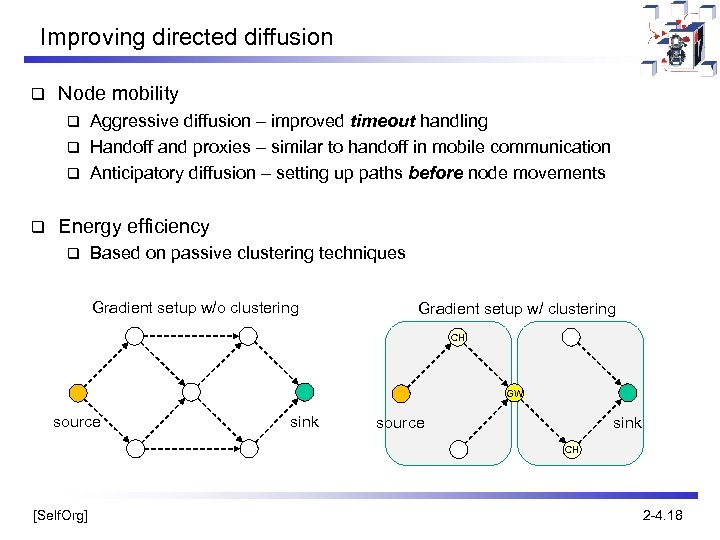 Improving directed diffusion q Node mobility Aggressive diffusion – improved timeout handling q Handoff and proxies – similar to handoff in mobile communication q Anticipatory diffusion – setting up paths before node movements q q Energy efficiency q Based on passive clustering techniques Gradient setup w/o clustering Gradient setup w/ clustering CH GW source sink CH [Self. Org] 2 -4. 18
 Data aggregation – Motivation q Energy constraints and network congestion Data transmission in sensor networks is much more energy expensive compared to local computation efforts q The reduced number of transmitted messages towards the base station helps reducing network congestion (especially near the base station) q q Redundancy and correlation A certain degree of overlap and redundancy is created as measured sensor data is often generated by nearby nodes q Measured data can be expected to be highly correlated allowing further improvements of the information quality by using data fusion approaches (possibly exploiting further available meta information) q [Self. Org] 2 -4. 19
 Data aggregation – Terminology q Data aggregation – Data aggregation is the process of combining multiple information particles (in our scenario, multiple sensor messages) into a single information that is representing all the original messages. Examples of aggregation methods are statistical operations like the mean or the median. q Data fusion – Data fusion is the process of annotating received information particles with meta information. Thus, data from different is combined to produce higher quality information, e. g. by adding a timestamp or location information to received sensor readings. [Self. Org] 2 -4. 20
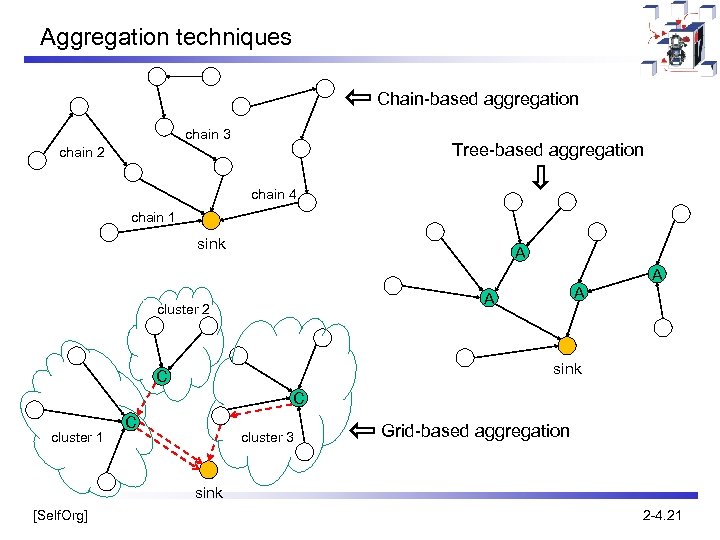 Aggregation techniques Chain-based aggregation chain 3 Tree-based aggregation chain 2 chain 4 chain 1 sink A A cluster 2 sink C C cluster 1 C cluster 3 Grid-based aggregation sink [Self. Org] 2 -4. 21
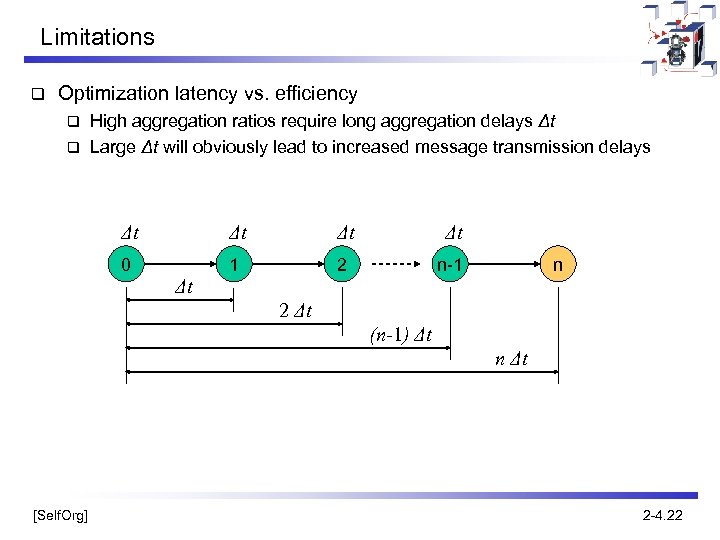 Limitations q Optimization latency vs. efficiency High aggregation ratios require long aggregation delays Δt q Large Δt will obviously lead to increased message transmission delays q Δt Δt 0 1 2 n-1 n Δt 2 Δt (n-1) Δt n Δt [Self. Org] 2 -4. 22
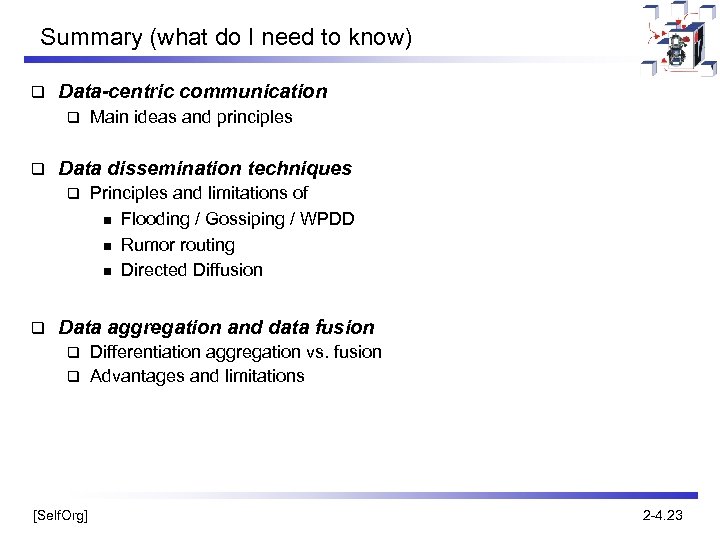 Summary (what do I need to know) q Data-centric communication q q Data dissemination techniques q q Main ideas and principles Principles and limitations of n Flooding / Gossiping / WPDD n Rumor routing n Directed Diffusion Data aggregation and data fusion Differentiation aggregation vs. fusion q Advantages and limitations q [Self. Org] 2 -4. 23
 References q q q q C. L. Barrett, S. J. Eidenbenz, and L. Kroc, "Parametric Probabilistic Sensor Network Routing, " Proceedings of International Conference on Mobile Computing and Networking, San Diego, CA, USA, 2003. A. Boulis, S. Ganeriwal, and M. B. Srivastava, "Aggregation in Sensor Networks: An Energy. Accuracy Trade-off, " Proceedings of IEEE Workshop on Sensor Network Protocols and Applications (SNPA 2003), May 2003, pp. 128 -138. D. Braginsky and D. Estrin, "Rumor Routing Algorithm For Sensor Networks, " Proceedings of First Workshop on Sensor Networks and Applications (WSNA), Atlanta, Georgia, USA, September 2002. Z. J. Haas, J. Y. Halpern, and L. Li, "Gossip-Based Ad Hoc Routing, " Proceedings of IEEE INFOCOM 2002, June 2002, pp. 1707 -1716. V. Handziski, A. Köpke, H. Karl, C. Frank, and W. Drytkiewicz, "Improving the Energy Efficiency of Directed Diffusion Using Pervasive Clustering, " Proceedings of 1 st European Workshop in Wireless Sensor Networks (EWSN), vol. LNCS 2920, Berlin, Germany, January 2004, pp. 172 -187. C. Intanagonwiwat, R. Govindan, and D. Estrin, "Directed diffusion: A scalable and robust communication paradigm for sensor networks, " Proceedings of 6 th Annual ACM/IEEE International Conference on Mobile Computing and Networking (Mobi. COM'00), Boston, MA, USA, August 2000, pp. 56 -67. R. Rajagopalan and P. K. Varshney, "Data-Aggregation Techniques in Sensor Networks: A Survey, " IEEE Communication Surveys and Tutorials, vol. 8 (4), pp. 48 -63, December 2006. R. C. Shah and J. M. Rabaey, "Energy Aware Routing for Low Energy Ad Hoc Sensor Networks, " Proceedings of IEEE Wireless Communications and Networking Conference (WCNC), Orlando, Florida, USA, 2002. [Self. Org] 2 -4. 24