


 Скачать презентацию Self-maintenance versus reproduction effect of experimentally increased food
11e0ed657a543ce99785706a09f56ec7.ppt
- Количество слайдов: 1
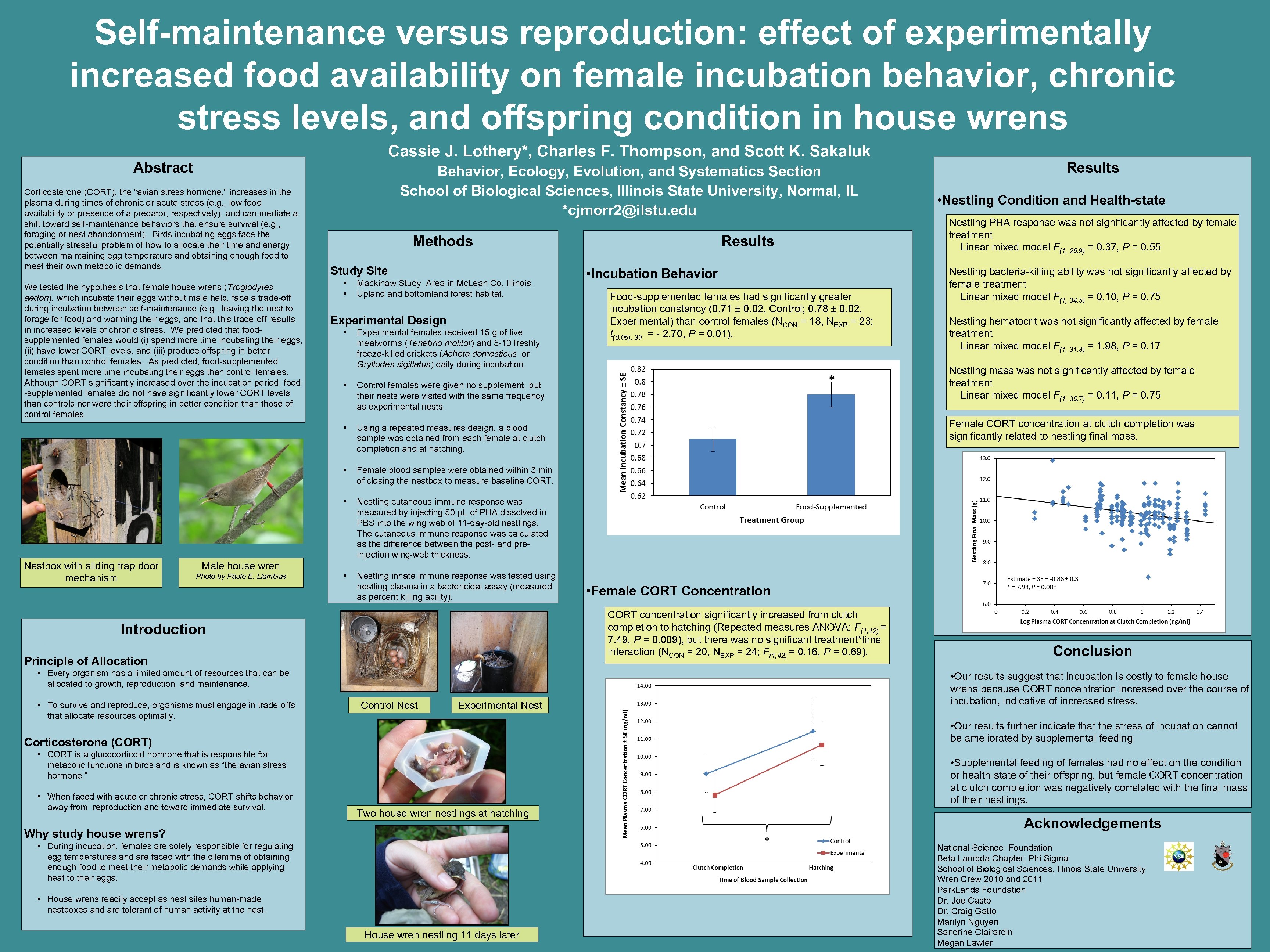 Self-maintenance versus reproduction: effect of experimentally increased food availability on female incubation behavior, chronic stress levels, and offspring condition in house wrens Cassie J. Lothery*, Charles F. Thompson, and Scott K. Sakaluk Abstract Corticosterone (CORT), the “avian stress hormone, ” increases in the plasma during times of chronic or acute stress (e. g. , low food availability or presence of a predator, respectively), and can mediate a shift toward self-maintenance behaviors that ensure survival (e. g. , foraging or nest abandonment). Birds incubating eggs face the potentially stressful problem of how to allocate their time and energy between maintaining egg temperature and obtaining enough food to meet their own metabolic demands. We tested the hypothesis that female house wrens (Troglodytes aedon), which incubate their eggs without male help, face a trade-off during incubation between self-maintenance (e. g. , leaving the nest to forage for food) and warming their eggs, and that this trade-off results in increased levels of chronic stress. We predicted that foodsupplemented females would (i) spend more time incubating their eggs, (ii) have lower CORT levels, and (iii) produce offspring in better condition than control females. As predicted, food-supplemented females spent more time incubating their eggs than control females. Although CORT significantly increased over the incubation period, food -supplemented females did not have significantly lower CORT levels than controls nor were their offspring in better condition than those of control females. Behavior, Ecology, Evolution, and Systematics Section School of Biological Sciences, Illinois State University, Normal, IL *cjmorr 2@ilstu. edu Methods Study Site • • Mackinaw Study Area in Mc. Lean Co. Illinois. Upland bottomland forest habitat. Experimental Design • Experimental females received 15 g of live mealworms (Tenebrio molitor) and 5 -10 freshly freeze-killed crickets (Acheta domesticus or Gryllodes sigillatus) daily during incubation. Male house wren Photo by Paulo E. Llambias Nestling innate immune response was tested using nestling plasma in a bactericidal assay (measured as percent killing ability). Principle of Allocation • Every organism has a limited amount of resources that can be allocated to growth, reproduction, and maintenance. Control Nest Experimental Nestling hematocrit was not significantly affected by female treatment Linear mixed model F(1, 31. 3) = 1. 98, P = 0. 17 Female CORT concentration at clutch completion was significantly related to nestling final mass. • Female CORT Concentration Conclusion • Our results suggest that incubation is costly to female house wrens because CORT concentration increased over the course of incubation, indicative of increased stress. • Our results further indicate that the stress of incubation cannot be ameliorated by supplemental feeding. Corticosterone (CORT) • CORT is a glucocorticoid hormone that is responsible for metabolic functions in birds and is known as “the avian stress hormone. ” • When faced with acute or chronic stress, CORT shifts behavior away from reproduction and toward immediate survival. Nestling bacteria-killing ability was not significantly affected by female treatment Linear mixed model F(1, 34. 5) = 0. 10, P = 0. 75 Nestling mass was not significantly affected by female treatment Linear mixed model F(1, 35. 7) = 0. 11, P = 0. 75 CORT concentration significantly increased from clutch completion to hatching (Repeated measures ANOVA; F(1, 42) = 7. 49, P = 0. 009), but there was no significant treatment*time interaction (NCON = 20, NEXP = 24; F(1, 42) = 0. 16, P = 0. 69). Introduction • To survive and reproduce, organisms must engage in trade-offs that allocate resources optimally. Nestling PHA response was not significantly affected by female treatment Linear mixed model F(1, 25. 9) = 0. 37, P = 0. 55 Nestling cutaneous immune response was measured by injecting 50 µL of PHA dissolved in PBS into the wing web of 11 -day-old nestlings. The cutaneous immune response was calculated as the difference between the post- and preinjection wing-web thickness. • • Nestling Condition and Health-state Female blood samples were obtained within 3 min of closing the nestbox to measure baseline CORT. • Food-supplemented females had significantly greater incubation constancy (0. 71 ± 0. 02, Control; 0. 78 ± 0. 02, Experimental) than control females (NCON = 18, NEXP = 23; t(0. 05), 39 = - 2. 70, P = 0. 01). Using a repeated measures design, a blood sample was obtained from each female at clutch completion and at hatching. • • Incubation Behavior Control females were given no supplement, but their nests were visited with the same frequency as experimental nests. • Nestbox with sliding trap door mechanism • Results • Supplemental feeding of females had no effect on the condition or health-state of their offspring, but female CORT concentration at clutch completion was negatively correlated with the final mass of their nestlings. Two house wren nestlings at hatching Why study house wrens? • During incubation, females are solely responsible for regulating egg temperatures and are faced with the dilemma of obtaining enough food to meet their metabolic demands while applying heat to their eggs. • House wrens readily accept as nest sites human-made nestboxes and are tolerant of human activity at the nest. House wren nestling 11 days later Acknowledgements National Science Foundation Beta Lambda Chapter, Phi Sigma School of Biological Sciences, Illinois State University Wren Crew 2010 and 2011 Park. Lands Foundation Dr. Joe Casto Dr. Craig Gatto Marilyn Nguyen Sandrine Clairardin Megan Lawler