 Скачать презентацию SELF-KNOWLEDGE AND THE BIG THREE MOTIVES LECTURE 9
lecture 9 Big three motives.pptx
- Количество слайдов: 16



SELF-KNOWLEDGE AND THE BIG THREE MOTIVES. LECTURE 9 Need for achievement (n Ach) a) Doing things better b) Increasing the need for achievement c) Determining sex differences Promoting achievement motivation in children 2. Need for Power (n Pow) a) Impact b) Sex differences c) Health status and n Pow 3. Need for Intimacy (n Int) 1. d)
Need for Achievement Desire to do better, to be successful and feel competence It is energized by: - achievement-related situations - Incentives of challenge and variety - Feelings of interest and surprise - Curiosity and exploration - Satisfaction from accomplishing a task
Research findings. The effect of achievement arousal was the same for both men and women, people from different cultures, despite differences in the social, linguistic, or cultural definitions of the concepts of achievement and success.
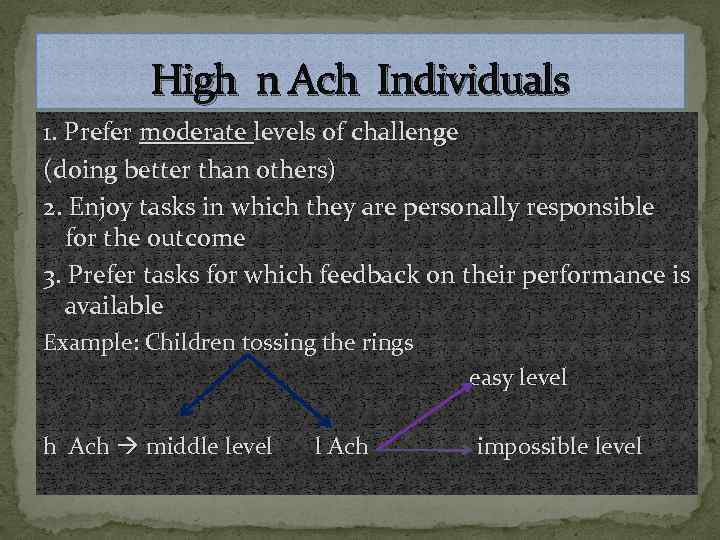
High n Ach Individuals 1. Prefer moderate levels of challenge (doing better than others) 2. Enjoy tasks in which they are personally responsible for the outcome 3. Prefer tasks for which feedback on their performance is available Example: Children tossing the rings easy level h Ach middle level l Ach impossible level
Increasing the need for Achievement Work habits of college students with h Ach: - More deliberate in getting good grades; - Speak to the professor prior to exams; - Contact the professor about the exam feedback; - Drawn to careers: with more potential risk and uncertainty;

SEX DIFFERENCES IN ACHIEVEMENT STRIVINGS Similarities 1) Preference for moderate challenge 2)Personal responsibility for the outcome 3)Tasks with feedback Differences 1) Life outcome predicted by n Ach 2)Children experiences

Life outcomes predicted by n Ach High need for achievement women who value having family. High need for achievement women who value having both family and work goals. More investment in activities related to dating and courtship more emphasis on physical appearance and talking about boyfriends more Achieving better grades completing a college starting a family later.

Children Experiences associated with n Ach Girls experiences with high n Ach 1. Stressful early family life 2. Mothers are critical, aggressive and competitive towards them 3. Parents have divorced or separated 4. Living with a single mom Boys experiences with high n Ach 1. Parental support and care 2. Living with both parents, without divorce or separation

COMPETITIVE ACHIEVEMENT SETTINGS Research findings: In settings where women perform just as well as men, they are less likely to want to engage in direct competition with other. Women may be more selective in how they express their achievement strivings, especially when winning for oneself means that others lose.

Promoting Achievement Motivation in Children 1) Parental behavior independence training ( promoting autonomy a sense of mastery and confidence) 2) Parental behavior challenging standards (high expectations which do not exceed the child’s abilities and rewarding him when the goal is attained)

Need for Power Readiness or preference for having an impact on other people Power – related behavior: Strong and vigorous actions that bring about strong reactions in other, emphasizing the importance of a character’s status or reputation.

Research Findings: 1) Individuals high in n Pow are interested in control-control situations and other people. 2) Men high in n Pow rate their ‘ideal wives’ as under the men’s control and dependent on them a sense of superiority 3) They tend to abuse their spouses. 4) Their friends, are less popular and do not pose a threat to their status.

Power Motive and Sex Differences Similarities Differences 1) Have formal social power 2) Have power –related careers 3) Gather prestige possessions 1) Men perform a wide variety of impulsive and aggressive behaviors, use more alcohol; 2) Men have higher divorce rates and more arguments with others; 3) Men are engaged in sexual exploitation of women (more sex partners)

Health Status and Need for Power Research findings: people high in n Pow do not deal well with frustration and conflict. If their power is blocked they are likely to show strong stress responses. Power stress: vulnerability to various diseases because stress is associated with inhibiting power.

Need for Intimacy Desire for warm and fulfilling relationship with others, more meaningful human contact in their day-to-day lives. Characteristics from their friends: -sincere -loving -not dominant -not self-centered -healthy adjustment: coping well with stress, free from alcohol problems -more happiness and satisfaction

Research Findings: Findings People high in n Int have been found to: 1) Spend more time during the day thinking about relationships 2) Report more pleasant emotions when they are around other people 3) Smile, laugh, and make more eye contact 4) Start up conversations more frequently and write more letters.
Скачать презентацию SELF-KNOWLEDGE AND THE BIG THREE MOTIVES LECTURE 9
lecture 9 Big three motives.pptx