


 Скачать презентацию Self-Constructing P 2 P Networks on the Project
3f3a0283ca9a95bce6dac5d9fce7b3a5.ppt
- Количество слайдов: 34
 Self-Constructing P 2 P Networks on the Project JXTA Platform Bill Yeager Chief Technologist Project JXTA Sun Microsystems, Inc.
 Highlights • Some weekend musings … – What is P 2 P – Why P 2 P Now • Fundamentals of the JXTA Virtual Network
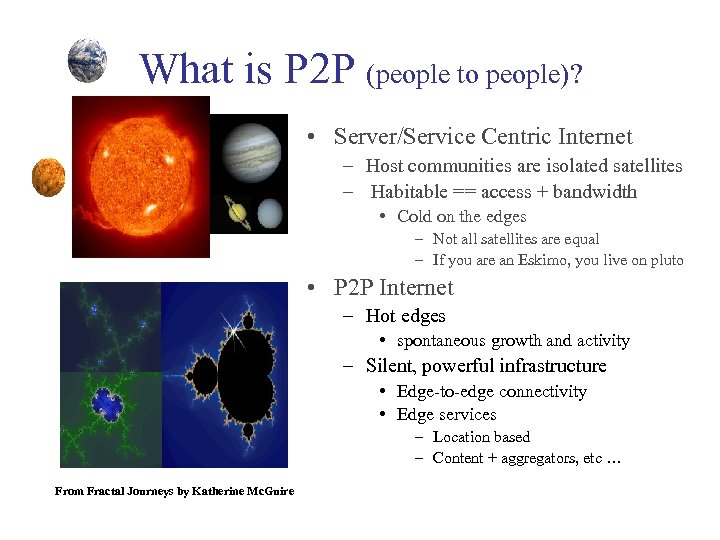 What is P 2 P (people to people)? • Server/Service Centric Internet – Host communities are isolated satellites – Habitable == access + bandwidth • Cold on the edges – Not all satellites are equal – If you are an Eskimo, you live on pluto • P 2 P Internet – Hot edges • spontaneous growth and activity – Silent, powerful infrastructure • Edge-to-edge connectivity • Edge services – Location based – Content + aggregators, etc … From Fractal Journeys by Katherine Mc. Guire
 Why P 2 P Now? • Current Internet – As the number of devices increases • Shorter / Fatter network is required – 10 mbps, 100 mbps, 1 gbps, 10 gbps … – More powerful servers • Same service and sometimes less QOS • We are not “knocking” the technology – It’s magnificent! – Rather when limits are reached history shows • disruptive technology arrives – It is scary and there is resistance – The economy always benefits
 Why P 2 P Now Continued Imagine that P 2 P, Edge technology arrived Before The Centralized Internet How would the “center” evolve?
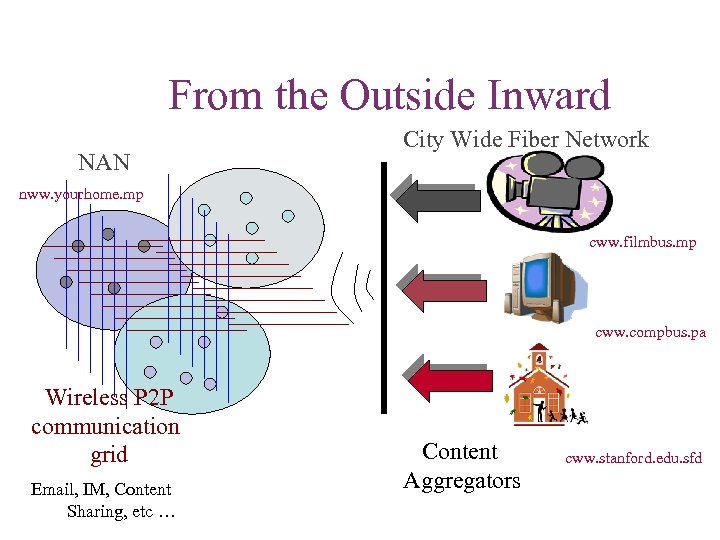 From the Outside Inward NAN City Wide Fiber Network nww. yourhome. mp cww. filmbus. mp cww. compbus. pa Wireless P 2 P communication grid Email, IM, Content Sharing, etc … Content Aggregators cww. stanford. edu. sfd
 The P 2 P Internet From Fractal Journeys by Katherine Mc. Guire
 The Fundamentals of the JXTA Virtual Network
 Overview • • The “Stack” Peers and Peergroups Network Abstractions JVNet Definitions Protocols Security Implementation Status
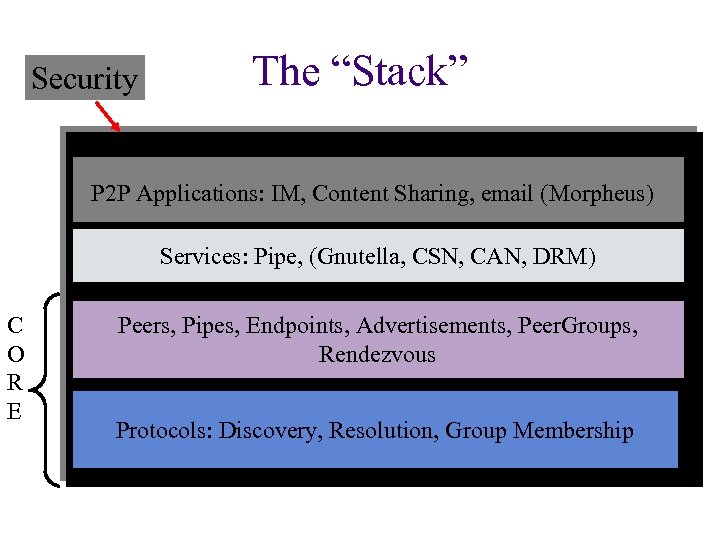 Security The “Stack” P 2 P Applications: IM, Content Sharing, email (Morpheus) Services: Pipe, (Gnutella, CSN, CAN, DRM) C O R E Peers, Pipes, Endpoints, Advertisements, Peer. Groups, Rendezvous Protocols: Discovery, Resolution, Group Membership
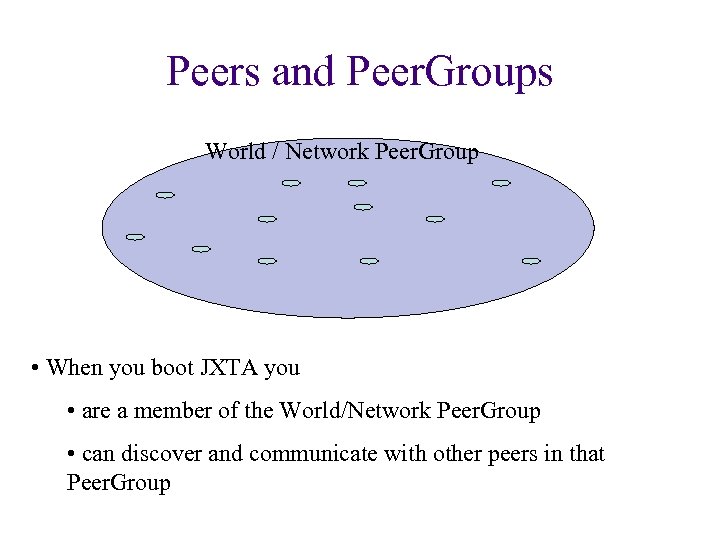 Peers and Peer. Groups World / Network Peer. Group • When you boot JXTA you • are a member of the World/Network Peer. Group • can discover and communicate with other peers in that Peer. Group
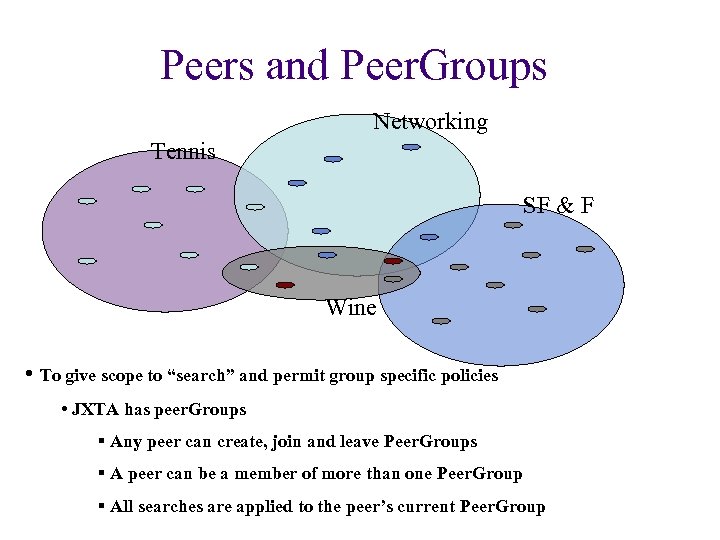 Peers and Peer. Groups Networking Tennis SF & F Wine • To give scope to “search” and permit group specific policies • JXTA has peer. Groups § Any peer can create, join and leave Peer. Groups § A peer can be a member of more than one Peer. Group § All searches are applied to the peer’s current Peer. Group
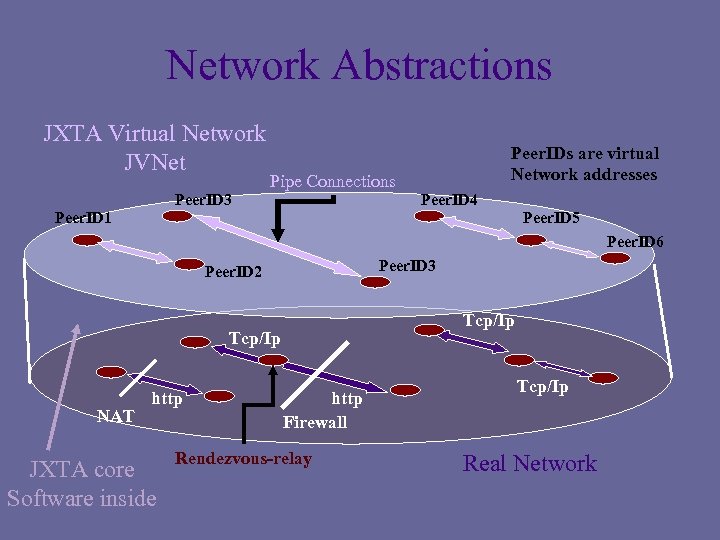 Network Abstractions JXTA Virtual Network JVNet Peer. ID 3 Pipe Connections Peer. IDs are virtual Network addresses Peer. ID 4 Peer. ID 1 Peer. ID 5 Peer. ID 6 Peer. ID 3 Peer. ID 2 Tcp/Ip NAT http JXTA core Software inside http Firewall Rendezvous-relay Tcp/Ip Real Network
 JVNet Definitions#1 • Peers – Any device on the jxta virtual network – Peer. Name • Each peer has a human readable text string name – Peer. IDs • These are virtual network addresses – Bound to a peer – urn: uuid-<320 unique bits>
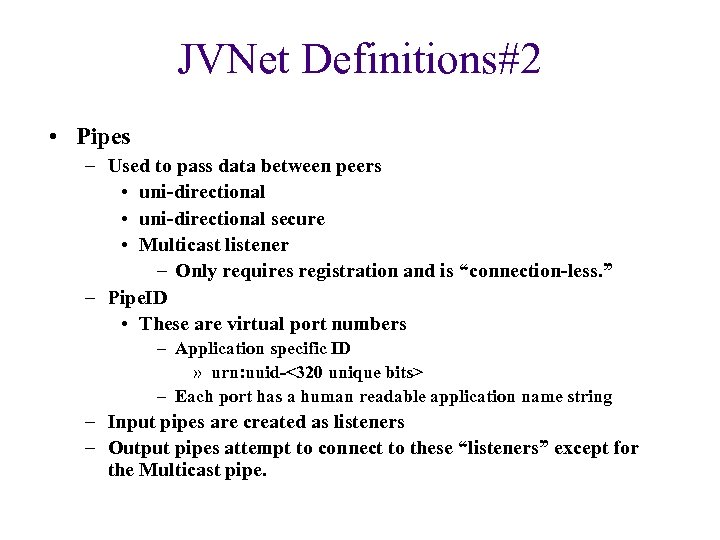 JVNet Definitions#2 • Pipes – Used to pass data between peers • uni-directional secure • Multicast listener – Only requires registration and is “connection-less. ” – Pipe. ID • These are virtual port numbers – Application specific ID » urn: uuid-<320 unique bits> – Each port has a human readable application name string – Input pipes are created as listeners – Output pipes attempt to connect to these “listeners” except for the Multicast pipe.
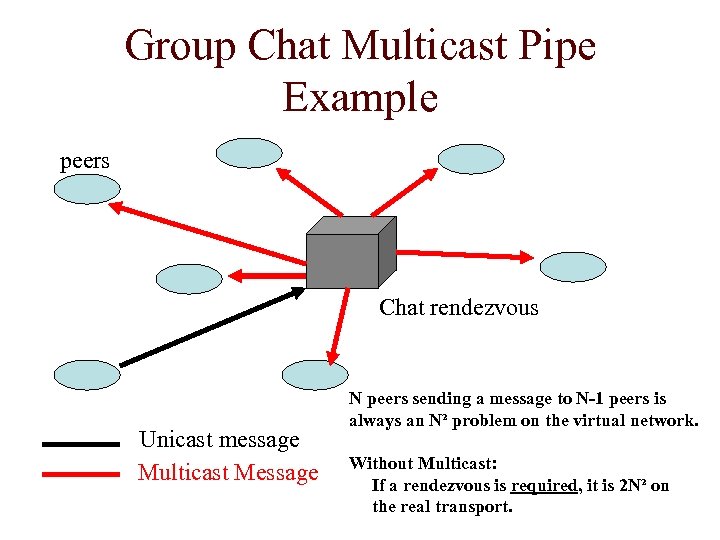 Group Chat Multicast Pipe Example peers Chat rendezvous Unicast message Multicast Message N peers sending a message to N-1 peers is always an N² problem on the virtual network. Without Multicast: If a rendezvous is required, it is 2 N² on the real transport.
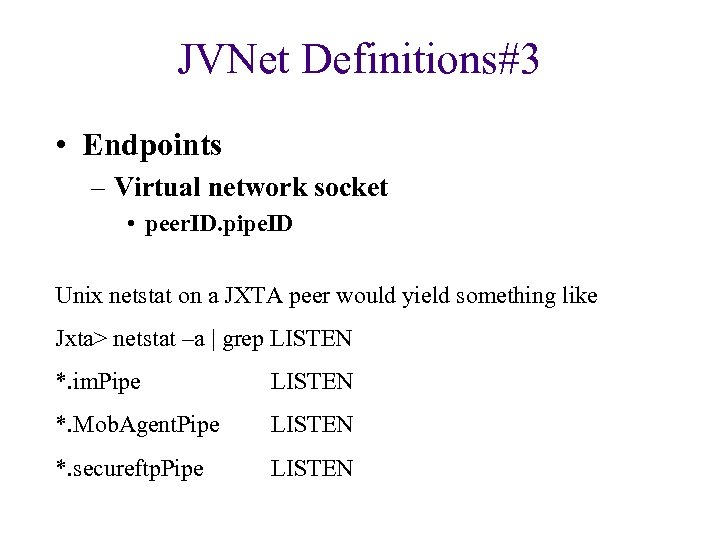 JVNet Definitions#3 • Endpoints – Virtual network socket • peer. ID. pipe. ID Unix netstat on a JXTA peer would yield something like Jxta> netstat –a | grep LISTEN *. im. Pipe LISTEN *. Mob. Agent. Pipe LISTEN *. secureftp. Pipe LISTEN
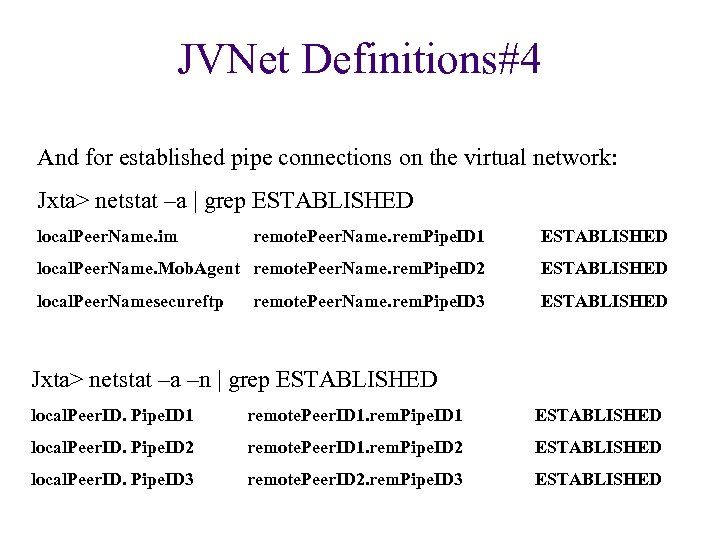 JVNet Definitions#4 And for established pipe connections on the virtual network: Jxta> netstat –a | grep ESTABLISHED local. Peer. Name. im remote. Peer. Name. rem. Pipe. ID 1 ESTABLISHED local. Peer. Name. Mob. Agent remote. Peer. Name. rem. Pipe. ID 2 ESTABLISHED local. Peer. Namesecureftp ESTABLISHED remote. Peer. Name. rem. Pipe. ID 3 Jxta> netstat –a –n | grep ESTABLISHED local. Peer. ID. Pipe. ID 1 remote. Peer. ID 1. rem. Pipe. ID 1 ESTABLISHED local. Peer. ID. Pipe. ID 2 remote. Peer. ID 1. rem. Pipe. ID 2 ESTABLISHED local. Peer. ID. Pipe. ID 3 remote. Peer. ID 2. rem. Pipe. ID 3 ESTABLISHED
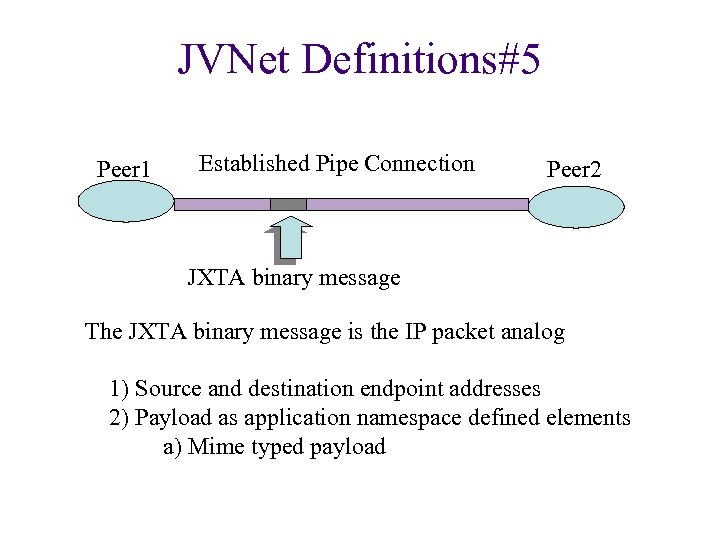 JVNet Definitions#5 Peer 1 Established Pipe Connection Peer 2 JXTA binary message The JXTA binary message is the IP packet analog 1) Source and destination endpoint addresses 2) Payload as application namespace defined elements a) Mime typed payload
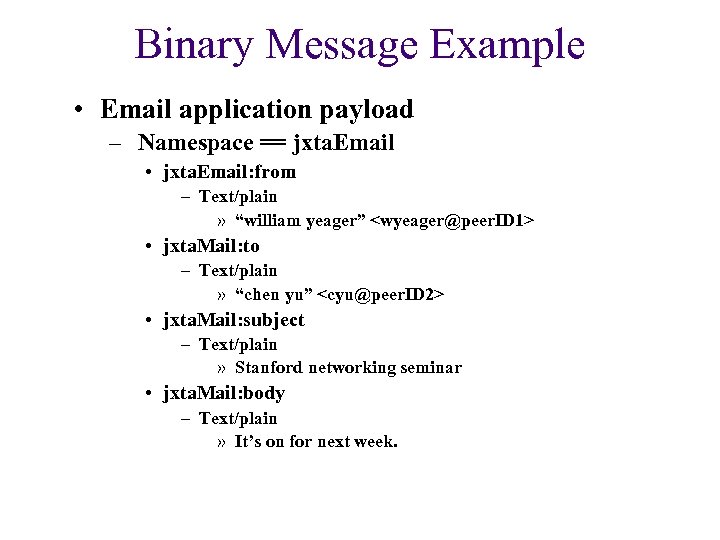 Binary Message Example • Email application payload – Namespace == jxta. Email • jxta. Email: from – Text/plain » “william yeager”
 Advertisements • JXTA uses advertisements to create descriptions of peers – XML Documents • • Peer Advertisement Pipe Advertisement Peer. Group Advertisement Rendezvous Advertisment – Protocols are used to publish and subscribe to these document types
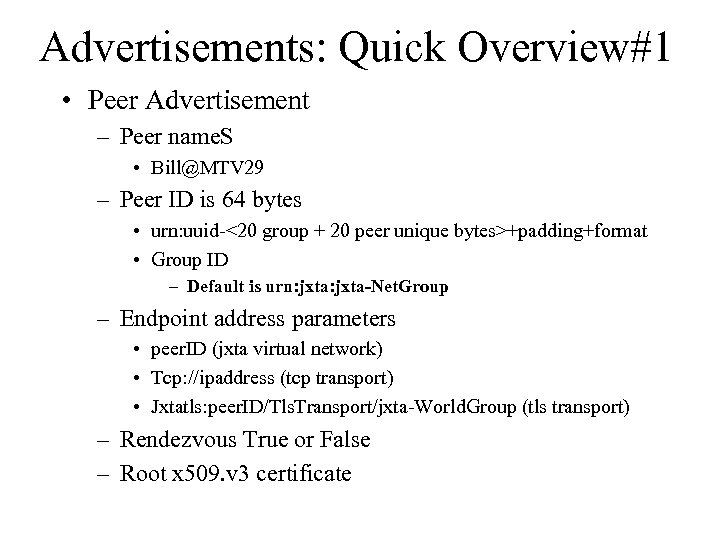 Advertisements: Quick Overview#1 • Peer Advertisement – Peer name. S • Bill@MTV 29 – Peer ID is 64 bytes • urn: uuid-<20 group + 20 peer unique bytes>+padding+format • Group ID – Default is urn: jxta-Net. Group – Endpoint address parameters • peer. ID (jxta virtual network) • Tcp: //ipaddress (tcp transport) • Jxtatls: peer. ID/Tls. Transport/jxta-World. Group (tls transport) – Rendezvous True or False – Root x 509. v 3 certificate
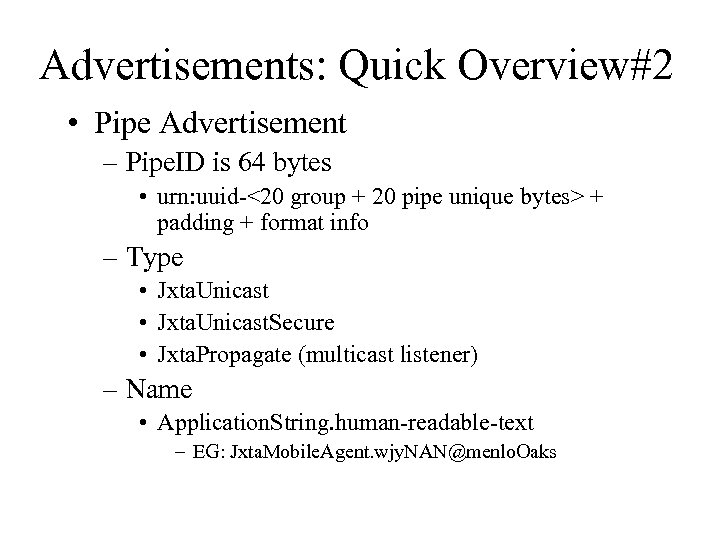 Advertisements: Quick Overview#2 • Pipe Advertisement – Pipe. ID is 64 bytes • urn: uuid-<20 group + 20 pipe unique bytes> + padding + format info – Type • Jxta. Unicast. Secure • Jxta. Propagate (multicast listener) – Name • Application. String. human-readable-text – EG: Jxta. Mobile. Agent. wjy. NAN@menlo. Oaks
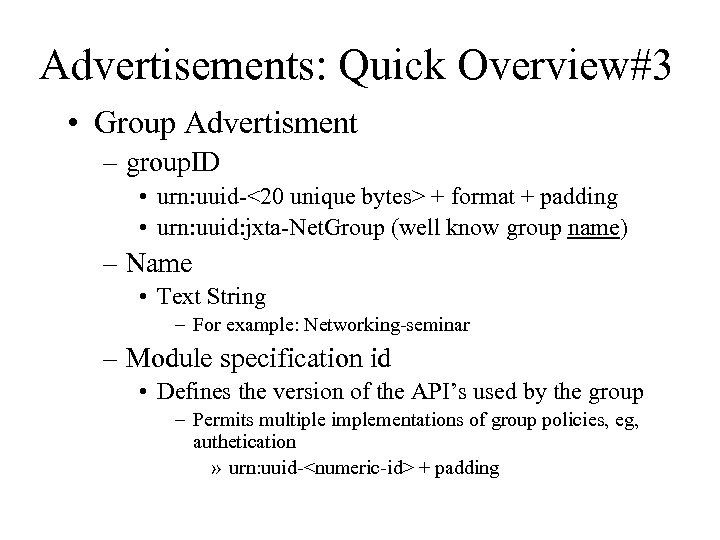 Advertisements: Quick Overview#3 • Group Advertisment – group. ID • urn: uuid-<20 unique bytes> + format + padding • urn: uuid: jxta-Net. Group (well know group name) – Name • Text String – For example: Networking-seminar – Module specification id • Defines the version of the API’s used by the group – Permits multiple implementations of group policies, eg, authetication » urn: uuid-
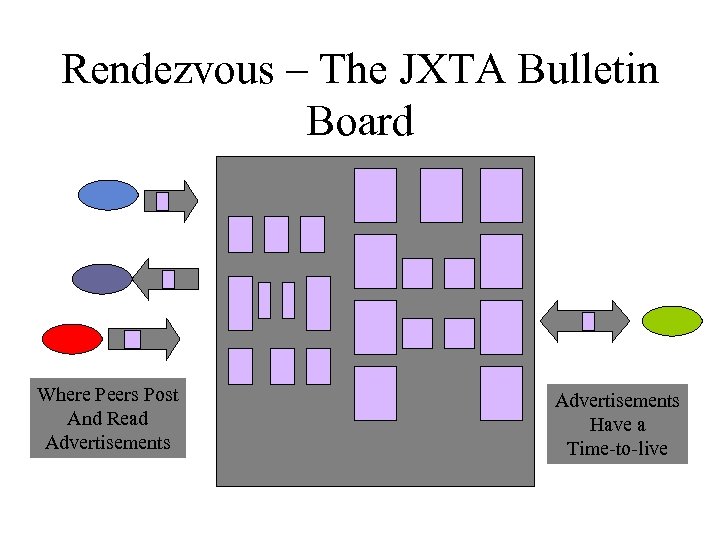 Rendezvous – The JXTA Bulletin Board Where Peers Post And Read Advertisements Have a Time-to-live
 Protocols • Discovery Group Services – Publication of advertisements • Locally and remotely – Upon advertisement creation they are usually published – Subscription to published advertisements • Retrieve locally and remotely published – These are searches and are scoped to the peer. Group – One can refine the search for pipe adv to the application » Search for Mobile. Agent listening pipes in the peer. Monitoring group for example
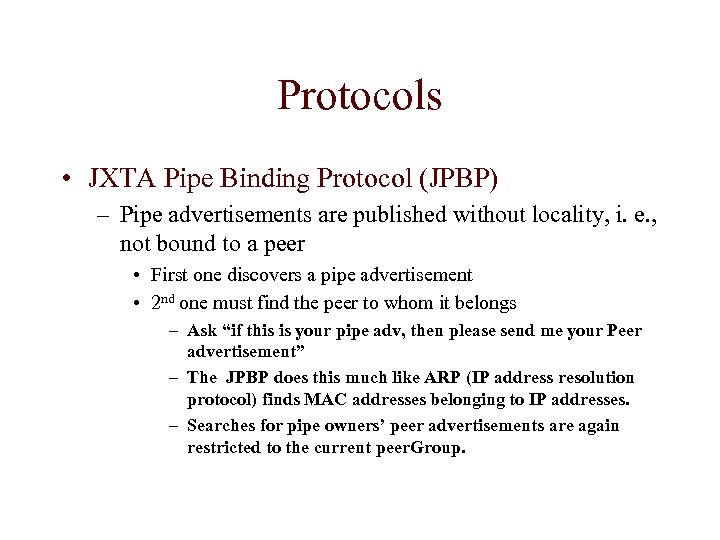 Protocols • JXTA Pipe Binding Protocol (JPBP) – Pipe advertisements are published without locality, i. e. , not bound to a peer • First one discovers a pipe advertisement • 2 nd one must find the peer to whom it belongs – Ask “if this is your pipe adv, then please send me your Peer advertisement” – The JPBP does this much like ARP (IP address resolution protocol) finds MAC addresses belonging to IP addresses. – Searches for pipe owners’ peer advertisements are again restricted to the current peer. Group.
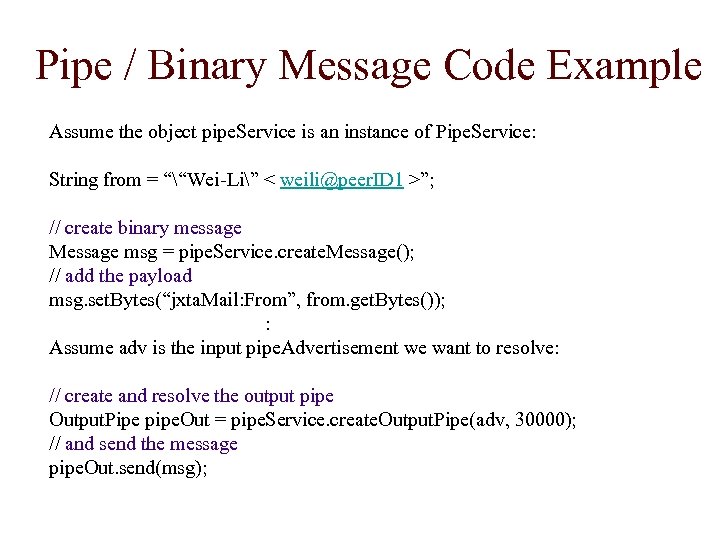 Pipe / Binary Message Code Example Assume the object pipe. Service is an instance of Pipe. Service: String from = ““Wei-Li” < weili@peer. ID 1 >”; // create binary message Message msg = pipe. Service. create. Message(); // add the payload msg. set. Bytes(“jxta. Mail: From”, from. get. Bytes()); : Assume adv is the input pipe. Advertisement we want to resolve: // create and resolve the output pipe Output. Pipe pipe. Out = pipe. Service. create. Output. Pipe(adv, 30000); // and send the message pipe. Out. send(msg);
 Group Membership Protocol • Peers can – Create groups • Creates and publishes advertisement – Provide the code for the membership policies • Authentication and authorization for example – Join groups • Automatically changes the group. ID in the peer advertisement – Leave groups
 JXTA’s Virtual Network Core Implementation • The JXTA Virtual Network hides – The complexity of the real underlying transports and their associated protocols • Just what is your IP address? – The infrastructure barriers • NAT, Firewalls – The physical transports • JXTA works end-to-end across physical layers from the P 2 P application programmer
 JXTA Security • Poblano “degrees of security model” – $0 cost is least secure (every peer it’s own Certificate Authority) – Use standard Web CA’s for most secure – http: //www. jxta. org/docs/trust. pdf • by Bill Yeager and Rita Chen • Full implementation of Transport Layer Security [rfc 2246] This is SSL. V 3+ – Default Cipher suite • RSA 1024, 3 DES EDE CBC, SHA-1 – X 509. v 3 certificates – http: //www. jxta. org/project/www/docs/Security. JXTA. PDF • by Bill Yeager
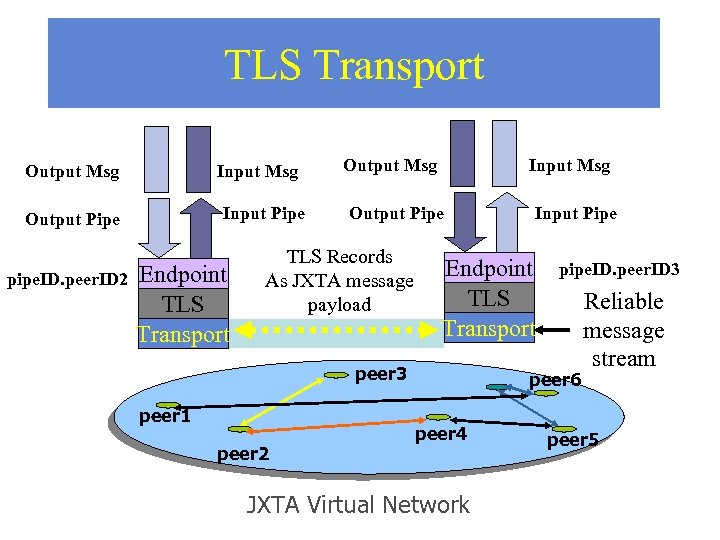 TLS Transport Output Msg Input Pipe Output Pipe pipe. ID. peer. ID 2 Endpoint TLS Transport Output Msg Input Msg Output Pipe TLS Records As JXTA message payload Endpoint TLS Transport peer 3 peer 1 peer 2 Input Pipe pipe. ID. peer. ID 3 peer 6 peer 4 JXTA Virtual Network Reliable message stream peer 5
 Implementation Status • Full J 2 SE implementation is complete • Full Java Mobile phone implementation is compete • C implementation is in progress with full completion targeted for May. • All implementations are edge-to-edge interoperable! – We can discover peers, maintain “buddy lists, ” and chat from a mobile phone to a laptop or desktop and viceversa.
 Questions? Project JXTA is open source http: //www. jxta. org