


 Скачать презентацию Selective Injection and Trapping of Hydrogen from vacuum
4429c2011c0fa67497978ae7a30a5fbc.ppt
- Количество слайдов: 19
 Selective Injection and Trapping of Hydrogen from vacuum discharge I. Be’ery 1, 2, O. Seemann 1, 2, A. Fisher 1, 2, A. Ron 1 and A. Fruchtman 3 1 Physics Department, Technion, Haifa 32000, Israel 2 Rafael plasma physics lab (RPL), Israel 3 Faculty of Sciences, H. I. T. – Holon Institute of Technology, Holon 58102, Israel
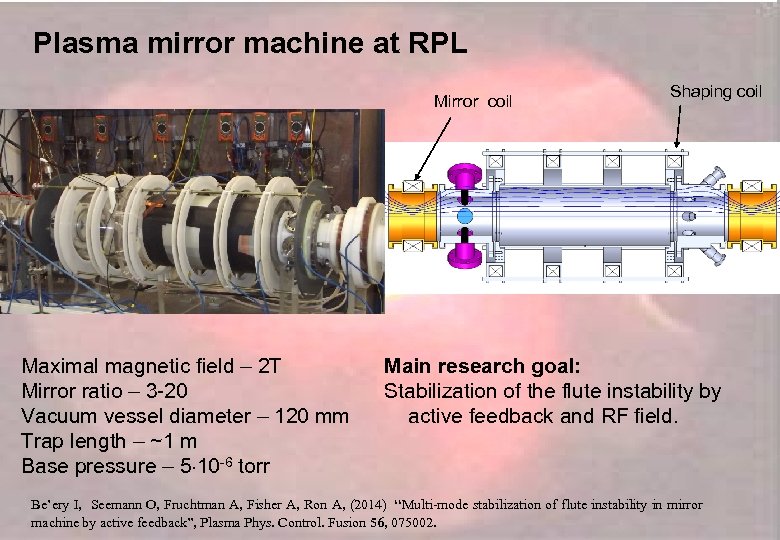 Plasma mirror machine at RPL Mirror coil Maximal magnetic field – 2 T Mirror ratio – 3 -20 Vacuum vessel diameter – 120 mm Trap length – ~1 m Base pressure – 5 10 -6 torr Shaping coil Main research goal: Stabilization of the flute instability by active feedback and RF field. Be’ery I, Seemann O, Fruchtman A, Fisher A, Ron A, (2014) “Multi-mode stabilization of flute instability in mirror machine by active feedback”, Plasma Phys. Control. Fusion 56, 075002.
 Hydrogen fueling in magnetic confinement machines Most hydrogen fuel injection sources for magnetic confinement machines rely on gas puff, pellet injection and neutral beams. • Slow injection (>hundreds of s). • Technically complex. • Vacuum issues. • Inject neutral hydrogen. Vacuum arcs can be put into beneficial use!
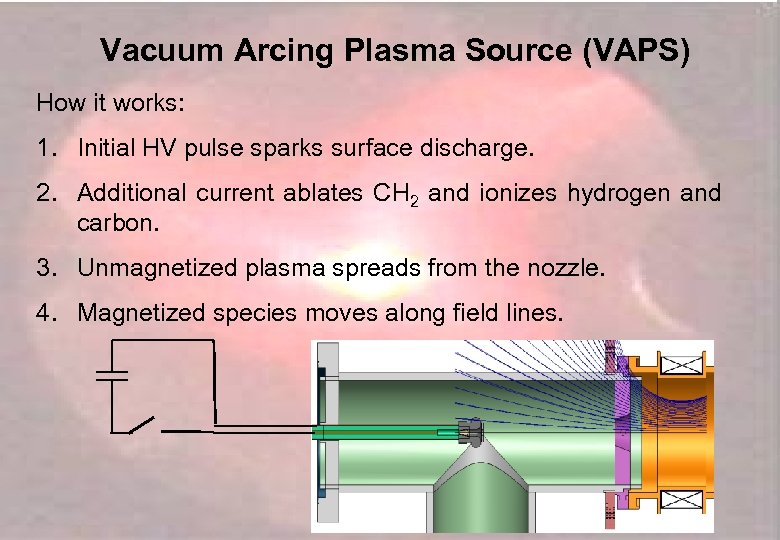 Vacuum Arcing Plasma Source (VAPS) How it works: 1. Initial HV pulse sparks surface discharge. 2. Additional current ablates CH 2 and ionizes hydrogen and carbon. 3. Unmagnetized plasma spreads from the nozzle. 4. Magnetized species moves along field lines.
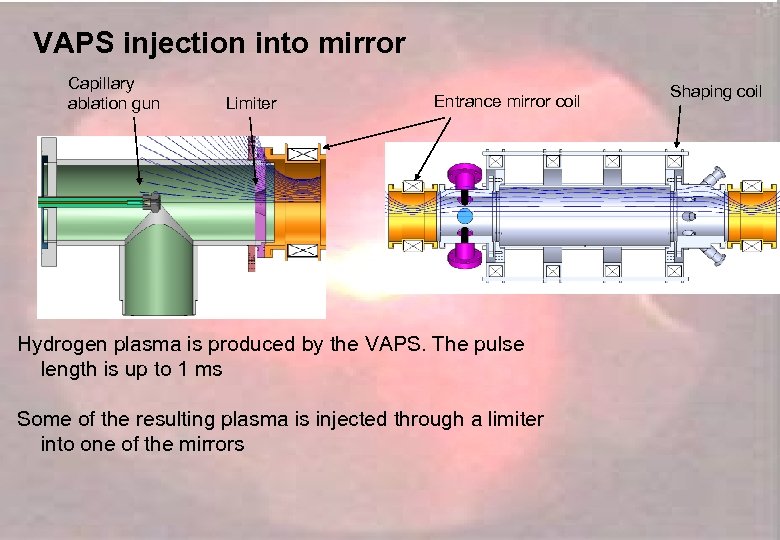 VAPS injection into mirror Capillary ablation gun Limiter Entrance mirror coil Hydrogen plasma is produced by the VAPS. The pulse length is up to 1 ms Some of the resulting plasma is injected through a limiter into one of the mirrors Shaping coil

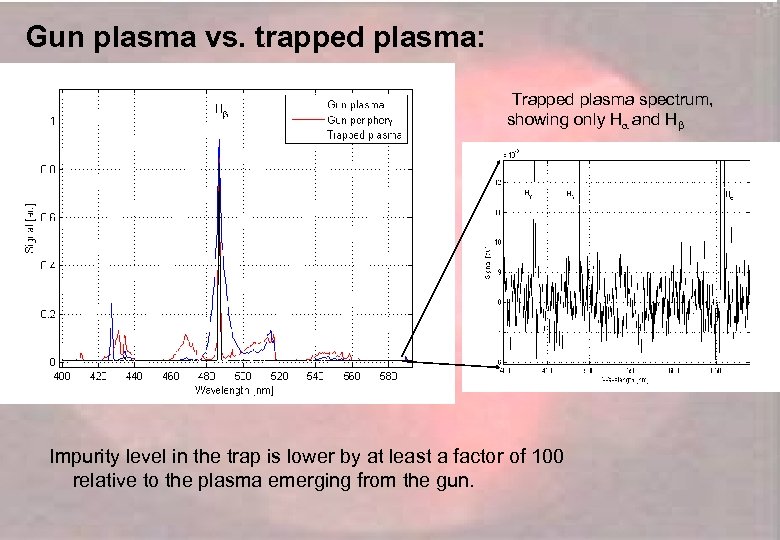 Gun plasma vs. trapped plasma: Trapped plasma spectrum, showing only H and H Impurity level in the trap is lower by at least a factor of 100 relative to the plasma emerging from the gun.
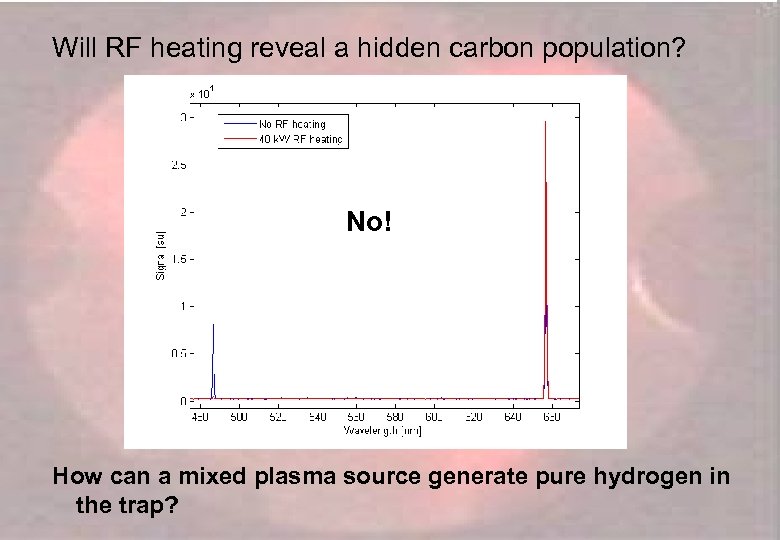 Will RF heating reveal a hidden carbon population? No! How can a mixed plasma source generate pure hydrogen in the trap?
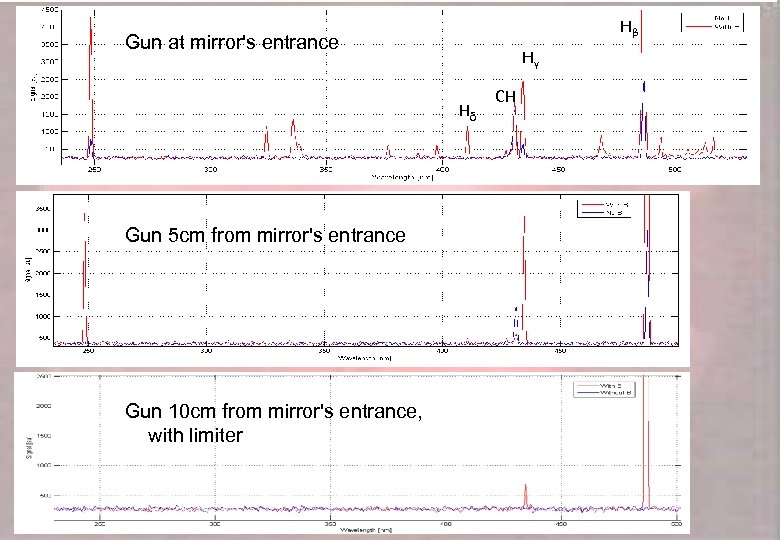 Hβ Gun at mirror's entrance Hγ Hδ Gun 5 cm from mirror's entrance Gun 10 cm from mirror's entrance, with limiter CH
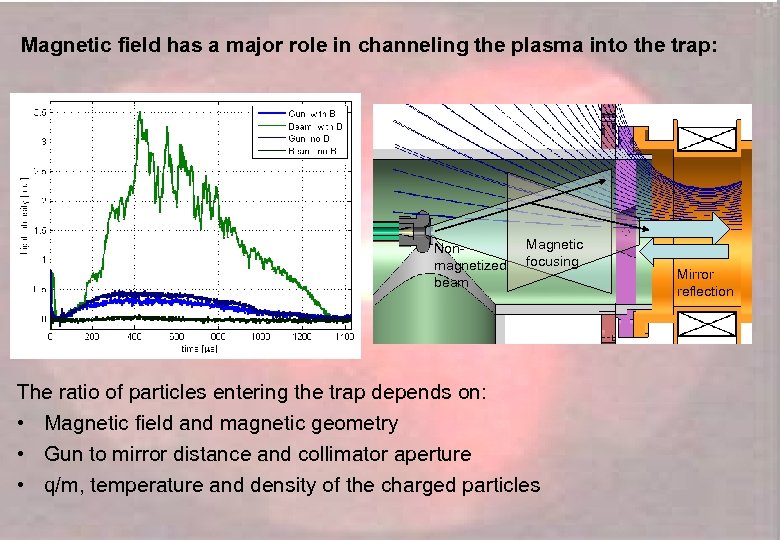 Magnetic field has a major role in channeling the plasma into the trap: Nonmagnetized beam Magnetic focusing The ratio of particles entering the trap depends on: • Magnetic field and magnetic geometry • Gun to mirror distance and collimator aperture • q/m, temperature and density of the charged particles Mirror reflection
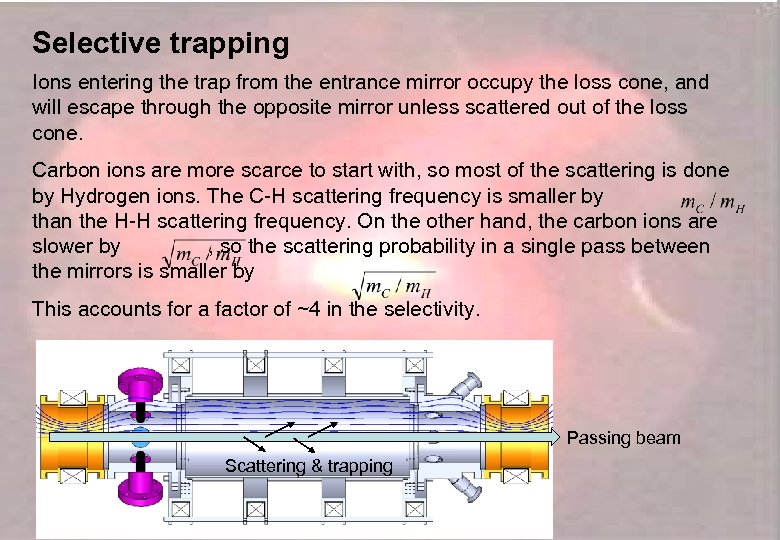 Selective trapping Ions entering the trap from the entrance mirror occupy the loss cone, and will escape through the opposite mirror unless scattered out of the loss cone. Carbon ions are more scarce to start with, so most of the scattering is done by Hydrogen ions. The C-H scattering frequency is smaller by than the H-H scattering frequency. On the other hand, the carbon ions are slower by , so the scattering probability in a single pass between the mirrors is smaller by This accounts for a factor of ~4 in the selectivity. Passing beam Scattering & trapping
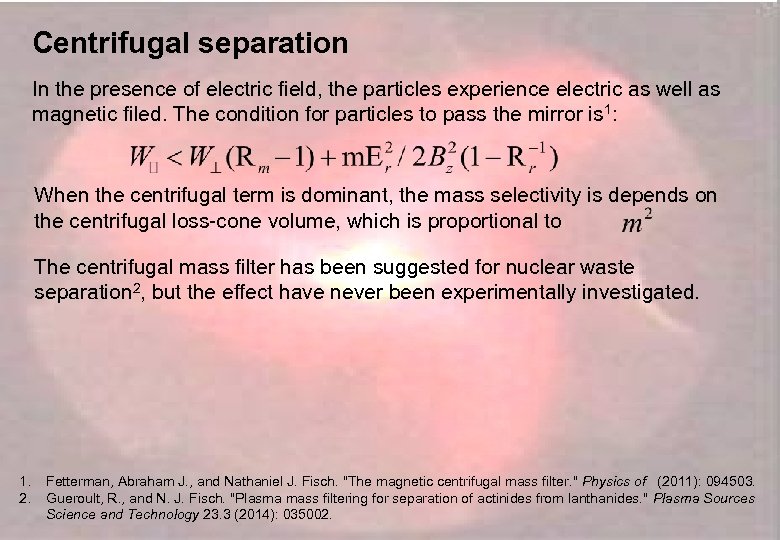 Centrifugal separation In the presence of electric field, the particles experience electric as well as magnetic filed. The condition for particles to pass the mirror is 1: When the centrifugal term is dominant, the mass selectivity is depends on the centrifugal loss-cone volume, which is proportional to The centrifugal mass filter has been suggested for nuclear waste separation 2, but the effect have never been experimentally investigated. 1. 2. Fetterman, Abraham J. , and Nathaniel J. Fisch. "The magnetic centrifugal mass filter. " Physics of (2011): 094503. Gueroult, R. , and N. J. Fisch. "Plasma mass filtering for separation of actinides from lanthanides. " Plasma Sources Science and Technology 23. 3 (2014): 035002.
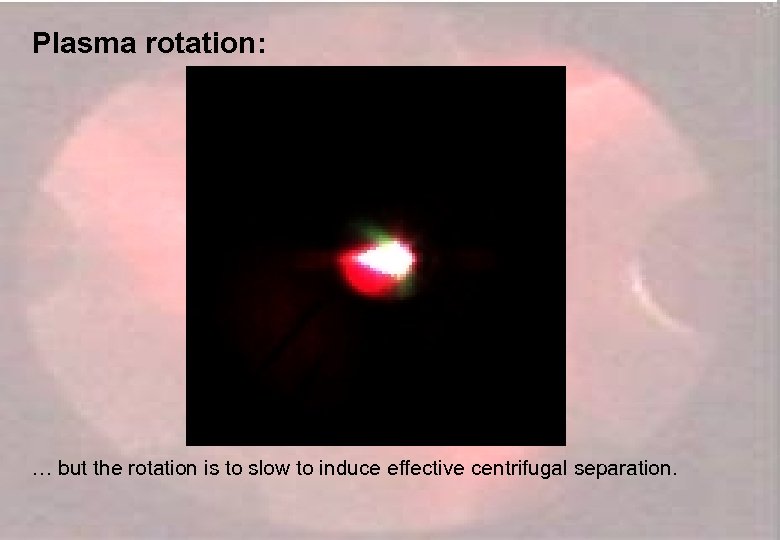 Plasma rotation: … but the rotation is to slow to induce effective centrifugal separation.
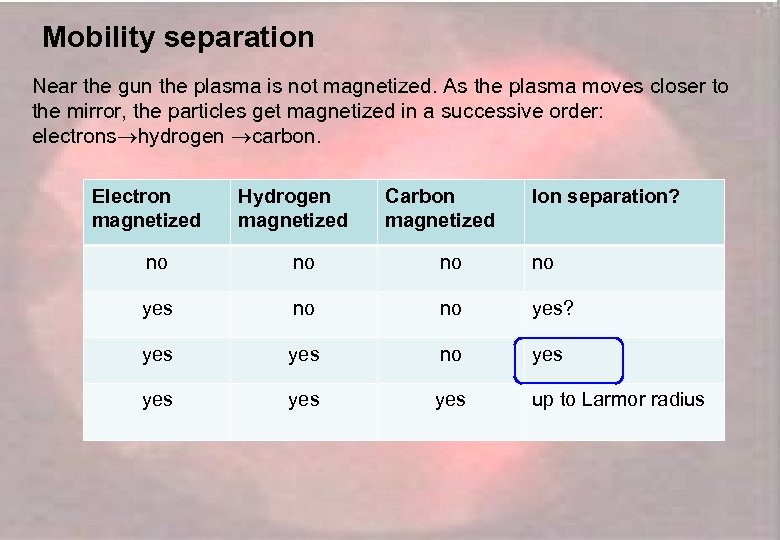 Mobility separation Near the gun the plasma is not magnetized. As the plasma moves closer to the mirror, the particles get magnetized in a successive order: electrons hydrogen carbon. Electron magnetized Hydrogen magnetized Carbon magnetized Ion separation? no no yes? yes no yes yes up to Larmor radius
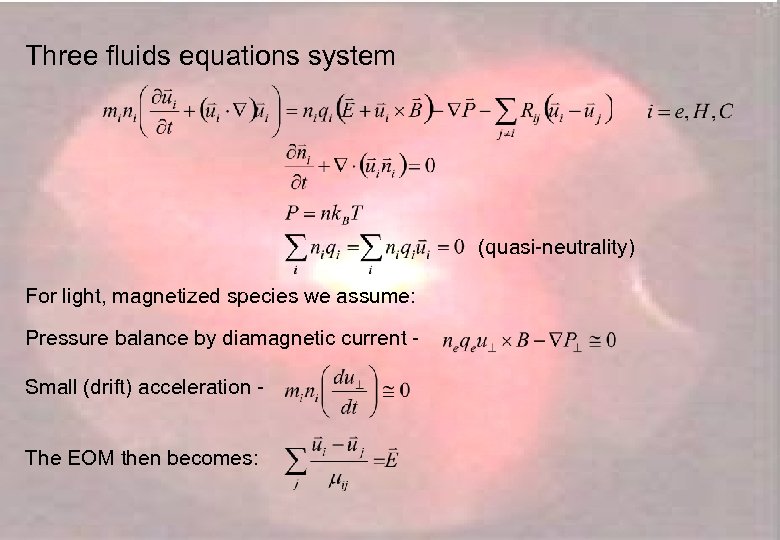 Three fluids equations system (quasi-neutrality) For light, magnetized species we assume: Pressure balance by diamagnetic current Small (drift) acceleration The EOM then becomes:
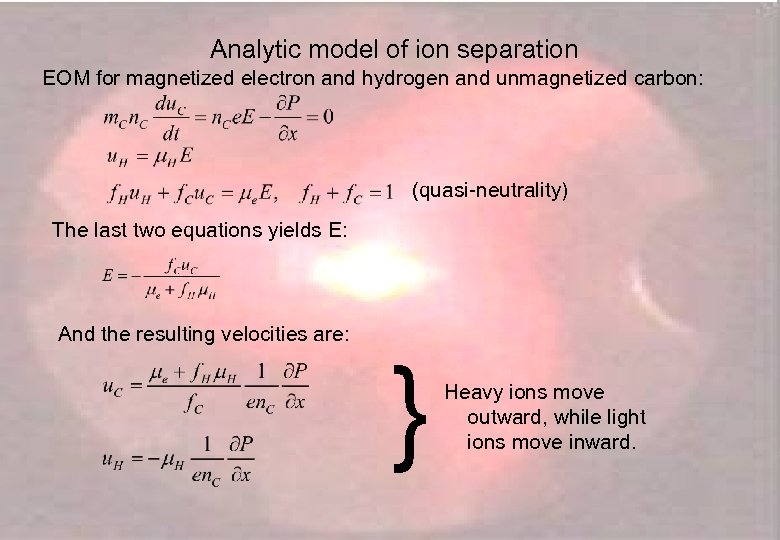 Analytic model of ion separation EOM for magnetized electron and hydrogen and unmagnetized carbon: (quasi-neutrality) The last two equations yields E: And the resulting velocities are: } Heavy ions move outward, while light ions move inward.
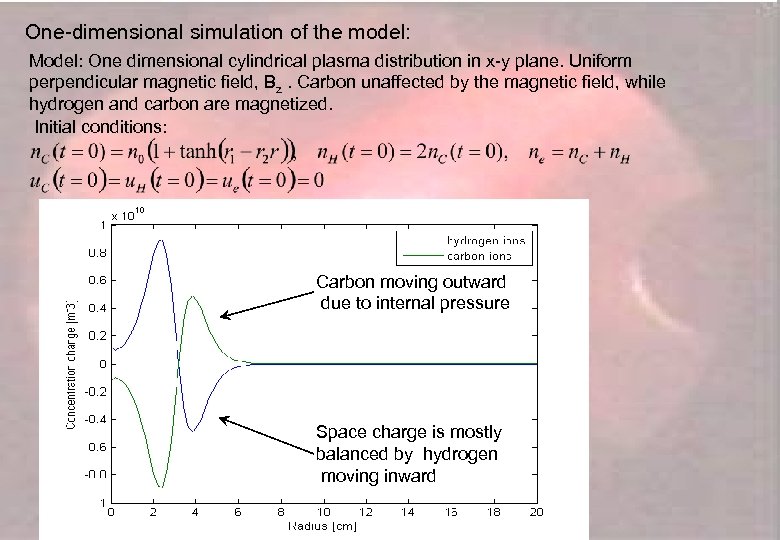 One-dimensional simulation of the model: Model: One dimensional cylindrical plasma distribution in x-y plane. Uniform perpendicular magnetic field, Bz. Carbon unaffected by the magnetic field, while hydrogen and carbon are magnetized. Initial conditions: Carbon moving outward due to internal pressure Space charge is mostly balanced by hydrogen moving inward
 Conclusions: • Vacuum arcs can be put into beneficial use: Ø • Several possible mechanism for ion separation: Ø Ø Ø • Very simple, fast and clean hydrogen plasma source. Selective trapping can explain ion separation ratio of up to 4. Centrifugal separation is non-relevant due to slow rotation. Simplified 3 -fluid model demonstrates ion separation in partly magnetized plasma. A more extensive calculation is under way to verify these results. Multi-species plasma can do funny things under electric and magnetic fields.
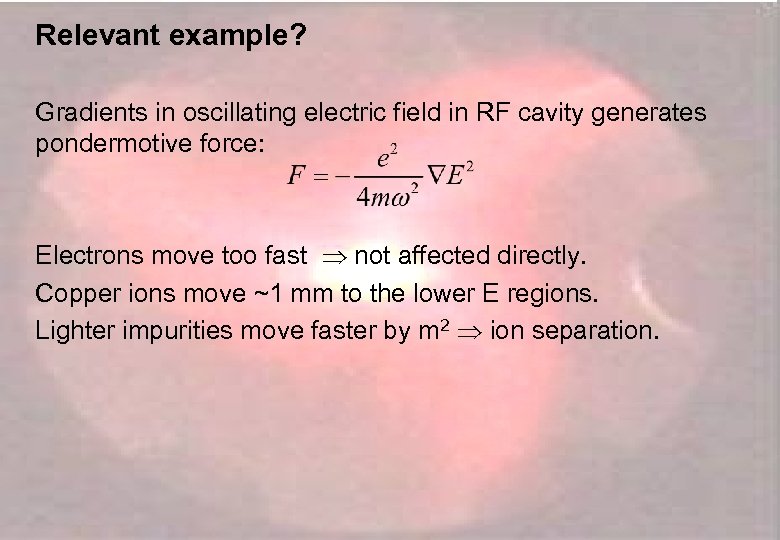 Relevant example? Gradients in oscillating electric field in RF cavity generates pondermotive force: Electrons move too fast not affected directly. Copper ions move ~1 mm to the lower E regions. Lighter impurities move faster by m 2 ion separation.