


 Скачать презентацию Selection of HCRW Treatment Technologies for Gauteng David
87aeaadda0a27145764f9bc17d11b9c5.ppt
- Количество слайдов: 22
 Selection of HCRW Treatment Technologies for Gauteng David A Baldwin, Ph. D, Pr. Sci. Nat. Environmental and Chemical Consultants cc and Torben Kristiansen Chief Technical Advisor. Gauteng Department of Agriculture, Conservation, Environment and Land Affairs Rambøll, Hanneman and Hojland August 2003 1
 Introduction Status Quo Study into HCRW in Gauteng – 2000: l Confirmed parlous state of HCRW management in Gauteng l Treatment facilities included 70 incinerators at 58 different locations l Only 58 were “operational” but only 25 had a permit l Many incinerators were poorly operated and maintained l Only one fitted with emission control equipment, which was not operational l Capital and operating costs were estimated at only R 1. 00 per kilogram of waste treated 2
 Introduction to Technologies -1 l Thermal treatment/combustion technologies: – Incineration which includes: l excess air, l controlled air, l rotary kiln and l fluidised bed – Plasma Arc and – Pyrolysis 3
 Introduction to Technologies -2 l Sterilisation/Disinfection Technologies, – Steam sterilisation, e. g. Autoclaving – Chemical sterilisation, e. g. with chlorine, glutaraldehyde – Gas sterilisation, e. g. with ethylene oxide, formaldehyde – Dry heat sterilisation, e. g. oil heated screw feed technology – Electro-thermal deactivation (ETD), – Microwave sterilisation, – Irradiation sterilisation l Cobalt-60 gamma rays l Ultra violet l Electron beam sterilisation 4
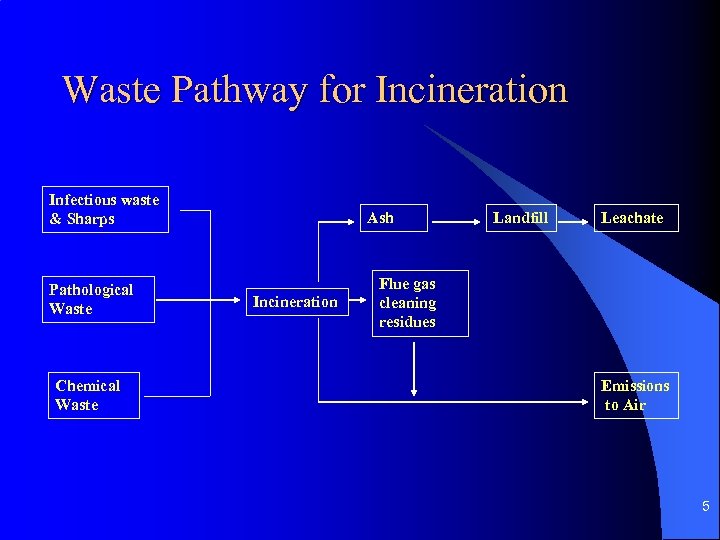 Waste Pathway for Incineration Infectious waste & Sharps Pathological Waste Chemical Waste Ash Incineration Landfill Leachate Flue gas cleaning residues Emissions to Air 5
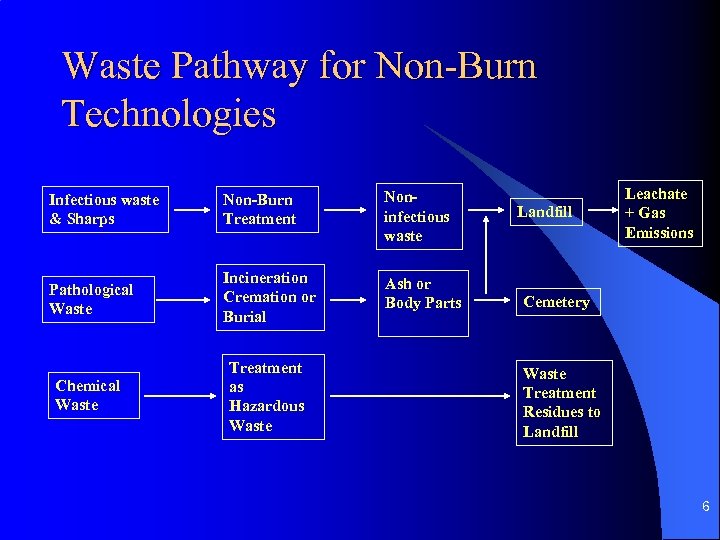 Waste Pathway for Non-Burn Technologies Infectious waste & Sharps Non-Burn Treatment Noninfectious waste Pathological Waste Incineration Cremation or Burial Ash or Body Parts Chemical Waste Treatment as Hazardous Waste Landfill Leachate + Gas Emissions Cemetery Waste Treatment Residues to Landfill 6
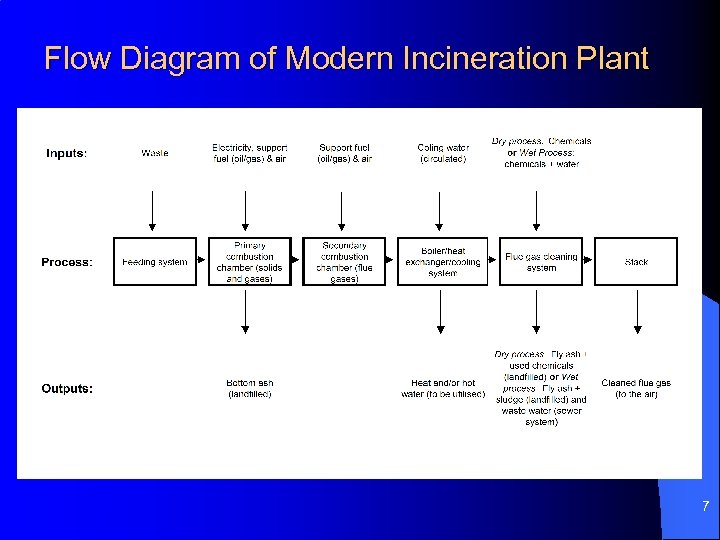 Flow Diagram of Modern Incineration Plant 7
 Advantages of Incineration l l l l Safe elimination of all infectious organisms in the waste at temperatures above ~700 o. C Flexible, as it can accept pathological waste and depending on the technology chemical waste. Residues are not recognisable Reduction of the waste by up to 95% by volume or 83 to 95% by mass: typically 5 -17% ash is obtained. Very well proven technology No pre-shredding required No special requirements for packaging of waste Full disinfection is assumed to have occurred provided the high temperatures are maintained and the ash quantity is adequate. No monitoring of sterilisation efficiency is required. 8
 Disadvantages of Incineration l l l l Normally higher investment costs required for incinerator and flue gas cleaning compared to non-burn technologies Point source immediate emissions to the air (as opposed to attenuated emission of CH 4 and CO 2 from landfill body over a period of decades) High cost of monitoring gas emissions and demonstrating compliance to emission standards. Solid and liquid by-products must be handled as potentially hazardous waste (may not apply to bottom ash if waste is well sorted and FGC residues handled separately) Incineration is perceived negatively by many sections of the community. PVC and heavy metals in the waste provide a significant pollutant load on the gas cleaning system and for heavy metals on the quality of bottom ash Existing health care risk waste incinerators in South Africa cannot accept significant amounts of chemical waste because of refractory damage. 9
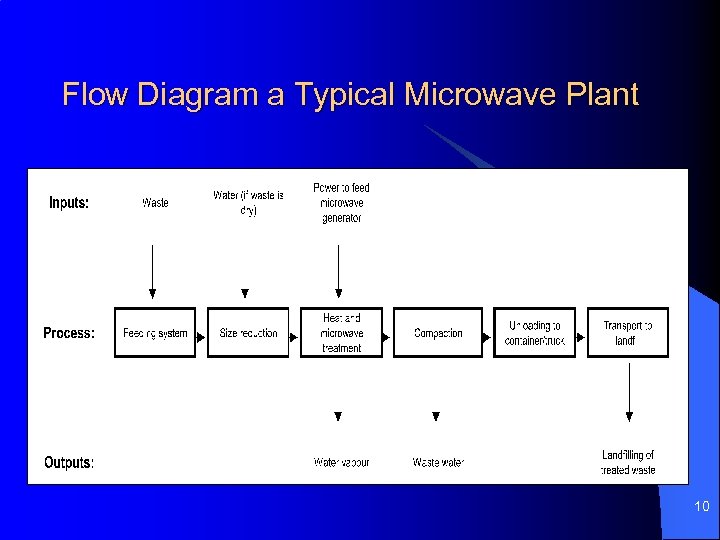 Flow Diagram a Typical Microwave Plant 10
 Advantages Non-Burn Technologies -1 Autoclaving, Microwaving ETD and DHS (Cross cutting) – High sterilisation efficiency under appropriate conditions – Low temperature of operation 90 o. C to 160 o. C – Volume reduction depending on type of shredding/compaction equipment that has been installed – Low risk of air pollution – Moderate operation costs – Easier to locate as generally more acceptable to communities and neighbours than incineration – Recovery technologies can be used on sterilised waste 11
 Advantages Non-Burn Technologies -2 l Autoclaving – Proven system that is familiar to health-care providers – Relatively High Sterilisation Temperature l Microwaving – Low capacity units are available for small waste producers e. g. clinics and GPs – Moderate investment costs – Low Sterilisation Temperature may lower energy costs l Electro-thermal Deactivation – Low Sterilisation Temperature may lower energy costs 12
 Disadvantages Non-Burn Technologies -1 Autoclaving, Microwaving ETD and DHS (Cross cutting) l Not suitable for pathological waste and chemical waste l Good waste segregation required l No or limited mass reduction l Shredders are subject to breakdowns and blocking and repairs are difficult when the waste is infectious. l It is not possible to visually determine that waste has been sterilised l Waste is not rendered unrecognisable or unusable, if not shredded l “High” monitoring costs to demonstrate compliance with sterilisation standards l Treated waste must be disposed to landfill l Air filtration is needed – some odour problems l Operation requires highly qualified technicians. l HEPA filters must be maintained and replaced regularly 13
 Disadvantages Non-Burn Technologies -2 l Autoclaving – Significant amounts of volatile organic carbon compounds produced – Contaminated water must be discharged to sewer – Waste and containers must have good steam permeability, especially if there is no prior shredding – No waste reduction l Microwaving – Unsuitable for very high quantities of infected metal (e. g. needles from inoculation campaigns) – Low sterilisation temperature increases time required for treatment. l Electro-thermal Deactivation – Relatively high investment and operating costs – Low sterilisation temperature increases time required for treatment. 14
 Cost Comparison of Selected HCRW Treatment Technologies - 1 Assumptions: l l l Salary costs include all normal contributions The cost for the establishment of a building in the estimated costs. A standard fixed amount for consultancy fees and other expenditure required to obtain an EIA authorisation, etc The cost of equipment was based on International/South African price levels for delivery in Gauteng. Incinerators include gas-cleaning equipment, i. e. lime treatment plus a ceramic filter. The cost of civil works and installation were based on Gauteng prices 15
 Cost Comparison of Selected HCRW Treatment Technologies - 2 l l Economic life of civil works and treatment technologies: 12 years Economic life of storage and transportation equipment: 10 years The following costs not included: – Infrastructure at the generators site, – Establishment of public utilities used, e. g. landfills – Cost of administration, invoicing, marketing etc. – Cost of training of operators – Cost of PPE/OSH programmes. – Value Added Tax. Depreciation costs are estimated as 10 years for equipment and 15 years for other capital and a real interest rate of 12% p. a. 16
 Cost Comparison of Selected HCRW Treatment Technologies - 3 l l l The operational hours for the plants were based on operation for 26 days per month and 12 months per year. However, the maximum operational hours were varied as follows: – Incinerators < 200 kg/hr: 12 hrs per day - manual de-ashing – Incinerators 200 kg/hr: 20 hours per day - automatic de-ashing – Non-burn Technologies: 24 hours per day The costs for disposal of residues, such as the ash and gas cleaning waste from incinerators, and sterilised the waste from non-burn technologies, were estimated using current disposal costs. Residues from non-burn are assumed deposited at normal landfill sites, whereas residues from incinerators are assumed deposited at a Hazardous Waste Landfill site. For non-burn technologies an estimate of the costs of disposal of pathological waste and chemical waste that could not be treated by the technology was included 17
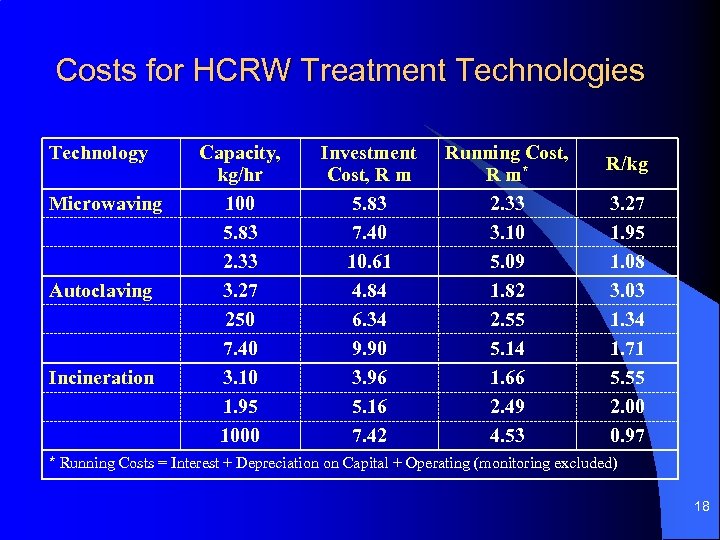 Costs for HCRW Treatment Technologies Technology Microwaving Autoclaving Incineration Capacity, kg/hr 100 5. 83 2. 33 3. 27 250 7. 40 3. 10 1. 95 1000 Investment Cost, R m 5. 83 7. 40 10. 61 4. 84 6. 34 9. 90 3. 96 5. 16 7. 42 Running Cost, R m* 2. 33 3. 10 5. 09 1. 82 2. 55 5. 14 1. 66 2. 49 4. 53 R/kg 3. 27 1. 95 1. 08 3. 03 1. 34 1. 71 5. 55 2. 00 0. 97 * Running Costs = Interest + Depreciation on Capital + Operating (monitoring excluded) 18
 Cost of HCRW Technologies l l l Treatment cost decreases dramatically as plant capacity increases For incineration, there is a discontinuity that occurs below 200 kg/hr due to the assumptions made The costs are based on operating the facility at its maximum capacity. According to the available data, microwaving is relatively expensive but the costs become comparable at higher loads. The investment costs for incineration appear to be relatively low compared to the other two technologies. 19
 Testing and Monitoring Incineration Plants - 1 Requirements: l Performance Testing – to conform to ROD l Standard Testing – at least over first year of operation l Minimum Programme – once prove conformance l Analysis Required: – Continuous Monitoring of PM, carbon monoxide, oxygen, water vapour, hydrochloric acid and sulphur dioxide – Dioxins: Performance x 1; Standard – 2/yr; Minimum – 1/yr – Metals: Performance x 1; Standard – 2/yr; Minimum – 1/yr – Loss on Ignition for Ash: Performance x 1; Standard and Minimum – 12/yr 20
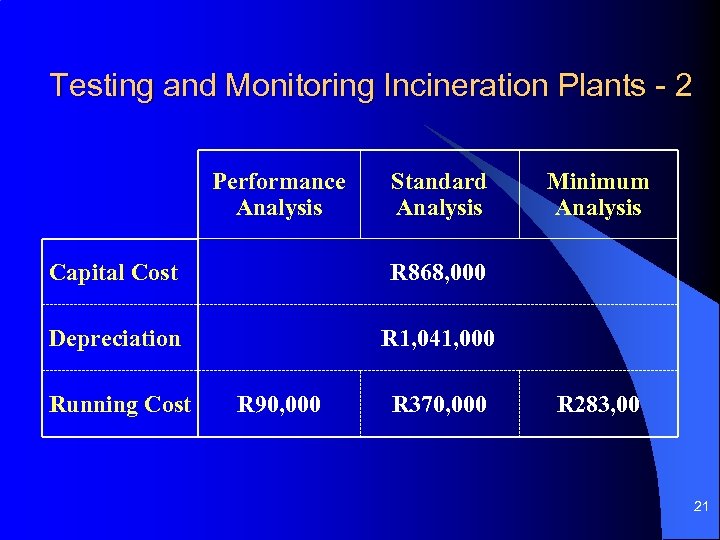 Testing and Monitoring Incineration Plants - 2 Performance Analysis Standard Analysis Capital Cost R 868, 000 Depreciation Minimum Analysis R 1, 041, 000 Running Cost R 90, 000 R 370, 000 R 283, 00 21
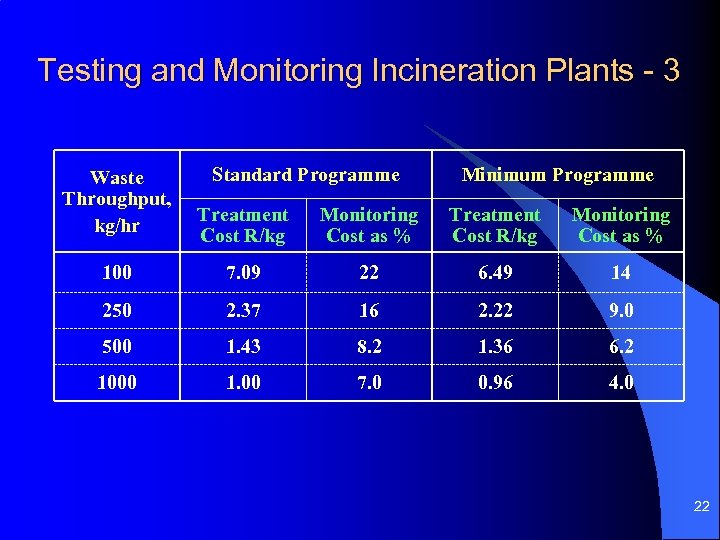 Testing and Monitoring Incineration Plants - 3 Waste Throughput, kg/hr Standard Programme Minimum Programme Treatment Cost R/kg Monitoring Cost as % 100 7. 09 22 6. 49 14 250 2. 37 16 2. 22 9. 0 500 1. 43 8. 2 1. 36 6. 2 1000 1. 00 7. 0 0. 96 4. 0 22