


 Скачать презентацию Selection of Differential Expression Genes in Microarray Experiments
829109414814955f6e8391bfcbc8e055.ppt
- Количество слайдов: 26
 Selection of Differential Expression Genes in Microarray Experiments James J. Chen, Ph. D. Division of Biometry and Risk Assessment National Center for Toxicological Research Food and Drug Administration e-mail: Jchen@nctr. fda. gov FDA/Industry Workshop September 19, 2003
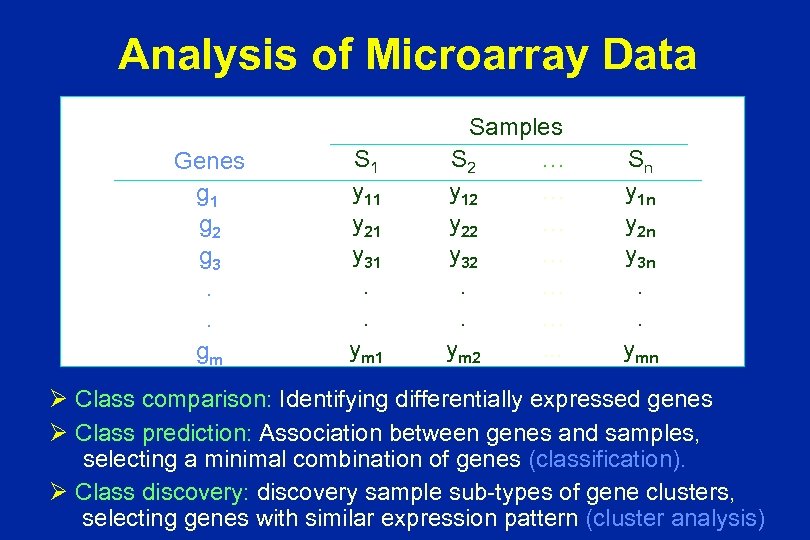 Analysis of Microarray Data Genes g 1 g 2 g 3. . gm S 1 y 11 y 21 y 31. . ym 1 Samples S 2 … y 12 … y 22 … y 32 …. …. … ym 2. . . Sn y 1 n y 2 n y 3 n. . ymn Ø Class comparison: Identifying differentially expressed genes Ø Class prediction: Association between genes and samples, selecting a minimal combination of genes (classification). Ø Class discovery: discovery sample sub-types of gene clusters, selecting genes with similar expression pattern (cluster analysis)
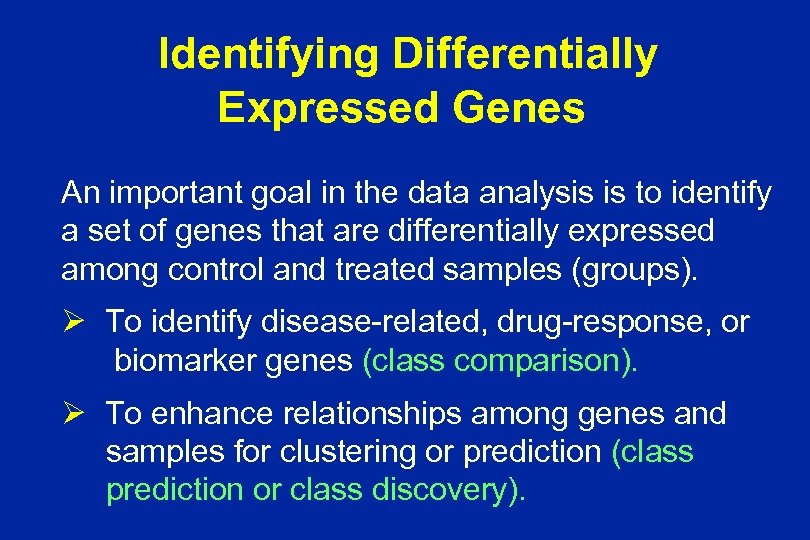 Identifying Differentially Expressed Genes An important goal in the data analysis is to identify a set of genes that are differentially expressed among control and treated samples (groups). Ø To identify disease-related, drug-response, or biomarker genes (class comparison). Ø To enhance relationships among genes and samples for clustering or prediction (class prediction or class discovery).
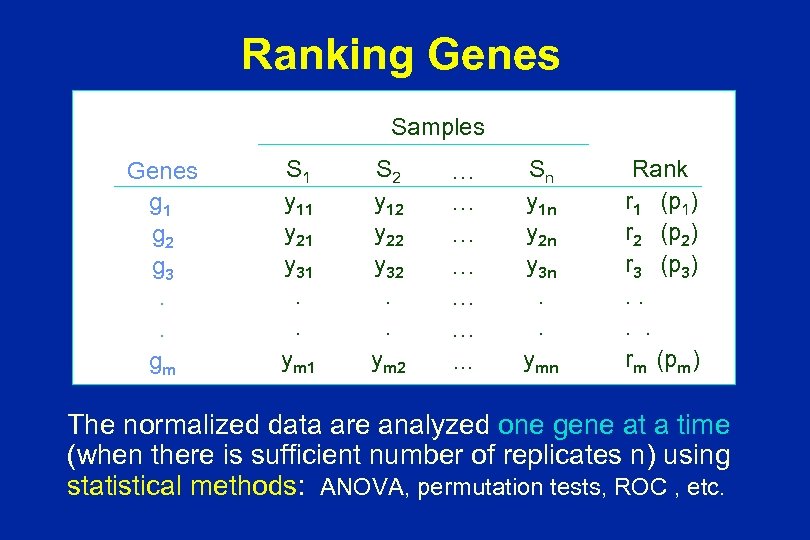 Ranking Genes Samples Genes g 1 g 2 g 3. . gm S 1 y 11 y 21 y 31. . ym 1 S 2 y 12 y 22 y 32. . ym 2 … … …. . . Sn y 1 n y 2 n y 3 n. . ymn Rank r 1 (p 1) r 2 (p 2) r 3 (p 3). . rm (pm) The normalized data are analyzed one gene at a time (when there is sufficient number of replicates n) using statistical methods: ANOVA, permutation tests, ROC , etc.
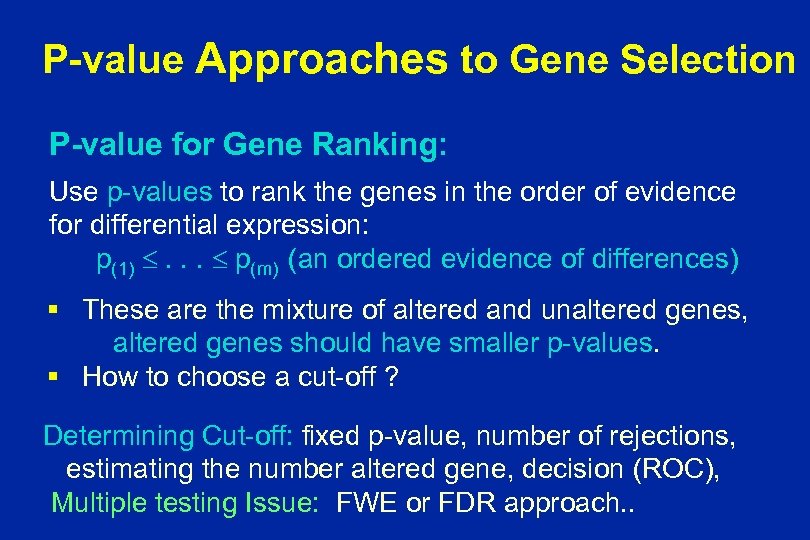 P-value Approaches to Gene Selection P-value for Gene Ranking: Use p-values to rank the genes in the order of evidence for differential expression: p(1) . . . p(m) (an ordered evidence of differences) § These are the mixture of altered and unaltered genes, altered genes should have smaller p-values. § How to choose a cut-off ? Determining Cut-off: fixed p-value, number of rejections, estimating the number altered gene, decision (ROC), Multiple testing Issue: FWE or FDR approach. .
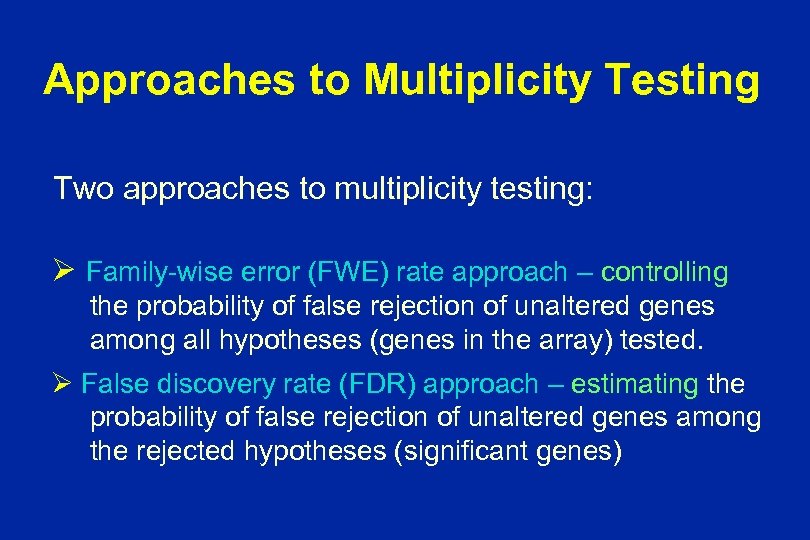 Approaches to Multiplicity Testing Two approaches to multiplicity testing: Ø Family-wise error (FWE) rate approach – controlling the probability of false rejection of unaltered genes among all hypotheses (genes in the array) tested. Ø False discovery rate (FDR) approach – estimating the probability of false rejection of unaltered genes among the rejected hypotheses (significant genes)
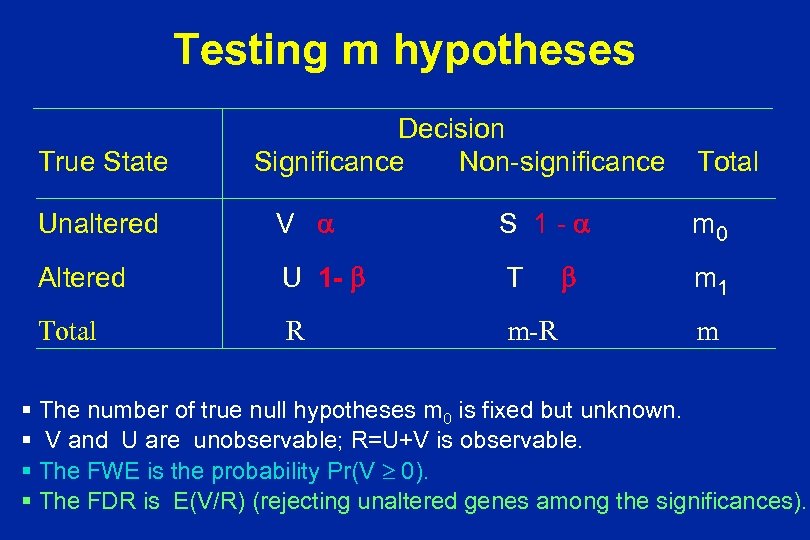 Testing m hypotheses True State Decision Significance Non-significance Unaltered V S 1 - Altered U 1 - T Total R m-R Total m 0 m 1 m § The number of true null hypotheses m 0 is fixed but unknown. § V and U are unobservable; R=U+V is observable. § The FWE is the probability Pr(V 0). § The FDR is E(V/R) (rejecting unaltered genes among the significances).
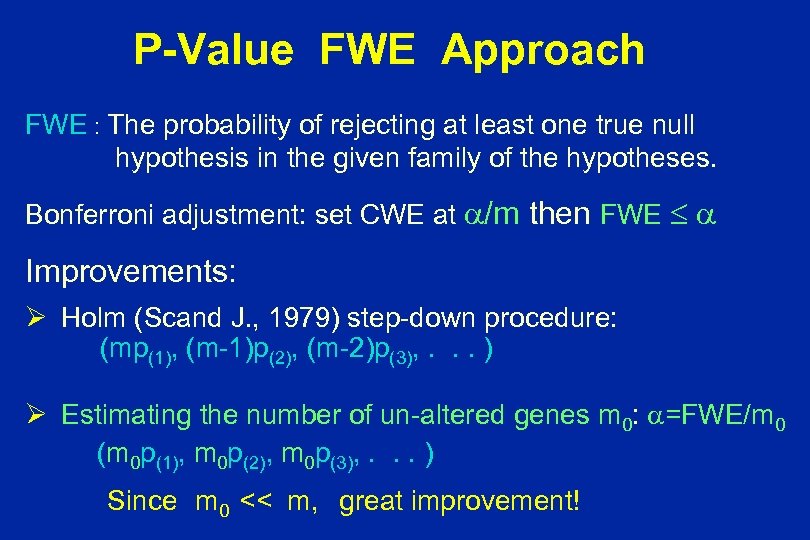 P-Value FWE Approach FWE : The probability of rejecting at least one true null hypothesis in the given family of the hypotheses. Bonferroni adjustment: set CWE at /m then FWE Improvements: Ø Holm (Scand J. , 1979) step-down procedure: (mp(1), (m-1)p(2), (m-2)p(3), . . . ) Ø Estimating the number of un-altered genes m 0: =FWE/m 0 (m 0 p(1), m 0 p(2), m 0 p(3), . . . ) Since m 0 << m, great improvement!
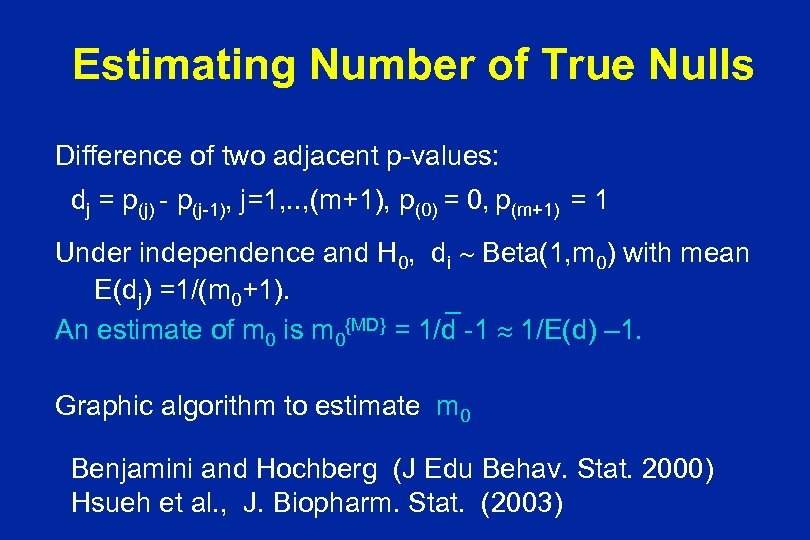 Estimating Number of True Nulls Difference of two adjacent p-values: dj = p(j) - p(j-1), j=1, . . , (m+1), p(0) = 0, p(m+1) = 1 Under independence and H 0, di Beta(1, m 0) with mean E(dj) =1/(m 0+1). _ An estimate of m 0 is m 0{MD} = 1/d -1 1/E(d) – 1. Graphic algorithm to estimate m 0 Benjamini and Hochberg (J Edu Behav. Stat. 2000) Hsueh et al. , J. Biopharm. Stat. (2003)
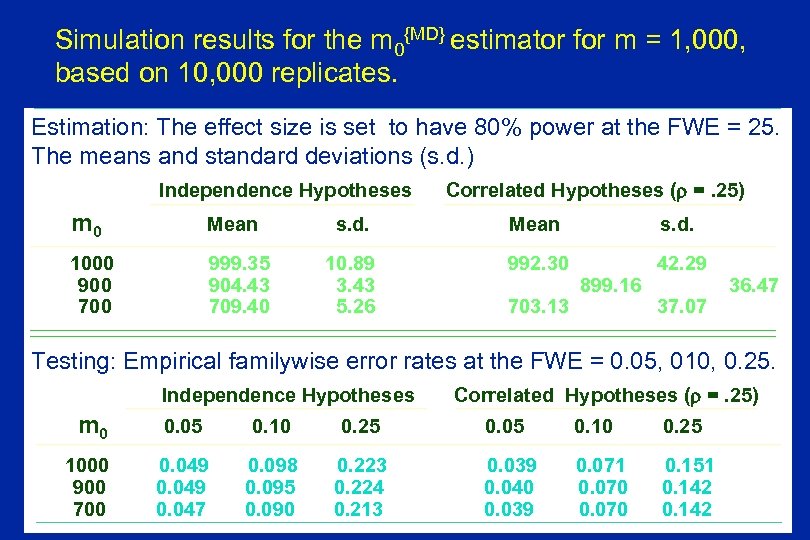 Simulation results for the m 0{MD} estimator for m = 1, 000, based on 10, 000 replicates. Estimation: The effect size is set to have 80% power at the FWE = 25. The means and standard deviations (s. d. ) Independence Hypotheses m 0 Mean 1000 900 700 999. 35 904. 43 709. 40 Correlated Hypotheses ( =. 25) s. d. Mean s. d. 10. 89 3. 43 5. 26 992. 30 42. 29 703. 13 899. 16 37. 07 36. 47 Testing: Empirical familywise error rates at the FWE = 0. 05, 010, 0. 25. Independence Hypotheses m 0 1000 900 700 Correlated Hypotheses ( =. 25) 0. 05 0. 10 0. 25 0. 049 0. 047 0. 098 0. 095 0. 090 0. 223 0. 224 0. 213 0. 039 0. 040 0. 039 0. 071 0. 070 0. 151 0. 142
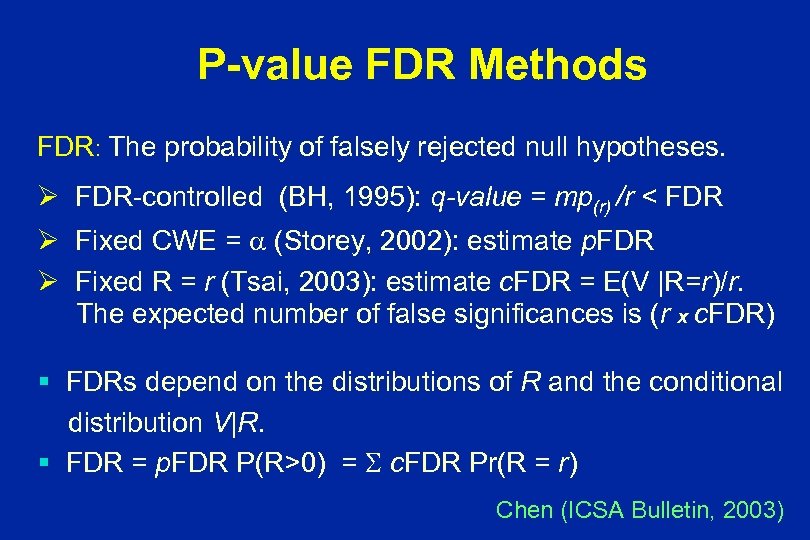 P-value FDR Methods FDR: The probability of falsely rejected null hypotheses. Ø FDR-controlled (BH, 1995): q-value = mp(r) /r < FDR Ø Fixed CWE = (Storey, 2002): estimate p. FDR Ø Fixed R = r (Tsai, 2003): estimate c. FDR = E(V |R=r)/r. The expected number of false significances is (r x c. FDR) § FDRs depend on the distributions of R and the conditional distribution V|R. § FDR = p. FDR P(R>0) = c. FDR Pr(R = r) Chen (ICSA Bulletin, 2003)
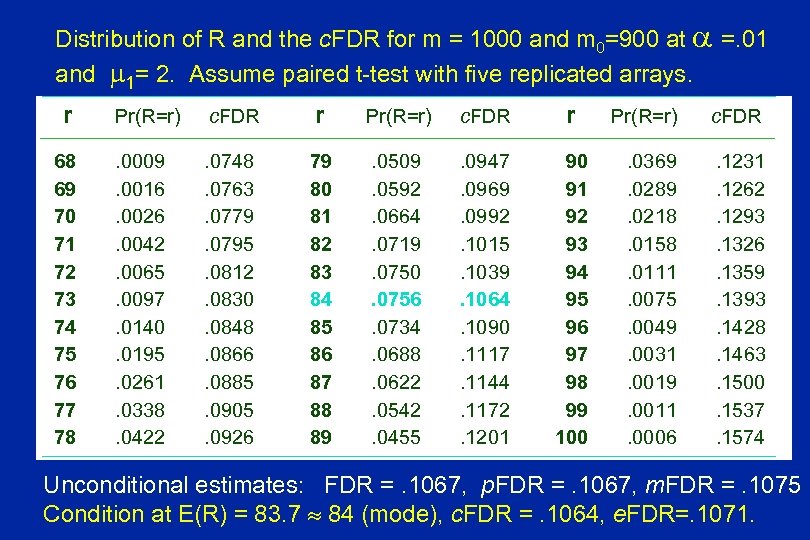 Distribution of R and the c. FDR for m = 1000 and m 0=900 at =. 01 and 1= 2. Assume paired t-test with five replicated arrays. r 68 69 70 71 72 73 74 75 76 77 78 Pr(R=r) c. FDR r . 0009. 0016. 0026. 0042. 0065. 0097. 0140. 0195. 0261. 0338. 0422 . 0748. 0763. 0779. 0795. 0812. 0830. 0848. 0866. 0885. 0905. 0926 79 80 81 82 83 84 85 86 87 88 89 . 0509. 0592. 0664. 0719. 0750. 0756. 0734. 0688. 0622. 0542. 0455 . 0947. 0969. 0992. 1015. 1039. 1064. 1090. 1117. 1144. 1172. 1201 90 91 92 93 94 95 96 97 98 99 100 Pr(R=r) c. FDR . 0369. 0289. 0218. 0158. 0111. 0075. 0049. 0031. 0019. 0011. 0006 . 1231. 1262. 1293. 1326. 1359. 1393. 1428. 1463. 1500. 1537. 1574 Unconditional estimates: FDR =. 1067, p. FDR =. 1067, m. FDR =. 1075 Condition at E(R) = 83. 7 84 (mode), c. FDR =. 1064, e. FDR=. 1071.
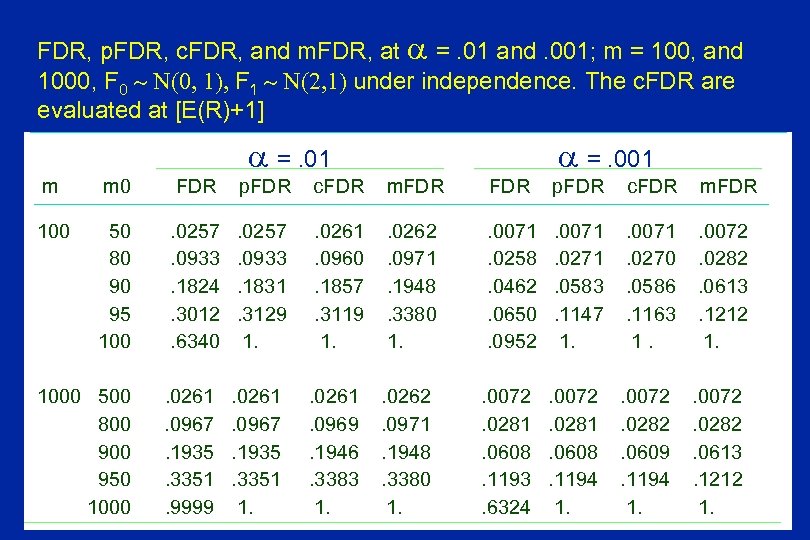 FDR, p. FDR, c. FDR, and m. FDR, at =. 01 and. 001; m = 100, and 1000, F 0 N(0, 1), F 1 N(2, 1) under independence. The c. FDR are evaluated at [E(R)+1] =. 01 =. 001 m m 0 FDR p. FDR c. FDR m. FDR 100 50 80 90 95 100 . 0257. 0933. 1824. 3012. 6340 . 0257. 0933. 1831. 3129 1. . 0261. 0960. 1857. 3119 1. . 0262. 0971. 1948. 3380 1. . 0071. 0258. 0462. 0650. 0952 . 0071. 0271. 0583. 1147 1. . 0071. 0270. 0586. 1163 1. . 0072. 0282. 0613. 1212 1. 1000 500 800 950 1000 . 0261. 0967. 1935. 3351. 9999 . 0261. 0967. 1935. 3351 1. . 0261. 0969. 1946. 3383 1. . 0262. 0971. 1948. 3380 1. . 0072. 0281. 0608. 1193. 6324 . 0072. 0281. 0608. 1194 1. . 0072. 0282. 0609. 1194 1. . 0072. 0282. 0613. 1212 1.
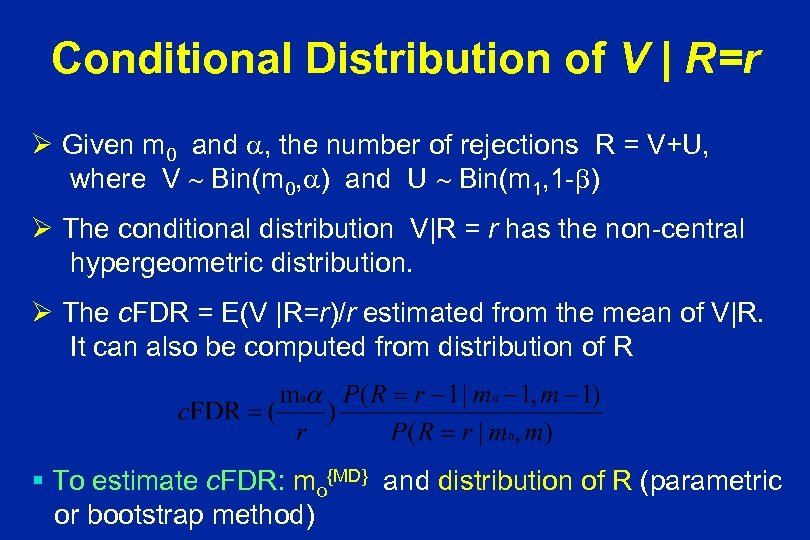 Conditional Distribution of V | R=r Ø Given m 0 and , the number of rejections R = V+U, where V Bin(m 0, ) and U Bin(m 1, 1 - ) Ø The conditional distribution V|R = r has the non-central hypergeometric distribution. Ø The c. FDR = E(V |R=r)/r estimated from the mean of V|R. It can also be computed from distribution of R § To estimate c. FDR: mo{MD} and distribution of R (parametric or bootstrap method)
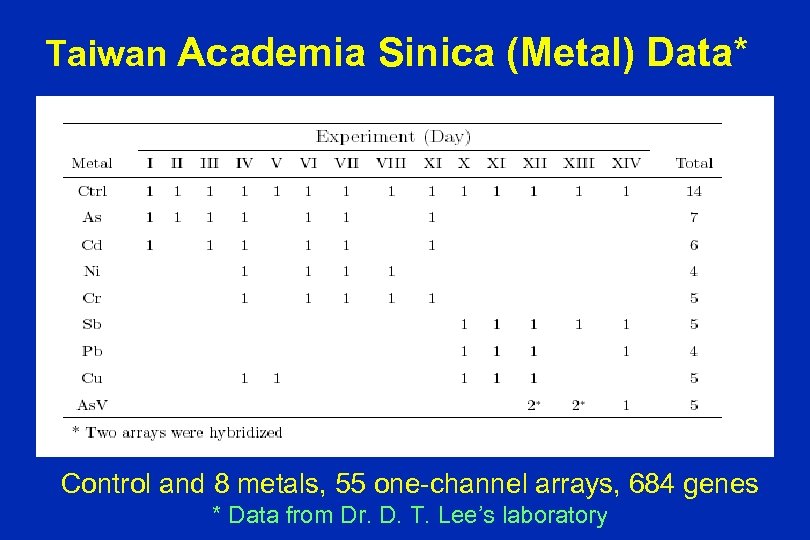 Taiwan Academia Sinica (Metal) Data* Control and 8 metals, 55 one-channel arrays, 684 genes * Data from Dr. D. T. Lee’s laboratory
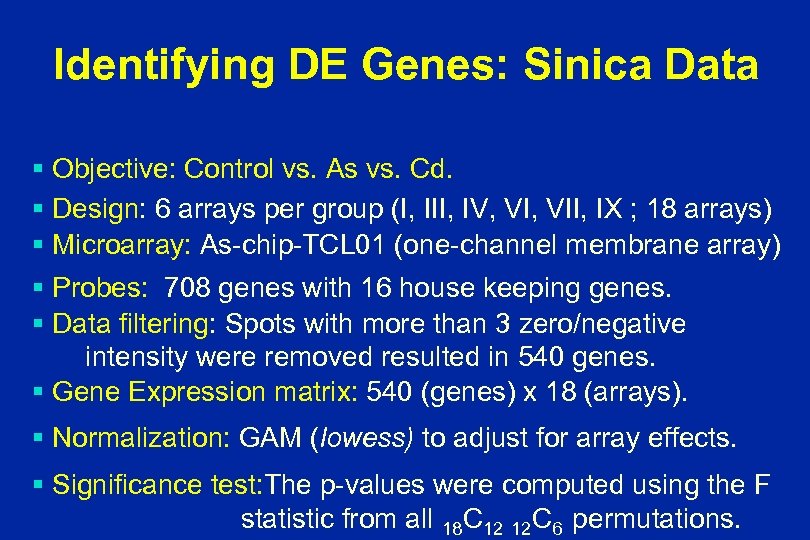 Identifying DE Genes: Sinica Data § Objective: Control vs. As vs. Cd. § Design: 6 arrays per group (I, III, IV, VII, IX ; 18 arrays) § Microarray: As-chip-TCL 01 (one-channel membrane array) § Probes: 708 genes with 16 house keeping genes. § Data filtering: Spots with more than 3 zero/negative intensity were removed resulted in 540 genes. § Gene Expression matrix: 540 (genes) x 18 (arrays). § Normalization: GAM (lowess) to adjust for array effects. § Significance test: The p-values were computed using the F statistic from all 18 C 12 12 C 6 permutations.
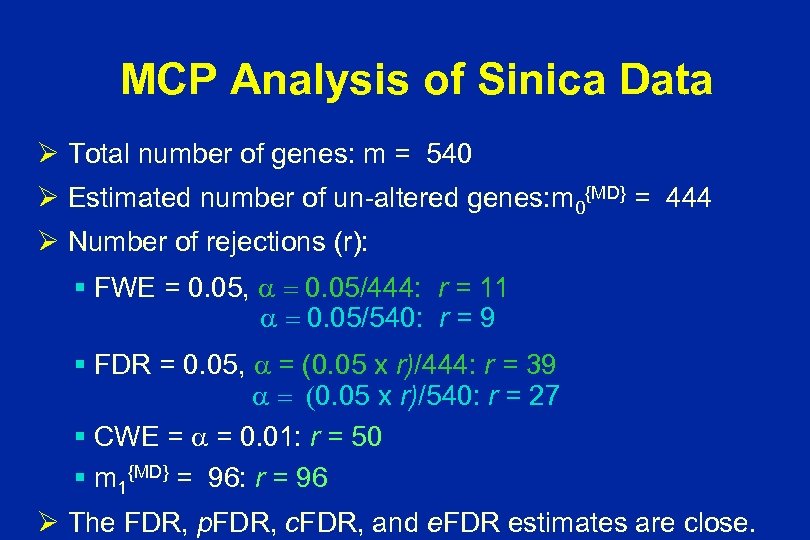 MCP Analysis of Sinica Data Ø Total number of genes: m = 540 Ø Estimated number of un-altered genes: m 0{MD} = 444 Ø Number of rejections (r): § FWE = 0. 05, = 0. 05/444: r = 11 = 0. 05/540: r = 9 § FDR = 0. 05, = (0. 05 x r)/444: r = 39 = (0. 05 x r)/540: r = 27 § CWE = = 0. 01: r = 50 § m 1{MD} = 96: r = 96 Ø The FDR, p. FDR, c. FDR, and e. FDR estimates are close.
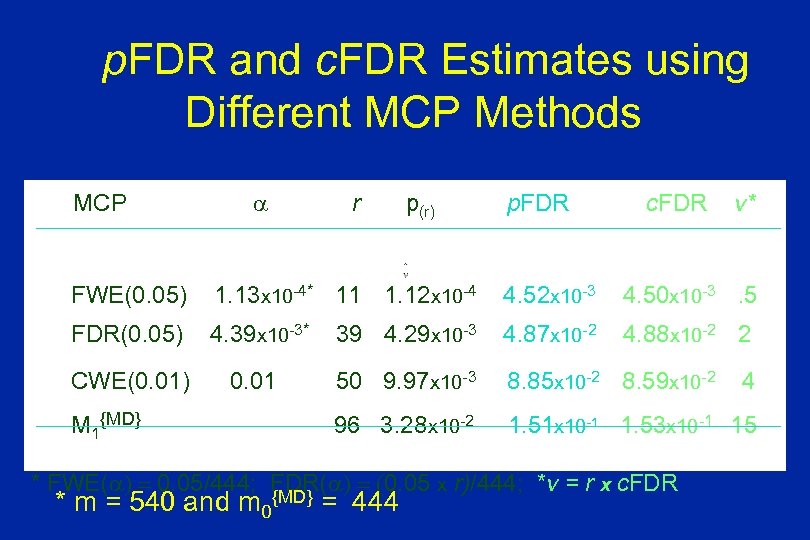 p. FDR and c. FDR Estimates using Different MCP Methods MCP r p(r) p. FDR c. FDR v* FWE(0. 05) 1. 13 x 10 -4* 11 1. 12 x 10 -4 4. 52 x 10 -3 4. 50 x 10 -3. 5 FDR(0. 05) 4. 39 x 10 -3* 39 4. 29 x 10 -3 4. 87 x 10 -2 4. 88 x 10 -2 2 CWE(0. 01) 0. 01 50 9. 97 x 10 -3 8. 85 x 10 -2 8. 59 x 10 -2 96 3. 28 x 10 -2 1. 51 x 10 -1 1. 53 x 10 -1 15 M 1{MD} * FWE( ) = 0. 05/444; FDR( ) = (0. 05 x r)/444; *v = r x c. FDR {MD} * m = 540 and m 0 = 444 4
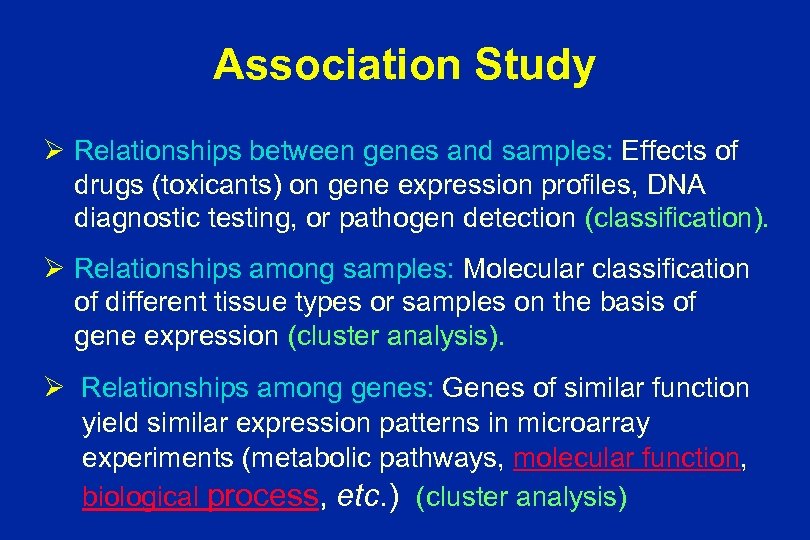 Association Study Ø Relationships between genes and samples: Effects of drugs (toxicants) on gene expression profiles, DNA diagnostic testing, or pathogen detection (classification). Ø Relationships among samples: Molecular classification of different tissue types or samples on the basis of gene expression (cluster analysis). Ø Relationships among genes: Genes of similar function yield similar expression patterns in microarray experiments (metabolic pathways, molecular function, biological process, etc. ) (cluster analysis)
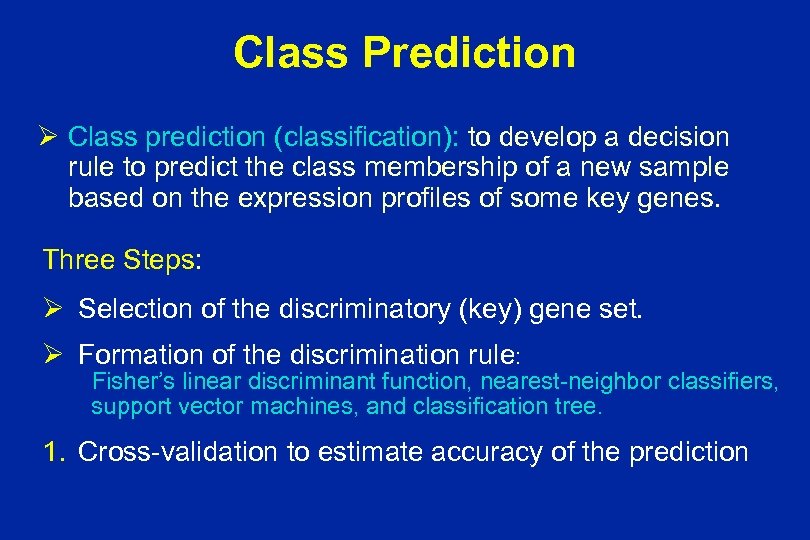 Class Prediction Ø Class prediction (classification): to develop a decision rule to predict the class membership of a new sample based on the expression profiles of some key genes. Three Steps: Ø Selection of the discriminatory (key) gene set. Ø Formation of the discrimination rule: Fisher’s linear discriminant function, nearest-neighbor classifiers, support vector machines, and classification tree. 1. Cross-validation to estimate accuracy of the prediction
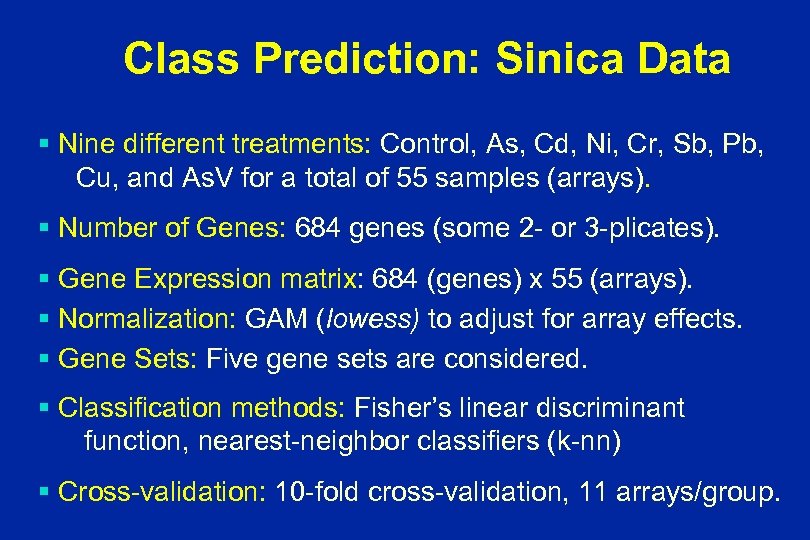 Class Prediction: Sinica Data § Nine different treatments: Control, As, Cd, Ni, Cr, Sb, Pb, Cu, and As. V for a total of 55 samples (arrays). § Number of Genes: 684 genes (some 2 - or 3 -plicates). § Gene Expression matrix: 684 (genes) x 55 (arrays). § Normalization: GAM (lowess) to adjust for array effects. § Gene Sets: Five gene sets are considered. § Classification methods: Fisher’s linear discriminant function, nearest-neighbor classifiers (k-nn) § Cross-validation: 10 -fold cross-validation, 11 arrays/group.
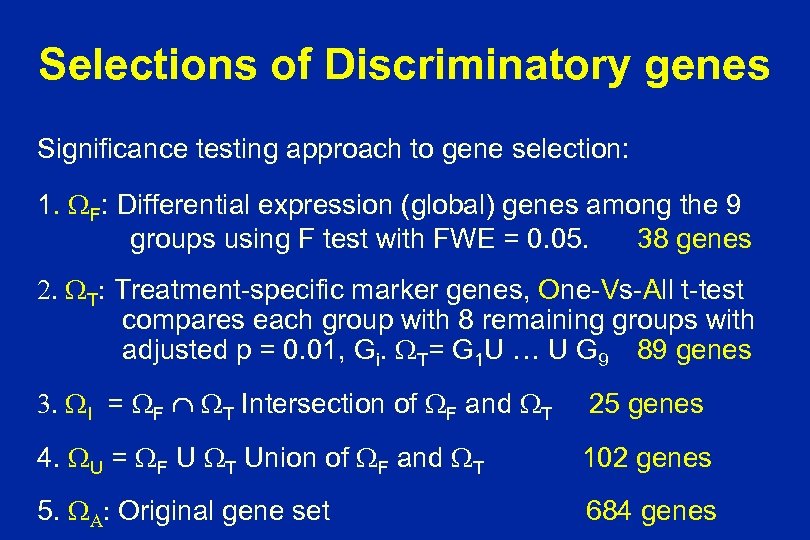 Selections of Discriminatory genes Significance testing approach to gene selection: 1. WF: Differential expression (global) genes among the 9 groups using F test with FWE = 0. 05. 38 genes 2. WT: Treatment-specific marker genes, One-Vs-All t-test compares each group with 8 remaining groups with adjusted p = 0. 01, Gi. WT= G 1 U … U G 9 89 genes 3. WI = WF WT Intersection of WF and WT 25 genes 4. WU = WF U WT Union of WF and WT 102 genes 5. WA: Original gene set 684 genes
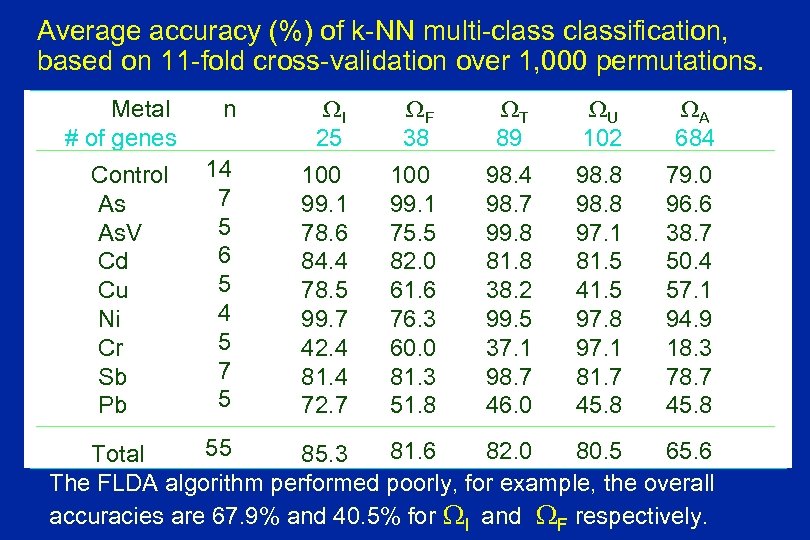 Average accuracy (%) of k-NN multi-classification, based on 11 -fold cross-validation over 1, 000 permutations. Metal # of genes Control As As. V Cd Cu Ni Cr Sb Pb n WI 25 WF 38 WT 89 WU 102 WA 684 14 7 5 6 5 4 5 7 5 100 99. 1 78. 6 84. 4 78. 5 99. 7 42. 4 81. 4 72. 7 100 99. 1 75. 5 82. 0 61. 6 76. 3 60. 0 81. 3 51. 8 98. 4 98. 7 99. 8 81. 8 38. 2 99. 5 37. 1 98. 7 46. 0 98. 8 97. 1 81. 5 41. 5 97. 8 97. 1 81. 7 45. 8 79. 0 96. 6 38. 7 50. 4 57. 1 94. 9 18. 3 78. 7 45. 8 55 81. 6 82. 0 80. 5 65. 6 Total 85. 3 The FLDA algorithm performed poorly, for example, the overall accuracies are 67. 9% and 40. 5% for WI and WF respectively.
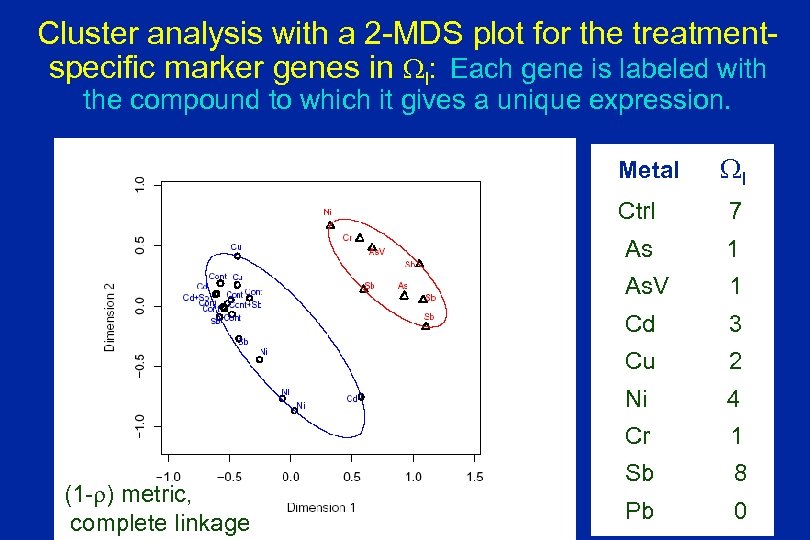 Cluster analysis with a 2 -MDS plot for the treatmentspecific marker genes in WI: Each gene is labeled with the compound to which it gives a unique expression. Metal WI Ctrl As 1 As. V 1 Cd 3 Cu 2 Ni 4 Cr (1 -r) metric, complete linkage 7 1 Sb 8 Pb 0
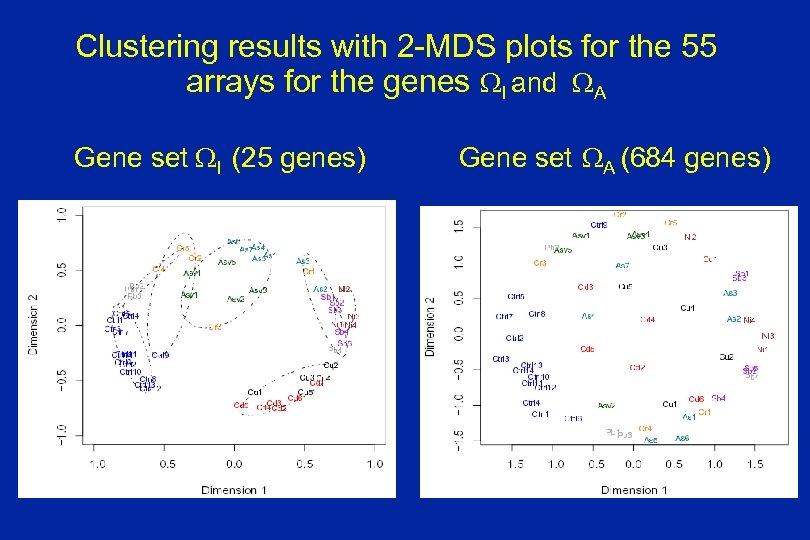 Clustering results with 2 -MDS plots for the 55 arrays for the genes WI and WA Gene set WI (25 genes) Gene set WA (684 genes)
 Acknowledgements Collaborators and Contributors § Dr. Frank Sistare & Staff § Dr. Sue-Jane Wang § Dr. T-C Lee & Staff § Dr. C-h Chen & Staff (CDER/FDA; Merck) (CDER/FDA) (Academia Sinica, Taiwan) § Dr. Suzanne Morris & Staff § Dr. Jim Fuscoe & Staff § Dr. Ralph Kodell § Dr. Robert Delongchamp (NCTR) (NCTR) § Dr. Hueymiin Hsueh § Dr. Chen-an Tsai § Ms. Yi-Ju Chen (Cheng-chi Univ. , Taiwan) (NCTR) (Pen State, NCTR)