Скачать презентацию Selection Decisions Using Economically Relevant Traits The Pathway
065a98832f0a34822b89afb7b0e72e65.ppt
- Количество слайдов: 48
 Selection Decisions Using Economically Relevant Traits: The Pathway to Indexes B. L. Golden 1 California Polytechnic State University, San Luis Obispo
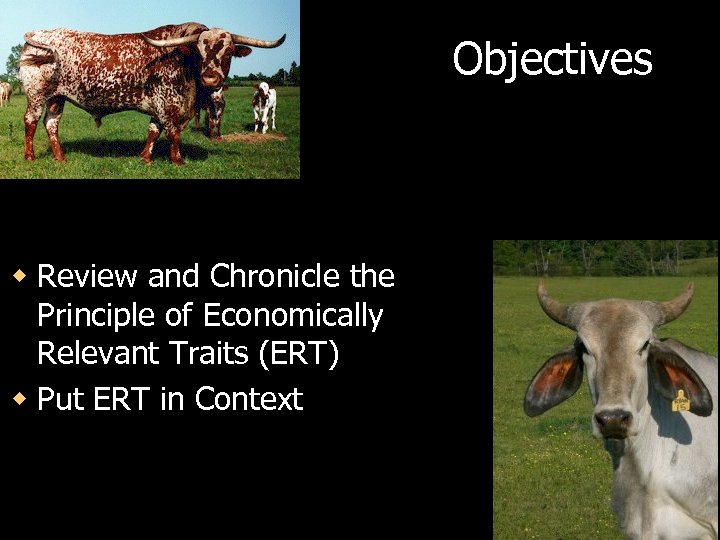 Objectives w Review and Chronicle the Principle of Economically Relevant Traits (ERT) w Put ERT in Context
 Ancient History
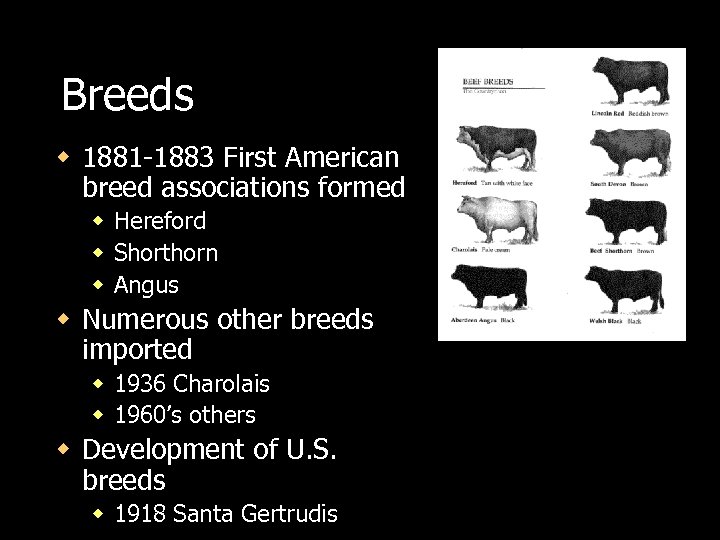 Breeds w 1881 -1883 First American breed associations formed w Hereford w Shorthorn w Angus w Numerous other breeds imported w 1936 Charolais w 1960’s others w Development of U. S. breeds w 1918 Santa Gertrudis
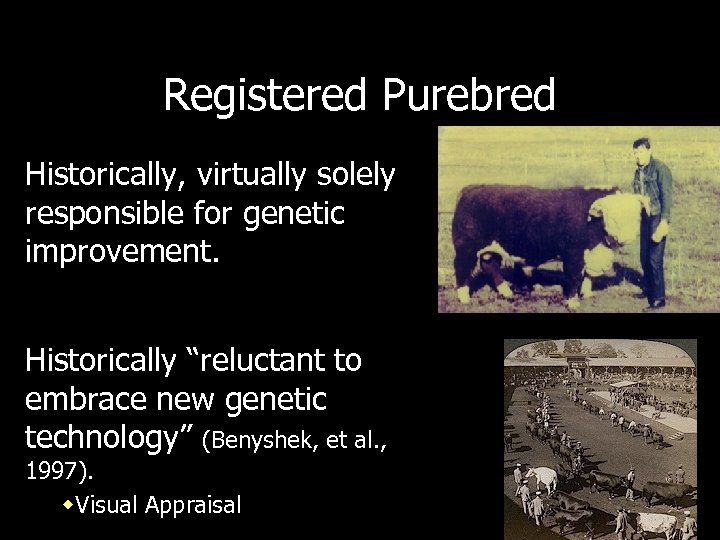 Registered Purebred Historically, virtually solely responsible for genetic improvement. Historically “reluctant to embrace new genetic technology” (Benyshek, et al. , 1997). w. Visual Appraisal
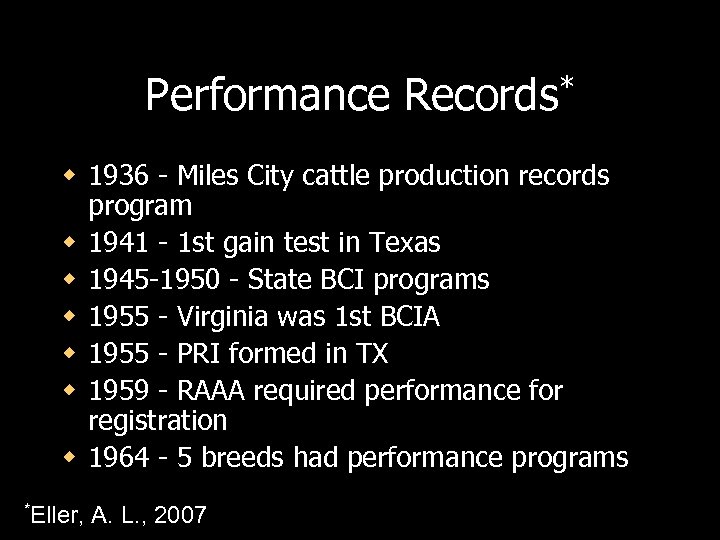 Performance Records* w 1936 - Miles City cattle production records program w 1941 - 1 st gain test in Texas w 1945 -1950 - State BCI programs w 1955 - Virginia was 1 st BCIA w 1955 - PRI formed in TX w 1959 - RAAA required performance for registration w 1964 - 5 breeds had performance programs *Eller, A. L. , 2007
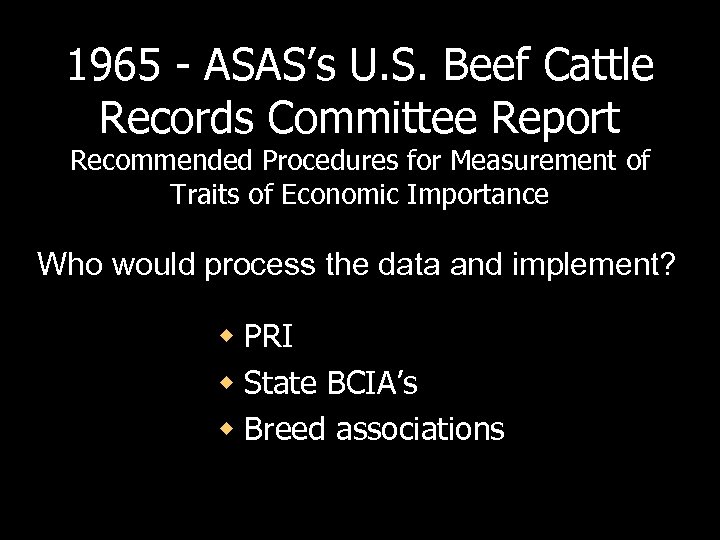 1965 - ASAS’s U. S. Beef Cattle Records Committee Report Recommended Procedures for Measurement of Traits of Economic Importance Who would process the data and implement? w PRI w State BCIA’s w Breed associations
 1968 1972 - 1 st BIF Guidlines
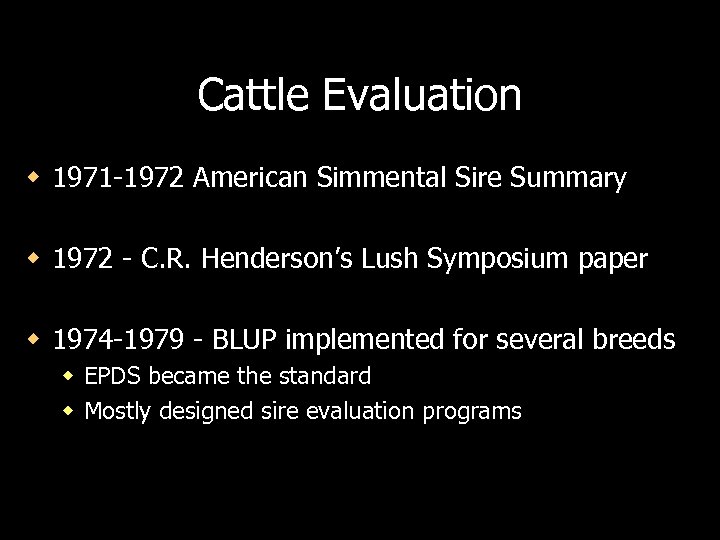 Cattle Evaluation w 1971 -1972 American Simmental Sire Summary w 1972 - C. R. Henderson’s Lush Symposium paper w 1974 -1979 - BLUP implemented for several breeds w EPDS became the standard w Mostly designed sire evaluation programs
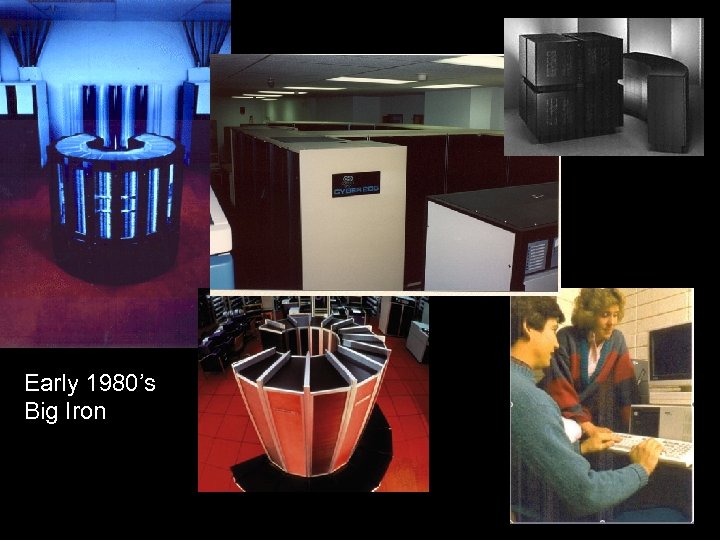
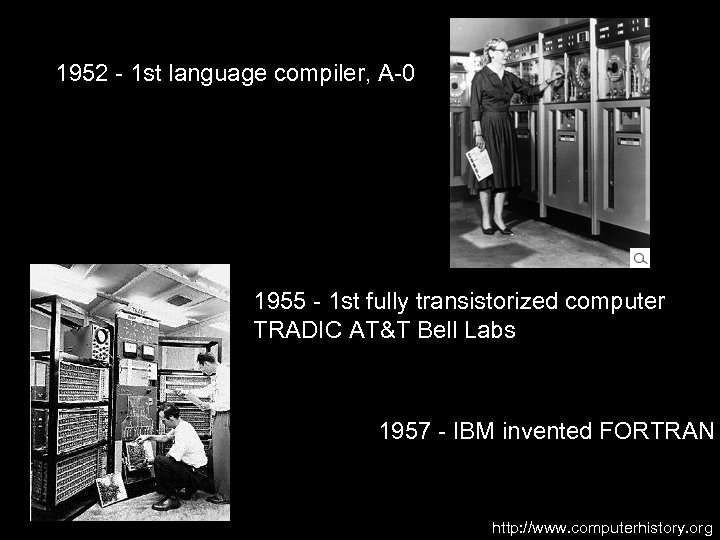 1952 - 1 st language compiler, A-0 1955 - 1 st fully transistorized computer TRADIC AT&T Bell Labs 1957 - IBM invented FORTRAN http: //www. computerhistory. org
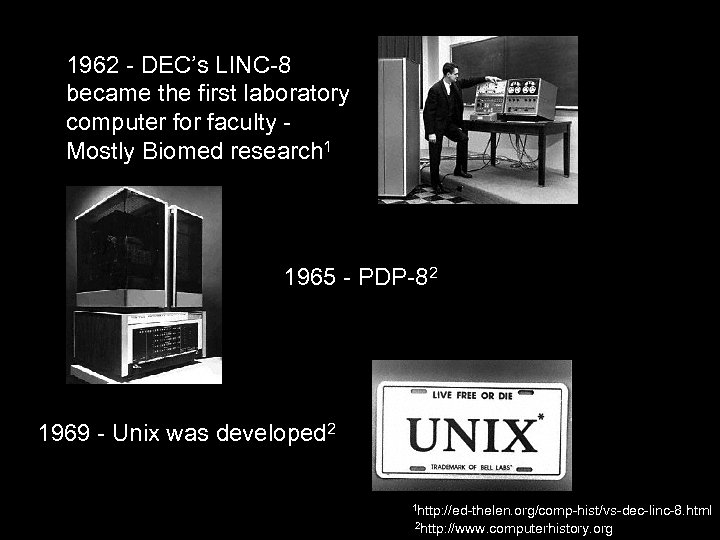 1962 - DEC’s LINC-8 became the first laboratory computer for faculty Mostly Biomed research 1 1965 - PDP-82 1969 - Unix was developed 2 1 http: //ed-thelen. org/comp-hist/vs-dec-linc-8. html 2 http: //www. computerhistory. org
 Modern History
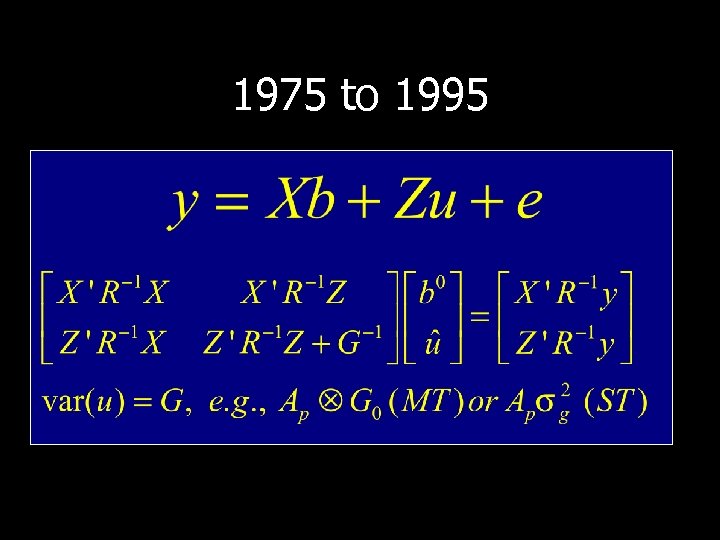
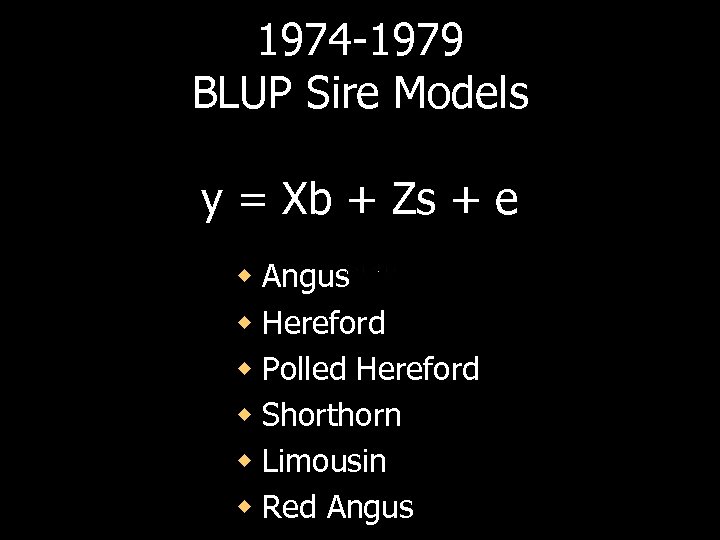 1974 -1979 BLUP Sire Models y = Xb + Zs + e w Angus w Hereford w Polled Hereford w Shorthorn w Limousin w Red Angus
 1975 to 1995
 Early 1980’s Big Iron
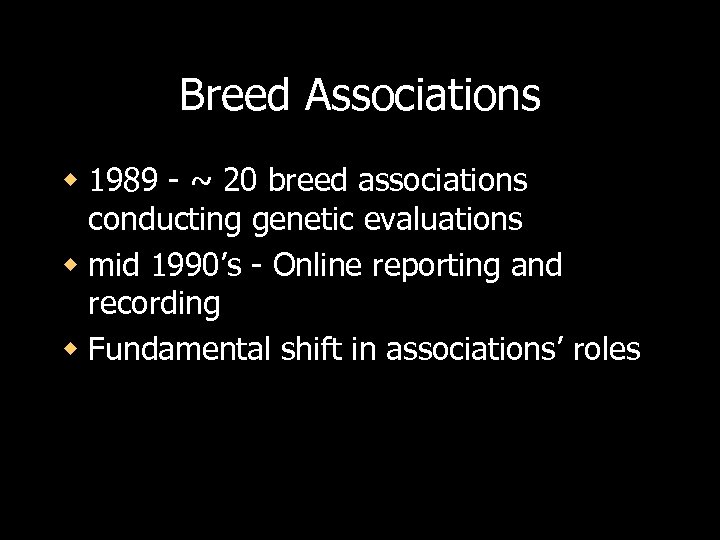 Breed Associations w 1989 - ~ 20 breed associations conducting genetic evaluations w mid 1990’s - Online reporting and recording w Fundamental shift in associations’ roles
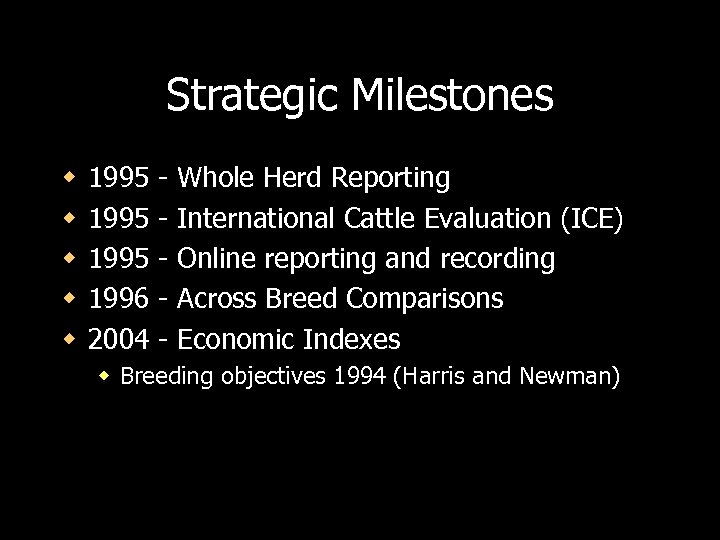 Strategic Milestones w w w 1995 1996 2004 - Whole Herd Reporting International Cattle Evaluation (ICE) Online reporting and recording Across Breed Comparisons Economic Indexes w Breeding objectives 1994 (Harris and Newman)
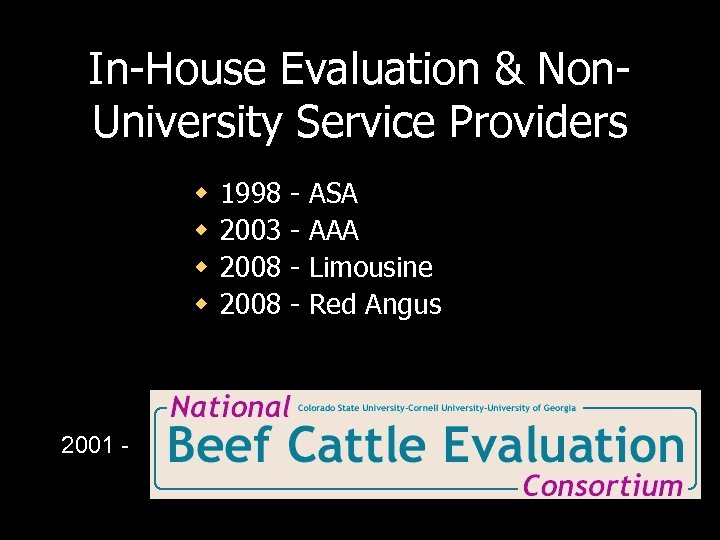 In-House Evaluation & Non. University Service Providers w w 2001 - 1998 2003 2008 - ASA AAA Limousine Red Angus
 Other Technological Milestones w More models w Algorithms w Approaches
 Molecular Information
 More Traits w w w w w 1983(? ) - Maternal milk 1985 - Calving ease 1986 - Gestation length ? Scrotal Circumference 1990 - Carcass traits 1993 - Docility 1995 - Stayability 1997 - Heifer pregnancy 2003 Maintenance energy …
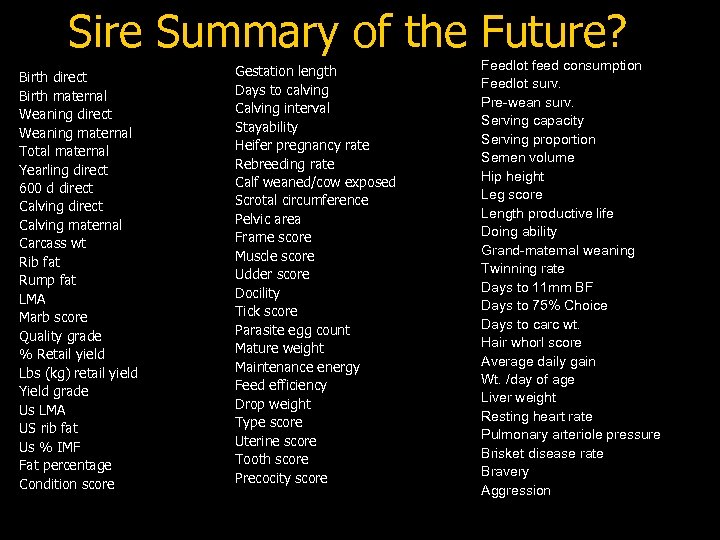 Sire Summary of the Future? Birth direct Birth maternal Weaning direct Weaning maternal Total maternal Yearling direct 600 d direct Calving maternal Carcass wt Rib fat Rump fat LMA Marb score Quality grade % Retail yield Lbs (kg) retail yield Yield grade Us LMA US rib fat Us % IMF Fat percentage Condition score Gestation length Days to calving Calving interval Stayability Heifer pregnancy rate Rebreeding rate Calf weaned/cow exposed Scrotal circumference Pelvic area Frame score Muscle score Udder score Docility Tick score Parasite egg count Mature weight Maintenance energy Feed efficiency Drop weight Type score Uterine score Tooth score Precocity score Feedlot feed consumption Feedlot surv. Pre-wean surv. Serving capacity Serving proportion Semen volume Hip height Leg score Length productive life Doing ability Grand-maternal weaning Twinning rate Days to 11 mm BF Days to 75% Choice Days to carc wt. Hair whorl score Average daily gain Wt. /day of age Liver weight Resting heart rate Pulmonary arteriole pressure Brisket disease rate Bravery Aggression
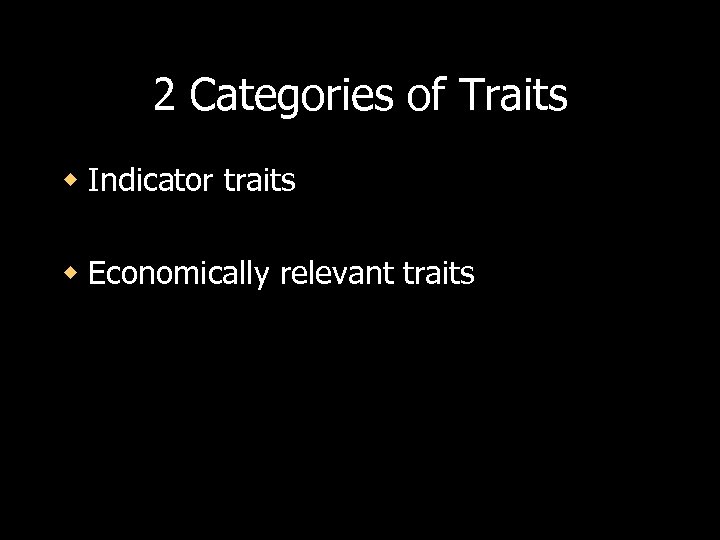 2 Categories of Traits w Indicator traits w Economically relevant traits
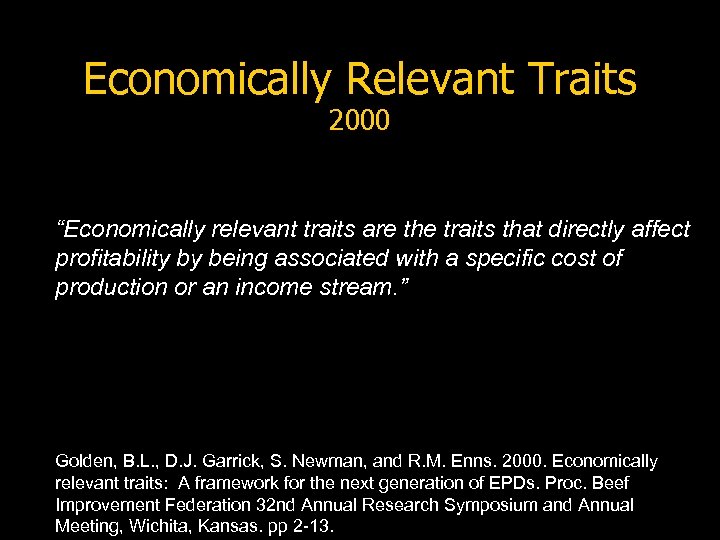 Economically Relevant Traits 2000 “Economically relevant traits are the traits that directly affect profitability by being associated with a specific cost of production or an income stream. ” Golden, B. L. , D. J. Garrick, S. Newman, and R. M. Enns. 2000. Economically relevant traits: A framework for the next generation of EPDs. Proc. Beef Improvement Federation 32 nd Annual Research Symposium and Annual Meeting, Wichita, Kansas. pp 2 -13.
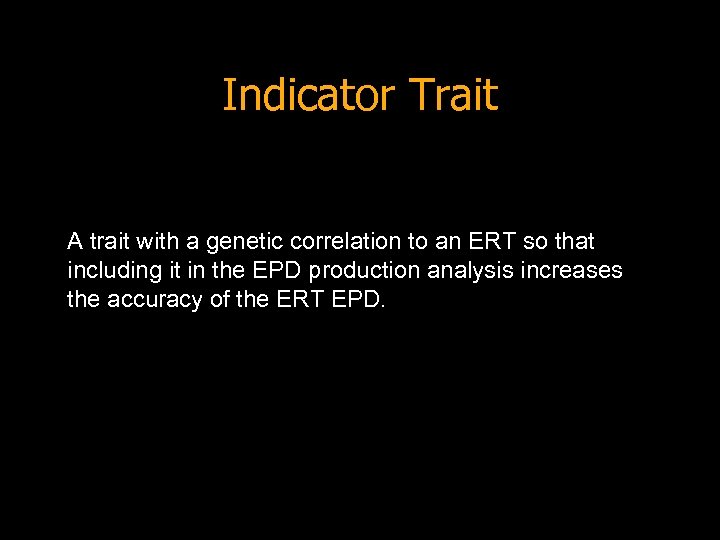 Indicator Trait A trait with a genetic correlation to an ERT so that including it in the EPD production analysis increases the accuracy of the ERT EPD.
 Using EPD of indicator traits in a selection decision DECREASES the accuracy of the selection decision
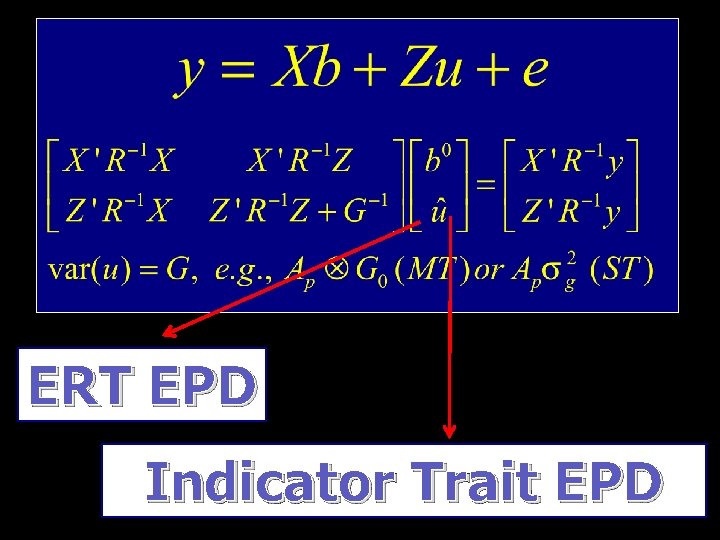 ERT EPD Indicator Trait EPD
 Scrotal Circumference Indicator Trait or ERT?
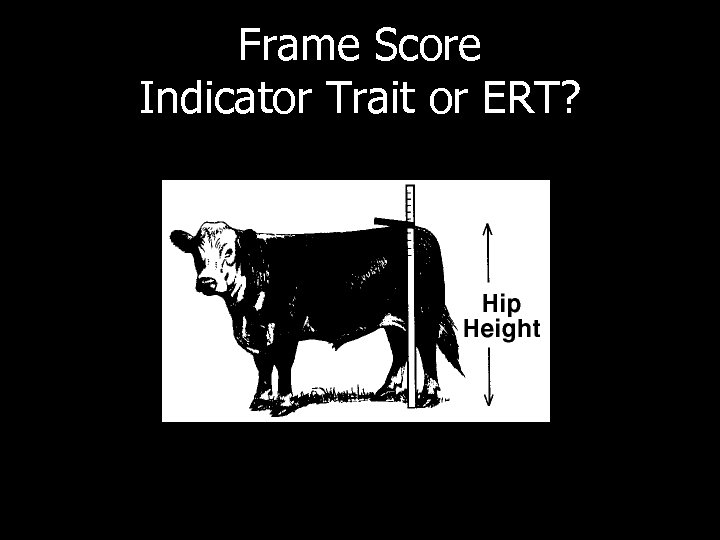 Frame Score Indicator Trait or ERT?
 Feedlot Feed Consumption Indicator Trait or ERT?
 Heifer Pregnancy Rate Indicator Trait or ERT?
 Weaning Weight Indicator Trait or ERT?
 Mature Weight Indicator Trait or ERT?
 Should indicator traits be measured? Should indicator trait EPD be published?
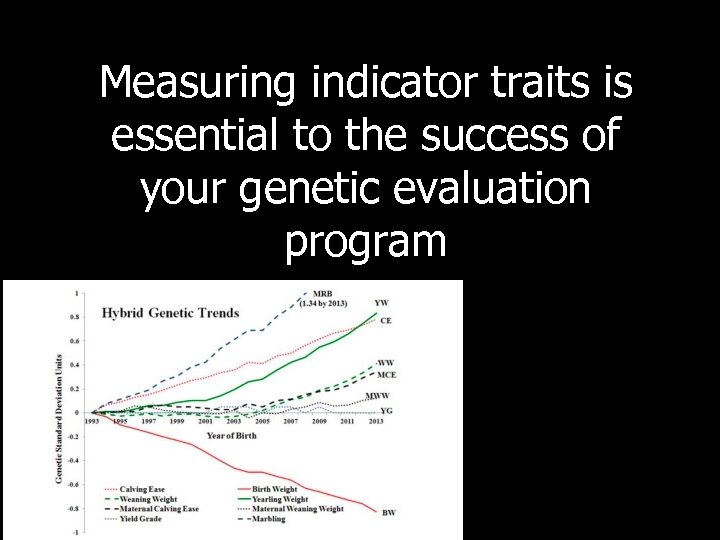 Measuring indicator traits is essential to the success of your genetic evaluation program
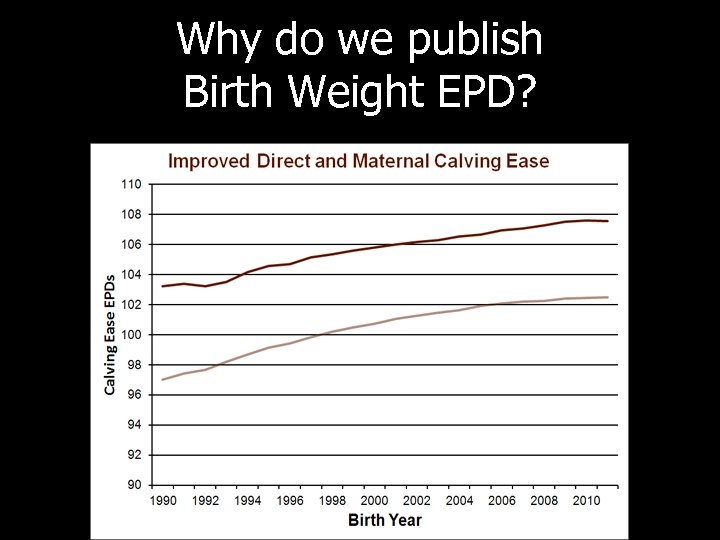 Why do we publish Birth Weight EPD?
 The EPD we should produce entirely depends on the tools we want to have to use them.
 Guideline: Only publish EPD that are used in any type of Partial Budget Decision Analysis
 Partial Budget Decision Analysis Any analysis that predicts the financial impact of incremental changes in revenue and costs from alternative decisions.
 In 2000 (14 years ago): “…to be used in an optimal manner, ERT-EPD should be used in a decision-making framework incorporating the breeder’s/producer’s desires for longer-term viability of their production system. ” … “Finally, systems that are better than EPDs should be developed for presentation to bull breeders and bull buyers. ”
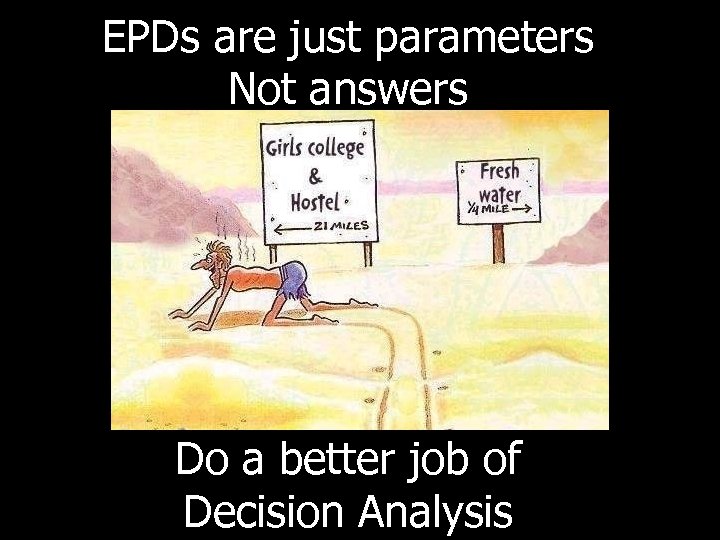 EPDs are just parameters Not answers Do a better job of Decision Analysis
 Until recently, relatively few tools available INDEXES
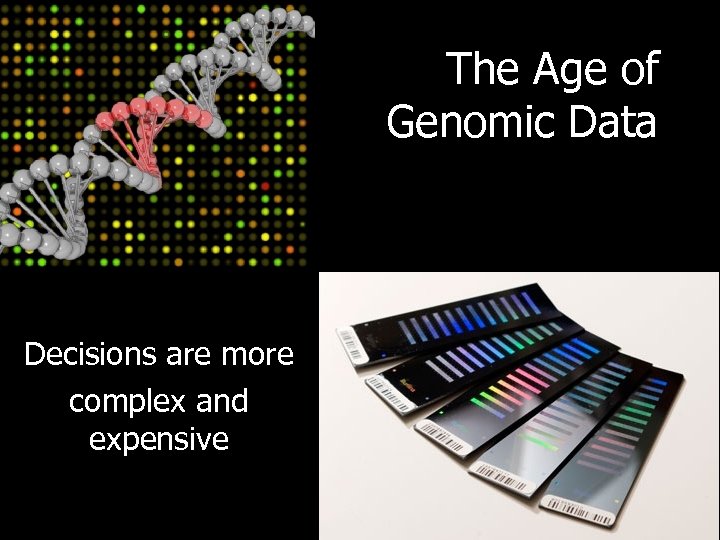 The Age of Genomic Data Decisions are more complex and expensive
 Questions: Who do you genotype and with what density? Purebred Breeder Commercial Producer
 Questions: How do you use the information? E. g. , Accuracy
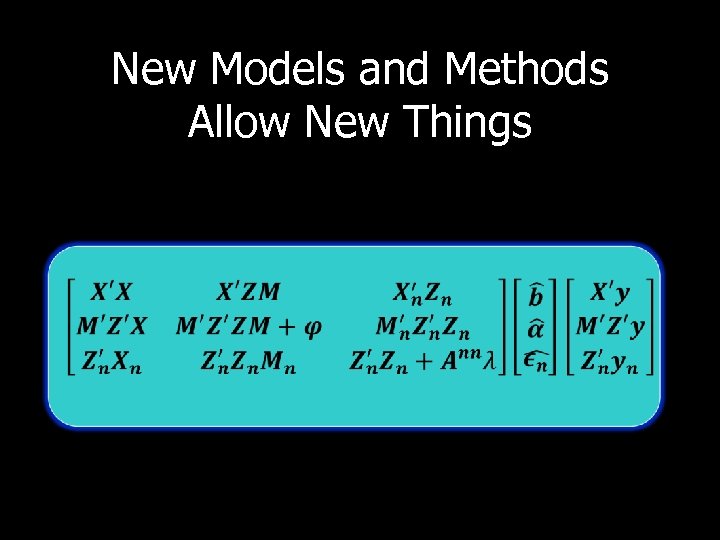 New Models and Methods Allow New Things
 To Develop Indexes We Need Production Simulation Models w Models for producers w Models for breeders w What ERT we produce completely depends on the models