 Скачать презентацию Selecting papers for publication or How does a
4f9a6b16dbfddd12321a7af42bbf1774.ppt
- Количество слайдов: 15



Selecting papers for publication or How does a journal decide which type of papers to select for their journal? Kristen Sejrsen, SVE
Why me? • • • Involved in the start of animal Senior editor animal President of EAAP- one of the 3 partners
Outline • • • Background for start of animal Consideration behind the scope Outline of the scope of animal Comparison with other journals Concluding remarks
Background • Many different small animal science journals • Many European scientist send their papers to the US • A wish to create a European journal of the same stature as Journal of Animal Science and Journal of Dairy Science • Unhappy with the financial agreement with Elsevier – Loss of funds for the federation
animal: an international journal on animal bioscience Animal – § is a new journal (first issue feb 2007) § seeks to attract the best research in animal biology and animal systems from across the spectrum of the agricultural, biomedical, and environmental sciences; § it is the central element in an exciting collaboration between the British Society of Animal Science (BSAS). Institut National de la Recherche Agronomique (INRA) and the European Federation for Animal Science (EAAP) § it represents a merging of the three scientific journals: Animal Science; Animal Research; and Reproduction, Nutrition, Development
Considerations regrading the scope of the journal What is important for authors? • Which topics? – Should it be open to other topics that traditional animal science – Can it be too broad? • Biomedical, genetic ressources, tropical agriculture, companion animals, aquaculture, human health aspects? – Too narrow? • International or European? – should papers of only local relevance be accepted? • Emphasis on the impact factor? – What is a high impact factor for this type of journal? • JDS - 2. 28 in 2006; JAS - 1. 98; LPS - 1. 13; RND – 1. 82; Animal Science – 1. 02; cta Agr. – 0. 33 A – Maximize impact factor via max. focus on potentially high impact papers? • New, Exotic, Buzz word topics, high selectivity – Or focus on papers from the scientist of the “constituency”? • Rapid handling of papers?
SCOPE Animal aims Ø to publish original, cutting-edge research and horizon-scanning reviews on animal-related aspects of the life sciences at the molecular (transcriptomics and proteomics), cellular, organ whole animal and production system levels (both animal and human). Ø to considered papers on aspects of both strategic and applied science in the areas of Animal Breeding and Genetics, Nutrition, Physiology and Functional Biology of Systems, Behaviour, Health and Welfare, Livestock Farming Systems and Product Quality. Animal models in relation with these key topics will be considered. Ø to put emphasis on managed animals and on the integrative nature of biological systems. Ø to particularly welcome papers dealing with the translation of basic and strategic science into whole animal and system impacts on Productivity, Product Quality, the Environment and Humans (health, nutrition and well being)
Animal will publish 1. papers of international relevance including original research articles, descriptions of novel techniques, contemporary reviews and meta-analyses. 2. short communications will only accepted in special cases where, in the Editor’s judgement, the contents are exceptionally exciting, novel or timely. 3. proceedings of scientific meetings and conference reports will be considered for special issues. . Animal will be essential reading for all animal scientists interested in biochemistry, microbiology, nutrition, physiology, modelling, genetics, behaviour, immunology, epidemiology, engineering, economics, sociology, food science and technology, human health, farming and land-use management.
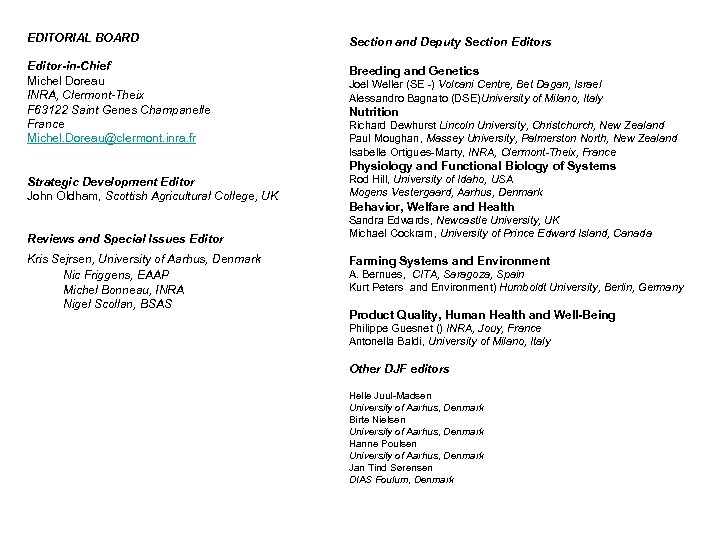
EDITORIAL BOARD Section and Deputy Section Editors Editor-in-Chief Michel Doreau INRA, Clermont-Theix F 63122 Saint Genes Champanelle France Michel. Doreau@clermont. inra. fr Breeding and Genetics Joel Weller (SE -) Volcani Centre, Bet Dagan, Israel Alessandro Bagnato (DSE)University of Milano, Italy Nutrition Richard Dewhurst Lincoln University, Christchurch, New Zealand Paul Moughan, Massey University, Palmerston North, New Zealand Isabelle Ortigues-Marty, INRA, Clermont-Theix, France Physiology and Functional Biology of Systems Strategic Development Editor John Oldham, Scottish Agricultural College, UK Reviews and Special Issues Editor Kris Sejrsen, University of Aarhus, Denmark Nic Friggens, EAAP Michel Bonneau, INRA Nigel Scollan, BSAS Rod Hill, University of Idaho, USA Mogens Vestergaard, Aarhus, Denmark Behavior, Welfare and Health Sandra Edwards, Newcastle University, UK Michael Cockram, University of Prince Edward Island, Canada Farming Systems and Environment A. Bernues, CITA, Saragoza, Spain Kurt Peters and Environment) Humboldt University, Berlin, Germany Product Quality, Human Health and Well-Being Philippe Guesnet () INRA, Jouy, France Antonella Baldi, University of Milano, Italy Other DJF editors Helle Juul-Madsen University of Aarhus, Denmark Birte Nielsen University of Aarhus, Denmark Hanne Poulsen University of Aarhus, Denmark Jan Tind Sørensen DIAS Foulum, Denmark
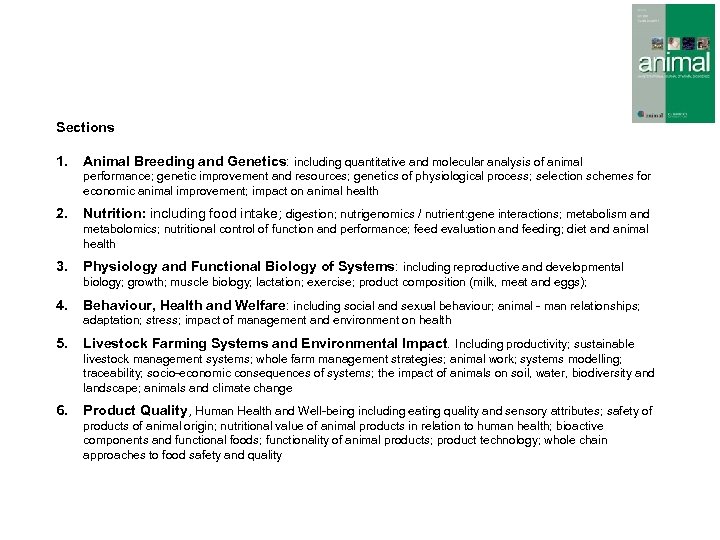
Sections 1. Animal Breeding and Genetics: including quantitative and molecular analysis of animal performance; genetic improvement and resources; genetics of physiological process; selection schemes for economic animal improvement; impact on animal health 2. 3. 4. 5. 6. Nutrition: including food intake; digestion; nutrigenomics / nutrient: gene interactions; metabolism and metabolomics; nutritional control of function and performance; feed evaluation and feeding; diet and animal health Physiology and Functional Biology of Systems: including reproductive and developmental biology; growth; muscle biology; lactation; exercise; product composition (milk, meat and eggs); Behaviour, Health and Welfare: including social and sexual behaviour; animal - man relationships; adaptation; stress; impact of management and environment on health Livestock Farming Systems and Environmental Impact. Including productivity; sustainable livestock management systems; whole farm management strategies; animal work; systems modelling; traceability; socio-economic consequences of systems; the impact of animals on soil, water, biodiversity and landscape; animals and climate change Product Quality, Human Health and Well-being including eating quality and sensory attributes; safety of products of animal origin; nutritional value of animal products in relation to human health; bioactive components and functional foods; functionality of animal products; product technology; whole chain approaches to food safety and quality
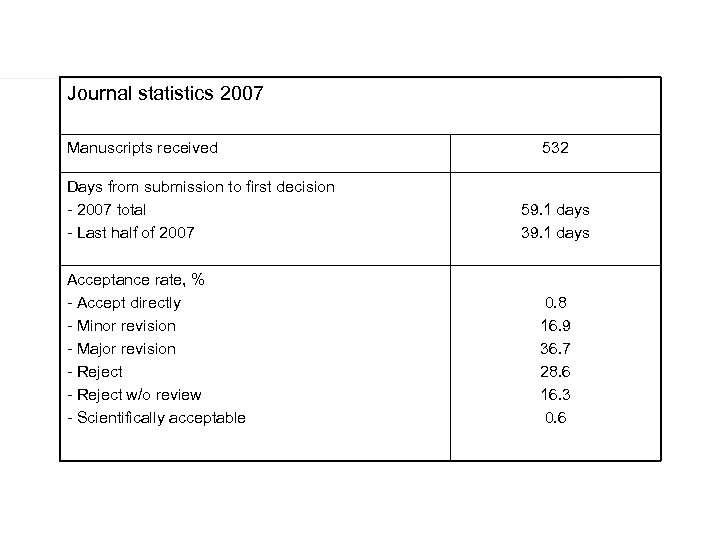
Journal statistics 2007 Manuscripts received Days from submission to first decision - 2007 total - Last half of 2007 Acceptance rate, % - Accept directly - Minor revision - Major revision - Reject w/o review - Scientifically acceptable 532 59. 1 days 39. 1 days 0. 8 16. 9 36. 7 28. 6 16. 3 0. 6
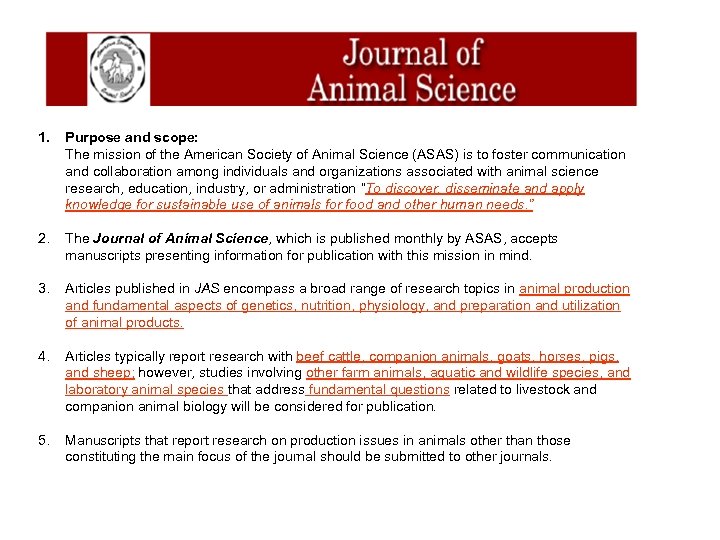
Journal of Animal Science 1. Purpose and scope: The mission of the American Society of Animal Science (ASAS) is to foster communication and collaboration among individuals and organizations associated with animal science research, education, industry, or administration “To discover, disseminate and apply knowledge for sustainable use of animals for food and other human needs. ” 2. The Journal of Animal Science, which is published monthly by ASAS, accepts manuscripts presenting information for publication with this mission in mind. 3. Articles published in JAS encompass a broad range of research topics in animal production and fundamental aspects of genetics, nutrition, physiology, and preparation and utilization of animal products. 4. Articles typically report research with beef cattle, companion animals, goats, horses, pigs, and sheep; however, studies involving other farm animals, aquatic and wildlife species, and laboratory animal species that address fundamental questions related to livestock and companion animal biology will be considered for publication. 5. Manuscripts that report research on production issues in animals other than those constituting the main focus of the journal should be submitted to other journals.
Intended readership: Ø JDS readers represent education, industry, and government, including research, teaching, administration, veterinary medicine, extension, management, quality assurance, product development, and technical services in more than 70 countries. Ø JDS is of interest to those in biochemistry, breeding, economics, engineering, environment, food science, genetics, microbiology, nutrition, pathology, physiology, processing, public health, quality assurance, and sanitation.
Livestock Science promotes the sound development of the livestock sector by publishing original, peerreviewed research and review articles covering all aspects of this broad field. The journal welcomes submissions on the avant-garde areas of genetic resources, tropical livestock farming, welfare, ethics and behaviour, in addition to those on genetics, breeding, growth, reproduction, nutrition, management, health, production, systems, and so on. The high-quality content of this journal reflects the truly international nature of this broad area of research.
Concluding remarks • Research from DJF is central to all journals • All journals try, in different ways, to expand the traditional area – Biomedical – Human health aspects – Tropical – Genetic ressources – Companion animals – Animal models – Aquaculture – Ethics • The hunt for high impact factor is futile for animal scientists • FOCUS ON REAL IMPACT – Publish in animal – or another animal science journal
Скачать презентацию Selecting papers for publication or How does a
4f9a6b16dbfddd12321a7af42bbf1774.ppt