


 Скачать презентацию Selecting and Adapting Digital Learning Resources for Science
5f09d8beb3431fd1713cca795115e132.ppt
- Количество слайдов: 34
 Selecting and Adapting Digital Learning Resources for Science, Mathematics, Engineering and Technology Education Brandon Muramatsu, mura@smete. org Originally Published 2001. Republished 2013. This work is licensed under a Creative Commons Attribution. Noncommercial-Share Alike 3. 0 United States License (http: // creativecommons. org/licenses/by-nc-sa/3. 0/us/)
 Outline • Background • Mechanisms and Methodologies to Evaluate and Select Digital Learning Resources • Mechanisms to Locate Resources – Educational Digital Libraries • National SMETE Digital Library Program • SMETE Open Federation
 Background • Information technologies provide the opportunity to “re-think” how we teach our classes and better understand how students learn – Computers, Web and other learning technologies • Builds upon the work of: – NEEDS, a digital library for engineering education – Premier Award for Excellence in Engineering Education Courseware – Engineering Education Coalitions – SMETE Open Federation
 The Audience • Introductions – Department? – Professor or Grad Student? – Have you developed digital learning materials? • What are/were they? Websites, applets, etc. ? • Have you adopted or adapted materials developed by others?
 Approach we will be discussing. . . • Provides processes and frameworks – To help you understand what tools you might want to use – To evaluate the quality of learning technologies – Leading to selecting and adapting learning technologies for your courses • Uses learning technologies as tools to improve teaching and learning – Learning technologies provide a number of benefits … but … don’t use technology just because you can.
 How do you select learning technologies?
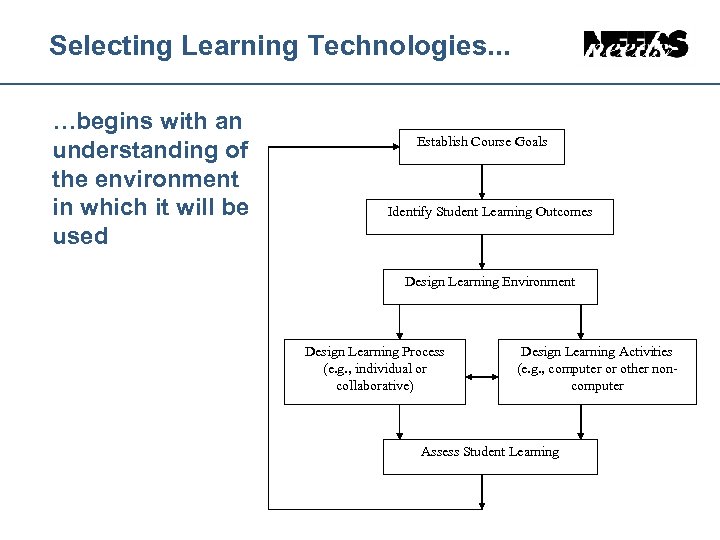 Selecting Learning Technologies. . . …begins with an understanding of the environment in which it will be used Establish Course Goals Identify Student Learning Outcomes Design Learning Environment Design Learning Process (e. g. , individual or collaborative) Design Learning Activities (e. g. , computer or other noncomputer Assess Student Learning
 7 Principles of Good Teaching • Encourages contact between students and faculty • Develops reciprocity and cooperation among students • Encourages active learning • Gives prompt feedback • Emphasizes time on task • Communicates high expectations • Respects divers talents and ways of learning Chickering, A. W. & Z. F. Gamson. (1991). “Applying the Seven Principles for Good Practice in Undergraduate Education. ” New Directions for Teaching and Learning. Vol. 47. San Francisco: Jossey-Bass Inc.
 Guidelines for Selecting Learning Technologies • Support Good Practices in Higher Education (Seven Principles) • Support teaching goals and learning outcomes • Consider (technical) support environment • Use quality resources
 How do you evaluate learning technologies? What things do you consider?
 Evaluating Learning Technologies • Identifying high-quality learning materials based upon criteria developed for Premier Award for Excellence in Engineering Education Courseware – Developed with the help of a number of experts in the field – Evolved over the last four years of competition – Brings diverse viewpoints together -- content area experts, instructional designers, students and publishers
 Premier Award Selection Criteria • Instructional Design – Will students learn from the courseware? – Interactivity: Is the learner actively involved and does the interaction enhance learning? – Cognition/Conceptual Change: Is learning significant and long lasting, allowing the construction of useful cognitive models? – Content: Is the content well chosen and structured? – Multimedia Use: Is multimedia used effectively to promote learning objectives and goals? – Instructional Use/Adaptability: Can the software be used in a variety of settings?
 Premier Award Selection Criteria, cont. • Software Design – Is the software well designed and useable? – Engagement: Does the software hold the interest of a diversity of learners? – Learner interface and navigation: Is the software easy to use? – Technical reliability: Is the software free from technical problems?
 Premier Award Selection Criteria, cont. • Engineering Content – Is the content appropriate and error-free? – Accuracy of content: Is the content error-free? – Organization of content: Is the content presented consistent with typical engineering instruction. – Consistency with learning objectives: Does the content match the stated learning objectives?
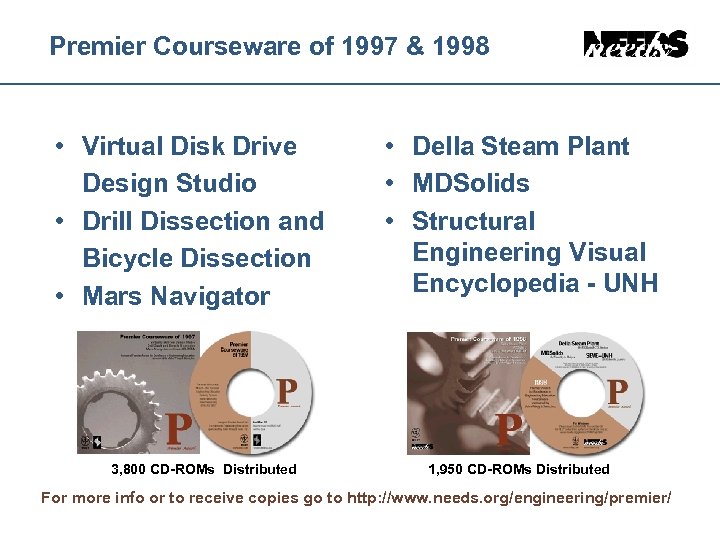 Premier Courseware of 1997 & 1998 • Virtual Disk Drive Design Studio • Drill Dissection and Bicycle Dissection • Mars Navigator 3, 800 CD-ROMs Distributed • Della Steam Plant • MDSolids • Structural Engineering Visual Encyclopedia - UNH 1, 950 CD-ROMs Distributed For more info or to receive copies go to http: //www. needs. org/engineering/premier/
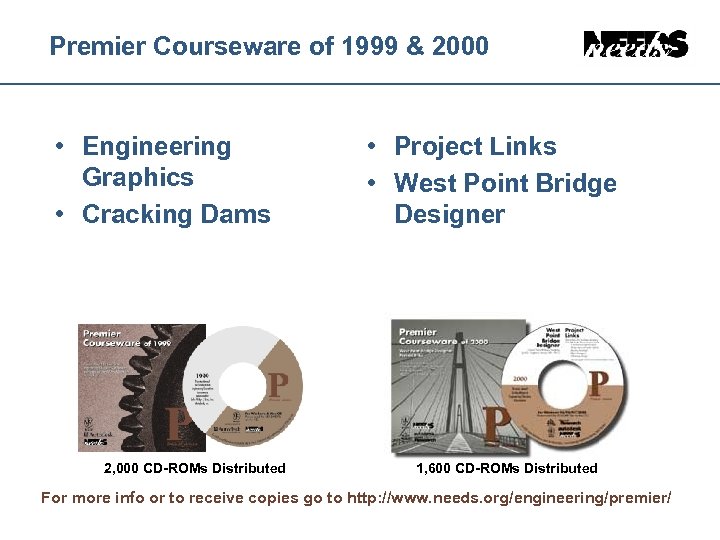 Premier Courseware of 1999 & 2000 • Engineering Graphics • Cracking Dams 2, 000 CD-ROMs Distributed • Project Links • West Point Bridge Designer 1, 600 CD-ROMs Distributed For more info or to receive copies go to http: //www. needs. org/engineering/premier/
 Locating Learning Technologies • How do you locate learning technologies? – Through word of mouth? – Through educational digital libraries?
 Educational Digital Libraries • What do you think I mean? – Who’s the user? – What services are available?
 “Working” Description of Educational Digital Libraries …or…what makes them different from research digital libraries… • Directly supports teaching and learning Activities • Supports communities of users • In K-12 through higher-education to life-long learning • Across a wide range of disciplines
 Background and History of the National Science Foundation’s National SMETE Digital Library Program
 The SMETE Open Federation A Brief Introduction
 Brief Background • To build a successful National SMETE Digital Library for deployment in Fall 2002… – That focuses on science, mathematics, engineering and technology at all levels – And more importantly, it focuses on education • …we needed to develop a team… – To overcome the challenges we face in developing a National SMETE Digital Library – To cover target audiences and disciplines – To share in the development efforts
 Vision • The SMETE Open Federation is committed to providing a service – to support learning – across disciplines in science, mathematics, engineering and technology – providing access to high-quality resources – in support of education reform and crossdisciplinary learning – from K-12 to higher education to professional development
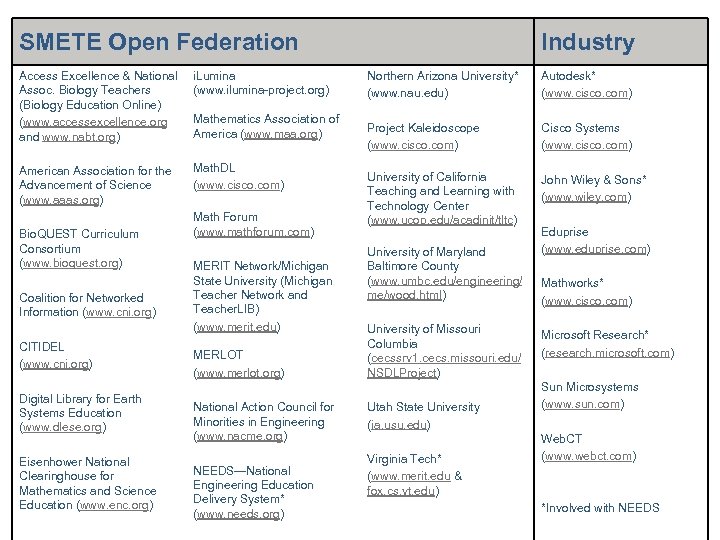 SMETE Open Federation Access Excellence & National Assoc. Biology Teachers (Biology Education Online) (www. accessexcellence. org and www. nabt. org) i. Lumina (www. ilumina-project. org) American Association for the Advancement of Science (www. aaas. org) Math. DL (www. cisco. com) Bio. QUEST Curriculum Consortium (www. bioquest. org) Coalition for Networked Information (www. cni. org) CITIDEL (www. cni. org) Digital Library for Earth Systems Education (www. dlese. org) Eisenhower National Clearinghouse for Mathematics and Science Education (www. enc. org) Mathematics Association of America (www. maa. org) Math Forum (www. mathforum. com) MERIT Network/Michigan State University (Michigan Teacher Network and Teacher. LIB) (www. merit. edu) MERLOT (www. merlot. org) National Action Council for Minorities in Engineering (www. nacme. org) NEEDS—National Engineering Education Delivery System* (www. needs. org) Industry Northern Arizona University* (www. nau. edu) Autodesk* (www. cisco. com) Project Kaleidoscope (www. cisco. com) Cisco Systems (www. cisco. com) University of California Teaching and Learning with Technology Center (www. ucop. edu/acadinit/tltc) John Wiley & Sons* (www. wiley. com) University of Maryland Baltimore County (www. umbc. edu/engineering/ me/wood. html) University of Missouri Columbia (cecssrv 1. cecs. missouri. edu/ NSDLProject) Utah State University (ia. usu. edu) Virginia Tech* (www. merit. edu & fox. cs. vt. edu) Eduprise (www. eduprise. com) Mathworks* (www. cisco. com) Microsoft Research* (research. microsoft. com) Sun Microsystems (www. sun. com) Web. CT (www. webct. com) *Involved with NEEDS
 Development Philosophy • The difference is learning, not just bibliographic information retrieval – Teaching and learning require something more • Guided by user needs and philosophy of education that is constructivist • Link content to community and services • Build integrative tools and incorporate “best of breed” tools from partners
 Strengths of Partners • Partners with existing collections each have a decade of experience providing digital SMETE resources to their target audiences and disciplines – ENC, NEEDS, Math Forum, Bio. QUEST • Most partners each have more than ten years of experience as organizations promoting SMETE reform – AAAS, Project Kaleidoscope, NACME, Mathematical Association of America, SRI International
 Strengths of Partners (cont. ) • Collections and service providers range from well established collections to incipient collections • Organizations serve full spectrum of audiences – K– 12, pre-College, community colleges, liberal arts colleges and universities, public and private research universities, and professional societies – Extended affiliations include professional development organizations
 Services • Interoperability of collections on a number of different levels – Federated search – Shared user profiles to enable personalization services • Support for community building – Recommender systems – Outreach and education efforts
 Making it All Work • What do we mean by interoperability? – We want to provide “seamless access to collections and services” • Existing and new collections • Existing and new services – We recognize there are different types of agreements necessary to provide “seamless access” • Social • Technical
 Social Aspects of Interoperability • Agree to interoperate – Shared principles – Shared understanding of the issues • Build an identity • Meet to develop common language and technical protocols
 Technical Aspects of Interoperability • Agree to common methods of representing information – Common metadata to help organize and describe collections – Common thesauri/controlled vocabularies to describe resources in consistent manner across collections • Agree to common methods for transmitting information – Protocols/specifications/API’s for shared access to contents of collections and services
 Technical Aspects of Interoperability • Agree to common methods of representing information – Common metadata to help organize and describe collections – Common thesauri/controlled vocabularies to describe resources in consistent manner across collections • Agree to common methods for transmitting information – Protocols/specifications/API’s for shared access to contents of collections and services
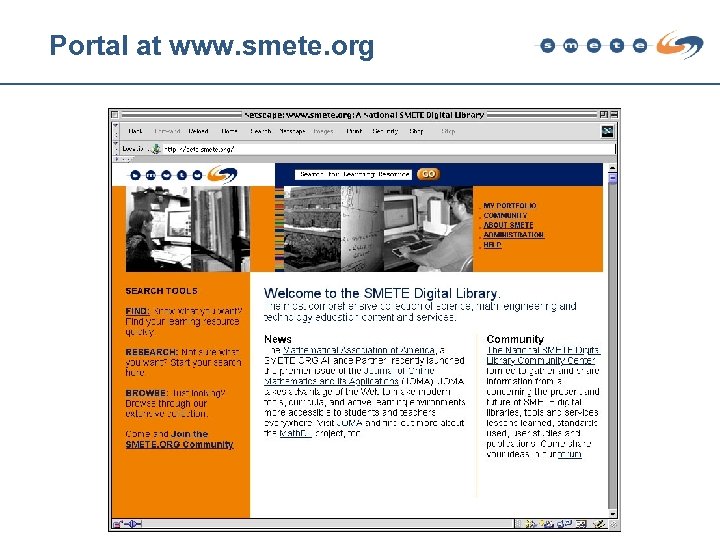 Portal at www. smete. org
 Contact Info Brandon Muramatsu, Project Director mura@smete. org University of California, Berkeley 3115 Etcheverry Hall Berkeley, CA 94720 -1750 USA (510) 643 -1817