


 Скачать презентацию Selected experiences of 6 years Rossendorf SRF Gun
f13618218b5306ef2e810dd6f64c828c.ppt
- Количество слайдов: 21
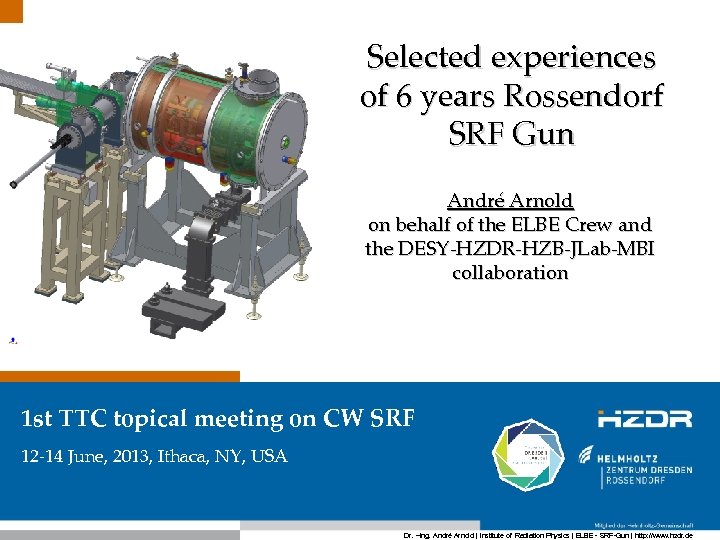 Selected experiences of 6 years Rossendorf SRF Gun André Arnold on behalf of the ELBE Crew and the DESY-HZDR-HZB-JLab-MBI collaboration 1 st TTC topical meeting on CW SRF 12 -14 June, 2013, Ithaca, NY, USA Dr. –Ing. André Arnold | Institute of Radiation Physics | ELBE - SRF-Gun | http: //www. hzdr. de
 Outline Introduction 1. CW operation • Mech. properties • Intrinsic quality factor • HOM coupler 2. Cathode • Preparation • Multipacting • Dark current 3. New Cavity Summary Slide 2 Dr. –Ing. André Arnold | Institute of Radiation Physics | ELBE - SRF-Gun | http: //www. hzdr. de
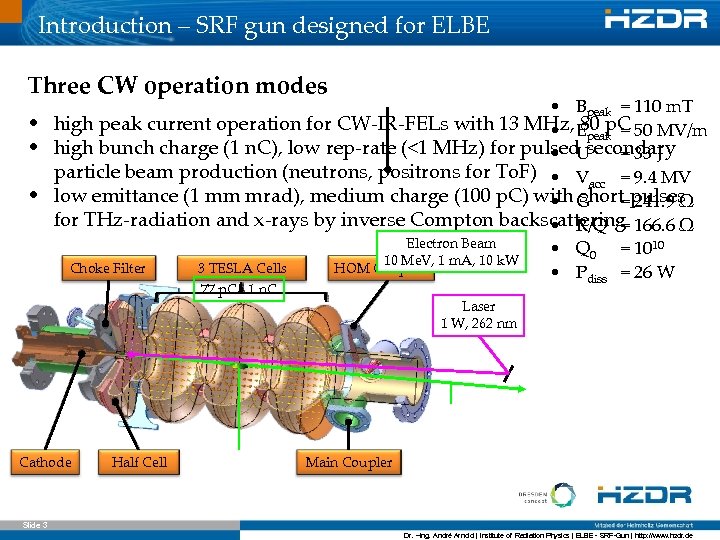 Introduction – SRF gun designed for ELBE Three CW operation modes • Bpeak = 110 m. T • high peak current operation for CW-IR-FELs with 13 MHz, 80 p. C • Epeak = 50 MV/m • high bunch charge (1 n. C), low rep-rate (<1 MHz) for pulsed secondary • U = 33 J particle beam production (neutrons, positrons for To. F) • Vacc = 9. 4 MV • low emittance (1 mm mrad), medium charge (100 p. C) with short pulses • G = 241. 9 Ω for THz-radiation and x-rays by inverse Compton backscattering • R/Q = 166. 6 Ω Electron Beam • Q 0 = 1010 10 Me. V, 1 m. A, 10 k. W Choke Filter HOM Coupler 3 TESLA Cells • Pdiss = 26 W 77 p. C - 1 n. C Cathode Half Cell Laser 1 W, 262 nm Main Coupler Slide 3 Dr. –Ing. André Arnold | Institute of Radiation Physics | ELBE - SRF-Gun | http: //www. hzdr. de
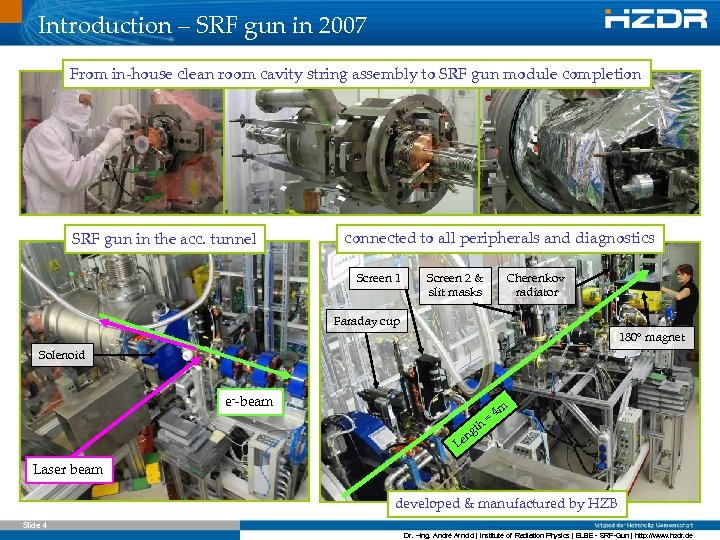 Introduction – SRF gun in 2007 From in-house clean room cavity string assembly to SRF gun module completion SRF gun in the acc. tunnel connected to all peripherals and diagnostics Screen 1 Screen 2 & slit masks Cherenkov radiator Faraday cup 180° magnet Solenoid e--beam gt = h n Le 4 m Laser beam developed & manufactured by HZB Slide 4 Dr. –Ing. André Arnold | Institute of Radiation Physics | ELBE - SRF-Gun | http: //www. hzdr. de
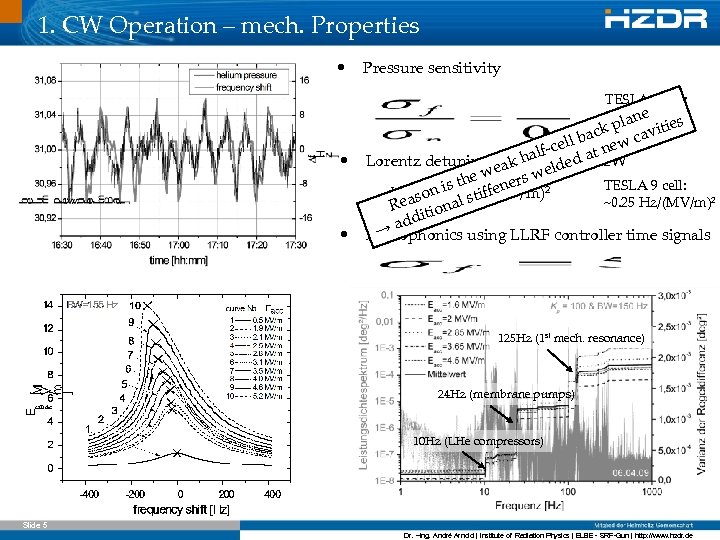 1. CW Operation – mech. Properties • Pressure sensitivity TESLA 9 cell: ~10 Hz/mbar lane s • • itie k p bac ew cav ll lf-ce d at n ha Lorentz detuning using NWA in CW eak welde e w s TESLA 9 cell: is th iffener 2 kpeak so 0. 69 Hz/(MV/m) =n st ~0. 25 Hz/(MV/m)2 Rea tional i add → Microphonics using LLRF controller time signals 125 Hz (1 st mech. resonance) 24 Hz (membrane pumps) 10 Hz (LHe compressors) Slide 5 Dr. –Ing. André Arnold | Institute of Radiation Physics | ELBE - SRF-Gun | http: //www. hzdr. de
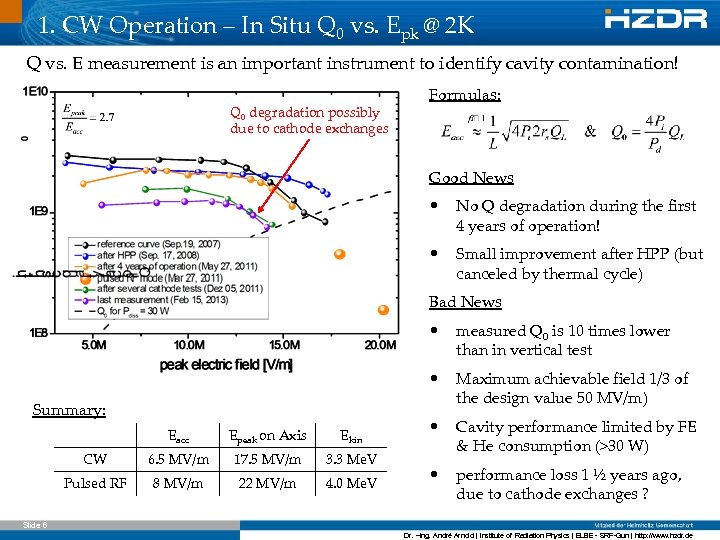 1. CW Operation – In Situ Q 0 vs. Epk @ 2 K Q vs. E measurement is an important instrument to identify cavity contamination! Q 0 degradation possibly due to cathode exchanges Formulas: Good News • No Q degradation during the first 4 years of operation! • Small improvement after HPP (but canceled by thermal cycle) Bad News • • Summary: Eacc Epeak on Axis Ekin CW 6. 5 MV/m 17. 5 MV/m 3. 3 Me. V Pulsed RF 8 MV/m 22 MV/m 4. 0 Me. V measured Q 0 is 10 times lower than in vertical test Maximum achievable field 1/3 of the design value 50 MV/m) • Cavity performance limited by FE & He consumption (>30 W) • performance loss 1 ½ years ago, due to cathode exchanges ? Slide 6 Dr. –Ing. André Arnold | Institute of Radiation Physics | ELBE - SRF-Gun | http: //www. hzdr. de
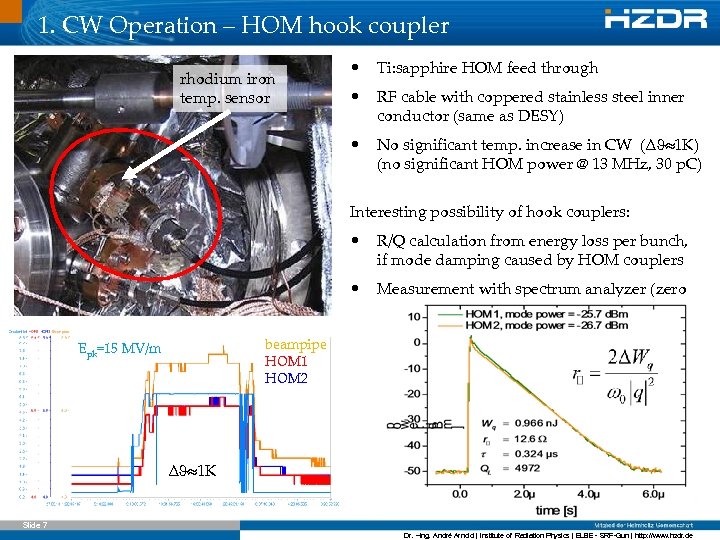 1. CW Operation – HOM hook coupler • Ti: sapphire HOM feed through • RF cable with coppered stainless steel inner conductor (same as DESY) • rhodium iron temp. sensor No significant temp. increase in CW (∆ 1 K) (no significant HOM power @ 13 MHz, 30 p. C) Interesting possibility of hook couplers: • R/Q calculation from energy loss per bunch, if mode damping caused by HOM couplers • Measurement with spectrum analyzer (zero span) beampipe HOM 1 HOM 2 Epk=15 MV/m ∆ 1 K Slide 7 Dr. –Ing. André Arnold | Institute of Radiation Physics | ELBE - SRF-Gun | http: //www. hzdr. de
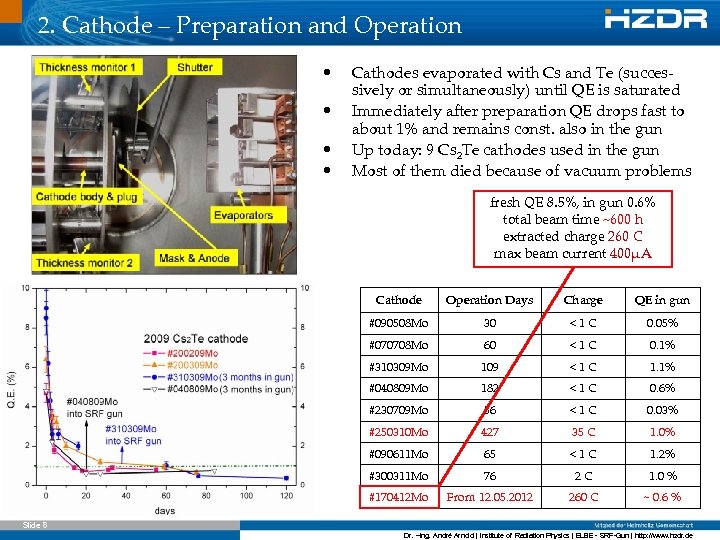 2. Cathode – Preparation and Operation • • Cathodes evaporated with Cs and Te (successively or simultaneously) until QE is saturated Immediately after preparation QE drops fast to about 1% and remains const. also in the gun Up today: 9 Cs 2 Te cathodes used in the gun Most of them died because of vacuum problems fresh QE 8. 5%, in gun 0. 6% total beam time ~600 h extracted charge 260 C max beam current 400µA Cathode Operation Days Charge QE in gun #090508 Mo 30 < 1 C 0. 05% #070708 Mo 60 < 1 C 0. 1% #310309 Mo 109 < 1 C 1. 1% #040809 Mo 182 < 1 C 0. 6% #230709 Mo 56 < 1 C 0. 03% #250310 Mo 427 35 C 1. 0% #090611 Mo 65 < 1 C 1. 2% #300311 Mo 76 2 C 1. 0 % #170412 Mo From 12. 05. 2012 260 C ~ 0. 6 % Slide 8 Dr. –Ing. André Arnold | Institute of Radiation Physics | ELBE - SRF-Gun | http: //www. hzdr. de
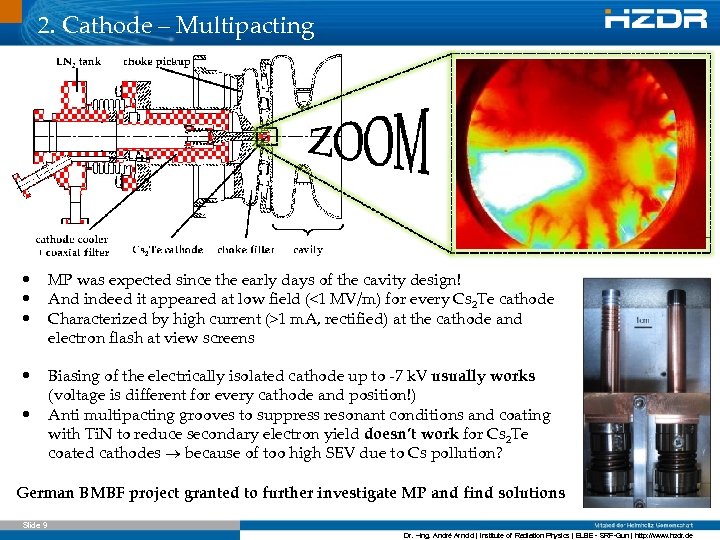 2. Cathode – Multipacting • • • MP was expected since the early days of the cavity design! And indeed it appeared at low field (<1 MV/m) for every Cs 2 Te cathode Characterized by high current (>1 m. A, rectified) at the cathode and electron flash at view screens • Biasing of the electrically isolated cathode up to -7 k. V usually works (voltage is different for every cathode and position!) Anti multipacting grooves to suppress resonant conditions and coating with Ti. N to reduce secondary electron yield doesn’t work for Cs 2 Te coated cathodes because of too high SEV due to Cs pollution? • German BMBF project granted to further investigate MP and find solutions Slide 9 Dr. –Ing. André Arnold | Institute of Radiation Physics | ELBE - SRF-Gun | http: //www. hzdr. de
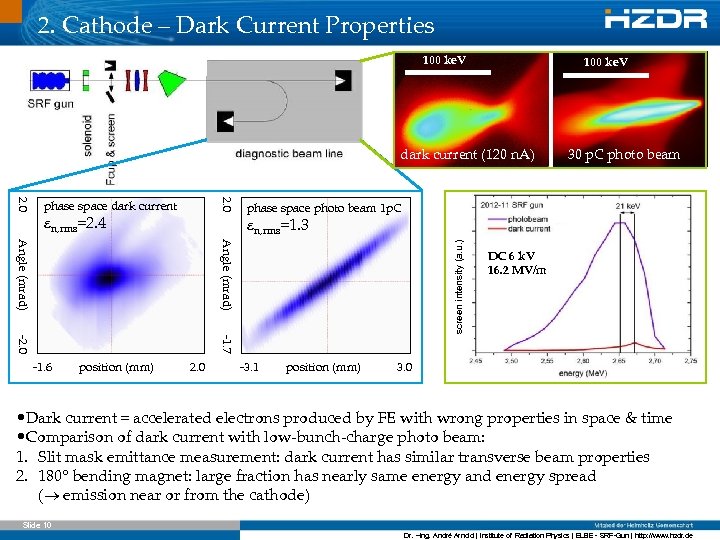 2. Cathode – Dark Current Properties 100 ke. V dark current (120 n. A) -1. 6 position (mm) 2. 0 phase space photo beam 1 p. C n, rms=1. 3 screen intensity (a. u. ) n, rms=2. 4 2. 0 Angle (mrad) -1. 7 2. 0 Angle (mrad) -2. 0 phase space dark current 30 p. C photo beam DC 6 k. V 16. 2 MV/m -3. 1 position (mm) 3. 0 • Dark current = accelerated electrons produced by FE with wrong properties in space & time • Comparison of dark current with low-bunch-charge photo beam: 1. Slit mask emittance measurement: dark current has similar transverse beam properties 2. 180° bending magnet: large fraction has nearly same energy and energy spread ( emission near or from the cathode) Slide 10 Dr. –Ing. André Arnold | Institute of Radiation Physics | ELBE - SRF-Gun | http: //www. hzdr. de
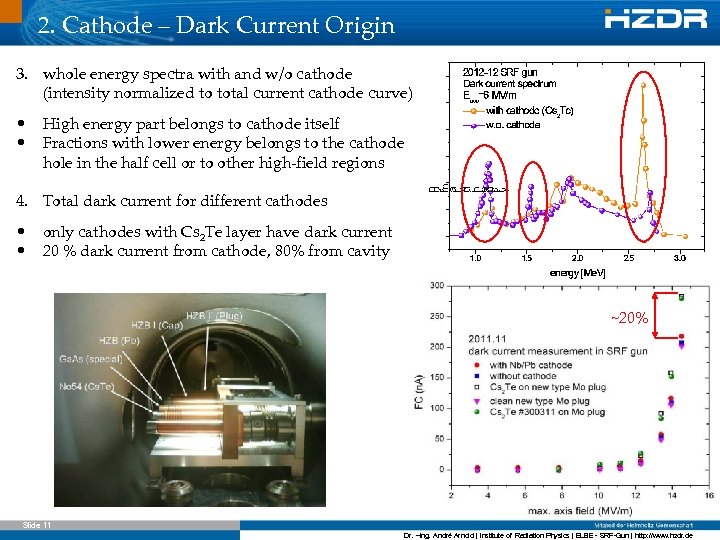 2. Cathode – Dark Current Origin 3. whole energy spectra with and w/o cathode (intensity normalized to total current cathode curve) • • High energy part belongs to cathode itself Fractions with lower energy belongs to the cathode hole in the half cell or to other high-field regions 4. Total dark current for different cathodes • • only cathodes with Cs 2 Te layer have dark current 20 % dark current from cathode, 80% from cavity ~20% Slide 11 Dr. –Ing. André Arnold | Institute of Radiation Physics | ELBE - SRF-Gun | http: //www. hzdr. de
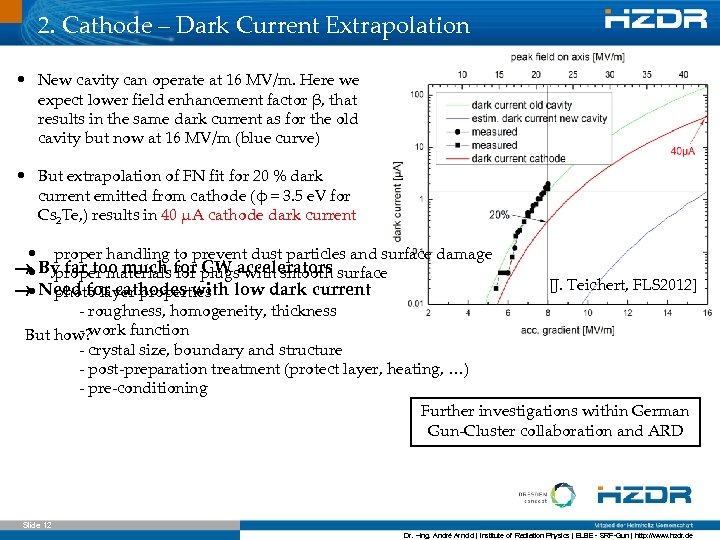 2. Cathode – Dark Current Extrapolation • New cavity can operate at 16 MV/m. Here we expect lower field enhancement factor β, that results in the same dark current as for the old cavity but now at 16 MV/m (blue curve) • But extrapolation of FN fit for 20 % dark current emitted from cathode (ϕ = 3. 5 e. V for Cs 2 Te, ) results in 40 µA cathode dark current • proper handling to prevent dust particles and surface damage By far too much for CW accelerators • proper materials for plugs with smooth surface [J. Teichert, FLS 2012] Need for cathodes with low dark current • photo layer properties - roughness, homogeneity, thickness - work function But how? - crystal size, boundary and structure - post-preparation treatment (protect layer, heating, …) - pre-conditioning Further investigations within German Gun-Cluster collaboration and ARD Slide 12 Dr. –Ing. André Arnold | Institute of Radiation Physics | ELBE - SRF-Gun | http: //www. hzdr. de
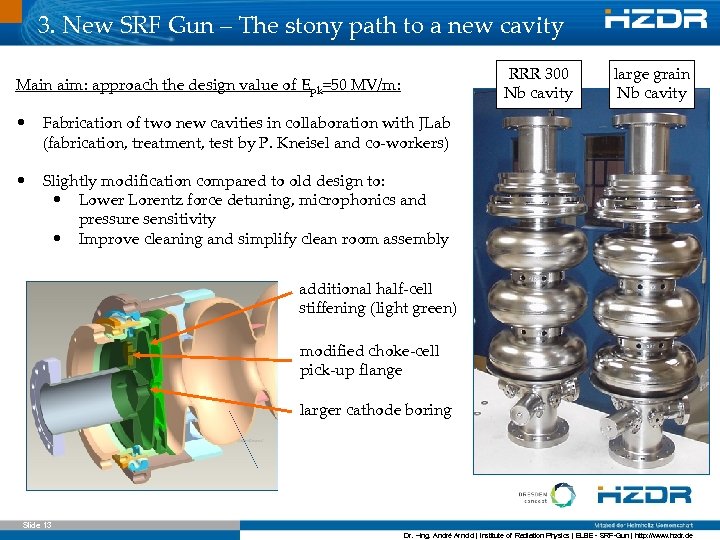 3. New SRF Gun – The stony path to a new cavity RRR 300 Nb cavity Main aim: approach the design value of Epk=50 MV/m: • Fabrication of two new cavities in collaboration with JLab (fabrication, treatment, test by P. Kneisel and co-workers) • large grain Nb cavity Slightly modification compared to old design to: • Lower Lorentz force detuning, microphonics and pressure sensitivity • Improve cleaning and simplify clean room assembly additional half-cell stiffening (light green) modified choke-cell pick-up flange larger cathode boring Slide 13 Dr. –Ing. André Arnold | Institute of Radiation Physics | ELBE - SRF-Gun | http: //www. hzdr. de
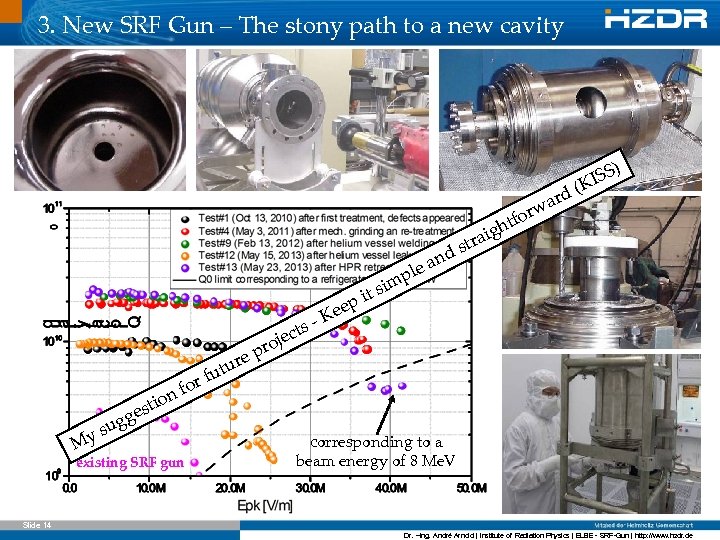 3. New SRF Gun – The stony path to a new cavity ) rd a orw ee i it s p ro p re u t r fu fo n stio e gg u y s M existing SRF gun K ts jec t s nd a ple m tf igh ra S KIS ( corresponding to a beam energy of 8 Me. V Slide 14 Dr. –Ing. André Arnold | Institute of Radiation Physics | ELBE - SRF-Gun | http: //www. hzdr. de
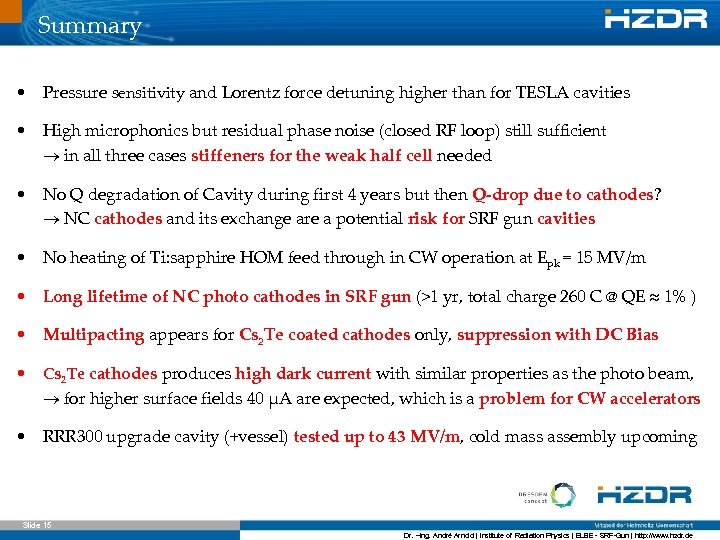 Summary • Pressure sensitivity and Lorentz force detuning higher than for TESLA cavities • High microphonics but residual phase noise (closed RF loop) still sufficient in all three cases stiffeners for the weak half cell needed • No Q degradation of Cavity during first 4 years but then Q-drop due to cathodes? NC cathodes and its exchange are a potential risk for SRF gun cavities • No heating of Ti: sapphire HOM feed through in CW operation at Epk = 15 MV/m • Long lifetime of NC photo cathodes in SRF gun (>1 yr, total charge 260 C @ QE 1% ) • Multipacting appears for Cs 2 Te coated cathodes only, suppression with DC Bias • Cs 2 Te cathodes produces high dark current with similar properties as the photo beam, for higher surface fields 40 µA are expected, which is a problem for CW accelerators • RRR 300 upgrade cavity (+vessel) tested up to 43 MV/m, cold mass assembly upcoming Slide 15 Dr. –Ing. André Arnold | Institute of Radiation Physics | ELBE - SRF-Gun | http: //www. hzdr. de
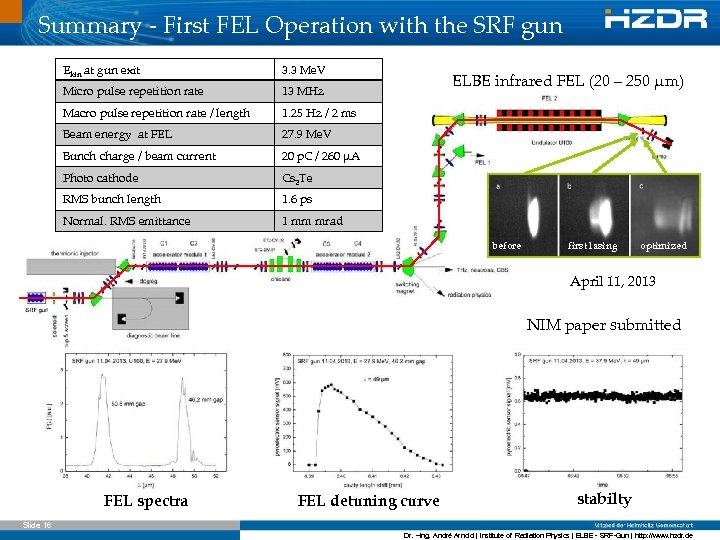 Summary - First FEL Operation with the SRF gun Ekin at gun exit 3. 3 Me. V Micro pulse repetition rate 13 MHz Macro pulse repetition rate / length 1. 25 Hz / 2 ms Beam energy at FEL 27. 9 Me. V Bunch charge / beam current 20 p. C / 260 µA Photo cathode Cs 2 Te RMS bunch length 1. 6 ps Normal. RMS emittance 1 mm mrad ELBE infrared FEL (20 – 250 µm) before first lasing optimized April 11, 2013 NIM paper submitted FEL spectra FEL detuning curve stabilty Slide 16 Dr. –Ing. André Arnold | Institute of Radiation Physics | ELBE - SRF-Gun | http: //www. hzdr. de
 Thanks to our collaborators (HZB for diagnostics, MBI for the laser and DESY for preparation and testing of the 1 st cavity) and thank you for your attention! Acknowledgement We acknowledge the support of the European Community-Research Infrastructure Activity under the FP 6 programme 2004 -08 (CARE, contract number RII 3 -CT-2003 -506395) and the FP 7 programme since 2009 (Eu. CARD, contract number 227579) as well as the support of the German Federal Ministry of Education and Research grant 05 ES 4 BR 1/8. ELBE Crew in front of museum of clocks in Glashütte, Germany Slide 17 Dr. –Ing. André Arnold | Institute of Radiation Physics | ELBE - SRF-Gun | http: //www. hzdr. de
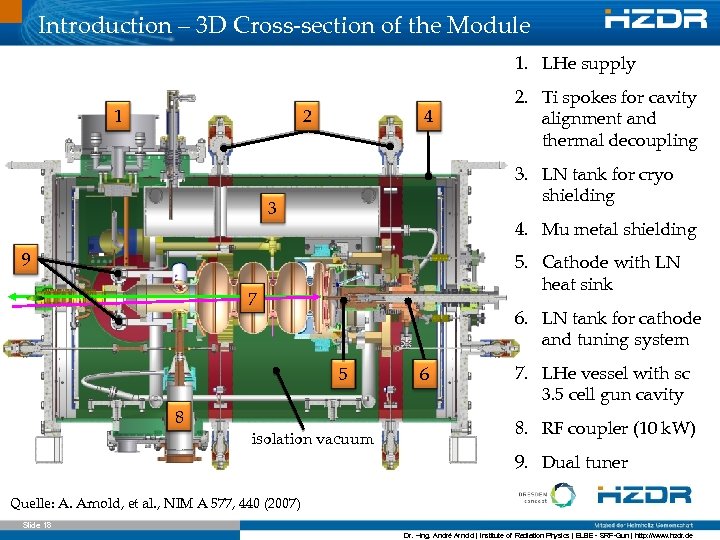 Introduction – 3 D Cross-section of the Module 1. LHe supply 2 1 4 3. LN tank for cryo shielding 3 4. Mu metal shielding 9 5. Cathode with LN heat sink 7 6. LN tank for cathode and tuning system 5 8 2. Ti spokes for cavity alignment and thermal decoupling isolation vacuum 6 7. LHe vessel with sc 3. 5 cell gun cavity 8. RF coupler (10 k. W) 9. Dual tuner Quelle: A. Arnold, et al. , NIM A 577, 440 (2007) Slide 18 Dr. –Ing. André Arnold | Institute of Radiation Physics | ELBE - SRF-Gun | http: //www. hzdr. de
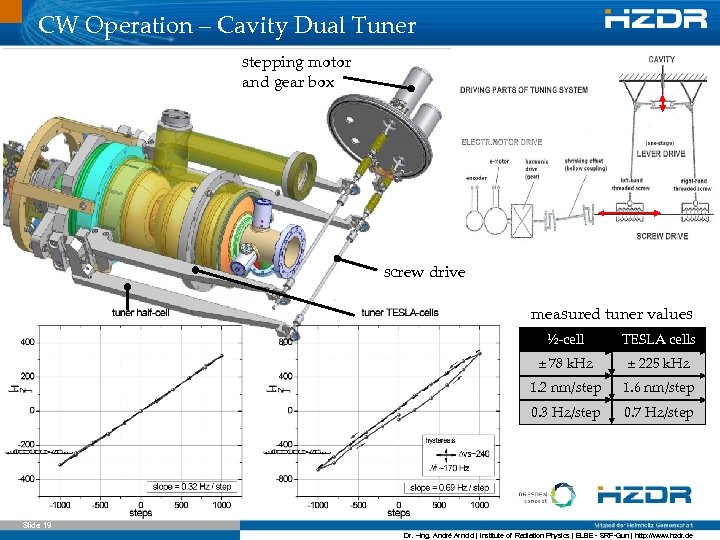 CW Operation – Cavity Dual Tuner stepping motor and gear box screw drive measured tuner values ½-cell TESLA cells ± 78 k. Hz ± 225 k. Hz 1. 2 nm/step 1. 6 nm/step 0. 3 Hz/step 0. 7 Hz/step Slide 19 Dr. –Ing. André Arnold | Institute of Radiation Physics | ELBE - SRF-Gun | http: //www. hzdr. de
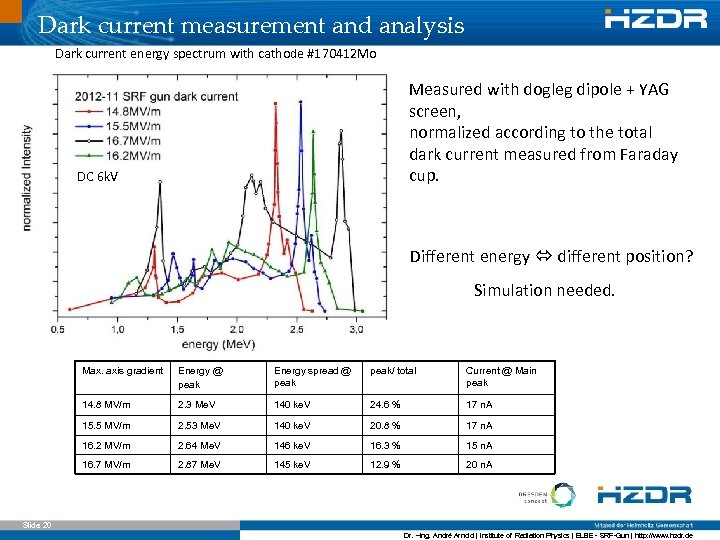 Dark current measurement and analysis Dark current energy spectrum with cathode #170412 Mo Measured with dogleg dipole + YAG screen, normalized according to the total dark current measured from Faraday cup. DC 6 k. V Different energy different position? Simulation needed. Max. axis gradient Energy @ peak Energy spread @ peak/ total Current @ Main peak 14. 8 MV/m 2. 3 Me. V 140 ke. V 24. 6 % 17 n. A 15. 5 MV/m 2. 53 Me. V 140 ke. V 20. 8 % 17 n. A 16. 2 MV/m 2. 64 Me. V 146 ke. V 16. 3 % 15 n. A 16. 7 MV/m 2. 87 Me. V 145 ke. V 12. 9 % 20 n. A Slide 20 Dr. –Ing. André Arnold | Institute of Radiation Physics | ELBE - SRF-Gun | http: //www. hzdr. de
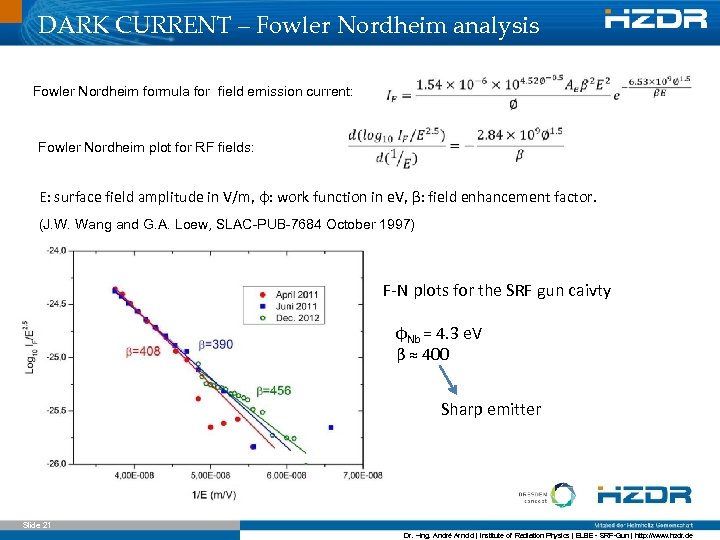 DARK CURRENT – Fowler Nordheim analysis Fowler Nordheim formula for field emission current: Fowler Nordheim plot for RF fields: E: surface field amplitude in V/m, ɸ: work function in e. V, β: field enhancement factor. (J. W. Wang and G. A. Loew, SLAC-PUB-7684 October 1997) F-N plots for the SRF gun caivty ф. Nb = 4. 3 e. V β ≈ 400 Sharp emitter Slide 21 Dr. –Ing. André Arnold | Institute of Radiation Physics | ELBE - SRF-Gun | http: //www. hzdr. de