


 Скачать презентацию Seizure Prediction System An Artificial Neural Network Approach
6d841ae453ad1853fe43226620a26a15.ppt
- Количество слайдов: 22
 Seizure Prediction System: An Artificial Neural Network Approach David Gilpin Chris Moore Advised by: Pradeep Modur, MD
 The Problem Epileptic (grand mal) seizure can happen anytime, anywhere l There is no reliable, physical warning to its imminent onset l Many electroencephalographers have increased interest in computer based recognition l Any warning could give time for preparation or prevention l
 Facts on Seizures l l l Seizures affect 0. 5% of the population regularly 1. 5 -5. 0% of the population may have a seizure in their lifetime No identifiable cause EEG data appear to synchronize prior to a seizure Some treatment available – No reliable prevention method exists
 Project Overview l l l EEG data has specific seizure “predictors” within (spikes) Signal processing can analyze spikes Results of analysis are normalized Normalized data is used to train a neural network Trained network tested with EEG data containing both epileptic and non-epileptic activity
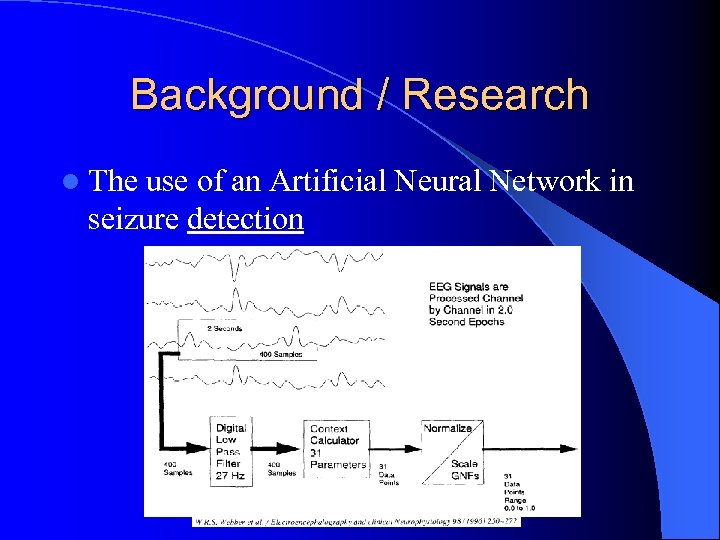 Background / Research l The use of an Artificial Neural Network in seizure detection
 Project Goal Use the ANN approach to detect pre-seizure events (spikes), prior to the onset of a seizure, in order to give an epileptic patient warning that a seizure is imminent
 Project Demands / Wishes l Demands – Successfully detect spikes for prediction of seizures l Wishes – Detect severity of seizure – Become a fully automated system (implantable)
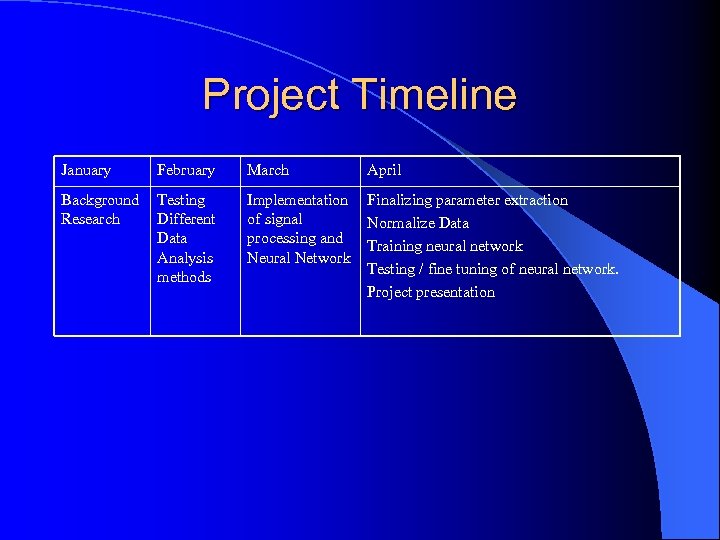 Project Timeline January February March April Background Research Testing Different Data Analysis methods Implementation of signal processing and Neural Network Finalizing parameter extraction Normalize Data Training neural network Testing / fine tuning of neural network. Project presentation
 Materials l Persyst® – Data Acquisition l Microsoft Excel® – Data Formatting l Matlab® Signal Processing Toolkit – Extraction of Data Parameters l Matlab® Neural Network Toolkit – Design of Artificial Neural Network
 Data Acquisition and Formatting l EEG data taken from different VUMC patients over 24 hour periods l Data exported from Persyst® into a text file l Data converted into M-file for use with Matlab – Data collected @ 200 Hz in 2 second epochs
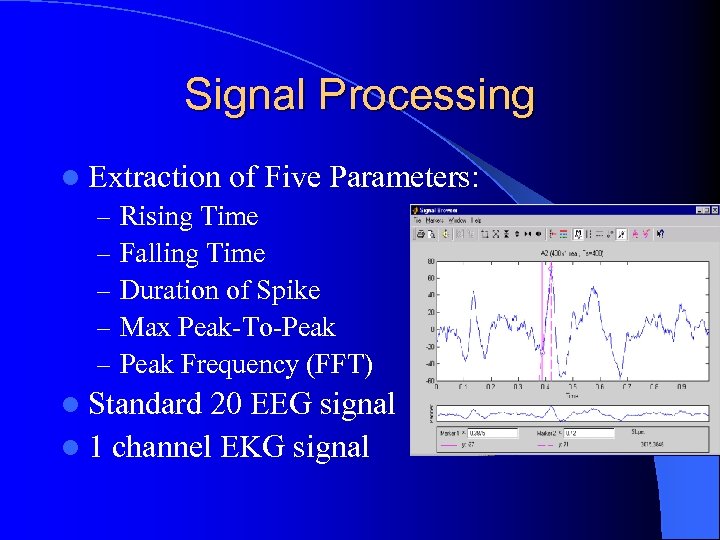 Signal Processing l Extraction of Five Parameters: – Rising Time – Falling Time – Duration of Spike – Max Peak-To-Peak – Peak Frequency (FFT) l Standard 20 EEG signal l 1 channel EKG signal
 Algorithm Design l l l All 20 channels are analyzed at same time Signal processing algorithm selects “candidate” spikes—it does not classify! Many waveforms look like a spike (eyeblinks, artifacts, muscle twitches) Algorithm then extracts the six parameters for the candidate spikes Target spike waveform values to be used in network are selected by Dr. Modur
 Neural Network Normalized parameters used as inputs l 3 layered feed-forward back-propagation network: l – 5 node input layer – 5 node hidden layer – Output layer with 1 output ~100 sample parameter sets used to train network l ~20 – 30 simulation samples l Output threshold range from. 5 -. 65 l If above threshold, spike; if below, no spike l
 Fine Tuning l Look at visible nodes; make sure all weights are functioning l Data from many, different spikes and patients will reduce individuality l Training proceeds with “split data” technique l Spike can occur anywhere from 10 secs to 10 min. before seizure
 Final Product (Ideal) Device would be implantable with external output computer; wireless connection l If and when seizure is detected, computer responds with ‘beep’ or vibration l Computer then gives several options based on severity of spike: l – VNS – Other medical treatment – Nothing at all
 Channel Synchronization l l l Seizure patterns with spikes appearing in even or odd numbered channels Spikes that only occur in one channels are more likely to be artifacts Higher number of spike channels, higher confidence level (only takes two, though) Certain combinations rule out seizure entirely (e. g. eyeblinks, muscle twitches) Simple rule-based program in C++ or MATLAB can sort through all channels
 Patent Search l A patent does exist on a seizure warning and prediction system – System does not use neural network approach – Uses chaotisity profiles to determine reduced randomness in signal – Gives time and severity of seizure Inventors: Iasemidis, Leonidas D; Sackellares, James. Appl. No: 400982 l Persyst® has developed detection system; is not neural network based l
 Market Cost Analysis l Cost of prediction program = $2000 (approximated from Persyst®) l Cost of implantable detector = $1000 (approximated from Cyberonix®) l Cost of readout computer = $400 (approximated from Palm®) Total Cost = $3400
 Cost vs. Benefits Costs Benefits Price of device Could save lives Surgical risks of implantation Hassle of wearing implantable device Risks of device failure; false pos. /neg. Could prevent seizures from happening Take the “randomness” out of a seizure
 Current Status l Signal Processing – Redesigning “Context Calculator” – Normalizing Data l Neural Network – Formatting Inputs for implementation – Making sure weights are assigned properly
 Future Work Upon completion of network training, we will simulate network with many sets of test data l Analysis of the network will be done to make sure every node is operating properly l After finalizing the network the project will move towards automation l Also researching cluster analysis as a possible collaborative approach l
 Main References Webber, W. R. S. , et al. An approach to seizure detection using an artificial neural network (ANN). Electroenceph. Clin. Neurophysiol. , 1996, 98: 250 -272 l Pradhan, N. , et al. Detection of Seizure Activity in EEG by an Artificial Neural Network. , Computers and Biomedical Research, 1996, 29: 303 -313 l Rumelhart, D. Parallel Distributed Processing, 1986: The MIT Press. l Eberhart, R. C. , Dobbins, R. W. Neural Network PC Tools, 1990: Academic Press, Inc. l