


 Скачать презентацию Seismic Evaluation of the Fruitland Formation with Implications
b05feebe61c05ff462c3d0f83759d1aa.ppt
- Количество слайдов: 1
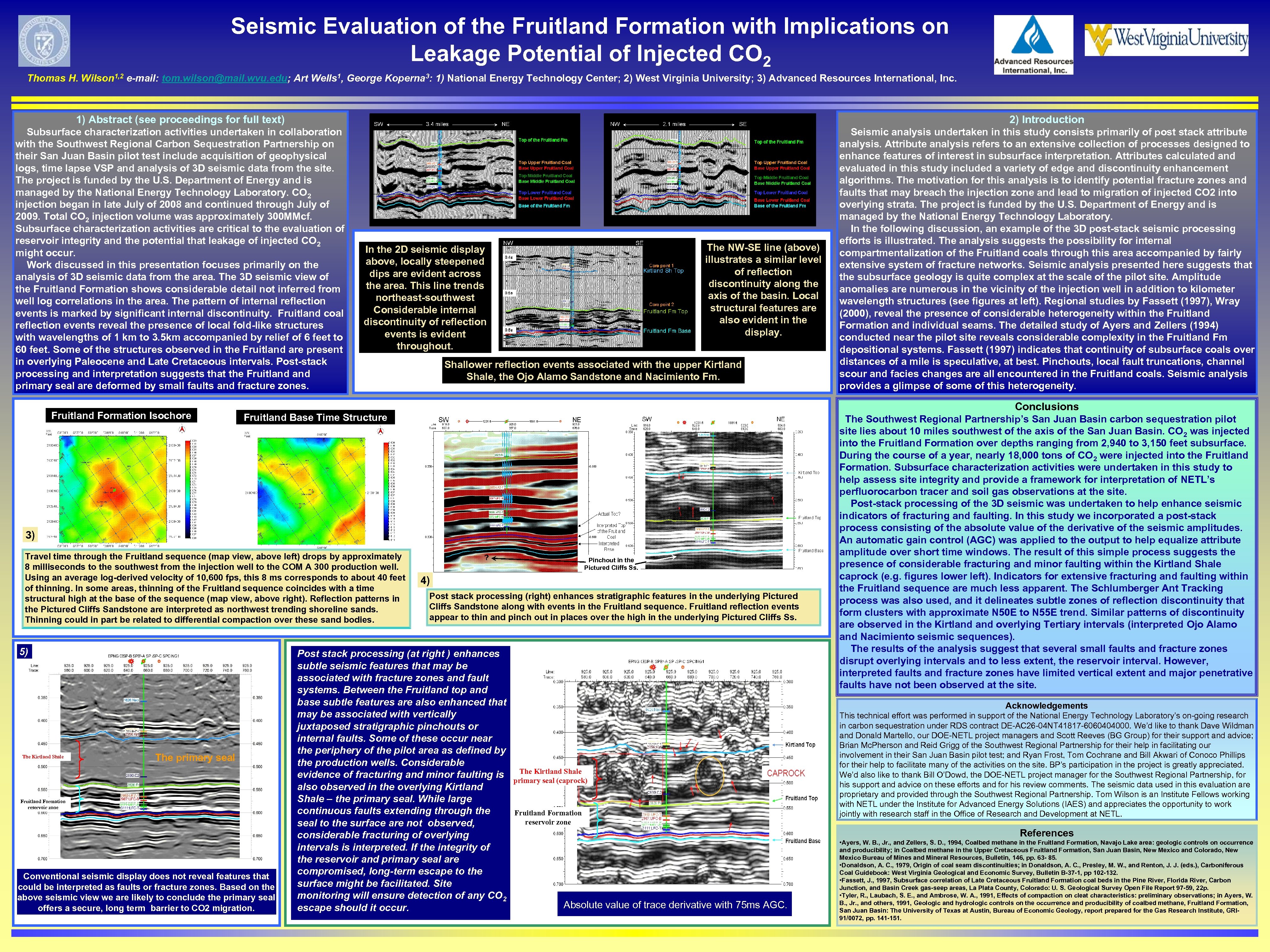 Seismic Evaluation of the Fruitland Formation with Implications on Leakage Potential of Injected CO 2 Thomas H. Wilson 1, 2 e-mail: tom. wilson@mail. wvu. edu; Art Wells 1, George Koperna 3: 1) National Energy Technology Center; 2) West Virginia University; 3) Advanced Resources International, Inc. 1) Abstract (see proceedings for full text) 2) Introduction Subsurface characterization activities undertaken in collaboration with the Southwest Regional Carbon Sequestration Partnership on their San Juan Basin pilot test include acquisition of geophysical logs, time lapse VSP and analysis of 3 D seismic data from the site. The project is funded by the U. S. Department of Energy and is managed by the National Energy Technology Laboratory. CO 2 injection began in late July of 2008 and continued through July of 2009. Total CO 2 injection volume was approximately 300 MMcf. Subsurface characterization activities are critical to the evaluation of reservoir integrity and the potential that leakage of injected CO 2 might occur. Work discussed in this presentation focuses primarily on the analysis of 3 D seismic data from the area. The 3 D seismic view of the Fruitland Formation shows considerable detail not inferred from well log correlations in the area. The pattern of internal reflection events is marked by significant internal discontinuity. Fruitland coal reflection events reveal the presence of local fold-like structures with wavelengths of 1 km to 3. 5 km accompanied by relief of 6 feet to 60 feet. Some of the structures observed in the Fruitland are present in overlying Paleocene and Late Cretaceous intervals. Post-stack processing and interpretation suggests that the Fruitland primary seal are deformed by small faults and fracture zones. Seismic analysis undertaken in this study consists primarily of post stack attribute analysis. Attribute analysis refers to an extensive collection of processes designed to enhance features of interest in subsurface interpretation. Attributes calculated and evaluated in this study included a variety of edge and discontinuity enhancement algorithms. The motivation for this analysis is to identify potential fracture zones and faults that may breach the injection zone and lead to migration of injected CO 2 into overlying strata. The project is funded by the U. S. Department of Energy and is managed by the National Energy Technology Laboratory. In the following discussion, an example of the 3 D post-stack seismic processing efforts is illustrated. The analysis suggests the possibility for internal compartmentalization of the Fruitland coals through this area accompanied by fairly extensive system of fracture networks. Seismic analysis presented here suggests that the subsurface geology is quite complex at the scale of the pilot site. Amplitude anomalies are numerous in the vicinity of the injection well in addition to kilometer wavelength structures (see figures at left). Regional studies by Fassett (1997), Wray (2000), reveal the presence of considerable heterogeneity within the Fruitland Formation and individual seams. The detailed study of Ayers and Zellers (1994) conducted near the pilot site reveals considerable complexity in the Fruitland Fm depositional systems. Fassett (1997) indicates that continuity of subsurface coals over distances of a mile is speculative, at best. Pinchouts, local fault truncations, channel scour and facies changes are all encountered in the Fruitland coals. Seismic analysis provides a glimpse of some of this heterogeneity. Fruitland Formation Isochore The NW-SE line (above) illustrates a similar level of reflection discontinuity along the axis of the basin. Local structural features are also evident in the display. In the 2 D seismic display above, locally steepened dips are evident across the area. This line trends northeast-southwest Considerable internal discontinuity of reflection events is evident throughout. Shallower reflection events associated with the upper Kirtland Shale, the Ojo Alamo Sandstone and Nacimiento Fm. Conclusions Fruitland Base Time Structure 3) Travel time through the Fruitland sequence (map view, above left) drops by approximately 8 milliseconds to the southwest from the injection well to the COM A 300 production well. Using an average log-derived velocity of 10, 600 fps, this 8 ms corresponds to about 40 feet of thinning. In some areas, thinning of the Fruitland sequence coincides with a time structural high at the base of the sequence (map view, above right). Reflection patterns in the Pictured Cliffs Sandstone are interpreted as northwest trending shoreline sands. Thinning could in part be related to differential compaction over these sand bodies. 5) The Kirtland Shale The primary seal Fruitland Formation reservoir zone Conventional seismic display does not reveal features that could be interpreted as faults or fracture zones. Based on the above seismic view we are likely to conclude the primary seal offers a secure, long term barrier to CO 2 migration. ? Pinchout in the Pictured Cliffs Ss. 4) Post stack processing (right) enhances stratigraphic features in the underlying Pictured Cliffs Sandstone along with events in the Fruitland sequence. Fruitland reflection events appear to thin and pinch out in places over the high in the underlying Pictured Cliffs Ss. Post stack processing (at right ) enhances subtle seismic features that may be associated with fracture zones and fault systems. Between the Fruitland top and base subtle features are also enhanced that may be associated with vertically juxtaposed stratigraphic pinchouts or internal faults. Some of these occur near the periphery of the pilot area as defined by the production wells. Considerable evidence of fracturing and minor faulting is also observed in the overlying Kirtland Shale – the primary seal. While large continuous faults extending through the seal to the surface are not observed, considerable fracturing of overlying intervals is interpreted. If the integrity of the reservoir and primary seal are compromised, long-term escape to the surface might be facilitated. Site monitoring will ensure detection of any CO 2 escape should it occur. The Southwest Regional Partnership’s San Juan Basin carbon sequestration pilot site lies about 10 miles southwest of the axis of the San Juan Basin. CO 2 was injected into the Fruitland Formation over depths ranging from 2, 940 to 3, 150 feet subsurface. During the course of a year, nearly 18, 000 tons of CO 2 were injected into the Fruitland Formation. Subsurface characterization activities were undertaken in this study to help assess site integrity and provide a framework for interpretation of NETL’s perfluorocarbon tracer and soil gas observations at the site. Post-stack processing of the 3 D seismic was undertaken to help enhance seismic indicators of fracturing and faulting. In this study we incorporated a post-stack process consisting of the absolute value of the derivative of the seismic amplitudes. An automatic gain control (AGC) was applied to the output to help equalize attribute amplitude over short time windows. The result of this simple process suggests the presence of considerable fracturing and minor faulting within the Kirtland Shale caprock (e. g. figures lower left). Indicators for extensive fracturing and faulting within the Fruitland sequence are much less apparent. The Schlumberger Ant Tracking process was also used, and it delineates subtle zones of reflection discontinuity that form clusters with approximate N 50 E to N 55 E trend. Similar patterns of discontinuity are observed in the Kirtland overlying Tertiary intervals (interpreted Ojo Alamo and Nacimiento seismic sequences). The results of the analysis suggest that several small faults and fracture zones disrupt overlying intervals and to less extent, the reservoir interval. However, interpreted faults and fracture zones have limited vertical extent and major penetrative faults have not been observed at the site. Acknowledgements The Kirtland Shale primary seal (caprock) Fruitland Formation reservoir zone This technical effort was performed in support of the National Energy Technology Laboratory’s on-going research in carbon sequestration under RDS contract DE-AC 26 -04 NT 41817 -6060404000. We’d like to thank Dave Wildman and Donald Martello, our DOE-NETL project managers and Scott Reeves (BG Group) for their support and advice; Brian Mc. Pherson and Reid Grigg of the Southwest Regional Partnership for their help in facilitating our involvement in their San Juan Basin pilot test; and Ryan Frost, Tom Cochrane and Bill Akwari of Conoco Phillips for their help to facilitate many of the activities on the site. BP’s participation in the project is greatly appreciated. We’d also like to thank Bill O’Dowd, the DOE-NETL project manager for the Southwest Regional Partnership, for his support and advice on these efforts and for his review comments. The seismic data used in this evaluation are proprietary and provided through the Southwest Regional Partnership. Tom Wilson is an Institute Fellows working with NETL under the Institute for Advanced Energy Solutions (IAES) and appreciates the opportunity to work jointly with research staff in the Office of Research and Development at NETL. References Absolute value of trace derivative with 75 ms AGC. • Ayers, W. B. , Jr. , and Zellers, S. D. , 1994, Coalbed methane in the Fruitland Formation, Navajo Lake area: geologic controls on occurrence and producibility; in Coalbed methane in the Upper Cretaceous Fruitland Formation, San Juan Basin, New Mexico and Colorado, New Mexico Bureau of Mines and Mineral Resources, Bulletin, 146, pp. 63 - 85. • Donaldson, A. C. , 1979, Origin of coal seam discontinuities; in Donaldson, A. C. , Presley, M. W. , and Renton, J. J. (eds. ), Carboniferous Coal Guidebook: West Virginia Geological and Economic Survey, Bulletin B-37 -1, pp 102 -132. • Fassett, J. , 1997, Subsurface correlation of Late Cretaceous Fruitland Formation coal beds in the Pine River, Florida River, Carbon Junction, and Basin Creek gas-seep areas, La Plata County, Colorado: U. S. Geological Survey Open File Report 97 -59, 22 p. • Tyler, R. , Laubach, S. E. , and Ambrose, W. A. , 1991, Effects of compaction on cleat characteristics: preliminary observations; in Ayers, W. B. , Jr. , and others, 1991, Geologic and hydrologic controls on the occurrence and producibility of coalbed methane, Fruitland Formation, San Juan Basin: The University of Texas at Austin, Bureau of Economic Geology, report prepared for the Gas Research Institute, GRI 91/0072, pp. 141 -151.