


 Скачать презентацию Segmenting the Paris residential market according to temporal
857421c68251eeb70027c2b2c2d61db3.ppt
- Количество слайдов: 36
 Segmenting the Paris residential market according to temporal evolution and housing attributes Michel Baroni, ESSEC Business School, France Fabrice Barthélémy, Univ. de Cergy-Pontoise, France François Des Rosiers, Laval University, Canada Paper presented at the 2009 ERES International Conference, Stockholm, Sweden, June 24 -27 Research partly funded by
 Objective and Context of Research This study aims at testing the existence of similarities and differences in the pricing of housing characteristics among the twenty “arrondissements” of Paris, France. The complexity of metropolitan residential markets makes it most relevant to assume that hedonic prices are not homogeneous over time and space. If so, various submarkets may be generated based on selected housing attributes affecting both the level and evolution of prices. 2 This market differentiation issue is all the more relevant in a rapidly changing real estate context and when looked upon from the investor’s perspective.
 Literature Review – Market Segmentation and House Price Appreciation Several authors have investigated the heterogeneity-ofattributes and market segmentation issues (Bajic, 1985; Can & Megbolugbe, 1997; Goodman & Thibodeau, 1998 and 2003; Thériault et al. , 2003; Bourassa, Hoesli & Peng, 2003; Des Rosiers et al. , 2007) as they affect the shaping and interpretation of hedonic prices and question a major assumption of the HP model (Rosen, 1974). 3 In that context, the price appreciation issue has been extensively addressed (Case & Quigley, 1991; Quigley, 1995; Knight, Dombrow and Sirmans, 1995; Meese & Wallace, 2003, for Paris dataset; Bourassa, Hoesli & Sun, 2006; Bourassa et al. , 2009).
 Literature Review – Market Segmentation and House Price Appreciation Past research suggests that…: Ø Ø Houses will appreciate at different rates depending on property characteristics, the relative bargaining power of agents and the strength of the local submarket; Ø 4 Hedonic prices of housing attributes may vary over space and time according to submarket specifics and structure as well as to property buyers’ profiles; Reliable estimates of the willingness-to-pay for housing attributes may be derived from the hedonic price (HP) framework in spite of the heterogeneity problem
 Overall Analytical Approach Step 1: Building a global hedonic price model for Paris as a whole, with a focus on the marginal contribution of time (Price Index), living area, building period and location (“arrondissements” dummies) on values. Step 2: Performing a series of Principal Component Analyses (PCA) on selected cluster criteria using either level or change variables, depending on the context. Step 3: Based on the interpretation of findings, homogeneous submarkets are generated and discussed. 5
 The Database The database (BIEN) is provided by the Chambre des Notaires de France and includes, after filtering, some 252, 000 apartment sales spread over a 17 year period, that is from 1990 to 2006. Housing descriptors include, among other things: Ø Ø Ø Ø 6 Ø Building age (construction period); Apartment size and number of rooms; Floor location in building; Number of bathrooms Presence of a garage; Type of street and access to building (blvd, square, alley, etc. ); Location dummy variables standing for the 20 “arrondissements” and 80 “neighbourhoods” (“quartiers”); Time dummy variables for sale year and month.
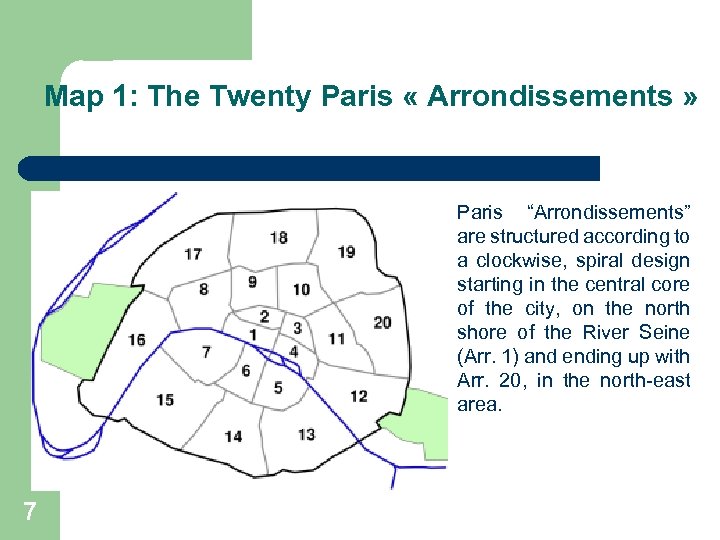 Map 1: The Twenty Paris « Arrondissements » Paris “Arrondissements” are structured according to a clockwise, spiral design starting in the central core of the city, on the north shore of the River Seine (Arr. 1) and ending up with Arr. 20, in the north-east area. 7
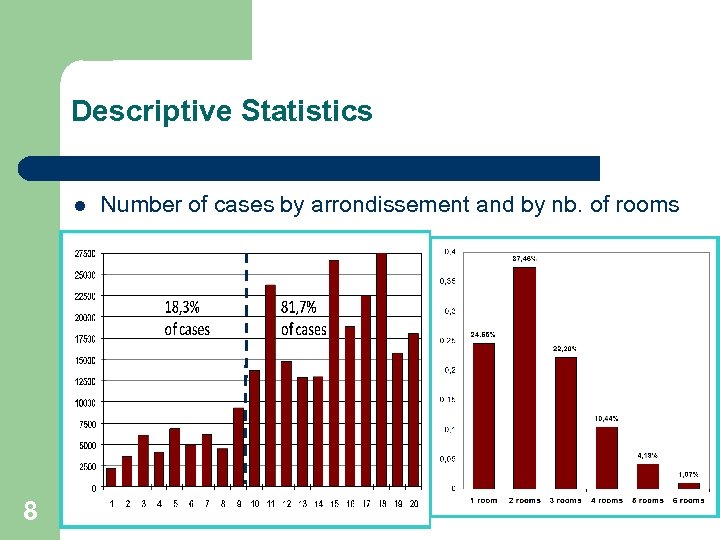 Descriptive Statistics l 8 Number of cases by arrondissement and by nb. of rooms
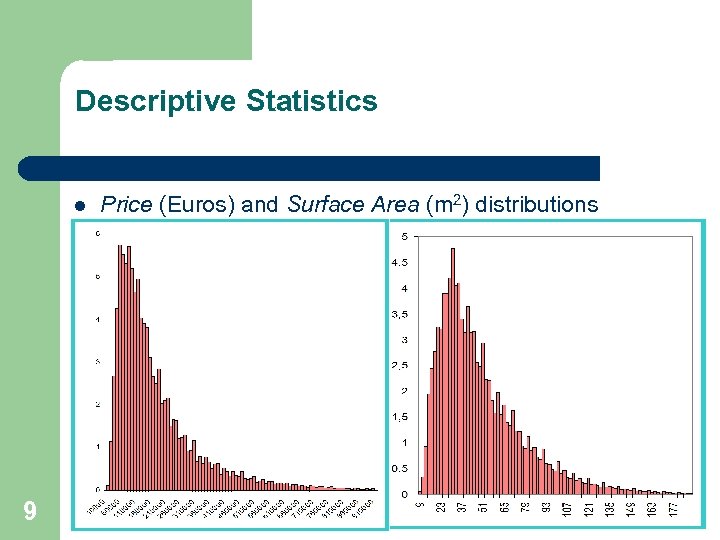 Descriptive Statistics l 9 Price (Euros) and Surface Area (m 2) distributions
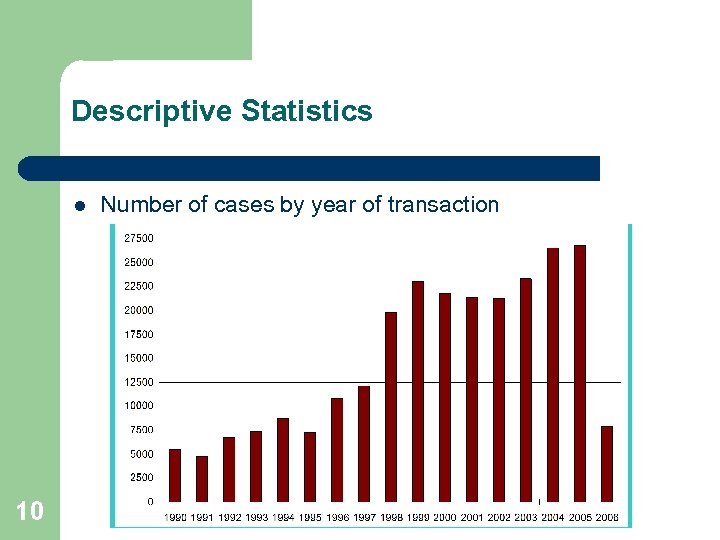 Descriptive Statistics l 10 Number of cases by year of transaction
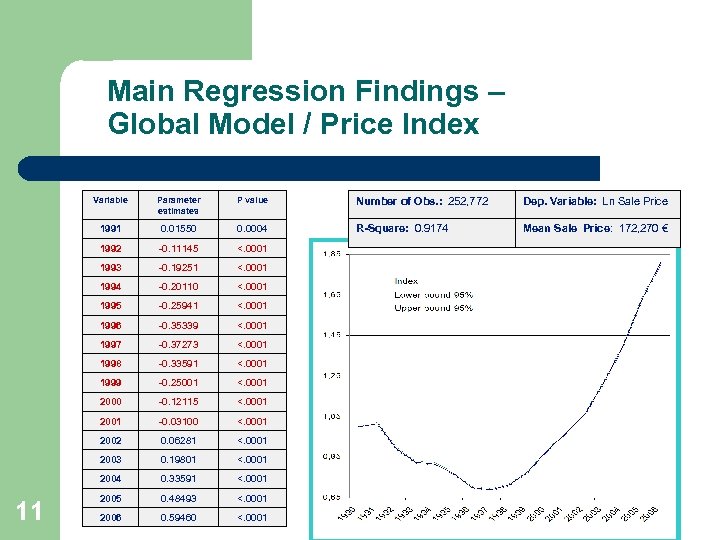 Main Regression Findings – Global Model / Price Index Variable P value Number of Obs. : 252, 772 Dep. Variable: Ln Sale Price 1991 0. 01550 0. 0004 R-Square: 0. 9174 Mean Sale Price: 172, 270 € 1992 -0. 11145 <. 0001 1993 -0. 19251 <. 0001 1994 -0. 20110 <. 0001 1995 -0. 25941 <. 0001 1996 -0. 35339 <. 0001 1997 -0. 37273 <. 0001 1998 -0. 33591 <. 0001 1999 -0. 25001 <. 0001 2000 -0. 12115 <. 0001 2001 -0. 03100 <. 0001 2002 0. 06281 <. 0001 2003 0. 19801 <. 0001 2004 11 Parameter estimates 0. 33591 <. 0001 2005 0. 48493 <. 0001 2006 0. 59460 <. 0001
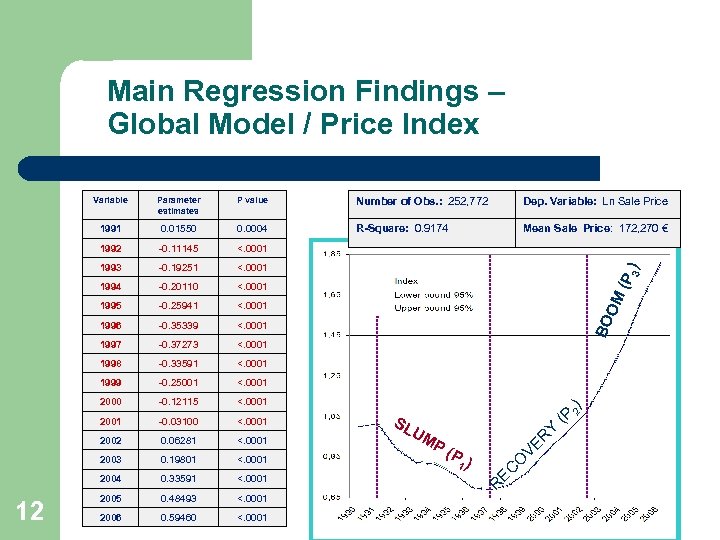 Main Regression Findings – Global Model / Price Index P value Number of Obs. : 252, 772 Dep. Variable: Ln Sale Price 1991 0. 01550 0. 0004 R-Square: 0. 9174 Mean Sale Price: 172, 270 € 1992 -0. 11145 <. 0001 1993 -0. 19251 <. 0001 1994 -0. 20110 <. 0001 1995 -0. 25941 <. 0001 1996 -0. 35339 <. 0001 1997 -0. 37273 <. 0001 1998 -0. 33591 <. 0001 1999 -0. 25001 <. 0001 2000 -0. 12115 <. 0001 2001 -0. 03100 <. 0001 2002 0. 06281 <. 0001 2003 0. 19801 <. 0001 2004 12 Parameter estimates 0. 33591 <. 0001 2005 0. 48493 <. 0001 2006 0. 59460 <. 0001 Y (P SL U 2) BO OM (P 3) Variable R MP O EC R 1) VE (P
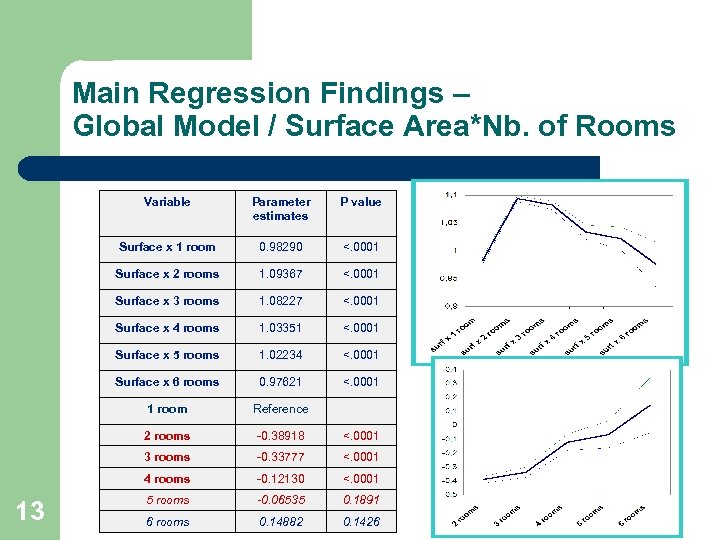 Main Regression Findings – Global Model / Surface Area*Nb. of Rooms Variable P value Surface x 1 room 0. 98290 <. 0001 Surface x 2 rooms 1. 09367 <. 0001 Surface x 3 rooms 1. 08227 <. 0001 Surface x 4 rooms 1. 03351 <. 0001 Surface x 5 rooms 1. 02234 <. 0001 Surface x 6 rooms 0. 97621 <. 0001 1 room Reference 2 rooms -0. 38918 <. 0001 3 rooms -0. 33777 <. 0001 4 rooms 13 Parameter estimates -0. 12130 <. 0001 5 rooms -0. 06535 0. 1891 6 rooms 0. 14882 0. 1426
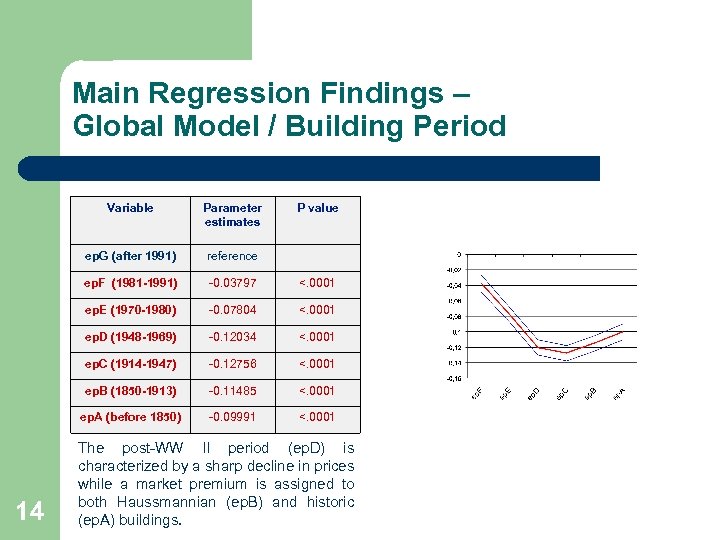 Main Regression Findings – Global Model / Building Period Variable ep. G (after 1991) reference ep. F (1981 -1991) -0. 03797 <. 0001 ep. E (1970 -1980) -0. 07804 <. 0001 ep. D (1948 -1969) -0. 12034 <. 0001 ep. C (1914 -1947) -0. 12756 <. 0001 ep. B (1850 -1913) -0. 11485 <. 0001 ep. A (before 1850) 14 Parameter estimates P value -0. 09991 <. 0001 The post-WW II period (ep. D) is characterized by a sharp decline in prices while a market premium is assigned to both Haussmannian (ep. B) and historic (ep. A) buildings.
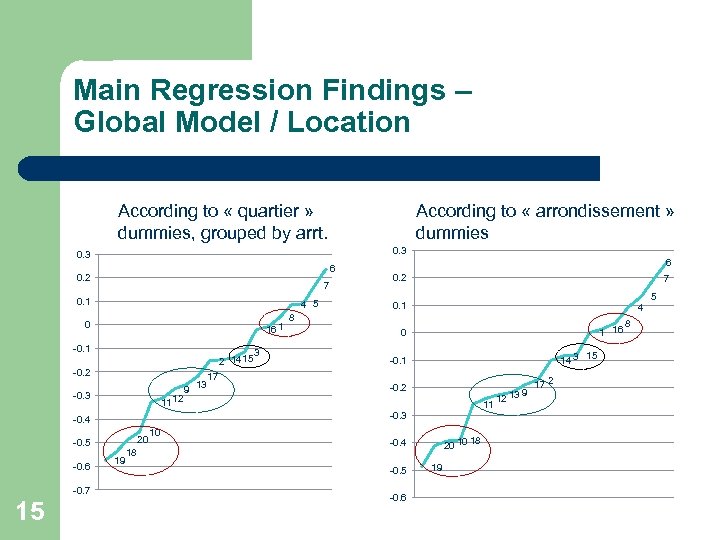 Main Regression Findings – Global Model / Location According to « quartier » dummies, grouped by arrt. 0. 3 6 0. 2 7 0. 1 4 5 0 16 1 -0. 1 2 14 15 -0. 2 -0. 3 11 12 20 -0. 5 -0. 7 15 9 13 3 6 0. 2 7 0. 1 4 8 1 16 0 14 3 -0. 1 17 -0. 2 11 -0. 3 -0. 4 -0. 6 According to « arrondissement » dummies 19 18 10 20 10 -0. 4 -0. 5 -0. 6 19 18 12 13 9 17 2 15 8 5
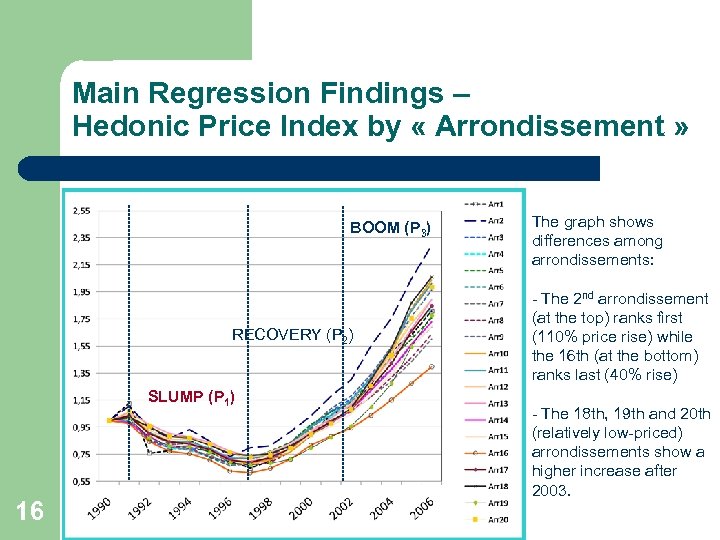 Main Regression Findings – Hedonic Price Index by « Arrondissement » BOOM (P 3) RECOVERY (P 2) SLUMP (P 1) 16 The graph shows differences among arrondissements: - The 2 nd arrondissement (at the top) ranks first (110% price rise) while the 16 th (at the bottom) ranks last (40% rise) - The 18 th, 19 th and 20 th (relatively low-priced) arrondissements show a higher increase after 2003.
 Resorting to PCA For Sorting Out Specific Residential Submarkets The principal components method (PCA) is applied to each set of estimated effects of attributes. The method essentially involves an orthogonal transformation of a set of variables (x 1, x 2, . . . , xm) into a new set of mutually independent components, or factors (y 1, y 2, . . . , ym) (King 1969), each of which consisting of a linear combination of all initial variables with weights that vary among components. 17 The first component, which captures the highest variance among the “m” set of components, also contributes most to the phenomenon under analysis.
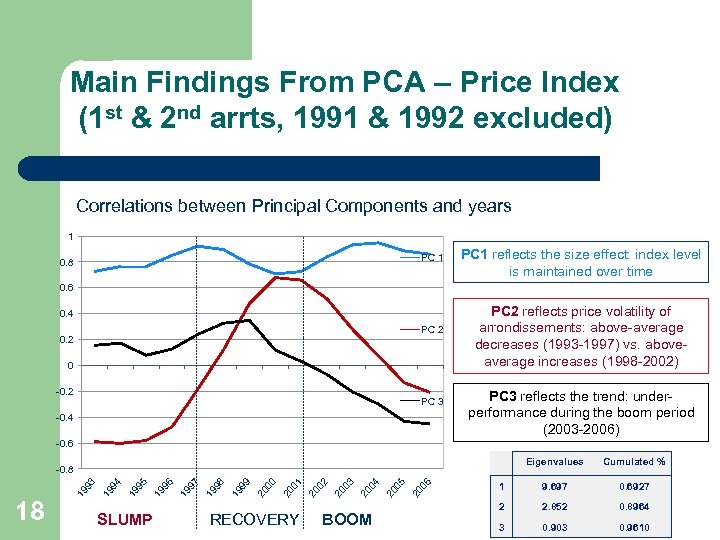 Main Findings From PCA – Price Index (1 st & 2 nd arrts, 1991 & 1992 excluded) Correlations between Principal Components and years 1 PC 1 0. 8 PC 1 reflects the size effect: index level is maintained over time 0. 6 0. 4 PC 2 0 -0. 2 PC 3 -0. 4 PC 2 reflects price volatility of arrondissements: above-average decreases (1993 -1997) vs. aboveaverage increases (1998 -2002) PC 3 reflects the trend: underperformance during the boom period (2003 -2006) -0. 6 SLUMP RECOVERY BOOM 06 20 05 20 04 20 03 20 02 20 01 20 00 20 99 19 98 19 97 19 96 19 95 19 94 19 18 19 93 -0. 8 Eigenvalues Cumulated % 1 9. 697 0. 6927 2 2. 852 0. 8964 3 0. 903 0. 9610
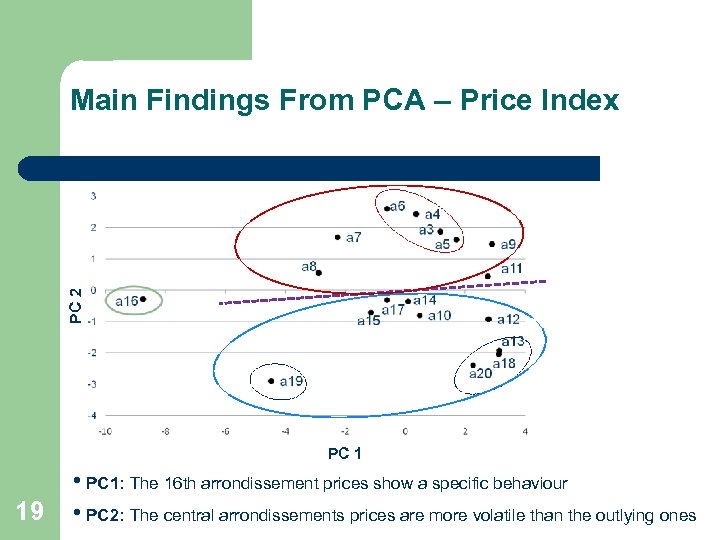 PC 2 Main Findings From PCA – Price Index PC 1 19 • PC 1: The 16 th arrondissement prices show a specific behaviour • PC 2: The central arrondissements prices are more volatile than the outlying ones
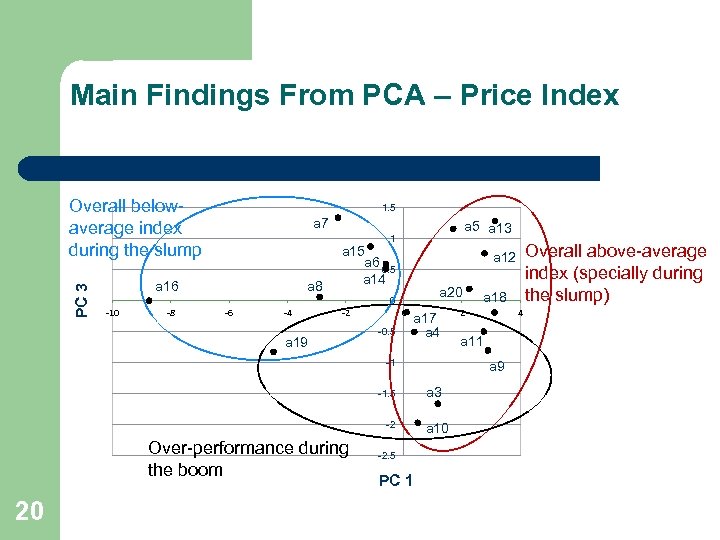 Main Findings From PCA – Price Index PC 3 Overall belowaverage index during the slump 1. 5 a 7 a 5 a 13 1 a 16 a 8 a 15 a 6 0. 5 a 14 a 20 0 -10 -8 -6 -4 -2 a 19 0 -0. 5 a 17 a 4 -1 -1. 5 -2 Over-performance during the boom 20 Overall above-average index (specially during the slump) a 12 -2. 5 PC 1 a 18 2 4 a 11 a 9 a 3 a 10
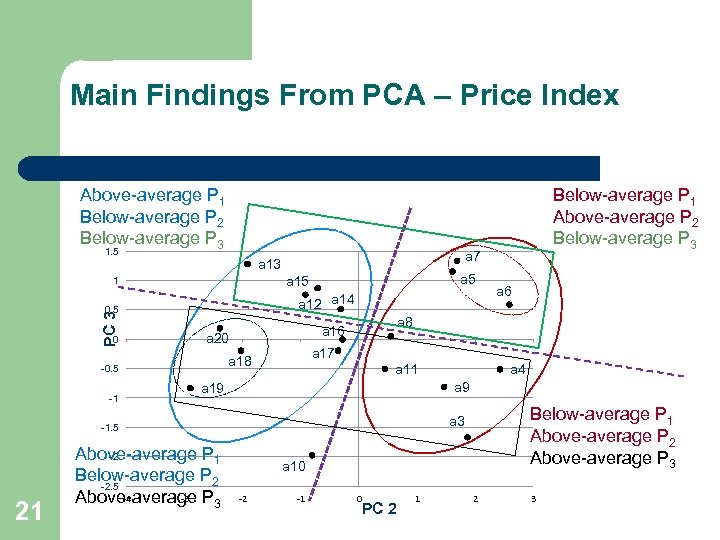 Main Findings From PCA – Price Index Above-average P 1 Below-average P 2 Below-average P 3 1. 5 a 12 a 14 PC 3 a 17 a 18 a 11 Below-average P 1 Above-average P 2 Above-average P 3 a 3 -1. 5 21 a 4 a 9 a 19 Above-average P 1 -2 Below-average P 2 -2. 5 -4 -3 Above-average P 3 a 6 a 8 a 16 a 20 -0. 5 -1 a 5 a 15 0. 5 0 a 7 a 13 1 Below-average P 1 Above-average P 2 Below-average P 3 a 10 -2 -1 0 PC 2 1 2 3
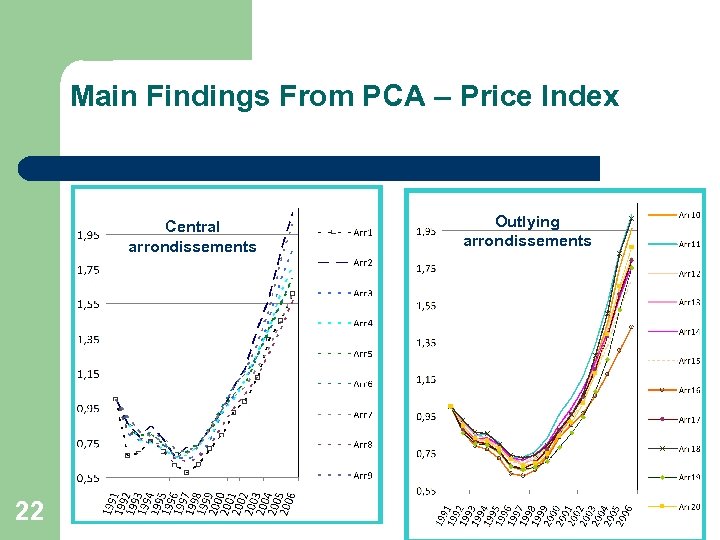 Main Findings From PCA – Price Index Central arrondissements 22 Outlying arrondissements
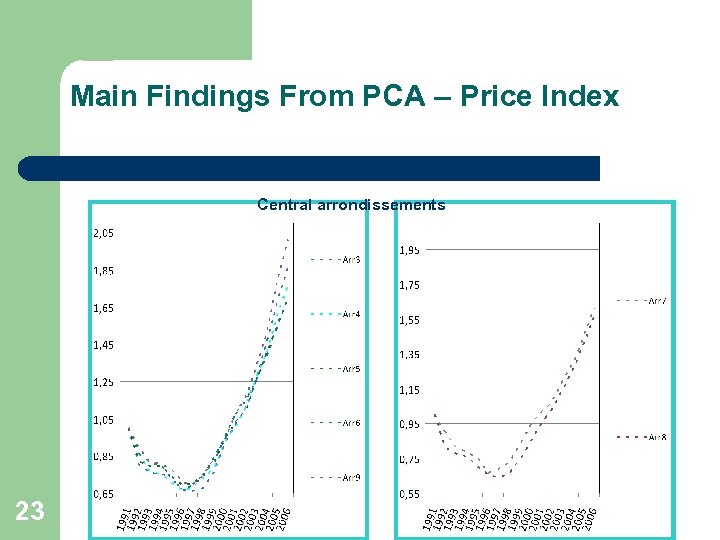 Main Findings From PCA – Price Index Central arrondissements 23
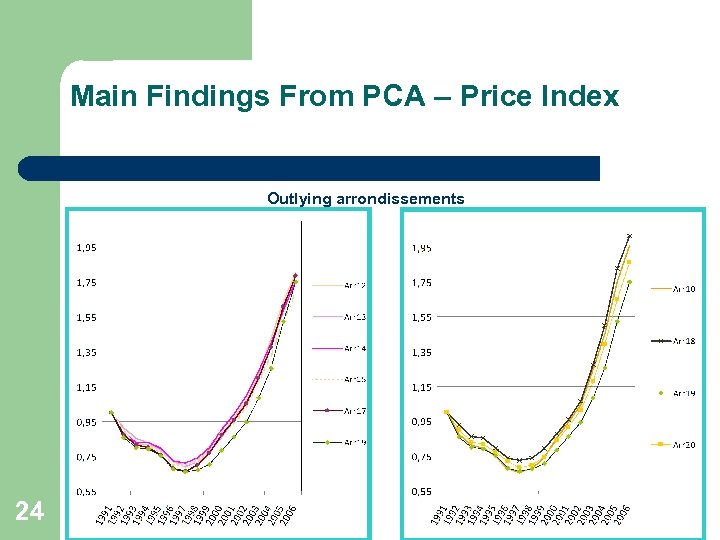 Main Findings From PCA – Price Index Outlying arrondissements 24
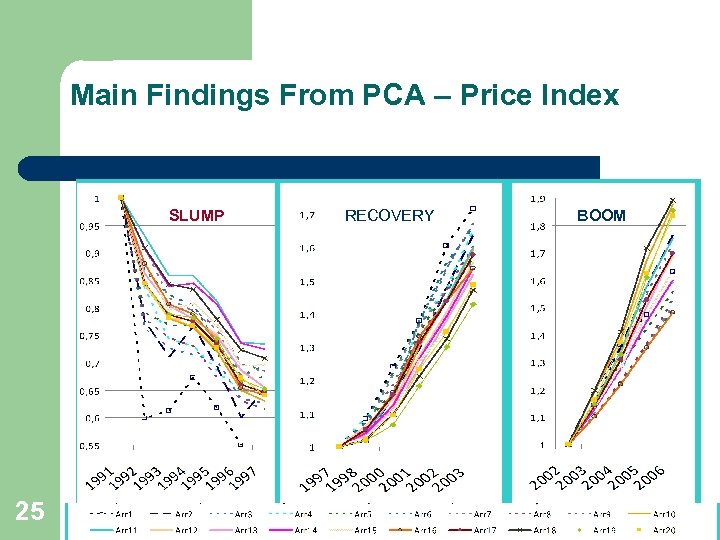 Main Findings From PCA – Price Index SLUMP 25 RECOVERY BOOM
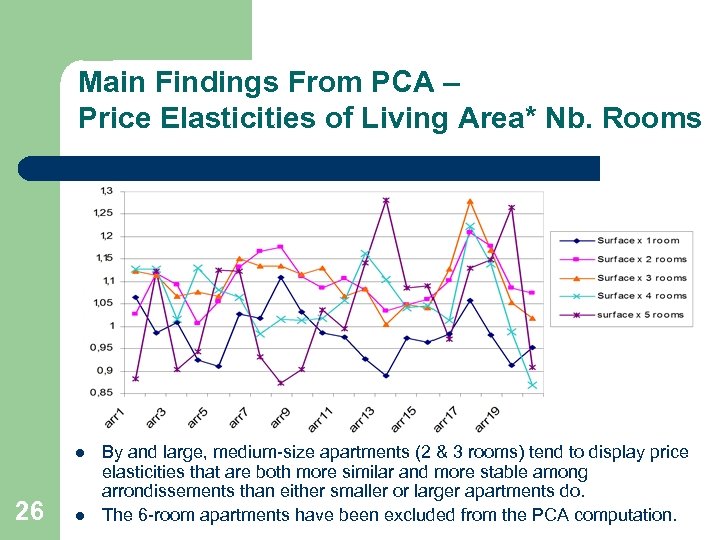 Main Findings From PCA – Price Elasticities of Living Area* Nb. Rooms l 26 l By and large, medium-size apartments (2 & 3 rooms) tend to display price elasticities that are both more similar and more stable among arrondissements than either smaller or larger apartments do. The 6 -room apartments have been excluded from the PCA computation.
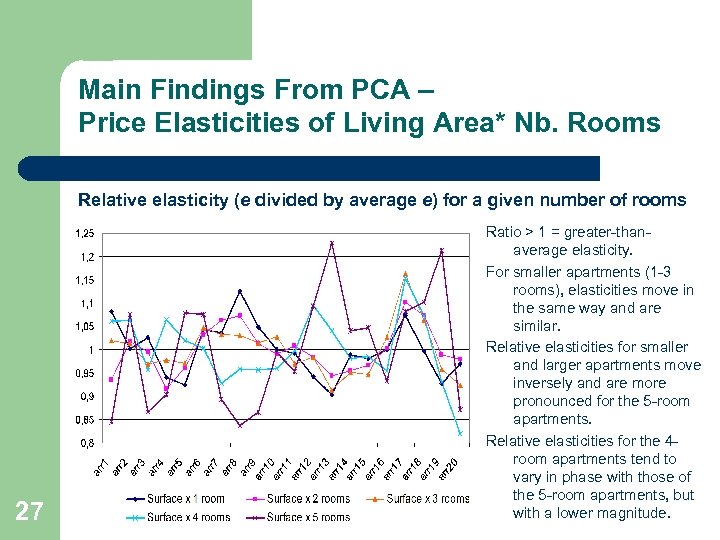 Main Findings From PCA – Price Elasticities of Living Area* Nb. Rooms Relative elasticity (e divided by average e) for a given number of rooms 27 Ratio > 1 = greater-thanaverage elasticity. For smaller apartments (1 -3 rooms), elasticities move in the same way and are similar. Relative elasticities for smaller and larger apartments move inversely and are more pronounced for the 5 -room apartments. Relative elasticities for the 4 room apartments tend to vary in phase with those of the 5 -room apartments, but with a lower magnitude.
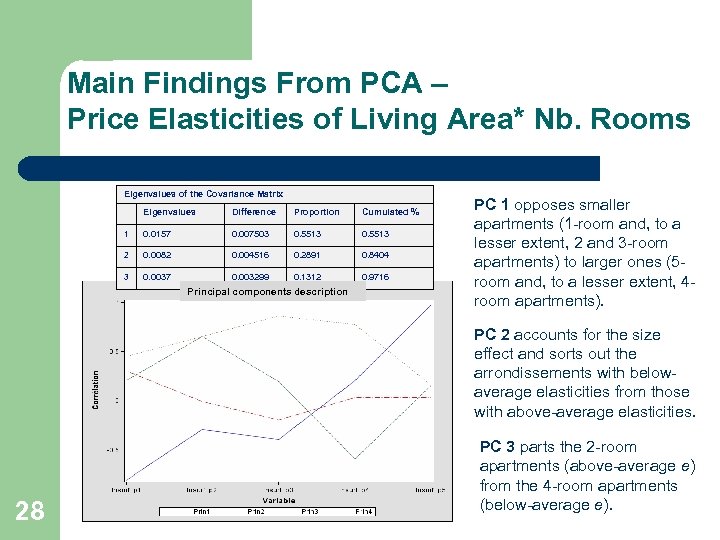 Main Findings From PCA – Price Elasticities of Living Area* Nb. Rooms Eigenvalues of the Covariance Matrix Eigenvalues Difference Proportion Cumulated % 1 0. 0157 0. 007503 0. 5513 2 0. 0082 0. 004516 0. 2891 0. 8404 3 0. 0037 0. 003299 0. 1312 0. 9716 Principal components description PC 1 opposes smaller apartments (1 -room and, to a lesser extent, 2 and 3 -room apartments) to larger ones (5 room and, to a lesser extent, 4 room apartments). PC 2 accounts for the size effect and sorts out the arrondissements with belowaverage elasticities from those with above-average elasticities. 28 PC 3 parts the 2 -room apartments (above-average e) from the 4 -room apartments (below-average e).
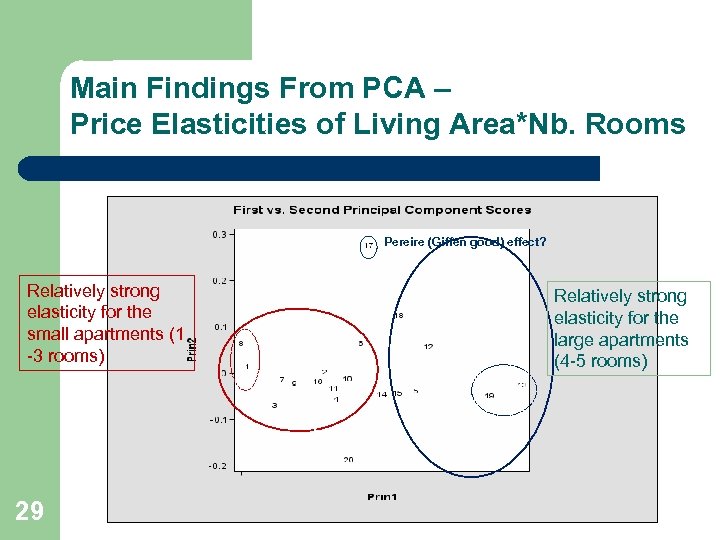 Main Findings From PCA – Price Elasticities of Living Area*Nb. Rooms Pereire (Giffen good) effect? Relatively strong elasticity for the small apartments (1 -3 rooms) 29 Relatively strong elasticity for the large apartments (4 -5 rooms)
 Concluding Comments and Suggestions for Further Research Based on the above findings, it is possible to assert that, while some housing attributes may display stable hedonic prices over space and time, others don’t. This paves the way for structuring specific housing submarkets in Paris around price indices, price elasticities of living area, building period, etc. 30 In particular, a major contribution of this research is to highlight the existence of a twofold residential dynamics in the Paris region, with the central « arrondissements » clearly parting from outlying ones with respect to apartment price appreciation over time.
 Concluding Comments and Suggestions for Further Research Furthermore, preliminary research findings also suggest that hedonic prices of various housing attributes also differ among Paris « quartiers » , which implies that the « arrondissements » , although currently serving as the basic spatial entity for administrative purposes, may not be as homogeneous as generally considered. Finally, while this research uses Paris as a case study, its conclusions extend well beyond any particular context and may be assumed to apply to most metropolitan urban areas in Europe and elsewhere. 31
 References l l l l 32 Bajic, V. (1985). Housing Market Segmentation And Demand For Housing Attributes: Some Empirical Findings, AREUEA Journal, 13(1), 58 -75. Bourassa, S. C. , Hoesli, M. and Peng, V. S. (2003). Do Housing Submarkets Really Matter? , Journal of Housing Economics, 12: 12 -28. Bourassa, S. C. , Hoesli, M. and Sun, J. (2006). A Simple Alternative House Price Index Method, Journal of Housing Economics, 15: 80 -97. Bourassa, S. C. , Haurin, D. , Haurin, J. L. and Hoesli, M. (2009). House Price Changes and Idiosyncratic Risk: The Impact of Property Characteristics, Real Estate Economics, forthcoming. Can, A. et Megbolugbe, I. (1997). Spatial Dependence and House Price Index Construction, Journal of Real Estate Finance and Economics, 14(1 -2): 203 -222. Case, B. and Quigley, J. M. (1991). The Dynamics of Real Estate Prices, Review of Economics and Statistics, 73(1): 50 -58. Des Rosiers, F. , M. Thériault, Y. Kestens and P-Y. Villeneuve. 2007. Landscaping Attributes and Property Buyers’ Profiles: Their Joint Effects on House Prices, Journal of Housing Studies, 22: 6, 945 -964. Goodman, A. C. et Thibodeau, T. G. (1998). Housing Market Segmentation, Journal of Housing Economics, 7(2): 121 -143.
 References l l l l 33 Goodman, A. C. et Thibodeau, T. G. (2003). Housing Market Segmentation and Hedonic Prediction Accuracy, Journal of Housing Economics, 12(3): 181 -201. King, Leslie J. (1969). King, 1969. Statistical Analysis in Geography, Prentice-Hall, Englewood Cliffs, N. J. Knight, J. R. , Dombrow, J. and Sirmans, C. F. (1995). A Varying Parameters Approach to Constructing House Price Indexes, Real Estate Economics, 23(2): 187 -205. Meese, R. and Wallace, N. (2003). House Price Dynamics and Market Fundamentals: The Parisian Housing Market, Urban Studies, 40: 1027 -1045. Quigley, J. M. (1995). A Simple Hybrid Model for Estimating Real Estate Price Indices, Journal of Housing Economics, 4(12): 1 -12. Rosen, S. (1974). Hedonic Prices and Implicit Markets: Product Differentiation in Pure Competition, Journal of Political Economy, 82: 34 -55. Thériault, M. , Des Rosiers, F. , Villeneuve, P. et Kestens Y. (2003) « Modelling Interactions of Location with Specific Value of Housing Attributes » . Property Management, 21 (1): 25 -62.
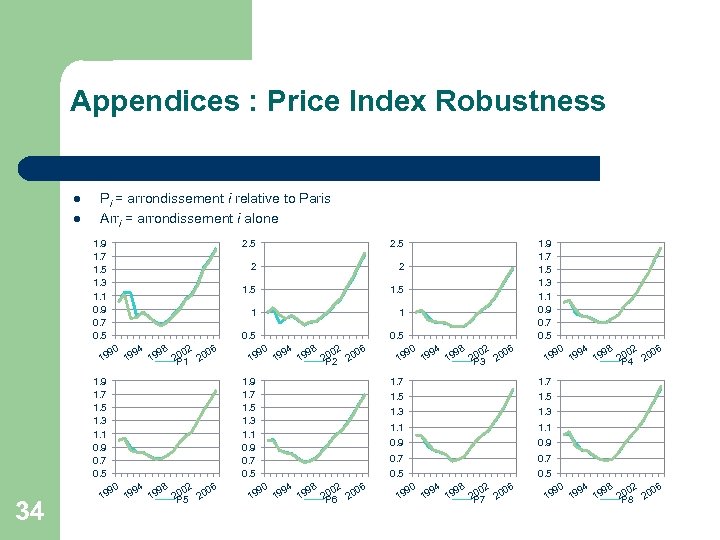 Appendices : Price Index Robustness l l Pi = arrondissement i relative to Paris Arri = arrondissement i alone 1. 9 1. 7 1. 5 1. 3 1. 1 0. 9 0. 7 0. 5 2 94 98 19 02 006 20 P 1 2 1. 9 1. 7 1. 5 1. 3 1. 1 0. 9 0. 7 0. 5 34 1 0 99 1 0. 5 19 1. 5 1 90 2 1. 5 19 2. 5 0. 5 90 19 94 19 98 19 02 006 20 P 2 2 1. 9 1. 7 1. 5 1. 3 1. 1 0. 9 0. 7 0. 5 19 94 19 98 02 006 20 P 5 2 1. 9 1. 7 1. 5 1. 3 1. 1 0. 9 0. 7 0. 5 90 19 94 19 98 19 02 006 20 P 3 2 90 19 1. 7 0. 9 0. 7 0. 5 19 90 19 94 19 98 02 006 20 P 6 2 02 006 20 P 8 2 1. 1 0. 9 98 1. 3 1. 1 02 006 20 P 4 2 1. 5 1. 3 98 19 1. 7 1. 5 94 19 0. 5 19 90 19 94 19 98 02 006 20 P 7 2 90 19 94 19 19
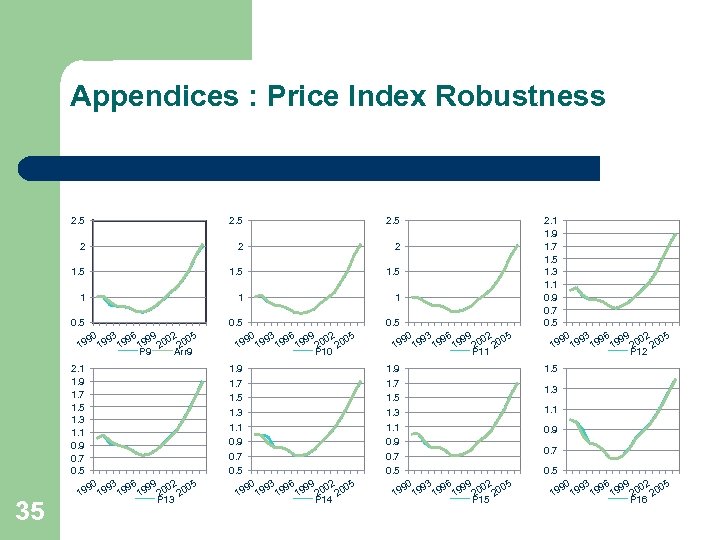 Appendices : Price Index Robustness 2. 5 2 2 2 1. 5 1 1 1 0. 5 90 19 93 96 99 02 05 19 19 19 20 20 P 9 Arr 9 2. 1 1. 9 1. 7 1. 5 1. 3 1. 1 0. 9 0. 7 0. 5 35 90 93 96 99 02 05 19 19 20 20 P 13 2. 1 1. 9 1. 7 1. 5 1. 3 1. 1 0. 9 0. 7 0. 5 90 19 93 19 96 19 99 19 02 05 20 20 P 10 1. 9 1. 7 1. 5 1. 3 1. 1 0. 9 0. 7 0. 5 90 993 996 999 002 005 1 1 1 2 2 P 11 19 1. 7 1. 5 1. 3 1. 1 0. 9 0. 7 0. 5 19 90 19 93 19 96 19 99 02 20 20 P 14 05 90 993 996 999 002 005 1 1 1 2 2 P 12 19 1. 5 1. 3 1. 1 0. 9 0. 7 0. 5 19 90 19 93 19 96 19 99 02 20 20 P 15 05 90 993 996 999 002 005 1 1 1 2 2 P 16 19
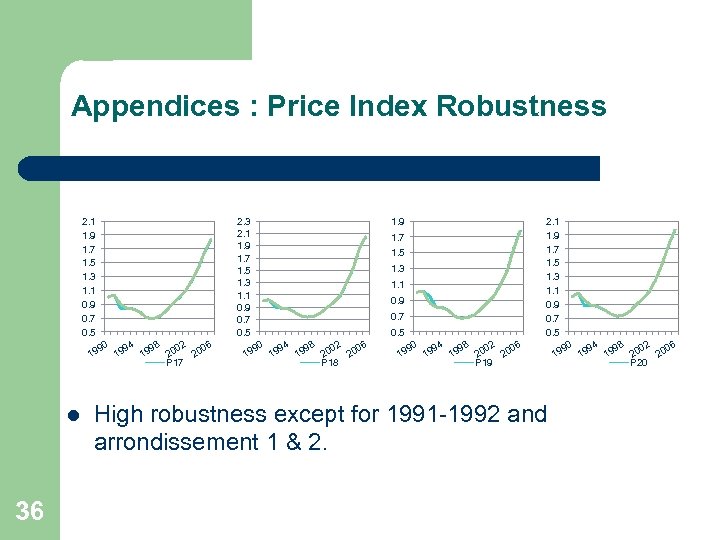 Appendices : Price Index Robustness 2. 1 1. 9 1. 7 1. 5 1. 3 1. 1 0. 9 0. 7 0. 5 2. 3 2. 1 1. 9 1. 7 1. 5 1. 3 1. 1 0. 9 0. 7 0. 5 90 19 l 36 94 19 98 19 02 006 20 2 P 17 1. 9 2. 1 1. 9 1. 7 1. 5 1. 3 1. 1 0. 9 0. 7 0. 5 90 19 94 19 98 19 02 006 20 2 P 18 90 19 94 19 98 19 02 006 20 2 P 19 High robustness except for 1991 -1992 and arrondissement 1 & 2. 90 19 94 19 98 19 02 006 20 2 P 20