


 Скачать презентацию SEG 3101 Fall 2010 Requirements Triage and Negotiation
a5d36edc16f4177e82a2190e81df4044.ppt
- Количество слайдов: 35
 SEG 3101 (Fall 2010) Requirements Triage and Negotiation Gregor v. Bochmann, University of Ottawa Based on Powerpoint slides by Gunter Mussbacher with material from: K. E. Wiegers, D. Leffingwell & D. Widrig, M. Jackson, I. K. Bray, B. Selic, Volere, Telelogic, D. Damian, S. Somé 2008, and D. Amyot 2008 -2009
 Introduction Structured Analysis OO Analysis Problem Frames State Machine-Based Analysis Triage/Prioritization Requirements Negotiation (1) • Possible conflicts to be resolved among stakeholders • Between supplier and customers about costs, benefits, risks • Power struggle within customer organization • Conflicts with other projects about resources • Conflicting goals, features, requirements • . . . • Conflict resolution involves negotiation • Negotiating a coherent set of requirements is not easy • But it is one task of the requirements analyst • Difficult to satisfy everyone, to achieve all goals, make good decisions! • Involves a lot of (group) discussions SEG 3101 (Fall 2010). Requirements Triage and Negotiation 2
 Introduction Structured Analysis OO Analysis Problem Frames State Machine-Based Analysis Triage/Prioritization Requirements Negotiation (2) • First, detect when requirements are inconsistent • Then, convince all stakeholders to understand the essential point of view of each other • Have each party explain what they believe the other party wants and why • Finally, reach an agreement on a coherent set of requirements that meets the needs of as many stakeholders as possible • Analyze each party’s goals, find solutions that do not conflict but ideally support everybody’s goals SEG 3101 (Fall 2010). Requirements Triage and Negotiation 3
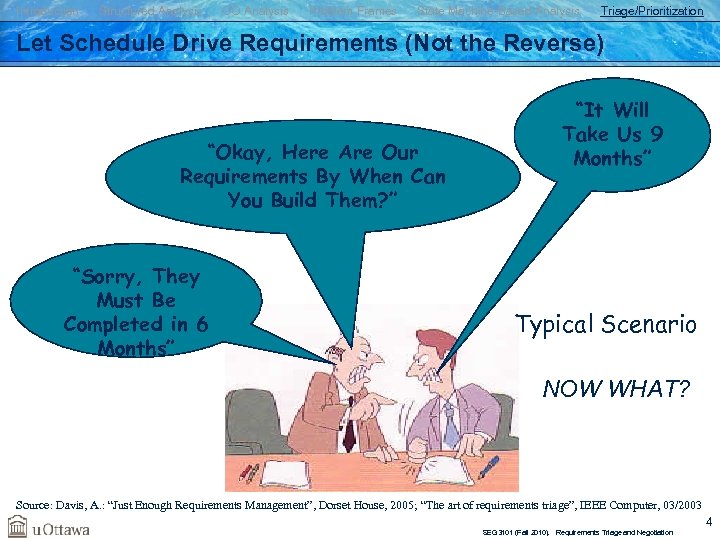 Introduction Structured Analysis OO Analysis Problem Frames State Machine-Based Analysis Triage/Prioritization Let Schedule Drive Requirements (Not the Reverse) “Okay, Here Are Our Requirements By When Can You Build Them? ” “Sorry, They Must Be Completed in 6 Months” “It Will Take Us 9 Months” Typical Scenario NOW WHAT? Source: Davis, A. : “Just Enough Requirements Management”, Dorset House, 2005; “The art of requirements triage”, IEEE Computer, 03/2003 SEG 3101 (Fall 2010). Requirements Triage and Negotiation 4
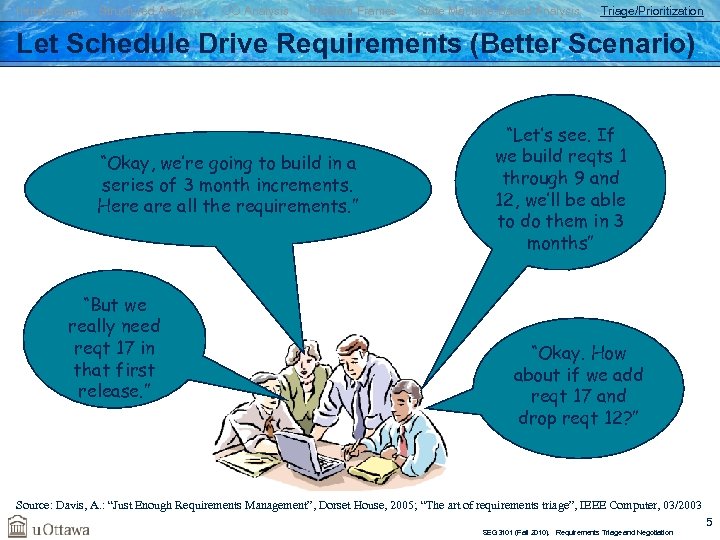 Introduction Structured Analysis OO Analysis Problem Frames State Machine-Based Analysis Triage/Prioritization Let Schedule Drive Requirements (Better Scenario) “Okay, we’re going to build in a series of 3 month increments. Here all the requirements. ” “But we really need reqt 17 in that first release. ” “Let’s see. If we build reqts 1 through 9 and 12, we’ll be able to do them in 3 months” “Okay. How about if we add reqt 17 and drop reqt 12? ” Source: Davis, A. : “Just Enough Requirements Management”, Dorset House, 2005; “The art of requirements triage”, IEEE Computer, 03/2003 SEG 3101 (Fall 2010). Requirements Triage and Negotiation 5
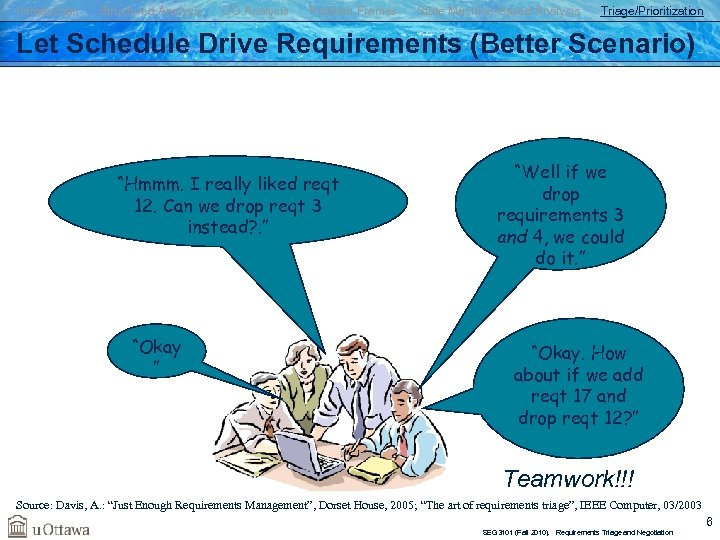 Introduction Structured Analysis OO Analysis Problem Frames State Machine-Based Analysis Triage/Prioritization Let Schedule Drive Requirements (Better Scenario) “Hmmm. I really liked reqt 12. Can we drop reqt 3 instead? . ” “Okay ” “Well if we drop requirements 3 and 4, we could do it. ” “Okay. How about if we add reqt 17 and drop reqt 12? ” Teamwork!!! Source: Davis, A. : “Just Enough Requirements Management”, Dorset House, 2005; “The art of requirements triage”, IEEE Computer, 03/2003 SEG 3101 (Fall 2010). Requirements Triage and Negotiation 6
 Introduction Structured Analysis OO Analysis Problem Frames State Machine-Based Analysis Triage/Prioritization Requirements Negotiation – Key Aspects (1) (by analogy with land negotiations) • Territory: desired requirements • The real requirements are those in the head of each stakeholder • Map: requirements document • An abstract model of intentions/requirements, imperfect and incomplete • Interpretation of the map: included requirements • May vary from one session to the next need to be clear, precise, and unambiguous • Looking at the map through the magnifying glass: importance • Each stakeholder has such a view about its requirements in the project • For each stakeholder, see if a documented requirement is important, conflicting, or optional SEG 3101 (Fall 2010). Requirements Triage and Negotiation 7
 Introduction Structured Analysis OO Analysis Problem Frames State Machine-Based Analysis Triage/Prioritization Requirements Negotiation – Key Aspects (2) • Negotiating boundaries: counterproposals of stakeholders • Reaction of a stakeholder (open, opposed, cooperative. . . ) to a documented requirement may indicate how far it is open for compromise • Helps optimize the requirements of all stakeholders • Can we be consistent? See techniques later on! SEG 3101 (Fall 2010). Requirements Triage and Negotiation 8
 Introduction Structured Analysis OO Analysis Problem Frames State Machine-Based Analysis Triage/Prioritization Difficulties (1) • There are too many requirements! • From many different sources • Resources are limited (budget, time…) • Establishing priorities is important, but • Which requirements are important, and to whom? • How to prioritize them? On what basis? What to minimize/maximize? • In which iteration should the requirement be considered? • Developers may not know the business value of some requirements, and clients may not know the implementation complexity of some requirements SEG 3101 (Fall 2010). Requirements Triage and Negotiation 9
 Introduction Structured Analysis OO Analysis Problem Frames State Machine-Based Analysis Triage/Prioritization Difficulties (2) • Different stakeholders have different goals and different priorities • Some stakeholders’ decisions carry more weight than others • Companies often lack systematic data, metrics, and technologies to support the prioritization process • Often done manually, informally, on an ad-hoc basis • Difficult to establish and communicate • Attitude! • "No need for priorities, we can do everything in the specification!“ • Yes, but when and at what cost? • Suddenly, when the deadline is fast approaching, some requirements are put aside in order to deliver something on time. . . SEG 3101 (Fall 2010). Requirements Triage and Negotiation 10
 Introduction Structured Analysis OO Analysis Problem Frames State Machine-Based Analysis Triage/Prioritization Requirements Prioritization and Triage • Requirements prioritization is also referred to as triage • Need to decide which requirements really matter or on those that need to be implemented in the current release • Need for compromise, negotiation, priorities • Prioritization is needed because there will almost always be the need for trade-offs (e. g. , required functionality vs. time and resources) • Must help: • Make acceptable tradeoffs among goals of value, cost, time-to-market • Allocate resources based on importance of requirements to the project as a whole (project planning) • Determine when a requirements should become part of the product • Offer the right product! SEG 3101 (Fall 2010). Requirements Triage and Negotiation 11
 Introduction Structured Analysis OO Analysis Problem Frames State Machine-Based Analysis Triage/Prioritization 80 -20 Rule • 20% of functionalities provide 80% of revenues • Think of MS Word… • The remaining 80% of functionalities offer a lower return on investment while adding delays, development costs, maintenance costs. . . • How to find the most useful and beneficial 20% of functionalities? SEG 3101 (Fall 2010). Requirements Triage and Negotiation 12
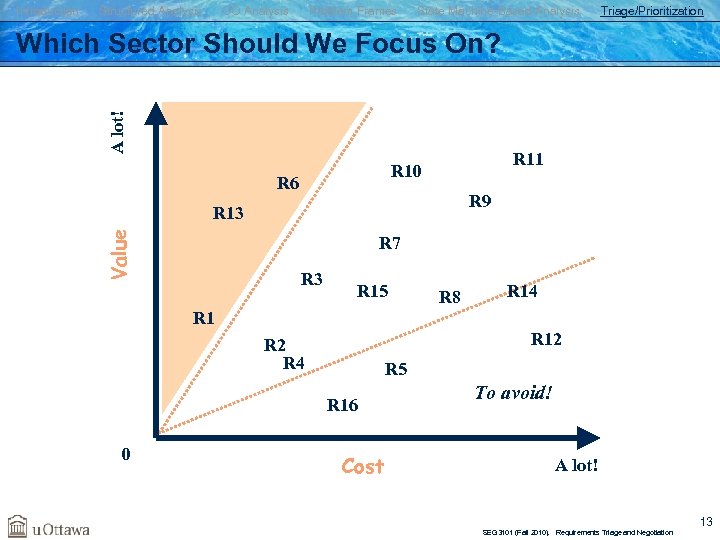 Introduction Structured Analysis OO Analysis Problem Frames State Machine-Based Analysis Triage/Prioritization A lot! Which Sector Should We Focus On? R 11 R 10 R 6 R 9 Value R 13 R 7 R 3 R 15 R 8 R 14 R 12 R 4 R 5 R 16 0 Cost To avoid! A lot! SEG 3101 (Fall 2010). Requirements Triage and Negotiation 13
 Introduction Structured Analysis OO Analysis Problem Frames State Machine-Based Analysis Triage/Prioritization Requirements Triage Process • Must be simple and fast, for industry adoption • Must yield accurate and trustworthy results • Must consider issues such as • The value of requirements to stakeholder (maximize) The cost of implementation (minimize) Time to market (to minimize) • Important to agree on requirements granularity • E. g. , use cases, features, detailed functional requirements SEG 3101 (Fall 2010). Requirements Triage and Negotiation 14
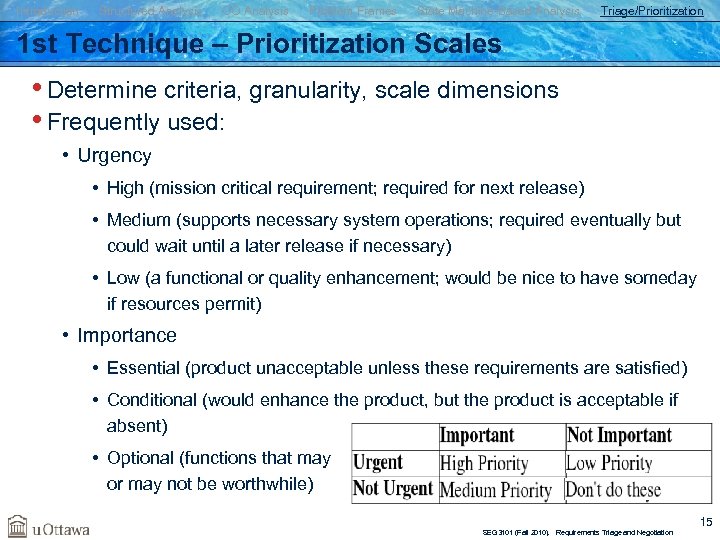 Introduction Structured Analysis OO Analysis Problem Frames State Machine-Based Analysis Triage/Prioritization 1 st Technique – Prioritization Scales • Determine criteria, granularity, scale dimensions • Frequently used: • Urgency • High (mission critical requirement; required for next release) • Medium (supports necessary system operations; required eventually but could wait until a later release if necessary) • Low (a functional or quality enhancement; would be nice to have someday if resources permit) • Importance • Essential (product unacceptable unless these requirements are satisfied) • Conditional (would enhance the product, but the product is acceptable if absent) • Optional (functions that may or may not be worthwhile) SEG 3101 (Fall 2010). Requirements Triage and Negotiation 15
 Introduction Structured Analysis OO Analysis Problem Frames State Machine-Based Analysis Triage/Prioritization Based on Cost and Value • Calculate return on investment by • Assessing the value of each requirement • Assessing the cost of each requirement • Calculating the cost-value trade-offs • Difficulties: • Hard to calculate absolute value/cost • Relative value/cost figures are easier to obtain • Interdependent requirements difficult to treat individually • Inconsistencies or conflicts in priorities assigned by individual stakeholders SEG 3101 (Fall 2010). Requirements Triage and Negotiation 16
 Introduction Structured Analysis OO Analysis Problem Frames State Machine-Based Analysis Triage/Prioritization 2 nd Technique – Wiegers’ Prioritization • Semi-quantitative analytical approach to requirements prioritization based on value, cost, and risk • Relies on estimation of relative priorities of requirements • Dimensions • Relative benefit (for having requirement) • Relative penalty to stakeholder (if requirement is not included) • Relative cost (to implement requirement) • Relative risk (technical and other risks) • Each dimension is given a value on a given scale (e. g. , 0. . 9) • Dimensions have relative weights • Formula used to derive overall priority • priority = (value%) / ((cost% * cost weight) + (risk% * risk weight)) • Still limited by ability to properly estimate • Requires adaptation and calibration SEG 3101 (Fall 2010). Requirements Triage and Negotiation 17
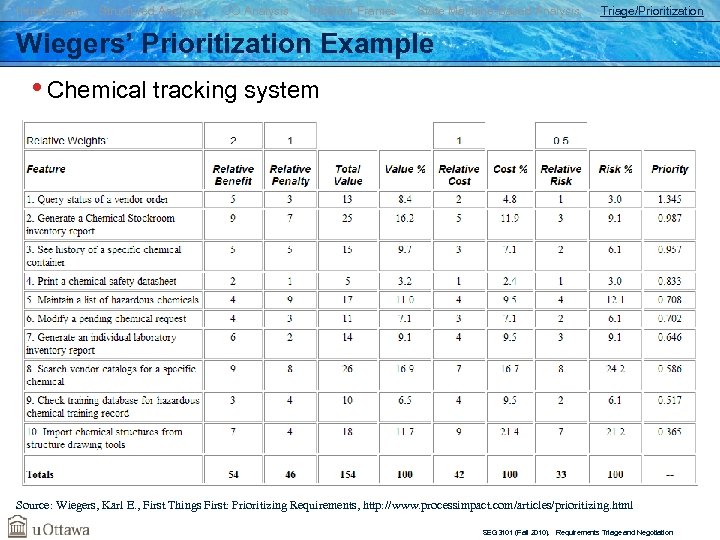 Introduction Structured Analysis OO Analysis Problem Frames State Machine-Based Analysis Triage/Prioritization Wiegers’ Prioritization Example • Chemical tracking system Source: Wiegers, Karl E. , First Things First: Prioritizing Requirements, http: //www. processimpact. com/articles/prioritizing. html SEG 3101 (Fall 2010). Requirements Triage and Negotiation
 Introduction Structured Analysis OO Analysis Problem Frames State Machine-Based Analysis Triage/Prioritization Other Criteria to Consider • Costs/benefits approach is good but sometimes insufficient • The following criteria are not all applicable to all projects, but they are there to be considered: • Cost of implementation (how much does it cost to develop? ) • Value to customer (how much does the customer want it? ) • Time to implement (how much time does it take to deliver? ) • Ease of implementation at technical level • Ease of implementation at the organizational level (business process) • Value to company (how much will the business benefit? ) • Obligation to some external authority (laws, standards, patents…) SEG 3101 (Fall 2010). Requirements Triage and Negotiation 19
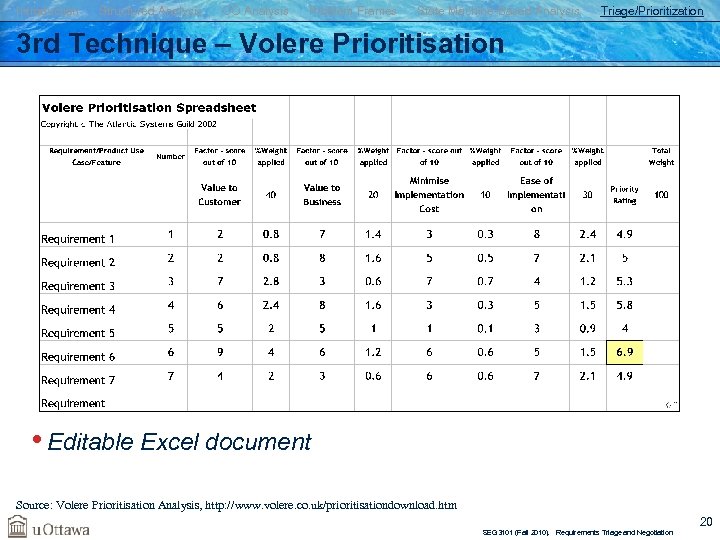 Introduction Structured Analysis OO Analysis Problem Frames State Machine-Based Analysis Triage/Prioritization 3 rd Technique – Volere Prioritisation • Editable Excel document Source: Volere Prioritisation Analysis, http: //www. volere. co. uk/prioritisationdownload. htm SEG 3101 (Fall 2010). Requirements Triage and Negotiation 20
 Introduction Structured Analysis OO Analysis Problem Frames State Machine-Based Analysis Triage/Prioritization Pairwise Comparisons (1) • Finding scores and weights is difficult and subjective • Potential solution: pairwise comparison • Which requirements (A or B) is more important: A << < = > >> B • Benefits • Indicates what is important to the client • Identifies requirements of high value and low cost (priority!) • Identifies requirements of low value and high cost (likely to be removed) • Has already been used to assist numerous corporate and government decision makers • Choosing a telecommunication system, formulating a drug policy, choosing a product marketing strategy SEG 3101 (Fall 2010). Requirements Triage and Negotiation 21
 Introduction Structured Analysis OO Analysis Problem Frames State Machine-Based Analysis Triage/Prioritization Pairwise Comparisons (2) • New problems • Large number of pairs – pairwise comparison can be tedious • Solved using transitivity and other tricks! • Mathematical optimization of the number of pairs to be considered (no need to cover all) • Many dependencies between requirements • Can actually be used to further reduce the # of pairs • E. g. , group many requirements as features, use cases, services… • Example approach • Analytic Hierarchy Process 1 [1] Karlsson, J. and Ryan, K. A cost-value approach for prioritizing requirements, IEEE Software, Sept/Oct 1997 SEG 3101 (Fall 2010). Requirements Triage and Negotiation 22
 Introduction Structured Analysis OO Analysis Problem Frames State Machine-Based Analysis Triage/Prioritization 4 th Technique – Analytic Hierarchy Process (AHP) • Developed by Karlsson and Ryan (1997) based on work by Saaty (early 1970) • see also http: //en. wikipedia. org/wiki/Analytic_Hierarchy_Process • Use cost-value diagrams to analyze and discuss candidate requirements • Useful for requirements triage and release planning (but also applicable in many other situations where complex decisions are to be made) • Basic procedure for rating a set of criteria • Develop pairwise comparison matrix of each criterion • Normalize the matrix • Average the value of each row to get corresponding rating • Criterion ratings are then used to evaluate different potential decisions SEG 3101 (Fall 2010). Requirements Triage and Negotiation 23
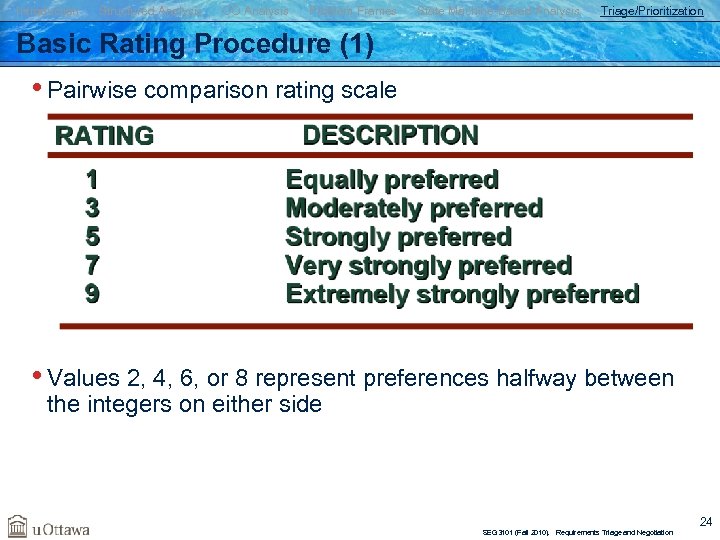 Introduction Structured Analysis OO Analysis Problem Frames State Machine-Based Analysis Triage/Prioritization Basic Rating Procedure (1) • Pairwise comparison rating scale • Values 2, 4, 6, or 8 represent preferences halfway between the integers on either side SEG 3101 (Fall 2010). Requirements Triage and Negotiation 24
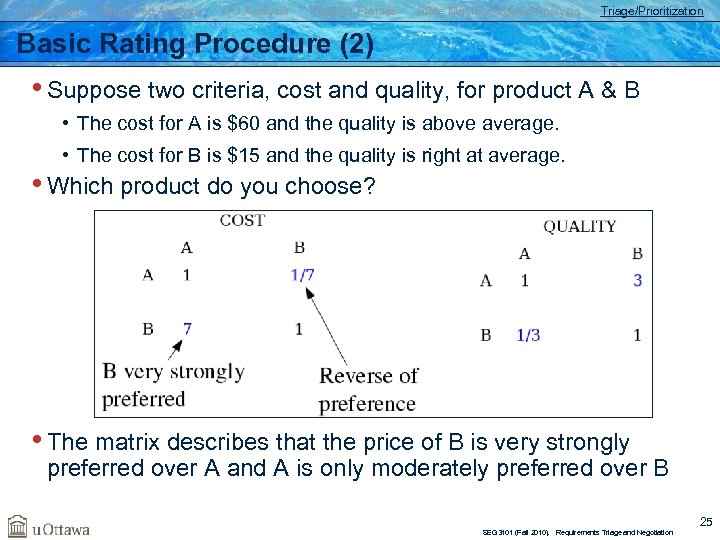 Introduction Structured Analysis OO Analysis Problem Frames State Machine-Based Analysis Triage/Prioritization Basic Rating Procedure (2) • Suppose two criteria, cost and quality, for product A & B • The cost for A is $60 and the quality is above average. • The cost for B is $15 and the quality is right at average. • Which product do you choose? • The matrix describes that the price of B is very strongly preferred over A and A is only moderately preferred over B SEG 3101 (Fall 2010). Requirements Triage and Negotiation 25
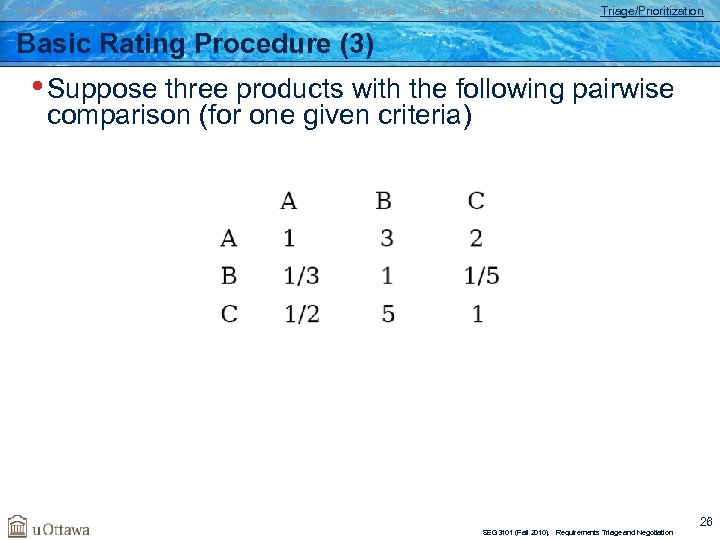 Introduction Structured Analysis OO Analysis Problem Frames State Machine-Based Analysis Triage/Prioritization Basic Rating Procedure (3) • Suppose three products with the following pairwise comparison (for one given criteria) SEG 3101 (Fall 2010). Requirements Triage and Negotiation 26
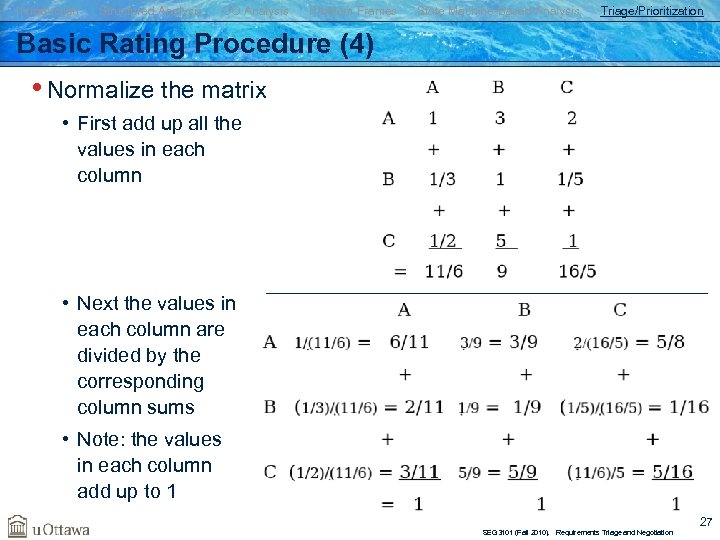 Introduction Structured Analysis OO Analysis Problem Frames State Machine-Based Analysis Triage/Prioritization Basic Rating Procedure (4) • Normalize the matrix • First add up all the values in each column • Next the values in each column are divided by the corresponding column sums • Note: the values in each column add up to 1 SEG 3101 (Fall 2010). Requirements Triage and Negotiation 27
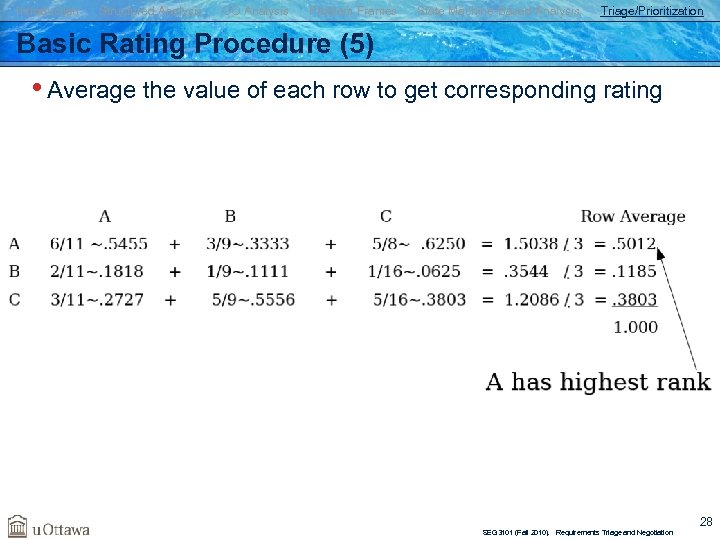 Introduction Structured Analysis OO Analysis Problem Frames State Machine-Based Analysis Triage/Prioritization Basic Rating Procedure (5) • Average the value of each row to get corresponding rating SEG 3101 (Fall 2010). Requirements Triage and Negotiation 28
 Introduction Structured Analysis OO Analysis Problem Frames State Machine-Based Analysis Triage/Prioritization Analytic Hierarchy Process – Steps • Requirements engineers check individual requirements for ambiguities, completeness… • Apply AHP’s pairwise comparison to estimate the relative value of candidate requirements • Experienced software engineers use AHP’s pairwise comparison to estimate the cost of candidate requirements • Plot these values on a cost-value diagram • Stakeholders use this diagram for analysis and to make tradeoffs SEG 3101 (Fall 2010). Requirements Triage and Negotiation 29
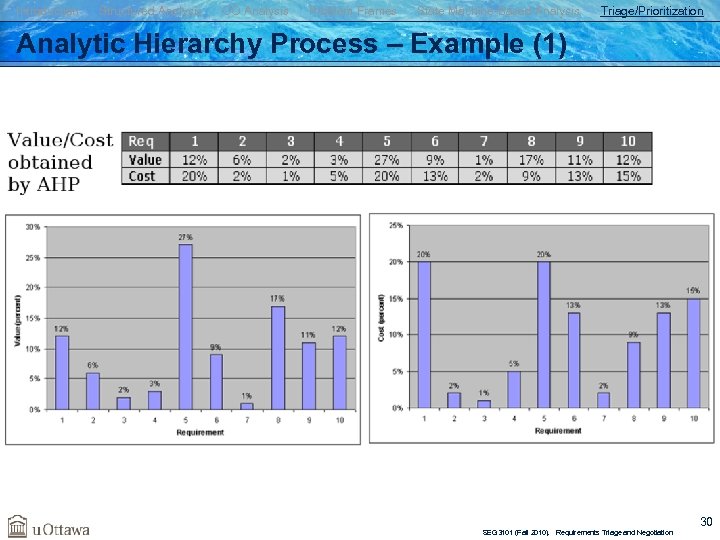 Introduction Structured Analysis OO Analysis Problem Frames State Machine-Based Analysis Triage/Prioritization Analytic Hierarchy Process – Example (1) SEG 3101 (Fall 2010). Requirements Triage and Negotiation 30
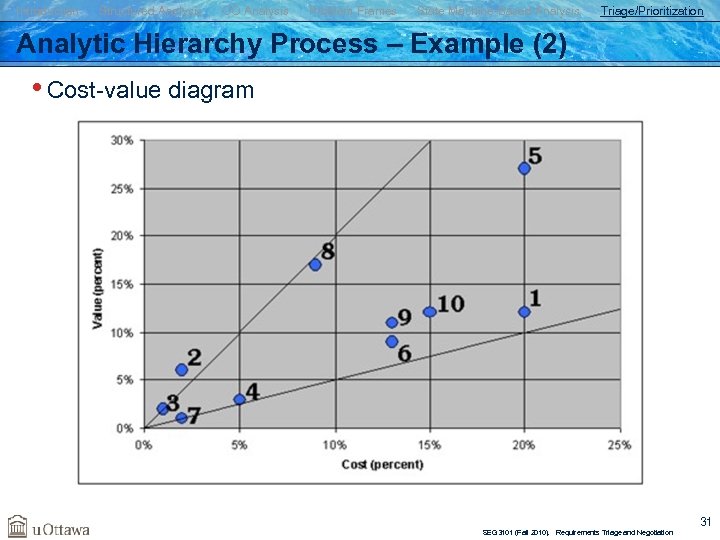 Introduction Structured Analysis OO Analysis Problem Frames State Machine-Based Analysis Triage/Prioritization Analytic Hierarchy Process – Example (2) • Cost-value diagram SEG 3101 (Fall 2010). Requirements Triage and Negotiation 31
 Introduction Structured Analysis OO Analysis Problem Frames State Machine-Based Analysis Triage/Prioritization Analytic Hierarchy Process – Stakeholders (1) • Each client is unique! • Each stakeholder group may have a different weight • Process uses a weighting criteria to consider each individual stakeholder group • Example (stakeholders M 1 to M 10 are different markets) • Revenue last release • Profit last release • Number of sold licenses last release • Predictions of the above criteria for the coming release • Number of contracts lost to competitors • Number of potential customer with nil licenses to date • Size of total market segment • Growth potential SEG 3101 (Fall 2010). Requirements Triage and Negotiation 32
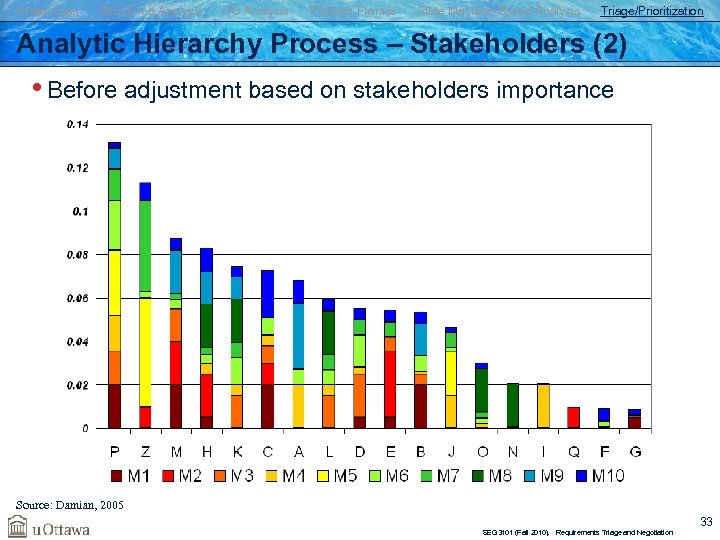 Introduction Structured Analysis OO Analysis Problem Frames State Machine-Based Analysis Triage/Prioritization Analytic Hierarchy Process – Stakeholders (2) • Before adjustment based on stakeholders importance Source: Damian, 2005 SEG 3101 (Fall 2010). Requirements Triage and Negotiation 33
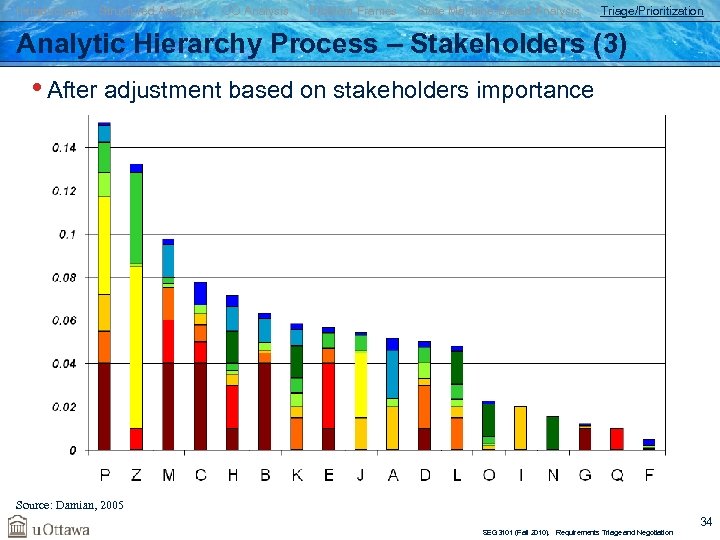 Introduction Structured Analysis OO Analysis Problem Frames State Machine-Based Analysis Triage/Prioritization Analytic Hierarchy Process – Stakeholders (3) • After adjustment based on stakeholders importance Source: Damian, 2005 SEG 3101 (Fall 2010). Requirements Triage and Negotiation 34
 Introduction Structured Analysis OO Analysis Problem Frames State Machine-Based Analysis Triage/Prioritization Example of Commercial Tool • IBM Rational (formerly Telelogic) Focal Point • Decision support, portfolio management • Pairwise comparisons of features • Creation and validation of web questionnaires • Dynamic algorithm for reducing the number of pairs, according to the responses • Detection of inconsistency between the answers • Priorities • For different markets • Represented in various different ways • Integration with DOORS • http: //www-01. ibm. com/software/awdtools/focalpoint/ SEG 3101 (Fall 2010). Requirements Triage and Negotiation 35