


 Скачать презентацию See if you can match up the two
fc0fc74da39162139bf4aa575c4a3136.ppt
- Количество слайдов: 18
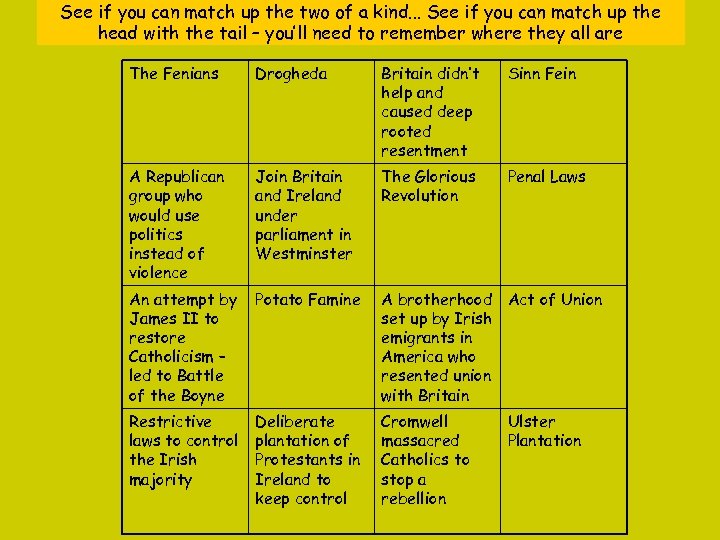 See if you can match up the two of a kind. . . See if you can match up the head with the tail – you’ll need to remember where they all are The Fenians Drogheda Britain didn’t help and caused deep rooted resentment Sinn Fein A Republican group who would use politics instead of violence Join Britain and Ireland under parliament in Westminster The Glorious Revolution Penal Laws An attempt by James II to restore Catholicism – led to Battle of the Boyne Potato Famine A brotherhood Act of Union set up by Irish emigrants in America who resented union with Britain Restrictive laws to control the Irish majority Deliberate plantation of Protestants in Ireland to keep control Cromwell massacred Catholics to stop a rebellion Ulster Plantation
 See if you can match up the two of a kind. . . See if you can match up the head with the tail – you’ll need to remember where they all are The Fenians Britain didn’t help and caused deep rooted resentment Sinn Fein Penal Laws A Republican group who would use politics instead of violence Ulster Plantation The Glorious Revolution An attempt by James II to restore Catholicism – led to Battle of the Boyne Potato Famine A brotherhood set up by Irish emigrants in America who resented union with Britain Restrictive laws to control the Irish majority Deliberate plantation of Protestants in Ireland to keep control
 What was the struggle for Home Rule?
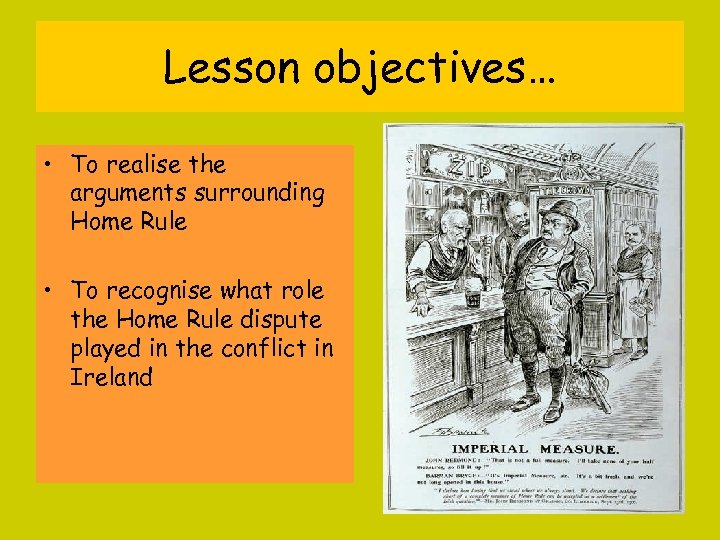 Lesson objectives… • To realise the arguments surrounding Home Rule • To recognise what role the Home Rule dispute played in the conflict in Ireland
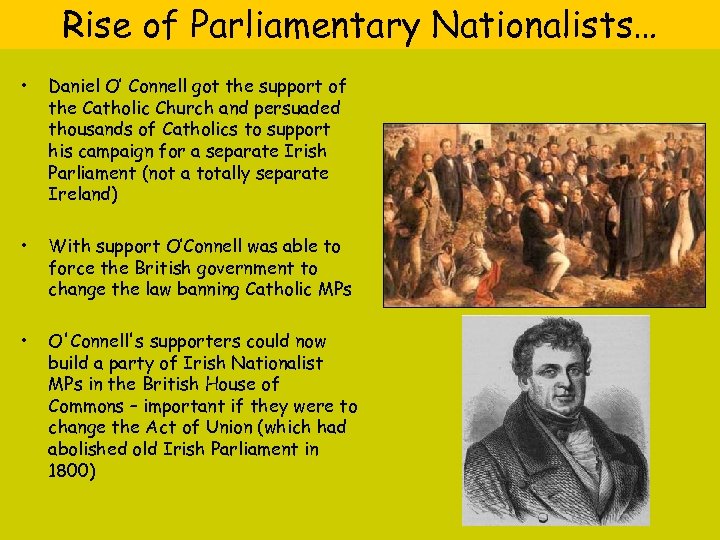 Rise of Parliamentary Nationalists… • Daniel O’ Connell got the support of the Catholic Church and persuaded thousands of Catholics to support his campaign for a separate Irish Parliament (not a totally separate Ireland) • With support O’Connell was able to force the British government to change the law banning Catholic MPs • O'Connell's supporters could now build a party of Irish Nationalist MPs in the British House of Commons – important if they were to change the Act of Union (which had abolished old Irish Parliament in 1800)
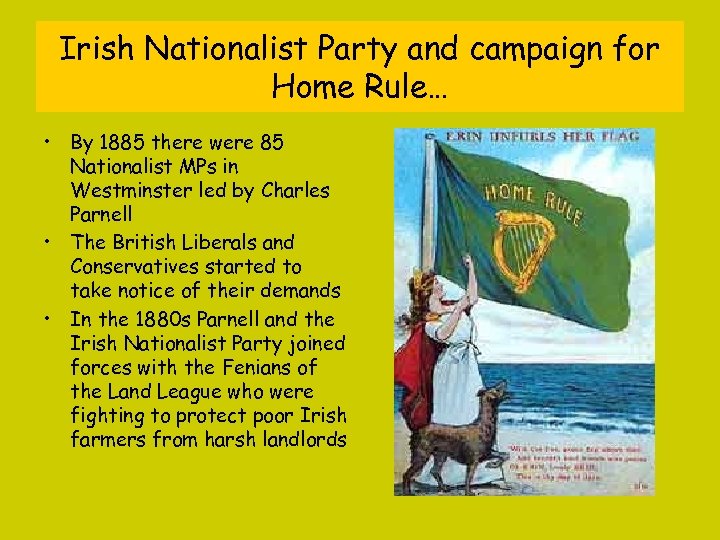 Irish Nationalist Party and campaign for Home Rule… • By 1885 there were 85 Nationalist MPs in Westminster led by Charles Parnell • The British Liberals and Conservatives started to take notice of their demands • In the 1880 s Parnell and the Irish Nationalist Party joined forces with the Fenians of the Land League who were fighting to protect poor Irish farmers from harsh landlords
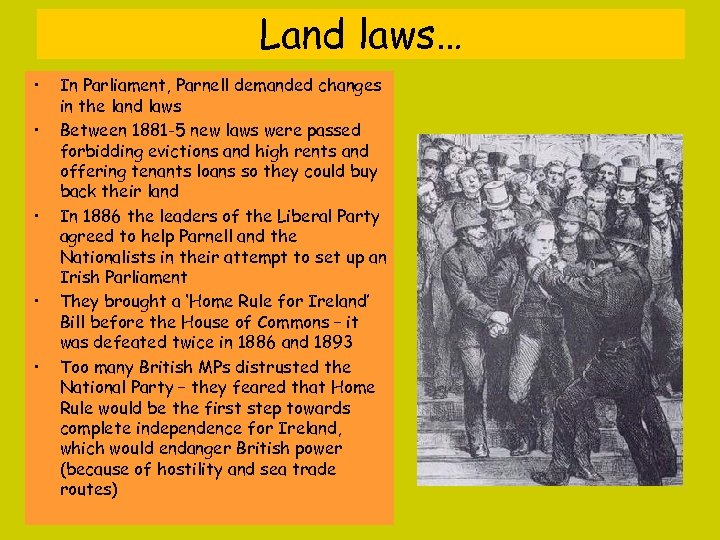 Land laws… • • • In Parliament, Parnell demanded changes in the land laws Between 1881 -5 new laws were passed forbidding evictions and high rents and offering tenants loans so they could buy back their land In 1886 the leaders of the Liberal Party agreed to help Parnell and the Nationalists in their attempt to set up an Irish Parliament They brought a ‘Home Rule for Ireland’ Bill before the House of Commons – it was defeated twice in 1886 and 1893 Too many British MPs distrusted the National Party – they feared that Home Rule would be the first step towards complete independence for Ireland, which would endanger British power (because of hostility and sea trade routes)
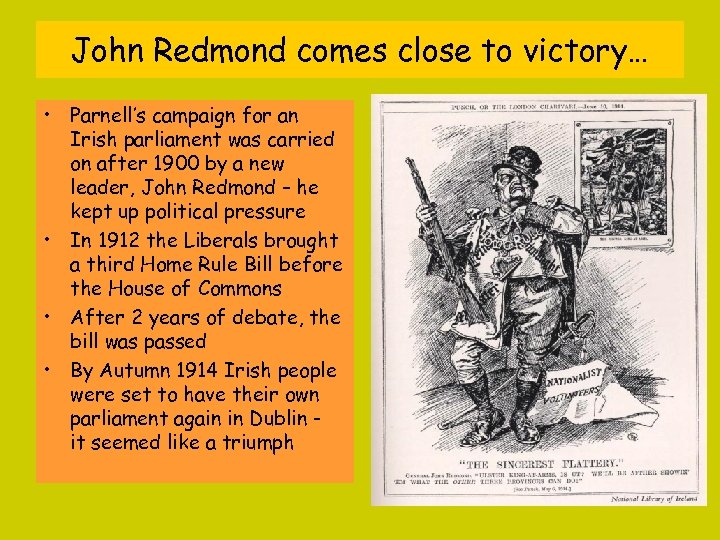 John Redmond comes close to victory… • Parnell’s campaign for an Irish parliament was carried on after 1900 by a new leader, John Redmond – he kept up political pressure • In 1912 the Liberals brought a third Home Rule Bill before the House of Commons • After 2 years of debate, the bill was passed • By Autumn 1914 Irish people were set to have their own parliament again in Dublin it seemed like a triumph
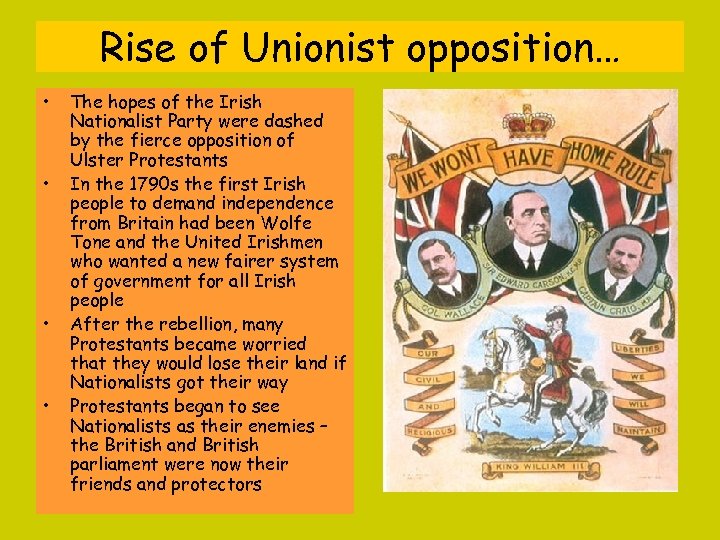 Rise of Unionist opposition… • • The hopes of the Irish Nationalist Party were dashed by the fierce opposition of Ulster Protestants In the 1790 s the first Irish people to demand independence from Britain had been Wolfe Tone and the United Irishmen who wanted a new fairer system of government for all Irish people After the rebellion, many Protestants became worried that they would lose their land if Nationalists got their way Protestants began to see Nationalists as their enemies – the British and British parliament were now their friends and protectors
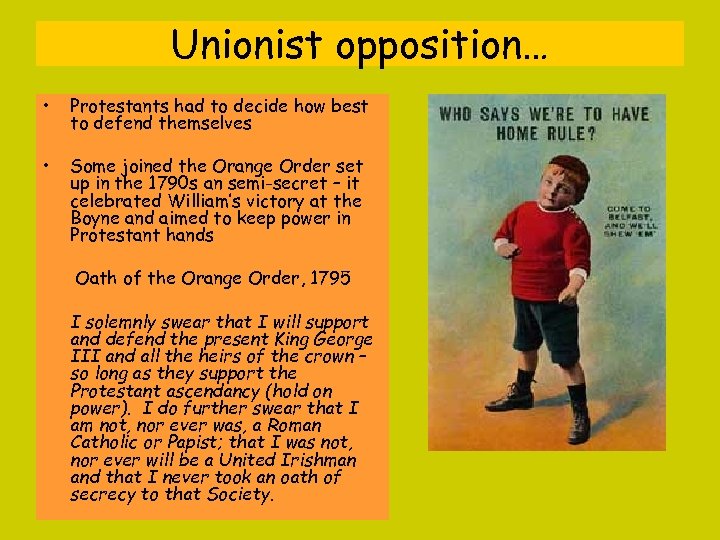 Unionist opposition… • Protestants had to decide how best to defend themselves • Some joined the Orange Order set up in the 1790 s an semi-secret – it celebrated William’s victory at the Boyne and aimed to keep power in Protestant hands Oath of the Orange Order, 1795 I solemnly swear that I will support and defend the present King George III and all the heirs of the crown – so long as they support the Protestant ascendancy (hold on power). I do further swear that I am not, nor ever was, a Roman Catholic or Papist; that I was not, nor ever will be a United Irishman and that I never took an oath of secrecy to that Society.
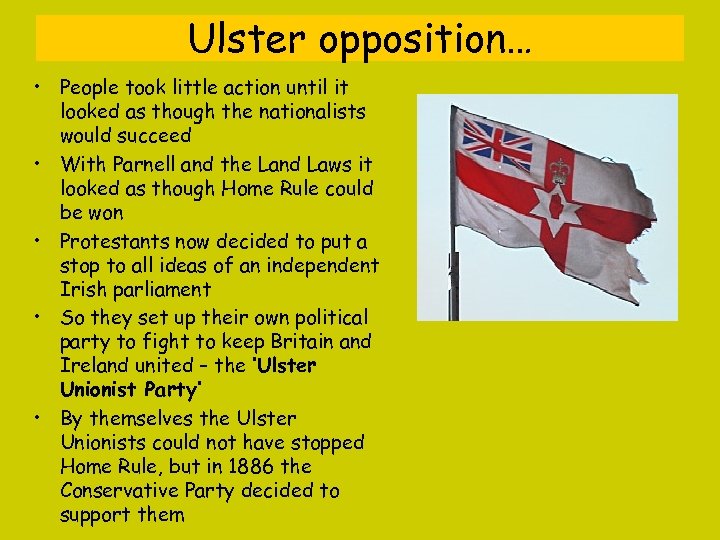 Ulster opposition… • People took little action until it looked as though the nationalists would succeed • With Parnell and the Land Laws it looked as though Home Rule could be won • Protestants now decided to put a stop to all ideas of an independent Irish parliament • So they set up their own political party to fight to keep Britain and Ireland united – the ‘Ulster Unionist Party’ • By themselves the Ulster Unionists could not have stopped Home Rule, but in 1886 the Conservative Party decided to support them
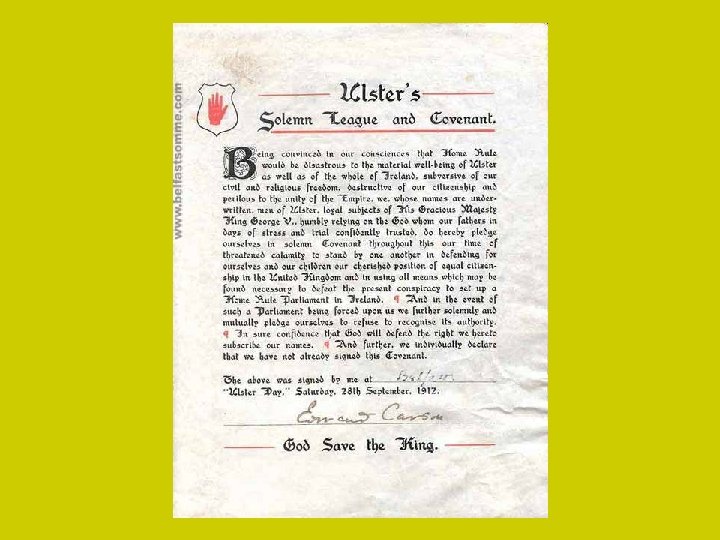
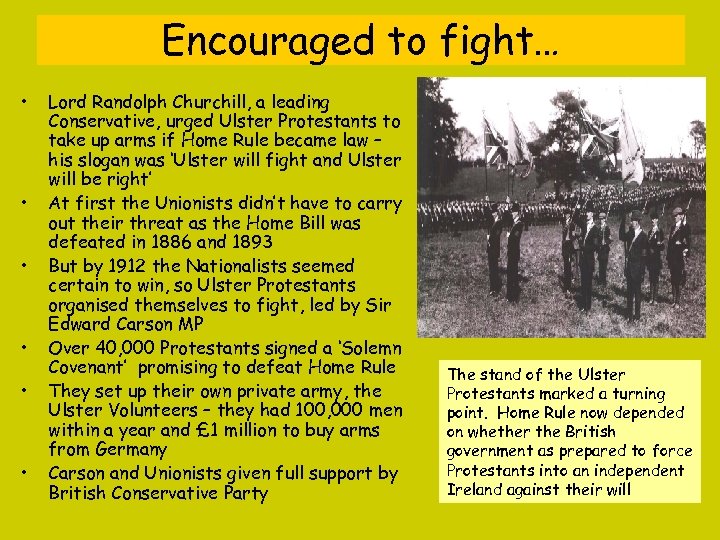 Encouraged to fight… • • • Lord Randolph Churchill, a leading Conservative, urged Ulster Protestants to take up arms if Home Rule became law – his slogan was ‘Ulster will fight and Ulster will be right’ At first the Unionists didn’t have to carry out their threat as the Home Bill was defeated in 1886 and 1893 But by 1912 the Nationalists seemed certain to win, so Ulster Protestants organised themselves to fight, led by Sir Edward Carson MP Over 40, 000 Protestants signed a ‘Solemn Covenant’ promising to defeat Home Rule They set up their own private army, the Ulster Volunteers – they had 100, 000 men within a year and £ 1 million to buy arms from Germany Carson and Unionists given full support by British Conservative Party The stand of the Ulster Protestants marked a turning point. Home Rule now depended on whether the British government as prepared to force Protestants into an independent Ireland against their will
 Nationalist Unionist
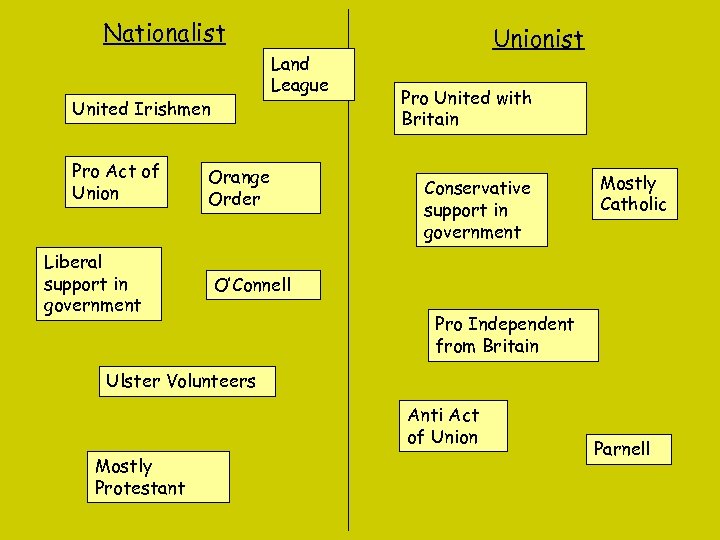 Nationalist Land League United Irishmen Pro Act of Union Liberal support in government Orange Order Unionist Pro United with Britain Conservative support in government Mostly Catholic O’Connell Pro Independent from Britain Ulster Volunteers Anti Act of Union Mostly Protestant Parnell
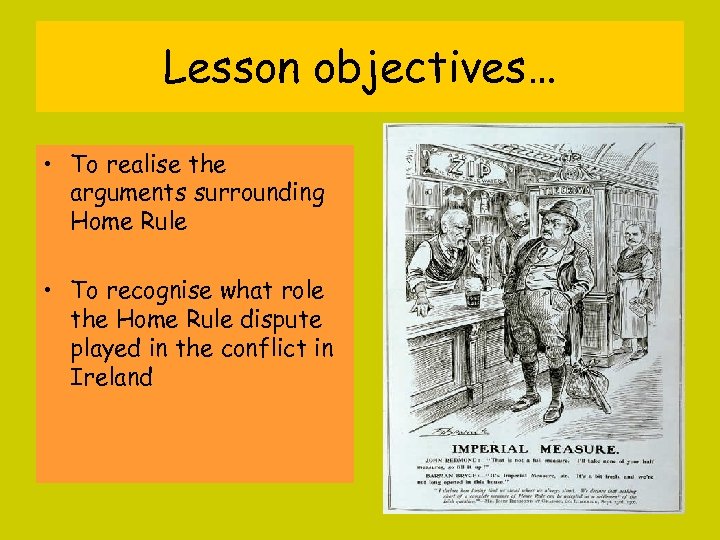 Lesson objectives… • To realise the arguments surrounding Home Rule • To recognise what role the Home Rule dispute played in the conflict in Ireland
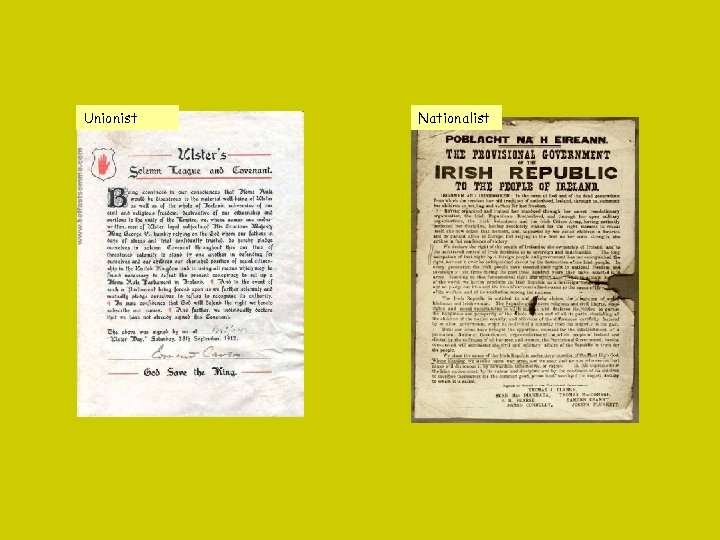 Unionist Nationalist