


 Скачать презентацию Security of computer and Networks Email Security
c528d427f33ff91abbb504fbac19a052.ppt
- Количество слайдов: 22
 Security of computer and Networks
 Email Security • email is one of the most widely used and regarded network services • currently message contents are not secure – may be inspected either in transit – or by suitably privileged users on destination system
 Email Security Enhancements • confidentiality – protection from disclosure • authentication – of sender of message • message integrity – protection from modification • non-repudiation of origin – protection from denial by sender
 Pretty Good Privacy (PGP) • • • widely used de facto secure email developed by Phil Zimmermann selected best available crypto algs to use integrated into a single program on Unix, PC, Macintosh and other systems originally free, now also have commercial versions available
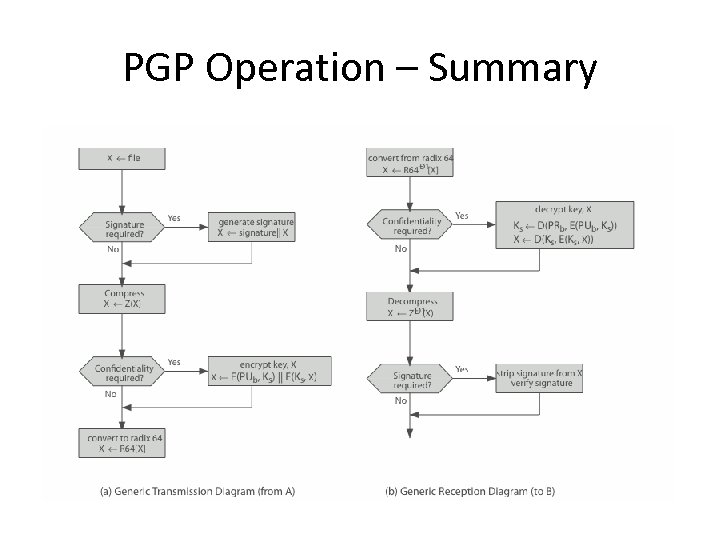
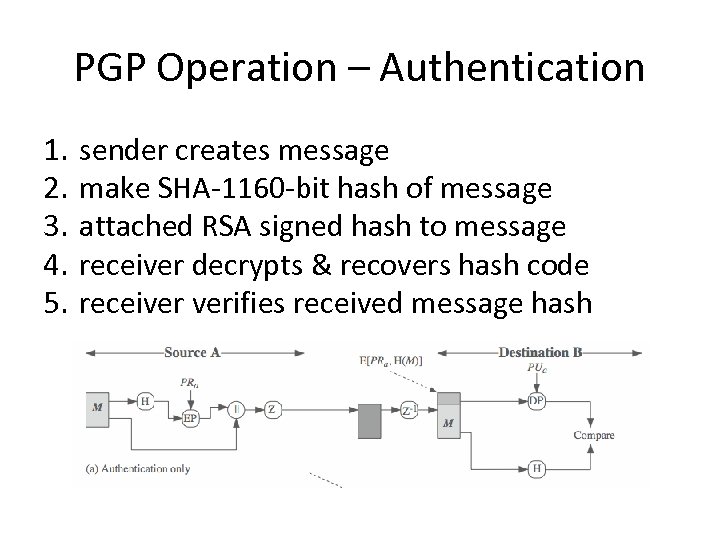 PGP Operation – Authentication 1. 2. 3. 4. 5. sender creates message make SHA-1160 -bit hash of message attached RSA signed hash to message receiver decrypts & recovers hash code receiver verifies received message hash
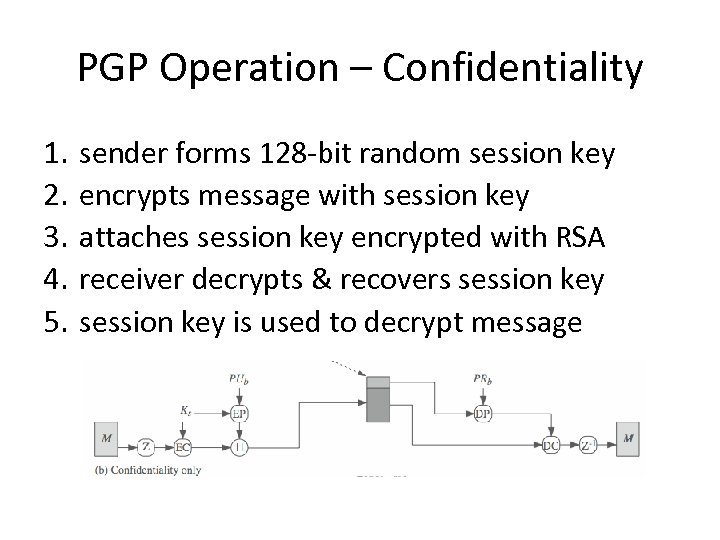 PGP Operation – Confidentiality 1. 2. 3. 4. 5. sender forms 128 -bit random session key encrypts message with session key attaches session key encrypted with RSA receiver decrypts & recovers session key is used to decrypt message
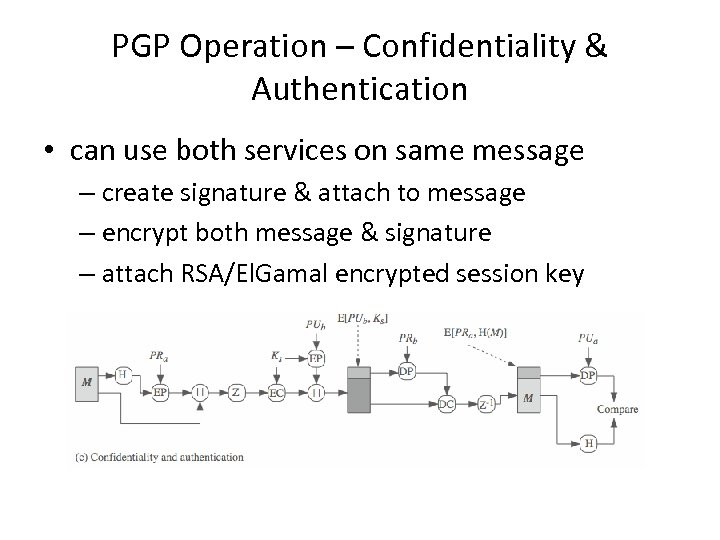 PGP Operation – Confidentiality & Authentication • can use both services on same message – create signature & attach to message – encrypt both message & signature – attach RSA/El. Gamal encrypted session key
 PGP Operation – Compression • by default PGP compresses message after signing but before encrypting – so can store uncompressed message & signature for later verification – & because compression is non deterministic • uses ZIP compression algorithm
 PGP Operation – Email Compatibility • when using PGP will have binary data to send (encrypted message etc) • however email was designed only for text • hence PGP must encode raw binary data into printable ASCII characters • uses radix-64 algorithm – maps 3 bytes to 4 printable chars – also appends a CRC • PGP also segments messages if too big
 PGP Operation – Summary
 PGP Session Keys • need a session key for each message – of varying sizes: 56 -bit DES, 128 -bit CAST or IDEA, 168 -bit Triple-DES • generated using ANSI X 12. 17 mode • uses random inputs taken from previous uses and from keystroke timing of user
 PGP Public & Private Keys • since many public/private keys may be in use, need to identify which is actually used to encrypt session key in a message – could send full public-key with every message – but this is inefficient • rather use a key identifier based on key – is least significant 64 -bits of the key – will very likely be unique • also use key ID in signatures
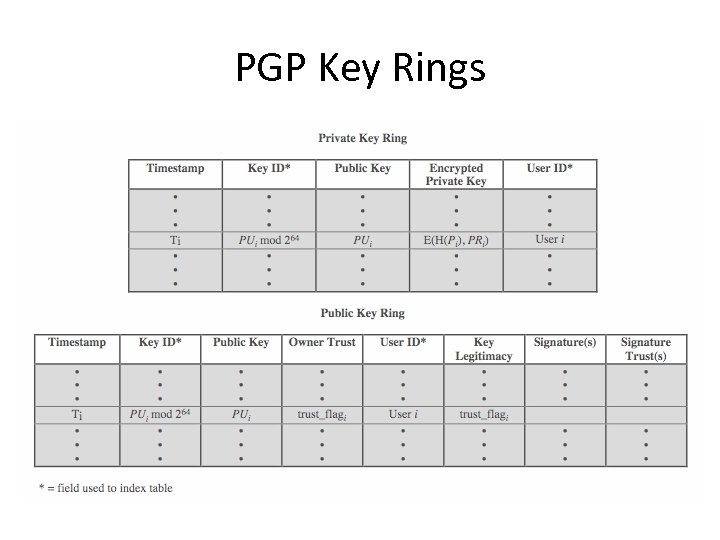
 PGP Key Rings • each PGP user has a pair of keyrings: – public-key ring contains all the public-keys of other PGP users known to this user, indexed by key ID – private-key ring contains the public/private key pair(s) for this user, indexed by key ID & encrypted keyed from a hashed passphrase • security of private keys thus depends on the pass-phrase security
 PGP Key Rings
 S/MIME (Secure/Multipurpose Internet Mail Extensions) • security enhancement to MIME email – original Internet RFC 822 email was text only – MIME provided support for varying content types and multi-part messages – with encoding of binary data to textual form – S/MIME added security enhancements • have S/MIME support in many mail agents – eg MS Outlook, Mozilla, Mac Mail etc
 S/MIME Functions • enveloped data – encrypted content and associated keys • signed data – encoded message + signed digest • clear-signed data – cleartext message + encoded signed digest • signed & enveloped data – nesting of signed & encrypted entities
 S/MIME Cryptographic Algorithms digital signatures: DSS & RSA hash functions: SHA-1 & MD 5 session key encryption: El. Gamal & RSA message encryption: AES, Triple-DES, RC 2/40 and others • MAC: HMAC with SHA-1 • have process to decide which algs to use • •
 S/MIME Messages • S/MIME secures a MIME entity with a signature, encryption, or both • forming a MIME wrapped PKCS object • have a range of content-types: – enveloped data – signed data – clear-signed data – registration request – certificate only message
 S/MIME Certificate Processing • S/MIME uses X. 509 v 3 certificates • managed using a hybrid of a strict X. 509 CA hierarchy & PGP’s web of trust • each client has a list of trusted CA’s certs • and own public/private key pairs & certs • certificates must be signed by trusted CA’s
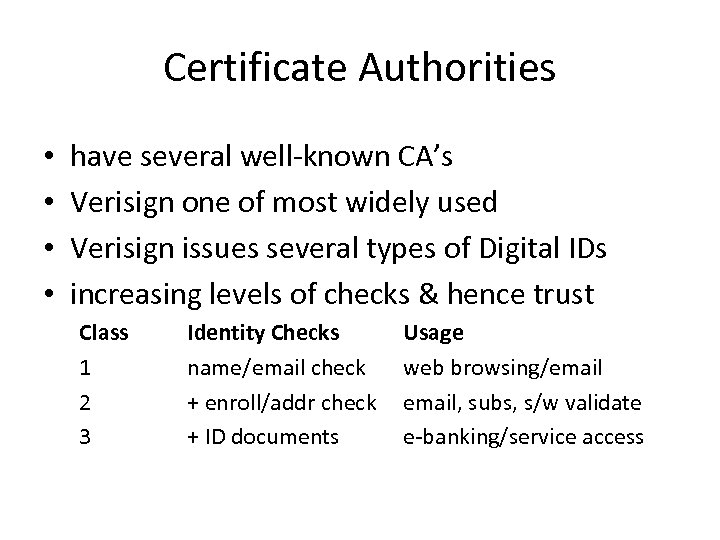 Certificate Authorities • • have several well-known CA’s Verisign one of most widely used Verisign issues several types of Digital IDs increasing levels of checks & hence trust Class 1 2 3 Identity Checks name/email check + enroll/addr check + ID documents Usage web browsing/email, subs, s/w validate e-banking/service access
 S/MIME Enhanced Security Services • 3 proposed enhanced security services: – signed receipts – security labels – secure mailing lists
 Summary • have considered: – secure email – PGP – S/MIME