


 Скачать презентацию Security in cdma 2000 Frank Quick QUALCOMM Incorporated
a0253cef6d791e05cced3f486066c180.ppt
- Количество слайдов: 28
 Security in cdma 2000 Frank Quick QUALCOMM, Incorporated Chair, 3 GPP 2 TSG-S WG 4 (Security) ITU-T Workshop on Security, Seoul (Korea) 13 -14 May, 2002 1
 Overview • • The 3 GPP 2 organization (www. 3 gpp 2. org) The cdma 2000 family of standards Wireless Security Architectures in cdma 2000 ITU-T Workshop on Security, Seoul (Korea) 13 -14 May, 2002 2
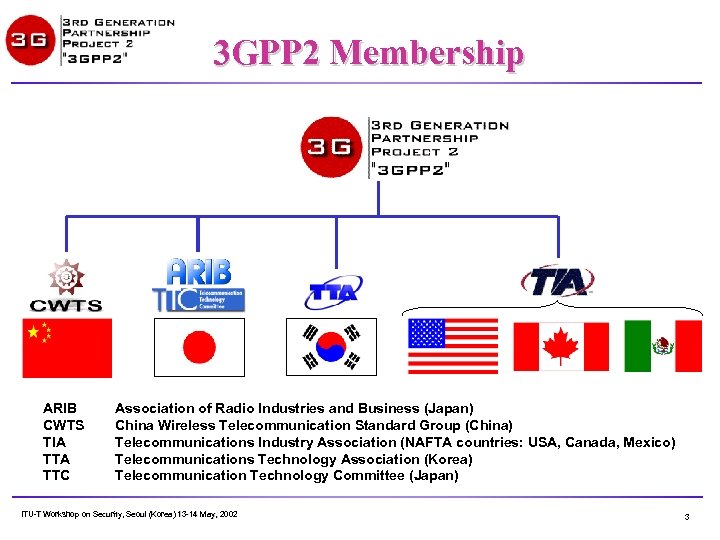 3 GPP 2 Membership ARIB CWTS TIA TTC Association of Radio Industries and Business (Japan) China Wireless Telecommunication Standard Group (China) Telecommunications Industry Association (NAFTA countries: USA, Canada, Mexico) Telecommunications Technology Association (Korea) Telecommunication Technology Committee (Japan) ITU-T Workshop on Security, Seoul (Korea) 13 -14 May, 2002 3
 Membership, cont’d Market Representation Partners – CDMA Development Group – MWIF – IPv 6 Observers – TSACC – ACIF – ETSI ITU-T Workshop on Security, Seoul (Korea) 13 -14 May, 2002 4
 Purpose of 3 GPP 2 • The purpose of 3 GPP 2 is to prepare, approve and maintain globally applicable Technical Specifications and Technical Reports for a 3 rd Generation Mobile System based on the evolving ANSI-41 Core Network and the cdma 2000 radio access technologies. • These specifications include support for 3 G Networks based on both Internet Protocol and evolved ANSI-41, including interoperability between these networks and mobile station. • 3 GPP 2 also takes into account the emerging ITU recommendations on interworking between IMT-2000 family members. • Serving the CDMA Community via Smooth Evolution of cdma 2000 from 2 G to 3 G while Expanding 2. 5 G Capabilities ITU-T Workshop on Security, Seoul (Korea) 13 -14 May, 2002 5
 Process • 3 GPP 2 publishes technical specifications as a cooperative effort of all partner members – TSGs develop technical specifications – TSGs’ outputs reviewed and approved by Steering Committee per 3 GPP 2 procedures • Partners apply national standardization processes to standardize results of work – Ownership and copyright of these output documents is shared between the Organizational Partners. • Resulting in globally developed standards for use on a region by region basis ITU-T Workshop on Security, Seoul (Korea) 13 -14 May, 2002 6
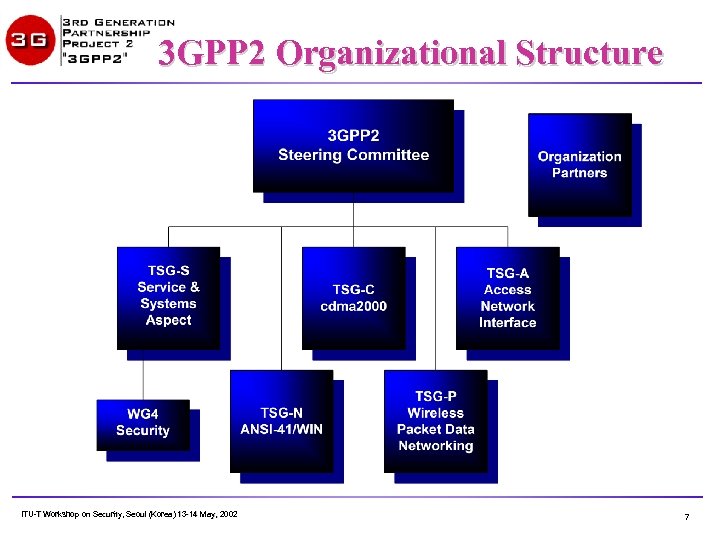 3 GPP 2 Organizational Structure ITU-T Workshop on Security, Seoul (Korea) 13 -14 May, 2002 7
 History • Prior to 2001, 3 GPP 2 relied on the TIA’s Ad Hoc Authentication Group (AHAG) for security needs. – AHAG was formed in 1991 to handle encryption-related work in accordance with US and Canadian law. – Recent changes in export laws make international meetings on security much simpler. • TSG-S WG 4 (Security) was formed in August 2001. – WG 4 will assume most of the work previously done by AHAG. – AHAG continues as a TIA support group. ITU-T Workshop on Security, Seoul (Korea) 13 -14 May, 2002 8
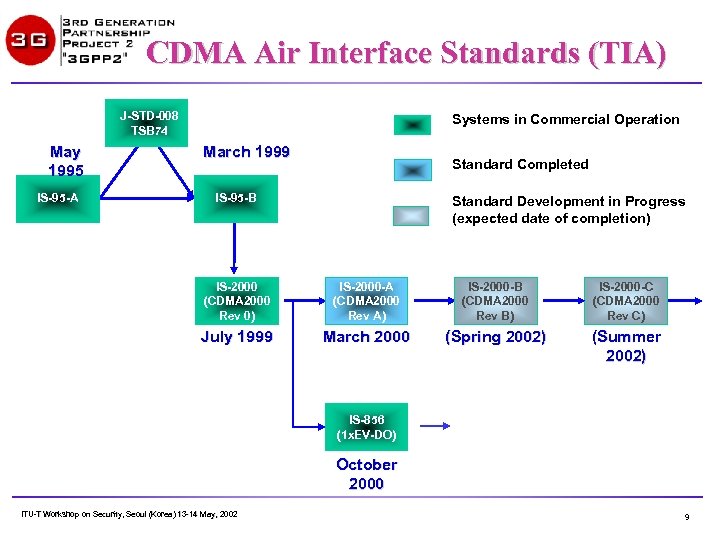 CDMA Air Interface Standards (TIA) J-STD-008 TSB 74 May 1995 IS-95 -A Systems in Commercial Operation March 1999 Standard Completed IS-95 -B Standard Development in Progress (expected date of completion) IS-2000 (CDMA 2000 Rev 0) IS-2000 -A (CDMA 2000 Rev A) IS-2000 -B (CDMA 2000 Rev B) IS-2000 -C (CDMA 2000 Rev C) July 1999 March 2000 (Spring 2002) (Summer 2002) IS-856 (1 x. EV-DO) October 2000 ITU-T Workshop on Security, Seoul (Korea) 13 -14 May, 2002 9
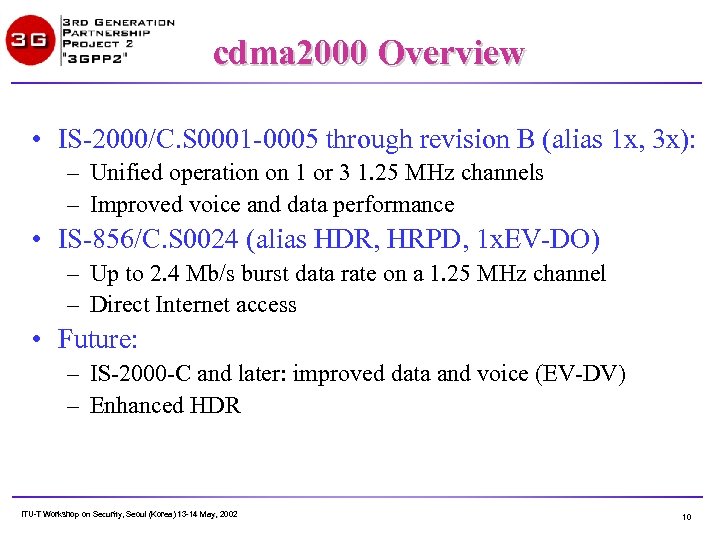 cdma 2000 Overview • IS-2000/C. S 0001 -0005 through revision B (alias 1 x, 3 x): – Unified operation on 1 or 3 1. 25 MHz channels – Improved voice and data performance • IS-856/C. S 0024 (alias HDR, HRPD, 1 x. EV-DO) – Up to 2. 4 Mb/s burst data rate on a 1. 25 MHz channel – Direct Internet access • Future: – IS-2000 -C and later: improved data and voice (EV-DV) – Enhanced HDR ITU-T Workshop on Security, Seoul (Korea) 13 -14 May, 2002 10
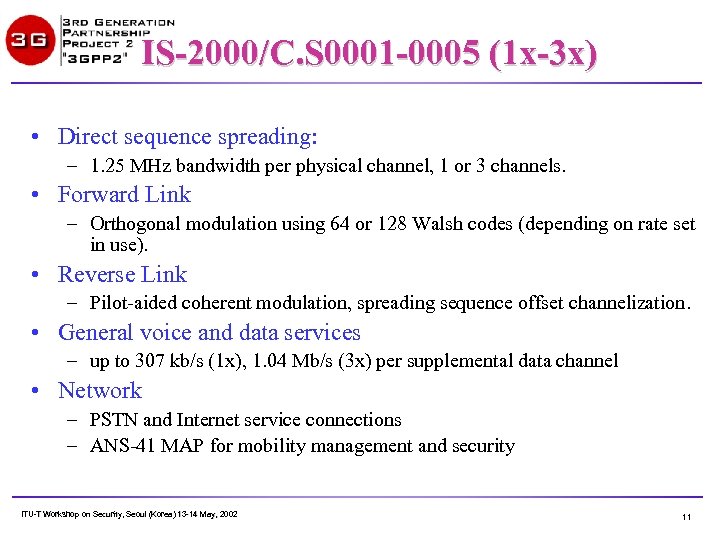 IS-2000/C. S 0001 -0005 (1 x-3 x) • Direct sequence spreading: – 1. 25 MHz bandwidth per physical channel, 1 or 3 channels. • Forward Link – Orthogonal modulation using 64 or 128 Walsh codes (depending on rate set in use). • Reverse Link – Pilot-aided coherent modulation, spreading sequence offset channelization. • General voice and data services – up to 307 kb/s (1 x), 1. 04 Mb/s (3 x) per supplemental data channel • Network – PSTN and Internet service connections – ANS-41 MAP for mobility management and security ITU-T Workshop on Security, Seoul (Korea) 13 -14 May, 2002 11
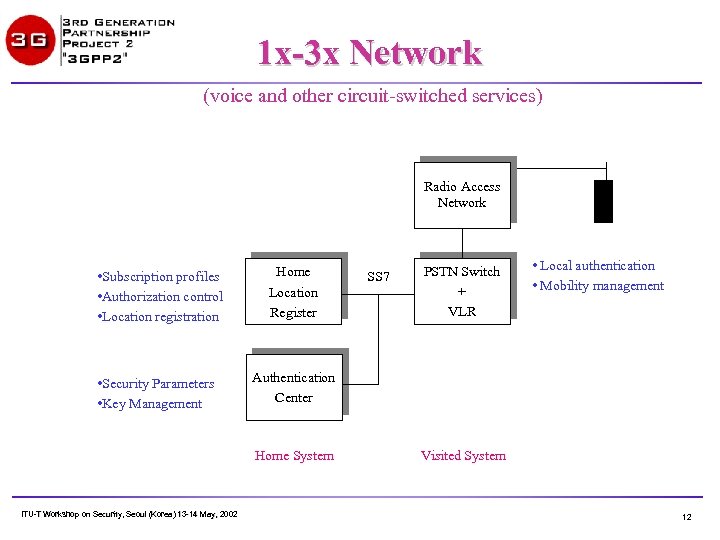 1 x-3 x Network (voice and other circuit-switched services) Radio Access Network • Subscription profiles • Authorization control • Location registration • Security Parameters • Key Management Home Location Register PSTN Switch + VLR • Local authentication • Mobility management Authentication Center Home System ITU-T Workshop on Security, Seoul (Korea) 13 -14 May, 2002 SS 7 Visited System 12
 Future All-IP Network • Not just a replacement for SS 7. • Internet-based network signaling, likely including: – – Mobile IP for location registration and data delivery. Presence servers may replace HLRs. SIP for call/session establishment. Internet security protocols. • New security challenges: – The network is directly exposed to Internet attacks. – Weak security in one operator’s system may jeopardize the entire system. • TSG-S WG 4 is establishing security requirements for the all-IP Network. ITU-T Workshop on Security, Seoul (Korea) 13 -14 May, 2002 13
 IS-856/C. S 0024 (1 x. EV-DO) • IS-2000 Compatible RF parameters and components. – Network planning. – Dual-mode 1 x/1 x. EV-DO terminals supported. • High-performance data service. – CDMA/TDMA hybrid with demand assignment. – Up to 2. 4576 Mb/s FL burst rate, 153. 6 kb/s RL. • Network: direct Internet access – Mobile IP for mobility with fixed IP address. – “simple IP” for mobility with locally assigned IP address. – AAA/Radius security model. ITU-T Workshop on Security, Seoul (Korea) 13 -14 May, 2002 14
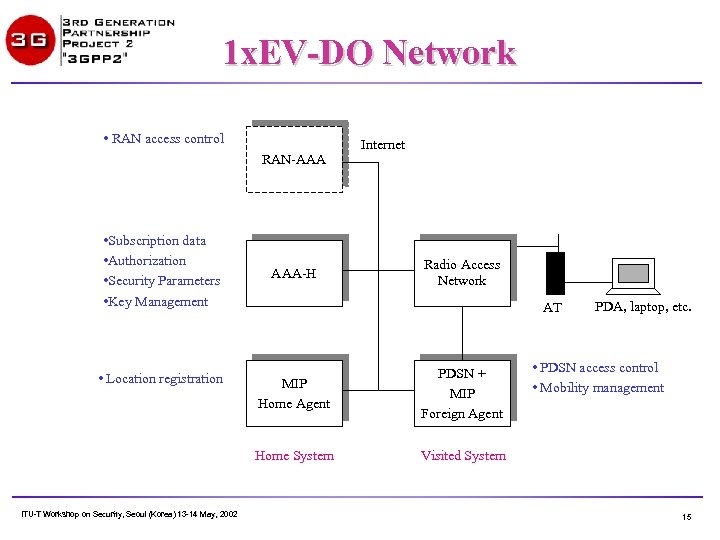 1 x. EV-DO Network • RAN access control RAN-AAA • Subscription data • Authorization • Security Parameters • Key Management AAA-H Internet Radio Access Network AT ITU-T Workshop on Security, Seoul (Korea) 13 -14 May, 2002 MIP Home Agent PDSN + MIP Foreign Agent Home System • Location registration PDA, laptop, etc. • PDSN access control • Mobility management Visited System 15
 Security Elements • • Access Control (bilateral) Key management Data and identity privacy Provisioning ITU-T Workshop on Security, Seoul (Korea) 13 -14 May, 2002 16
 Access Control • Protection of System Resources against Unauthorized Use. • Authentication – Terminal authentication • Prevent fraudulent use of the network – Proof of subscription identity – Proof of sender identity and message integrity – Network authentication • Prevent false base station attacks on user information • Authorization – Authentication is a pre-requisite for Authorization. – Service Access Rights based on Subscription data are passed from home system (HLR or AAA) to serving system ITU-T Workshop on Security, Seoul (Korea) 13 -14 May, 2002 17
 Key Management • IS-2000/C. S 0001 -0005: – Relies on symmetric keys for all security. – A root authentication key forms the base security association. – Session keys are derived from the root key during authentication. • IS-856/C. S 0024: – Uses public-key agreement to establish airlink session keys. – Uses symmetric keys for Radius authentication. ITU-T Workshop on Security, Seoul (Korea) 13 -14 May, 2002 18
 Authentication Methods • Message authentication – A method where each message includes identification and proof of identity. – This method is required on random-access channels. – Requires a long-term security association • Connection authentication – A method where identity is proven once, and all subsequent data includes proof that it comes from the same source. – Useful where a connection is established, including a sessionrelated security association. ITU-T Workshop on Security, Seoul (Korea) 13 -14 May, 2002 19
 IS-2000 Authentication • Challenge-Response Authentication – Rev B and earlier: • Legacy authentication based on IS-95. – Rev C and later: • AKA (same as UMTS authentication), plus: • Optional UIM authentication procedure to prove presence of a valid UIM, preventing rogue shell attacks. • Message Integrity Checks – Keyed SHA-1 -based hash of message contents. – Cryptosync based on time and other data to prevent replay attacks. ITU-T Workshop on Security, Seoul (Korea) 13 -14 May, 2002 20
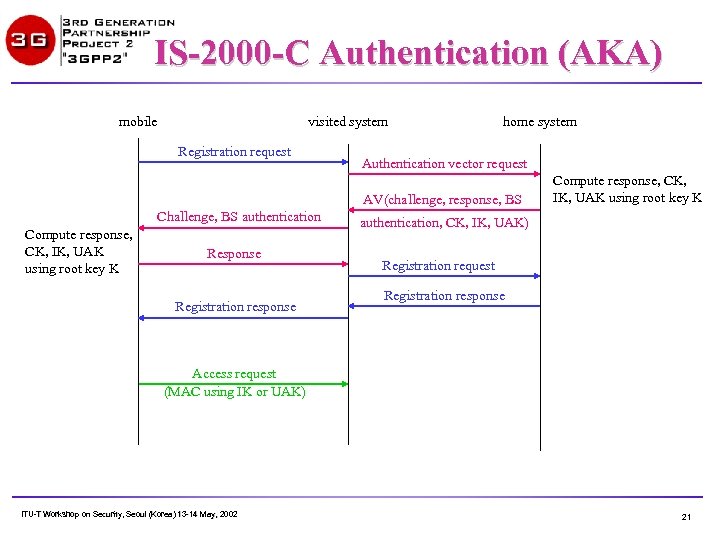 IS-2000 -C Authentication (AKA) mobile visited system Registration request home system Authentication vector request AV(challenge, response, BS Challenge, BS authentication Compute response, CK, IK, UAK using root key K Response Registration response Compute response, CK, IK, UAK using root key K authentication, CK, IK, UAK) Registration request Registration response Access request (MAC using IK or UAK) ITU-T Workshop on Security, Seoul (Korea) 13 -14 May, 2002 21
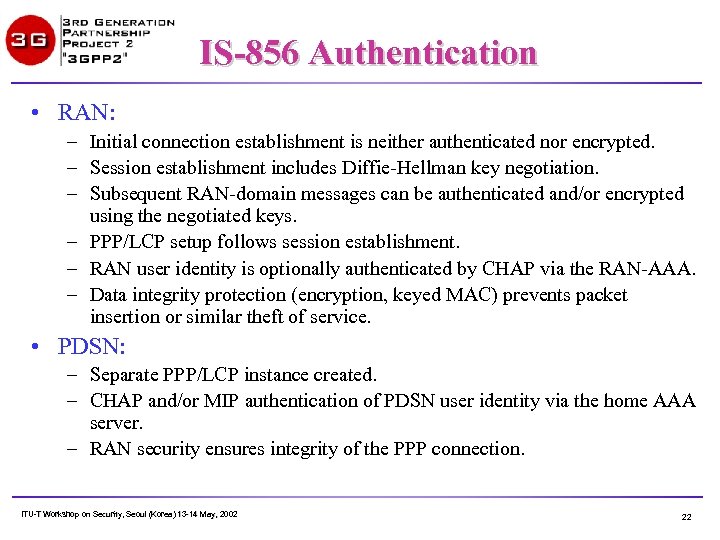 IS-856 Authentication • RAN: – Initial connection establishment is neither authenticated nor encrypted. – Session establishment includes Diffie-Hellman key negotiation. – Subsequent RAN-domain messages can be authenticated and/or encrypted using the negotiated keys. – PPP/LCP setup follows session establishment. – RAN user identity is optionally authenticated by CHAP via the RAN-AAA. – Data integrity protection (encryption, keyed MAC) prevents packet insertion or similar theft of service. • PDSN: – Separate PPP/LCP instance created. – CHAP and/or MIP authentication of PDSN user identity via the home AAA server. – RAN security ensures integrity of the PPP connection. ITU-T Workshop on Security, Seoul (Korea) 13 -14 May, 2002 22
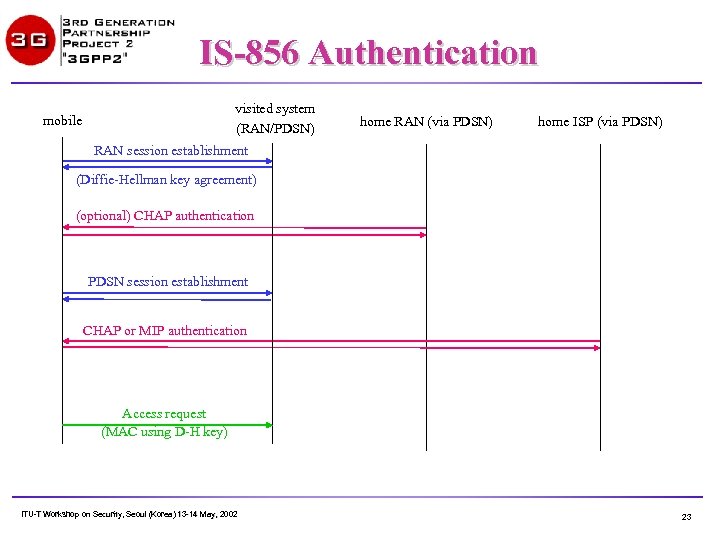 IS-856 Authentication visited system (RAN/PDSN) mobile home RAN (via PDSN) home ISP (via PDSN) RAN session establishment (Diffie-Hellman key agreement) (optional) CHAP authentication PDSN session establishment CHAP or MIP authentication Access request (MAC using D-H key) ITU-T Workshop on Security, Seoul (Korea) 13 -14 May, 2002 23
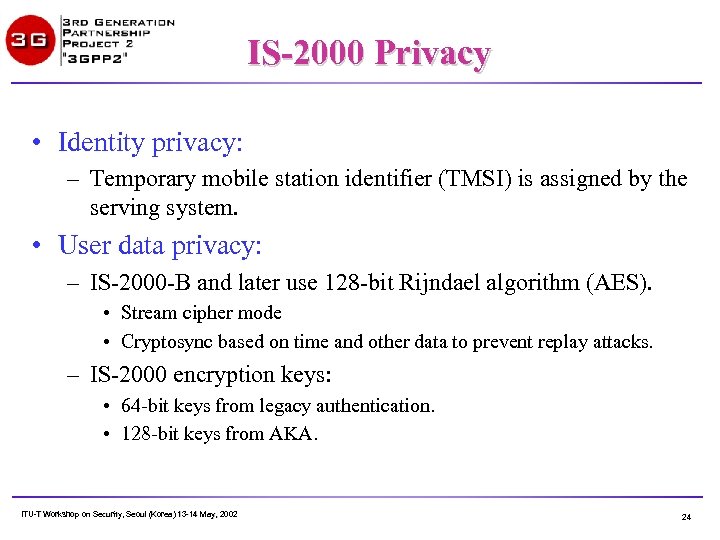 IS-2000 Privacy • Identity privacy: – Temporary mobile station identifier (TMSI) is assigned by the serving system. • User data privacy: – IS-2000 -B and later use 128 -bit Rijndael algorithm (AES). • Stream cipher mode • Cryptosync based on time and other data to prevent replay attacks. – IS-2000 encryption keys: • 64 -bit keys from legacy authentication. • 128 -bit keys from AKA. ITU-T Workshop on Security, Seoul (Korea) 13 -14 May, 2002 24
 IS-856 Privacy • Identity privacy: – When encryption is available, user identities are sent only after encryption is invoked. • User data privacy: – Over-the-air encryption • Protects against packet insertion, session hijacking, and data eavesdropping within the wireless system. • Does not address the greater Internet privacy risks once the data leaves the wireless network. – Internet security protocols (IPsec, SSL, etc. ) are necessary for end-to-end security. ITU-T Workshop on Security, Seoul (Korea) 13 -14 May, 2002 25
 Provisioning • Installation of subscription data in the mobile and network. – Symmetric key security requires at least one key provisioned. • Provisioning is a major operational concern. – High cost – High impact on customer satisfaction – Operator solutions will vary depending on business models. ITU-T Workshop on Security, Seoul (Korea) 13 -14 May, 2002 26
 Provisioning Methods (In approximate order of prevalence in cdma 2000 deployments) • Manufacturer provisioning – Keys are installed by the manufacturer, and securely communicated to the operator’s AC or AAA. • Manual provisioning – User or service representative enters the key via a keypad or provisioning device. • Over-the-air Service Provisioning (OTASP) – Unprovisioned devices are hotlined to special service numbers/URLs; secure protocols are used to install keys. • Removable UIM – Like GSM SIM; keys are in a removable “token” provided separately from the terminal and installed by the user. ITU-T Workshop on Security, Seoul (Korea) 13 -14 May, 2002 27
 In Conclusion: • Cdma 2000 standards support a full set of security features for: – Fraud prevention – User privacy • Future evolution to all-IP networks poses new security challenges. • Actual system security is only as good as the operators make it. ITU-T Workshop on Security, Seoul (Korea) 13 -14 May, 2002 28