


 Скачать презентацию Security Assurance The Times They Are A
c93078601351b99419ae7d32c8821ef2.ppt
- Количество слайдов: 23
 Security Assurance: The Times They Are A ’ The Case for Information Assurance Mary Ann Davidson Chief Security Officer Oracle Copyright © Oracle Corporation, 2001. All rights reserved.
 “A few lines of code can wreak more havoc than a bomb. ” - Tom Ridge (Former) Secretary of the U. S. Department of Homeland Security 1 -2
 Agenda • • 1 -3 State of Information Security Problem Encapsulation Is There a Market Failure in IT Security? Hopeful Signs in Information Assurance Why Secure Coding Matters Oracle Software Security Assurance Program Some Wild Eyed Ideas… Q and A
 State of Information Security “The Long Knives Are Out” • The cost of poor security in the US alone is between $22. 2 B and $59. 5 billion per year (NIST) – Cost per patch applied: $900 per server, $700 per client (Economist) • Tipping point: the poor security of commercial software is a board level issue – Business Roundtable blames defective, easily exploitable software for increase in cyber incidents • …and a US national security issue – Multiple US government-led initiatives on information software assurance, • Many CSOs think the IT industry should be regulated 1 -4
 What If Civil Engineers Built Bridges Like Developers Write Code? • “Structural integrity is a legacy problem. It’s not really interesting. Or elegant. ” • “We can add some rebar later, so what if the concrete has set? ” • “The bridge has crumbled? Sorry, I can’t reproduce that problem here. ” • “But it wasn’t designed to have so many trucks on it. ” IT means “infrastructure technology”: it has to be designed and built to be as reliable and secure as physical infrastructure. 1 -5
 Is Poor IT Security Is a Market Failure? • Customers – Have insufficient information to caveat emptor – Think “cost to secure” is the license cost – Have no idea if there is a security ROI – Are well trained by vendors to patch, patch • Vendors – Still driven by time to market, since “it works” – Often lack tools / will to do a better job in security – Can’t tell customers how to secure their products and what it costs to do so 1 -6
 Is Poor IT Security Is a Market Failure? (2) • Venture Capitalists – Make more money on band-aids than vaccines – Often don’t want to solve the real problem • Universities – Don’t have standard CS curricula that include secure programming practice – Are reluctant to change their curriculum (with some notable exceptions…) – Graduate good coders, not software engineers 1 -7
 What Isn’t a Market Failure… • Hackers/ “security research” firms – Collude well – “Find a need and fill it” – (Sometimes) create businesses from bad behavior – Have excellent automated tools to increase hacking efficiency and time to exploit – (Sometimes) are “for hire” by bad guys 1 -8
 Should the IT Industry Be Regulated? • Governments typically regulate industries where there is a compelling public safety requirement and/or a market failure • IT reliability and safety is a public safety issue because IT is the backbone of critical infrastructure • “Social costs” of bad code are generally not reflected in pricing – a market failure – Vendors have no liability – To-date very little “market correction” (e. g. , through insurance) • Conclusion: Market correction needed – Preferably through procurement power… – But possibly through regulation if market fails to correct 1 -9
 Hopeful Signs in Information Assurance • More Information on Assurance – Books! Seminars! Collect the Set! • More industry collusion, in a good way – US Department of Homeland Security sponsoring forums on software assurance, with lots of participants – Common Body of Knowledge, Procurement Guide, etc. – Secure Software Forum • • 1 -10 Increased customer awareness More automated tools to help (static analysis, web vulnerability, etc. )
 Why Secure Coding Matters to Oracle Customers • • All our products rest on a foundation of secure development practice • Most of secure coding practice is just good coding practice • • 1 -11 Oracle builds mission-critical software that protects customers’ most sensitive information Ripple effect of patching multiple critical systems Oracle’s security brand directly depends on secure development processes
 Secure Product Definition • Oracle Secure Coding Standards – Compliments C and Java coding standards – Revised frequently for new hacks – Uses Oracle “true stories” as examples • Oracle Secure Coding Standards Training – Web-based, interactive class – Mandatory for development, up to SVP, including PMs, QA, release management… – Status: has been rolled out across ST, Apps just beginning 1 -12
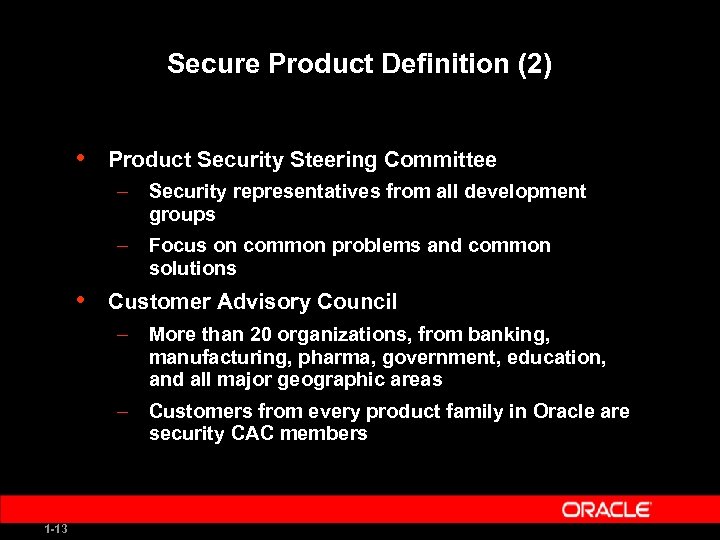 Secure Product Definition (2) • Product Security Steering Committee – Security representatives from all development groups – Focus on common problems and common solutions • Customer Advisory Council – More than 20 organizations, from banking, manufacturing, pharma, government, education, and all major geographic areas – Customers from every product family in Oracle are security CAC members 1 -13
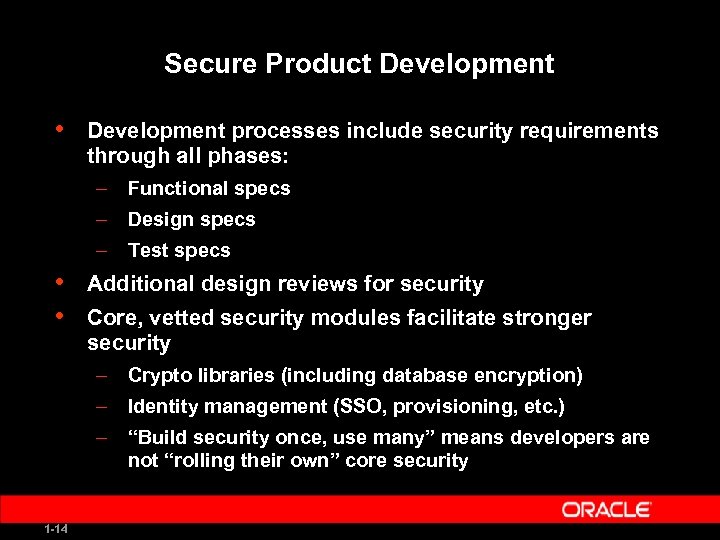 Secure Product Development • Development processes include security requirements through all phases: – Functional specs – Design specs – Test specs • • Additional design reviews for security Core, vetted security modules facilitate stronger security – Crypto libraries (including database encryption) – Identity management (SSO, provisioning, etc. ) – “Build security once, use many” means developers are not “rolling their own” core security 1 -14
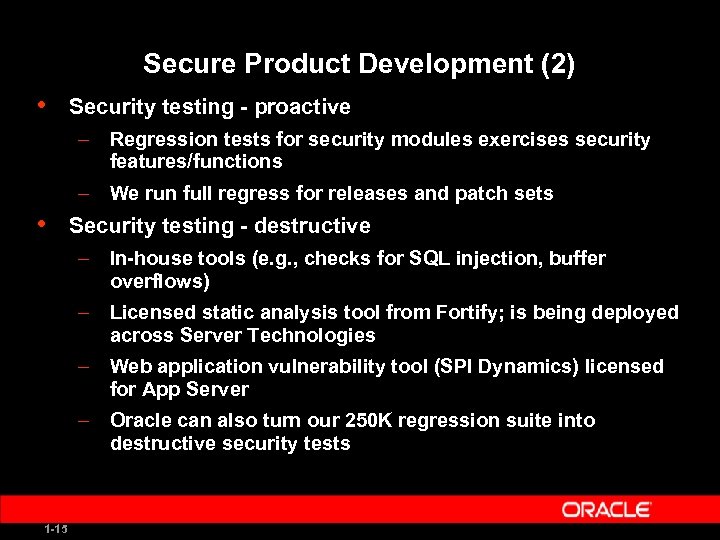 Secure Product Development (2) • Security testing - proactive – Regression tests for security modules exercises security features/functions – We run full regress for releases and patch sets • Security testing - destructive – In-house tools (e. g. , checks for SQL injection, buffer overflows) – Licensed static analysis tool from Fortify; is being deployed across Server Technologies – Web application vulnerability tool (SPI Dynamics) licensed for App Server – Oracle can also turn our 250 K regression suite into destructive security tests 1 -15
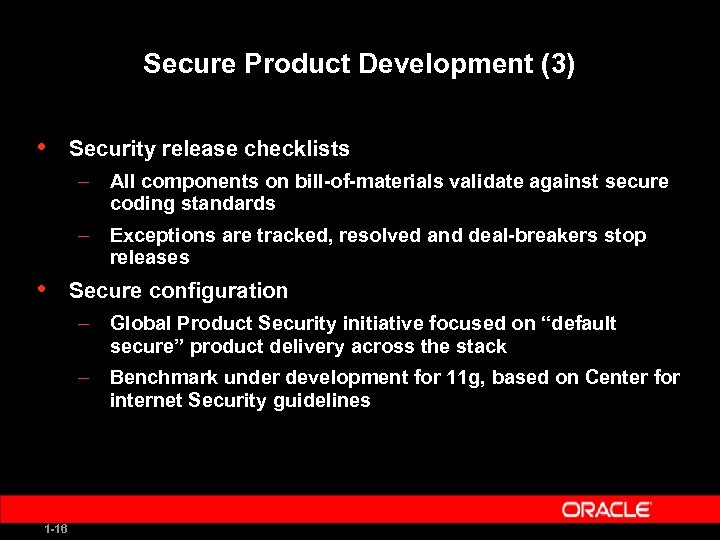 Secure Product Development (3) • Security release checklists – All components on bill-of-materials validate against secure coding standards – Exceptions are tracked, resolved and deal-breakers stop releases • Secure configuration – Global Product Security initiative focused on “default secure” product delivery across the stack – Benchmark under development for 11 g, based on Center for internet Security guidelines 1 -16
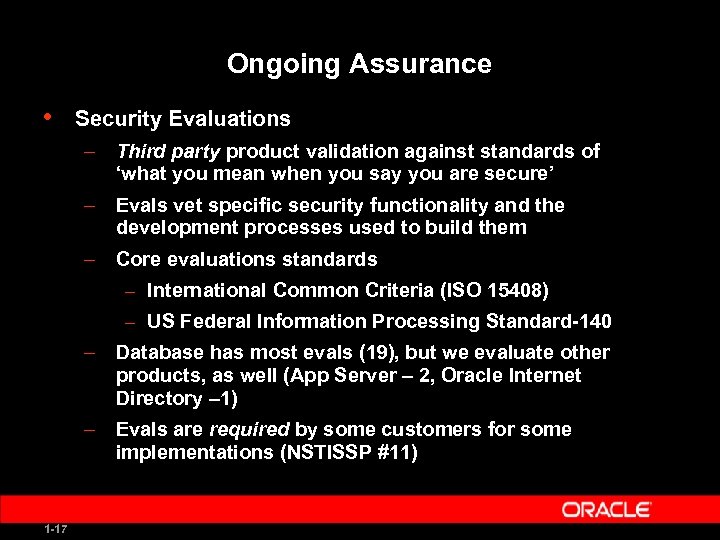 Ongoing Assurance • Security Evaluations – Third party product validation against standards of ‘what you mean when you say you are secure’ – Evals vet specific security functionality and the development processes used to build them – Core evaluations standards – International Common Criteria (ISO 15408) – US Federal Information Processing Standard-140 – Database has most evals (19), but we evaluate other products, as well (App Server – 2, Oracle Internet Directory – 1) – Evals are required by some customers for some implementations (NSTISSP #11) 1 -17
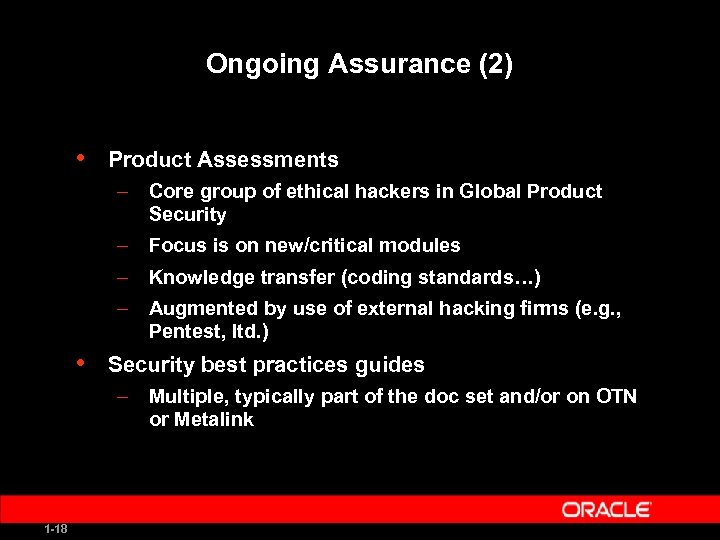 Ongoing Assurance (2) • Product Assessments – Core group of ethical hackers in Global Product Security – Focus is on new/critical modules – Knowledge transfer (coding standards…) – Augmented by use of external hacking firms (e. g. , Pentest, ltd. ) • Security best practices guides – Multiple, typically part of the doc set and/or on OTN or Metalink 1 -18
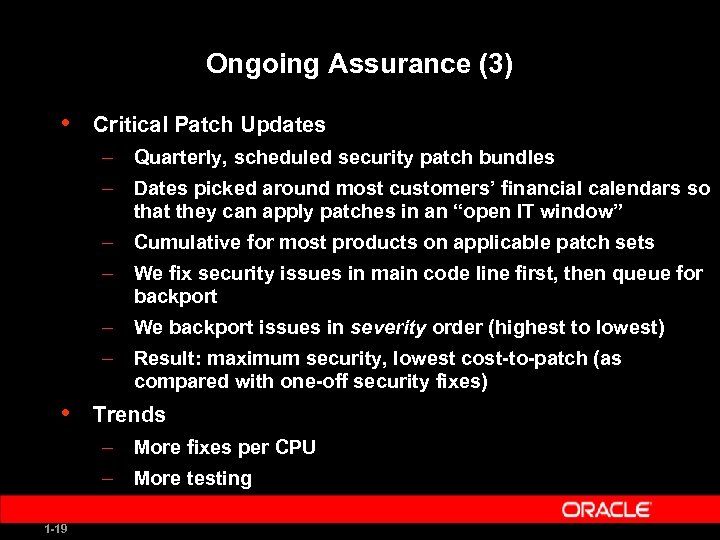 Ongoing Assurance (3) • Critical Patch Updates – Quarterly, scheduled security patch bundles – Dates picked around most customers’ financial calendars so that they can apply patches in an “open IT window” – Cumulative for most products on applicable patch sets – We fix security issues in main code line first, then queue for backport – We backport issues in severity order (highest to lowest) – Result: maximum security, lowest cost-to-patch (as compared with one-off security fixes) • Trends – More fixes per CPU – More testing 1 -19
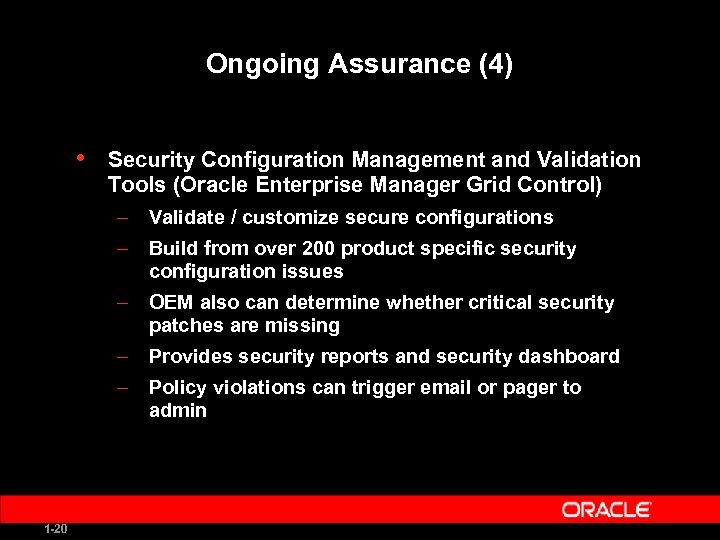 Ongoing Assurance (4) • Security Configuration Management and Validation Tools (Oracle Enterprise Manager Grid Control) – Validate / customize secure configurations – Build from over 200 product specific security configuration issues – OEM also can determine whether critical security patches are missing – Provides security reports and security dashboard – Policy violations can trigger email or pager to admin 1 -20
 Some Wild-eyed Ideas (1) • What if CS degree programs had the same level of required content, and stringent accreditation as CE programs? • What if software developers had to be licensed, like licensed professional engineers (PEs)? – Changing lightbulbs, adding a dimmer switch and designing the power grid need different levels of electrical engineering expertise – Increased accountability for IT professionals is the ultimate process improvement • 1 -21 What if product development processes were certified, and customers required this as proof of “best development practice? ”
 Some Wild-eyed Ideas (2) • What if we had better, more automated tools to find security faults in software, that were widely available – from large vendors to small startups? – … and if customers required that code be scanned for avoidable, preventable security faults? • What if products were required to be secure on installation, and continuously monitored for best practice? ’ • What if the IT industry colluded on secure development practice? • What if the IT industry doesn’t improve? – “At Dawn We Slept” 1 -22
 "A nation, as a society, forms a moral person, and every member of it is personally responsible for his society. “ -Thomas Jefferson (in letter to George Hammond, 1792) 1 -23