 Скачать презентацию Security APIs in LCG-2 Andrea Sciabà LCG Experiment
99b32b93a7bd48cf174ef96b79635c6f.ppt
- Количество слайдов: 66



Security APIs in LCG-2 Andrea Sciabà LCG Experiment Integration and Support CERN IT
Overview • • Basic security concepts Certificates Virtual Organisations Command line interface C/C++ interfaces (GSS-API, GSS Assist) Java interface (Co. G) g. SOAP plugins Hands-on exercises LCG-2 Security APIs – November 29, 2004 - 2
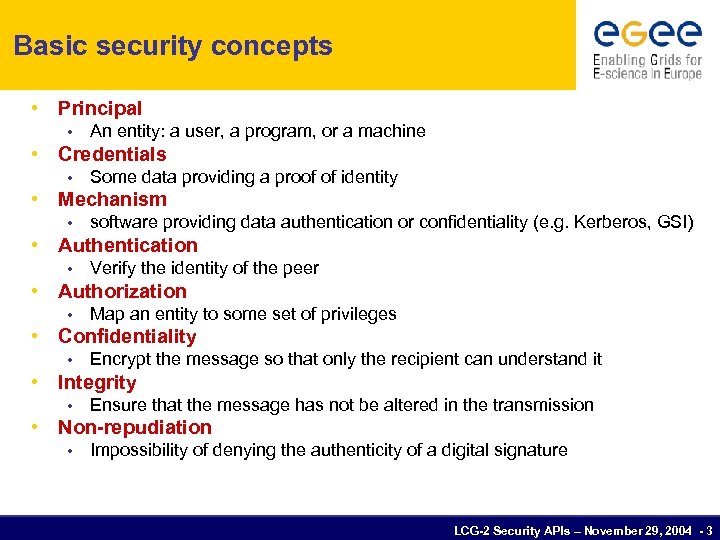
Basic security concepts • Principal • An entity: a user, a program, or a machine • Credentials • Some data providing a proof of identity • Mechanism • software providing data authentication or confidentiality (e. g. Kerberos, GSI) • Authentication • Verify the identity of the peer • Authorization • Map an entity to some set of privileges • Confidentiality • Encrypt the message so that only the recipient can understand it • Integrity • Ensure that the message has not be altered in the transmission • Non-repudiation • Impossibility of denying the authenticity of a digital signature LCG-2 Security APIs – November 29, 2004 - 3
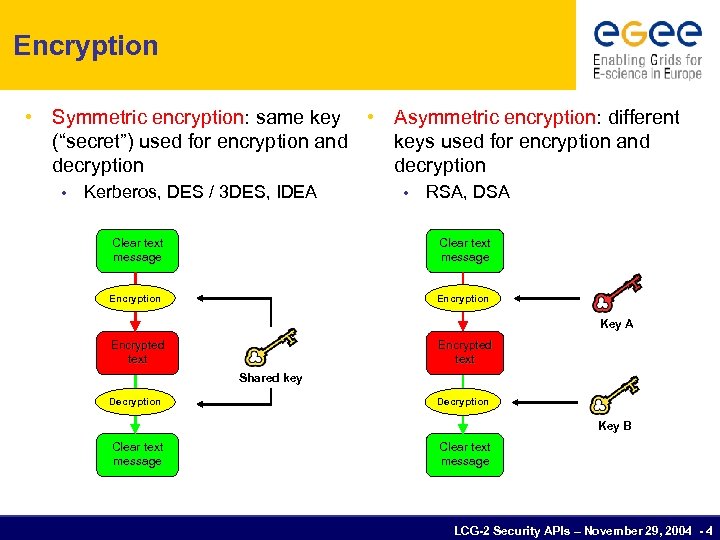
Encryption • Symmetric encryption: same key • Asymmetric encryption: different (“secret”) used for encryption and keys used for encryption and decryption • Kerberos, DES / 3 DES, IDEA • RSA, DSA Clear text message Encryption Key A Encrypted text Shared key Decryption Key B Clear text message LCG-2 Security APIs – November 29, 2004 - 4
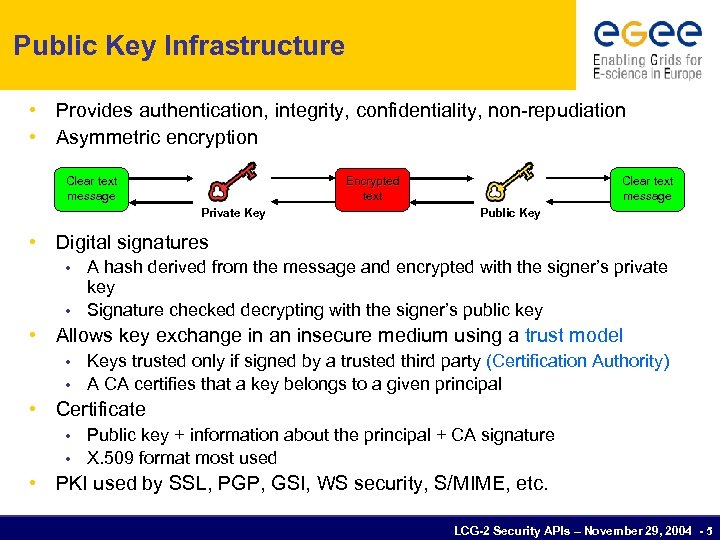
Public Key Infrastructure • Provides authentication, integrity, confidentiality, non-repudiation • Asymmetric encryption Clear text message Encrypted text Private Key Public Key • Digital signatures A hash derived from the message and encrypted with the signer’s private key • Signature checked decrypting with the signer’s public key • • Allows key exchange in an insecure medium using a trust model Keys trusted only if signed by a trusted third party (Certification Authority) • A CA certifies that a key belongs to a given principal • • Certificate Public key + information about the principal + CA signature • X. 509 format most used • • PKI used by SSL, PGP, GSI, WS security, S/MIME, etc. LCG-2 Security APIs – November 29, 2004 - 5
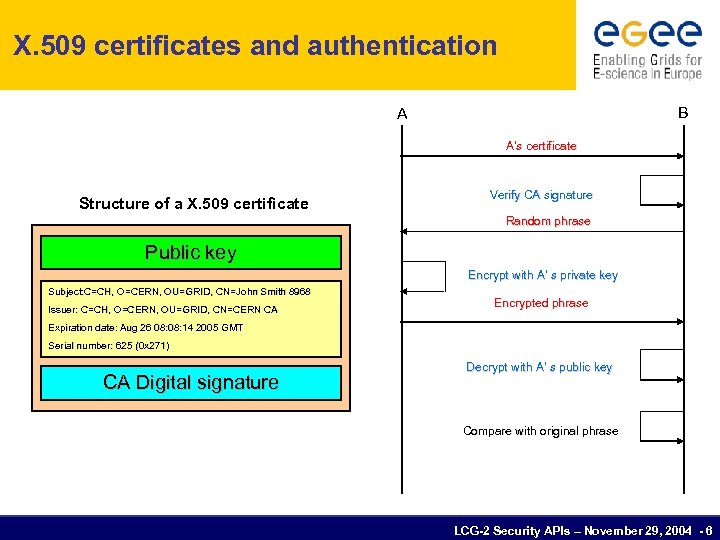
X. 509 certificates and authentication B A A’s certificate Structure of a X. 509 certificate Verify CA signature Random phrase Public key Encrypt with A’ s private key Subject: C=CH, O=CERN, OU=GRID, CN=John Smith 8968 Subject: C=CH, Issuer: C=CH, O=CERN, OU=GRID, CN=CERN CA Encrypted phrase Expiration date: Aug 26 08: 14 2005 GMT Serial number: 625 (0 x 271) CA Digital signature Decrypt with A’ s public key Compare with original phrase LCG-2 Security APIs – November 29, 2004 - 6
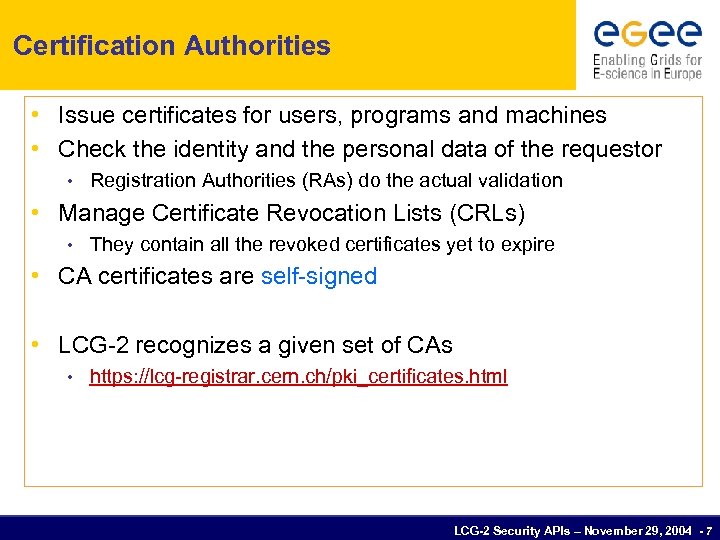
Certification Authorities • Issue certificates for users, programs and machines • Check the identity and the personal data of the requestor • Registration Authorities (RAs) do the actual validation • Manage Certificate Revocation Lists (CRLs) • They contain all the revoked certificates yet to expire • CA certificates are self-signed • LCG-2 recognizes a given set of CAs • https: //lcg-registrar. cern. ch/pki_certificates. html LCG-2 Security APIs – November 29, 2004 - 7
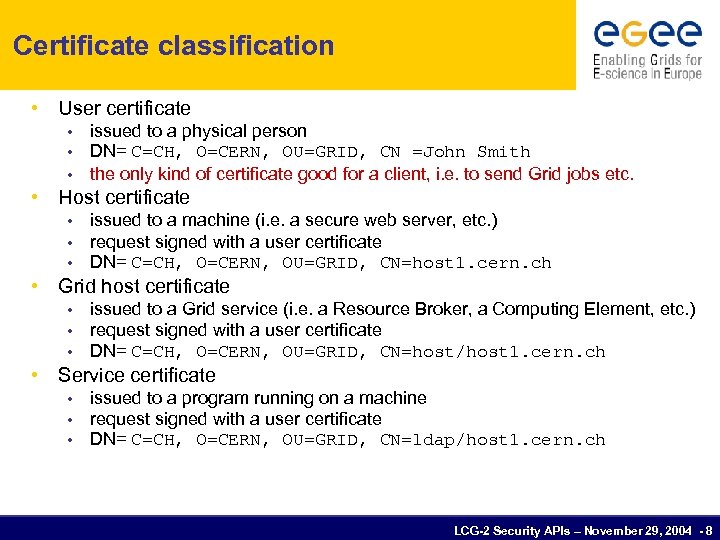
Certificate classification • User certificate issued to a physical person DN= C=CH, O=CERN, OU=GRID, CN =John Smith • the only kind of certificate good for a client, i. e. to send Grid jobs etc. • • • Host certificate • • • issued to a machine (i. e. a secure web server, etc. ) request signed with a user certificate DN= C=CH, O=CERN, OU=GRID, CN=host 1. cern. ch • Grid host certificate • • • issued to a Grid service (i. e. a Resource Broker, a Computing Element, etc. ) request signed with a user certificate DN= C=CH, O=CERN, OU=GRID, CN=host/host 1. cern. ch • Service certificate • • • issued to a program running on a machine request signed with a user certificate DN= C=CH, O=CERN, OU=GRID, CN=ldap/host 1. cern. ch LCG-2 Security APIs – November 29, 2004 - 8
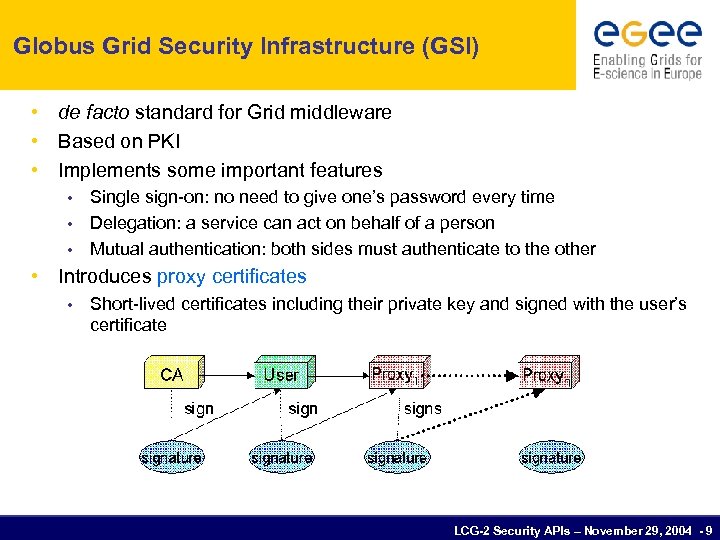
Globus Grid Security Infrastructure (GSI) • de facto standard for Grid middleware • Based on PKI • Implements some important features Single sign-on: no need to give one’s password every time • Delegation: a service can act on behalf of a person • Mutual authentication: both sides must authenticate to the other • • Introduces proxy certificates • Short-lived certificates including their private key and signed with the user’s certificate LCG-2 Security APIs – November 29, 2004 - 9
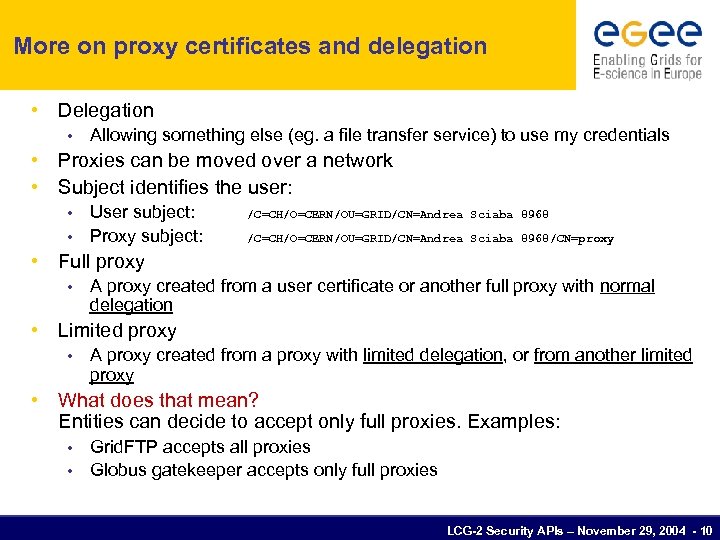
More on proxy certificates and delegation • Delegation • Allowing something else (eg. a file transfer service) to use my credentials • Proxies can be moved over a network • Subject identifies the user: User subject: • Proxy subject: • /C=CH/O=CERN/OU=GRID/CN=Andrea Sciaba 8968/CN=proxy • Full proxy • A proxy created from a user certificate or another full proxy with normal delegation • Limited proxy • A proxy created from a proxy with limited delegation, or from another limited proxy • What does that mean? Entities can decide to accept only full proxies. Examples: Grid. FTP accepts all proxies • Globus gatekeeper accepts only full proxies • LCG-2 Security APIs – November 29, 2004 - 10
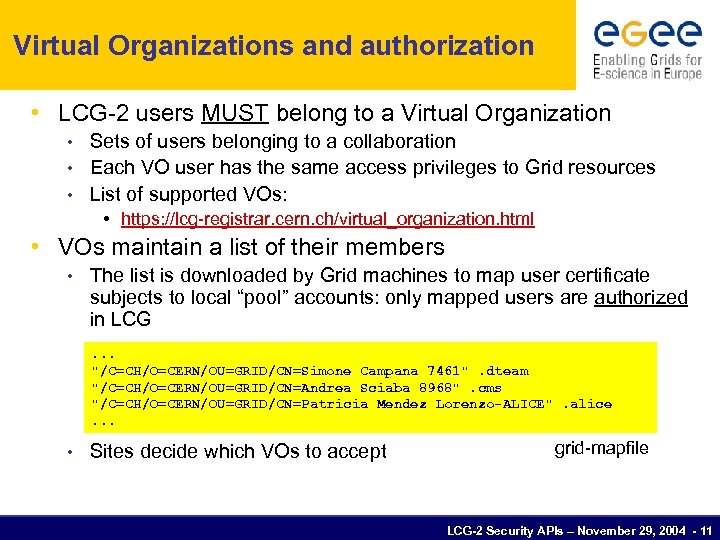
Virtual Organizations and authorization • LCG-2 users MUST belong to a Virtual Organization Sets of users belonging to a collaboration • Each VO user has the same access privileges to Grid resources • List of supported VOs: • • https: //lcg-registrar. cern. ch/virtual_organization. html • VOs maintain a list of their members • The list is downloaded by Grid machines to map user certificate subjects to local “pool” accounts: only mapped users are authorized in LCG. . . "/C=CH/O=CERN/OU=GRID/CN=Simone Campana 7461". dteam "/C=CH/O=CERN/OU=GRID/CN=Andrea Sciaba 8968". cms "/C=CH/O=CERN/OU=GRID/CN=Patricia Mendez Lorenzo-ALICE". alice. . . • Sites decide which VOs to accept grid-mapfile LCG-2 Security APIs – November 29, 2004 - 11
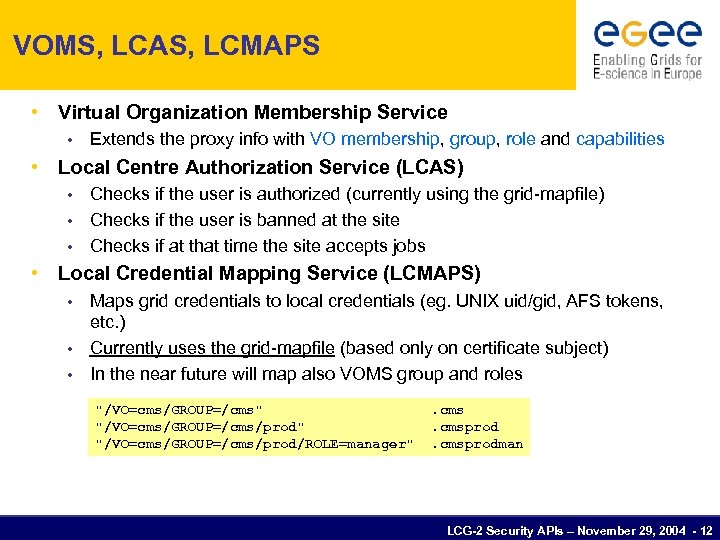
VOMS, LCAS, LCMAPS • Virtual Organization Membership Service • Extends the proxy info with VO membership, group, role and capabilities • Local Centre Authorization Service (LCAS) Checks if the user is authorized (currently using the grid-mapfile) • Checks if the user is banned at the site • Checks if at that time the site accepts jobs • • Local Credential Mapping Service (LCMAPS) Maps grid credentials to local credentials (eg. UNIX uid/gid, AFS tokens, etc. ) • Currently uses the grid-mapfile (based only on certificate subject) • In the near future will map also VOMS group and roles • "/VO=cms/GROUP=/cms" "/VO=cms/GROUP=/cms/prod/ROLE=manager" . cmsprodman LCG-2 Security APIs – November 29, 2004 - 12
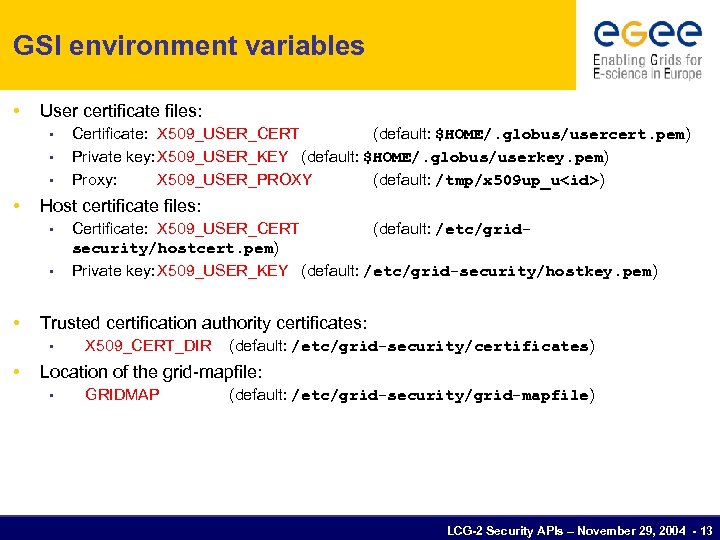
GSI environment variables • User certificate files: • • Host certificate files: • • • Certificate: X 509_USER_CERT (default: /etc/gridsecurity/hostcert. pem) Private key: X 509_USER_KEY (default: /etc/grid-security/hostkey. pem) Trusted certification authority certificates: • • Certificate: X 509_USER_CERT (default: $HOME/. globus/usercert. pem) Private key: X 509_USER_KEY (default: $HOME/. globus/userkey. pem) Proxy: X 509_USER_PROXY (default: /tmp/x 509 up_u<id>) X 509_CERT_DIR (default: /etc/grid-security/certificates) Location of the grid-mapfile: • GRIDMAP (default: /etc/grid-security/grid-mapfile) LCG-2 Security APIs – November 29, 2004 - 13
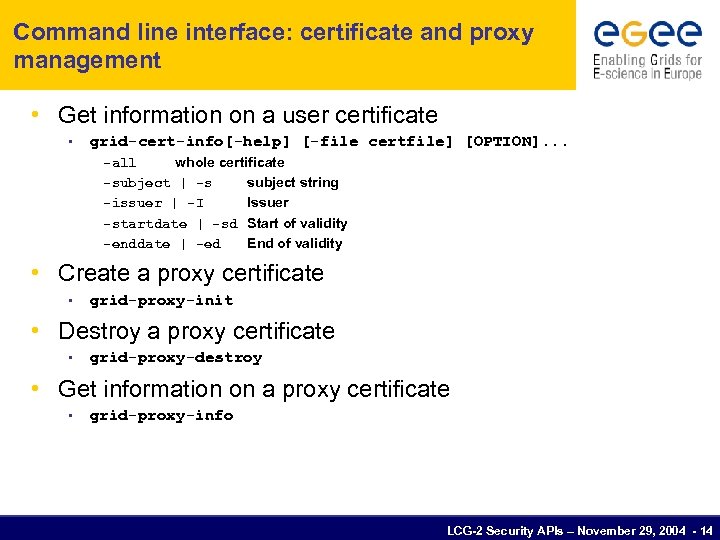
Command line interface: certificate and proxy management • Get information on a user certificate • grid-cert-info[-help] [-file certfile] [OPTION]. . . -all whole certificate -subject | -s subject string -issuer | -I Issuer -startdate | -sd Start of validity -enddate | -ed End of validity • Create a proxy certificate • grid-proxy-init • Destroy a proxy certificate • grid-proxy-destroy • Get information on a proxy certificate • grid-proxy-info LCG-2 Security APIs – November 29, 2004 - 14
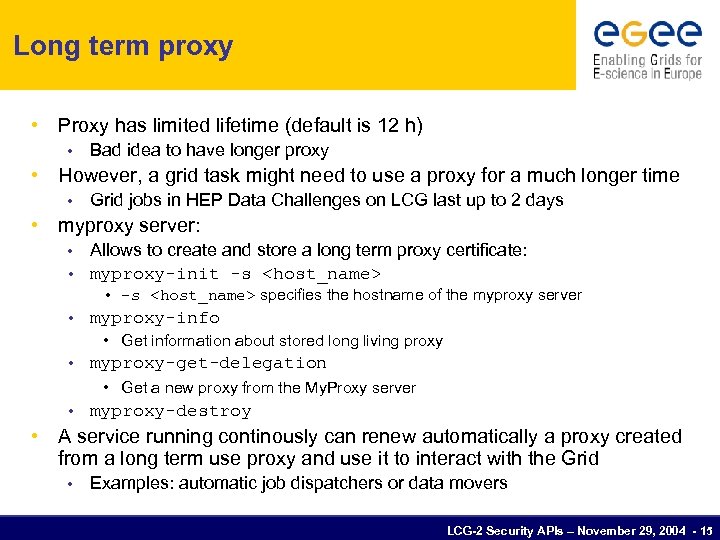
Long term proxy • Proxy has limited lifetime (default is 12 h) • Bad idea to have longer proxy • However, a grid task might need to use a proxy for a much longer time • Grid jobs in HEP Data Challenges on LCG last up to 2 days • myproxy server: • • Allows to create and store a long term proxy certificate: myproxy-init -s <host_name> • -s <host_name> specifies the hostname of the myproxy server • myproxy-info • Get information about stored long living proxy • myproxy-get-delegation • Get a new proxy from the My. Proxy server • myproxy-destroy • A service running continously can renew automatically a proxy created from a long term use proxy and use it to interact with the Grid • Examples: automatic job dispatchers or data movers LCG-2 Security APIs – November 29, 2004 - 15
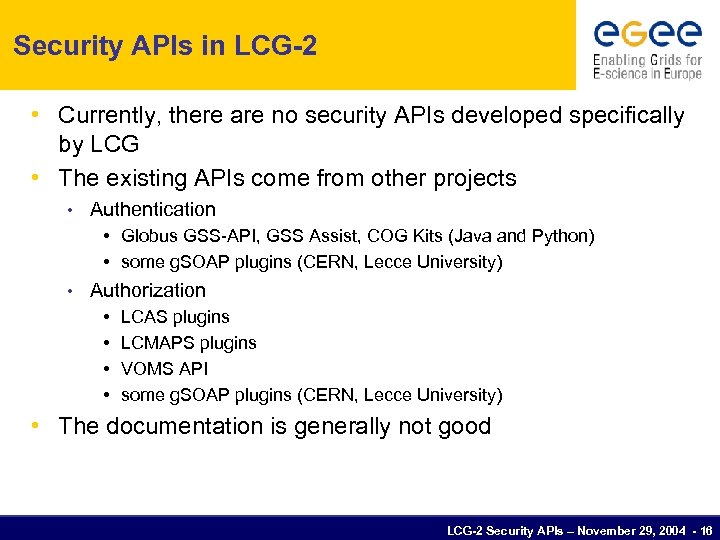
Security APIs in LCG-2 • Currently, there are no security APIs developed specifically by LCG • The existing APIs come from other projects • Authentication • Globus GSS-API, GSS Assist, COG Kits (Java and Python) • some g. SOAP plugins (CERN, Lecce University) • Authorization • • LCAS plugins LCMAPS plugins VOMS API some g. SOAP plugins (CERN, Lecce University) • The documentation is generally not good LCG-2 Security APIs – November 29, 2004 - 16
API: GSS-API and GSS Assist • GSS-API (Generic Security Services Application Programming Interface) is a generic API for client-server authentication (RFC-2743, 2744) • • • Traditionally, it interfaces to Kerberos The Globus project interfaced it to GSI Communication is kept separate: it just creates data buffers, does not move them Rather complicated to use… Documentation at http: //docs. sun. com/app/docs/doc/816 -1331 http: //www. gnu. org/software/gss/manual/html_node/index. html • GSS-API as user interface to GSI: C API • Java API (see later) • • The Globus GSS Assist routines are designed to simplify the use of the GSSAPI: they are a thin layer over them LCG-2 Security APIs – November 29, 2004 - 17
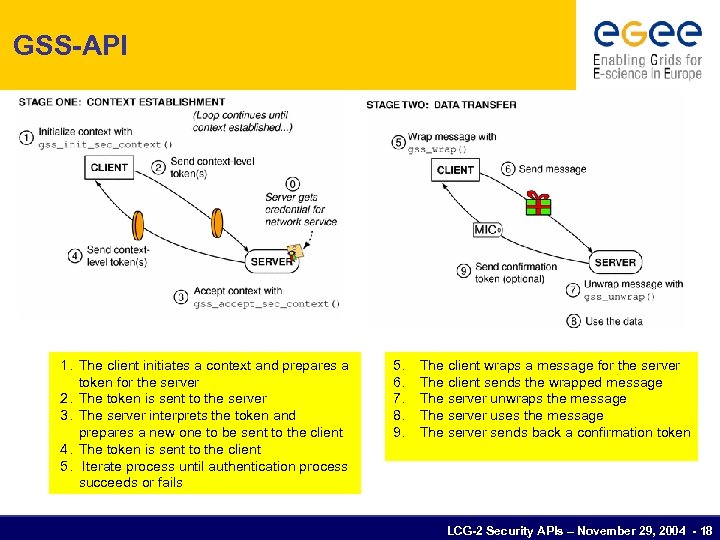
GSS-API 1. The client initiates a context and prepares a token for the server 2. The token is sent to the server 3. The server interprets the token and prepares a new one to be sent to the client 4. The token is sent to the client 5. Iterate process until authentication process succeeds or fails 5. 6. 7. 8. 9. The client wraps a message for the server The client sends the wrapped message The server unwraps the message The server uses the message The server sends back a confirmation token LCG-2 Security APIs – November 29, 2004 - 18
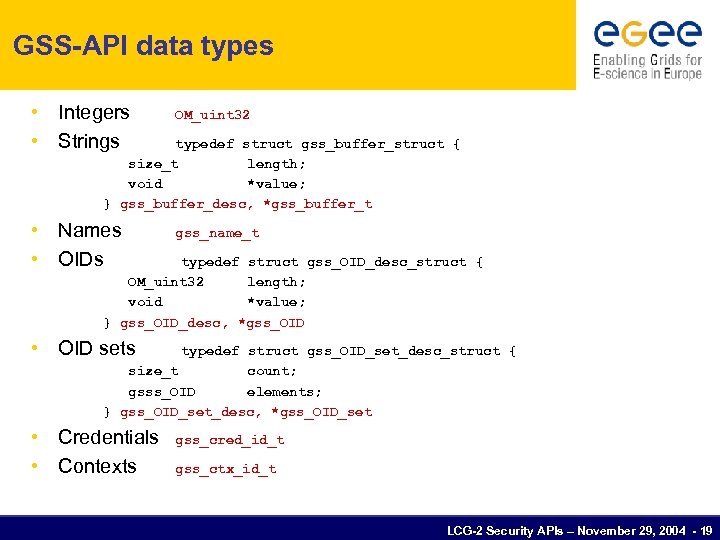
GSS-API data types • Integers • Strings OM_uint 32 • Names • OIDs gss_name_t typedef struct gss_buffer_struct { size_t length; void *value; } gss_buffer_desc, *gss_buffer_t typedef struct gss_OID_desc_struct { OM_uint 32 length; void *value; } gss_OID_desc, *gss_OID • OID sets typedef struct gss_OID_set_desc_struct { size_t count; gsss_OID elements; } gss_OID_set_desc, *gss_OID_set • Credentials • Contexts gss_cred_id_t gss_ctx_id_t LCG-2 Security APIs – November 29, 2004 - 19
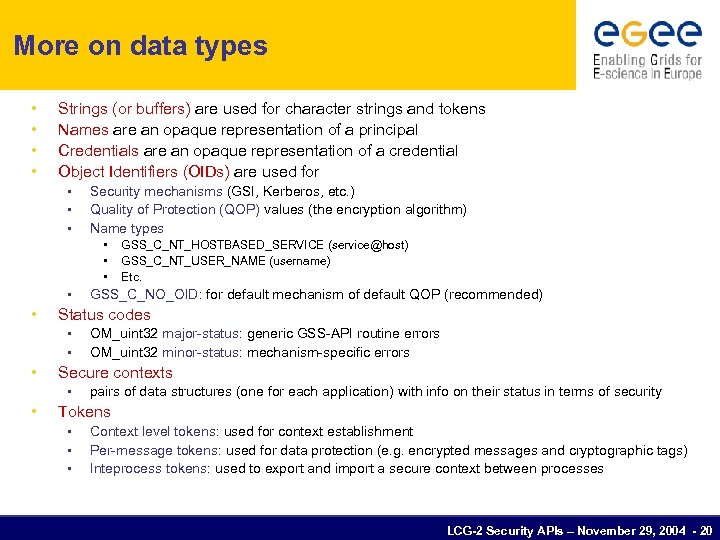
More on data types • • Strings (or buffers) are used for character strings and tokens Names are an opaque representation of a principal Credentials are an opaque representation of a credential Object Identifiers (OIDs) are used for • • • Security mechanisms (GSI, Kerberos, etc. ) Quality of Protection (QOP) values (the encryption algorithm) Name types • • • OM_uint 32 major-status: generic GSS-API routine errors OM_uint 32 minor-status: mechanism-specific errors Secure contexts • • GSS_C_NO_OID: for default mechanism of default QOP (recommended) Status codes • • GSS_C_NT_HOSTBASED_SERVICE (service@host) GSS_C_NT_USER_NAME (username) Etc. pairs of data structures (one for each application) with info on their status in terms of security Tokens • • • Context level tokens: used for context establishment Per-message tokens: used for data protection (e. g. encrypted messages and cryptographic tags) Inteprocess tokens: used to export and import a secure context between processes LCG-2 Security APIs – November 29, 2004 - 20
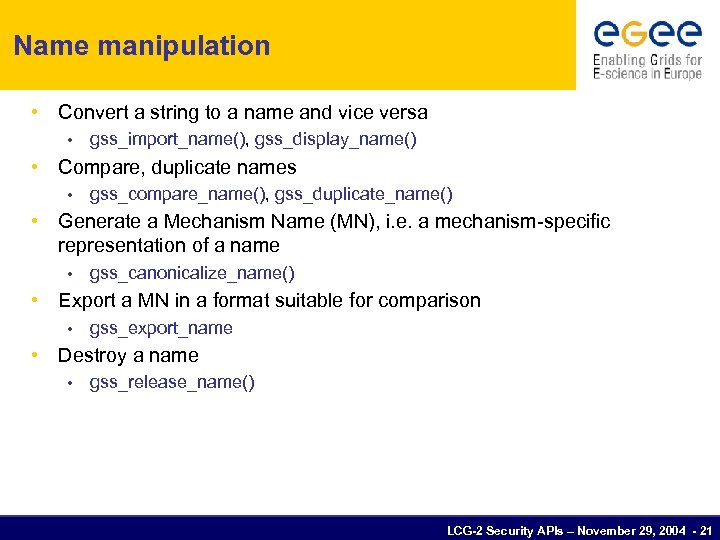
Name manipulation • Convert a string to a name and vice versa • gss_import_name(), gss_display_name() • Compare, duplicate names • gss_compare_name(), gss_duplicate_name() • Generate a Mechanism Name (MN), i. e. a mechanism-specific representation of a name • gss_canonicalize_name() • Export a MN in a format suitable for comparison • gss_export_name • Destroy a name • gss_release_name() LCG-2 Security APIs – November 29, 2004 - 21
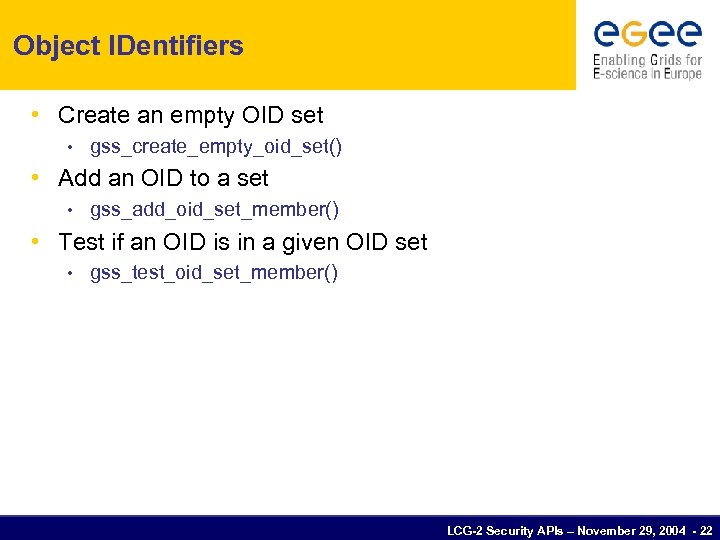
Object IDentifiers • Create an empty OID set • gss_create_empty_oid_set() • Add an OID to a set • gss_add_oid_set_member() • Test if an OID is in a given OID set • gss_test_oid_set_member() LCG-2 Security APIs – November 29, 2004 - 22
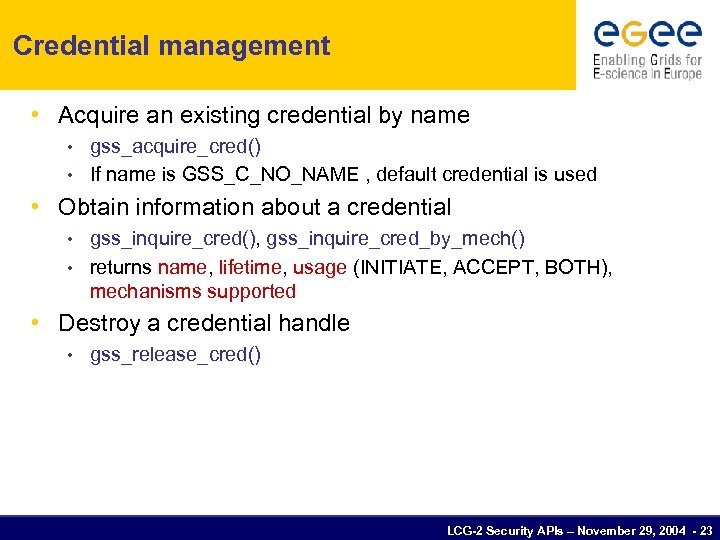
Credential management • Acquire an existing credential by name gss_acquire_cred() • If name is GSS_C_NO_NAME , default credential is used • • Obtain information about a credential gss_inquire_cred(), gss_inquire_cred_by_mech() • returns name, lifetime, usage (INITIATE, ACCEPT, BOTH), mechanisms supported • • Destroy a credential handle • gss_release_cred() LCG-2 Security APIs – November 29, 2004 - 23
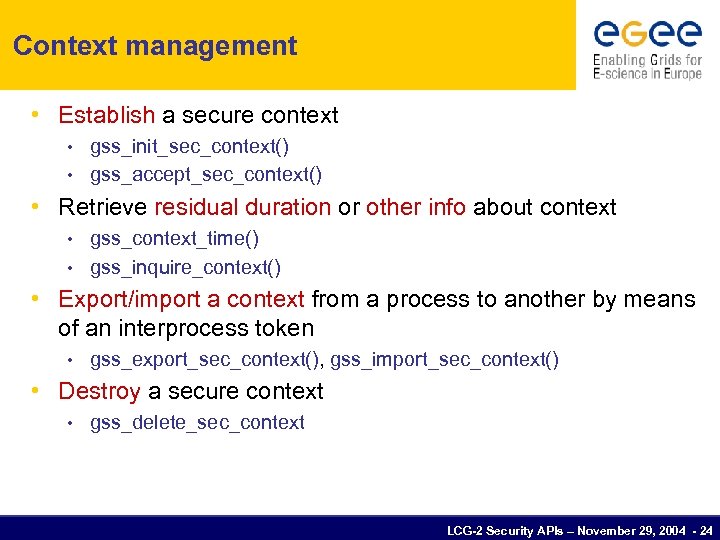
Context management • Establish a secure context gss_init_sec_context() • gss_accept_sec_context() • • Retrieve residual duration or other info about context gss_context_time() • gss_inquire_context() • • Export/import a context from a process to another by means of an interprocess token • gss_export_sec_context(), gss_import_sec_context() • Destroy a secure context • gss_delete_sec_context LCG-2 Security APIs – November 29, 2004 - 24
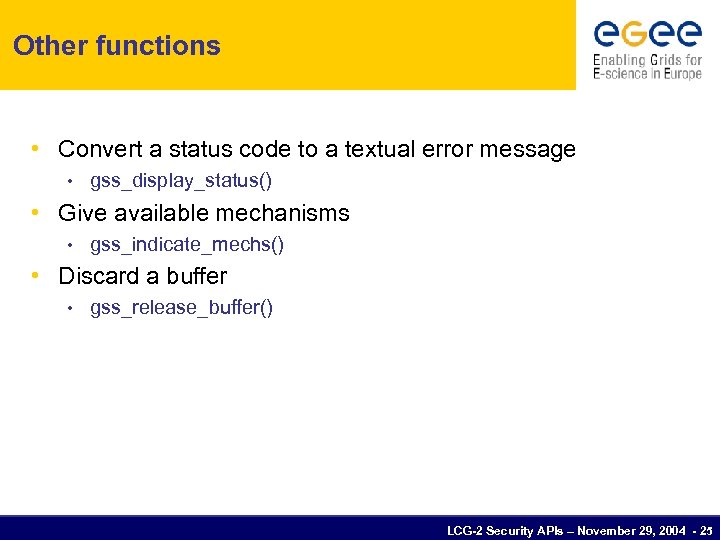
Other functions • Convert a status code to a textual error message • gss_display_status() • Give available mechanisms • gss_indicate_mechs() • Discard a buffer • gss_release_buffer() LCG-2 Security APIs – November 29, 2004 - 25
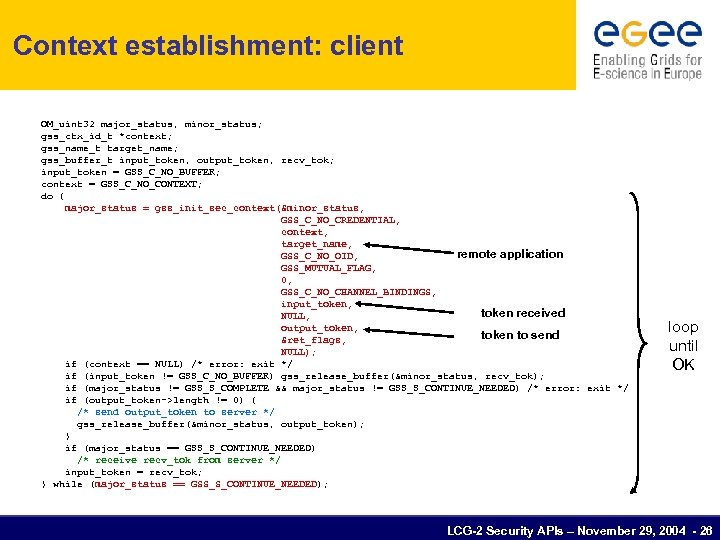
Context establishment: client OM_uint 32 major_status, minor_status; gss_ctx_id_t *context; gss_name_t target_name; gss_buffer_t input_token, output_token, recv_tok; input_token = GSS_C_NO_BUFFER; context = GSS_C_NO_CONTEXT; do { major_status = gss_init_sec_context(&minor_status, GSS_C_NO_CREDENTIAL, context, target_name, remote application GSS_C_NO_OID, GSS_MUTUAL_FLAG, 0, GSS_C_NO_CHANNEL_BINDINGS, input_token, token received NULL, output_token, token to send &ret_flags, NULL); if (context == NULL) /* error: exit */ if (input_token != GSS_C_NO_BUFFER) gss_release_buffer(&minor_status, recv_tok); if (major_status != GSS_S_COMPLETE && major_status != GSS_S_CONTINUE_NEEDED) /* error: exit */ if (output_token->length != 0) { /* send output_token to server */ gss_release_buffer(&minor_status, output_token); } if (major_status == GSS_S_CONTINUE_NEEDED) /* receive recv_tok from server */ input_token = recv_tok; } while (major_status == GSS_S_CONTINUE_NEEDED); loop until OK LCG-2 Security APIs – November 29, 2004 - 26
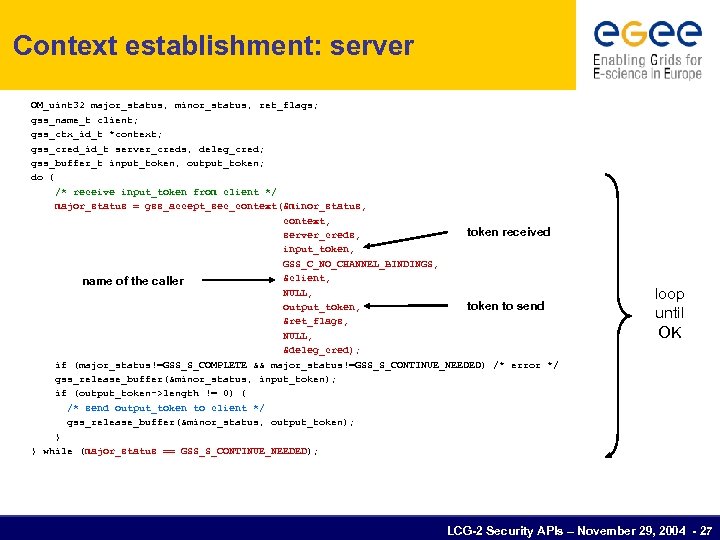
Context establishment: server OM_uint 32 major_status, minor_status, ret_flags; gss_name_t client; gss_ctx_id_t *context; gss_cred_id_t server_creds, deleg_cred; gss_buffer_t input_token, output_token; do { /* receive input_token from client */ major_status = gss_accept_sec_context(&minor_status, context, token received server_creds, input_token, GSS_C_NO_CHANNEL_BINDINGS, &client, name of the caller NULL, token to send output_token, &ret_flags, NULL, &deleg_cred); if (major_status!=GSS_S_COMPLETE && major_status!=GSS_S_CONTINUE_NEEDED) /* error */ gss_release_buffer(&minor_status, input_token); if (output_token->length != 0) { /* send output_token to client */ gss_release_buffer(&minor_status, output_token); } } while (major_status == GSS_S_CONTINUE_NEEDED); loop until OK LCG-2 Security APIs – November 29, 2004 - 27
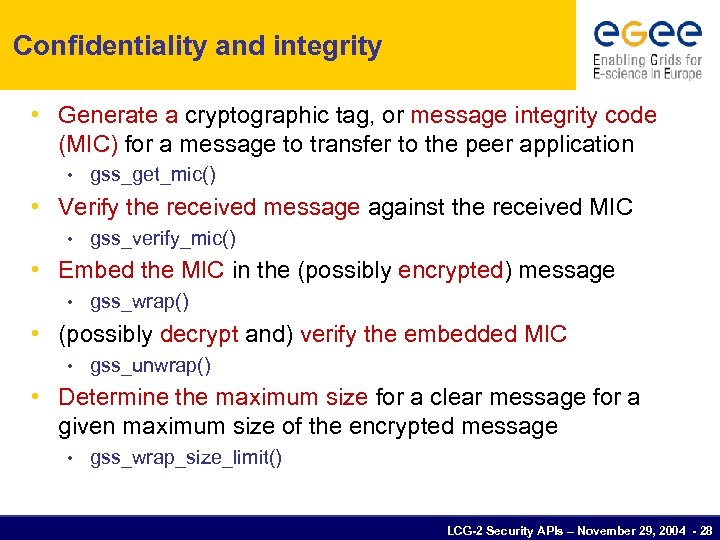
Confidentiality and integrity • Generate a cryptographic tag, or message integrity code (MIC) for a message to transfer to the peer application • gss_get_mic() • Verify the received message against the received MIC • gss_verify_mic() • Embed the MIC in the (possibly encrypted) message • gss_wrap() • (possibly decrypt and) verify the embedded MIC • gss_unwrap() • Determine the maximum size for a clear message for a given maximum size of the encrypted message • gss_wrap_size_limit() LCG-2 Security APIs – November 29, 2004 - 28
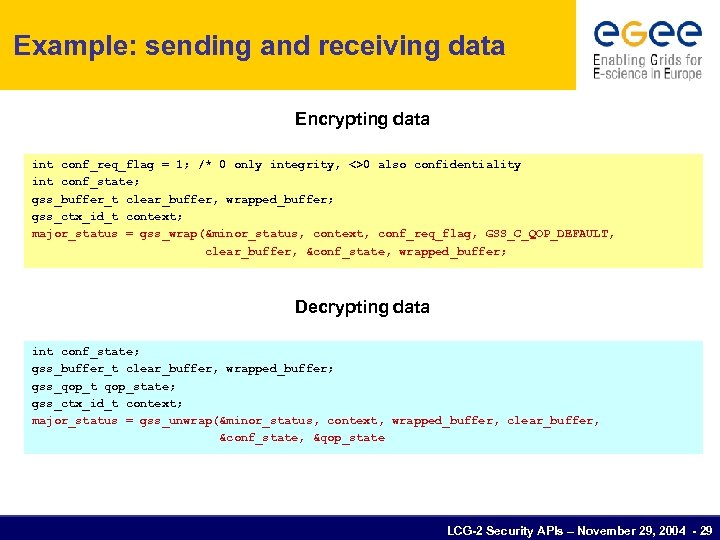
Example: sending and receiving data Encrypting data int conf_req_flag = 1; /* 0 only integrity, <>0 also confidentiality int conf_state; gss_buffer_t clear_buffer, wrapped_buffer; gss_ctx_id_t context; major_status = gss_wrap(&minor_status, context, conf_req_flag, GSS_C_QOP_DEFAULT, clear_buffer, &conf_state, wrapped_buffer; Decrypting data int conf_state; gss_buffer_t clear_buffer, wrapped_buffer; gss_qop_t qop_state; gss_ctx_id_t context; major_status = gss_unwrap(&minor_status, context, wrapped_buffer, clear_buffer, &conf_state, &qop_state LCG-2 Security APIs – November 29, 2004 - 29
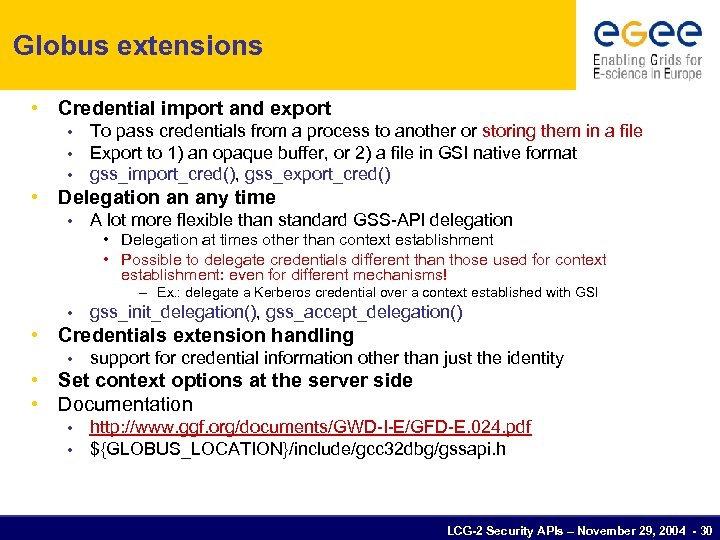
Globus extensions • Credential import and export • • • To pass credentials from a process to another or storing them in a file Export to 1) an opaque buffer, or 2) a file in GSI native format gss_import_cred(), gss_export_cred() • Delegation an any time • A lot more flexible than standard GSS-API delegation • Delegation at times other than context establishment • Possible to delegate credentials different than those used for context establishment: even for different mechanisms! – Ex. : delegate a Kerberos credential over a context established with GSI • gss_init_delegation(), gss_accept_delegation() • Credentials extension handling • support for credential information other than just the identity • Set context options at the server side • Documentation • • http: //www. ggf. org/documents/GWD-I-E/GFD-E. 024. pdf ${GLOBUS_LOCATION}/include/gcc 32 dbg/gssapi. h LCG-2 Security APIs – November 29, 2004 - 30
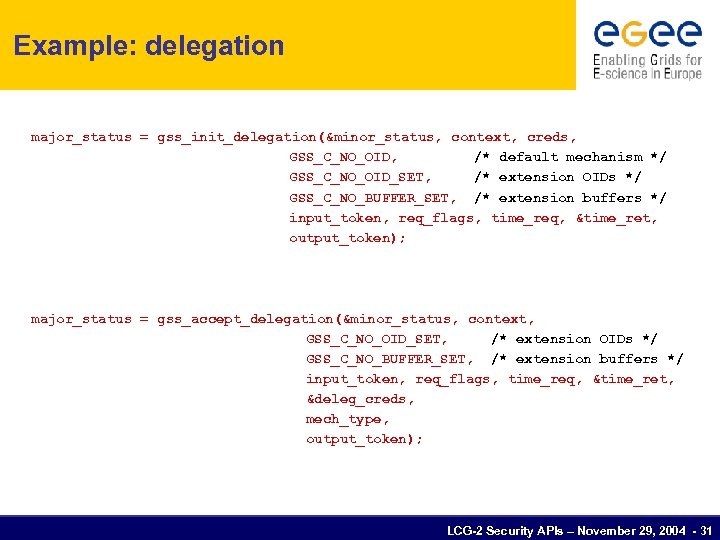
Example: delegation major_status = gss_init_delegation(&minor_status, context, creds, GSS_C_NO_OID, /* default mechanism */ GSS_C_NO_OID_SET, /* extension OIDs */ GSS_C_NO_BUFFER_SET, /* extension buffers */ input_token, req_flags, time_req, &time_ret, output_token); major_status = gss_accept_delegation(&minor_status, context, GSS_C_NO_OID_SET, /* extension OIDs */ GSS_C_NO_BUFFER_SET, /* extension buffers */ input_token, req_flags, time_req, &time_ret, &deleg_creds, mech_type, output_token); LCG-2 Security APIs – November 29, 2004 - 31
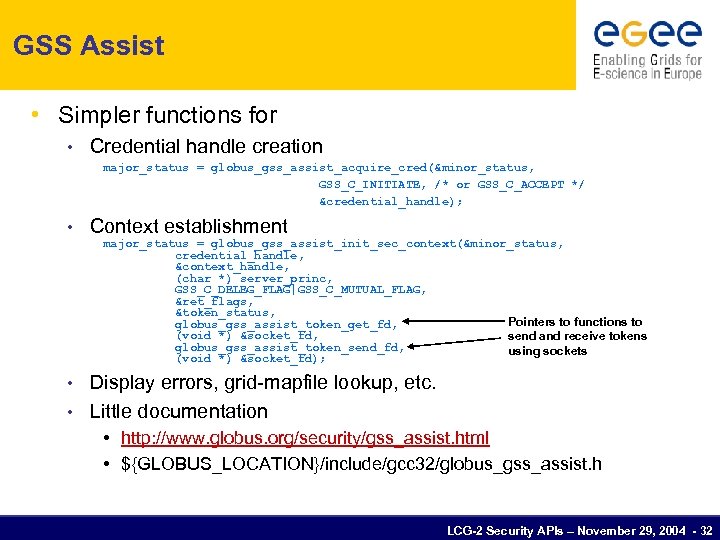
GSS Assist • Simpler functions for • Credential handle creation major_status = globus_gss_assist_acquire_cred(&minor_status, GSS_C_INITIATE, /* or GSS_C_ACCEPT */ &credential_handle); • Context establishment major_status = globus_gss_assist_init_sec_context(&minor_status, credential_handle, &context_handle, (char *) server_princ, GSS_C_DELEG_FLAG|GSS_C_MUTUAL_FLAG, &ret_flags, &token_status, Pointers to functions to globus_gss_assist_token_get_fd, (void *) &socket_fd, send and receive tokens globus_gss_assist_token_send_fd, using sockets (void *) &socket_fd); Display errors, grid-mapfile lookup, etc. • Little documentation • • http: //www. globus. org/security/gss_assist. html • ${GLOBUS_LOCATION}/include/gcc 32/globus_gss_assist. h LCG-2 Security APIs – November 29, 2004 - 32
Java Commodity Grid (Co. G) API • • • Provides a mapping between the Globus Toolkit and Java It is implemented in pure Java Does not wrap the Globus C implementation Allows to interface to all Globus services Here we limit ourselves to the GSI library (org. globus. gsi. gssapi) Implements the standard Java GSS-API (org. ietf. jgss) • Implements the GSS-API extensions (org. gridforum. jgss) • Supports the Globus proxy certificates • • Web site • http: //www-unix. globus. org/cog/java/ • Manual • http: //www-unix. globus. org/cog/manual-user. pdf • API documentation • http: //www-unix. globus. org/cog/distribution/1. 1/api-new/index. html LCG-2 Security APIs – November 29, 2004 - 33
Java GSS-API • Package org. ietf. jgss (RFC 2853) • Interfaces GSSContext • GSSCredential • GSSName • • Classes Channel Binding • GSSManager • Message. Prop • Oid • (used to strengthen the authentication) (used to instantiate names, credentials and contexts) (to specify the level of QOP and confidentiality) • Exceptions • GSSException • Documentation • http: //java. sun. com/j 2 se/1. 4. 2/docs/api/org/ietf/jgss/package-summary. html LCG-2 Security APIs – November 29, 2004 - 34
Java GSS-API: how it works 1. 2. 3. 4. 5. Instantiate a GSSManager (acts as factory) Create principal names and credentials as needed Create a context Engage in a context establishment loop When finished, authentication is complete • The GSS-API does not perform any communication with the peer; it just generates tokens LCG-2 Security APIs – November 29, 2004 - 35
Globus GSS-API extensions • Package org. gridforum. jgss (RFC 3820) • Interfaces • Extended. GSSContext • Set and get context options, delegate credentials • Extended. GSSCredential • Credential export • Classes • Extended. GSSManager • Create a previously imported credential LCG-2 Security APIs – November 29, 2004 - 36
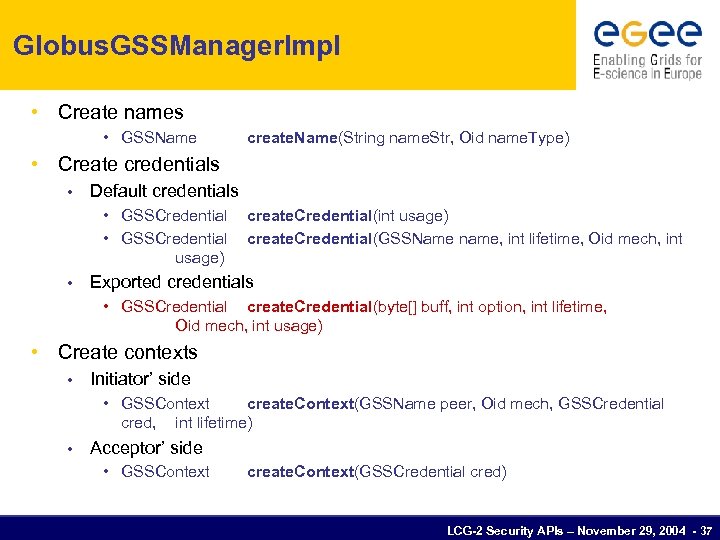
Globus. GSSManager. Impl • Create names • GSSName create. Name(String name. Str, Oid name. Type) • Create credentials • Default credentials • GSSCredential usage) • create. Credential(int usage) create. Credential(GSSName name, int lifetime, Oid mech, int Exported credentials • GSSCredential create. Credential(byte[] buff, int option, int lifetime, Oid mech, int usage) • Create contexts • Initiator’ side • GSSContext create. Context(GSSName peer, Oid mech, GSSCredential cred, int lifetime) • Acceptor’ side • GSSContext create. Context(GSSCredential cred) LCG-2 Security APIs – November 29, 2004 - 37
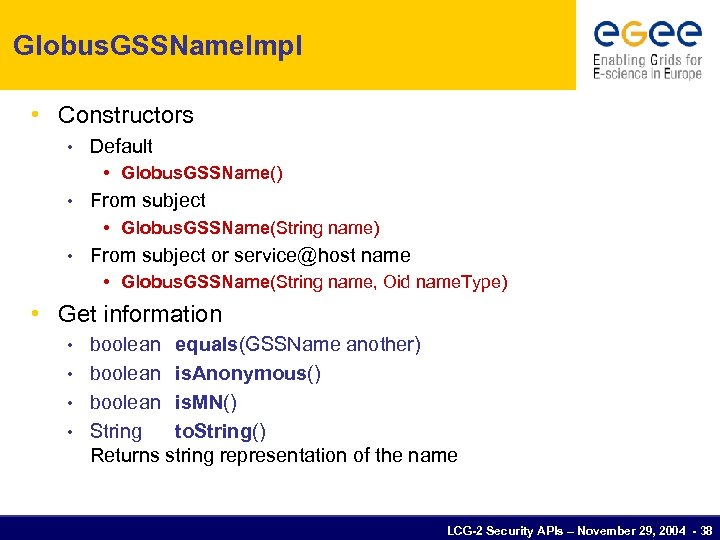
Globus. GSSName. Impl • Constructors • Default • Globus. GSSName() • From subject • Globus. GSSName(String name) • From subject or service@host name • Globus. GSSName(String name, Oid name. Type) • Get information boolean equals(GSSName another) • boolean is. Anonymous() • boolean is. MN() • String to. String() Returns string representation of the name • LCG-2 Security APIs – November 29, 2004 - 38
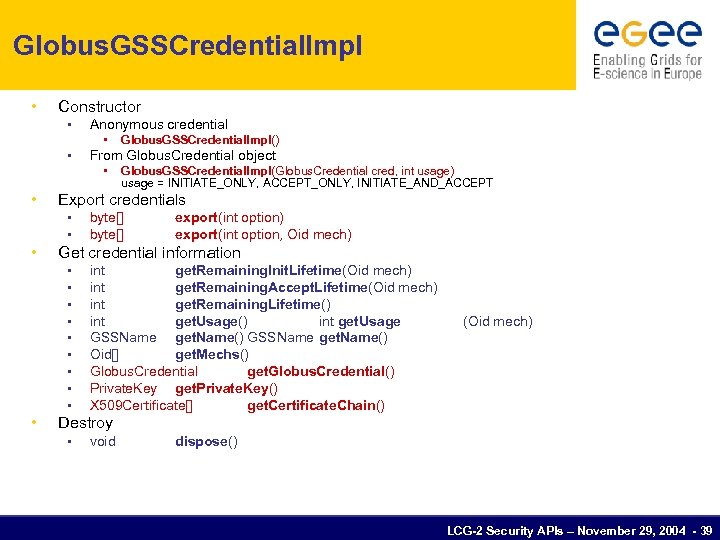
Globus. GSSCredential. Impl • Constructor • Anonymous credential • • From Globus. Credential object • • byte[] export(int option) export(int option, Oid mech) Get credential information • • • Globus. GSSCredential. Impl(Globus. Credential cred, int usage) usage = INITIATE_ONLY, ACCEPT_ONLY, INITIATE_AND_ACCEPT Export credentials • • • Globus. GSSCredential. Impl() int get. Remaining. Init. Lifetime(Oid mech) int get. Remaining. Accept. Lifetime(Oid mech) int get. Remaining. Lifetime() int get. Usage GSSName get. Name() Oid[] get. Mechs() Globus. Credential get. Globus. Credential() Private. Key get. Private. Key() X 509 Certificate[] get. Certificate. Chain() (Oid mech) Destroy • void dispose() LCG-2 Security APIs – November 29, 2004 - 39
![Globus. GSSContext. Impl (1/2) • Authenticate • • byte[] wrap(byte[] in. Buf, int off,](https://present5.com/presentation/99b32b93a7bd48cf174ef96b79635c6f/image-40.jpg "Globus. GSSContext. Impl (1/2) • Authenticate • • byte[] wrap(byte[] in. Buf, int off,")
Globus. GSSContext. Impl (1/2) • Authenticate • • byte[] wrap(byte[] in. Buf, int off, int len, Message. Prop prop) unwrap(byte[] in. Buf, int off, int len, Message. Prop prop) Create and verify a MIC • • • init. Sec. Context(byte[] in. Buff, int off, int len) init. Sec. Context(Input. Stream in, Output. Stream out) accept. Sec. Context(byte[] in. Buff, int off, int len) accept. Sec. Context(Input. Stream in, Output. Stream out) is. Established() Encrypt, decrypt • • byte[] int byte[] void boolean byte[] get. MIC(byte[] in. Buf, int off, int len, Message. Prop prop) void verify. MIC(byte[] in. Tok, int tok. Off, int tok. Len, byte[] in. Msg, int msg. Off, int msg. Len, Message. Prop prop) Request context properties • void request. Anonymity(boolean state) void request. Cred. Deleg(boolean state) void request. Lifetime(int lifetime) void request. Replay. Det(boolean state) void request. Conf(boolean state) void request. Integ(boolean state) void request. Mutual. Auth(boolean state) void request. Sequence. Det(boolean state) LCG-2 Security APIs – November 29, 2004 - 40
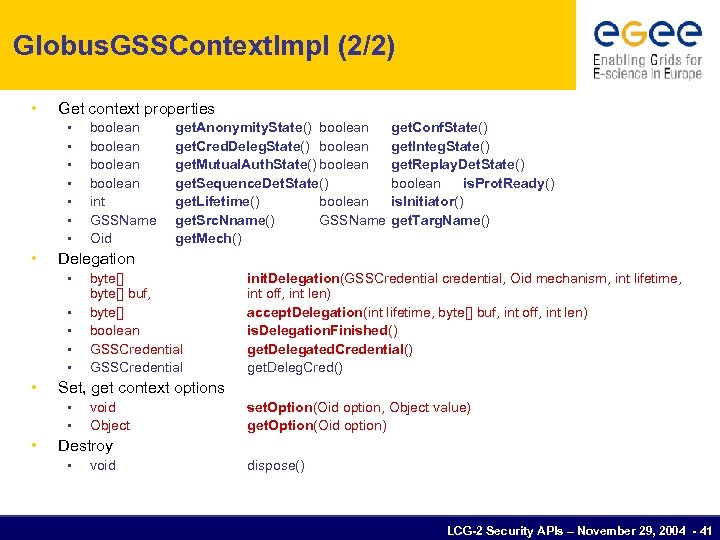
Globus. GSSContext. Impl (2/2) • Get context properties • • • get. Conf. State() get. Integ. State() get. Replay. Det. State() boolean is. Prot. Ready() is. Initiator() get. Targ. Name() byte[] buf, byte[] boolean GSSCredential init. Delegation(GSSCredential credential, Oid mechanism, int lifetime, int off, int len) accept. Delegation(int lifetime, byte[] buf, int off, int len) is. Delegation. Finished() get. Delegated. Credential() get. Deleg. Cred() Set, get context options • • • get. Anonymity. State() boolean get. Cred. Deleg. State() boolean get. Mutual. Auth. State() boolean get. Sequence. Det. State() get. Lifetime() boolean get. Src. Nname() GSSName get. Mech() Delegation • • boolean int GSSName Oid void Object set. Option(Oid option, Object value) get. Option(Oid option) Destroy • void dispose() LCG-2 Security APIs – November 29, 2004 - 41
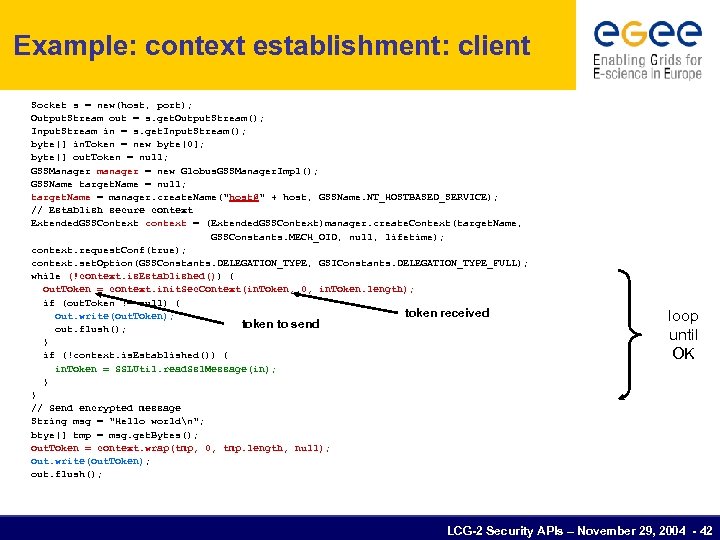
Example: context establishment: client Socket s = new(host, port); Output. Stream out = s. get. Output. Stream(); Input. Stream in = s. get. Input. Stream(); byte[] in. Token = new byte[0]; byte[] out. Token = null; GSSManager manager = new Globus. GSSManager. Impl(); GSSName target. Name = null; target. Name = manager. create. Name("host@" + host, GSSName. NT_HOSTBASED_SERVICE); // Establish secure context Extended. GSSContext context = (Extended. GSSContext)manager. create. Context(target. Name, GSSConstants. MECH_OID, null, lifetime); context. request. Conf(true); context. set. Option(GSSConstants. DELEGATION_TYPE, GSIConstants. DELEGATION_TYPE_FULL); while (!context. is. Established()) { out. Token = context. init. Sec. Context(in. Token, 0, in. Token. length); if (out. Token != null) { token received out. write(out. Token); token to send out. flush(); } if (!context. is. Established()) { in. Token = SSLUtil. read. Ssl. Message(in); } } // Send encrypted message String msg = "Hello worldn"; btye[] tmp = msg. get. Bytes(); out. Token = context. wrap(tmp, 0, tmp. length, null); out. write(out. Token); out. flush(); loop until OK LCG-2 Security APIs – November 29, 2004 - 42
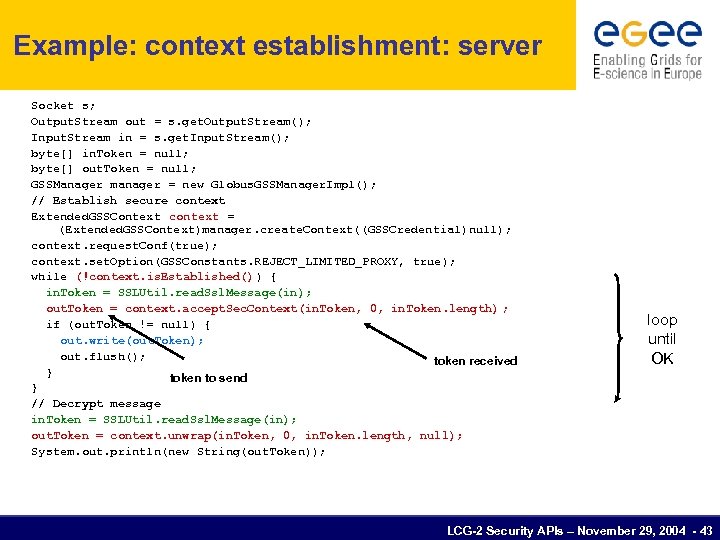
Example: context establishment: server Socket s; Output. Stream out = s. get. Output. Stream(); Input. Stream in = s. get. Input. Stream(); byte[] in. Token = null; byte[] out. Token = null; GSSManager manager = new Globus. GSSManager. Impl(); // Establish secure context Extended. GSSContext context = (Extended. GSSContext)manager. create. Context((GSSCredential)null); context. request. Conf(true); context. set. Option(GSSConstants. REJECT_LIMITED_PROXY, true); while (!context. is. Established() ) { in. Token = SSLUtil. read. Ssl. Message(in); out. Token = context. accept. Sec. Context(in. Token, 0, in. Token. length) ; if (out. Token != null) { out. write(out. Token); out. flush(); token received } token to send } // Decrypt message in. Token = SSLUtil. read. Ssl. Message(in); out. Token = context. unwrap(in. Token, 0, in. Token. length, null); System. out. println(new String(out. Token)); loop until OK LCG-2 Security APIs – November 29, 2004 - 43
![Example: credential delegation Client in. Token = new byte[0]; while(!context. is. Delegation. Finished()) {](https://present5.com/presentation/99b32b93a7bd48cf174ef96b79635c6f/image-44.jpg "Example: credential delegation Client in. Token = new byte[0]; while(!context. is. Delegation. Finished()) {")
Example: credential delegation Client in. Token = new byte[0]; while(!context. is. Delegation. Finished()) { out. Token = context. init. Delegation(null, 10000, in. Token, 0, in. Token. length); if (out. Token != null) { out. write(out. Token); out. flush(); } if (!context. is. Delegation. Finished()) { in. Token = SSLUtil. read. Ssl. Message(in); } } Server while (!context. is. Delegation. Finished()) { in. Token = SSLUtil. read. Ssl. Message(in); out. Token = context. accept. Delegation(10000, in. Token, 0, in. Token. length); if (out. Token != null) { out. write(out. Token); out. flush(); } } LCG-2 Security APIs – November 29, 2004 - 44
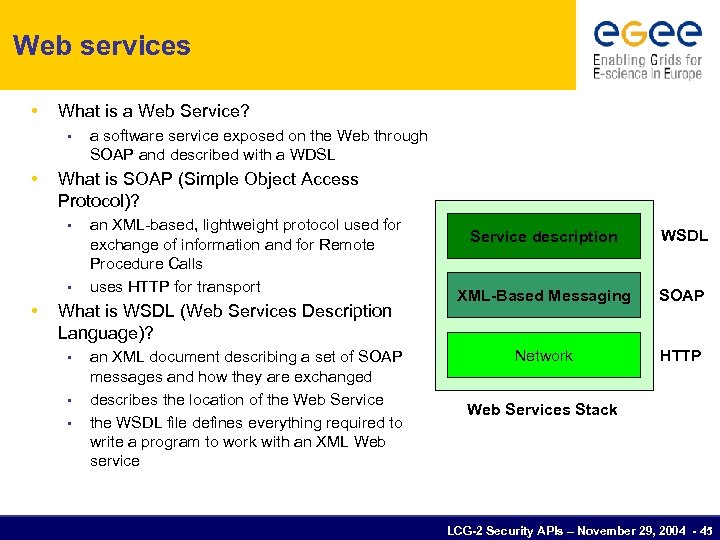
Web services • What is a Web Service? • • What is SOAP (Simple Object Access Protocol)? • • • a software service exposed on the Web through SOAP and described with a WDSL an XML-based, lightweight protocol used for exchange of information and for Remote Procedure Calls uses HTTP for transport What is WSDL (Web Services Description Language)? • • • an XML document describing a set of SOAP messages and how they are exchanged describes the location of the Web Service the WSDL file defines everything required to write a program to work with an XML Web service Service description WSDL XML-Based Messaging SOAP Network HTTP Web Services Stack LCG-2 Security APIs – November 29, 2004 - 45
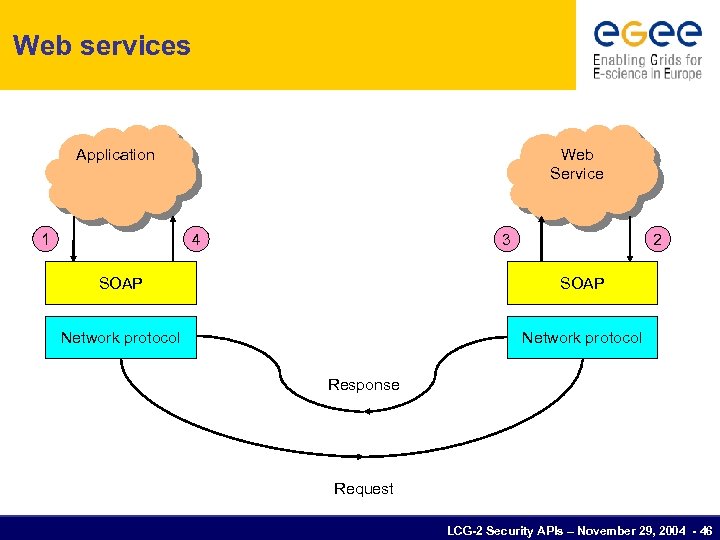
Web services Application 1 Web Service 4 3 2 SOAP Network protocol Response Request LCG-2 Security APIs – November 29, 2004 - 46
Web Service Security • Message level security • WS-Security • set of SOAP extensions to implement integrity and confidentiality in Web Services • <Security> header contains the security-related information • http: //www-128. ibm. com/developerworks/library/ws-secure/ • WS-Secure. Conversation • defines how to establish secure contexts and exchange keys • Used in Globus Toolkit 3 • Transport level security SOAP messages are transmitted encrypted • used by some g. SOAP GSI plugins • • Only transport level security covered in this tutorial LCG-2 Security APIs – November 29, 2004 - 47
g. SOAP • • • g. SOAP is a toolkit that offers an XML to C/C++ language binding to make easy the development of SOAP/XML Web services in C and C/C++ Allows to generate code to write a client to interact with a Web Service starting from the service description published by the WS itself (WSDL file) Allows to generate code to implement a WS in C/C++ starting from the WS description Generates the code which provides a transport layer with HTTP on top of TCP/IP and to serialize/deserialize structured data For more information, look at http: //www. cs. fsu. edu/~engelen/soap. html LCG-2 Security APIs – November 29, 2004 - 48
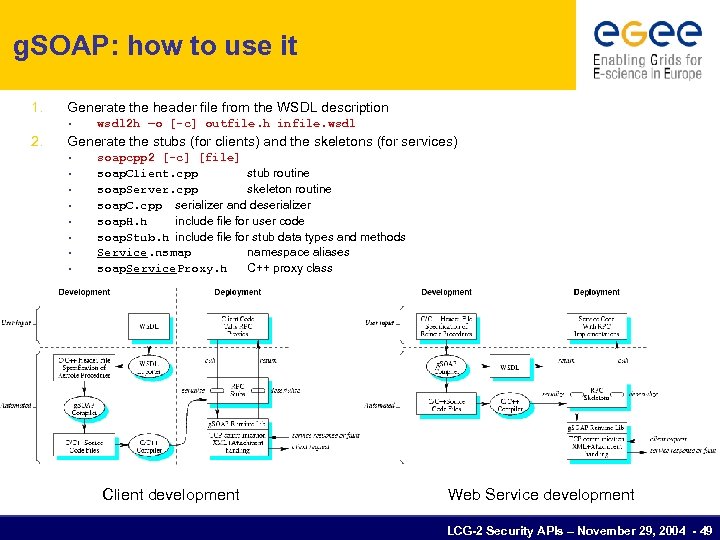
g. SOAP: how to use it 1. Generate the header file from the WSDL description • 2. wsdl 2 h –o [-c] outfile. h infile. wsdl Generate the stubs (for clients) and the skeletons (for services) • • soapcpp 2 [-c] [file] soap. Client. cpp stub routine soap. Server. cpp skeleton routine soap. C. cpp serializer and deserializer soap. H. h include file for user code soap. Stub. h include file for stub data types and methods Service. nsmap namespace aliases soap. Service. Proxy. h C++ proxy class Client development Web Service development LCG-2 Security APIs – November 29, 2004 - 49
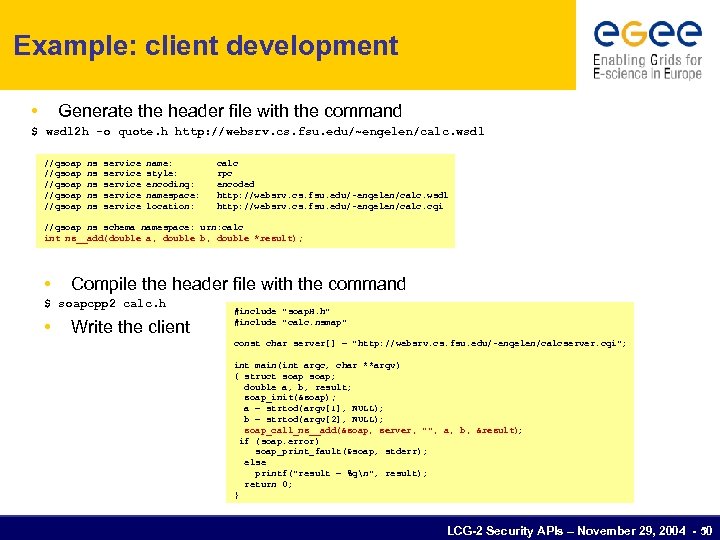
Example: client development • Generate the header file with the command $ wsdl 2 h -o quote. h http: //websrv. cs. fsu. edu/~engelen/calc. wsdl //gsoap //gsoap ns ns ns service service name: style: encoding: namespace: location: calc rpc encoded http: //websrv. cs. fsu. edu/~engelen/calc. wsdl http: //websrv. cs. fsu. edu/~engelen/calc. cgi //gsoap ns schema namespace: urn: calc int ns__add(double a, double b, double *result); • Compile the header file with the command $ soapcpp 2 calc. h • Write the client #include "soap. H. h" #include "calc. nsmap" const char server[] = "http: //websrv. cs. fsu. edu/~engelen/calcserver. cgi"; int main(int argc, char **argv) { struct soap; double a, b, result; soap_init(&soap); a = strtod(argv[1], NULL); b = strtod(argv[2], NULL); soap_call_ns__add(&soap, server, "", a, b, &result); if (soap. error) soap_print_fault(&soap, stderr); else printf("result = %gn", result); return 0; } LCG-2 Security APIs – November 29, 2004 - 50
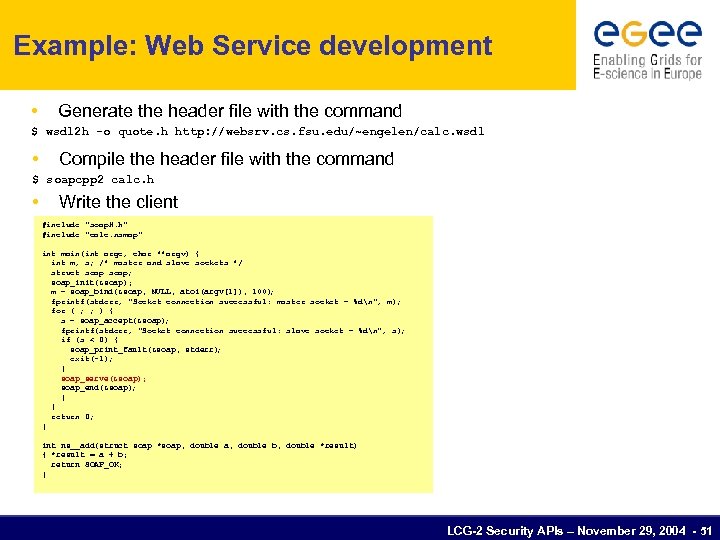
Example: Web Service development • Generate the header file with the command $ wsdl 2 h -o quote. h http: //websrv. cs. fsu. edu/~engelen/calc. wsdl • Compile the header file with the command $ soapcpp 2 calc. h • Write the client #include "soap. H. h" #include "calc. nsmap" int main(int argc, char **argv) { int m, s; /* master and slave sockets */ struct soap; soap_init(&soap); m = soap_bind(&soap, NULL, atoi(argv[1]), 100) ; fprintf(stderr, "Socket connection successful: master socket = %dn", m); for ( ; ; ) { s = soap_accept(&soap); fprintf(stderr, "Socket connection successful: slave socket = %dn", s); if (s < 0) { soap_print_fault(&soap, stderr); exit(-1); } soap_serve(&soap); soap_end(&soap); } } return 0; } int ns__add(struct soap *soap, double a, double b, double *result) { *result = a + b; return SOAP_OK; } LCG-2 Security APIs – November 29, 2004 - 51
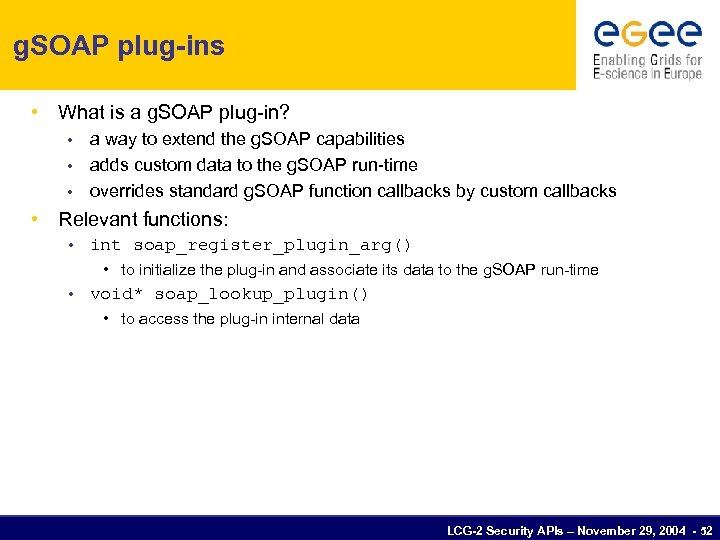
g. SOAP plug-ins • What is a g. SOAP plug-in? a way to extend the g. SOAP capabilities • adds custom data to the g. SOAP run-time • overrides standard g. SOAP function callbacks by custom callbacks • • Relevant functions: • int soap_register_plugin_arg() • to initialize the plug-in and associate its data to the g. SOAP run-time • void* soap_lookup_plugin() • to access the plug-in internal data LCG-2 Security APIs – November 29, 2004 - 52
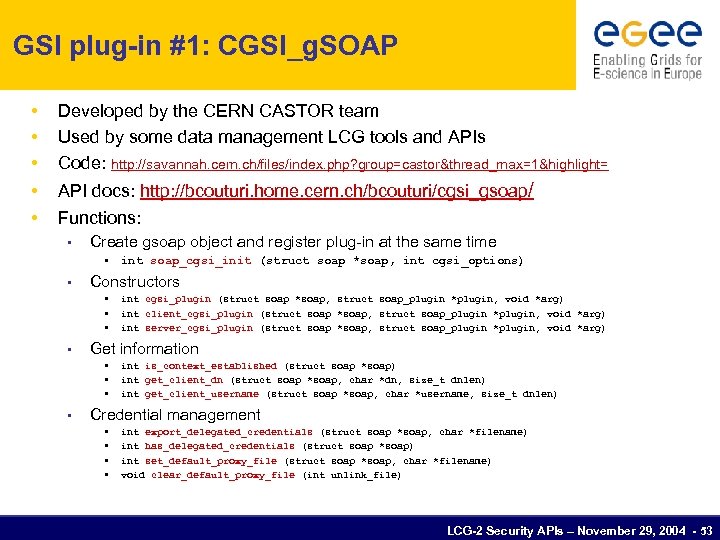
GSI plug-in #1: CGSI_g. SOAP • • • Developed by the CERN CASTOR team Used by some data management LCG tools and APIs Code: http: //savannah. cern. ch/files/index. php? group=castor&thread_max=1&highlight= • • API docs: http: //bcouturi. home. cern. ch/bcouturi/cgsi_gsoap/ Functions: • Create gsoap object and register plug-in at the same time • int soap_cgsi_init (struct soap *soap, int cgsi_options) • Constructors • • Get information • • int cgsi_plugin (struct soap *soap, struct soap_plugin *plugin, void *arg) int client_cgsi_plugin (struct soap *soap, struct soap_plugin *plugin, void *arg) int server_cgsi_plugin (struct soap *soap, struct soap_plugin *plugin, void *arg) int is_context_established (struct soap *soap) int get_client_dn (struct soap *soap, char *dn, size_t dnlen) int get_client_username (struct soap *soap, char *username, size_t dnlen) Credential management • • int export_delegated_credentials (struct soap *soap, char *filename) int has_delegated_credentials (struct soap *soap) int set_default_proxy_file (struct soap *soap, char *filename) void clear_default_proxy_file (int unlink_file) LCG-2 Security APIs – November 29, 2004 - 53
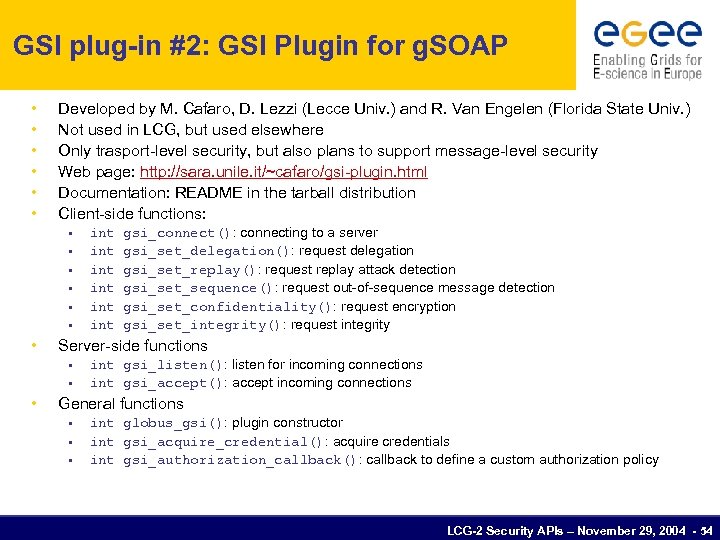
GSI plug-in #2: GSI Plugin for g. SOAP • • • Developed by M. Cafaro, D. Lezzi (Lecce Univ. ) and R. Van Engelen (Florida State Univ. ) Not used in LCG, but used elsewhere Only trasport-level security, but also plans to support message-level security Web page: http: //sara. unile. it/~cafaro/gsi-plugin. html Documentation: README in the tarball distribution Client-side functions: • • gsi_connect(): connecting to a server gsi_set_delegation(): request delegation gsi_set_replay(): request replay attack detection gsi_set_sequence(): request out-of-sequence message detection gsi_set_confidentiality(): request encryption gsi_set_integrity(): request integrity Server-side functions • • • int int gsi_listen(): listen for incoming connections int gsi_accept(): accept incoming connections General functions • • • int globus_gsi(): plugin constructor int gsi_acquire_credential(): acquire credentials int gsi_authorization_callback(): callback to define a custom authorization policy LCG-2 Security APIs – November 29, 2004 - 54
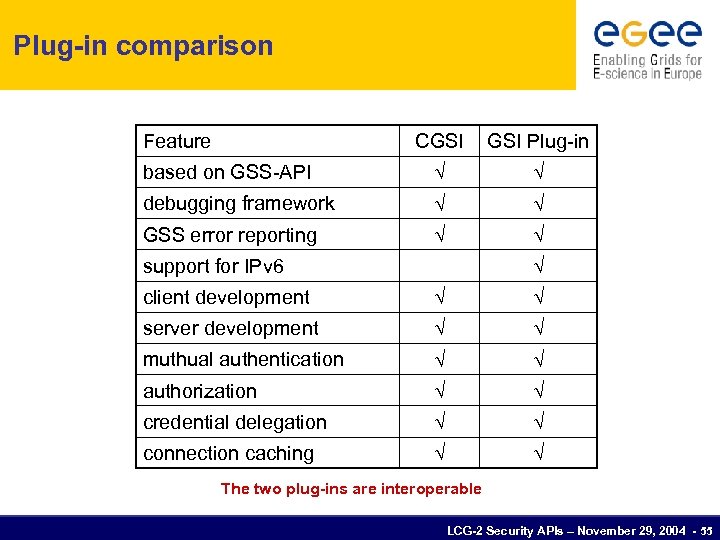
Plug-in comparison Feature CGSI Plug-in based on GSS-API debugging framework GSS error reporting support for IPv 6 client development server development muthual authentication authorization credential delegation connection caching The two plug-ins are interoperable LCG-2 Security APIs – November 29, 2004 - 55
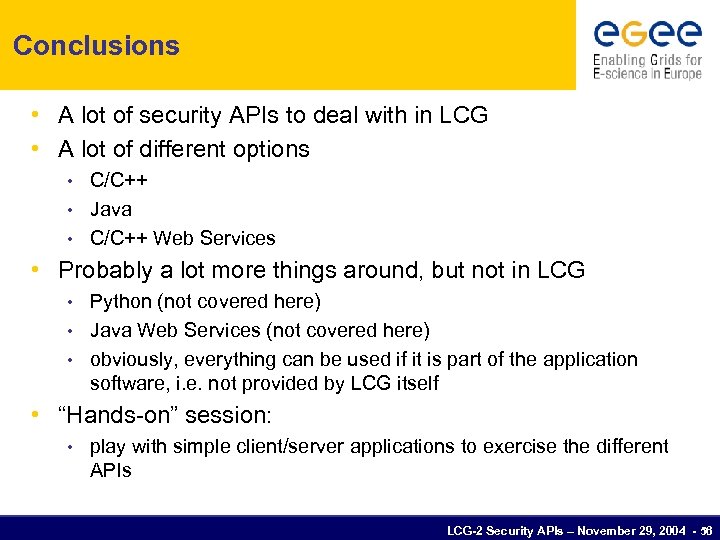
Conclusions • A lot of security APIs to deal with in LCG • A lot of different options C/C++ • Java • C/C++ Web Services • • Probably a lot more things around, but not in LCG Python (not covered here) • Java Web Services (not covered here) • obviously, everything can be used if it is part of the application software, i. e. not provided by LCG itself • • “Hands-on” session: • play with simple client/server applications to exercise the different APIs LCG-2 Security APIs – November 29, 2004 - 56
LCG Security API “Hands-on” session
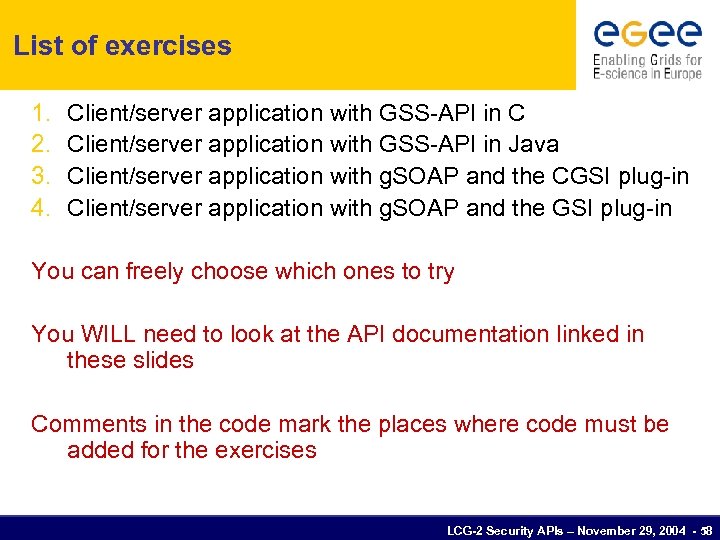
List of exercises 1. 2. 3. 4. Client/server application with GSS-API in C Client/server application with GSS-API in Java Client/server application with g. SOAP and the CGSI plug-in Client/server application with g. SOAP and the GSI plug-in You can freely choose which ones to try You WILL need to look at the API documentation linked in these slides Comments in the code mark the places where code must be added for the exercises LCG-2 Security APIs – November 29, 2004 - 58
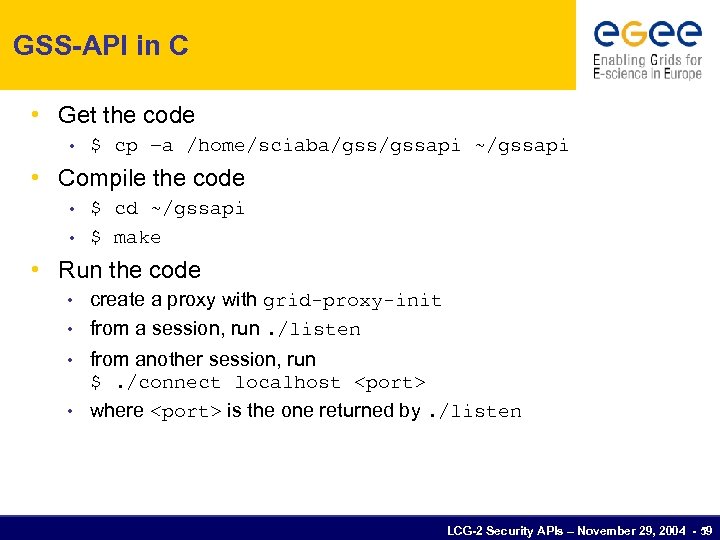
GSS-API in C • Get the code • $ cp –a /home/sciaba/gssapi ~/gssapi • Compile the code $ cd ~/gssapi • $ make • • Run the code create a proxy with grid-proxy-init • from a session, run. /listen • from another session, run $. /connect localhost <port> • where <port> is the one returned by. /listen • LCG-2 Security APIs – November 29, 2004 - 59
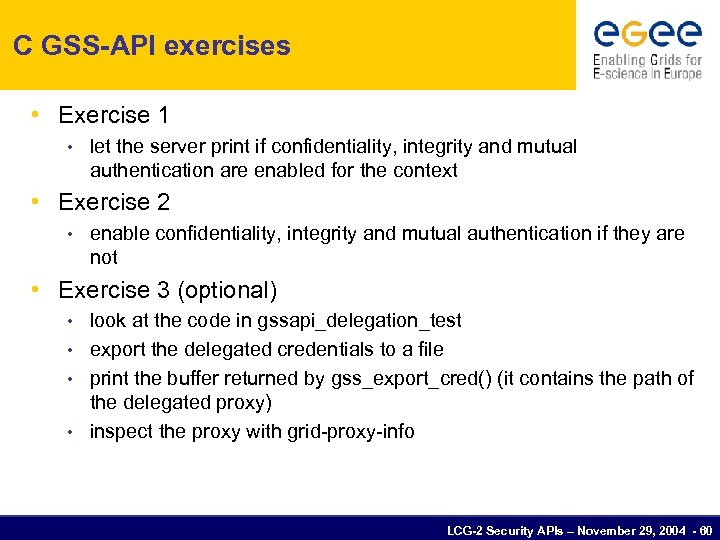
C GSS-API exercises • Exercise 1 • let the server print if confidentiality, integrity and mutual authentication are enabled for the context • Exercise 2 • enable confidentiality, integrity and mutual authentication if they are not • Exercise 3 (optional) look at the code in gssapi_delegation_test • export the delegated credentials to a file • print the buffer returned by gss_export_cred() (it contains the path of the delegated proxy) • inspect the proxy with grid-proxy-info • LCG-2 Security APIs – November 29, 2004 - 60
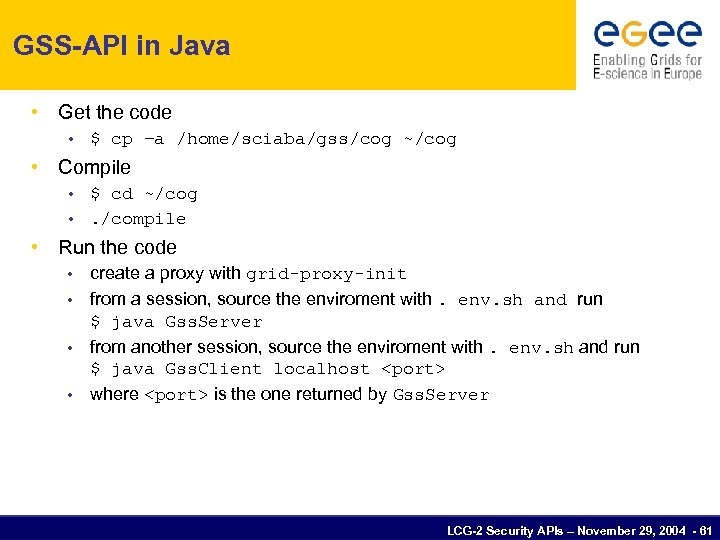
GSS-API in Java • Get the code • $ cp –a /home/sciaba/gss/cog ~/cog • Compile $ cd ~/cog • . /compile • • Run the code create a proxy with grid-proxy-init • from a session, source the enviroment with. env. sh and run $ java Gss. Server • from another session, source the enviroment with. env. sh and run $ java Gss. Client localhost <port> • where <port> is the one returned by Gss. Server • LCG-2 Security APIs – November 29, 2004 - 61
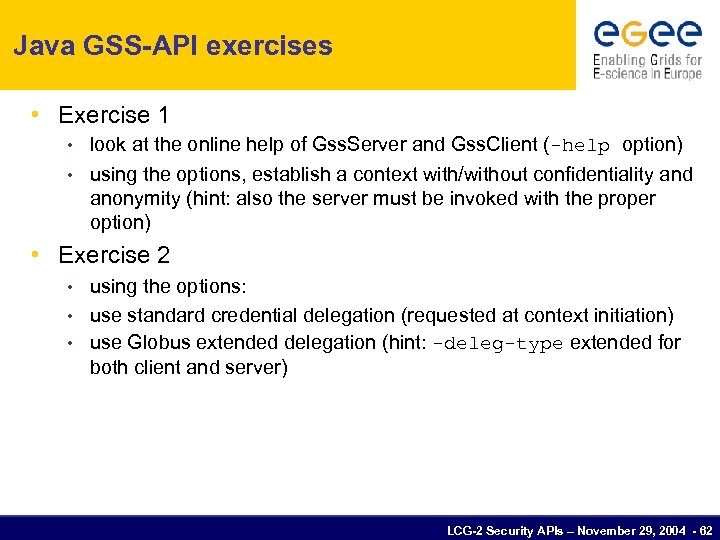
Java GSS-API exercises • Exercise 1 • look at the online help of Gss. Server and Gss. Client (-help option) • using the options, establish a context with/without confidentiality and anonymity (hint: also the server must be invoked with the proper option) • Exercise 2 using the options: • use standard credential delegation (requested at context initiation) • use Globus extended delegation (hint: -deleg-type extended for both client and server) • LCG-2 Security APIs – November 29, 2004 - 62
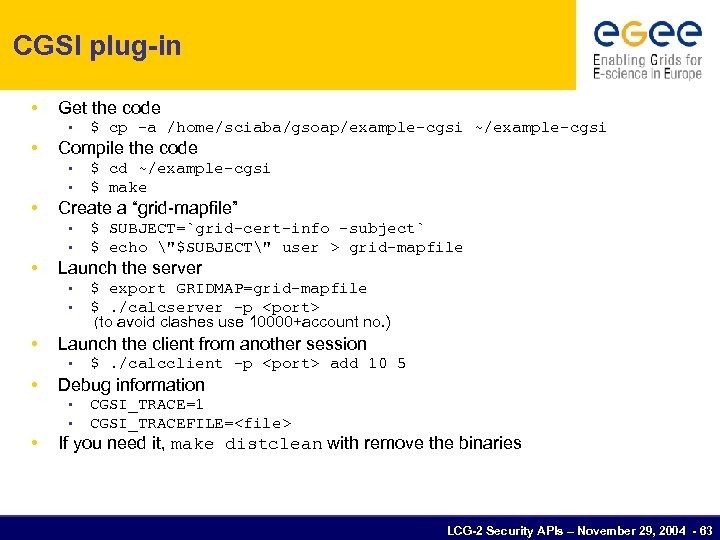
CGSI plug-in • Get the code • • Compile the code • • • $. /calcclient –p <port> add 10 5 Debug information • • • $ export GRIDMAP=grid-mapfile $. /calcserver –p <port> (to avoid clashes use 10000+account no. ) Launch the client from another session • • $ SUBJECT=`grid-cert-info -subject` $ echo "$SUBJECT" user > grid-mapfile Launch the server • • • $ cd ~/example-cgsi $ make Create a “grid-mapfile” • • • $ cp –a /home/sciaba/gsoap/example-cgsi ~/example-cgsi CGSI_TRACE=1 CGSI_TRACEFILE=<file> If you need it, make distclean with remove the binaries LCG-2 Security APIs – November 29, 2004 - 63
CGSI plug-in exercises • Exercise 1 modify the server code to check if the client has delegated credentials, and if so, export them to a file • make the client to delegate its credentials to the server • LCG-2 Security APIs – November 29, 2004 - 64
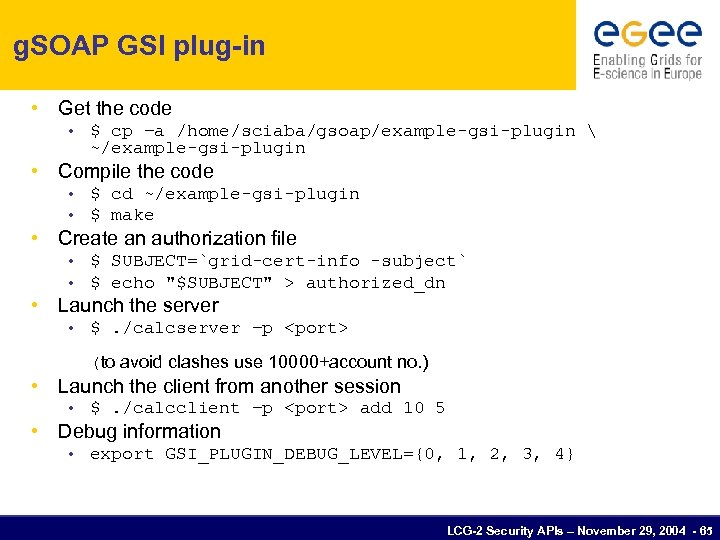
g. SOAP GSI plug-in • Get the code • $ cp –a /home/sciaba/gsoap/example-gsi-plugin ~/example-gsi-plugin • Compile the code • • $ cd ~/example-gsi-plugin $ make • Create an authorization file • • $ SUBJECT=`grid-cert-info -subject` $ echo "$SUBJECT" > authorized_dn • Launch the server • $. /calcserver –p <port> (to avoid clashes use 10000+account no. ) • Launch the client from another session • $. /calcclient –p <port> add 10 5 • Debug information • export GSI_PLUGIN_DEBUG_LEVEL={0, 1, 2, 3, 4} LCG-2 Security APIs – November 29, 2004 - 65
g. SOAP GSI plug-in exercises • Exercise 1 make the client delegate the credentials to the server • make the server export the delegated credentials (if any) to a file • Hints: • • refer to /home/sciaba/gsoap-gsi-plugin-2. 4. 2/include/gsi. h • use gss_export_cred() from the extended GSS-API LCG-2 Security APIs – November 29, 2004 - 66
Скачать презентацию Security APIs in LCG-2 Andrea Sciabà LCG Experiment
99b32b93a7bd48cf174ef96b79635c6f.ppt