 Скачать презентацию Security and Cryptography CSE 461 Ben Greenstein Jeremy
9e8df12f2c3790329ffc31dd3f83abc5.ppt
- Количество слайдов: 48



Security and Cryptography CSE 461 Ben Greenstein Jeremy Elson TA: Ivan Beschastnikh
Administrivia Project 3, part 2 due December 5 § Special extended office hours: Tuesday, December 2, 11: 30 -1: 30 Room 218 § No HW this week §
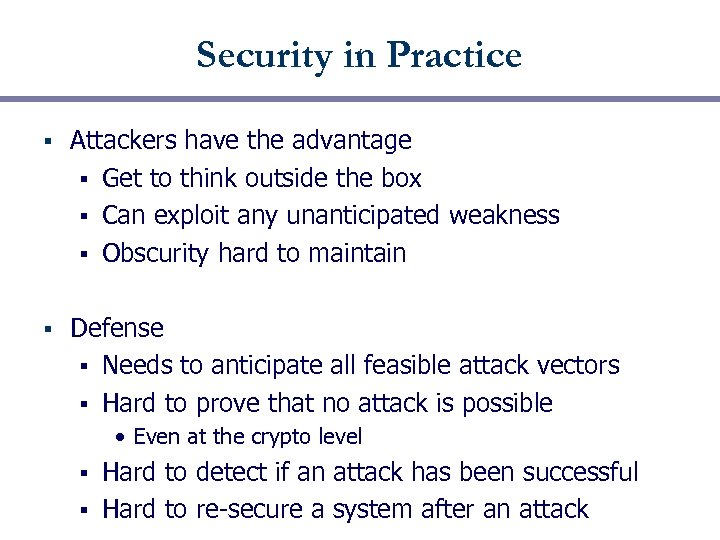
Security in Practice § Attackers have the advantage § Get to think outside the box § Can exploit any unanticipated weakness § Obscurity hard to maintain § Defense § Needs to anticipate all feasible attack vectors § Hard to prove that no attack is possible • Even at the crypto level Hard to detect if an attack has been successful § Hard to re-secure a system after an attack §
Fundamental Tenet: If lots of smart people have failed to break a system, then it probably won’t be broken
To Publish or Not to Publish If the good guys break your system, you’ll hear about it § If you publish your system, the white hats provide free consulting by trying to crack it § The black hats will learn about your system anyway § Today, most (but not all) commercial systems are published; most military systems are not §
To Publish or Not to Publish (Part 2) If you discover a workable attack, what is your responsibility? § Gap between discovery of vulnerability, and exploiting the vulnerability can be seconds § Should notify vendor and publish §
Some Old Examples § Western Digital Compromise went undetected for months § Thompson self-propagating back door login § Reinstalls itself in every new version of UNIX § Tiger team attempt on Pentagon computer § § § No physical access Secure communications channel: one time pad paper tape of random #’s § same tape used at sender, receiver § system XORs to each bit before xmit/receive §
Some Recent Examples § § § § § House Keys ATM keypad Pacemakers Mifare transit smart cards Washington State Driver’s Licenses (EPC RFID) Electronic car keys Elevator controls Voting machines WEP 8
Network Security § Networks are shared § § each packet traverses many devices on path from source to receiver Attacker might be in control of any of these devices § Or other machines on the network Or administrative machines § Or, … §
Network Security § How do you know messages aren’t: § Copied § Injected § Replaced/modified § Spoofed § Inferred § Prevented from being delivered § … 10
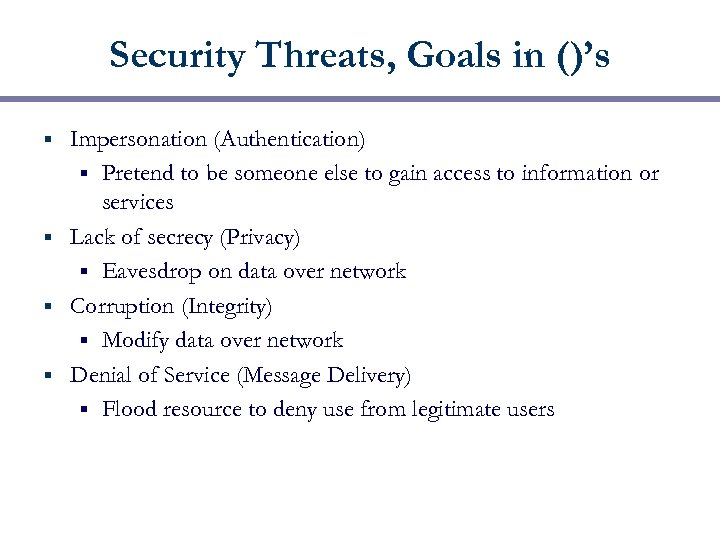
Security Threats, Goals in ()’s Impersonation (Authentication) § Pretend to be someone else to gain access to information or services § Lack of secrecy (Privacy) § Eavesdrop on data over network § Corruption (Integrity) § Modify data over network § Denial of Service (Message Delivery) § Flood resource to deny use from legitimate users §
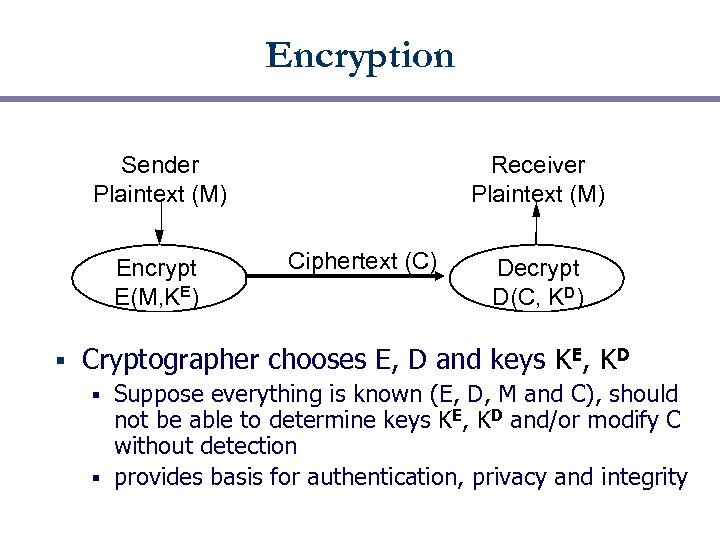
Encryption Sender Plaintext (M) Encrypt E(M, KE) § Receiver Plaintext (M) Ciphertext (C) Decrypt D(C, KD) Cryptographer chooses E, D and keys KE, KD Suppose everything is known (E, D, M and C), should not be able to determine keys KE, KD and/or modify C without detection § provides basis for authentication, privacy and integrity §
How Secure is Encryption? An attacker who knows the algorithm we’re using could try all possible keys § Security of cryptography depends on the limited computational power of the attacker § A fairly small key (e. g. 128 bits) represents a formidable challenge to the attacker § Algorithms can also have weaknesses, independent of key size §
How Practical is Encryption Usability depends on being efficient for the good guys § Cost to the good guys tends to rise linearly with key length § Cost to search all keys rises exponentially with key length § How do we keep keys secret? § Short keys: easy to remember, easy to break §
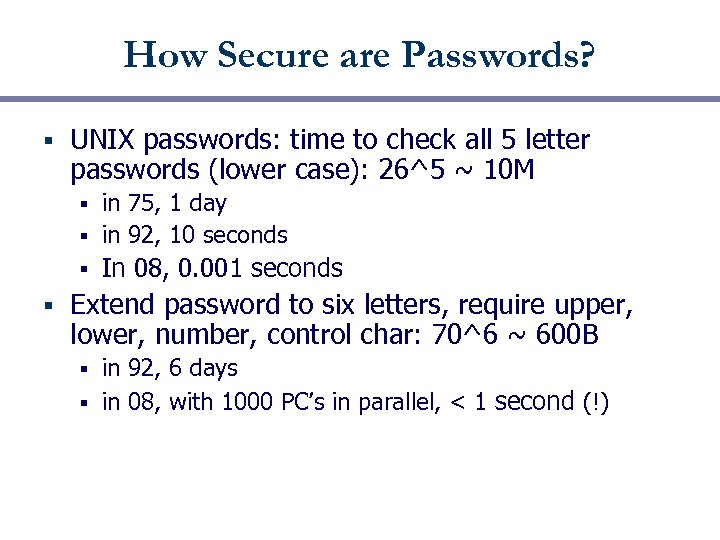
How Secure are Passwords? § UNIX passwords: time to check all 5 letter passwords (lower case): 26^5 ~ 10 M in 75, 1 day § in 92, 10 seconds § § § In 08, 0. 001 seconds Extend password to six letters, require upper, lower, number, control char: 70^6 ~ 600 B in 92, 6 days § in 08, with 1000 PC’s in parallel, < 1 second (!) §
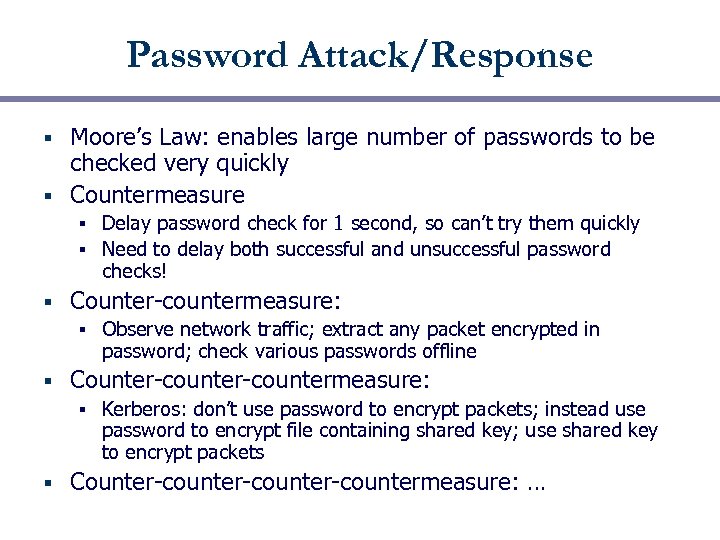
Password Attack/Response Moore’s Law: enables large number of passwords to be checked very quickly § Countermeasure § Delay password check for 1 second, so can’t try them quickly § Need to delay both successful and unsuccessful password checks! § § Counter-countermeasure: § § Observe network traffic; extract any packet encrypted in password; check various passwords offline Kerberos: don’t use password to encrypt packets; instead use password to encrypt file containing shared key; use shared key to encrypt packets Counter-counter-countermeasure: …
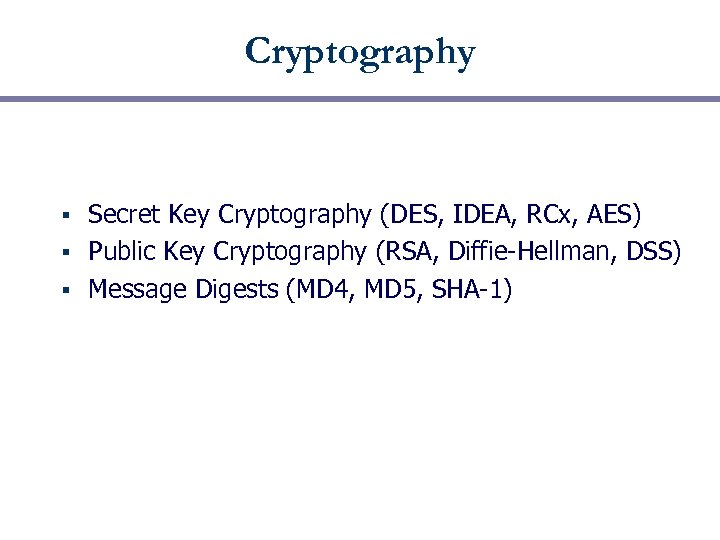
Cryptography Secret Key Cryptography (DES, IDEA, RCx, AES) § Public Key Cryptography (RSA, Diffie-Hellman, DSS) § Message Digests (MD 4, MD 5, SHA-1) §
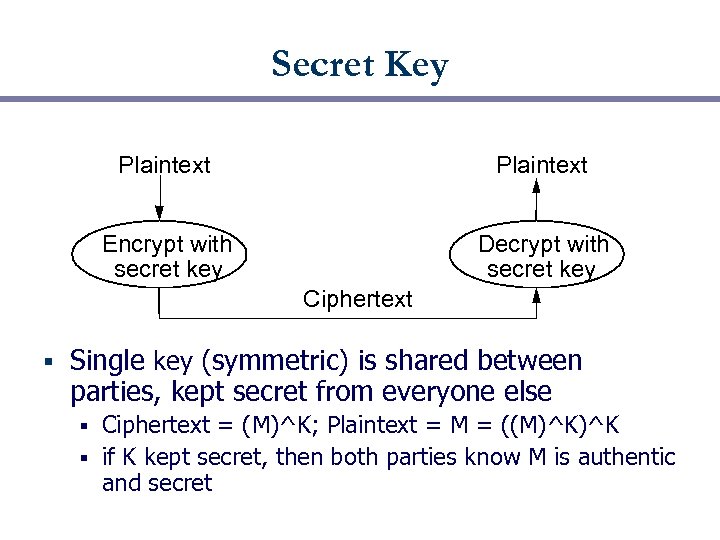
Secret Key Plaintext Encrypt with secret key Decrypt with secret key Ciphertext § Single key (symmetric) is shared between parties, kept secret from everyone else Ciphertext = (M)^K; Plaintext = M = ((M)^K)^K § if K kept secret, then both parties know M is authentic and secret §
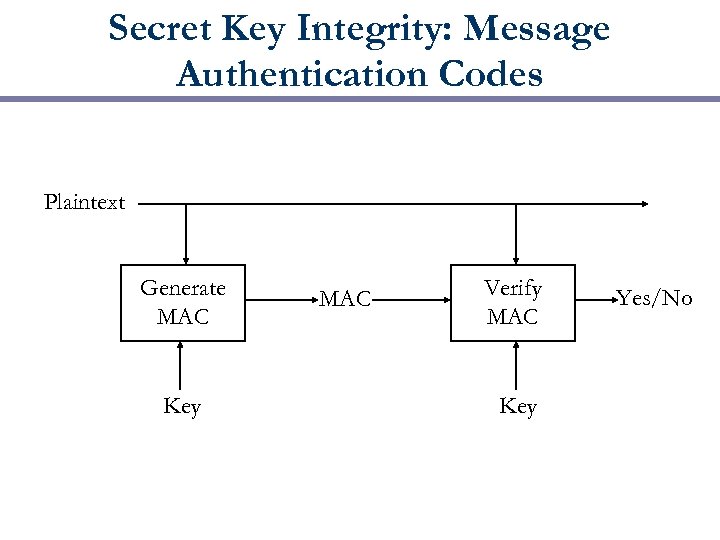
Secret Key Integrity: Message Authentication Codes Plaintext Generate MAC Key MAC Verify MAC Key Yes/No
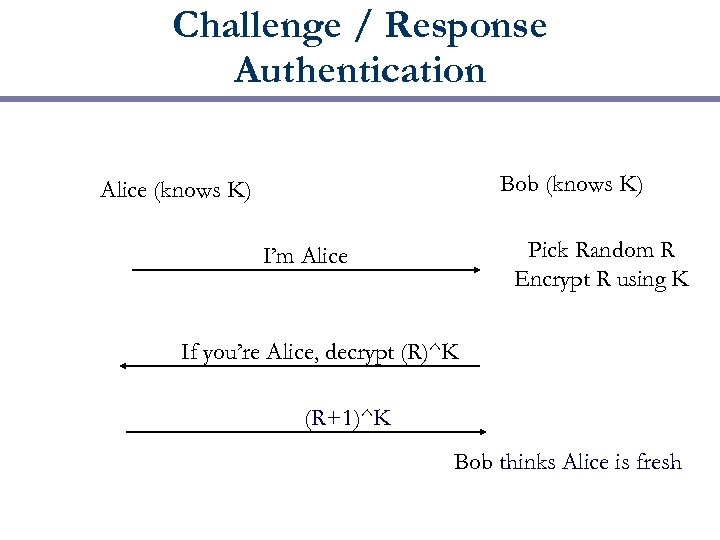
Challenge / Response Authentication Bob (knows K) Alice (knows K) Pick Random R Encrypt R using K I’m Alice If you’re Alice, decrypt (R)^K (R+1)^K Bob thinks Alice is fresh
Secret Key Algorithms § DES (Data Encryption Standard) – 1970’s IBM, NSA? § 56 bit key (+ 8 parity bits) => has become too small § Input and output are 64 bit blocks § slow in software, based on (gratuitous? ) bit twiddling
Other Ciphers § Triple-DES § DES three times • mc = E(D(E(mp, k 1), k 2, k 3) § § Effectively 112 bits Three times as slow as DES § Blowfish § Developed by Bruce Schneier circa 1993 § Variable key size from 32 to 448 bits § Very fast on large general purpose CPUs (modern PCs) § Not very easy to implement in small hardware § Advanced Encryption Standard (AES) § Selected by NIST as replacement for DES in 2001 § Uses the Rijndael algorithm § Keys of 128, 192 or 256 bits
Encrypting Large Messages The basic algorithms encrypt a fixed size block § Obvious solution is to encrypt a block at a time. This is called Electronic Code Book (ECB) § Leaks data: repeated plaintext blocks yield repeated ciphertext blocks § Does not guarantee integrity! § Other modes “chain” to avoid this (CBC, CFB, OFB) §
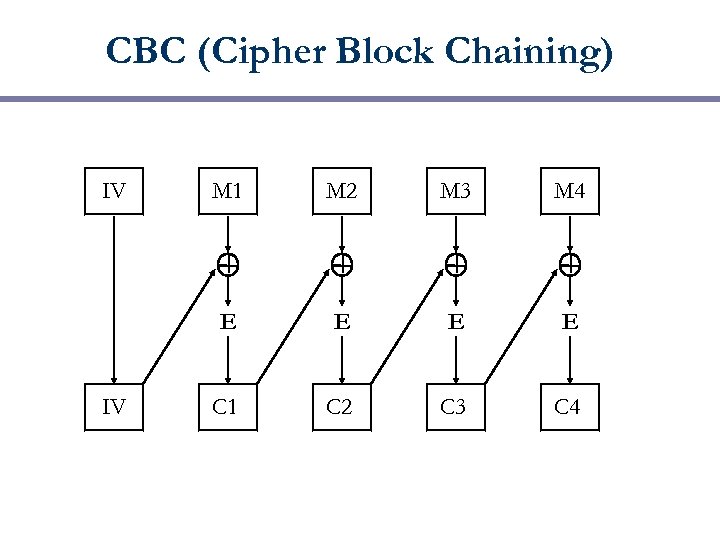
CBC (Cipher Block Chaining) IV M 2 M 3 M 4 E IV M 1 E E E C 1 C 2 C 3 C 4
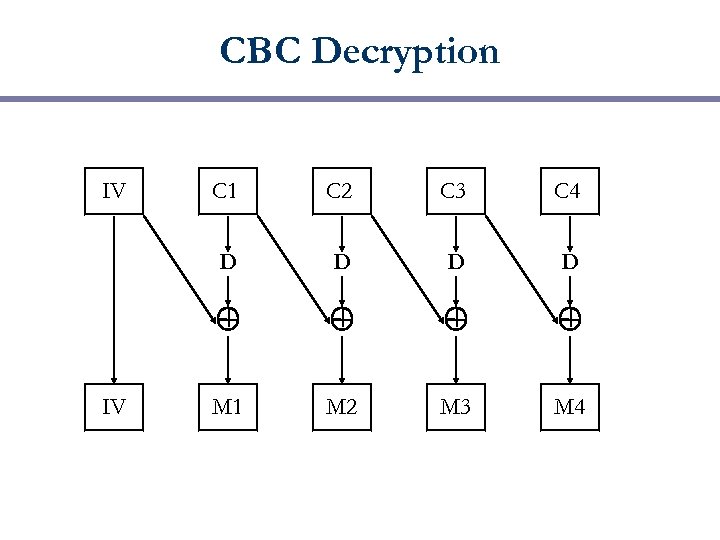
CBC Decryption IV C 2 C 3 C 4 D IV C 1 D D D M 1 M 2 M 3 M 4
XOR (Exclusive-OR) Bitwise operation with two inputs where the output bit is 1 if exactly one of the two input bits is one § (B XOR A) = B § If A is a “one time pad”, very efficient and secure § Common encryption schemes (e. g. RC 4) calculate a pseudo-random stream from a key §
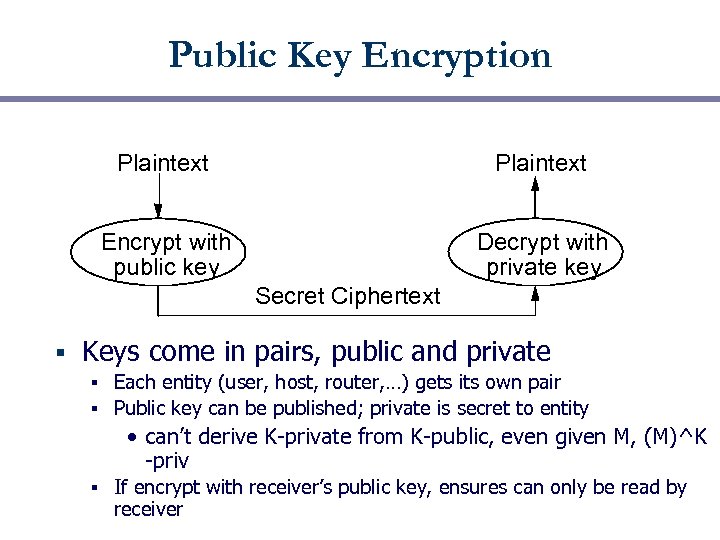
Public Key Encryption Plaintext Encrypt with public key Decrypt with private key Secret Ciphertext § Keys come in pairs, public and private Each entity (user, host, router, …) gets its own pair § Public key can be published; private is secret to entity § • can’t derive K-private from K-public, even given M, (M)^K -priv § If encrypt with receiver’s public key, ensures can only be read by receiver
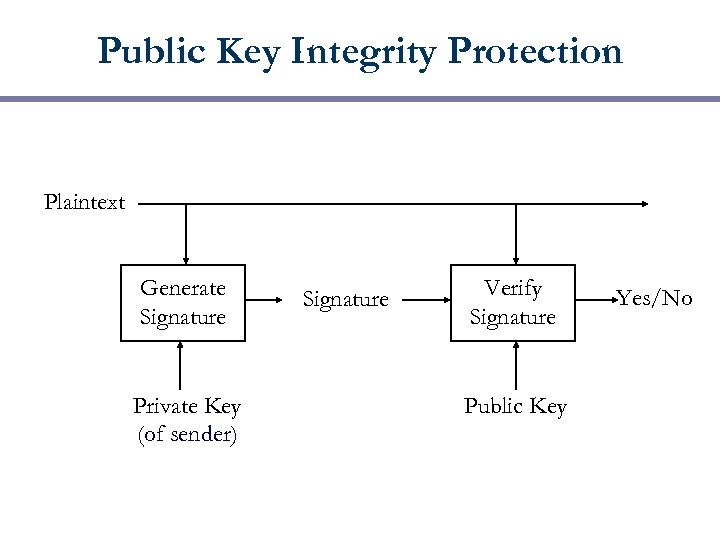
Public Key Integrity Protection Plaintext Generate Signature Private Key (of sender) Signature Verify Signature Public Key Yes/No
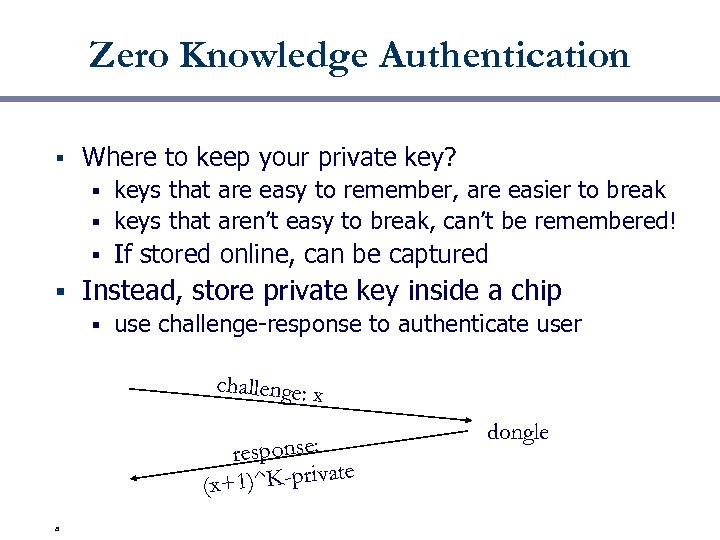
Zero Knowledge Authentication § Where to keep your private key? keys that are easy to remember, are easier to break § keys that aren’t easy to break, can’t be remembered! § § § If stored online, can be captured Instead, store private key inside a chip § use challenge-response to authenticate user challenge: x response: ate x+1)^K-priv ( a dongle
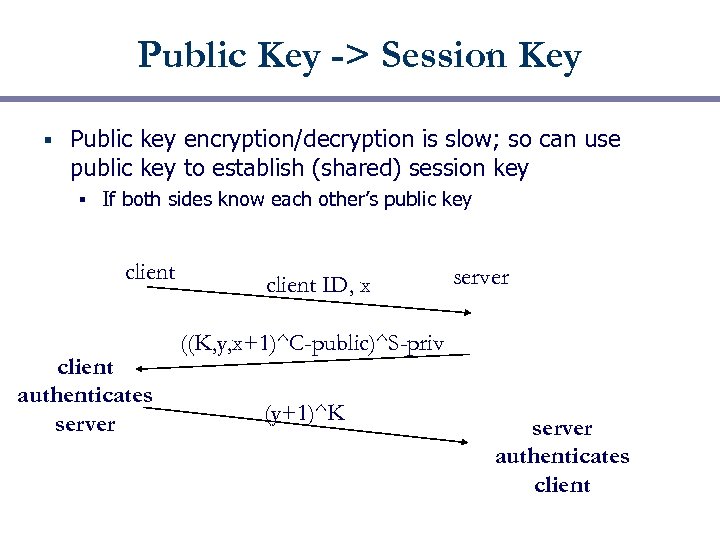
Public Key -> Session Key § Public key encryption/decryption is slow; so can use public key to establish (shared) session key § If both sides know each other’s public key client authenticates server client ID, x server ((K, y, x+1)^C-public)^S-priv (y+1)^K server authenticates client
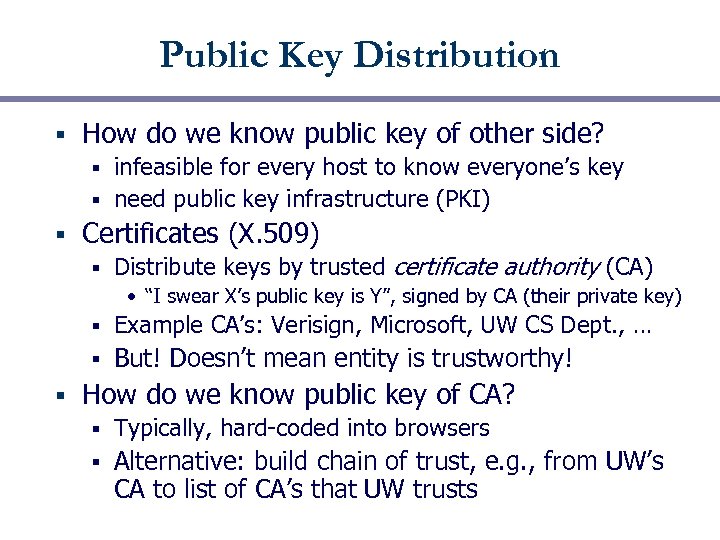
Public Key Distribution § How do we know public key of other side? infeasible for every host to know everyone’s key § need public key infrastructure (PKI) § § Certificates (X. 509) § Distribute keys by trusted certificate authority (CA) • “I swear X’s public key is Y”, signed by CA (their private key) § § § Example CA’s: Verisign, Microsoft, UW CS Dept. , … But! Doesn’t mean entity is trustworthy! How do we know public key of CA? § Typically, hard-coded into browsers § Alternative: build chain of trust, e. g. , from UW’s CA to list of CA’s that UW trusts
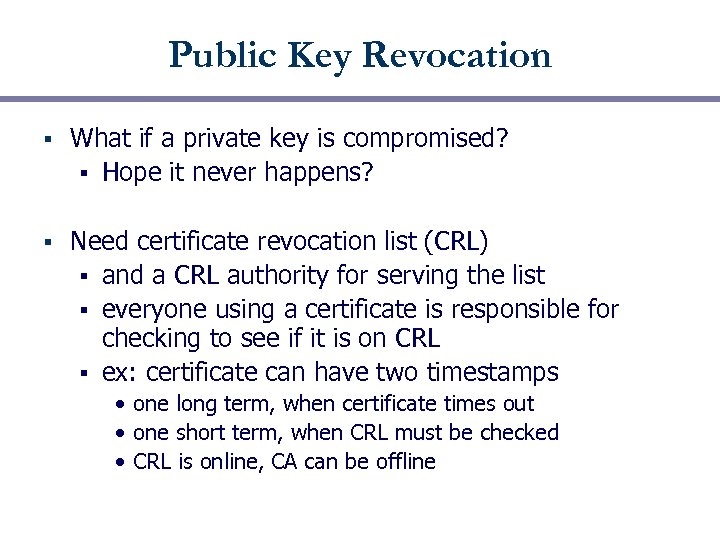
Public Key Revocation § What if a private key is compromised? § Hope it never happens? § Need certificate revocation list (CRL) § and a CRL authority for serving the list § everyone using a certificate is responsible for checking to see if it is on CRL § ex: certificate can have two timestamps • one long term, when certificate times out • one short term, when CRL must be checked • CRL is online, CA can be offline
Secret Key -> Session Key In secret key systems, how do we get a secret with other side? § infeasible for everyone to share a secret with everyone else § Solution: “authentication server” (Kerberos) § everyone shares (a separate) secret with server § server provides session key for A <-> B § everyone trusts authentication server § • if compromise server, can do anything!
Kerberos § § § Developed at MIT Based on secret key cryptography Code is publicly available (for a long time not legally exportable from the U. S. ) Early version used block cipher § Vulnerability caught and fixed Embedded in a variety of commercial products § Ex: in use by UW CSE
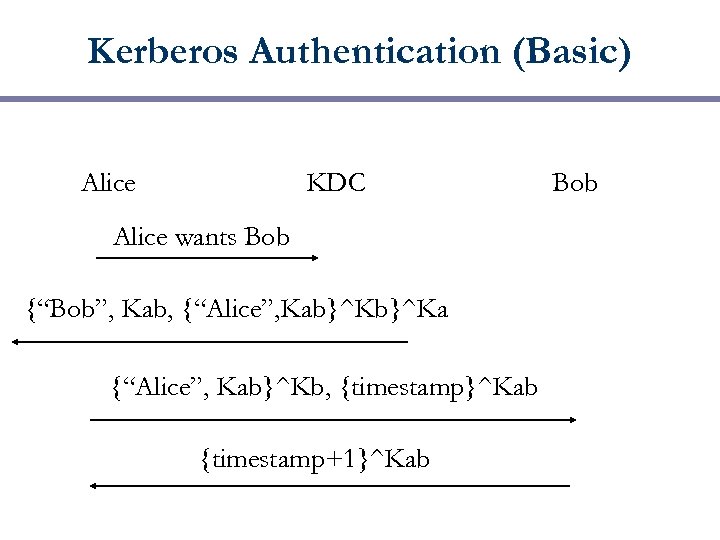
Kerberos Authentication (Basic) Alice KDC Alice wants Bob {“Bob”, Kab, {“Alice”, Kab}^Ka {“Alice”, Kab}^Kb, {timestamp}^Kab {timestamp+1}^Kab Bob
Ticket Granting Tickets It is dangerous for the workstation to hold Alice’s secret for her entire login session § Instead, Alice uses her password to get a short lived “ticket” to the “Ticket Granting Service” which can be used to get tickets for a limited time § For a login session >8 hours, she must enter her password again §
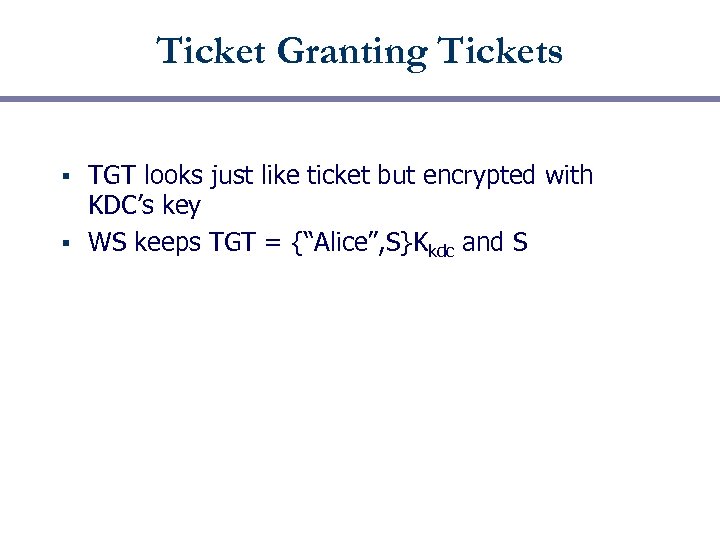
Ticket Granting Tickets TGT looks just like ticket but encrypted with KDC’s key § WS keeps TGT = {“Alice”, S}Kkdc and S §
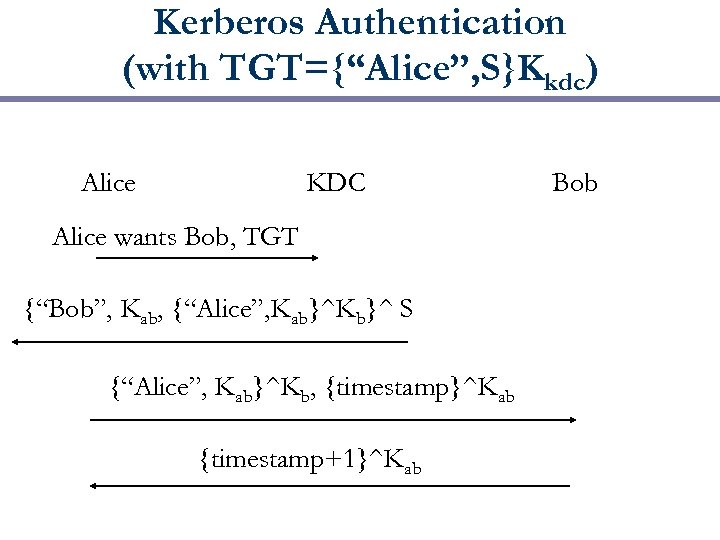
Kerberos Authentication (with TGT={“Alice”, S}Kkdc) Alice KDC Alice wants Bob, TGT {“Bob”, Kab, {“Alice”, Kab}^Kb}^ S {“Alice”, Kab}^Kb, {timestamp}^Kab {timestamp+1}^Kab Bob
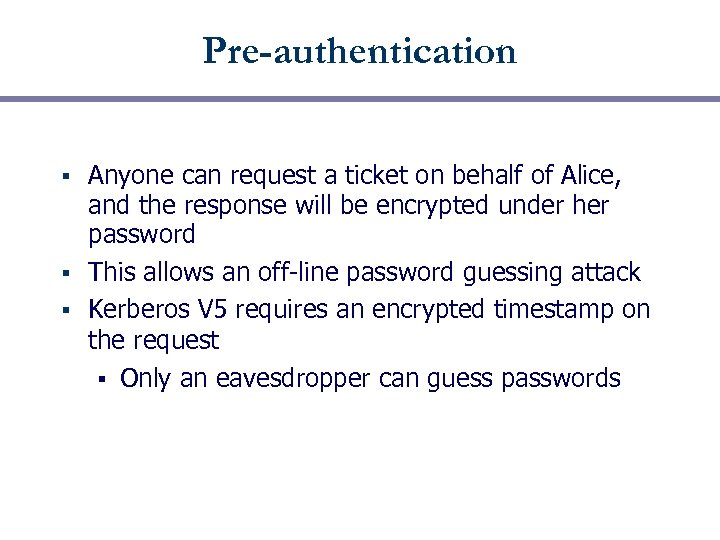
Pre-authentication Anyone can request a ticket on behalf of Alice, and the response will be encrypted under her password § This allows an off-line password guessing attack § Kerberos V 5 requires an encrypted timestamp on the request § Only an eavesdropper can guess passwords §
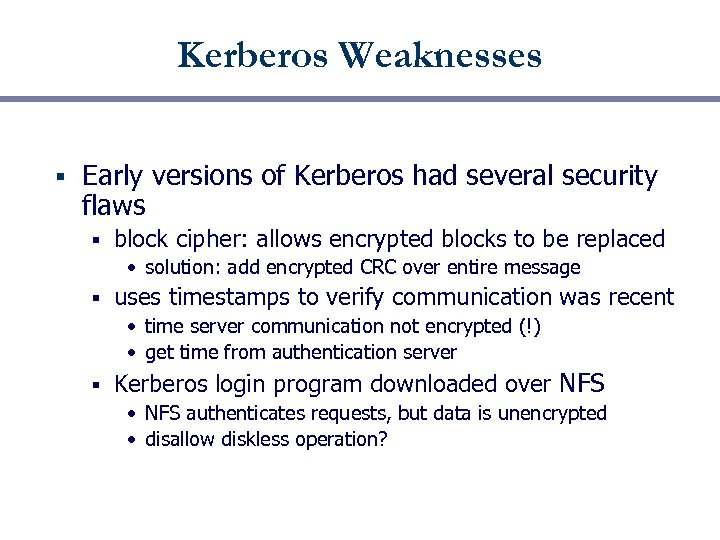
Kerberos Weaknesses § Early versions of Kerberos had several security flaws § block cipher: allows encrypted blocks to be replaced • solution: add encrypted CRC over entire message § uses timestamps to verify communication was recent • time server communication not encrypted (!) • get time from authentication server § Kerberos login program downloaded over NFS • NFS authenticates requests, but data is unencrypted • disallow diskless operation?
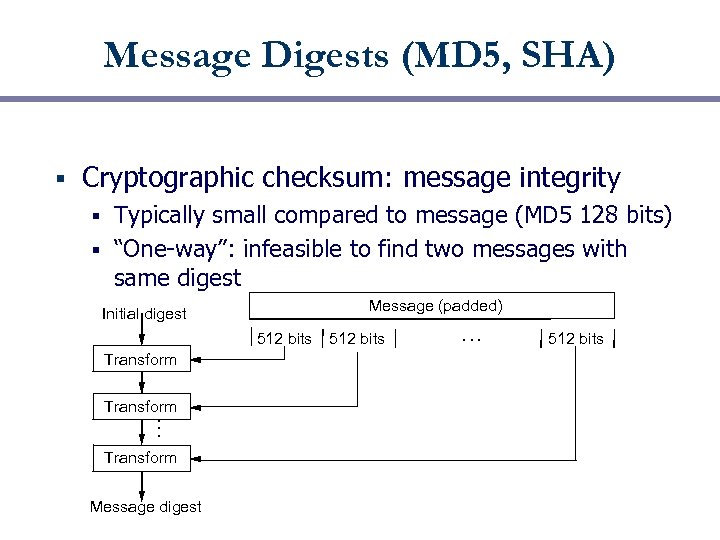
Message Digests (MD 5, SHA) Cryptographic checksum: message integrity Typically small compared to message (MD 5 128 bits) § “One-way”: infeasible to find two messages with same digest § Message (padded) Initial digest 512 bits Transform … § Transform Message digest 512 bits … 512 bits
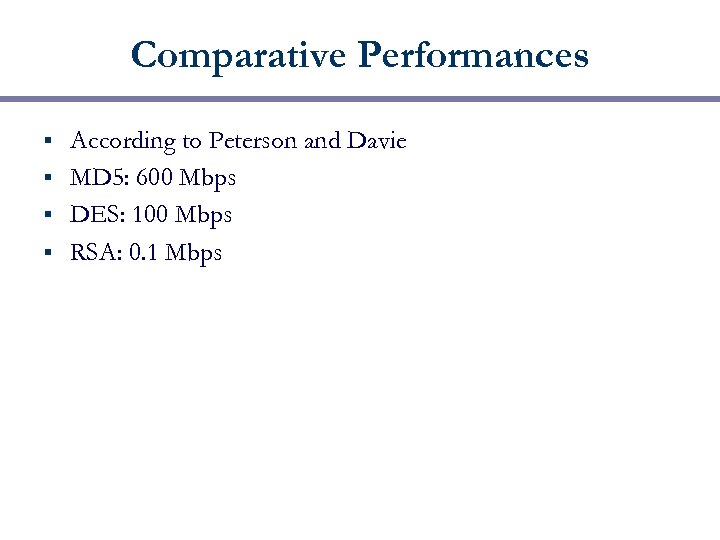
Comparative Performances According to Peterson and Davie § MD 5: 600 Mbps § DES: 100 Mbps § RSA: 0. 1 Mbps §
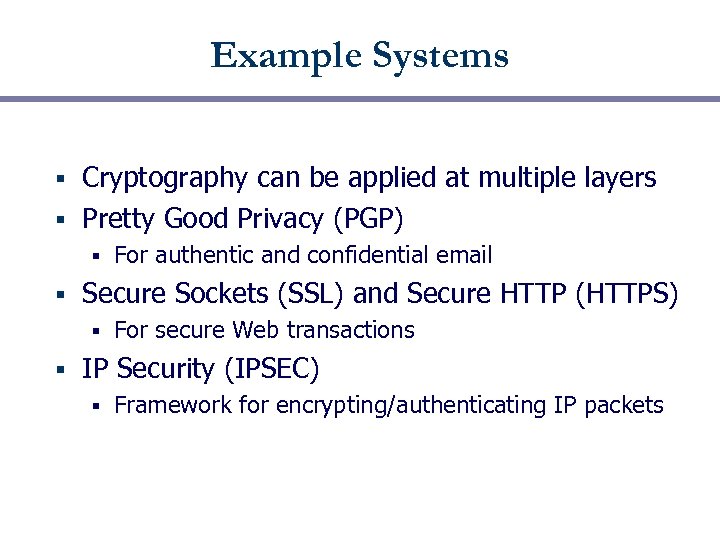
Example Systems Cryptography can be applied at multiple layers § Pretty Good Privacy (PGP) § § § Secure Sockets (SSL) and Secure HTTP (HTTPS) § § For authentic and confidential email For secure Web transactions IP Security (IPSEC) § Framework for encrypting/authenticating IP packets
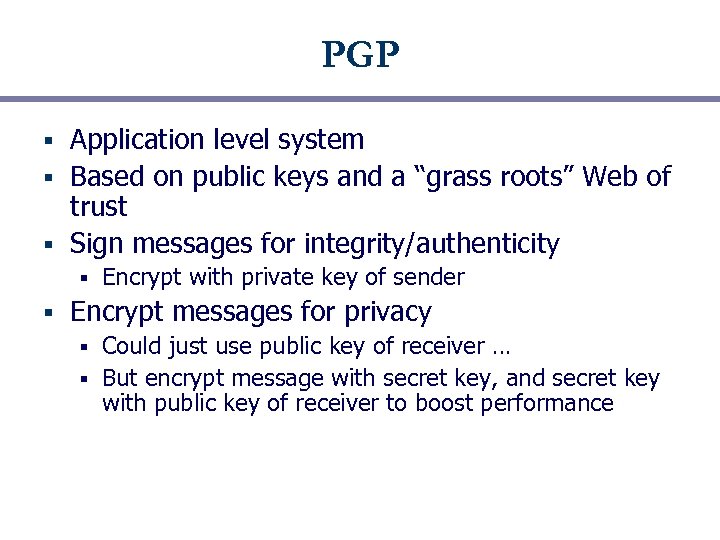
PGP Application level system § Based on public keys and a “grass roots” Web of trust § Sign messages for integrity/authenticity § § § Encrypt with private key of sender Encrypt messages for privacy Could just use public key of receiver … § But encrypt message with secret key, and secret key with public key of receiver to boost performance §
SSL/TLS and HTTPS § Secure transport layer targeted at Web transactions § § Extra handshake phase to authenticate and exchange shared session keys § § SSL/TLS inserted between TCP and HTTP to make secure HTTP Client might authenticate Web server but not vice-versa • Certificate Authority embedded in Web browser Performance optimization Refer to shared state with session id § Can use same parameters across connections • Client sends session id, allowing server to skip handshake §
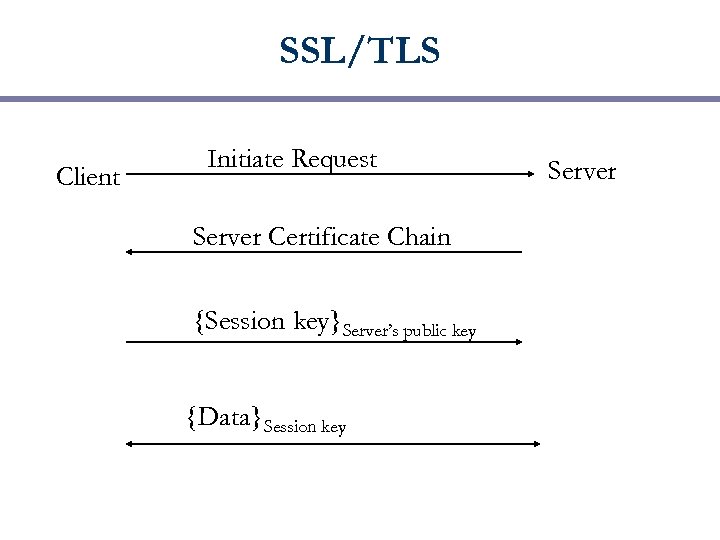
SSL/TLS Client Initiate Request Server Certificate Chain {Session key}Server’s public key {Data}Session key Server
IPSEC § Framework for encrypted IP packets § § Choice of algorithms not specified Uses new protocol headers inside IPv 4 packets § Authentication header • For message integrity and origin authenticity • Optionally “anti-replay” protection (via sequence number) § Encapsulating Security Payload • Adds encryption for privacy § Depends on key distribution (ISAKAMP) § § Sets up security associations Ex: secure tunnels between corporate offices
Summary Security goals: Authenticity, Integrity, Privacy § Public key crypto slow, good for signing § Secret (symmetric) key faster, e. g. , AES § Important security practices: IPSEC, TLS/SSL, PGP, 802. 11 i §
Скачать презентацию Security and Cryptography CSE 461 Ben Greenstein Jeremy
9e8df12f2c3790329ffc31dd3f83abc5.ppt