


 Скачать презентацию Security and Cooperation in Wireless Networks http secowinet
a423f39712c7b6c8eddc76b4d1b6dfb5.ppt
- Количество слайдов: 53
 Security and Cooperation in Wireless Networks http: //secowinet. epfl. ch/ Chapter 5: Establishment of security associations key establishment in sensor networks; key establishment in ad hoc networks exploiting - physical contact - vicinity - node mobility; revocation; © 2007 Levente Buttyán and Jean-Pierre Hubaux
 Chapter outline 5. 1 5. 2 5. 3 5. 4 5. 5 Key establishment in sensor networks Exploiting physical contact Exploiting mobility Exploiting the properties of vicinity and of the radio link Revocation Security and Cooperation in Wireless Networks Chapter 5: Establishment of security associations 2
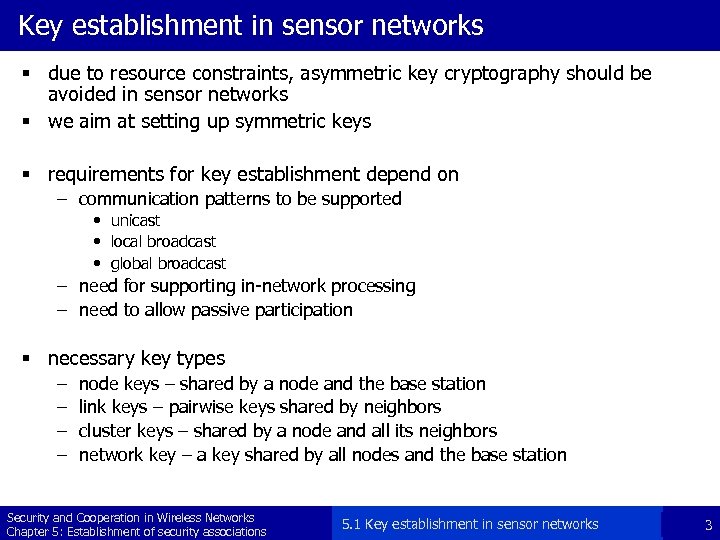 Key establishment in sensor networks § due to resource constraints, asymmetric key cryptography should be avoided in sensor networks § we aim at setting up symmetric keys § requirements for key establishment depend on – communication patterns to be supported • unicast • local broadcast • global broadcast – need for supporting in-network processing – need to allow passive participation § necessary key types – – node keys – shared by a node and the base station link keys – pairwise keys shared by neighbors cluster keys – shared by a node and all its neighbors network key – a key shared by all nodes and the base station Security and Cooperation in Wireless Networks Chapter 5: Establishment of security associations 5. 1 Key establishment in sensor networks 3
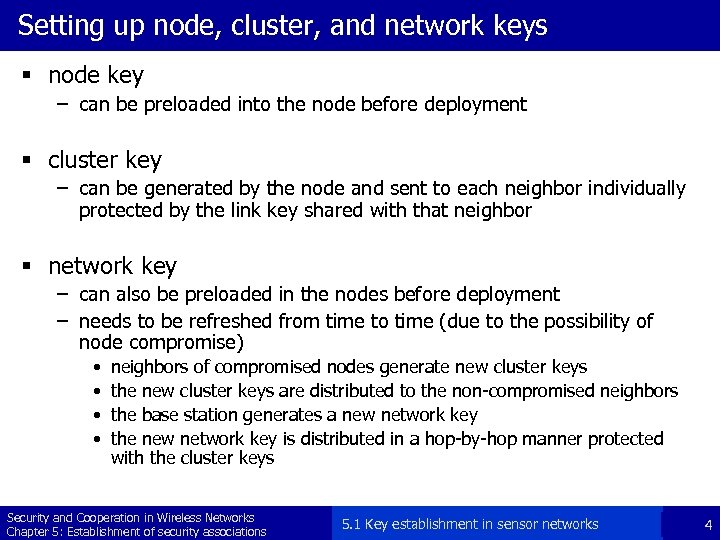 Setting up node, cluster, and network keys § node key – can be preloaded into the node before deployment § cluster key – can be generated by the node and sent to each neighbor individually protected by the link key shared with that neighbor § network key – can also be preloaded in the nodes before deployment – needs to be refreshed from time to time (due to the possibility of node compromise) • • neighbors of compromised nodes generate new cluster keys the new cluster keys are distributed to the non-compromised neighbors the base station generates a new network key the new network key is distributed in a hop-by-hop manner protected with the cluster keys Security and Cooperation in Wireless Networks Chapter 5: Establishment of security associations 5. 1 Key establishment in sensor networks 4
 Design constraints for link key establishment § network lifetime – severe constraints on energy consumption § hardware limits – 8 -bit CPU, small memory – large integer arithmetics are infeasible § no tamper resistance – nodes can be compromised – secrets can be leaked § no a priori knowledge of post-deployment topology – it is not known a priori who will be neighbors § gradual deployment – need to add new sensors after deployment Security and Cooperation in Wireless Networks Chapter 5: Establishment of security associations 5. 1 Key establishment in sensor networks 5
 Traditional approaches § use of public key crypto (e. g. , Diffie-Hellman ) – limited computational and energy resources of sensors § use of a trusted key distribution server (Kerberos-like) – base station could play the role of the server – requires routing of key establishment messages to and from the base station • routing may already need link keys • unequal communication load on the sensors – base station becomes single point of failure § pre-loaded link keys in sensors – post-deployment topology is unknown – single “mission key” approach • vulnerable to single node compromise – n -1 keys in each of the n sensors • excessive memory requirements • gradual deployment is difficult • doesn’t scale Security and Cooperation in Wireless Networks Chapter 5: Establishment of security associations 5. 1 Key establishment in sensor networks 6
 Link key setup using a short-term master key – Sensor networks: stationary nodes, neighborhood of a node does not change frequently § Link key establishment protocol: – – Master key pre-loading Neighbor discovery Link key computation Master key deletion § Master key pre-loading: – Before deployment – Master key Kinit is loaded into the nodes – Each node u computes Ku = f. Kinit (u) Security and Cooperation in Wireless Networks Chapter 5: Establishment of security associations 5. 1 Key establishment in sensor networks 5. 1. 4 Link key establishment using a short-term master key 7
 Link key setup using a short-term master key § Neighbor discovery: – – – After the deployment Node u initializes a timer Discovers its neighbors: HELLO message Neighbor v responds with ACK: identifier of v, authenticated with Kv u verifies ACK § link key computation: – link key: Kuv=f. Kv (u). § Master key deletion: – When timer expires: u deletes Kinit and all Kv Security and Cooperation in Wireless Networks Chapter 5: Establishment of security associations 5. 1 Key establishment in sensor networks 5. 1. 4 Link key establishment using a short-term master key 8
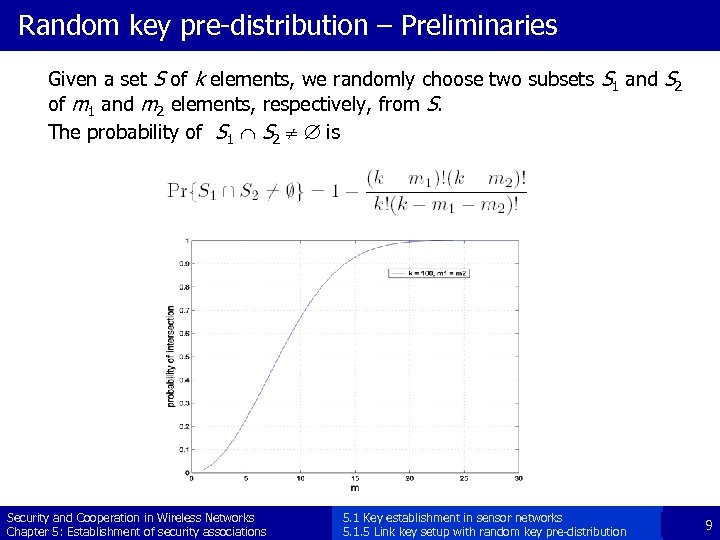 Random key pre-distribution – Preliminaries Given a set S of k elements, we randomly choose two subsets S 1 and S 2 of m 1 and m 2 elements, respectively, from S. The probability of S 1 Ç S 2 ¹ Æ is Security and Cooperation in Wireless Networks Chapter 5: Establishment of security associations 5. 1 Key establishment in sensor networks 5. 1. 5 Link key setup with random key pre-distribution 9
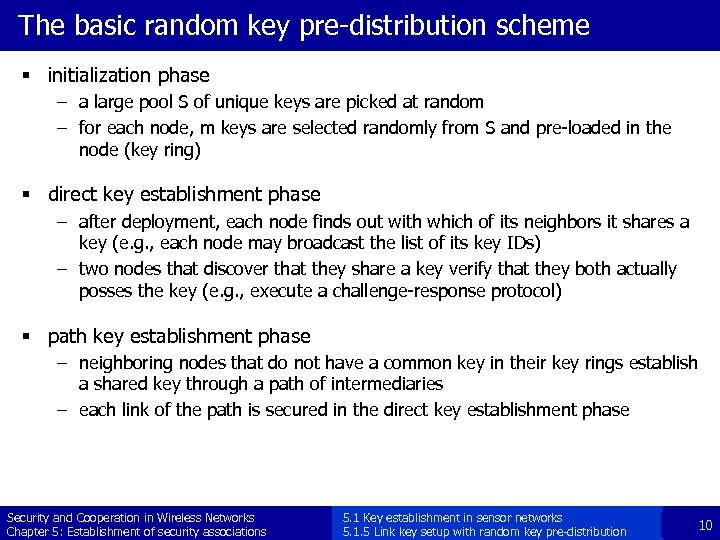 The basic random key pre-distribution scheme § initialization phase – a large pool S of unique keys are picked at random – for each node, m keys are selected randomly from S and pre-loaded in the node (key ring) § direct key establishment phase – after deployment, each node finds out with which of its neighbors it shares a key (e. g. , each node may broadcast the list of its key IDs) – two nodes that discover that they share a key verify that they both actually posses the key (e. g. , execute a challenge-response protocol) § path key establishment phase – neighboring nodes that do not have a common key in their key rings establish a shared key through a path of intermediaries – each link of the path is secured in the direct key establishment phase Security and Cooperation in Wireless Networks Chapter 5: Establishment of security associations 5. 1 Key establishment in sensor networks 5. 1. 5 Link key setup with random key pre-distribution 10
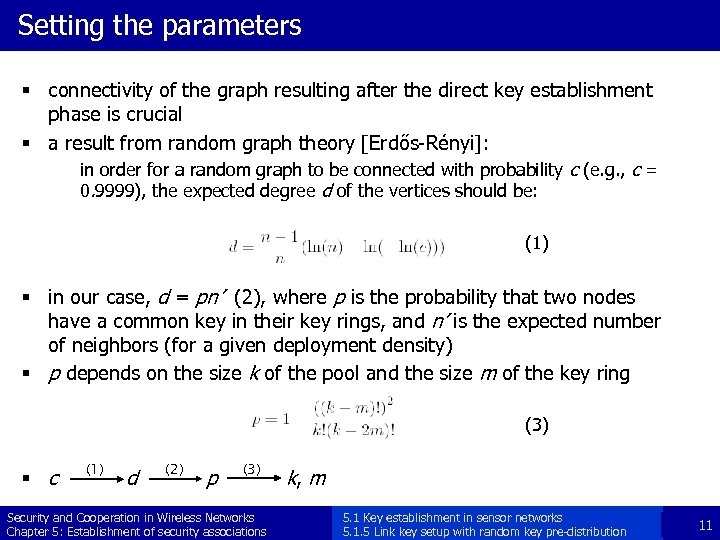 Setting the parameters § connectivity of the graph resulting after the direct key establishment phase is crucial § a result from random graph theory [Erdős-Rényi]: in order for a random graph to be connected with probability c (e. g. , c = 0. 9999), the expected degree d of the vertices should be: (1) § in our case, d = pn’ (2), where p is the probability that two nodes have a common key in their key rings, and n’ is the expected number of neighbors (for a given deployment density) § p depends on the size k of the pool and the size m of the key ring (3) § c (1) d (2) p (3) Security and Cooperation in Wireless Networks Chapter 5: Establishment of security associations k, m 5. 1 Key establishment in sensor networks 5. 1. 5 Link key setup with random key pre-distribution 11
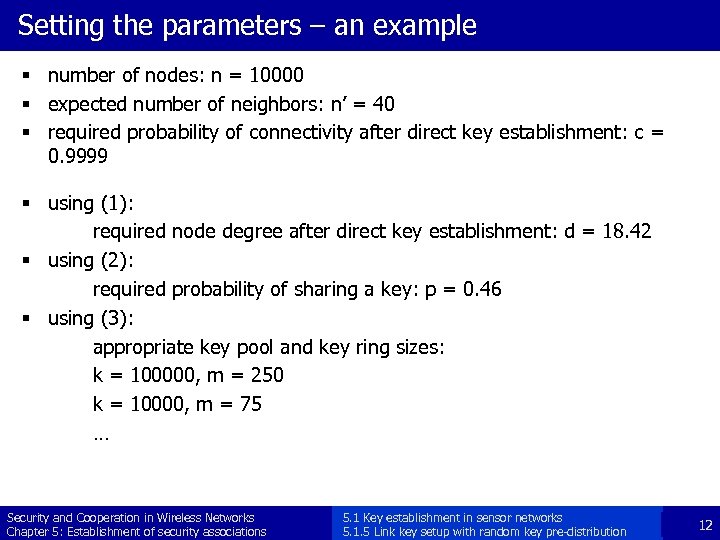 Setting the parameters – an example § number of nodes: n = 10000 § expected number of neighbors: n’ = 40 § required probability of connectivity after direct key establishment: c = 0. 9999 § using (1): required node degree after direct key establishment: d = 18. 42 § using (2): required probability of sharing a key: p = 0. 46 § using (3): appropriate key pool and key ring sizes: k = 100000, m = 250 k = 10000, m = 75 … Security and Cooperation in Wireless Networks Chapter 5: Establishment of security associations 5. 1 Key establishment in sensor networks 5. 1. 5 Link key setup with random key pre-distribution 12
 Qualitative analysis § advantages: – parameters can be adopted to special requirements – no need for intensive computation – path key establishment have some overhead … • decryption and re-encryption at intermediate nodes • communication overhead – but simulation results show that paths are not very long (2 -3 hops) – no assumption on topology – easy addition of new nodes § disadvantages: – node capture affects the security of non-captured nodes too • if a node is captured, then its keys are compromised • these keys may be used by other nodes too – if a path key is established through captured nodes, then the path key is compromised – no authentication is provided Security and Cooperation in Wireless Networks Chapter 5: Establishment of security associations 5. 1 Key establishment in sensor networks 5. 1. 5 Link key setup with random key pre-distribution 13
 Improvements: q-composite rand key pre-distribution § basic idea: – two nodes can set up a shared key if they have at least q common keys in their key rings – the pairwise key is computed as the hash of all common keys § advantage: – in order to compromise a link key, all keys that have been hashed together must be compromised § disadvantage: – probability of being able to establish a shared key directly is smaller (it is less likely to have q common keys, than to have one) – key ring size should be increased (but: memory constraints) or key pool size should be decreased (but: effect of captured nodes) Security and Cooperation in Wireless Networks Chapter 5: Establishment of security associations 5. 1 Key establishment in sensor networks 5. 1. 5 Link key setup with random key pre-distribution 14
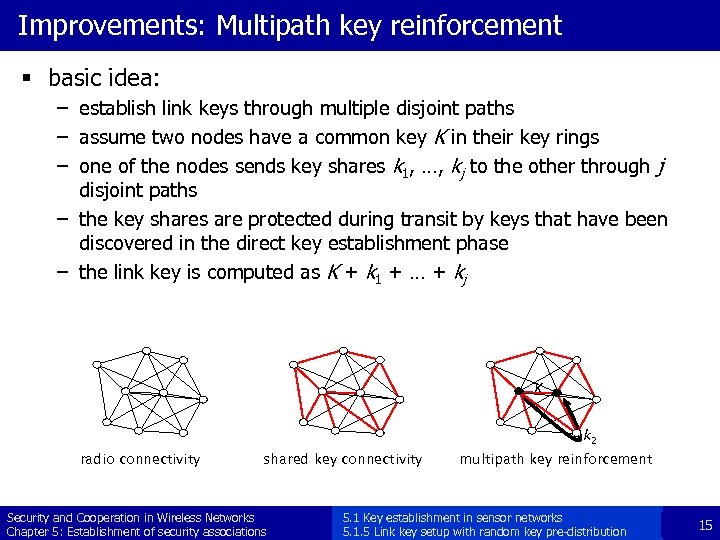 Improvements: Multipath key reinforcement § basic idea: – establish link keys through multiple disjoint paths – assume two nodes have a common key K in their key rings – one of the nodes sends key shares k 1, …, kj to the other through j disjoint paths – the key shares are protected during transit by keys that have been discovered in the direct key establishment phase – the link key is computed as K + k 1 + … + kj K k 2 radio connectivity shared key connectivity Security and Cooperation in Wireless Networks Chapter 5: Establishment of security associations multipath key reinforcement 5. 1 Key establishment in sensor networks 5. 1. 5 Link key setup with random key pre-distribution 15
 Improvements: Multipath key reinforcement § advantages: – in order to compromise a link key, at least one link on each path must be compromised increased resilience to node capture § disadvantages: – increased overhead § note: – multipath key reinforcement can be used for path key setup too Security and Cooperation in Wireless Networks Chapter 5: Establishment of security associations 5. 1 Key establishment in sensor networks 5. 1. 5 Link key setup with random key pre-distribution 16
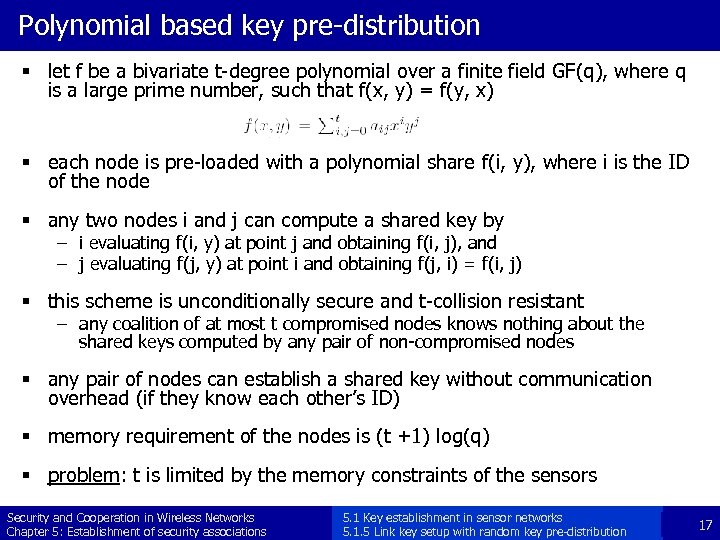 Polynomial based key pre-distribution § let f be a bivariate t-degree polynomial over a finite field GF(q), where q is a large prime number, such that f(x, y) = f(y, x) § each node is pre-loaded with a polynomial share f(i, y), where i is the ID of the node § any two nodes i and j can compute a shared key by – i evaluating f(i, y) at point j and obtaining f(i, j), and – j evaluating f(j, y) at point i and obtaining f(j, i) = f(i, j) § this scheme is unconditionally secure and t-collision resistant – any coalition of at most t compromised nodes knows nothing about the shared keys computed by any pair of non-compromised nodes § any pair of nodes can establish a shared key without communication overhead (if they know each other’s ID) § memory requirement of the nodes is (t +1) log(q) § problem: t is limited by the memory constraints of the sensors Security and Cooperation in Wireless Networks Chapter 5: Establishment of security associations 5. 1 Key establishment in sensor networks 5. 1. 5 Link key setup with random key pre-distribution 17
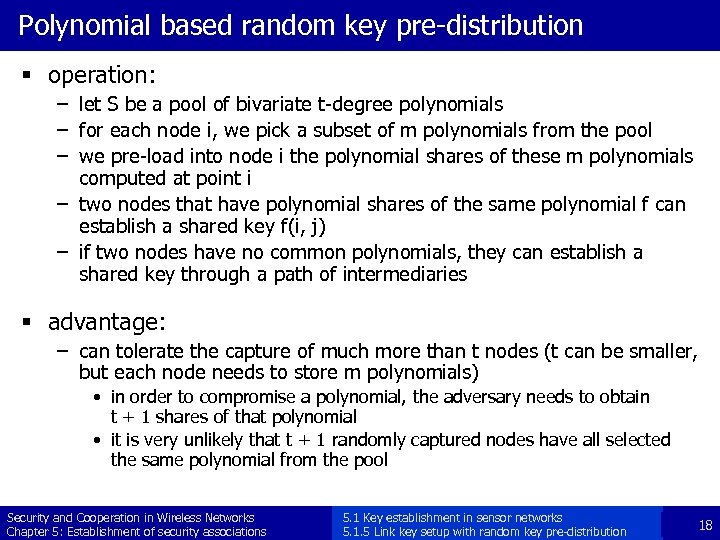 Polynomial based random key pre-distribution § operation: – let S be a pool of bivariate t-degree polynomials – for each node i, we pick a subset of m polynomials from the pool – we pre-load into node i the polynomial shares of these m polynomials computed at point i – two nodes that have polynomial shares of the same polynomial f can establish a shared key f(i, j) – if two nodes have no common polynomials, they can establish a shared key through a path of intermediaries § advantage: – can tolerate the capture of much more than t nodes (t can be smaller, but each node needs to store m polynomials) • in order to compromise a polynomial, the adversary needs to obtain t + 1 shares of that polynomial • it is very unlikely that t + 1 randomly captured nodes have all selected the same polynomial from the pool Security and Cooperation in Wireless Networks Chapter 5: Establishment of security associations 5. 1 Key establishment in sensor networks 5. 1. 5 Link key setup with random key pre-distribution 18
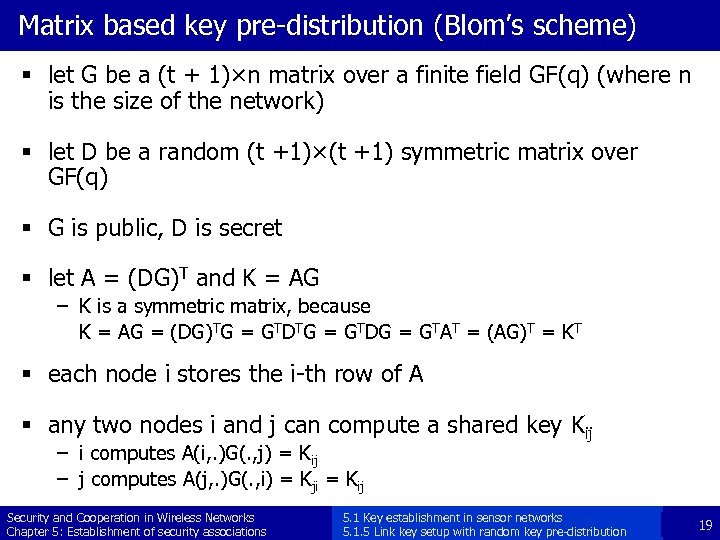 Matrix based key pre-distribution (Blom’s scheme) § let G be a (t + 1)×n matrix over a finite field GF(q) (where n is the size of the network) § let D be a random (t +1)×(t +1) symmetric matrix over GF(q) § G is public, D is secret § let A = (DG)T and K = AG – K is a symmetric matrix, because K = AG = (DG)TG = GTDG = GTAT = (AG)T = KT § each node i stores the i-th row of A § any two nodes i and j can compute a shared key Kij – i computes A(i, . )G(. , j) = Kij – j computes A(j, . )G(. , i) = Kji = Kij Security and Cooperation in Wireless Networks Chapter 5: Establishment of security associations 5. 1 Key establishment in sensor networks 5. 1. 5 Link key setup with random key pre-distribution 19
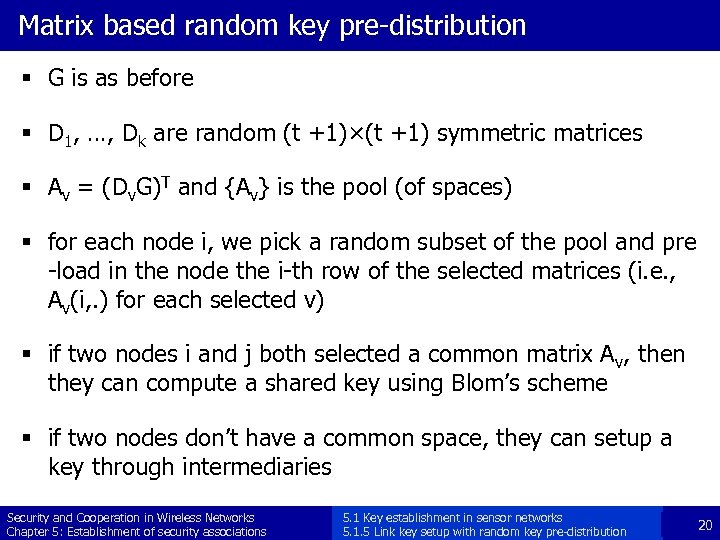 Matrix based random key pre-distribution § G is as before § D 1, …, Dk are random (t +1)×(t +1) symmetric matrices § Av = (Dv. G)T and {Av} is the pool (of spaces) § for each node i, we pick a random subset of the pool and pre -load in the node the i-th row of the selected matrices (i. e. , Av(i, . ) for each selected v) § if two nodes i and j both selected a common matrix Av, then they can compute a shared key using Blom’s scheme § if two nodes don’t have a common space, they can setup a key through intermediaries Security and Cooperation in Wireless Networks Chapter 5: Establishment of security associations 5. 1 Key establishment in sensor networks 5. 1. 5 Link key setup with random key pre-distribution 20
 Chapter outline 5. 1 5. 2 5. 3 5. 4 5. 5 Key establishment in sensor networks Exploiting physical contact Exploiting mobility Exploiting the properties of vicinity and of the radio link Revocation Security and Cooperation in Wireless Networks Chapter 5: Establishment of security associations 21
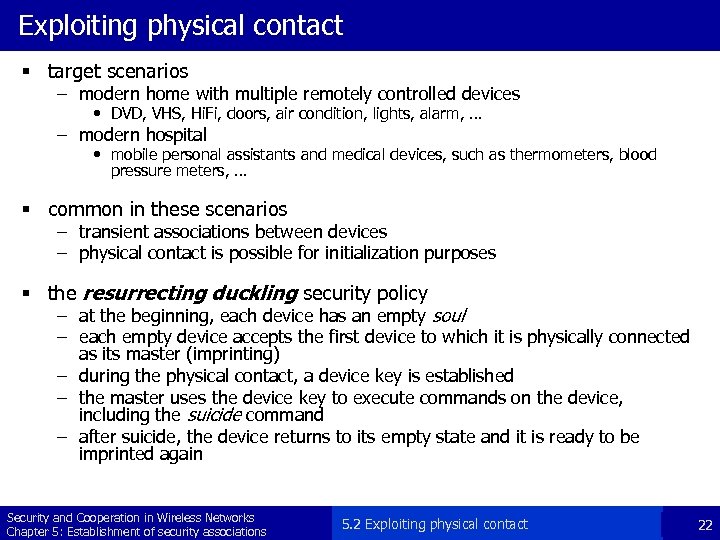 Exploiting physical contact § target scenarios – modern home with multiple remotely controlled devices • DVD, VHS, Hi. Fi, doors, air condition, lights, alarm, … – modern hospital • mobile personal assistants and medical devices, such as thermometers, blood pressure meters, … § common in these scenarios – transient associations between devices – physical contact is possible for initialization purposes § the resurrecting duckling security policy – at the beginning, each device has an empty soul – each empty device accepts the first device to which it is physically connected as its master (imprinting) – during the physical contact, a device key is established – the master uses the device key to execute commands on the device, including the suicide command – after suicide, the device returns to its empty state and it is ready to be imprinted again Security and Cooperation in Wireless Networks Chapter 5: Establishment of security associations 5. 2 Exploiting physical contact 22
 Chapter outline 5. 1 5. 2 5. 3 5. 4 5. 5 Key establishment in sensor networks Exploiting physical contact Exploiting mobility Exploiting the properties of vicinity and of the radio link Revocation Security and Cooperation in Wireless Networks Chapter 5: Establishment of security associations 23
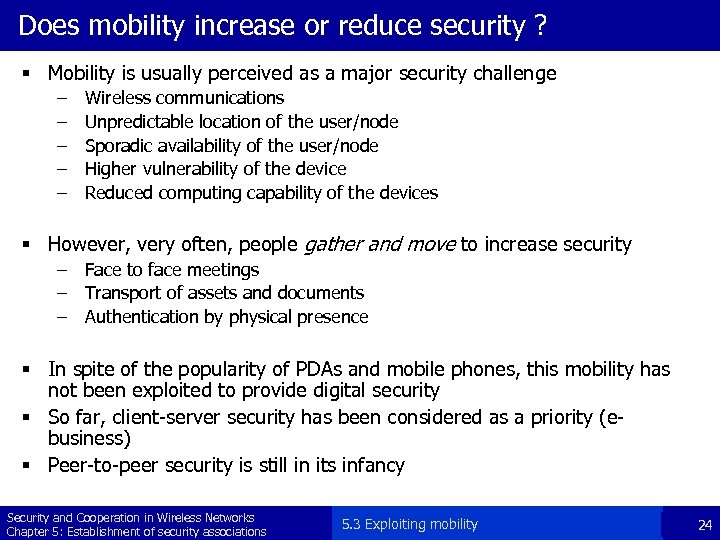 Does mobility increase or reduce security ? § Mobility is usually perceived as a major security challenge – – – Wireless communications Unpredictable location of the user/node Sporadic availability of the user/node Higher vulnerability of the device Reduced computing capability of the devices § However, very often, people gather and move to increase security – Face to face meetings – Transport of assets and documents – Authentication by physical presence § In spite of the popularity of PDAs and mobile phones, this mobility has not been exploited to provide digital security § So far, client-server security has been considered as a priority (ebusiness) § Peer-to-peer security is still in its infancy Security and Cooperation in Wireless Networks Chapter 5: Establishment of security associations 5. 3 Exploiting mobility 24
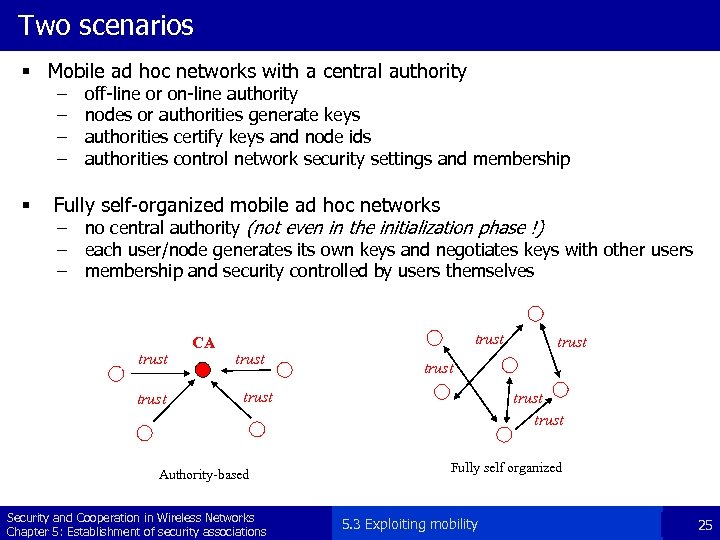 Two scenarios § Mobile ad hoc networks with a central authority – – § off-line or on-line authority nodes or authorities generate keys authorities certify keys and node ids authorities control network security settings and membership Fully self-organized mobile ad hoc networks – no central authority (not even in the initialization phase !) – each user/node generates its own keys and negotiates keys with other users – membership and security controlled by users themselves trust CA trust Authority-based Security and Cooperation in Wireless Networks Chapter 5: Establishment of security associations trust Fully self organized 5. 3 Exploiting mobility 25
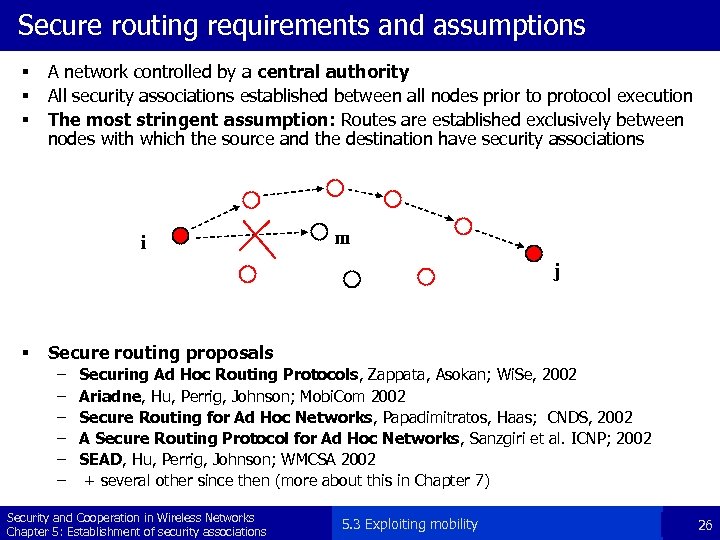 Secure routing requirements and assumptions § § § A network controlled by a central authority All security associations established between all nodes prior to protocol execution The most stringent assumption: Routes are established exclusively between nodes with which the source and the destination have security associations i m j § Secure routing proposals – – – Securing Ad Hoc Routing Protocols, Zappata, Asokan; Wi. Se, 2002 Ariadne, Hu, Perrig, Johnson; Mobi. Com 2002 Secure Routing for Ad Hoc Networks, Papadimitratos, Haas; CNDS, 2002 A Secure Routing Protocol for Ad Hoc Networks, Sanzgiri et al. ICNP; 2002 SEAD, Hu, Perrig, Johnson; WMCSA 2002 + several other since then (more about this in Chapter 7) Security and Cooperation in Wireless Networks Chapter 5: Establishment of security associations 5. 3 Exploiting mobility 26
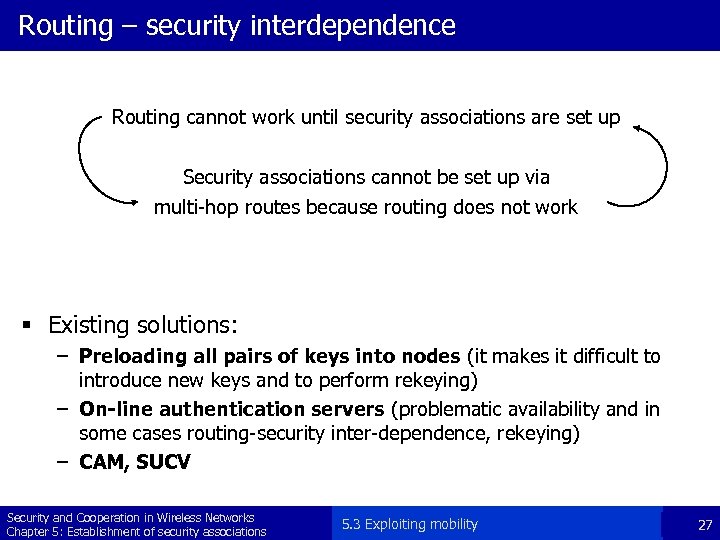 Routing – security interdependence Routing cannot work until security associations are set up Security associations cannot be set up via multi-hop routes because routing does not work § Existing solutions: – Preloading all pairs of keys into nodes (it makes it difficult to introduce new keys and to perform rekeying) – On-line authentication servers (problematic availability and in some cases routing-security inter-dependence, rekeying) – CAM, SUCV Security and Cooperation in Wireless Networks Chapter 5: Establishment of security associations 5. 3 Exploiting mobility 27
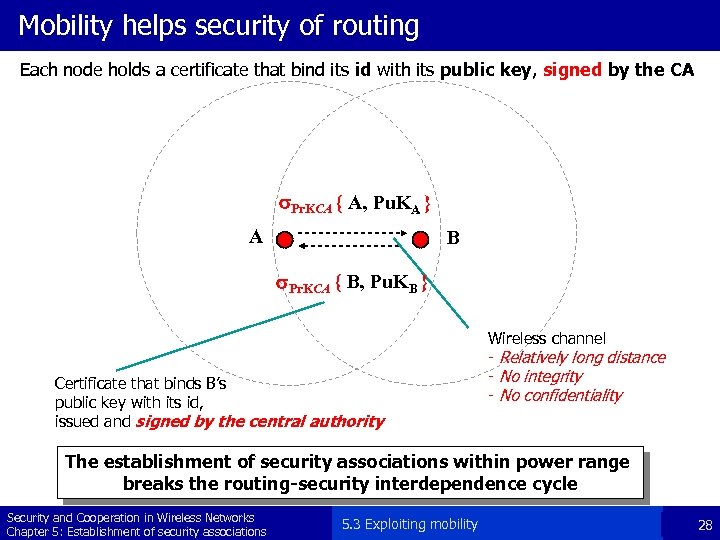 Mobility helps security of routing Each node holds a certificate that bind its id with its public key, signed by the CA s. Pr. KCA { A, Pu. KA } A B s. Pr. KCA { B, Pu. KB } Certificate that binds B’s public key with its id, issued and signed by the central authority Wireless channel - Relatively long distance - No integrity - No confidentiality The establishment of security associations within power range breaks the routing-security interdependence cycle Security and Cooperation in Wireless Networks Chapter 5: Establishment of security associations 5. 3 Exploiting mobility 28
 Advantages of the mobility approach (1/2) § Mobile ad hoc networks with authority-based security systems – – – breaks the routing-security dependence circle automatic establishment of security associations no user involvement associations can be established in power range only off-line authorities are needed straightforward re-keying Security and Cooperation in Wireless Networks Chapter 5: Establishment of security associations 5. 3 Exploiting mobility 29
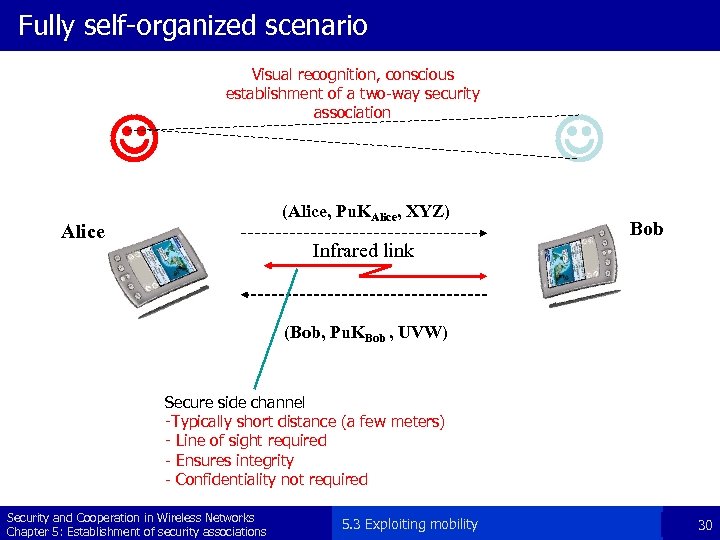 Fully self-organized scenario Visual recognition, conscious establishment of a two-way security association (Alice, Pu. KAlice, XYZ) Alice Infrared link Bob (Bob, Pu. KBob , UVW) Secure side channel -Typically short distance (a few meters) - Line of sight required - Ensures integrity - Confidentiality not required Security and Cooperation in Wireless Networks Chapter 5: Establishment of security associations 5. 3 Exploiting mobility 30
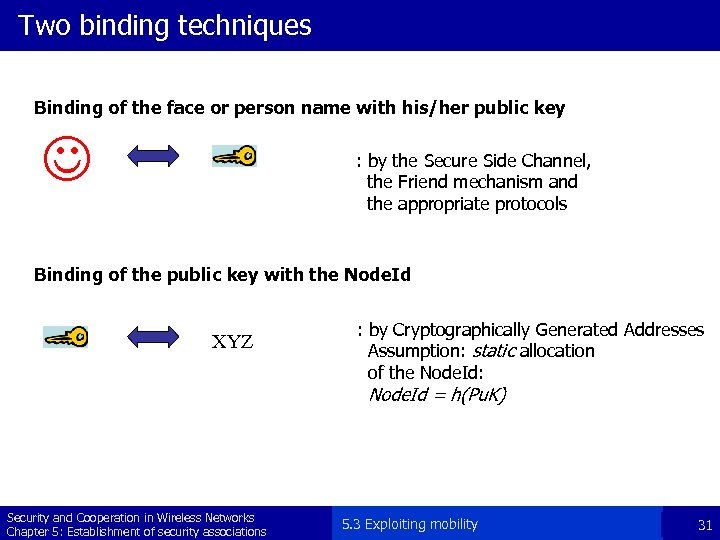 Two binding techniques Binding of the face or person name with his/her public key : by the Secure Side Channel, the Friend mechanism and the appropriate protocols Binding of the public key with the Node. Id XYZ : by Cryptographically Generated Addresses Assumption: static allocation of the Node. Id: Node. Id = h(Pu. K) Security and Cooperation in Wireless Networks Chapter 5: Establishment of security associations 5. 3 Exploiting mobility 31
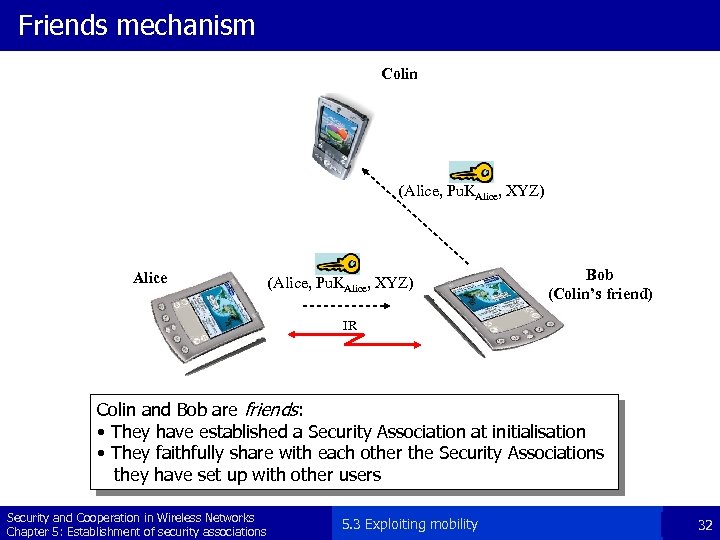 Friends mechanism Colin (Alice, Pu. KAlice, XYZ) Alice (Alice, Pu. KAlice, XYZ) Bob (Colin’s friend) IR Colin and Bob are friends: • They have established a Security Association at initialisation • They faithfully share with each other the Security Associations they have set up with other users Security and Cooperation in Wireless Networks Chapter 5: Establishment of security associations 5. 3 Exploiting mobility 32
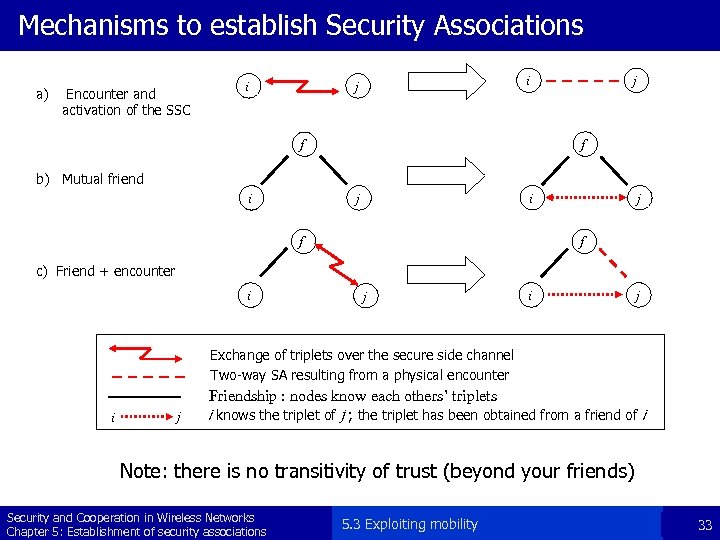 Mechanisms to establish Security Associations a) Encounter and activation of the SSC i i j j f f b) Mutual friend i i j j f f c) Friend + encounter i j Exchange of triplets over the secure side channel Two-way SA resulting from a physical encounter Friendship : nodes know each others’ triplets i j i knows the triplet of j ; the triplet has been obtained from a friend of i Note: there is no transitivity of trust (beyond your friends) Security and Cooperation in Wireless Networks Chapter 5: Establishment of security associations 5. 3 Exploiting mobility 33
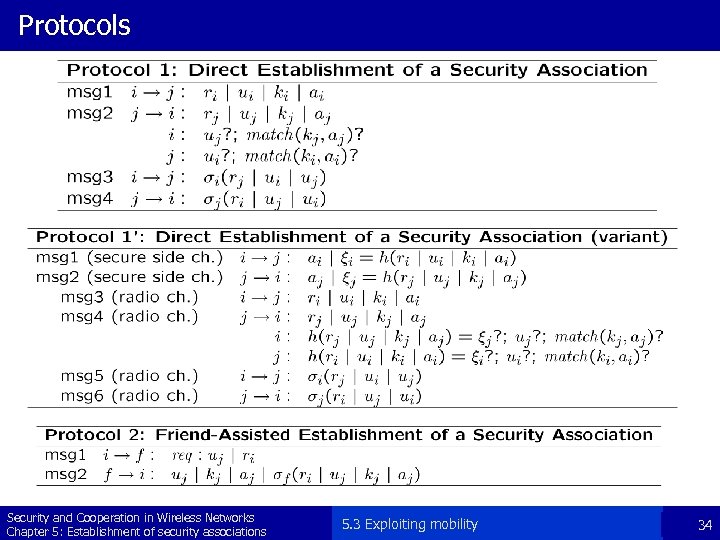 Protocols Security and Cooperation in Wireless Networks Chapter 5: Establishment of security associations 5. 3 Exploiting mobility 34
 Advantages of the mobility approach (2/2) § Fully self-organized mobile ad hoc networks – – – There are no central authorities Each user/node generates its own public/private key pairs (No) trust transitivity Intuitive for users Can be easily implemented (v. Card) Useful for setting up security associations for secure routing in smaller networks or peer-to-peer applications – Requires some time until network is fully secure – User/application oriented Security and Cooperation in Wireless Networks Chapter 5: Establishment of security associations 5. 3 Exploiting mobility 35
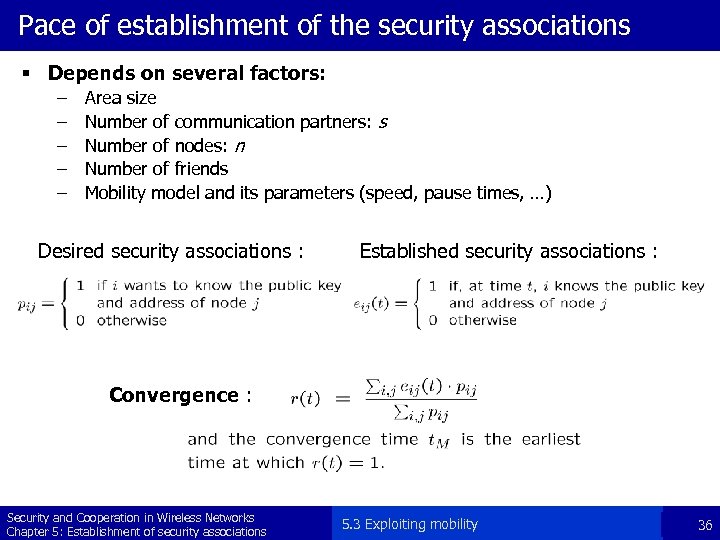 Pace of establishment of the security associations § Depends on several factors: – – – Area size Number of communication partners: s Number of nodes: n Number of friends Mobility model and its parameters (speed, pause times, …) Desired security associations : Established security associations : Convergence : Security and Cooperation in Wireless Networks Chapter 5: Establishment of security associations 5. 3 Exploiting mobility 36
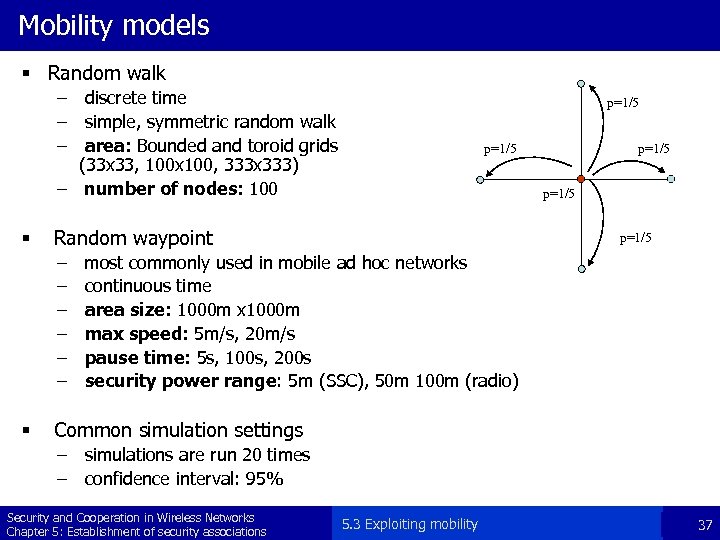 Mobility models § Random walk – discrete time – simple, symmetric random walk – area: Bounded and toroid grids (33 x 33, 100 x 100, 333 x 333) – number of nodes: 100 § p=1/5 Random waypoint – – – § p=1/5 most commonly used in mobile ad hoc networks continuous time area size: 1000 m x 1000 m max speed: 5 m/s, 20 m/s pause time: 5 s, 100 s, 200 s security power range: 5 m (SSC), 50 m 100 m (radio) Common simulation settings – simulations are run 20 times – confidence interval: 95% Security and Cooperation in Wireless Networks Chapter 5: Establishment of security associations 5. 3 Exploiting mobility 37
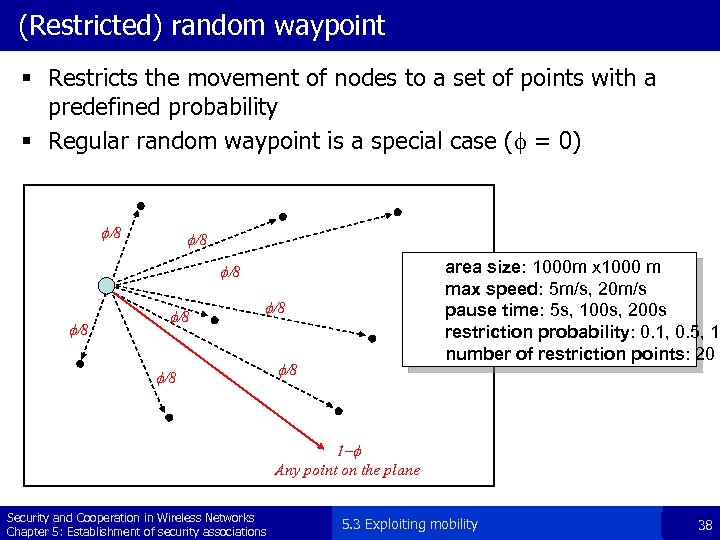 (Restricted) random waypoint § Restricts the movement of nodes to a set of points with a predefined probability § Regular random waypoint is a special case (f = 0) f/8 area size: 1000 m x 1000 m max speed: 5 m/s, 20 m/s pause time: 5 s, 100 s, 200 s restriction probability: 0. 1, 0. 5, 1 number of restriction points: 20 f/8 f/8 f/8 1 -f Any point on the plane Security and Cooperation in Wireless Networks Chapter 5: Establishment of security associations 5. 3 Exploiting mobility 38
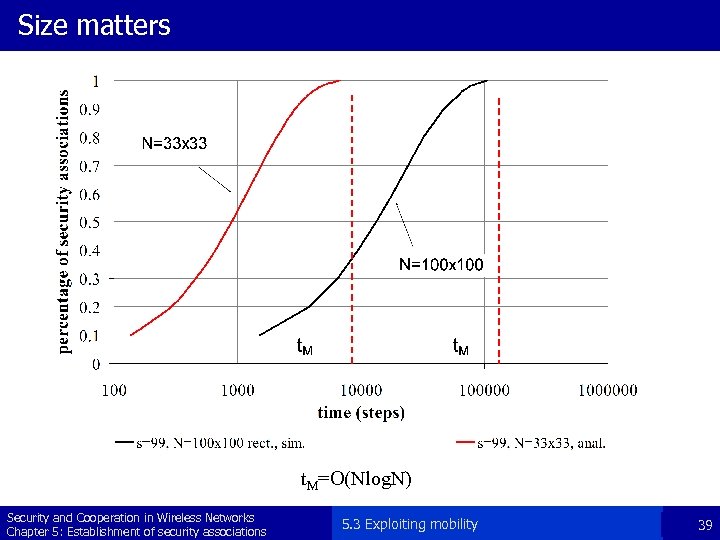 Size matters t. M=O(Nlog. N) Security and Cooperation in Wireless Networks Chapter 5: Establishment of security associations 5. 3 Exploiting mobility 39
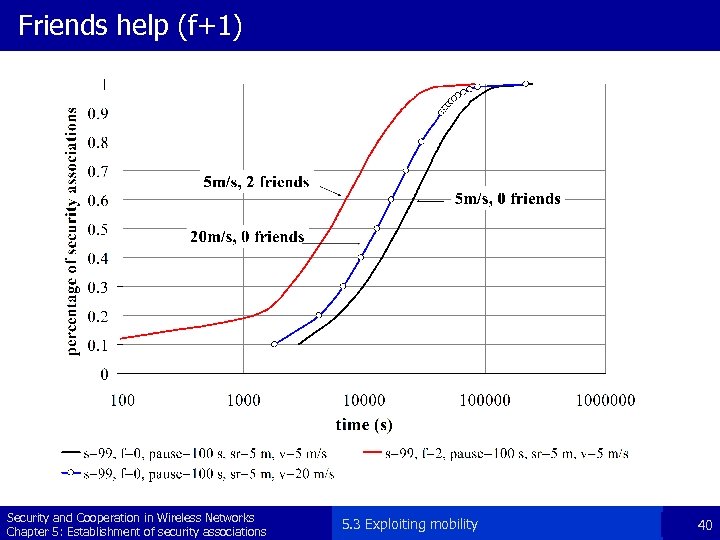 Friends help (f+1) Security and Cooperation in Wireless Networks Chapter 5: Establishment of security associations 5. 3 Exploiting mobility 40
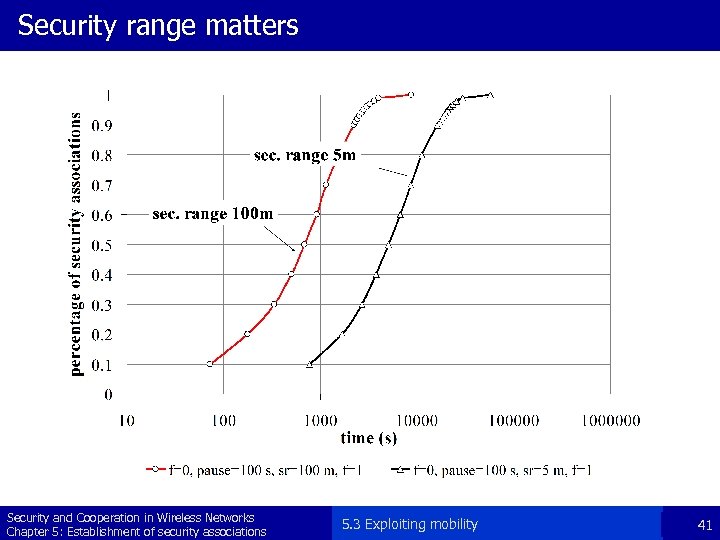 Security range matters Security and Cooperation in Wireless Networks Chapter 5: Establishment of security associations 5. 3 Exploiting mobility 41
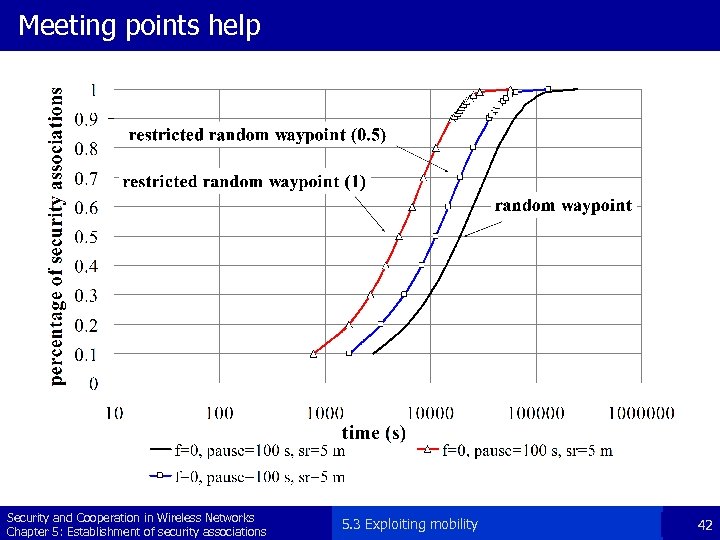 Meeting points help Security and Cooperation in Wireless Networks Chapter 5: Establishment of security associations 5. 3 Exploiting mobility 42
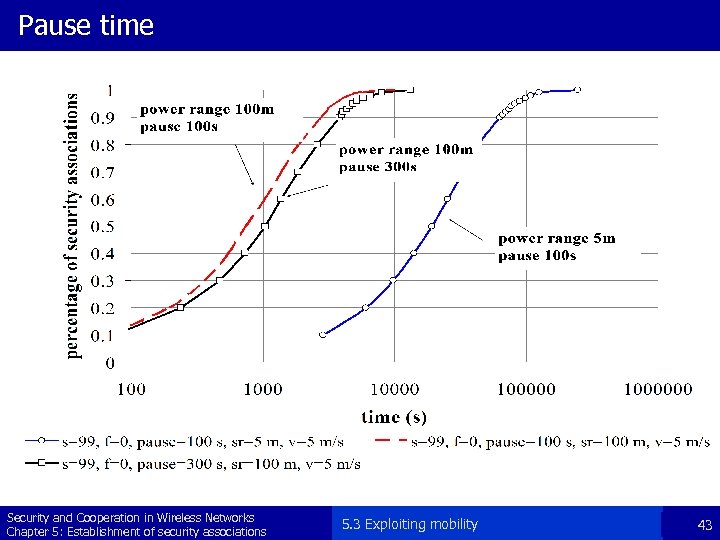 Pause time Security and Cooperation in Wireless Networks Chapter 5: Establishment of security associations 5. 3 Exploiting mobility 43
 Conclusion on Section 5. 3 § Mobility can help security in mobile ad hoc networks, from the networking layer up to the applications § Mobility “breaks” the security-routing interdependence cycle § The pace of establishment of the security associations is strongly influenced by the area size, the number of friends, and the speed of the nodes § The proposed solution also supports re-keying § The proposed solution can easily be implemented with both symmetric and asymmetric crypto Security and Cooperation in Wireless Networks Chapter 5: Establishment of security associations 5. 3 Exploiting mobility 44
 Chapter outline 5. 1 5. 2 5. 3 5. 4 5. 5 Key establishment in sensor networks Exploiting physical contact Exploiting mobility Exploiting the properties of vicinity and of the radio link Revocation Security and Cooperation in Wireless Networks Chapter 5: Establishment of security associations 45
 Exploiting vicinity § problem – how to establish a shared key between two PDAs? § assumptions – – no CA, no KDC PDAs can use short range radio communications (e. g. , Bluetooth) PDAs have a display PDAs are held by human users § idea – use the Diffie-Hellman key agreement protocol – ensure key authentication by the human users Security and Cooperation in Wireless Networks Chapter 5: Establishment of security associations 5. 4 Exploiting vicinity and properties of the radio link 46
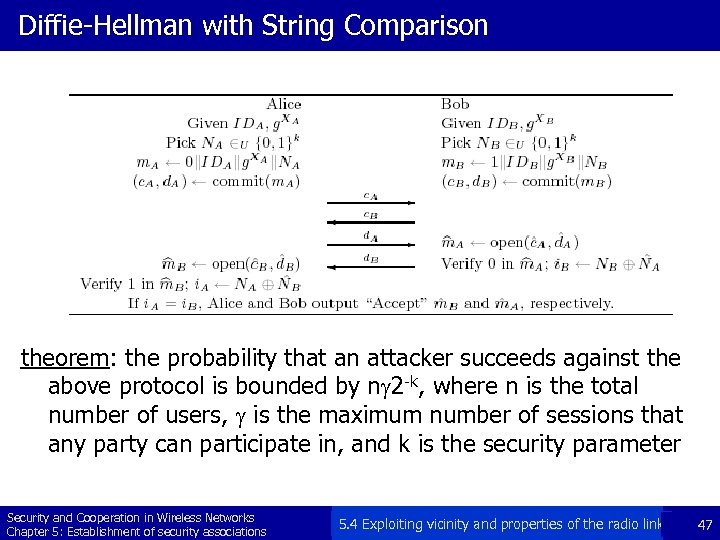 Diffie-Hellman with String Comparison theorem: the probability that an attacker succeeds against the above protocol is bounded by ng 2 -k, where n is the total number of users, g is the maximum number of sessions that any party can participate in, and k is the security parameter Security and Cooperation in Wireless Networks Chapter 5: Establishment of security associations 5. 4 Exploiting vicinity and properties of the radio link 47
 Integrity Codes § is it possible to rely on the radio channel only? § assumption – it is possible to implement a channel with the following property: • bit 0 can be turned into bit 1 • bit 1 cannot be turned into bit 0 – an example: • bit 1 = presence of random signal (~noise) • bit 0 = no signal at all § i(ntegrity)-codes – each codeword has the same number of 0 s and 1 s – such a codeword cannot be modified in an unnoticeable way – encoding messages with i-codes ensures the integrity of the communications Man-in-the-Middle is excluded Security and Cooperation in Wireless Networks Chapter 5: Establishment of security associations 5. 4 Exploiting vicinity and properties of the radio link 48
 Chapter outline 5. 1 5. 2 5. 3 5. 4 5. 5 Key establishment in sensor networks Exploiting physical contact Exploiting mobility Exploiting the properties of vicinity and of the radio link Revocation Security and Cooperation in Wireless Networks Chapter 5: Establishment of security associations 49
 Revocation § methods of revocation proposed in the IEEE P 1609. 2: – distribution of CRLs (Certificate Revocation Lists) – Using short-lived certificates § Drawbacks: – CRLs can be very long – Short lifetime creates a vulnerability window § Solution: based on – RTPD (Revocation Protocol of the Tamper-Proof Device) – RCCRL (Revocation protocol using Compressed Certificate Revocation Lists) – DRP (Distributed Revocation Protocol). Security and Cooperation in Wireless Networks Chapter 5: Establishment of security associations 5. 5 Revocation 50
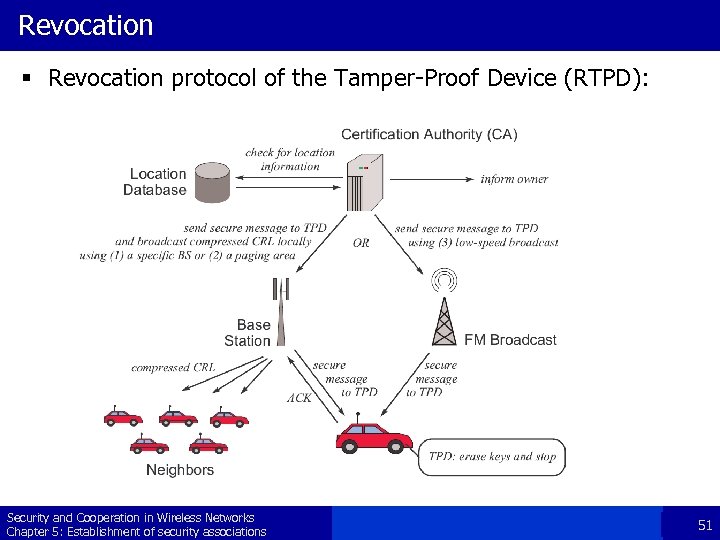 Revocation § Revocation protocol of the Tamper-Proof Device (RTPD): Security and Cooperation in Wireless Networks Chapter 5: Establishment of security associations 51
 Revocation § RCCRL: – when the CA wants to revoke only a subset of a vehicle's keys – or when the TPD of the target vehicle is unreachable § Using Bloom filters § DRP: – Is used in the pure ad hoc mode – Vehicles accumulate accusations against misbehaving vehicles, evaluate them using a reputation system – If misbehavior: report them to the CA Security and Cooperation in Wireless Networks Chapter 5: Establishment of security associations 52
 Summary § it is possible to establish pairwise shared keys in ad hoc networks without a globally trusted third party § mobility, secure side channels, and friends are helpful § in sensor networks, we need different types of keys – node keys, cluster keys, and network keys can be established relatively easily using the technique of key pre-loading and using already established link keys – link keys can be established using a short-term master key or with the technique of random key pre-distribution Security and Cooperation in Wireless Networks Chapter 5: Establishment of security associations 5. 6 Summary 53