


 Скачать презентацию Security and Authentication L Chitanana Ecommerce L Chitanana
0e7e4f24a03cb38e68b350db3bb7aebc.ppt
- Количество слайдов: 27
 Security and Authentication L. Chitanana Ecommerce L. Chitanana 1
 Objectives To introduce the basics E-Commerce security issues and web entity authentication Ecommerce L. Chitanana 2
 Outline Why is security such an issue? Physical security IT Security Basics – Firewalls Public Key Cryptography SSL – Secure Socket Layer SET – Secure Electronic Transactions Ecommerce L. Chitanana 3
 Why is Security an Issue? The Internet lets you travel outside of your network and others travel in – Those travelers are not all friendly!! Critical and private information can be snooped - sniffed Information can be deleted or destroyed The Internet provides an opportunity for anonymous and rapid theft of large quantities of money Ecommerce L. Chitanana 4
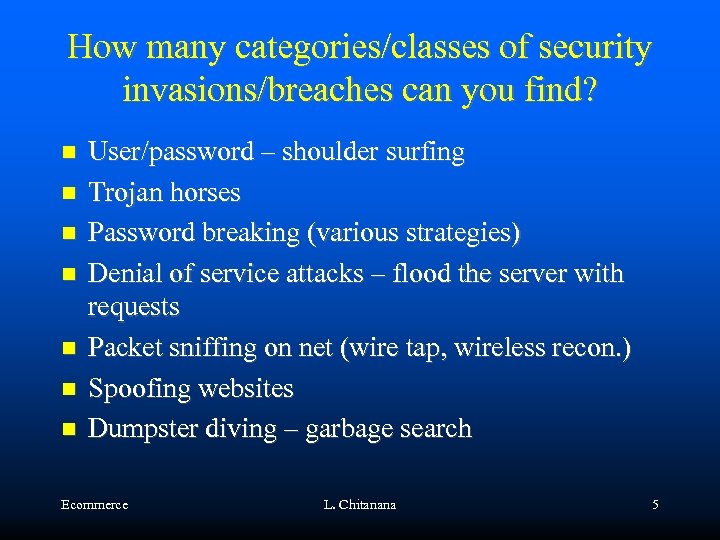 How many categories/classes of security invasions/breaches can you find? User/password – shoulder surfing Trojan horses Password breaking (various strategies) Denial of service attacks – flood the server with requests Packet sniffing on net (wire tap, wireless recon. ) Spoofing websites Dumpster diving – garbage search Ecommerce L. Chitanana 5
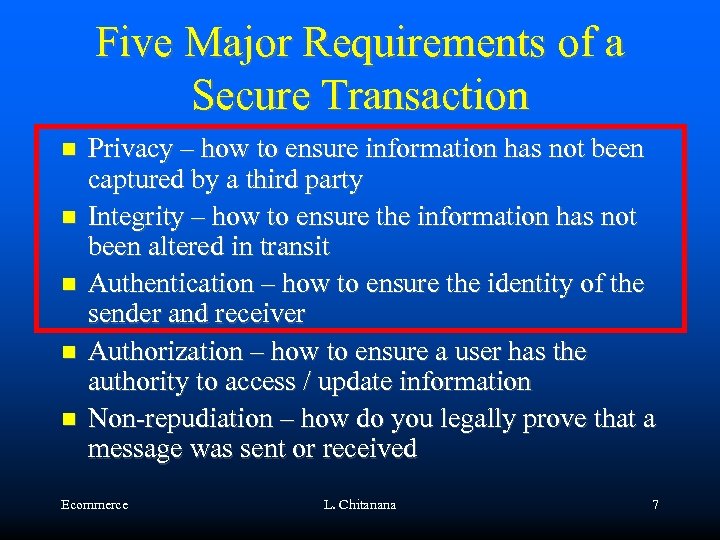 Five Major Requirements of a Secure Transaction Privacy – how to ensure information has not been captured by a third party Integrity – how to ensure the information has not been altered in transit Authentication – how to ensure the identity of the sender and receiver Authorization – how to ensure a user has the authority to access / update information Non-repudiation – how do you legally prove that a message was sent or received Ecommerce L. Chitanana 7
 Physical Security Large mainframe systems have always had adequate physical security The transition from LAN to WAN to Internet has caused new interest in these methods Physical security means locked doors and security personnel Options are to host on a secure ISP/ASP (Internet. Hosting. com) Ecommerce L. Chitanana 8
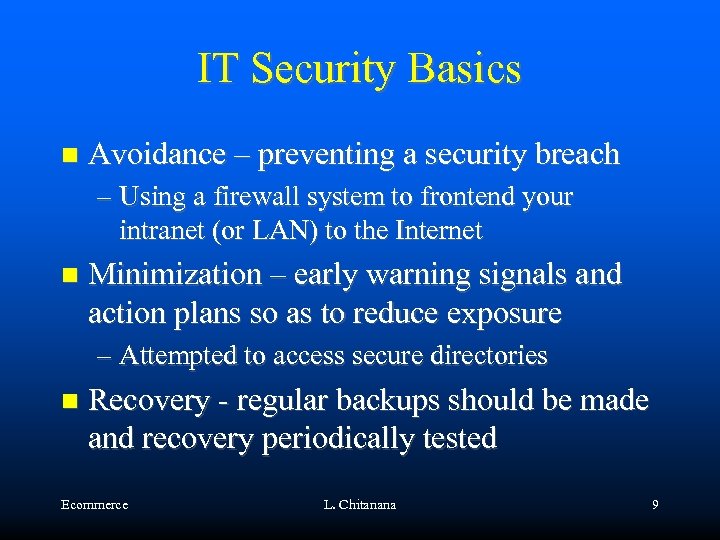 IT Security Basics Avoidance – preventing a security breach – Using a firewall system to frontend your intranet (or LAN) to the Internet Minimization – early warning signals and action plans so as to reduce exposure – Attempted to access secure directories Recovery - regular backups should be made and recovery periodically tested Ecommerce L. Chitanana 9
 Using a Firewall – A firewall server or router acts as an electronic security cop – No machine other than firewall is directly accessible from Internet – May also function as a “proxy” server allowing intranet systems to access only portions of the Internet – Internet security methods are focused at the firewall reducing cost and admin overhead Ecommerce L. Chitanana 10
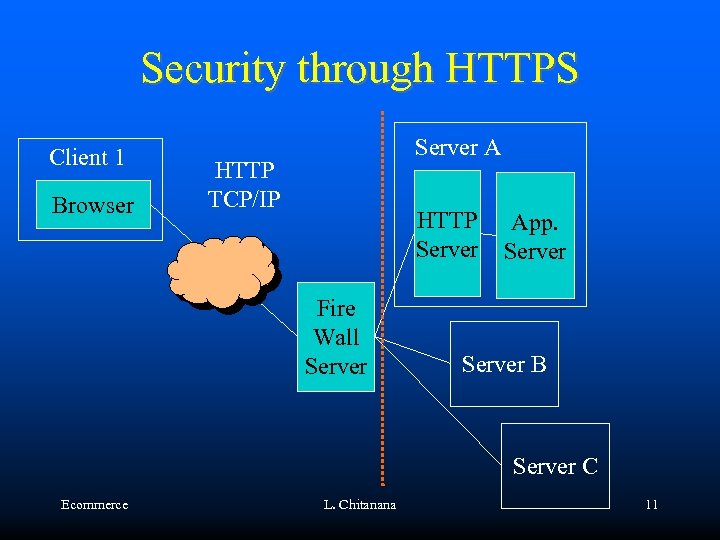 Security through HTTPS Client 1 Browser Server A HTTP TCP/IP HTTP Server Fire Wall Server App. Server B Server C Ecommerce L. Chitanana 11
 IT Security Basics Passwords (and potentially User Ids) should be forced to change periodically Passwords should be difficult to guess – Try to create passwords such as: To Be or Not To Be => 2 bon 2 b Databases should be secured in terms of access rights to data (usually by individual or group) Ecommerce L. Chitanana 12
 IT Security Basics Software, particularly low layer components such as the operating system and DBMS, should be kept to recent patch levels Access from dial-in lines should be limited and if possible call-back systems can be used Ecommerce L. Chitanana 13
 Cryptography Cryptogrpahy or ciphering is an ancient method of encoding a message - only a receiver with a key can decipher the content A single (symetric) secret key is used to encrypt and decrypt Requires the communication of the key between sender and receiver ? ? Basis of nuclear war-head CAC security Ecommerce L. Chitanana 14
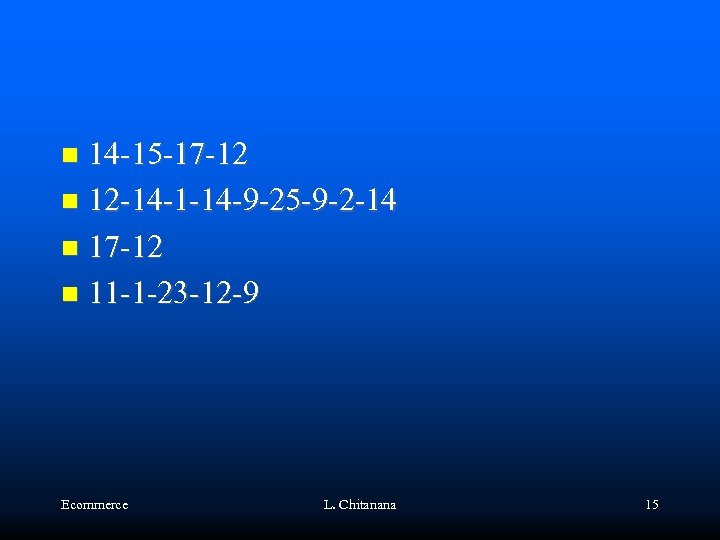 14 -15 -17 -12 12 -14 -1 -14 -9 -25 -9 -2 -14 17 -12 11 -1 -23 -12 -9 Ecommerce L. Chitanana 15
 Public Key Cryptography In 1976 Diffie and Hellman at Standford U. developed public-key cryptography Asymetric in nature: – – – Private key – kept secret by owner Public key – distributed freely to all who wish to send Generated by computer algorithm, so a mathematical relation exists between them. . . however. . . – It is computationally difficult to determine the private key from the public key, even with knowledge of the encryption algorithm Ecommerce L. Chitanana 16
 Public Key Cryptography The keys come in the form of tightly coupled pairs which anyone can generate using methods such as RSA, SHA-1, DSA (RSA is most common) – Javascript demo: http: //shop-js. sourceforge. net/crypto 2. htm There is only one public key corresponding to any one private key and vice versa Sender encodes data using public key of receiver Receiver decodes data using unique private key, no one else can do the same This ensures integrity of the data Ecommerce L. Chitanana 17
 Authentication How can you be sure that the person sending the encrypted data is who they say they are This requires some method of authenticating the identity of the sender The solution is for the sender to “sign” the data using his/her private key – the data is encrypted using the sender’s private key The receiver validates (decrypts the data) the “signature” using the sender’s public key This will work as long as receiver can be sure the sender’s public key belongs to the sender and not an imposter … enter PKI Ecommerce L. Chitanana 18
 Integrity and Authentication Example: Consider a merchant wants to send a secure message to a customer: – Merchant encrypts message using customer’s public key – Merchant then signs message by encrypting with their private key – Customer decrypts using the merchants public key to prove authenticity of sender – Customer decrypts using their private key to ensure integrity of message Ecommerce L. Chitanana 19
 PKI – Public Key Infrastructure Integrates PK cryptography with digital certificates and certificate authorities (CA) Digital certificate = issued by a CA, includes user name, public key, serial number, expiration date, signature of trusted CA (message encrypted by CA’s private key) Receipt of a valid certificate is proof of identity – can be checked at CAs sight www. verisign. com is major player Ecommerce L. Chitanana 20
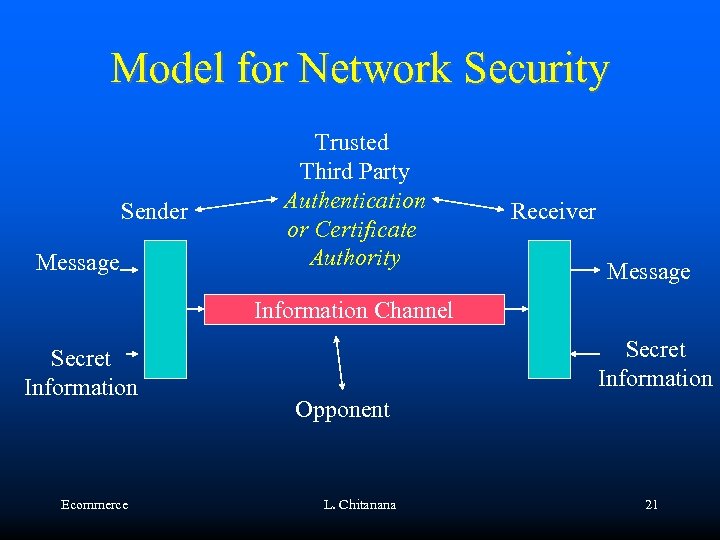 Model for Network Security Sender Message Trusted Third Party Authentication or Certificate Authority Receiver Message Information Channel Secret Information Ecommerce Secret Information Opponent L. Chitanana 21
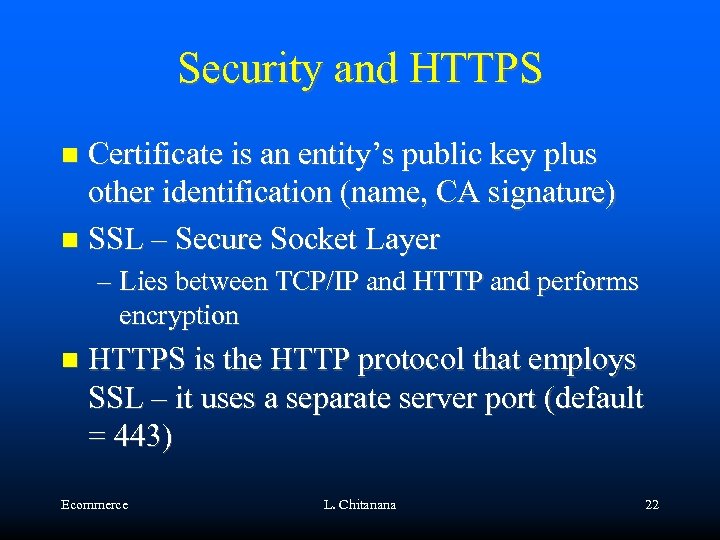 Security and HTTPS Certificate is an entity’s public key plus other identification (name, CA signature) SSL – Secure Socket Layer – Lies between TCP/IP and HTTP and performs encryption HTTPS is the HTTP protocol that employs SSL – it uses a separate server port (default = 443) Ecommerce L. Chitanana 22
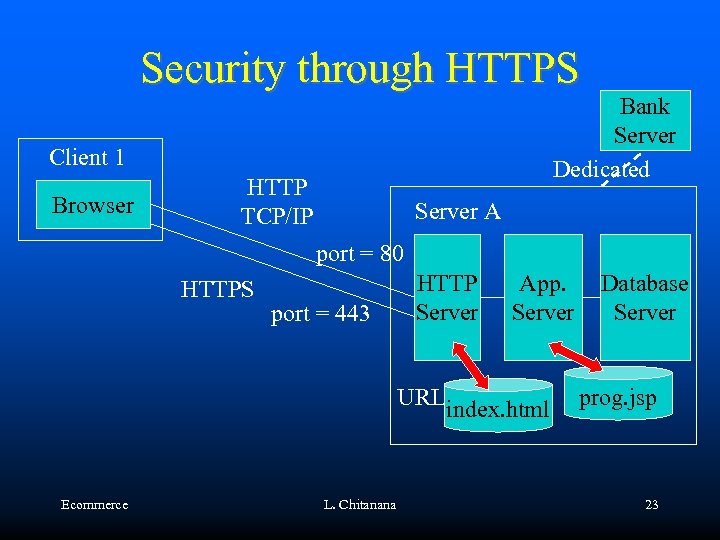 Security through HTTPS Bank Server Dedicated Client 1 Browser HTTP TCP/IP Server A port = 80 HTTPS port = 443 HTTP Server URL Ecommerce L. Chitanana App. Server index. html Database Server prog. jsp 23
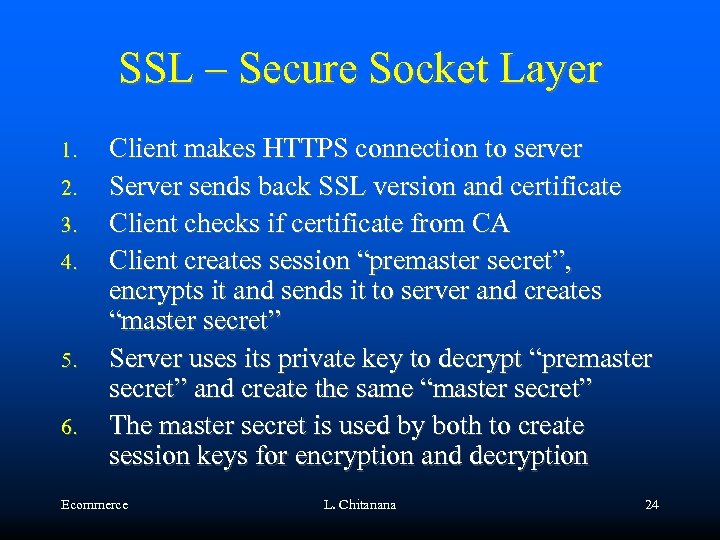 SSL – Secure Socket Layer 1. 2. 3. 4. 5. 6. Client makes HTTPS connection to server Server sends back SSL version and certificate Client checks if certificate from CA Client creates session “premaster secret”, encrypts it and sends it to server and creates “master secret” Server uses its private key to decrypt “premaster secret” and create the same “master secret” The master secret is used by both to create session keys for encryption and decryption Ecommerce L. Chitanana 24
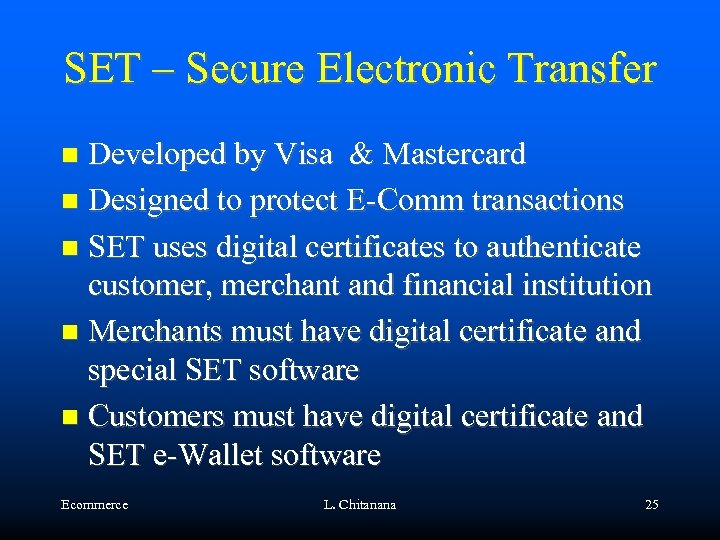 SET – Secure Electronic Transfer Developed by Visa & Mastercard Designed to protect E-Comm transactions SET uses digital certificates to authenticate customer, merchant and financial institution Merchants must have digital certificate and special SET software Customers must have digital certificate and SET e-Wallet software Ecommerce L. Chitanana 25
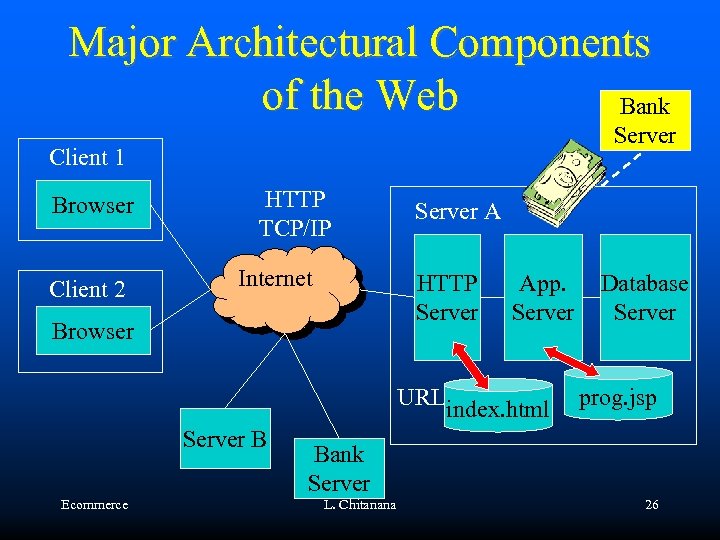 Major Architectural Components of the Web Bank Server Client 1 Browser Client 2 HTTP TCP/IP Internet Server A HTTP Server Browser URL Server B Ecommerce App. Server index. html Database Server prog. jsp Bank Server L. Chitanana 26
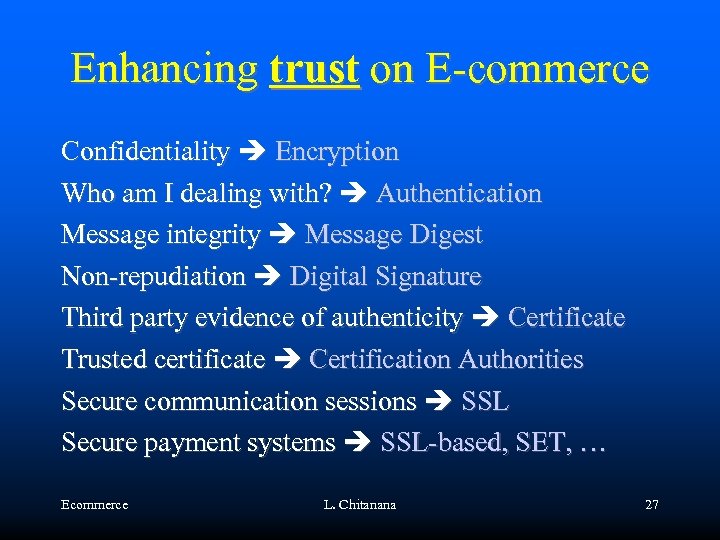 Enhancing trust on E-commerce Confidentiality Encryption Who am I dealing with? Authentication Message integrity Message Digest Non-repudiation Digital Signature Third party evidence of authenticity Certificate Trusted certificate Certification Authorities Secure communication sessions SSL Secure payment systems SSL-based, SET, … Ecommerce L. Chitanana 27
 THE END Ecommerce L. Chitanana 28