


 Скачать презентацию Securities in the Russian Federation Anna Ivanchukova The
Securities_in_the_RF_and_USA.pptx
- Количество слайдов: 15
 Securities in the Russian Federation Anna Ivanchukova, The Higher School of Economics, Faculty of Law, Master’s program the Corporate lawyer
 Regulation • The Civil Code of the RF • Federal Law No. 39 -FZ “On the Securities Market, ” dated 22 April 1996 • Federal Law No. 208 -FZ “On Joint-Stock Companies, ” dated 26 December 1995 • Law No. 395 -1 “On Banks and Banking Activity, ” dated 2 December 1990 • regulations issued by the Central Bank of the RF and the Federal Service for Financial Markets of the RF (on 1 September 2013 all the powers of the FSFM were transferred to the Central Bank of the RF)
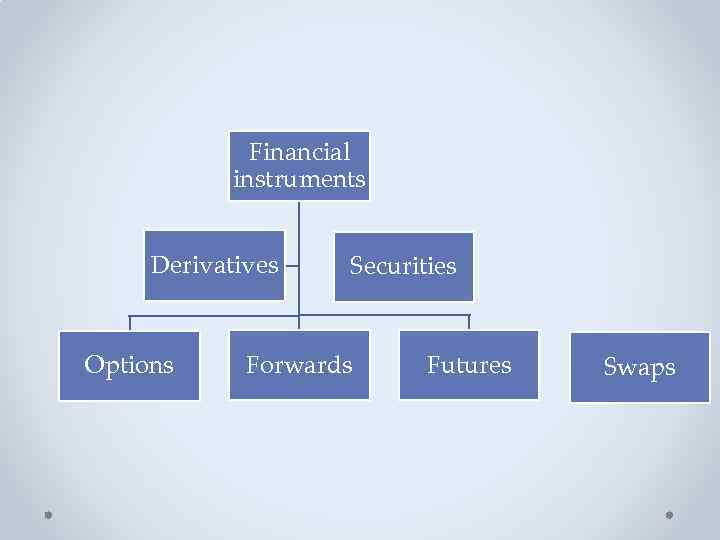 Financial instruments Derivatives Options Securities Forwards Futures Swaps
 The types of securities • Mass-issued (those which should be issued in compliance with a specific issuance procedure prescribed by the Securities Law and which require registration with the Bank of Russia ( • Non mass-issued (those which need not be registered) • In certain cases the Securities Law also requires a prospectus to be registered simultaneously with registration of the securities’ issue • Corporate and government securities • Documentary and non-documentary securities
 Item 2 of Article 142 • • share, bill of exchange, mortgage deed, an investment unit of a unit investment trust, bill of lading, bond, cheque and the other securities named as such in a law or deemed as such in the procedure established by a law.
 Equity Securities • Russian joint-stock companies (“JSCs”) may issue shares, options on shares, corporate bonds, and other securities. • JSCs may raise capital either by issuing shares to the public or by private placement. • Shares in a limited liability company are not deemed to be securities and cannot be used for raising capital from the general public.
 Bonds • Corporate and government • Secured and unsecured bonds Secured bonds must be fully or partly secured with: • a suretyship, • bank (independent) guarantee, • state or municipal guarantee, • or with a pledge (or a mortgage) over the issuer’s and/or third party’s property.
 Exchange bonds differ from ordinary bonds in that they can be issued through a simplified procedure, because the issuance, prospectus and placement report do not need to be registered. However, the following conditions apply: • (i) the placement must be made through a public offering; • (ii) exchange bonds may not be secured by pledge; • (iii) the bonds must be issued in documentary form; and • (iv) the Bank of Russia must be notified of admittance to trading and placement on the stock exchange. • Commercial bonds are also issued in documentary form through a simplified procedure. Such bonds may not be secured by pledge. However, commercial bonds can only be placed by way of private offering.
 Notes • Federal Law No. 48 -FZ “On Promissory Notes and Bills of Exchange”, dated 11 March 1997 • Uniform Law for Bills of Exchange and Promissory Notes (Geneva, 7 June 1930)
 Foreign securities in the RF • Foreign securities may be admitted for placement and/or public circulation in Russia • (i) by decision of either a Russian stock exchange (if foreign securities have been listed abroad with any of 56 stock exchanges approved by the Bank of Russia); • ii) by decision of the Bank of Russia (if foreign securities are not listed with a stock exchange recognized by the Bank of Russia and are offered to the general public for the first time). • In both instances the foreign law governing the securities to be placed/offered must not restrict placement/public circulation of such securities in Russia.
 If securities have not been listed with a stock exchange recognized by the Bank of Russia, in order to list them in Russia a foreign issuer has to comply with a number of requirements, the most important of which are: • registration of a Russian prospectus with the Bank of Russia; • obtaining permission of the Bank of Russia for placement of • foreign securities; and • assignment of ISIN/CFI codes.
 Russian Depositary Receipts (RDRs) • An RDR is a documented registered security without a nominal value stored centrally by the issuer (i. e. Russian depositary), which certifies both the right to a specified amount of shares or bonds of a foreign issuer and the provision of services in connection with the realization of rights by a Russian holder of an RDR. • The first RDRs, which started trading on December 24, 2010 and listed on the MICEX SE (RUALR) trading platform and RTS (RUAL trading code) on December 16, 2010, are RDRs for common shares traded on the Hong Kong Stock Exchange The incorporated company "Rusal", which is registered on the island of Jersey (jurisdiction of Great Britain).
 The financial instruments in the USA • The Securities Act of 1933 • The Securities Exchange Act of 1934 • US Sarbanes-Oxley Act 2002 • Uniform Commercial Code • Revised Model Business Corporation Act • Blue sky laws – laws of States • Acts of United States Securities and Exchange Commission (SEC)
 Financial instruments Uncertificated securities (investment securities) • equity securities (stocks) • debt securities • options • negotiable instruments • document of Title • quasi-negotiable • convertible bonds Share certificate • seminegotiable instruments
 Registry of the rights to the stocks Minor Investors Major institutional Investors (Insurance companies, pension and investment funds and banks) • Depositaries (a little) Legal, or nominal owner, record owner: • Clearing corporations • Brokerage company • Depository Trust Company, DTC (a subsidiary of the New York Stock Exchange) • Trustee Nominee of DTC - Cede and Company (Cede & Co. ) – in fact possess of over 70% of all shares traded on the US stock market Shares are able to be traded if form of bearer papers • Beneficial owner – shareholder “Floating supply” – Who are beneficial owners? ? ?