


 Скачать презентацию Securities Analysis Section II Security Valuation EIC
8b1e18d5eb953697292391c5deb26fad.ppt
- Количество слайдов: 90
 Securities Analysis, Section II Security Valuation & EIC Analysis (Part 1) Copyright © 2000 by Harcourt, Inc. All rights reserved
 Lecture Presentation Software to accompany Investment Analysis and Portfolio Management Seventh Edition by Frank K. Reilly & Keith C. Brown Chapters 11, 14, 15, & 18 Copyright © 2000 by Harcourt, Inc. All rights reserved
 The Investment Decision Process • Determine the required rate of return • Evaluate the investment to determine if its market price is consistent with your required rate of return – Estimate the value of the security based on its expected cash flows and your required rate of return – Compare this intrinsic value to the market price to decide if you want to buy it • But how do you narrow down the list of potential investments to a reasonable level? Copyright © 2000 by Harcourt, Inc. All rights reserved
 Valuation Process • Two general approaches: 1. Top-down, three-step approach 2. Bottom-up, stock valuation, stock picking (stock screening) approach • The difference between the two approaches is the perceived importance of economic and industry influence on individual firms and stocks Copyright © 2000 by Harcourt, Inc. All rights reserved
 Top-Down, Three-Step Approach 1. General economic influences – Decide how to allocate investment funds among countries, and within countries to bonds, stocks, and cash 2. Industry influences – Determine which industries will prosper and which industries will suffer on a global basis and within countries 3. Company analysis – Determine which companies in the selected industries will prosper and which stocks are undervalued Copyright © 2000 by Harcourt, Inc. All rights reserved
 Does the Three-Step Process Work? • Studies indicate that most changes in an individual firm’s earnings can be attributed to changes in aggregate corporate earnings and changes in the firm’s industry • If you are trying to stay ahead of the market quarter by quarter, then this is your best bet Copyright © 2000 by Harcourt, Inc. All rights reserved
 Does the Three-Step Process Work? • Studies have found a relationship between aggregate stock prices and various economic series such as employment, income, or production • An analysis of the relationship between rates of return for the aggregate stock market, alternative industries, and individual stocks showed that most of the changes in rates of return for individual stock could be explained by changes in the rates of return for the aggregate stock market and the stock’s industry Copyright © 2000 by Harcourt, Inc. All rights reserved
 Theory of Valuation • The value of an asset is the present value of its expected returns • You expect an asset to provide a stream of returns while you own it • To convert this stream of returns to a value for the security, you must discount this stream at your required rate of return • This requires estimates of: – The stream of expected returns, and – The required rate of return on the investment Copyright © 2000 by Harcourt, Inc. All rights reserved
 Stream of Expected Returns • First item to estimate • Two considerations: • Form of returns – – – Earnings Cash flows Dividends Interest payments Capital gains (increases in value) • Time pattern and growth rate of returns Copyright © 2000 by Harcourt, Inc. All rights reserved
 Required Rate of Return • Second item to estimate • Determined by – 1. Economy’s risk-free real rate of return, plus – 2. Expected rate of inflation during the holding period, plus – 3. Risk premium determined by the uncertainty of returns Copyright © 2000 by Harcourt, Inc. All rights reserved
 Uncertainty of Returns There are many different sources of uncertainty: • Internal characteristics of assets – – – Business risk (BR) Financial risk (FR) Liquidity risk (LR) Exchange rate risk (ERR) Country risk (CR) • Market determined factors – Systematic risk (beta) or – Multiple APT factors Copyright © 2000 by Harcourt, Inc. All rights reserved
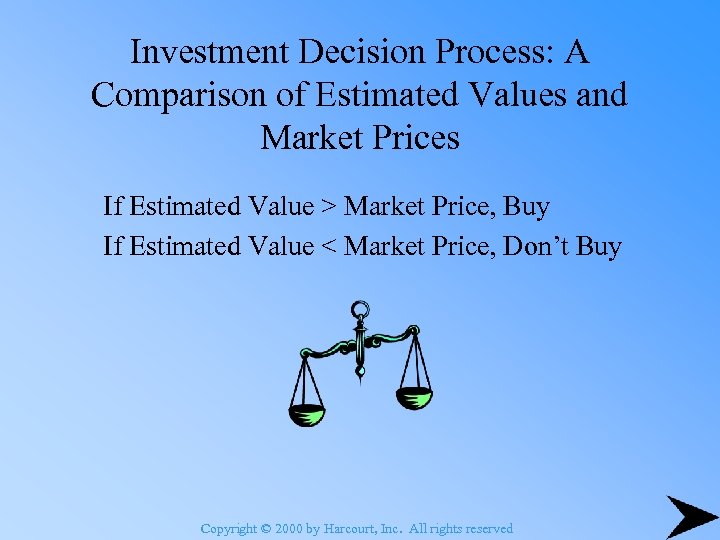 Investment Decision Process: A Comparison of Estimated Values and Market Prices If Estimated Value > Market Price, Buy If Estimated Value < Market Price, Don’t Buy Copyright © 2000 by Harcourt, Inc. All rights reserved
 Top-Down Approach, Step One Two Components: • Geographic (International) Allocation – Which region / country? • Asset Allocation – Bonds? – Preferred Stocks? – Common Stocks? Copyright © 2000 by Harcourt, Inc. All rights reserved
 Valuation of Bonds • Valuation of Bonds is relatively easy because the size and time pattern of cash flows from the bond over its life are known 1. Interest payments usually every six months (semiannually) equal to one-half the coupon rate times the face value of the bond 2. Payment of principal on the bond’s maturity date Copyright © 2000 by Harcourt, Inc. All rights reserved
 Valuation of Bonds • Example: in 2000, a $10, 000 bond due in 2015 with 10% coupon • Discount these payments at the investor’s required rate of return (if the risk-free rate is 9% and the investor requires a risk premium of 1%, then the required rate of return would be 10%) Copyright © 2000 by Harcourt, Inc. All rights reserved
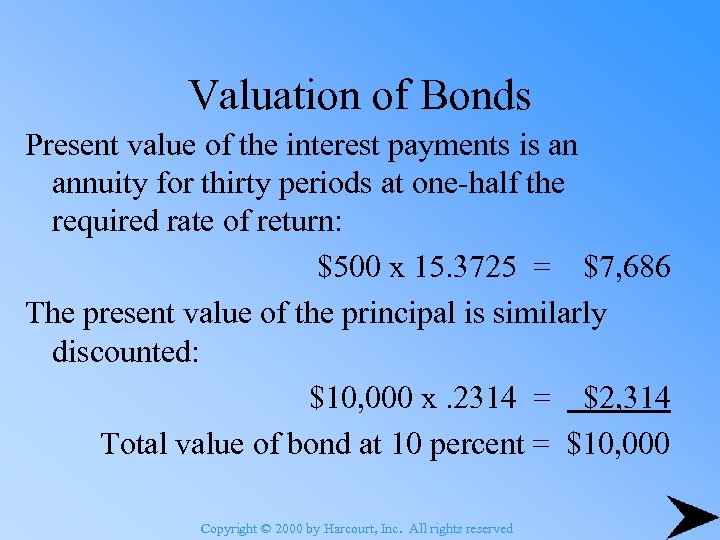 Valuation of Bonds Present value of the interest payments is an annuity for thirty periods at one-half the required rate of return: $500 x 15. 3725 = $7, 686 The present value of the principal is similarly discounted: $10, 000 x. 2314 = $2, 314 Total value of bond at 10 percent = $10, 000 Copyright © 2000 by Harcourt, Inc. All rights reserved
 Valuation of Bonds The $10, 000 valuation is the amount that an investor should be willing to pay for this bond, assuming that the required rate of return on a bond of this risk class is 10 percent Copyright © 2000 by Harcourt, Inc. All rights reserved
 Valuation of Bonds • • • If the market price of the bond is above this value, the investor should not buy it because the promised yield to maturity will be less than the investor’s required rate of return But typically there is little mispricing in bonds “Home Run” in bond investing is: 1. Investing in bond just before unanticipated upgrade 2. Lengthening duration just before interest rate decrease Copyright © 2000 by Harcourt, Inc. All rights reserved
 Valuation of Bonds Alternatively, assuming an investor requires a 12 percent return on this bond, its value would be: $500 x 13. 7648 = $6, 882 $10, 000 x. 1741 = 1, 741 Total value of bond at 12 percent = $8, 623 Higher rates of return lower the value! (and vice versa) Compare the computed value to the market price of the bond to determine whether you should buy it. Copyright © 2000 by Harcourt, Inc. All rights reserved
 What Determines the Price Volatility for Bonds • • The maturity effect The coupon effect The yield level effect Some trading strategies Copyright © 2000 by Harcourt, Inc. All rights reserved
 The Duration Measure • Since price volatility of a bond varies inversely with its coupon and directly with its term to maturity, it is necessary to determine the best combination of these two variables to achieve your objective • A composite measure considering both coupon and maturity would be beneficial Copyright © 2000 by Harcourt, Inc. All rights reserved
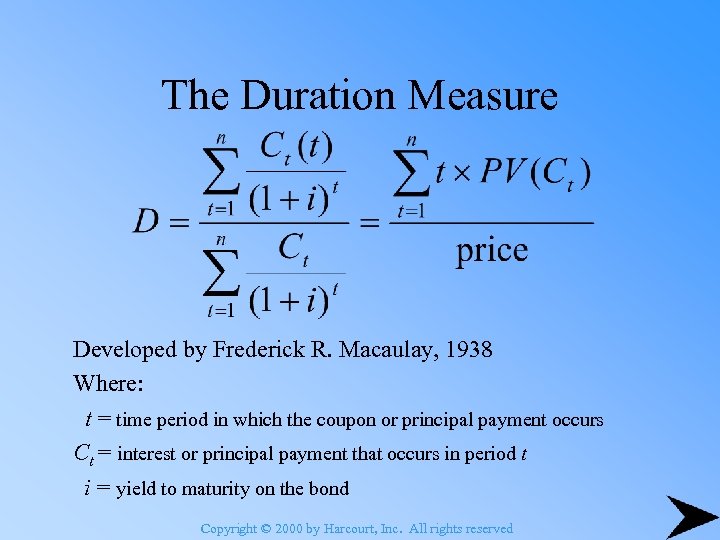 The Duration Measure Developed by Frederick R. Macaulay, 1938 Where: t = time period in which the coupon or principal payment occurs Ct = interest or principal payment that occurs in period t i = yield to maturity on the bond Copyright © 2000 by Harcourt, Inc. All rights reserved
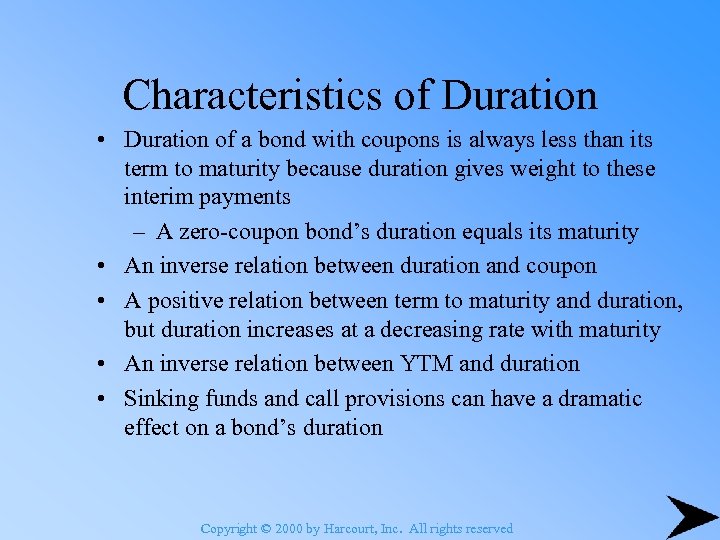 Characteristics of Duration • Duration of a bond with coupons is always less than its term to maturity because duration gives weight to these interim payments – A zero-coupon bond’s duration equals its maturity • An inverse relation between duration and coupon • A positive relation between term to maturity and duration, but duration increases at a decreasing rate with maturity • An inverse relation between YTM and duration • Sinking funds and call provisions can have a dramatic effect on a bond’s duration Copyright © 2000 by Harcourt, Inc. All rights reserved
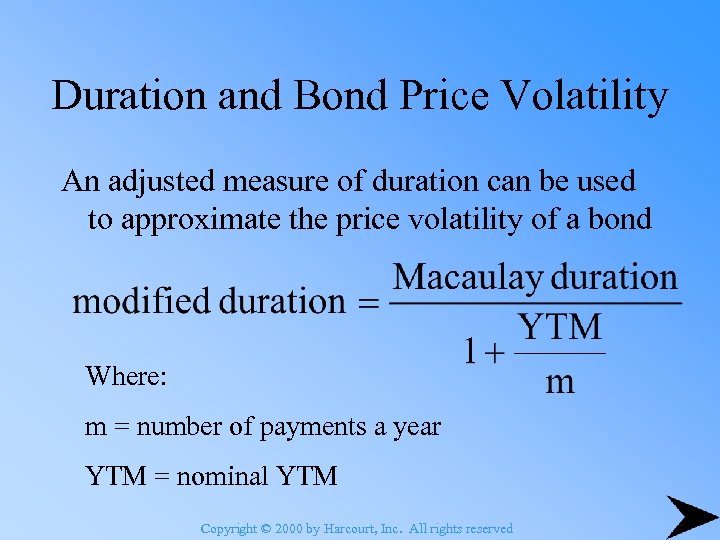 Duration and Bond Price Volatility An adjusted measure of duration can be used to approximate the price volatility of a bond Where: m = number of payments a year YTM = nominal YTM Copyright © 2000 by Harcourt, Inc. All rights reserved
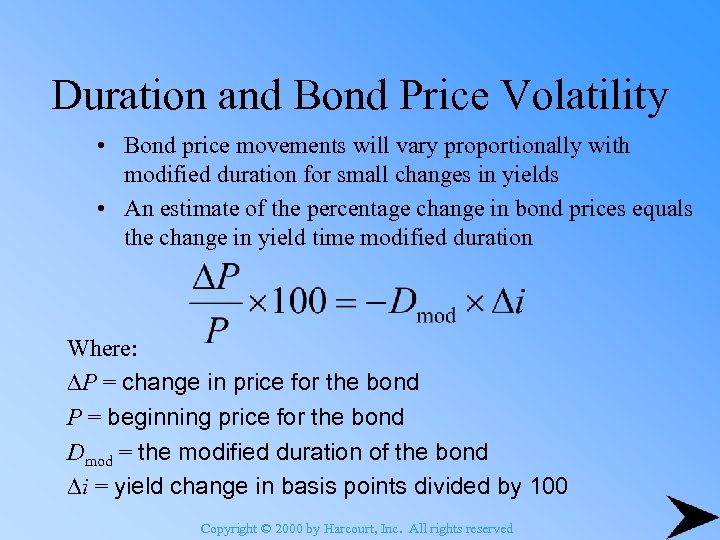 Duration and Bond Price Volatility • Bond price movements will vary proportionally with modified duration for small changes in yields • An estimate of the percentage change in bond prices equals the change in yield time modified duration Where: P = change in price for the bond P = beginning price for the bond Dmod = the modified duration of the bond i = yield change in basis points divided by 100 Copyright © 2000 by Harcourt, Inc. All rights reserved
 Trading Strategies Using Duration • Longest-duration security provides the maximum price variation • If you expect a decline in interest rates, increase the average duration of your bond portfolio to experience maximum price volatility • If you expect an increase in interest rates, reduce the average duration to minimize your price decline • Note that the duration of your portfolio is the market-valueweighted average of the duration of the individual bonds in the portfolio Copyright © 2000 by Harcourt, Inc. All rights reserved
 Valuation of Preferred Stock • Owner of preferred stock receives a promise to pay a stated dividend, usually quarterly, for perpetuity • Since payments are only made after the firm meets its bond interest payments, there is more uncertainty of returns • Tax treatment of dividends paid to corporations (80% tax-exempt) offsets the risk premium Copyright © 2000 by Harcourt, Inc. All rights reserved
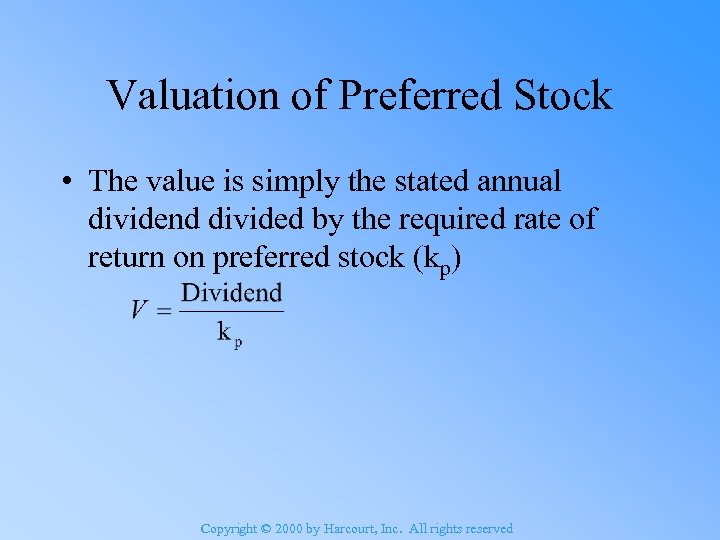 Valuation of Preferred Stock • The value is simply the stated annual dividend divided by the required rate of return on preferred stock (kp) Copyright © 2000 by Harcourt, Inc. All rights reserved
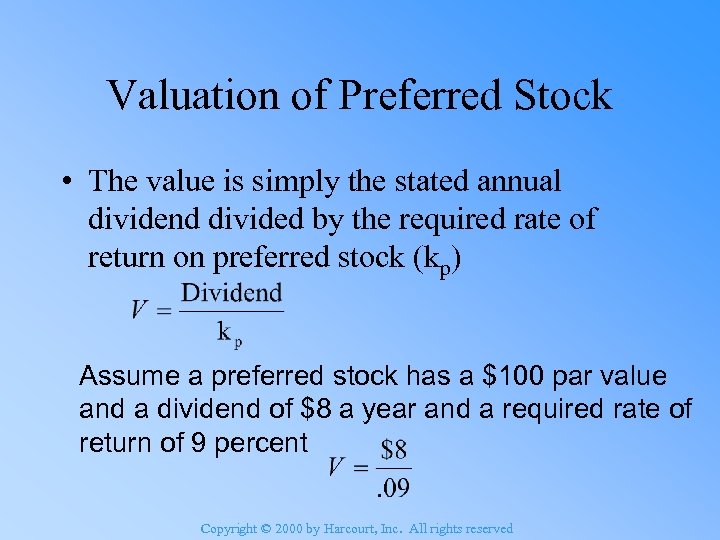
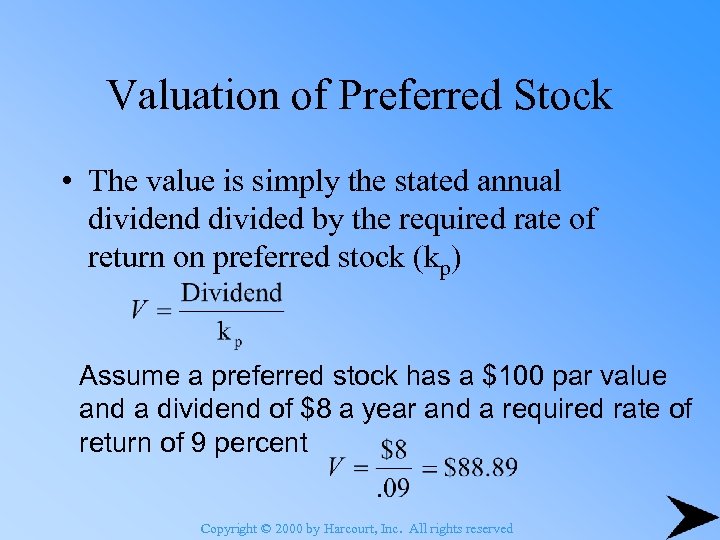
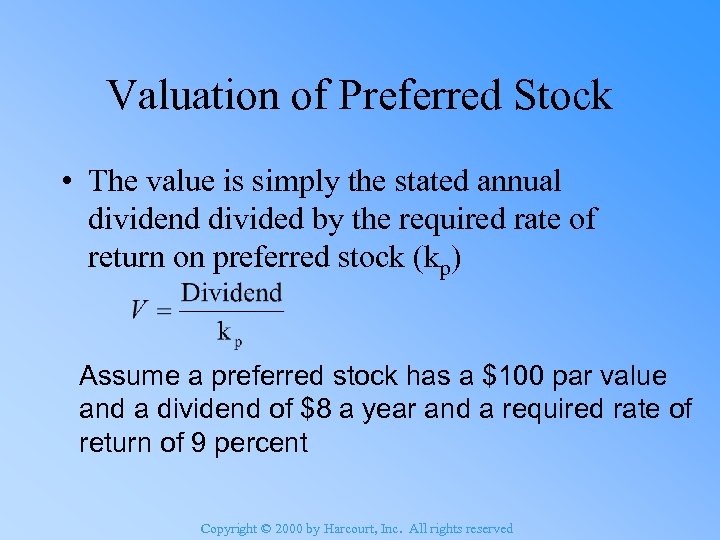 Valuation of Preferred Stock • The value is simply the stated annual dividend divided by the required rate of return on preferred stock (kp) Assume a preferred stock has a $100 par value and a dividend of $8 a year and a required rate of return of 9 percent Copyright © 2000 by Harcourt, Inc. All rights reserved
 Valuation of Preferred Stock • The value is simply the stated annual dividend divided by the required rate of return on preferred stock (kp) Assume a preferred stock has a $100 par value and a dividend of $8 a year and a required rate of return of 9 percent Copyright © 2000 by Harcourt, Inc. All rights reserved
 Valuation of Preferred Stock • The value is simply the stated annual dividend divided by the required rate of return on preferred stock (kp) Assume a preferred stock has a $100 par value and a dividend of $8 a year and a required rate of return of 9 percent Copyright © 2000 by Harcourt, Inc. All rights reserved
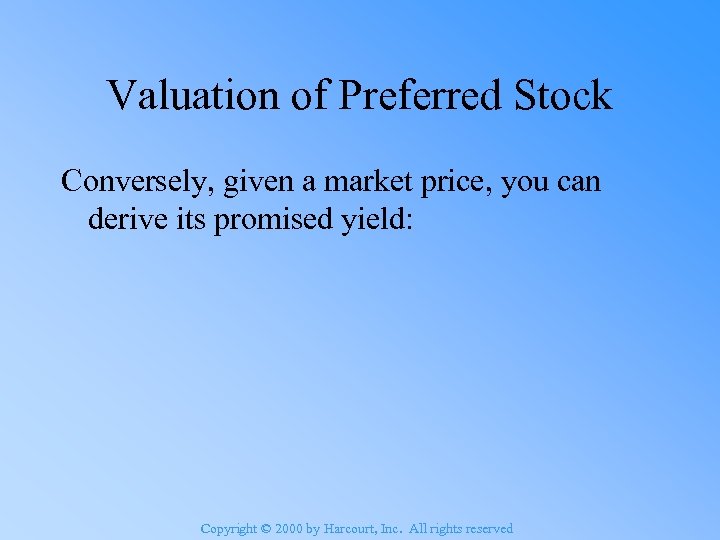 Valuation of Preferred Stock Conversely, given a market price, you can derive its promised yield: Copyright © 2000 by Harcourt, Inc. All rights reserved
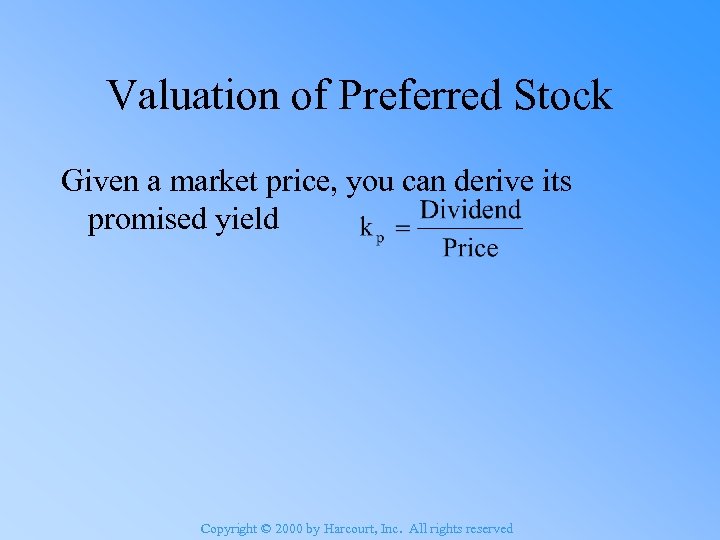 Valuation of Preferred Stock Given a market price, you can derive its promised yield Copyright © 2000 by Harcourt, Inc. All rights reserved
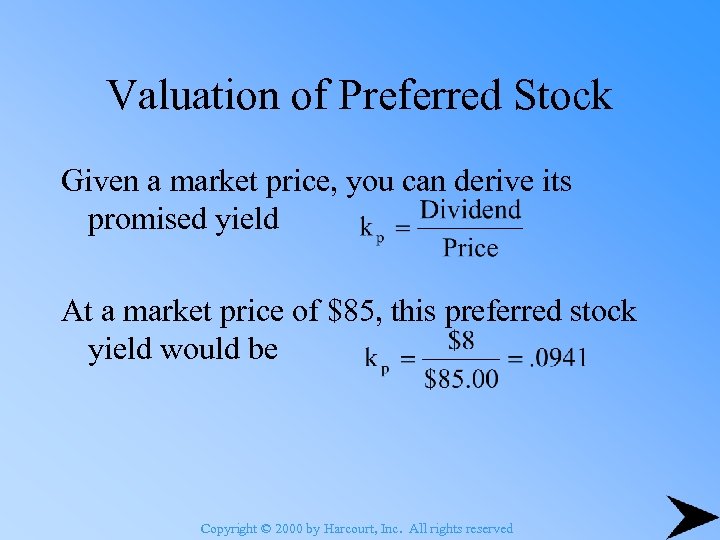 Valuation of Preferred Stock Given a market price, you can derive its promised yield At a market price of $85, this preferred stock yield would be Copyright © 2000 by Harcourt, Inc. All rights reserved
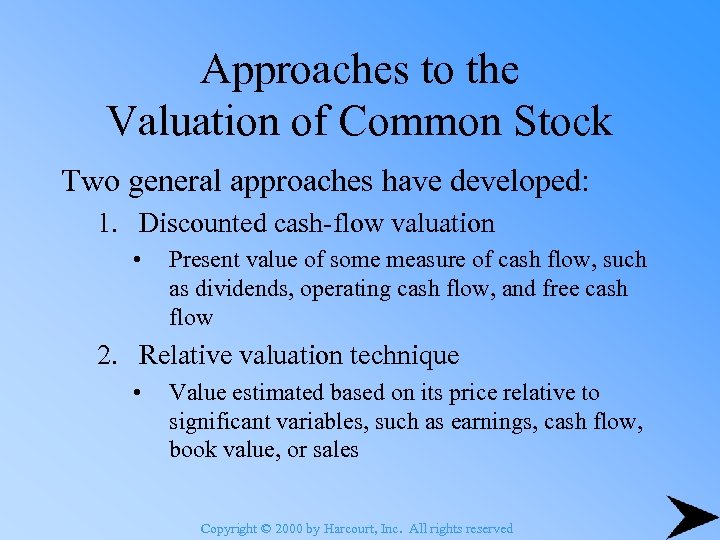 Approaches to the Valuation of Common Stock Two general approaches have developed: 1. Discounted cash-flow valuation • Present value of some measure of cash flow, such as dividends, operating cash flow, and free cash flow 2. Relative valuation technique • Value estimated based on its price relative to significant variables, such as earnings, cash flow, book value, or sales Copyright © 2000 by Harcourt, Inc. All rights reserved
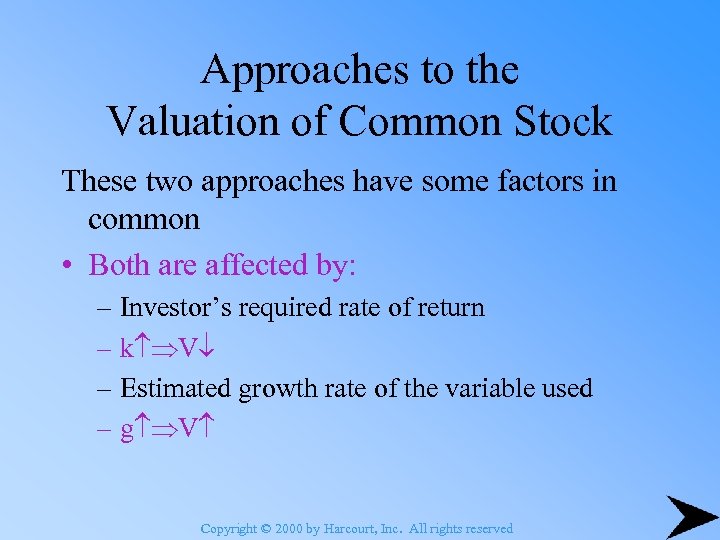 Approaches to the Valuation of Common Stock These two approaches have some factors in common • Both are affected by: – Investor’s required rate of return – k V – Estimated growth rate of the variable used – g V Copyright © 2000 by Harcourt, Inc. All rights reserved
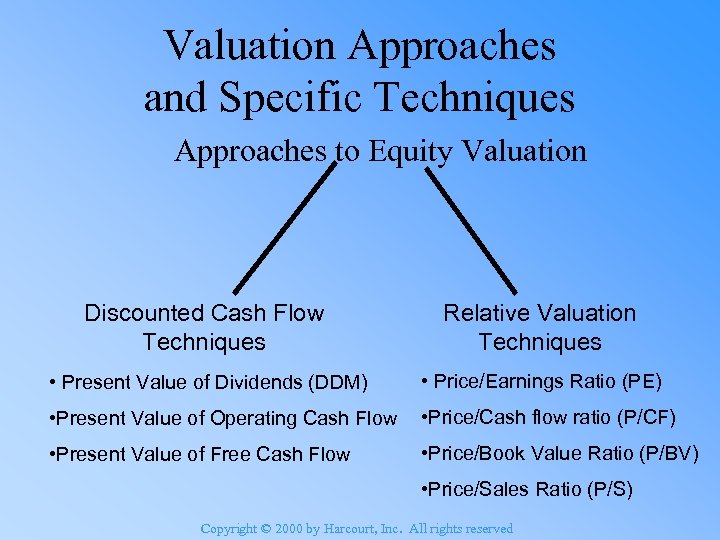 Valuation Approaches and Specific Techniques Approaches to Equity Valuation Discounted Cash Flow Techniques Relative Valuation Techniques • Present Value of Dividends (DDM) • Price/Earnings Ratio (PE) • Present Value of Operating Cash Flow • Price/Cash flow ratio (P/CF) • Present Value of Free Cash Flow • Price/Book Value Ratio (P/BV) • Price/Sales Ratio (P/S) Copyright © 2000 by Harcourt, Inc. All rights reserved
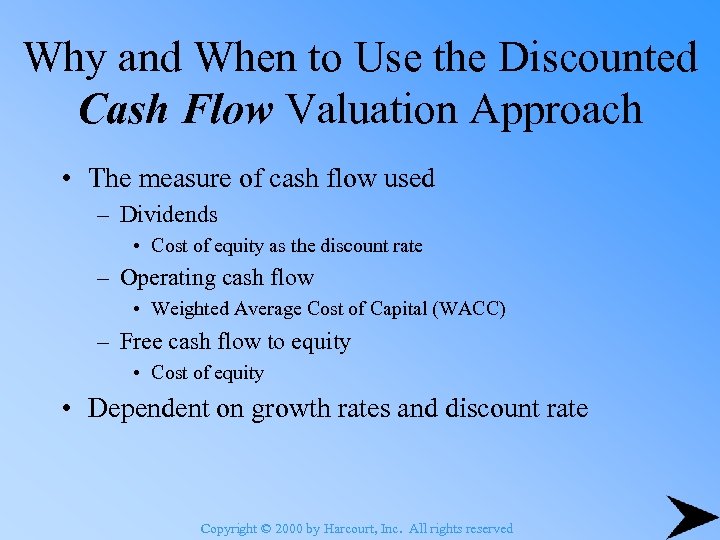 Why and When to Use the Discounted Cash Flow Valuation Approach • The measure of cash flow used – Dividends • Cost of equity as the discount rate – Operating cash flow • Weighted Average Cost of Capital (WACC) – Free cash flow to equity • Cost of equity • Dependent on growth rates and discount rate Copyright © 2000 by Harcourt, Inc. All rights reserved
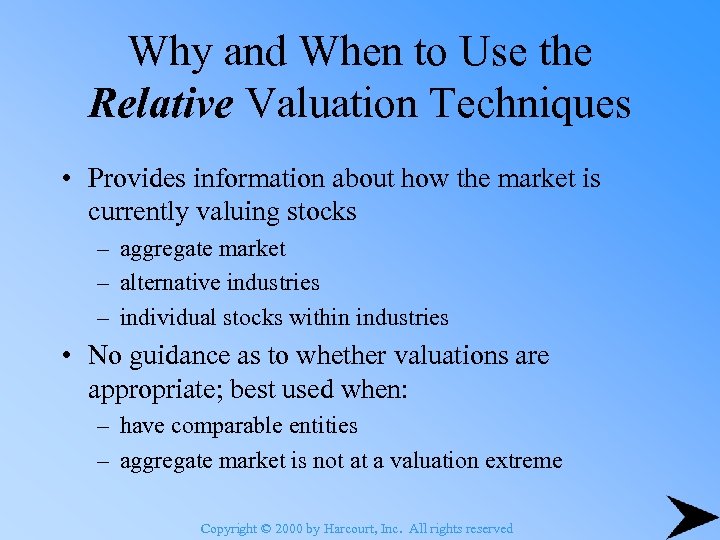 Why and When to Use the Relative Valuation Techniques • Provides information about how the market is currently valuing stocks – aggregate market – alternative industries – individual stocks within industries • No guidance as to whether valuations are appropriate; best used when: – have comparable entities – aggregate market is not at a valuation extreme Copyright © 2000 by Harcourt, Inc. All rights reserved
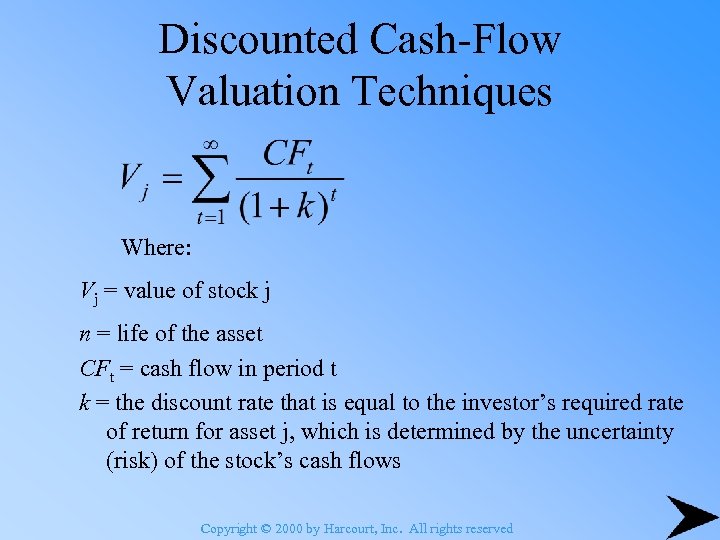 Discounted Cash-Flow Valuation Techniques Where: Vj = value of stock j n = life of the asset CFt = cash flow in period t k = the discount rate that is equal to the investor’s required rate of return for asset j, which is determined by the uncertainty (risk) of the stock’s cash flows Copyright © 2000 by Harcourt, Inc. All rights reserved
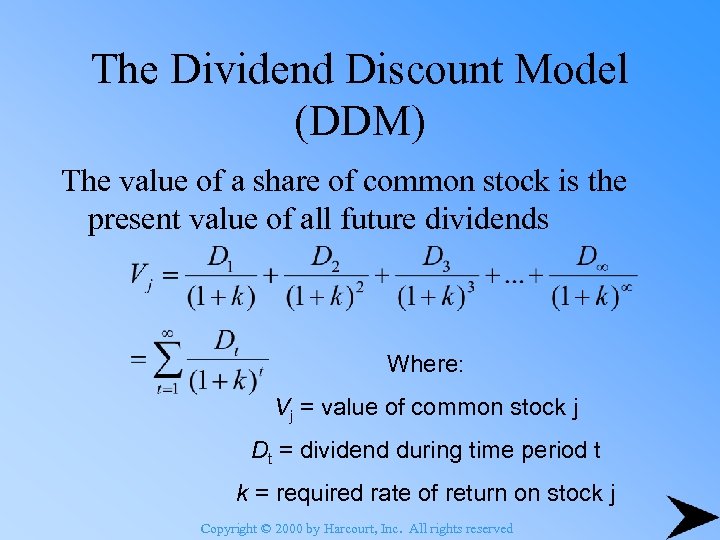 The Dividend Discount Model (DDM) The value of a share of common stock is the present value of all future dividends Where: Vj = value of common stock j Dt = dividend during time period t k = required rate of return on stock j Copyright © 2000 by Harcourt, Inc. All rights reserved
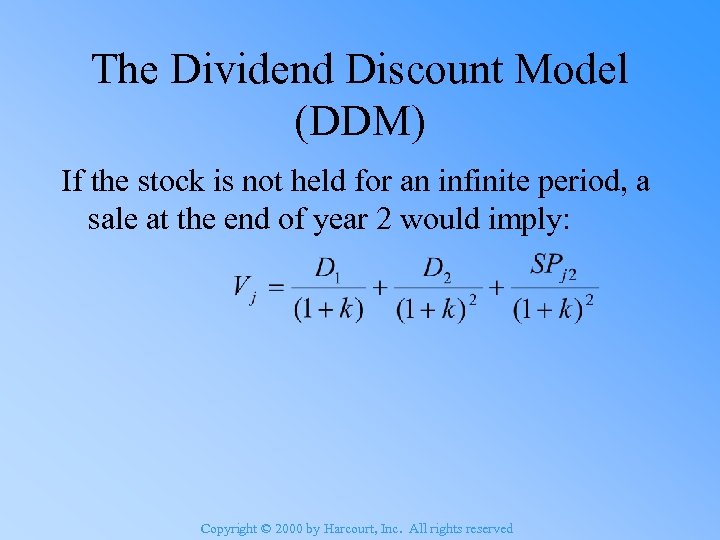 The Dividend Discount Model (DDM) If the stock is not held for an infinite period, a sale at the end of year 2 would imply: Copyright © 2000 by Harcourt, Inc. All rights reserved
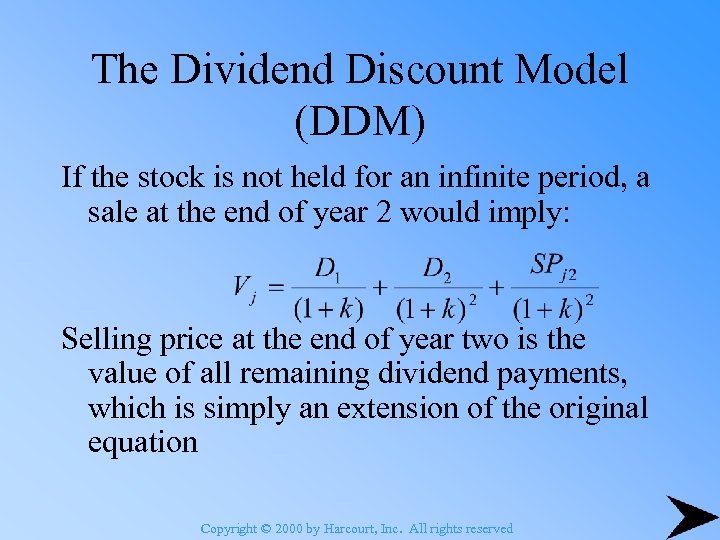 The Dividend Discount Model (DDM) If the stock is not held for an infinite period, a sale at the end of year 2 would imply: Selling price at the end of year two is the value of all remaining dividend payments, which is simply an extension of the original equation Copyright © 2000 by Harcourt, Inc. All rights reserved
 The Dividend Discount Model (DDM) Stocks with no dividends are expected to start paying dividends at some point else they would not have any value! Copyright © 2000 by Harcourt, Inc. All rights reserved
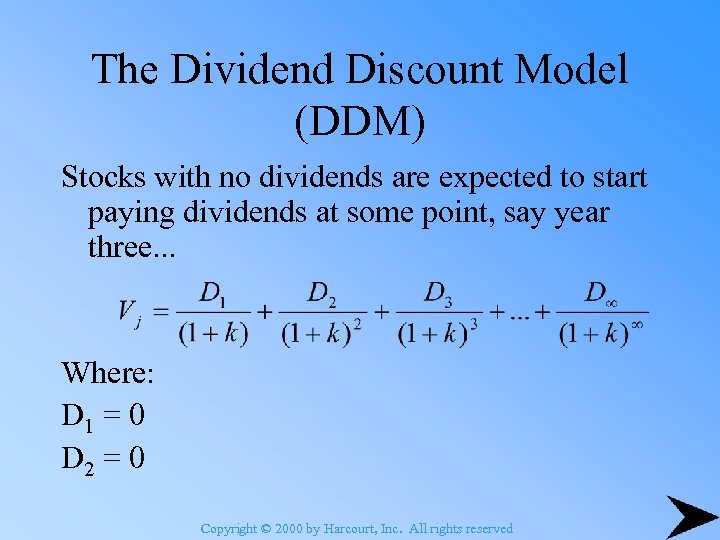 The Dividend Discount Model (DDM) Stocks with no dividends are expected to start paying dividends at some point, say year three. . . Where: D 1 = 0 D 2 = 0 Copyright © 2000 by Harcourt, Inc. All rights reserved
 The Dividend Discount Model (DDM) Infinite period model assumes a constant growth rate for estimating future dividends Copyright © 2000 by Harcourt, Inc. All rights reserved
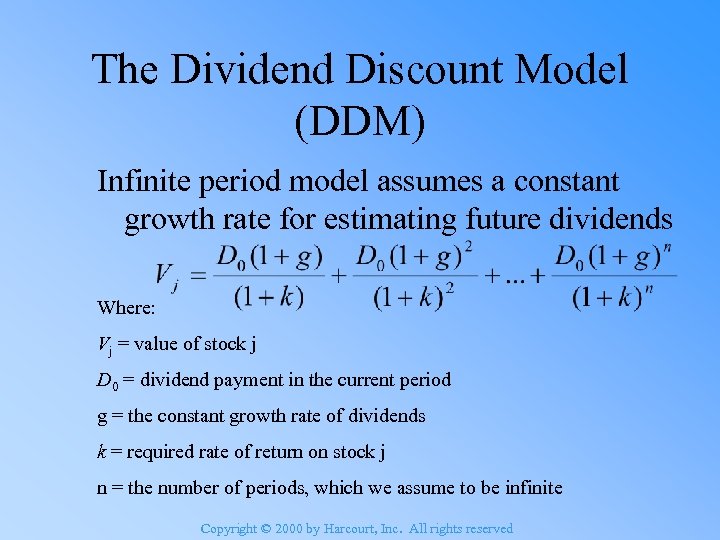 The Dividend Discount Model (DDM) Infinite period model assumes a constant growth rate for estimating future dividends Where: Vj = value of stock j D 0 = dividend payment in the current period g = the constant growth rate of dividends k = required rate of return on stock j n = the number of periods, which we assume to be infinite Copyright © 2000 by Harcourt, Inc. All rights reserved
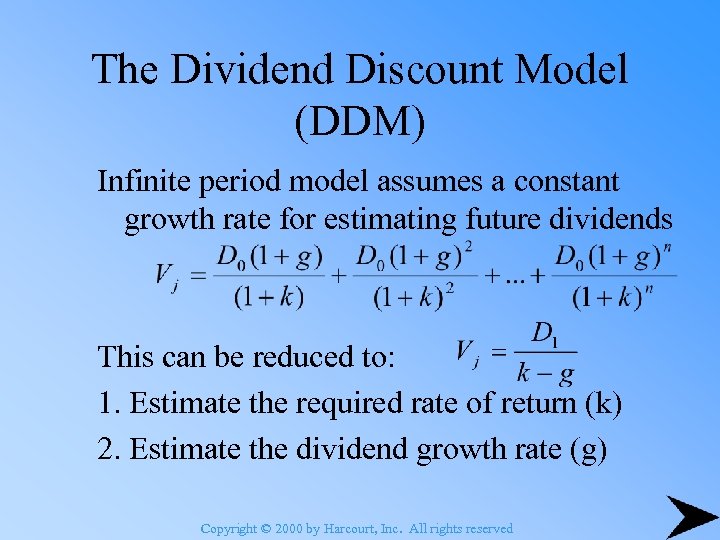 The Dividend Discount Model (DDM) Infinite period model assumes a constant growth rate for estimating future dividends This can be reduced to: 1. Estimate the required rate of return (k) 2. Estimate the dividend growth rate (g) Copyright © 2000 by Harcourt, Inc. All rights reserved
 Infinite Period DDM and Growth Companies Assumptions of DDM: 1. Dividends grow at a constant rate 2. The constant growth rate will continue for an infinite period 3. The required rate of return (k) is greater than the infinite growth rate (g) Copyright © 2000 by Harcourt, Inc. All rights reserved
 Infinite Period DDM and Growth Companies Growth companies have opportunities to earn return on investments greater than their required rates of return To exploit these opportunities, these firms generally retain a high percentage of earnings for reinvestment, and their earnings grow faster than those of a typical firm This is inconsistent with the infinite period DDM assumptions Copyright © 2000 by Harcourt, Inc. All rights reserved
 Infinite Period DDM and Growth Companies The infinite period DDM assumes constant growth for an infinite period, but abnormally high growth usually cannot be maintained indefinitely Risk and growth are not necessarily related Temporary conditions of high growth cannot be valued using the CGR-DDM Copyright © 2000 by Harcourt, Inc. All rights reserved
 Valuation with Temporary Supernormal Growth Combine the models to evaluate the years of supernormal growth and then use DDM to compute the remaining years at a sustainable rate Copyright © 2000 by Harcourt, Inc. All rights reserved
 Valuation with Temporary Supernormal Growth Combine the models to evaluate the years of supernormal growth and then use DDM to compute the remaining years at a sustainable rate For example: With a 14 percent required rate of return, a most recently paid dividend of $2. 00 per share, and dividend growth of: Copyright © 2000 by Harcourt, Inc. All rights reserved
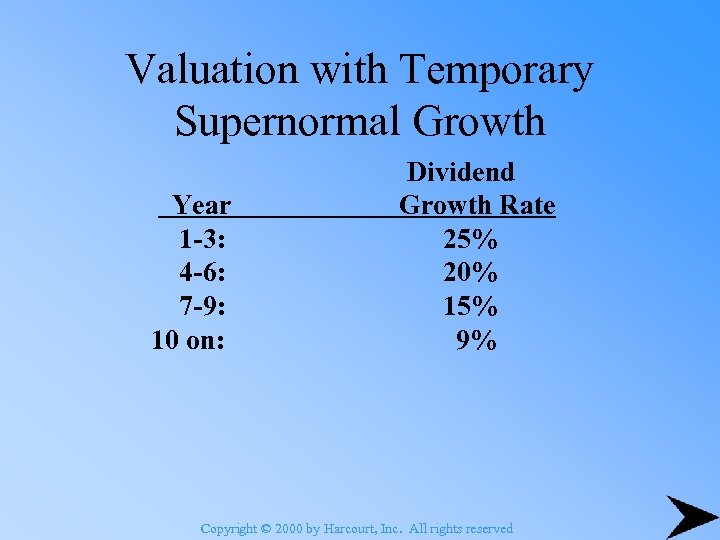 Valuation with Temporary Supernormal Growth Year 1 -3: 4 -6: 7 -9: 10 on: Dividend Growth Rate 25% 20% 15% 9% Copyright © 2000 by Harcourt, Inc. All rights reserved
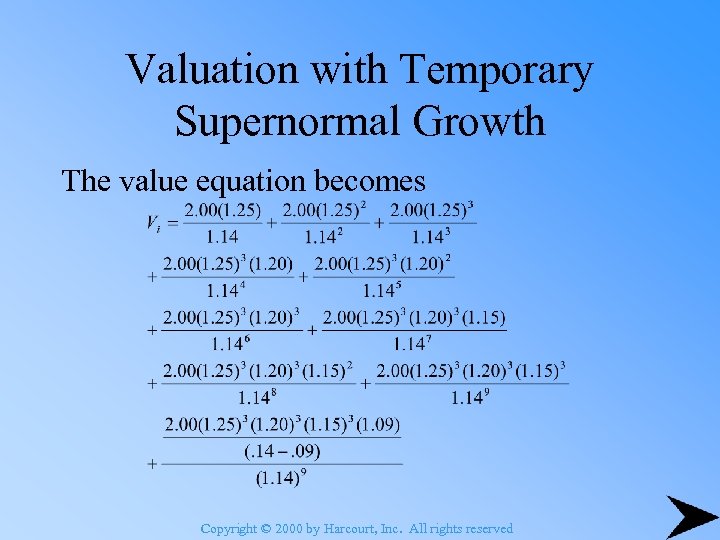 Valuation with Temporary Supernormal Growth The value equation becomes Copyright © 2000 by Harcourt, Inc. All rights reserved
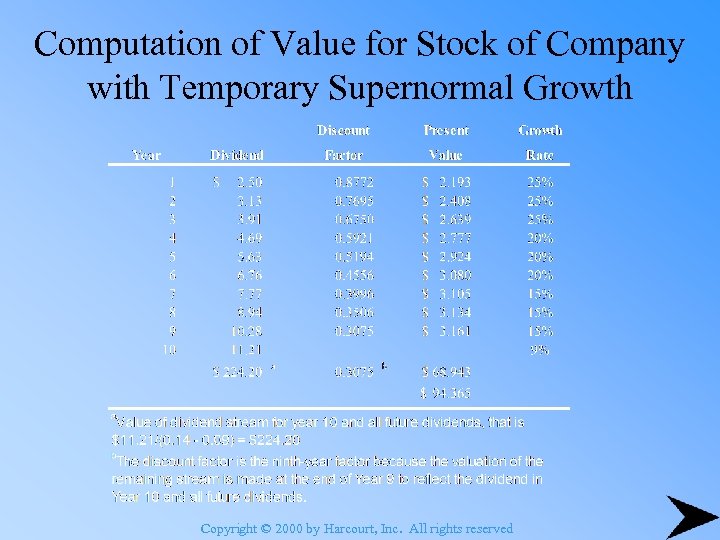 Computation of Value for Stock of Company with Temporary Supernormal Growth Copyright © 2000 by Harcourt, Inc. All rights reserved
 Present Value of Operating Cash Flows • 2 nd DCF method Derive the value of the total firm by discounting the total operating cash flows prior to the payment of interest to the debtholders Then subtract the value of debt to arrive at an estimate of the value of the equity Copyright © 2000 by Harcourt, Inc. All rights reserved
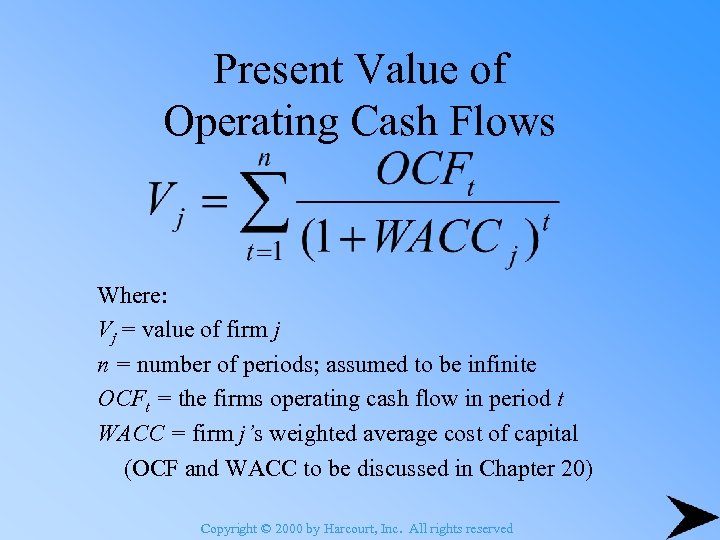 Present Value of Operating Cash Flows Where: Vj = value of firm j n = number of periods; assumed to be infinite OCFt = the firms operating cash flow in period t WACC = firm j’s weighted average cost of capital (OCF and WACC to be discussed in Chapter 20) Copyright © 2000 by Harcourt, Inc. All rights reserved
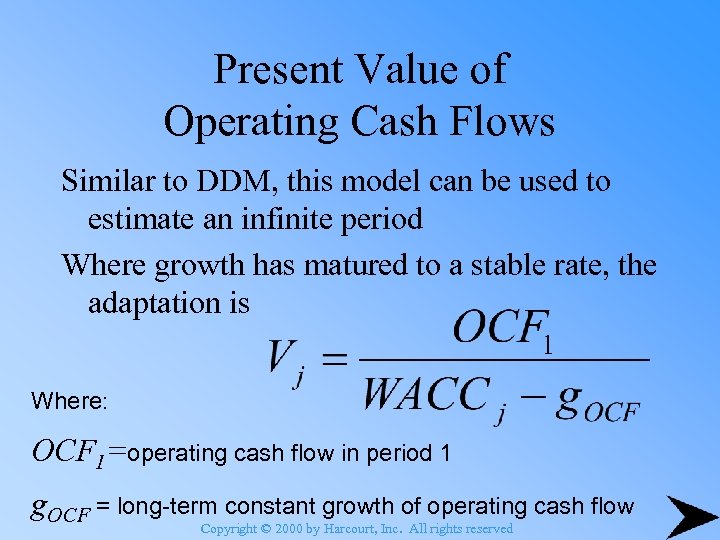 Present Value of Operating Cash Flows Similar to DDM, this model can be used to estimate an infinite period Where growth has matured to a stable rate, the adaptation is Where: OCF 1=operating cash flow in period 1 g. OCF = long-term constant growth of operating cash flow Copyright © 2000 by Harcourt, Inc. All rights reserved
 Present Value of Operating Cash Flows • Assuming several different rates of growth for OCF, these estimates can be divided into stages as with the supernormal dividend growth model • Estimate the rate of growth and the duration of growth for each period • This will be demonstrated later Copyright © 2000 by Harcourt, Inc. All rights reserved
 Present Value of Free Cash Flows to Equity • 3 rd DCF method • “Free” cash flows to equity are derived after operating cash flows have been adjusted for debt payments (interest and principle) • The discount rate used is the firm’s cost of equity (k) rather than WACC Copyright © 2000 by Harcourt, Inc. All rights reserved
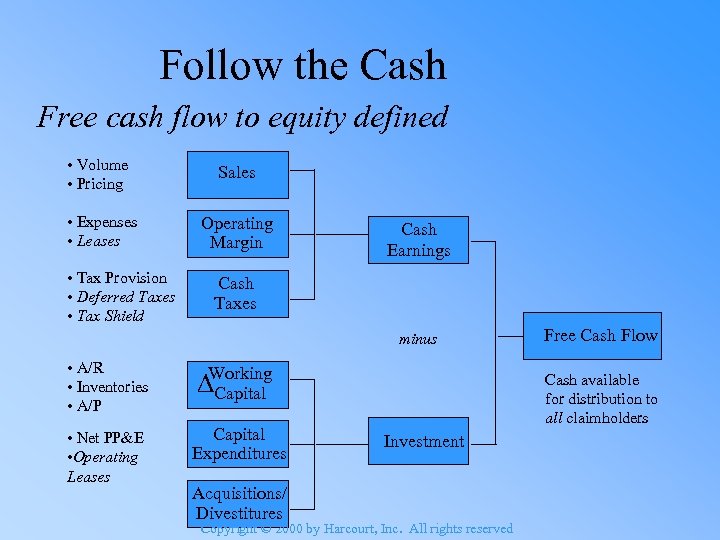 Follow the Cash Free cash flow to equity defined • Volume • Pricing Sales • Expenses • Leases Operating Margin • Tax Provision • Deferred Taxes • Tax Shield Cash Earnings Cash Taxes minus • A/R • Inventories • A/P Working Capital • Net PP&E • Operating Leases Capital Expenditures Acquisitions/ Divestitures Free Cash Flow Cash available for distribution to all claimholders Investment Copyright © 2000 by Harcourt, Inc. All rights reserved
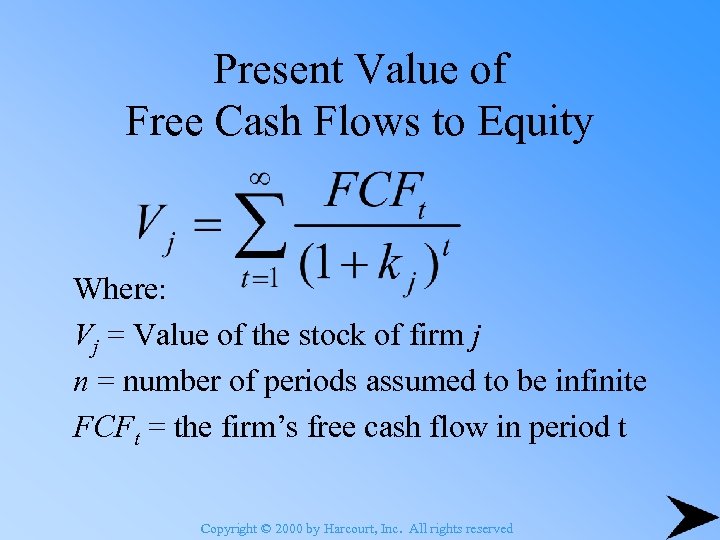 Present Value of Free Cash Flows to Equity Where: Vj = Value of the stock of firm j n = number of periods assumed to be infinite FCFt = the firm’s free cash flow in period t Copyright © 2000 by Harcourt, Inc. All rights reserved
 Relative Valuation Techniques • Value can be determined by comparing to similar stocks based on relative ratios • Relevant variables include earnings, cash flow, book value, and sales • Multiply this variable by some “capitalization factor” • The most popular relative valuation technique is based on price to earnings (the P/E approach) Copyright © 2000 by Harcourt, Inc. All rights reserved
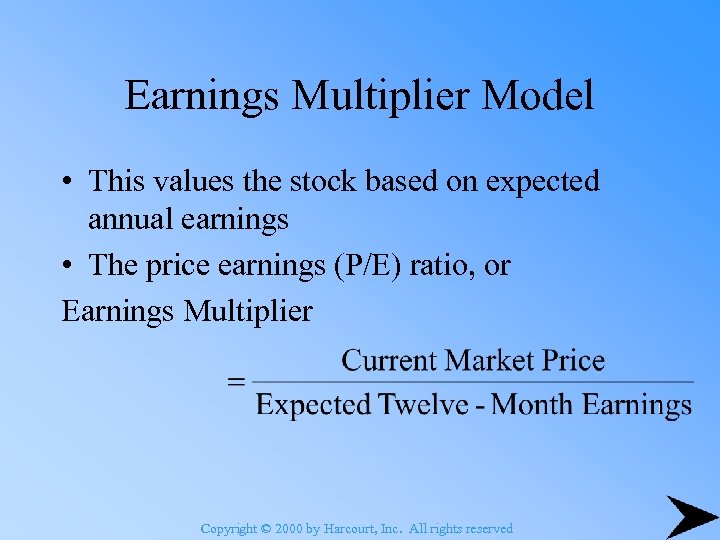 Earnings Multiplier Model • This values the stock based on expected annual earnings • The price earnings (P/E) ratio, or Earnings Multiplier Copyright © 2000 by Harcourt, Inc. All rights reserved
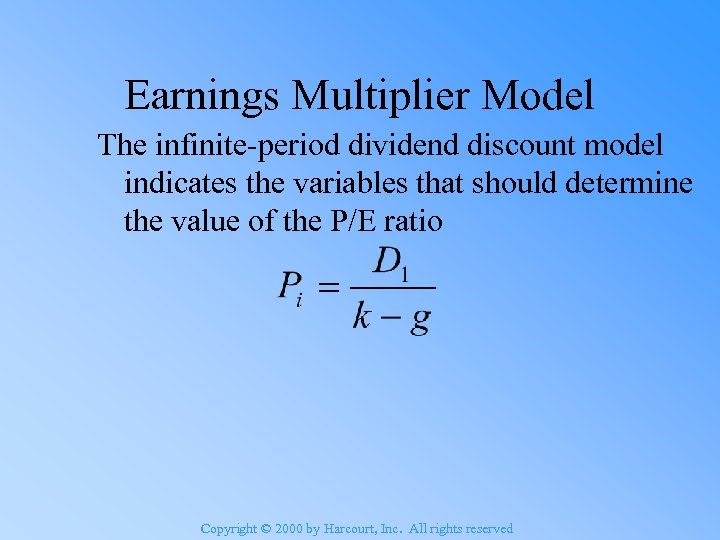 Earnings Multiplier Model The infinite-period dividend discount model indicates the variables that should determine the value of the P/E ratio Copyright © 2000 by Harcourt, Inc. All rights reserved
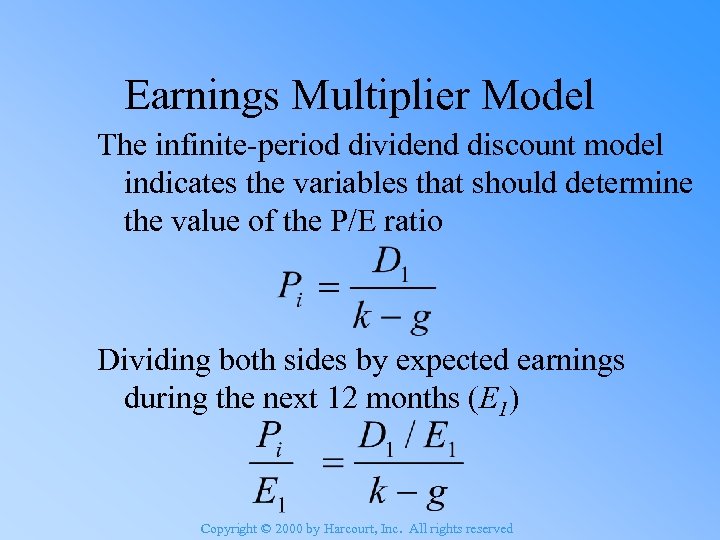 Earnings Multiplier Model The infinite-period dividend discount model indicates the variables that should determine the value of the P/E ratio Dividing both sides by expected earnings during the next 12 months (E 1) Copyright © 2000 by Harcourt, Inc. All rights reserved
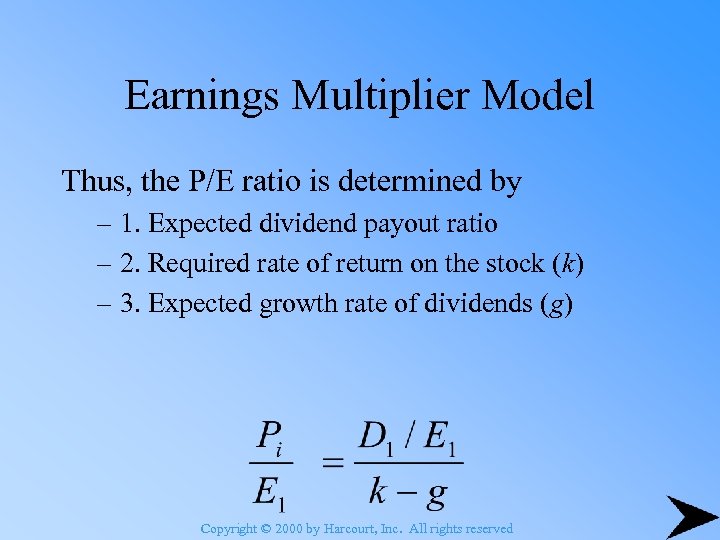 Earnings Multiplier Model Thus, the P/E ratio is determined by – 1. Expected dividend payout ratio – 2. Required rate of return on the stock (k) – 3. Expected growth rate of dividends (g) Copyright © 2000 by Harcourt, Inc. All rights reserved
 Earnings Multiplier Model As an example, assume: – – Dividend payout = 50% Required return = 12% Expected growth = 8% D/E =. 50; k =. 12; g=. 08 Copyright © 2000 by Harcourt, Inc. All rights reserved
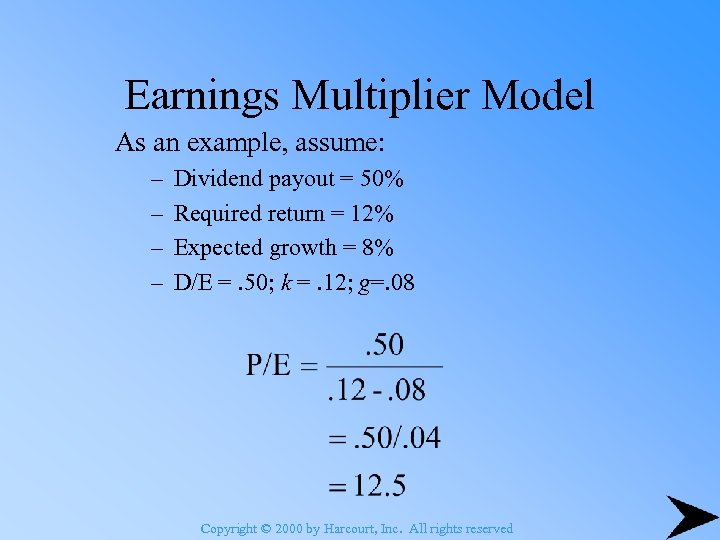 Earnings Multiplier Model As an example, assume: – – Dividend payout = 50% Required return = 12% Expected growth = 8% D/E =. 50; k =. 12; g=. 08 Copyright © 2000 by Harcourt, Inc. All rights reserved
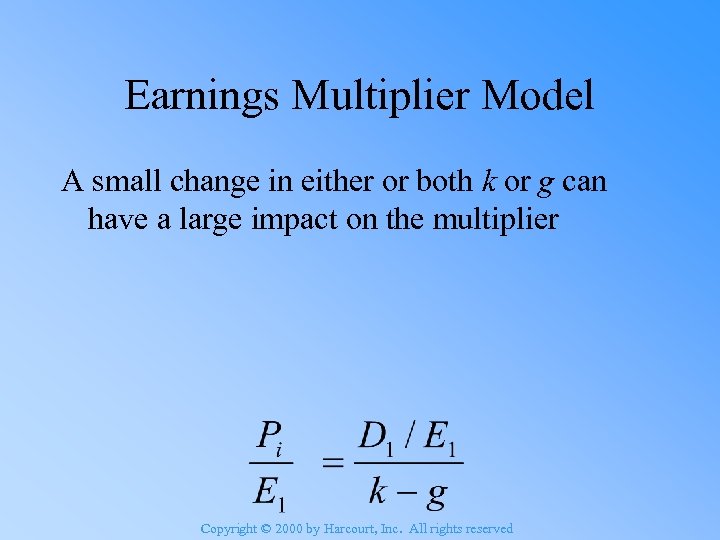 Earnings Multiplier Model A small change in either or both k or g can have a large impact on the multiplier Copyright © 2000 by Harcourt, Inc. All rights reserved
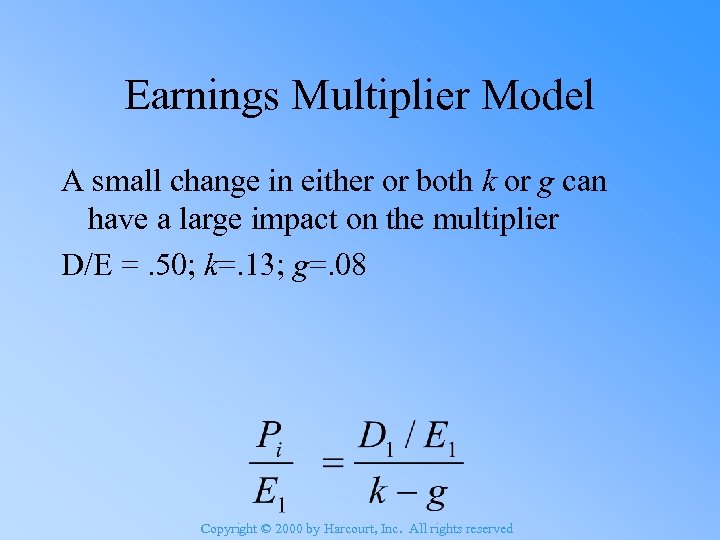 Earnings Multiplier Model A small change in either or both k or g can have a large impact on the multiplier D/E =. 50; k=. 13; g=. 08 Copyright © 2000 by Harcourt, Inc. All rights reserved
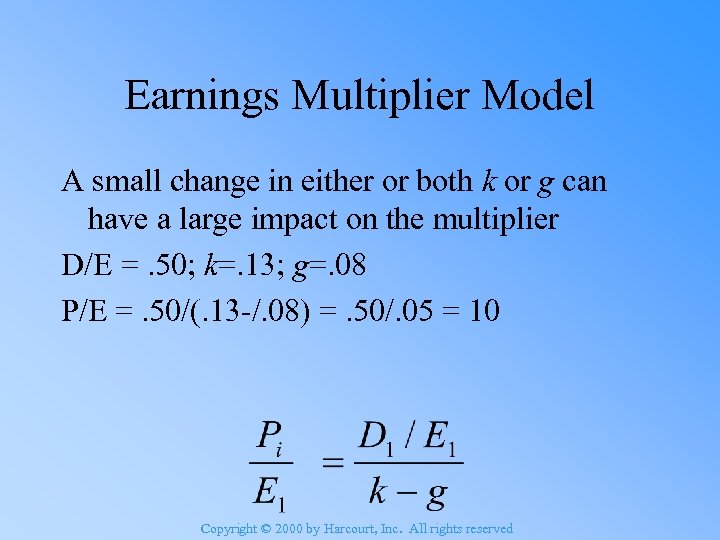 Earnings Multiplier Model A small change in either or both k or g can have a large impact on the multiplier D/E =. 50; k=. 13; g=. 08 P/E =. 50/(. 13 -/. 08) =. 50/. 05 = 10 Copyright © 2000 by Harcourt, Inc. All rights reserved
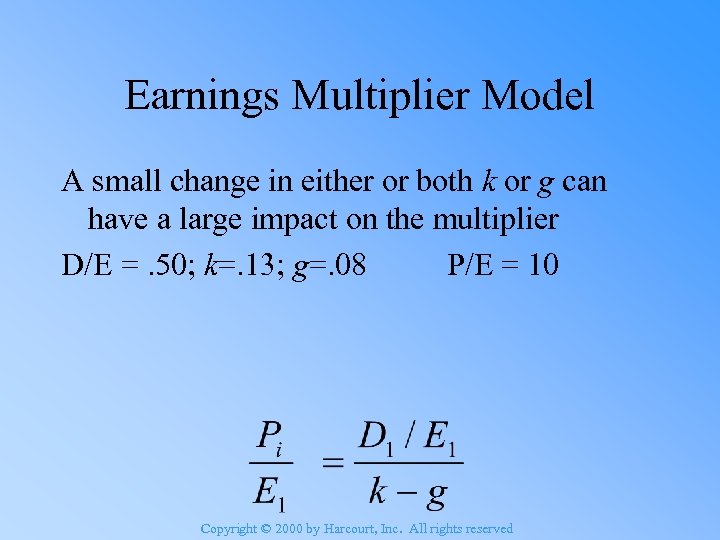 Earnings Multiplier Model A small change in either or both k or g can have a large impact on the multiplier D/E =. 50; k=. 13; g=. 08 P/E = 10 Copyright © 2000 by Harcourt, Inc. All rights reserved
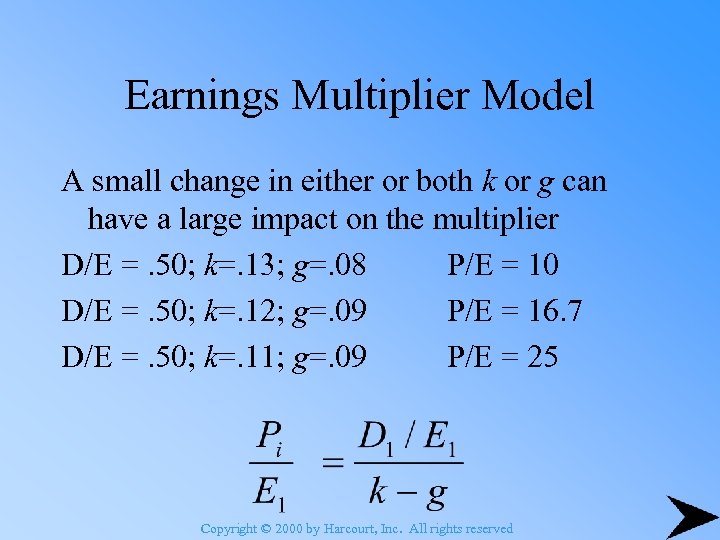 Earnings Multiplier Model A small change in either or both k or g can have a large impact on the multiplier D/E =. 50; k=. 13; g=. 08 P/E = 10 D/E =. 50; k=. 12; g=. 09 P/E = 16. 7 D/E =. 50; k=. 11; g=. 09 P/E = 25 Copyright © 2000 by Harcourt, Inc. All rights reserved
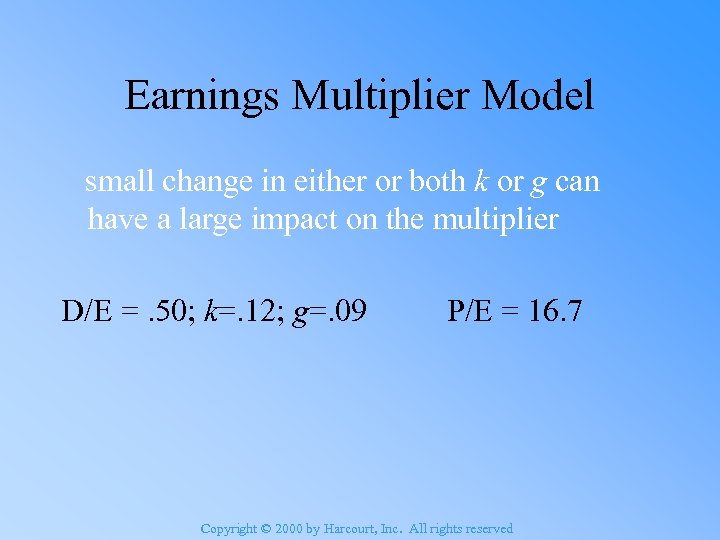 Earnings Multiplier Model small change in either or both k or g can have a large impact on the multiplier D/E =. 50; k=. 12; g=. 09 P/E = 16. 7 Copyright © 2000 by Harcourt, Inc. All rights reserved
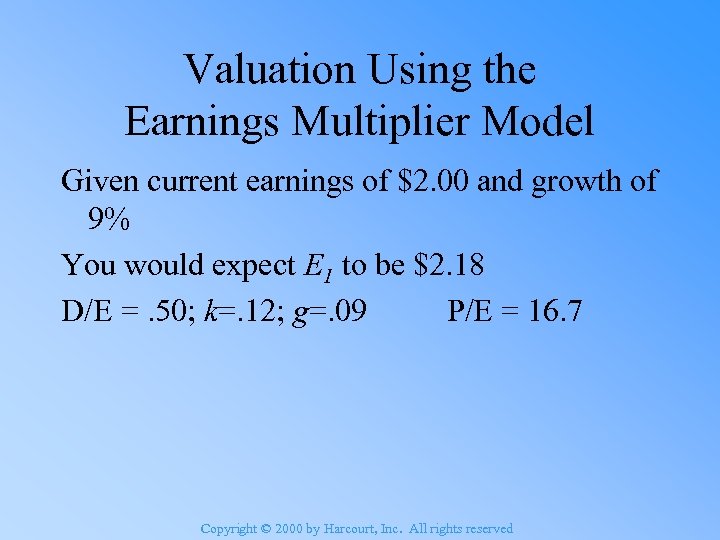 Valuation Using the Earnings Multiplier Model Given current earnings of $2. 00 and growth of 9% You would expect E 1 to be $2. 18 D/E =. 50; k=. 12; g=. 09 P/E = 16. 7 Copyright © 2000 by Harcourt, Inc. All rights reserved
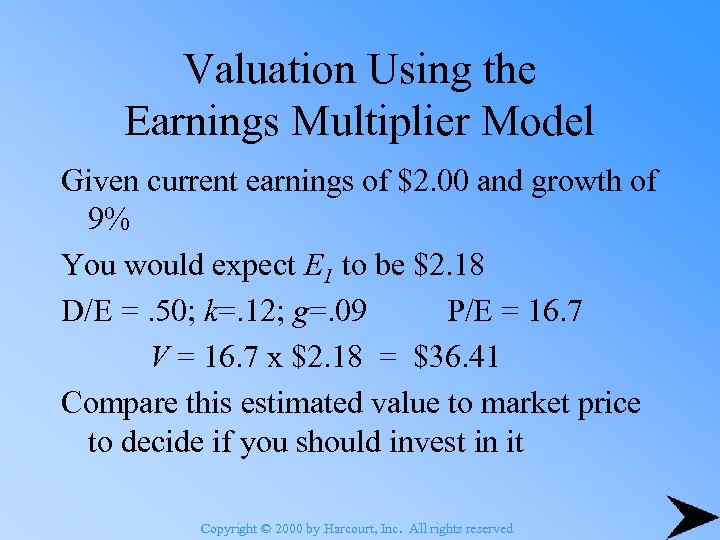 Valuation Using the Earnings Multiplier Model Given current earnings of $2. 00 and growth of 9% You would expect E 1 to be $2. 18 D/E =. 50; k=. 12; g=. 09 P/E = 16. 7 V = 16. 7 x $2. 18 = $36. 41 Compare this estimated value to market price to decide if you should invest in it Copyright © 2000 by Harcourt, Inc. All rights reserved
 The Price-Cash Flow Ratio • • 2 nd relative valuation approach Companies can manipulate earnings Cash-flow is less prone to manipulation Cash-flow is important for fundamental valuation and in credit analysis Copyright © 2000 by Harcourt, Inc. All rights reserved
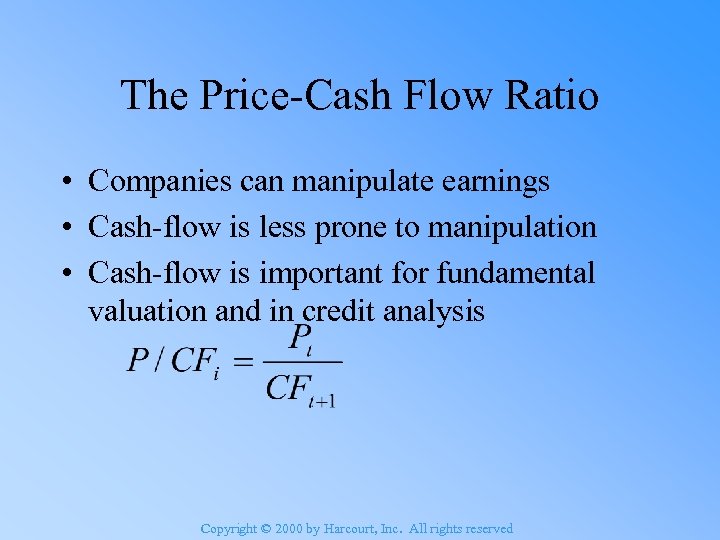 The Price-Cash Flow Ratio • Companies can manipulate earnings • Cash-flow is less prone to manipulation • Cash-flow is important for fundamental valuation and in credit analysis Copyright © 2000 by Harcourt, Inc. All rights reserved
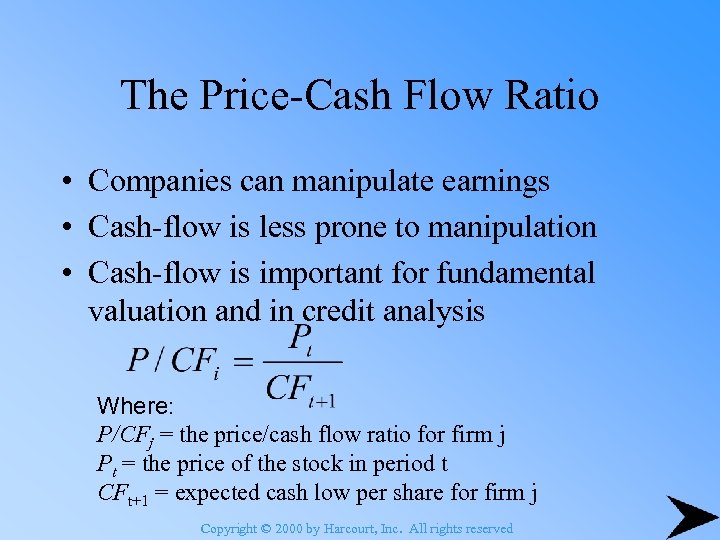 The Price-Cash Flow Ratio • Companies can manipulate earnings • Cash-flow is less prone to manipulation • Cash-flow is important for fundamental valuation and in credit analysis Where: P/CFj = the price/cash flow ratio for firm j Pt = the price of the stock in period t CFt+1 = expected cash low per share for firm j Copyright © 2000 by Harcourt, Inc. All rights reserved
 The Price-Book Value Ratio • 3 rd relative valuation approach Widely used to measure bank values (most bank assets are liquid (bonds and commercial loans) Fama and French study indicated inverse relationship between P/BV ratios and excess return for a cross section of stocks Copyright © 2000 by Harcourt, Inc. All rights reserved
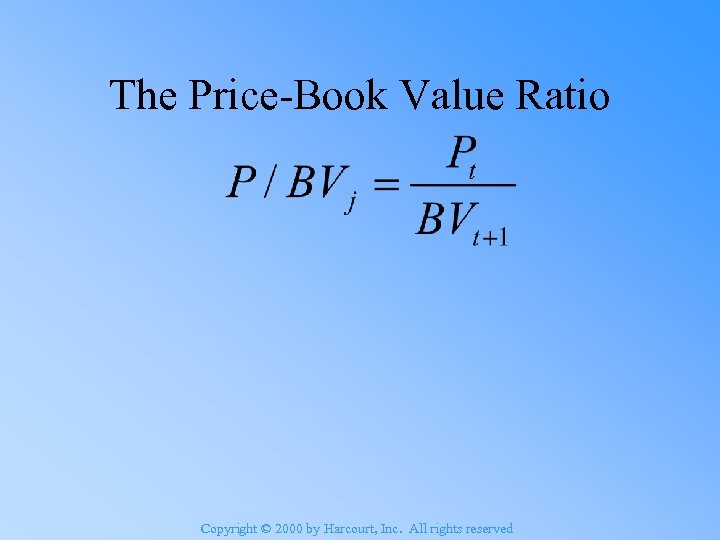 The Price-Book Value Ratio Copyright © 2000 by Harcourt, Inc. All rights reserved
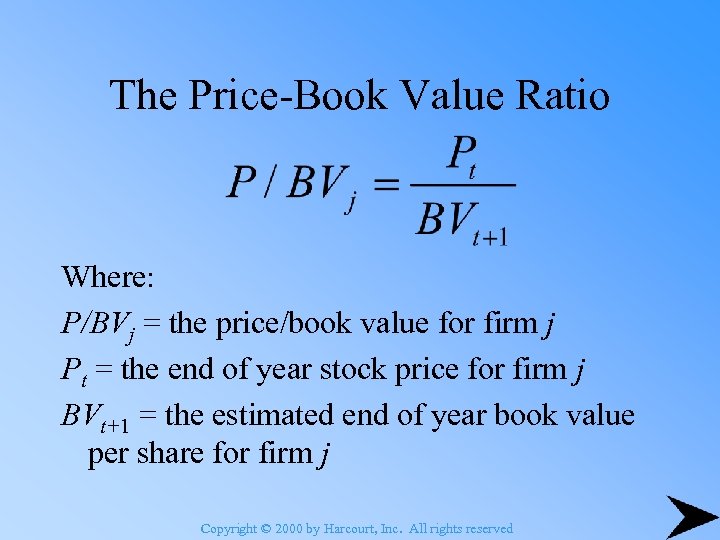 The Price-Book Value Ratio Where: P/BVj = the price/book value for firm j Pt = the end of year stock price for firm j BVt+1 = the estimated end of year book value per share for firm j Copyright © 2000 by Harcourt, Inc. All rights reserved
 The Price-Book Value Ratio • Be sure to match the price with either a recent book value number, or estimate the book value for the subsequent year • Can derive an estimate based upon historical growth rate for the series or use the growth rate implied by the (ROE) X (Ret. Rate) analysis Copyright © 2000 by Harcourt, Inc. All rights reserved
 The Price-Sales Ratio • 4 th relative valuation approach • Strong, consistent growth rate is a requirement of a growth company • Sales is less subject to manipulation than other financial data • Popularized by Ken Fisher Copyright © 2000 by Harcourt, Inc. All rights reserved
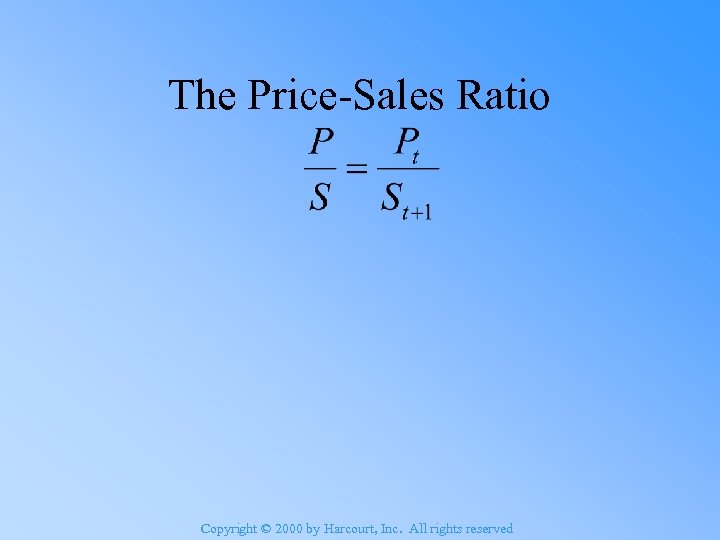 The Price-Sales Ratio Copyright © 2000 by Harcourt, Inc. All rights reserved
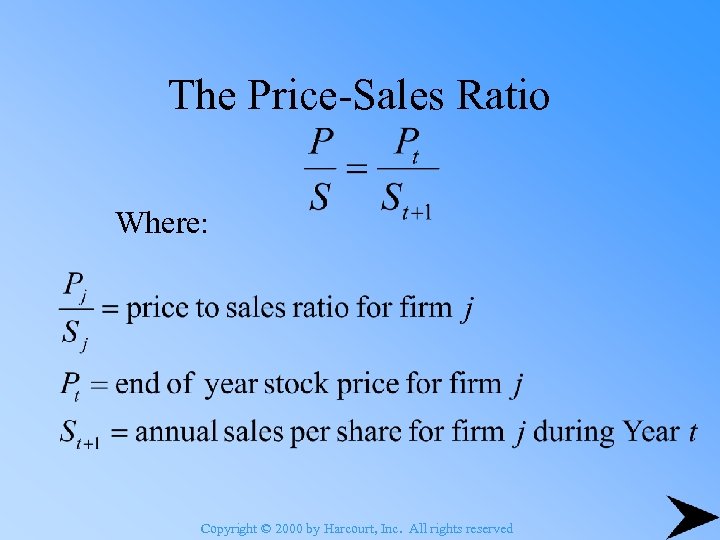 The Price-Sales Ratio Where: Copyright © 2000 by Harcourt, Inc. All rights reserved
 The Price-Sales Ratio Match the stock price with recent annual sales, or future sales per share This ratio varies dramatically by industry Profit margins also vary by industry Relative comparisons using P/S ratio should be between firms in similar industries Copyright © 2000 by Harcourt, Inc. All rights reserved
 Copyright © 2000 by Harcourt, Inc. All rights reserved