 Скачать презентацию Securing the Internet Backbone Current activities in the
18217892a5b76cc781ad44abbd7b5e37.ppt
- Количество слайдов: 53



Securing the Internet Backbone: Current activities in the IETF’s Secure Inter. Domain Routing Working Group Geoff Huston Chief Scientist, APNIC

On the Internet…

there are many ways to be bad!
there are many ways to be bad! • Enlist a bot army and mount multi-gigabit DOS attacks Extortion leverage and general mayhem • Port Scan for known exploits General annoyance • Spew spam Yes, there are still gullible folk out there! • Mount a fake web site attack And lure victims • Mount a routing attack And bring down an entire region / country / global network!
If I were really bad (and evil)… I’d attack routing. • Through routing I’d attack: – – – the route registry server system the DNS root system trust anchors for TLS and browser certificates isolate critical public servers and resources overwhelm the routing system with spurious information And bring selected parts of the network to a complete chaotic halt!
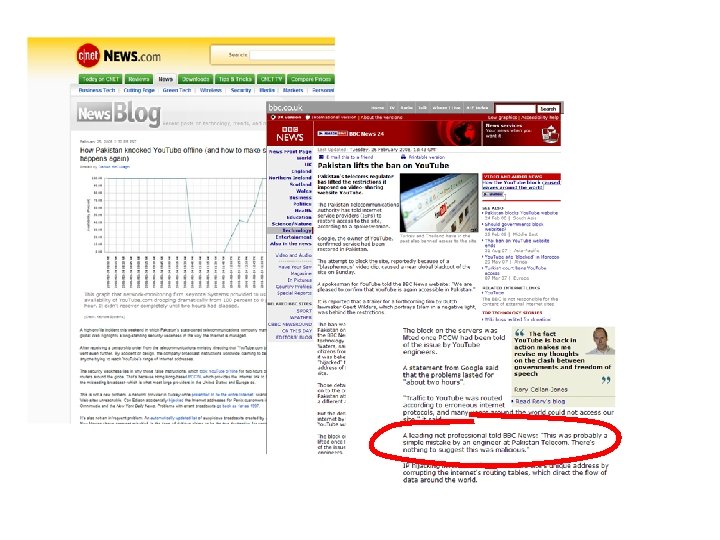
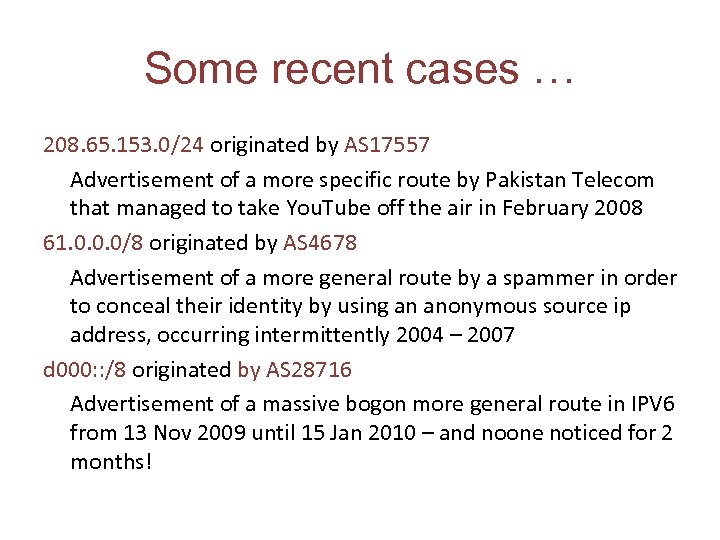
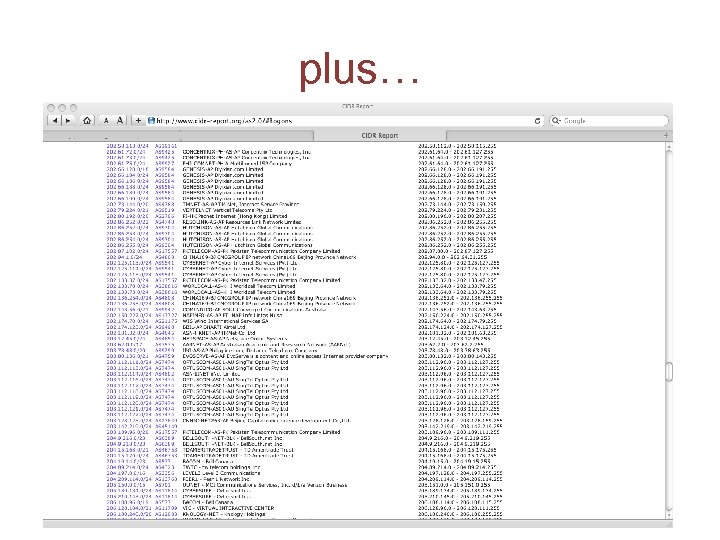
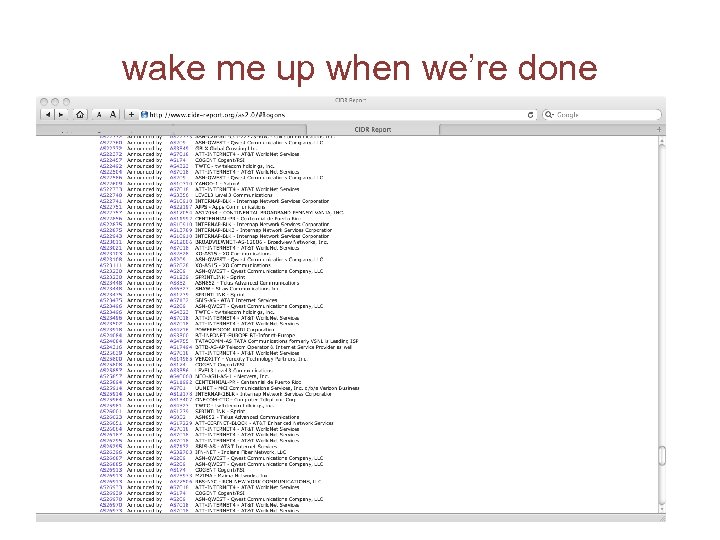
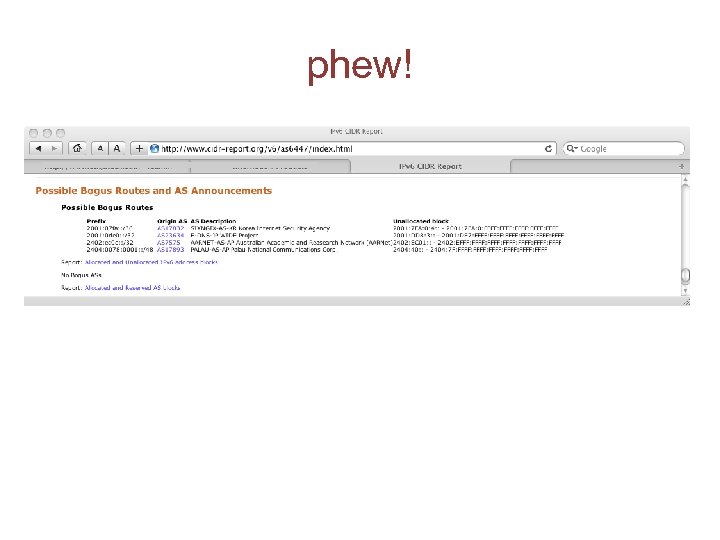
Some recent cases … 208. 65. 153. 0/24 originated by AS 17557 Advertisement of a more specific route by Pakistan Telecom that managed to take You. Tube off the air in February 2008 61. 0. 0. 0/8 originated by AS 4678 Advertisement of a more general route by a spammer in order to conceal their identity by using an anonymous source ip address, occurring intermittently 2004 – 2007 d 000: : /8 originated by AS 28716 Advertisement of a massive bogon more general route in IPV 6 from 13 Nov 2009 until 15 Jan 2010 – and noone noticed for 2 months!
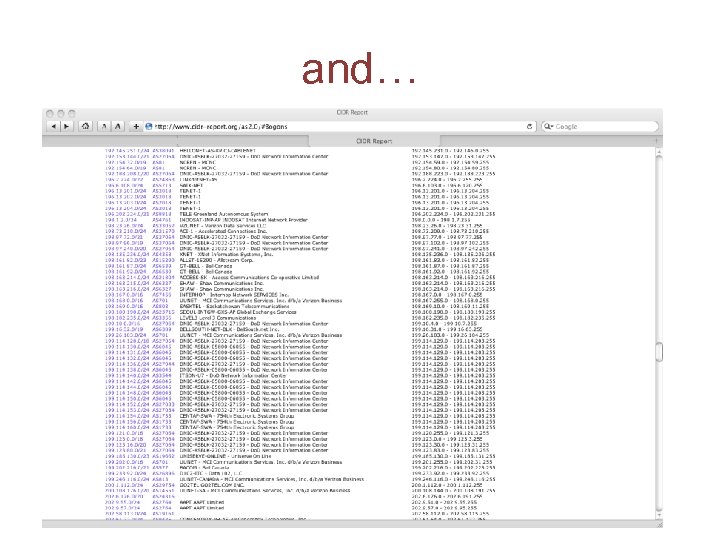
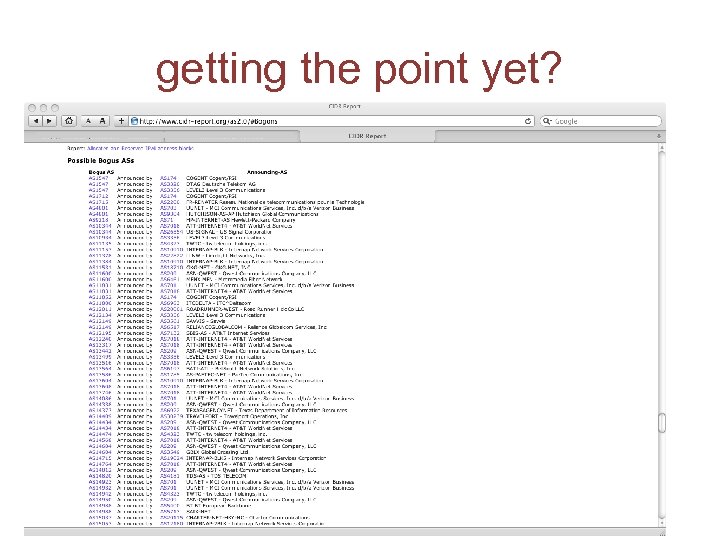
How many advertisements in today’s BGP are “lies”?
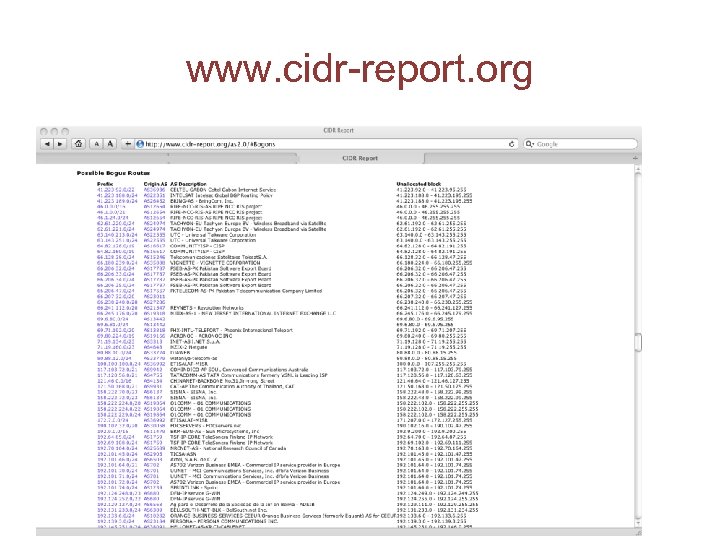
www. cidr-report. org
and…
plus…
yes, there’s more
getting the point yet?
still more!
wake me up when we’re done
zzzzzzz
almost done…
phew!
What’s the base problem here? Noone seems to want to care enough about the integrity of the network to address routing integrity!
Today’s Routing Environment is Insecure • Routing is built on sloppy mutual trust models • Routing auditing is a low value activity that noone performs with any level of thoroughness • We have grown used to lousy solutions and institutionalized lying in the routing system
Three Basic Issues: • Session Integrity – Protect the TCP session from various forms of attack and/or disruption • Route Object Integrity – Protect a BGP speaker from learning false routing information • Routing Integrity – Ensure that the forwarding tables matches the policy intent of each BGP speaker
BGP Session Integrity • Protect the long held TCP session from – RST attacks – MITM attacks • Responses: – Narrow the RST window in BGP’s TCP – Use the TTL hack for multi-hop BGP – Use MD 5 session encryption • All of these measures are available in most BGP implementations – and all are in use to some extent
Route Object Integrity • Prefix Hijacking: originate an unauthorized more specific route – This route will take precedence and traffic will be diverted to the new route
Can we tweak BGP so that it can detect the difference between good and evil, and only accept “good” routes?
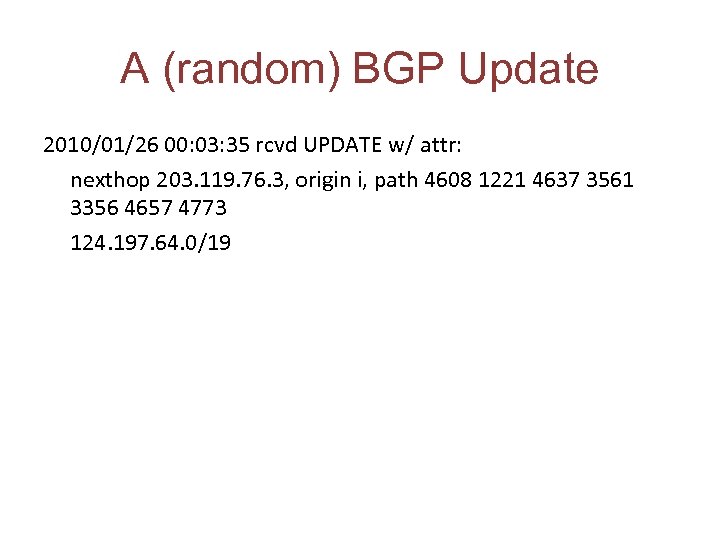
A (random) BGP Update 2010/01/26 00: 03: 35 rcvd UPDATE w/ attr: nexthop 203. 119. 76. 3, origin i, path 4608 1221 4637 3561 3356 4657 4773 124. 197. 64. 0/19
Routing Security • The basic routing payload security questions that need to be answered are: – Who injected this address prefix into the network? – Did they have the necessary credentials to inject this address prefix? Is this a valid address prefix? – Is the forwarding path to reach this address prefix trustable? • And can these questions be answered by any BGP speaker quickly and cheaply?
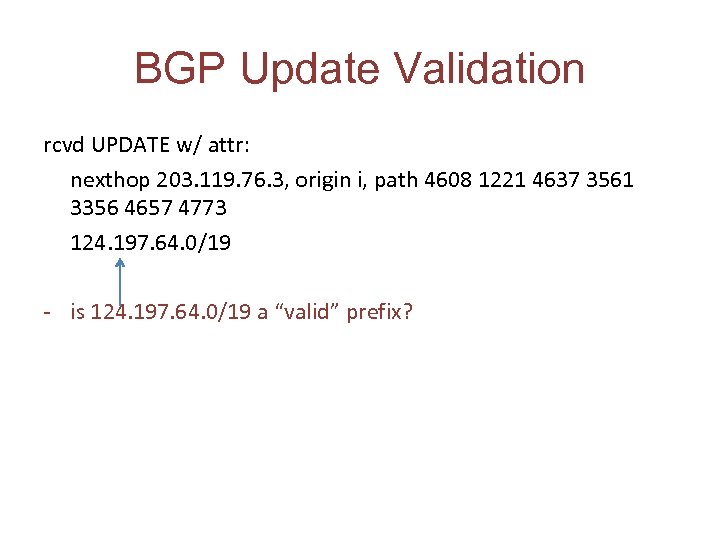
BGP Update Validation rcvd UPDATE w/ attr: nexthop 203. 119. 76. 3, origin i, path 4608 1221 4637 3561 3356 4657 4773 124. 197. 64. 0/19 - is 124. 197. 64. 0/19 a “valid” prefix?
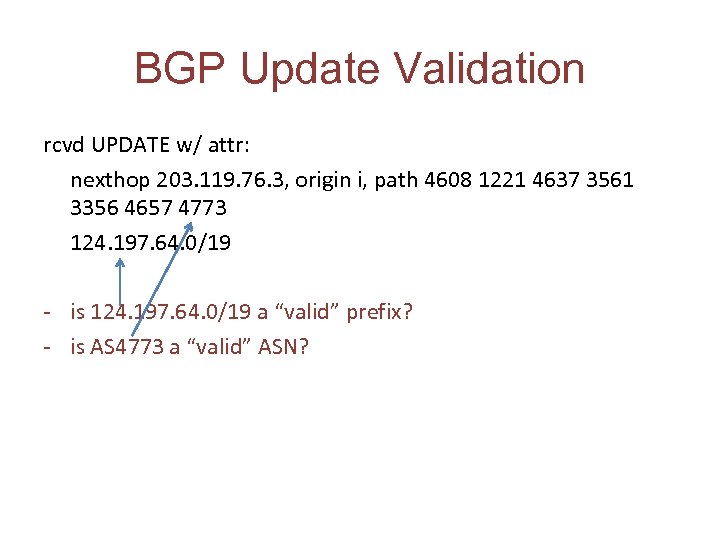
BGP Update Validation rcvd UPDATE w/ attr: nexthop 203. 119. 76. 3, origin i, path 4608 1221 4637 3561 3356 4657 4773 124. 197. 64. 0/19 - is 124. 197. 64. 0/19 a “valid” prefix? - is AS 4773 a “valid” ASN?
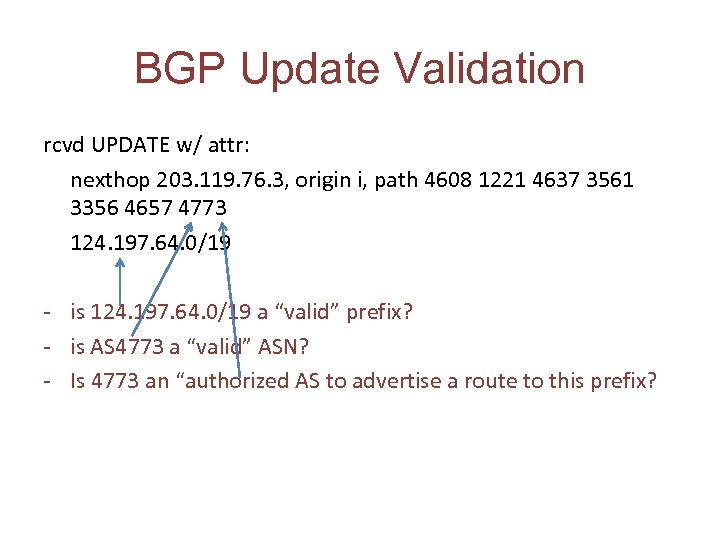
BGP Update Validation rcvd UPDATE w/ attr: nexthop 203. 119. 76. 3, origin i, path 4608 1221 4637 3561 3356 4657 4773 124. 197. 64. 0/19 - is 124. 197. 64. 0/19 a “valid” prefix? - is AS 4773 a “valid” ASN? - Is 4773 an “authorized AS to advertise a route to this prefix?
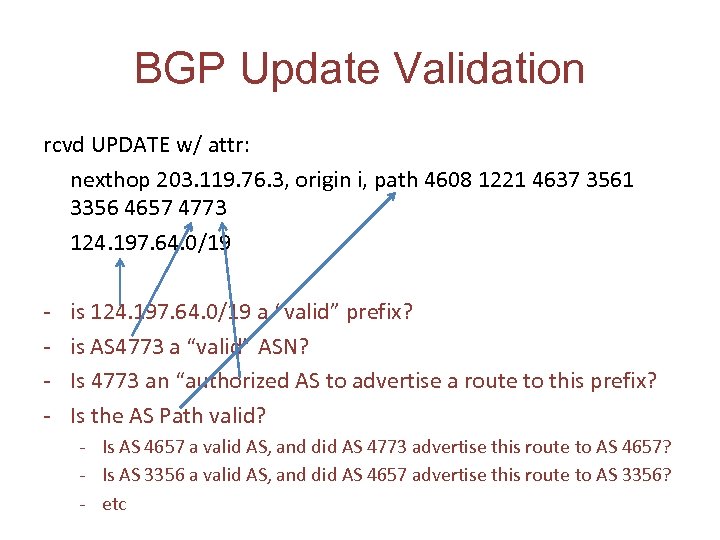
BGP Update Validation rcvd UPDATE w/ attr: nexthop 203. 119. 76. 3, origin i, path 4608 1221 4637 3561 3356 4657 4773 124. 197. 64. 0/19 - is 124. 197. 64. 0/19 a “valid” prefix? is AS 4773 a “valid” ASN? Is 4773 an “authorized AS to advertise a route to this prefix? Is the AS Path valid? - Is AS 4657 a valid AS, and did AS 4773 advertise this route to AS 4657? - Is AS 3356 a valid AS, and did AS 4657 advertise this route to AS 3356? - etc
A Foundation for Routing Security • The use of authenticatable attestations to allow automated validation of: – the authenticity of the route object being advertised – authenticity of the origin AS – the binding of the origin AS to the route object • Such attestations used to provide a cost effective method of validating routing requests – as compared to the today’s state of the art based on techniques of vague trust and random whois data mining
A Foundation for Routing Security Adoption of some basic security functions into the Internet’s routing domain: • Injection of reliable trustable data A Resource PKI as the base of validation of network data • Explicit verifiable mechanisms for integrity of data distribution Adoption of some form of certified authorization mechanism to support validation of credentials associated with address and routing information
A Starting Point • How can you certify who what which address? – follow the allocation trail – Certification of the “Right-of-Use” of IP Addresses and AS numbers as a linked attribute of the Internet’s number resource allocation and distribution framework For example: APNIC (the “Issuer”) certifies that: the certificate “Subject” whose public key is contained in the certificate is the current holder of a set of IP address and AS resources that are listed in the certificate extension APNIC does NOT certify the identity of the subject, nor their good (or evil) intentions!
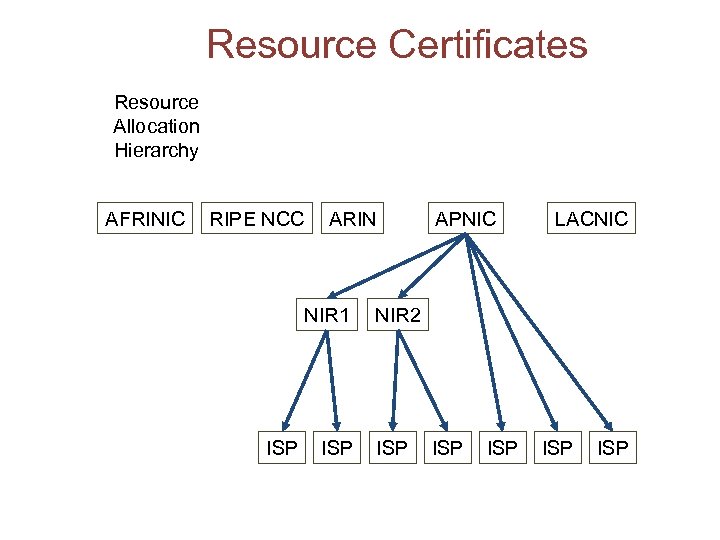
Resource Certificates Resource Allocation Hierarchy AFRINIC RIPE NCC ARIN NIR 1 ISP APNIC LACNIC NIR 2 ISP ISP ISP
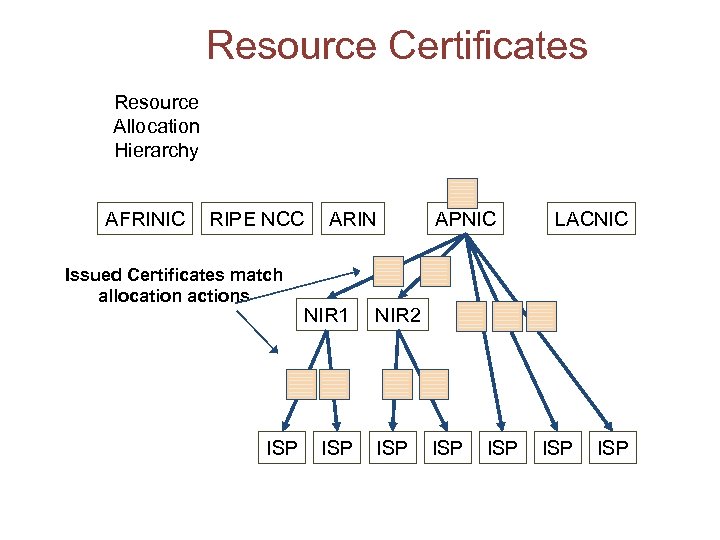
Resource Certificates Resource Allocation Hierarchy AFRINIC RIPE NCC Issued Certificates match allocation actions ISP ARIN NIR 1 ISP APNIC LACNIC NIR 2 ISP ISP ISP
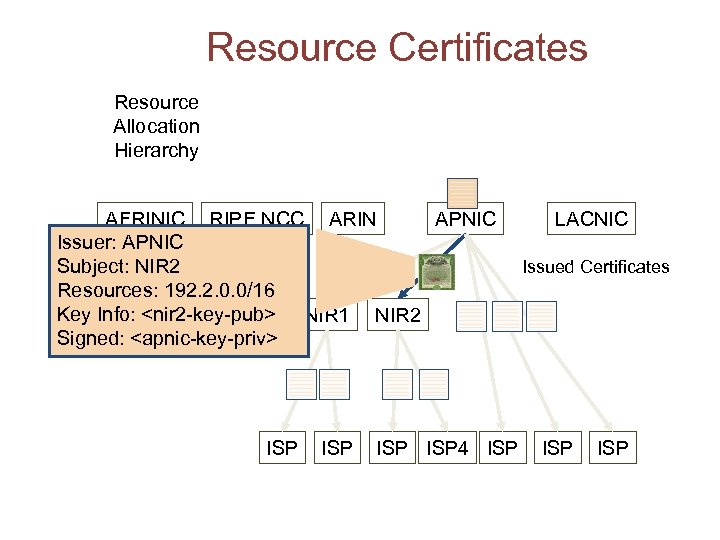
Resource Certificates Resource Allocation Hierarchy AFRINIC RIPE NCC ARIN APNIC Issuer: APNIC Subject: NIR 2 Resources: 192. 2. 0. 0/16 Key Info: <nir 2 -key-pub> NIR 1 NIR 2 Signed: <apnic-key-priv> ISP ISP 4 ISP LACNIC Issued Certificates ISP
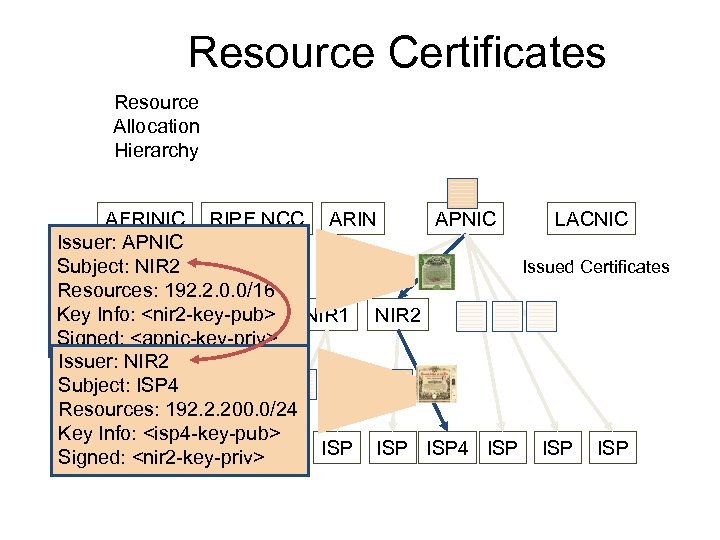
Resource Certificates Resource Allocation Hierarchy AFRINIC RIPE NCC ARIN APNIC LACNIC Issuer: APNIC Issued Certificates Subject: NIR 2 Resources: 192. 2. 0. 0/16 Key Info: <nir 2 -key-pub> NIR 1 NIR 2 Signed: <apnic-key-priv> Issuer: NIR 2 Subject: ISP 4 Resources: 192. 2. 200. 0/24 Key Info: <isp 4 -key-pub> Signed: <nir 2 -key-priv> ISP ISP 4 ISP ISP
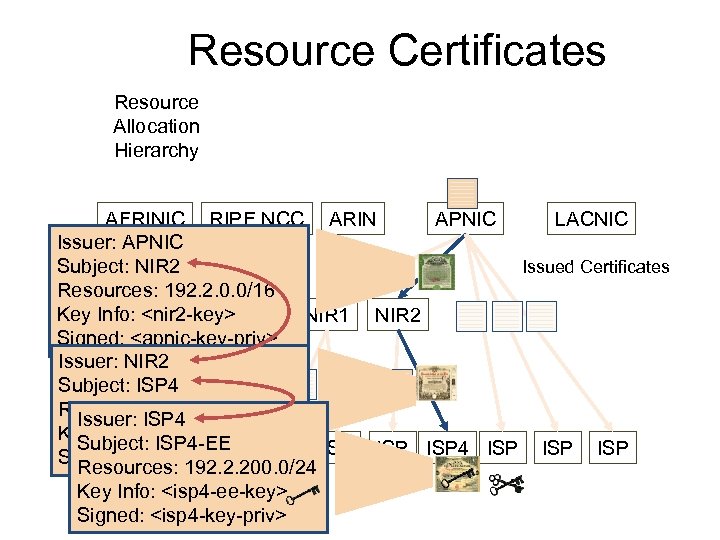
Resource Certificates Resource Allocation Hierarchy AFRINIC RIPE NCC ARIN APNIC LACNIC Issuer: APNIC Issued Certificates Subject: NIR 2 Resources: 192. 2. 0. 0/16 Key Info: <nir 2 -key> NIR 1 NIR 2 Signed: <apnic-key-priv> Issuer: NIR 2 Subject: ISP 4 Resources: 192. 2. 200. 0/22 Issuer: ISP 4 Key Info: <isp 4 -key> Subject: ISP 4 -EE Signed: <nir 2 -key-priv> ISP ISP 4 ISP ISP Resources: 192. 2. 200. 0/24 Key Info: <isp 4 -ee-key> Signed: <isp 4 -key-priv>
What could you do with Resource Certificates? • You could sign “routing authorities” with your private key, providing an authority for an AS to originate a route for the named prefix. Any Relying Party could validate this authority in the RPKI
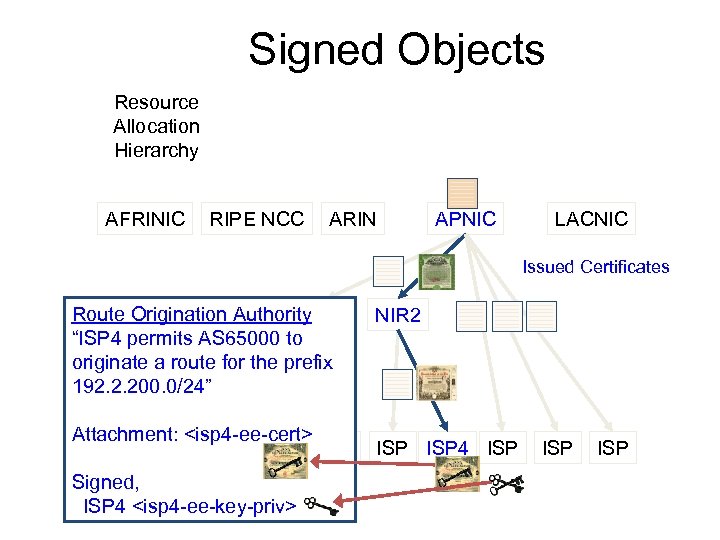
Signed Objects Resource Allocation Hierarchy AFRINIC RIPE NCC ARIN APNIC LACNIC Issued Certificates Route Origination Authority LIR 1 “ISP 4 permits AS 65000 to originate a route for the prefix 192. 2. 200. 0/24” Attachment: <isp 4 -ee-cert> ISP Signed, ISP 4 <isp 4 -ee-key-priv> NIR 2 ISP 4 ISP ISP
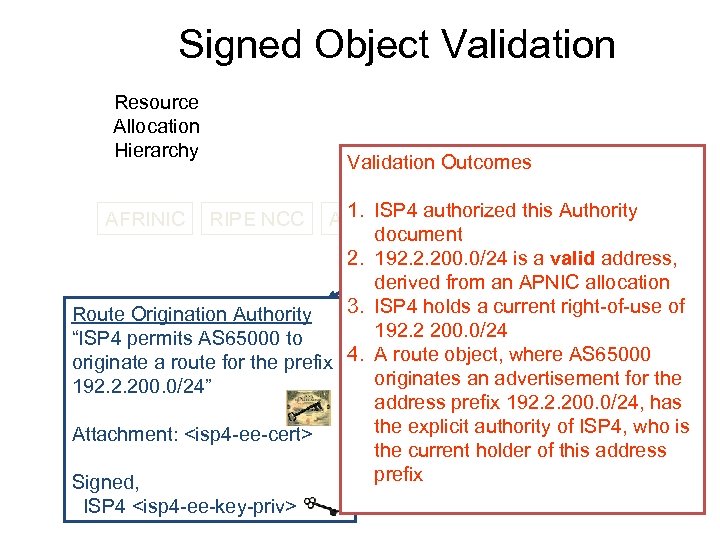
Signed Object Validation Resource Allocation Hierarchy Validation Outcomes RIPE NCC Trust Anchor 1. authorized Authority ARINISP 4 RIPE NCC this LACNIC document 2. 192. 2. 200. 0/24 is a valid address, Issued Certificates derived from an APNIC allocation Route Origination Authority LIR 13. ISP 4 holds a current right-of-use of LIR 2 192. 2 200. 0/24 “ISP 4 permits AS 65000 to originate a route for the prefix 4. A route object, where AS 65000 originates an advertisement for the 192. 2. 200. 0/24” address prefix 192. 2. 200. 0/24, has the explicit authority of ISP 4, who is Attachment: <isp 4 -ee-cert> ISP the current holder of this address ISP 4 ISP ISP prefix Signed, AFRINIC RIPE NCC ISP 4 <isp 4 -ee-key-priv>
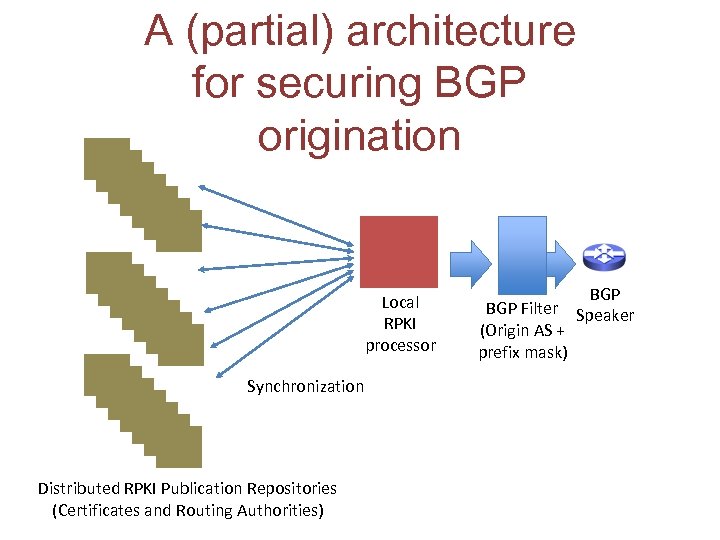
A (partial) architecture for securing BGP origination Local RPKI processor Synchronization Distributed RPKI Publication Repositories (Certificates and Routing Authorities) BGP Filter Speaker (Origin AS + prefix mask)
What about AS Path Validation?
Use AS Certificates • Each router has a router key issued by the AS – Each router adds a signature to a route attribute that is a signature across its own router certificate id, its own AS, and the AS to whom the update is being passed “forward signing” in the AS Path validation
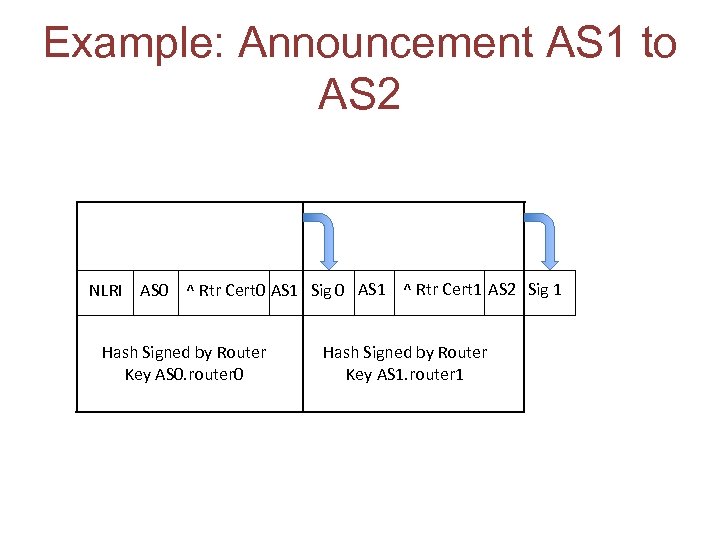
Example: Announcement AS 1 to AS 2 NLRI AS 0 ^ Rtr Cert 0 AS 1 Sig 0 AS 1 ^ Rtr Cert 1 AS 2 Sig 1 Hash Signed by Router Key AS 0. router 0 Hash Signed by Router Key AS 1. router 1
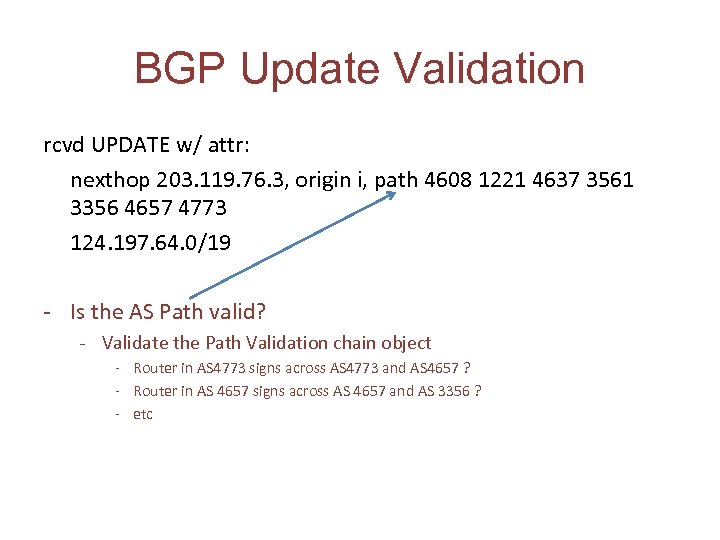
BGP Update Validation rcvd UPDATE w/ attr: nexthop 203. 119. 76. 3, origin i, path 4608 1221 4637 3561 3356 4657 4773 124. 197. 64. 0/19 - Is the AS Path valid? - Validate the Path Validation chain object - Router in AS 4773 signs across AS 4773 and AS 4657 ? - Router in AS 4657 signs across AS 4657 and AS 3356 ? - etc
It’s work in progress 1
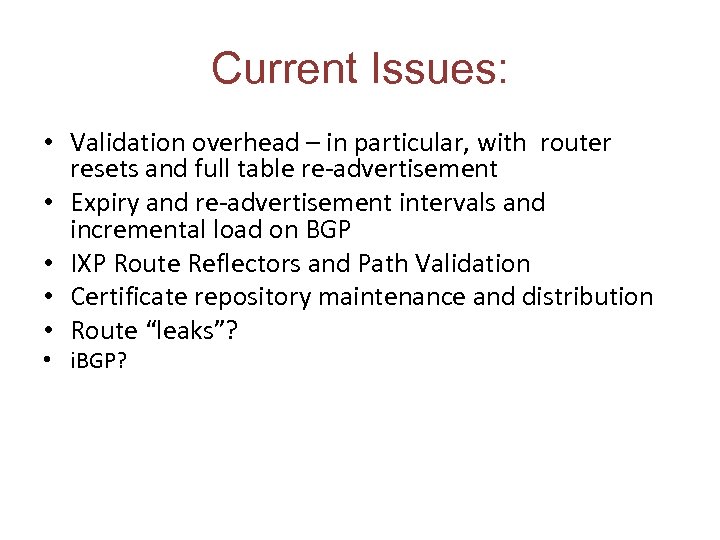
Current Issues: • Validation overhead – in particular, with router resets and full table re-advertisement • Expiry and re-advertisement intervals and incremental load on BGP • IXP Route Reflectors and Path Validation • Certificate repository maintenance and distribution • Route “leaks”? • i. BGP?
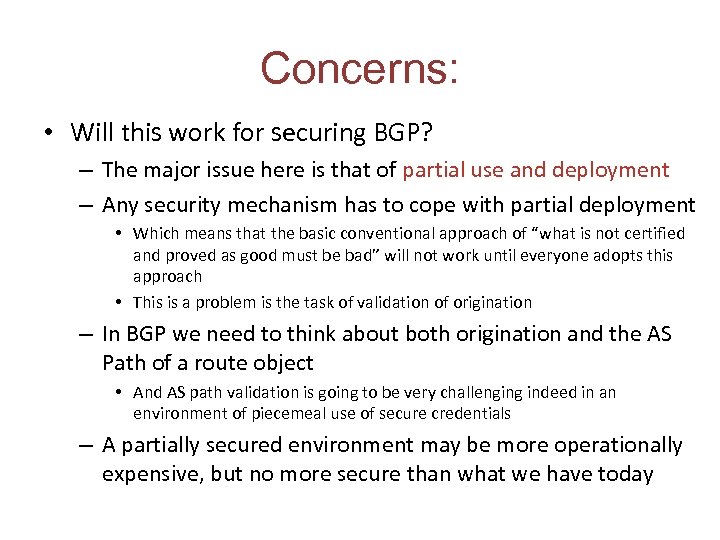
Concerns: • Will this work for securing BGP? – The major issue here is that of partial use and deployment – Any security mechanism has to cope with partial deployment • Which means that the basic conventional approach of “what is not certified and proved as good must be bad” will not work until everyone adopts this approach • This is a problem is the task of validation of origination – In BGP we need to think about both origination and the AS Path of a route object • And AS path validation is going to be very challenging indeed in an environment of piecemeal use of secure credentials – A partially secured environment may be more operationally expensive, but no more secure than what we have today
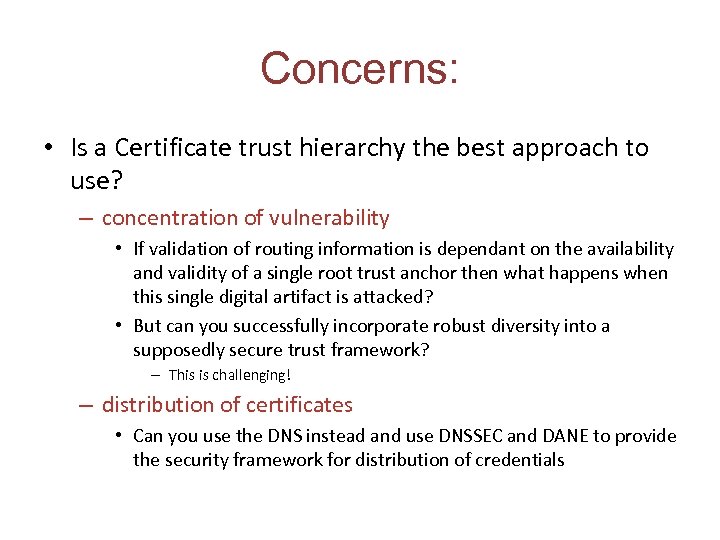
Concerns: • Is a Certificate trust hierarchy the best approach to use? – concentration of vulnerability • If validation of routing information is dependant on the availability and validity of a single root trust anchor then what happens when this single digital artifact is attacked? • But can you successfully incorporate robust diversity into a supposedly secure trust framework? – This is challenging! – distribution of certificates • Can you use the DNS instead and use DNSSEC and DANE to provide the security framework for distribution of credentials
Concerns: • Is this the only way to achieve generally useful outcomes? – Is this form of augmentation to BGP to enforce “protocol payload correctness” over-engineered, and does it rely on impractical models of universal adoption? – Can routing anomaly detectors adequately detect the most prevalent forms of typos and deliberate lies in routing with a far lower overhead, and allow for unilateral detection of routing anomalies?
Routing is a shared problem It’s a “tragedy of the commons” situation: – Nobody can single-handedly apply rigorous tests on the routing system – And the lowest common denominator approach that everyone can apply is to apply no integrity tests at all

Thank You Questions?
Скачать презентацию Securing the Internet Backbone Current activities in the
18217892a5b76cc781ad44abbd7b5e37.ppt