 Скачать презентацию Securing BGP Large scale trust to build an
63ba8e08a54cefe56269ffa44f2f60e5.ppt
- Количество слайдов: 13



Securing BGP Large scale trust to build an Internet again Lutz Donnerhacke db 089309: 1 c 1 c 6311 ef 09 d 819 e 029 65 be bfb 6 c 9 cb 1
A protocol from better times • A protocol from the early Internet • People were friendly and trustworthy • Internet was a warm and fuzzy place • BGP: protocol from admins for managers • Main assumption: Routers do not lie • Idea 1: Announce what you have • Idea 2: Redistribute politically • Inject locally, route globally 2
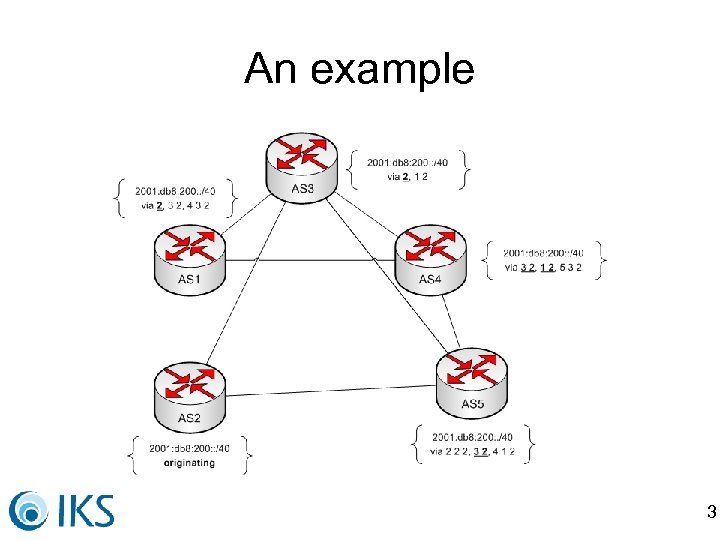
An example 3
Policy documentation • Whois database • Distributed store of resource allocation • Database ensures correctness • RPSL database • Centralized store of peering information • Both views of a peering: Sender / Receiver • Detailed peering policy incl. filter, precedence • Software available • Generates router configuration 4
Threats to BGP • Fat fingers • Announcing wrong network • Prepending foreign ASN • Broken devices • Bitflip in memory or transit • Commercial/criminal attacks • Redirect traffic (claim prefix, claim peering) • Inject unallocated networks (sending Spam) • Governmental/Lawful attacks • Filtering traffic to protect the innocent 5
so. BGP • Trustworthy ISP approach • Transport authorisations as BGP attribute • Certifying assignment of a prefix by parent • Each AS is a X. 509 -CA • Certifying injection policy per prefix (which ASNs are/is/isn’t the first peerings) • Certifying it own peering policy with peers • Web of trust • Resilience against erroneous behaviour • Permitting multiple hierarchies 6
S(ecure)-BGP • RPKI approach • Transport authorisations as BGP attribute • Certifying allocation of prefix/ASN top-down • Each ISP is a X. 509 -CA • Certifying injection policy: Prefixes per ASN • Certifying it own routers to sign redistribution • Trust anchor management • Accessing various CA repositories 7
S-BGP operation • Routers • Access external caches for object verification • Sign each update announcement • New hardware for storage and crypto operation • Resource deallocation • Prefix updates time out => ~15 updates/s • Certificate and CRL times out => rsync • Only one structure • Errors are disastrous • Ideal for LE 8
An other approach • RPSL / Whois • • Use it for non-local checks (was it allowed? ) No modification to BGP protocol Skips gaps in deployment Fails to deal with non-public policies • Use DNSSEC ? • DNS as a trustworthy, distributed database • Routers: Offload crypto to AD-bit, caching implicit • Drastic RPSL simplification necessary 9
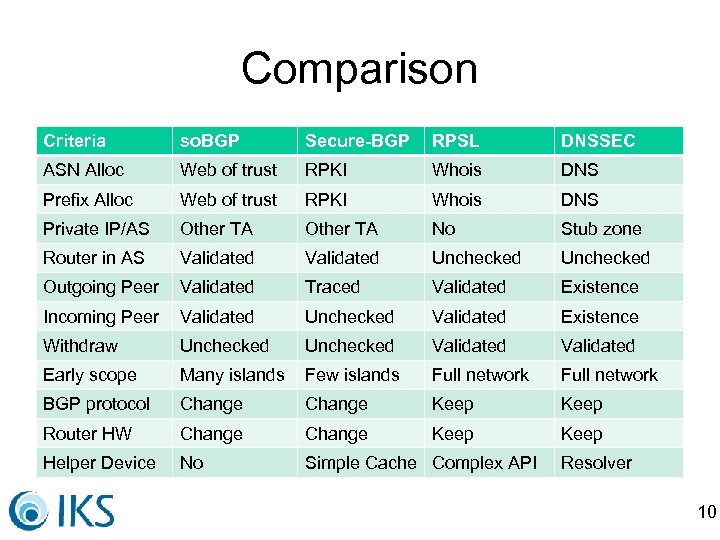
Comparison Criteria so. BGP Secure-BGP RPSL DNSSEC ASN Alloc Web of trust RPKI Whois DNS Prefix Alloc Web of trust RPKI Whois DNS Private IP/AS Other TA No Stub zone Router in AS Validated Unchecked Outgoing Peer Validated Traced Validated Existence Incoming Peer Validated Unchecked Validated Existence Withdraw Unchecked Validated Early scope Many islands Few islands Full network BGP protocol Change Keep Router HW Change Keep Helper Device No Simple Cache Complex API Resolver 10
Questions? 11
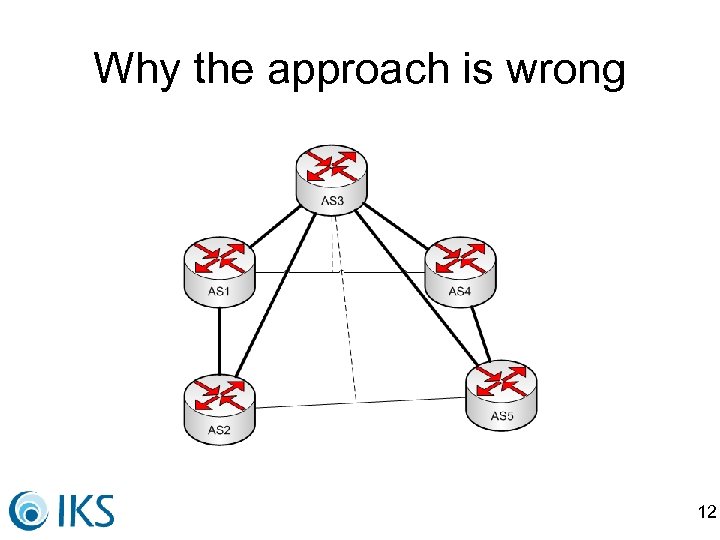
Why the approach is wrong 12
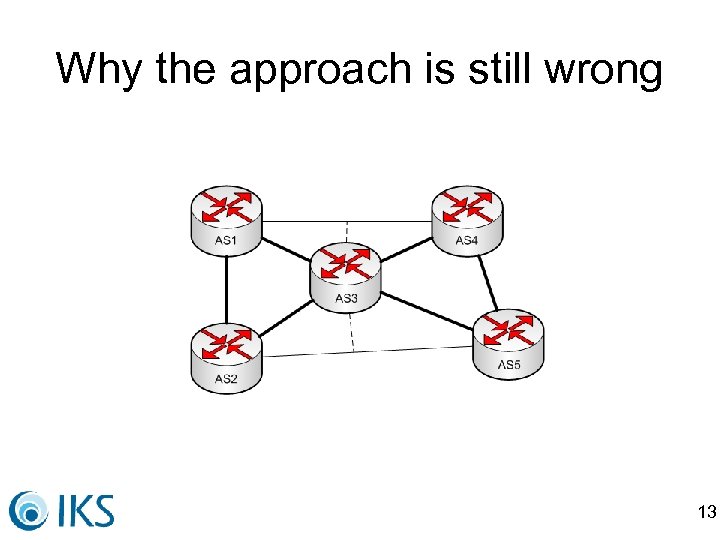
Why the approach is still wrong 13
Скачать презентацию Securing BGP Large scale trust to build an
63ba8e08a54cefe56269ffa44f2f60e5.ppt