


 Скачать презентацию Secured Transactions Assignment 3 Repossession of Collateral 1
a5d55fea1c667cbd494de7daa85c0d92.ppt
- Количество слайдов: 104
 Secured Transactions Assignment 3 Repossession of Collateral 1
 Chapter 1: Creditors’ Remedies Under State Law Assignment 1: Remedies of Unsecured Creditors Assignment 2: Security and Foreclosure: title Assignment 3: Repossession: possession ************** Title and possession are independent Foreclosure without repossession: Davet, p. 31 Repossession without foreclosure: Assignment 5 2
 Chapter 1: Creditors’ Remedies Under State Law Assignment 1: Remedies of Unsecured Creditors Assignment 2: Security and Foreclosure: title Assignment 3: Repossession: possession ************** Title and possession are independent Foreclosure without repossession: Davet, p. 31 Repossession without foreclosure: Assignment 5 3
 Chapter 1: Creditors’ Remedies Under State Law Assignment 1: Remedies of Unsecured Creditors Assignment 2: Security and Foreclosure: title (can occur without repossession – writ of assistance) 4
 Chapter 1: Creditors’ Remedies Under State Law Assignment 1: Remedies of Unsecured Creditors Assignment 2: Security and Foreclosure: title (can occur without repossession – writ of assistance) Assignment 3: Repossession: possession 5
 Chapter 1: Creditors’ Remedies Under State Law Assignment 1: Remedies of Unsecured Creditors Assignment 2: Security and Foreclosure: title (can occur without repossession – writ of assistance) Assignment 3: Repossession: possession (can occur without foreclosure – cases in this assignment) 6
 Basic Concepts: Repossession 1. Replevin 2. Self help 3. Receiver 4. Breach of the peace 5. Trespass 6. Privilege to trespass 7. Concealment 7
 Basic Concepts: Repossession Replevin: A cause of action (writ) for possession 8
 Basic Concepts: Repossession Replevin: A cause of action (writ) for possession 1. Secured party has right to possession UCC § 9 -609 9
 Basic Concepts: Repossession Replevin: A cause of action (writ) for possession 1. Secured party has right to possession UCC § 9 -609 2. Powerful: sheriff delivers temporary possession early 10
 Basic Concepts: Repossession Replevin: A cause of action (writ) for possession 1. Secured party has right to possession UCC § 9 -609 2. Powerful: sheriff delivers temporary possession early 3. Two procedures both Constitutional: 11
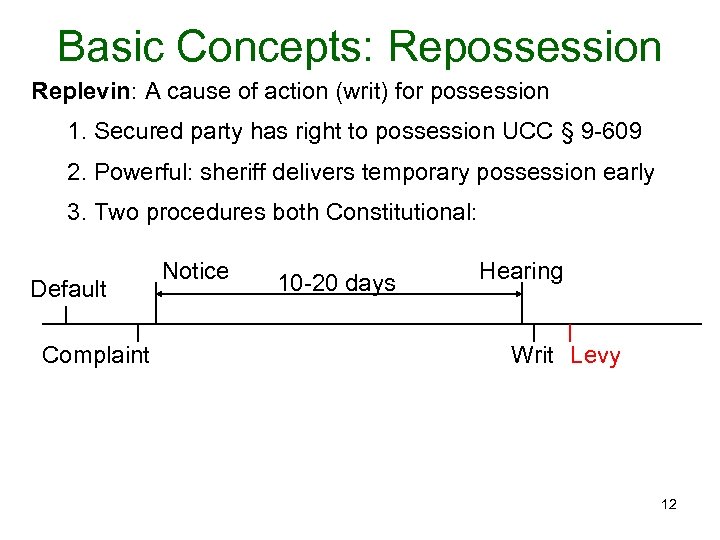 Basic Concepts: Repossession Replevin: A cause of action (writ) for possession 1. Secured party has right to possession UCC § 9 -609 2. Powerful: sheriff delivers temporary possession early 3. Two procedures both Constitutional: Default Complaint Notice 10 -20 days Hearing Writ Levy 12
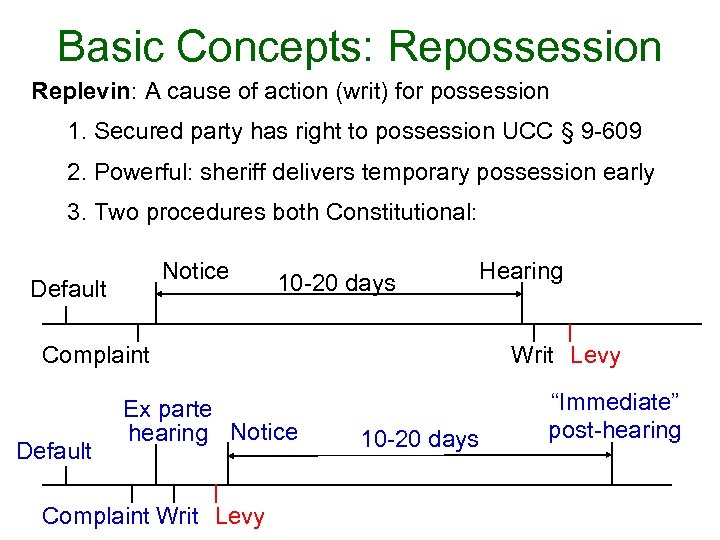 Basic Concepts: Repossession Replevin: A cause of action (writ) for possession 1. Secured party has right to possession UCC § 9 -609 2. Powerful: sheriff delivers temporary possession early 3. Two procedures both Constitutional: Notice Default 10 -20 days Complaint Default Ex parte hearing Notice Complaint Writ Levy Hearing Writ Levy 10 -20 days “Immediate” post-hearing
 Basic Concepts: Repossession 14
 Basic Concepts: Repossession Breach of the peace (limits self help, not sheriff levy) 15
 Basic Concepts: Repossession Breach of the peace (limits self help, not sheriff levy) 1. Criminal standard: Public disturbance 16
 Basic Concepts: Repossession Breach of the peace (limits self help, not sheriff levy) 1. Criminal standard: Public disturbance 2. Article 9 standard: “Tending to provoke others to break the peace, ” Callaway v. Whittenton Trespass 1. Criminal standard: “after warning” 2. Civil: Entry on land without express or implied authority Privilege (to trespass): An entry to repossess is privileged if “there [is] no confrontation and the timing and manner, including notice or lack of notice, are found reasonable. ” Concealment: "Whoever. . . conceals any personal property in which he knows another has a security interest. . . is guilty 17 of a Class E felony" Wis. Stat. § 943. 25
 Basic Concepts: Repossession Breach of the peace (limits self help, not sheriff levy) 1. Criminal standard: Public disturbance 2. Article 9 standard: “Tending to provoke others to break the peace, ” Callaway v. Whittenton Trespass 1. Criminal standard: “after warning” 2. Civil: Entry on land without express or implied authority Privilege (to trespass): An entry to repossess is privileged if “there [is] no confrontation and the timing and manner, including notice or lack of notice, are found reasonable. ” Concealment: "Whoever. . . conceals any personal property in which he knows another has a security interest. . . is guilty 18 of a Class E felony" Wis. Stat. § 943. 25
 Basic Concepts: Repossession Breach of the peace (limits self help, not sheriff levy) 1. Criminal standard: Public disturbance 2. Article 9 standard: “Tending to provoke others to break the peace, ” Callaway v. Whittenton Trespass 1. Criminal standard: fenced, posted, “after warning” 2. Civil: Entry on land without express or implied authority Privilege (to trespass): An entry to repossess is privileged if “there [is] no confrontation and the timing and manner, including notice or lack of notice, are found reasonable. ” Concealment: "Whoever. . . conceals any personal property in which he knows another has a security interest. . . is guilty 19 of a Class E felony" Wis. Stat. § 943. 25
 Basic Concepts: Repossession Breach of the peace (limits self help, not sheriff levy) 1. Criminal standard: Public disturbance 2. Article 9 standard: “Tending to provoke others to break the peace, ” Callaway v. Whittenton Trespass 1. Criminal standard: fenced, posted, “after warning” 2. Civil: Intentional entry on land without authority Privilege (to trespass): An entry to repossess is privileged if “there [is] no confrontation and the timing and manner, including notice or lack of notice, are found reasonable. ” Concealment: "Whoever. . . conceals any personal property in which he knows another has a security interest. . . is guilty 20 of a Class E felony" Wis. Stat. § 943. 25
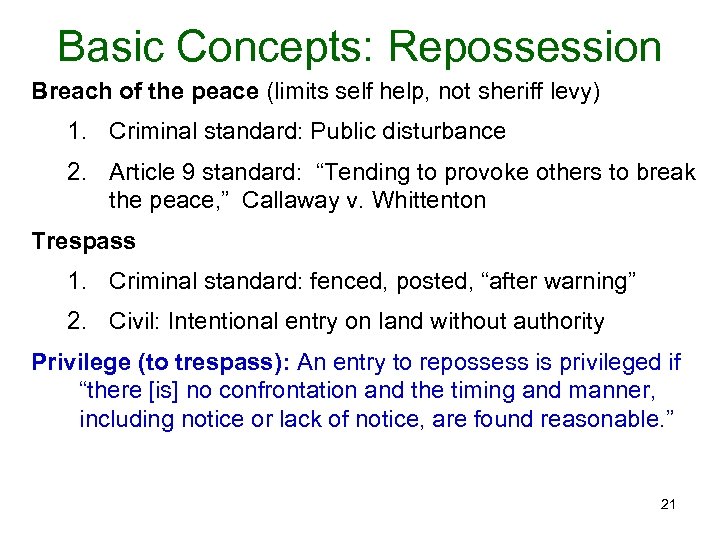 Basic Concepts: Repossession Breach of the peace (limits self help, not sheriff levy) 1. Criminal standard: Public disturbance 2. Article 9 standard: “Tending to provoke others to break the peace, ” Callaway v. Whittenton Trespass 1. Criminal standard: fenced, posted, “after warning” 2. Civil: Intentional entry on land without authority Privilege (to trespass): An entry to repossess is privileged if “there [is] no confrontation and the timing and manner, including notice or lack of notice, are found reasonable. ” Concealment: "Whoever. . . conceals any personal property in which he knows another has a security interest. . . is guilty 21 of a Class E felony" Wis. Stat. § 943. 25
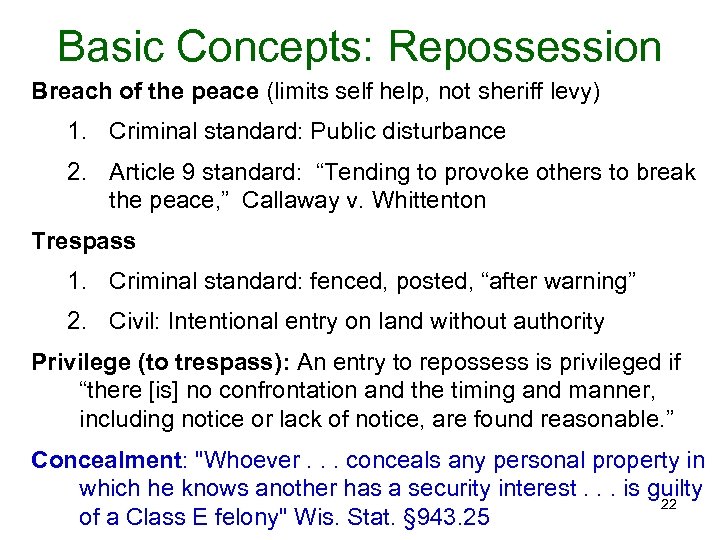 Basic Concepts: Repossession Breach of the peace (limits self help, not sheriff levy) 1. Criminal standard: Public disturbance 2. Article 9 standard: “Tending to provoke others to break the peace, ” Callaway v. Whittenton Trespass 1. Criminal standard: fenced, posted, “after warning” 2. Civil: Intentional entry on land without authority Privilege (to trespass): An entry to repossess is privileged if “there [is] no confrontation and the timing and manner, including notice or lack of notice, are found reasonable. ” Concealment: "Whoever. . . conceals any personal property in which he knows another has a security interest. . . is guilty 22 of a Class E felony" Wis. Stat. § 943. 25
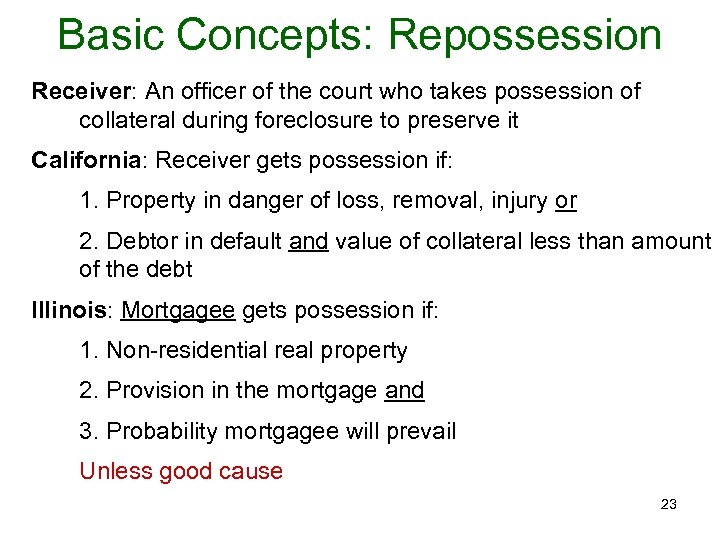 Basic Concepts: Repossession Receiver: An officer of the court who takes possession of collateral during foreclosure to preserve it California: Receiver gets possession if: 1. Property in danger of loss, removal, injury or 2. Debtor in default and value of collateral less than amount of the debt Illinois: Mortgagee gets possession if: 1. Non-residential real property 2. Provision in the mortgage and 3. Probability mortgagee will prevail Unless good cause 23
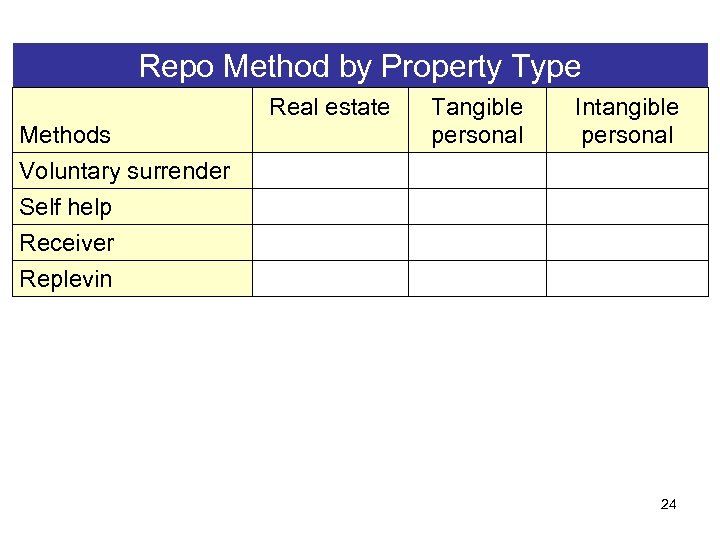 Repo Method by Property Type Real estate Methods Voluntary surrender Tangible personal Intangible personal Self help Receiver Replevin 24
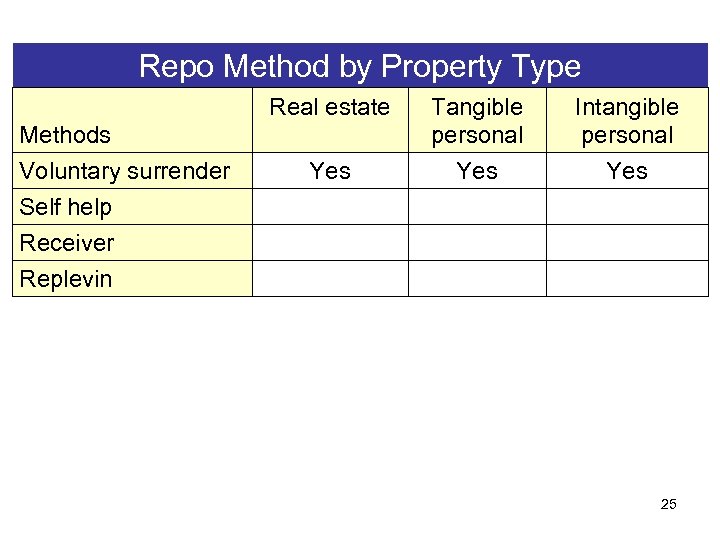 Repo Method by Property Type Real estate Methods Voluntary surrender Yes Tangible personal Yes Intangible personal Yes Self help Receiver Replevin 25
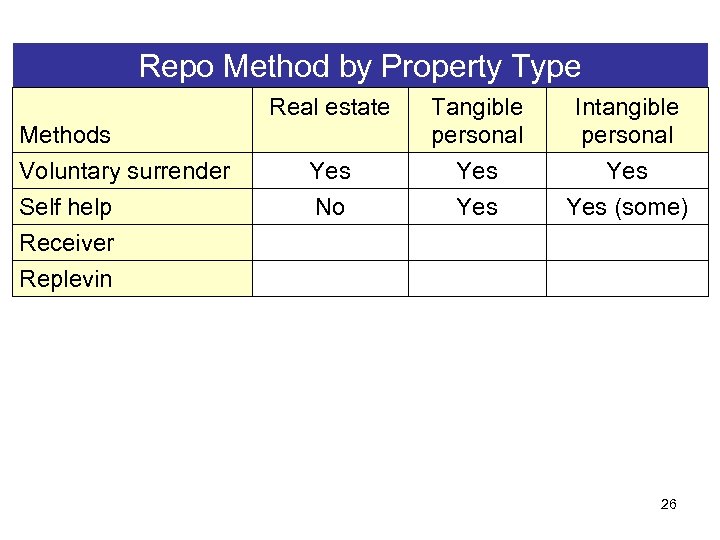 Repo Method by Property Type Real estate Methods Voluntary surrender Self help Receiver Replevin Yes Tangible personal Yes Intangible personal Yes No Yes (some) 26
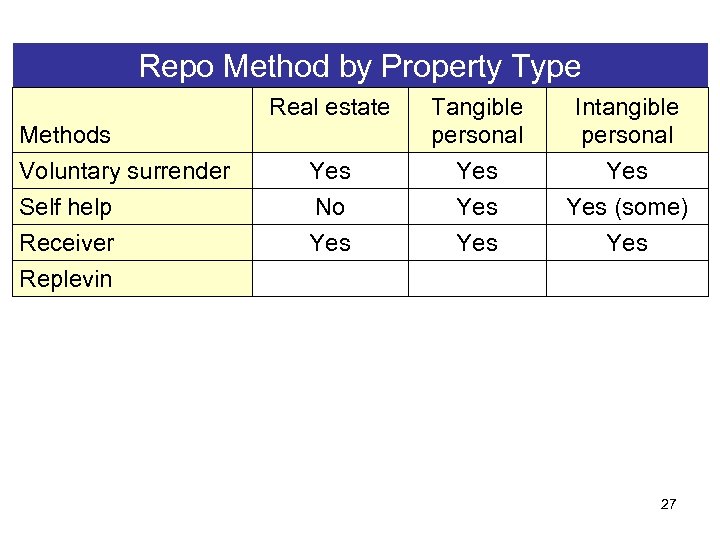 Repo Method by Property Type Real estate Methods Voluntary surrender Self help Receiver Replevin Yes Tangible personal Yes Intangible personal Yes No Yes Yes (some) Yes 27
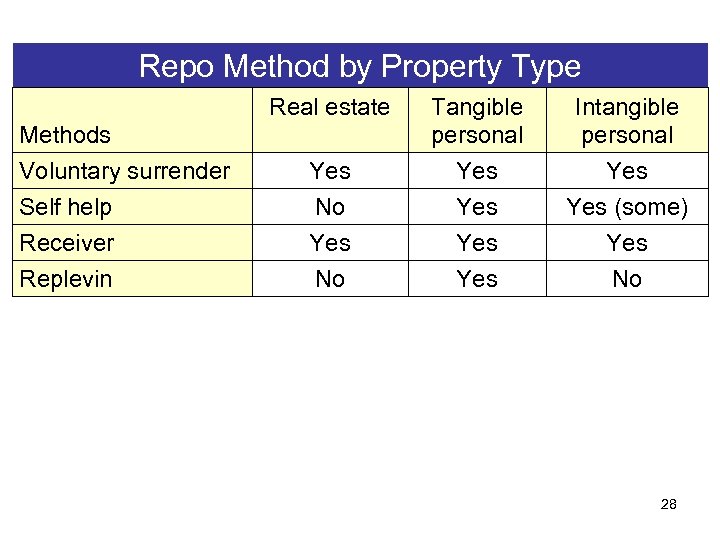 Repo Method by Property Type Real estate Methods Voluntary surrender Yes Tangible personal Yes Self help Receiver Replevin No Yes Yes Intangible personal Yes (some) Yes No 28
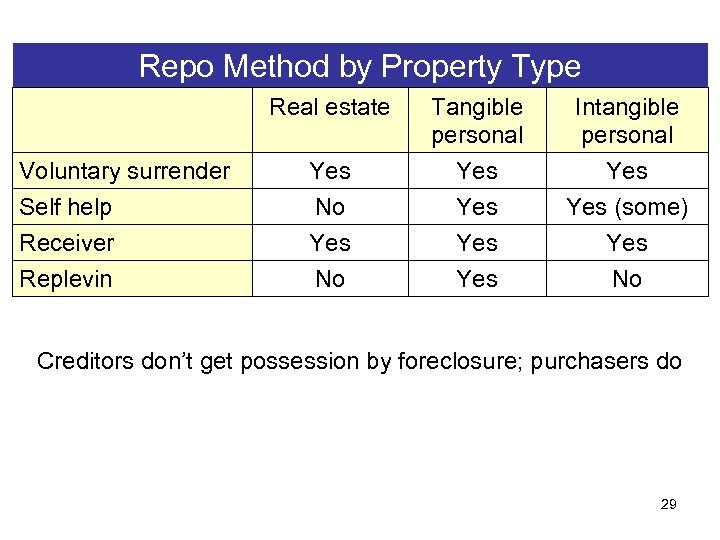 Repo Method by Property Type Real estate Voluntary surrender Yes Tangible personal Yes Self help Receiver Replevin No Yes Yes Intangible personal Yes (some) Yes No Creditors don’t get possession by foreclosure; purchasers do 29
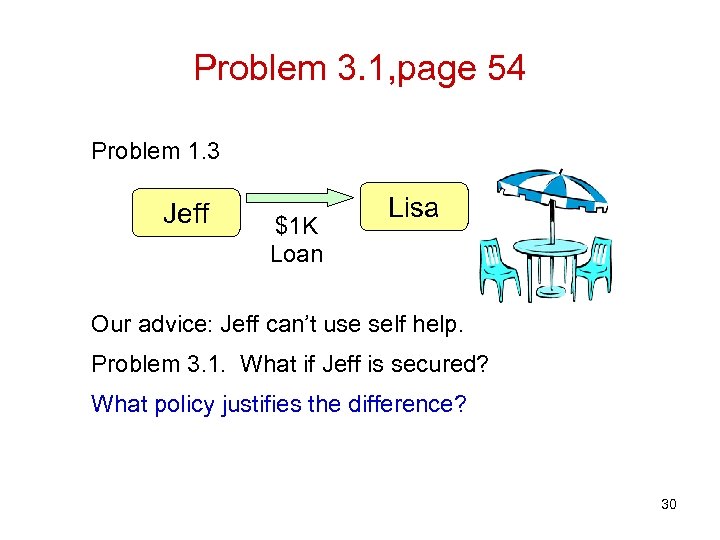 Problem 3. 1, page 54 Problem 1. 3 Jeff $1 K Loan Lisa Our advice: Jeff can’t use self help. Problem 3. 1. What if Jeff is secured? What policy justifies the difference? 30
 Problem 3. 2, page 54 How do we repossess? 32
 Problem 3. 2, page 54 How do we repossess? Owner 33
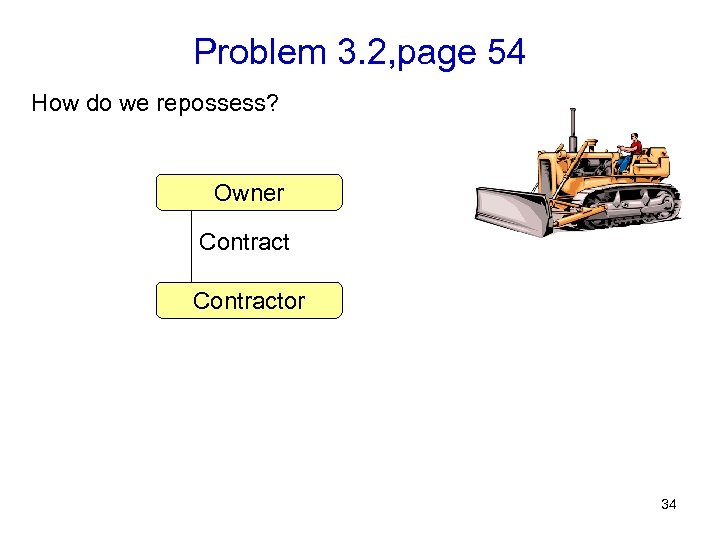 Problem 3. 2, page 54 How do we repossess? Owner Contractor 34
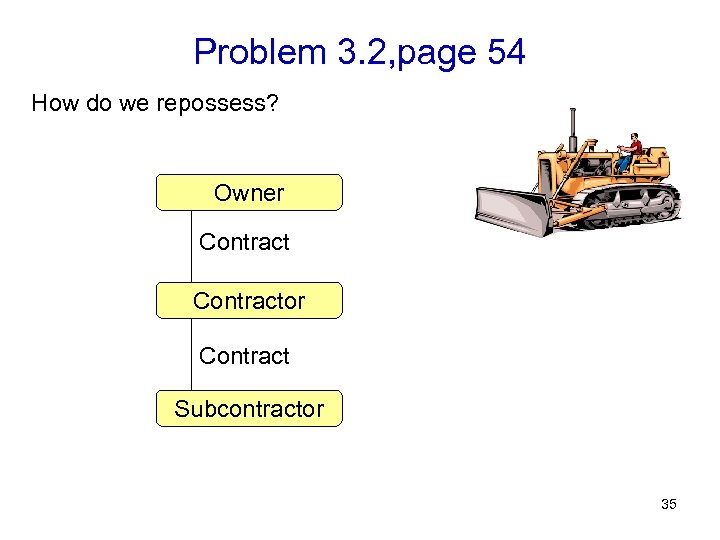 Problem 3. 2, page 54 How do we repossess? Owner Contractor Contract Subcontractor 35
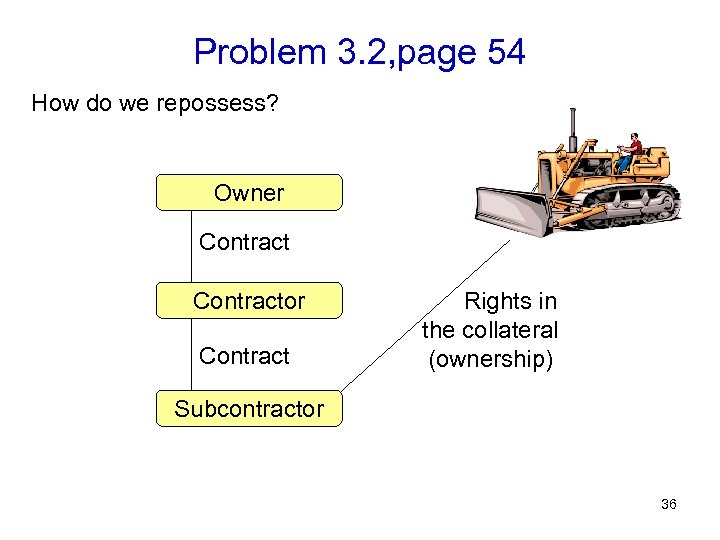 Problem 3. 2, page 54 How do we repossess? Owner Contractor Contract Rights in the collateral (ownership) Subcontractor 36
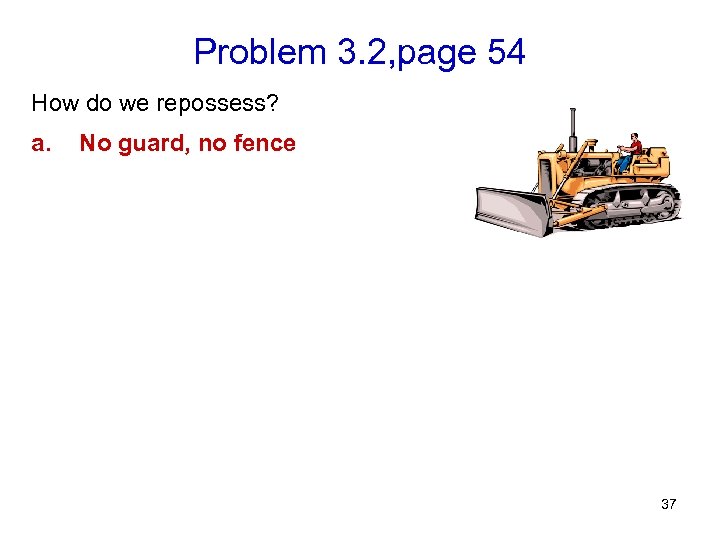 Problem 3. 2, page 54 How do we repossess? a. No guard, no fence 37
 Problem 3. 2, page 54 How do we repossess? a. No guard, no fence - Time of day? 38
 Problem 3. 2, page 54 How do we repossess? a. No guard, no fence - Time of day? - OK to trespass? 39
 Problem 3. 2, page 54 How do we repossess? a. No guard, no fence - Time of day? - OK to trespass? - Give prior notice? 40
 Problem 3. 2, page 54 How do we repossess? a. No guard, no fence - Time of day? - OK to trespass? - Give prior notice? - If someone objects? 41
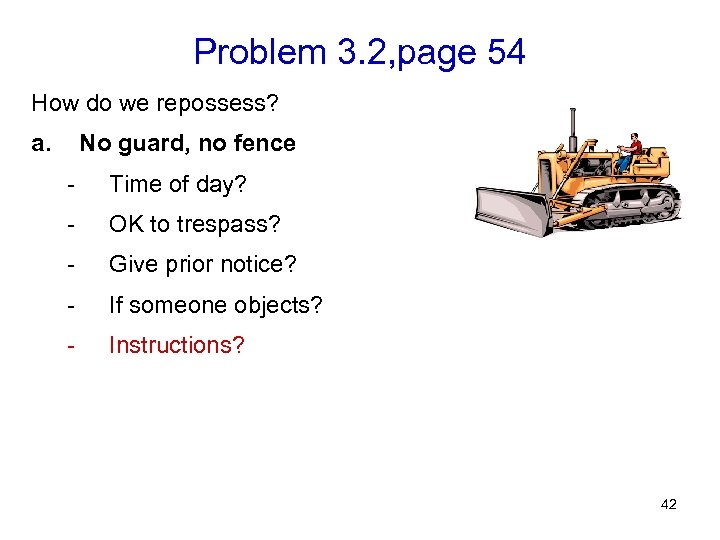 Problem 3. 2, page 54 How do we repossess? a. No guard, no fence - Time of day? - OK to trespass? - Give prior notice? - If someone objects? - Instructions? 42
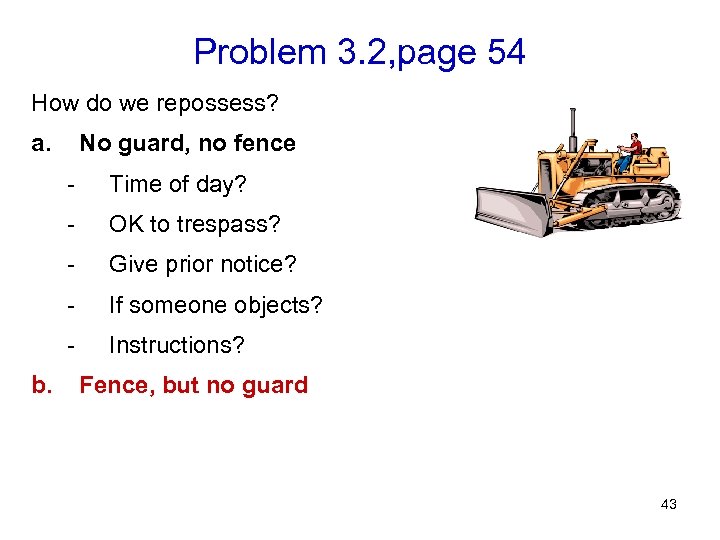 Problem 3. 2, page 54 How do we repossess? a. No guard, no fence - OK to trespass? - Give prior notice? - If someone objects? b. Time of day? Instructions? Fence, but no guard 43
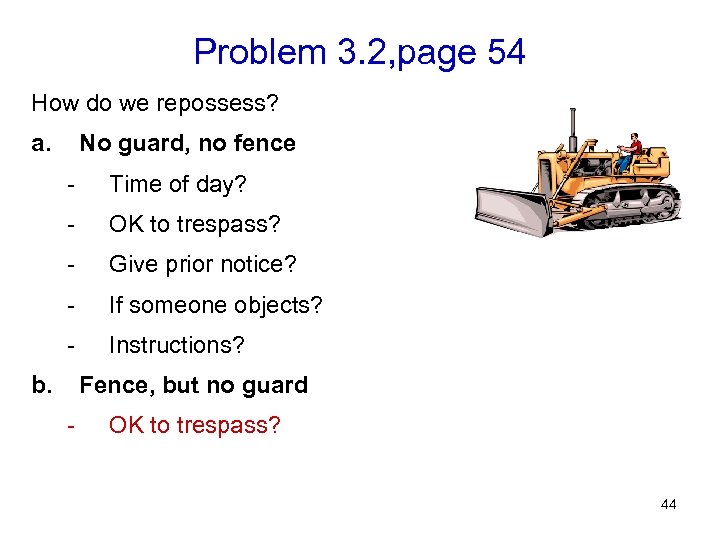 Problem 3. 2, page 54 How do we repossess? a. No guard, no fence - Time of day? - OK to trespass? - Give prior notice? - If someone objects? - Instructions? b. Fence, but no guard - OK to trespass? 44
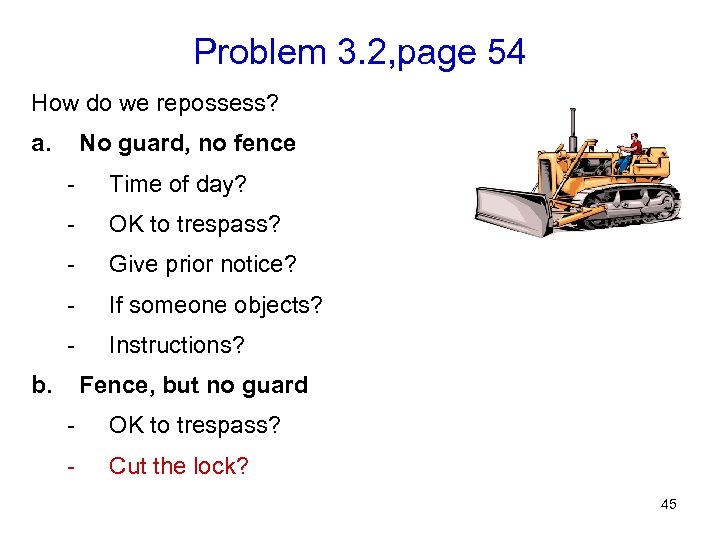 Problem 3. 2, page 54 How do we repossess? a. No guard, no fence - Time of day? - OK to trespass? - Give prior notice? - If someone objects? - Instructions? b. Fence, but no guard - OK to trespass? - Cut the lock? 45
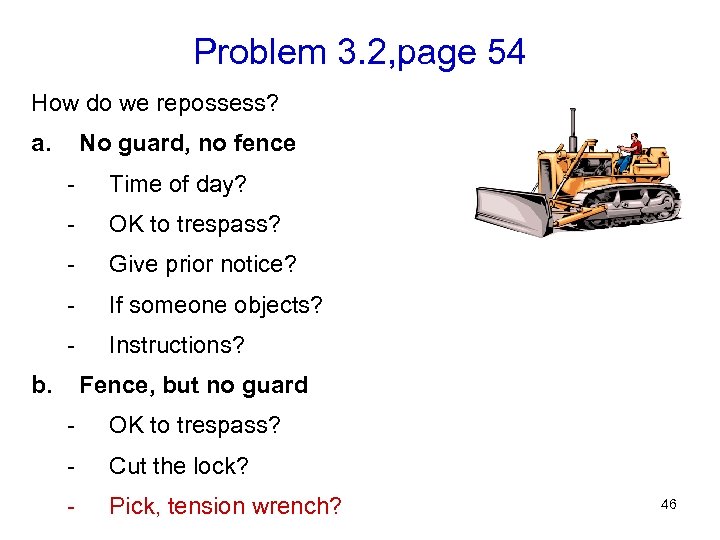 Problem 3. 2, page 54 How do we repossess? a. No guard, no fence - Time of day? - OK to trespass? - Give prior notice? - If someone objects? - Instructions? b. Fence, but no guard - OK to trespass? - Cut the lock? - Pick, tension wrench? 46
 Problem 3. 2, page 54 How do we repossess? a. No guard, no fence - Time of day? - OK to trespass? - Give prior notice? - If someone objects? - c. Guard and fence Instructions? b. Fence, but no guard - OK to trespass? - Cut the lock? - Pick, tension wrench? 47
 Problem 3. 2, page 54 How do we repossess? a. No guard, no fence - Time of day? - Give prior notice? - If someone objects? - What happens if we ask for the dozer? OK to trespass? - c. Guard and fence Instructions? b. Fence, but no guard - OK to trespass? - Cut the lock? - Pick, tension wrench? 48
 Problem 3. 2, page 54 How do we repossess? a. No guard, no fence c. Guard and fence - Time of day? What happens if we ask for the dozer? - OK to trespass? What if we defraud? - Give prior notice? - If someone objects? - Instructions? b. Fence, but no guard - OK to trespass? - Cut the lock? - Pick, tension wrench? 49
 Problem 3. 2, page 54 How do we repossess? a. No guard, no fence c. Guard and fence - Time of day? What happens if we ask for the dozer? - OK to trespass? What if we defraud? - Give prior notice? - If someone objects? - Instructions? b. d. In debtor’s steel building Fence, but no guard - OK to trespass? - Cut the lock? - Pick, tension wrench? 50
 Problem 3. 2, page 54 How do we repossess? a. No guard, no fence c. Guard and fence - Time of day? What happens if we ask for the dozer? - OK to trespass? What if we defraud? - Give prior notice? - If someone objects? - Instructions? b. d. In debtor’s steel building Pick the lock? Fence, but no guard - OK to trespass? - Cut the lock? - Pick, tension wrench? 51
 Problem 3. 2, page 54 How do we repossess? a. No guard, no fence c. Guard and fence - Time of day? What happens if we ask for the dozer? - OK to trespass? What if we defraud? - Give prior notice? - If someone objects? Pick the lock? - Instructions? If interrupted? Return? b. d. In debtor’s steel building Fence, but no guard - OK to trespass? - Cut the lock? - Pick, tension wrench? 52
 Problem 3. 2, page 54 How do we repossess? a. No guard, no fence c. Guard and fence - Time of day? What happens if we ask for the dozer? - OK to trespass? What if we defraud? - Give prior notice? - If someone objects? Pick the lock? - Instructions? If interrupted? Return? b. Fence, but no guard - OK to trespass? - Pick, tension wrench? e. Anything we should put in the security agreement? Cut the lock? - d. In debtor’s steel building 53
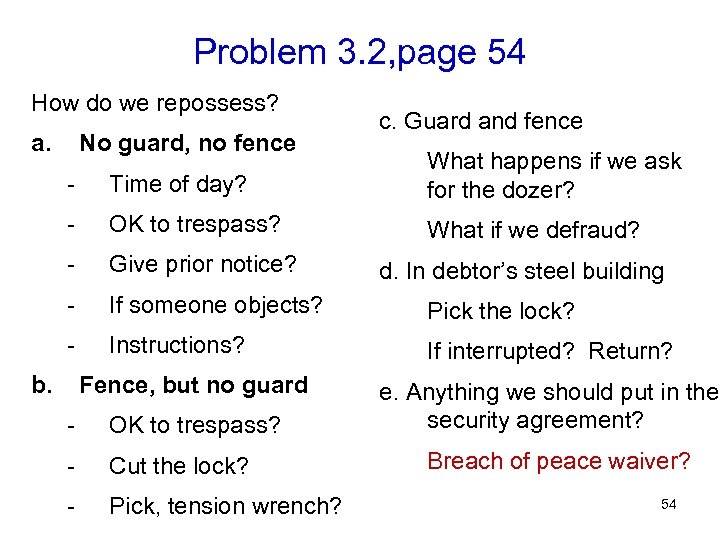 Problem 3. 2, page 54 How do we repossess? a. No guard, no fence c. Guard and fence - Time of day? What happens if we ask for the dozer? - OK to trespass? What if we defraud? - Give prior notice? - If someone objects? Pick the lock? - Instructions? If interrupted? Return? b. Fence, but no guard - OK to trespass? - Cut the lock? - Pick, tension wrench? d. In debtor’s steel building e. Anything we should put in the security agreement? Breach of peace waiver? 54
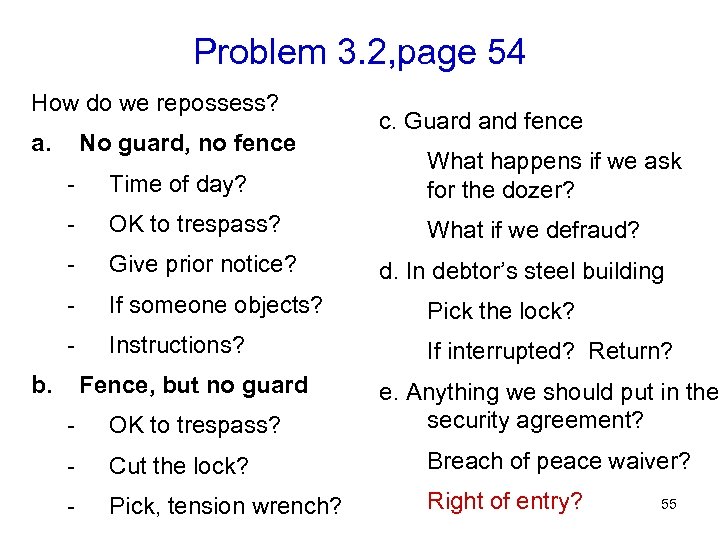 Problem 3. 2, page 54 How do we repossess? a. No guard, no fence c. Guard and fence - Time of day? What happens if we ask for the dozer? - OK to trespass? What if we defraud? - Give prior notice? - If someone objects? Pick the lock? - Instructions? If interrupted? Return? b. Fence, but no guard d. In debtor’s steel building e. Anything we should put in the security agreement? - OK to trespass? - Cut the lock? Breach of peace waiver? - Pick, tension wrench? Right of entry? 55
 Problem 3. 3, page 54 How do we prevent repossession “for a week or two? ” 56
 Problem 3. 3, page 54 How do we prevent repossession “for a week or two? ” - What if the repossessors persist? 57
 Problem 3. 3, page 54 How do we prevent repossession “for a week or two? ” - What if the repossessors persist? Gun? 58
 Problem 3. 3, page 54 How do we prevent repossession “for a week or two? ” - What if the repossessors persist? Gun? - Is there an ethical problem? Rule 1. 2 59
 Problem 3. 3, page 54 How do we prevent repossession “for a week or two? ” - What if the repossessors persist? Gun? - Is there an ethical problem? Rule 1. 2 What if they bring the sheriff? 60
 Problem 3. 3, page 54 How do we prevent repossession “for a week or two? ” - What if the repossessors persist? Gun? - Is there an ethical problem? Rule 1. 2 What if they bring the sheriff? - Self help? - Writ of replevin? 61
 Problem 3. 3, page 54 How do we prevent repossession “for a week or two? ” - What if the repossessors persist? Gun? - Is there an ethical problem? Rule 1. 2 What if they bring the sheriff? - Self help? - Writ of replevin? Should we resist the sheriff? 67
 Problem 3. 3, page 54 How do we prevent repossession “for a week or two? ” - What if the repossessors persist? Gun? - Is there an ethical problem? Rule 1. 2 What if they bring the sheriff? - Self help? - Writ of replevin? Should we resist the sheriff? Should we call sheriff? 68
 Problem 3. 3, page 54 How do we prevent repossession “for a week or two? ” - What if the repossessors persist? Gun? - Is there an ethical problem? Rule 1. 2 What if they bring the sheriff? - Self help? - Writ of replevin? Should we resist the sheriff? Should we call sheriff? “Officers. . . cross the line if they affirmatively intervene to aid the repossessor. ” Marcus 69
 Problem 3. 3, page 54 How do we prevent repossession “for a week or two? ” - What if the repossessors persist? Gun? - Is there an ethical problem? Rule 1. 2 What if they bring the sheriff? - Self help? - Writ of replevin? Should we resist the sheriff? Should we call sheriff? “Officers. . . cross the line if they affirmatively intervene to aid the repossessor. ” Marcus Should we hide the bulldozer? 70
 Problem 3. 3, page 54 How do we prevent repossession “for a week or two? ” - What if the repossessors persist? Gun? - Is there an ethical problem? Rule 1. 2 What if they bring the sheriff? - Self help? - Writ of replevin? Should we resist the sheriff? Should we call sheriff? “Officers. . . cross the line if they affirmatively intervene to aid the repossessor. ” Marcus Should we hide the bulldozer? No: Wis. Stat. 943. 25 71
 Problem 3. 3, page 54 How do we prevent repossession “for a week or two? ” - What if the repossessors persist? Gun? - Is there an ethical problem? Rule 1. 2 What if they bring the sheriff? - Self help? - Writ of replevin? Should we resist the sheriff? Should we call sheriff? “Officers. . . cross the line if they affirmatively intervene to aid the repossessor. ” Marcus Should we hide the bulldozer? No: Wis. Stat. 943. 25 Is the District Attorney going to prosecute Sal for hiding his own bulldozer? 72
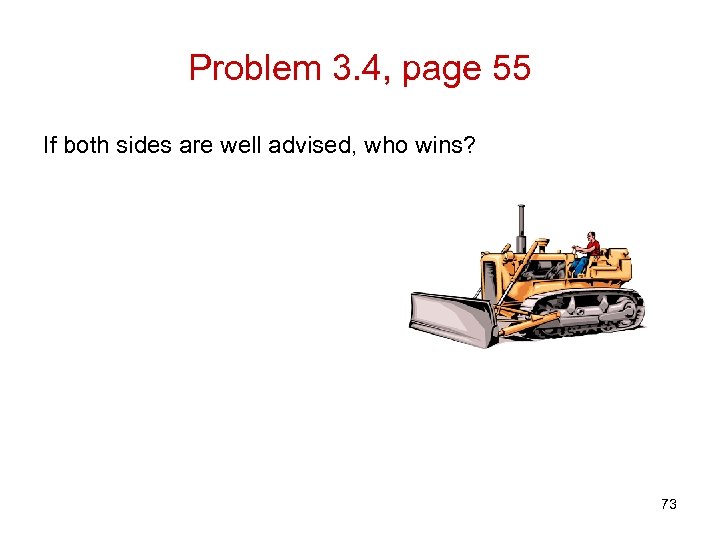 Problem 3. 4, page 55 If both sides are well advised, who wins? 73
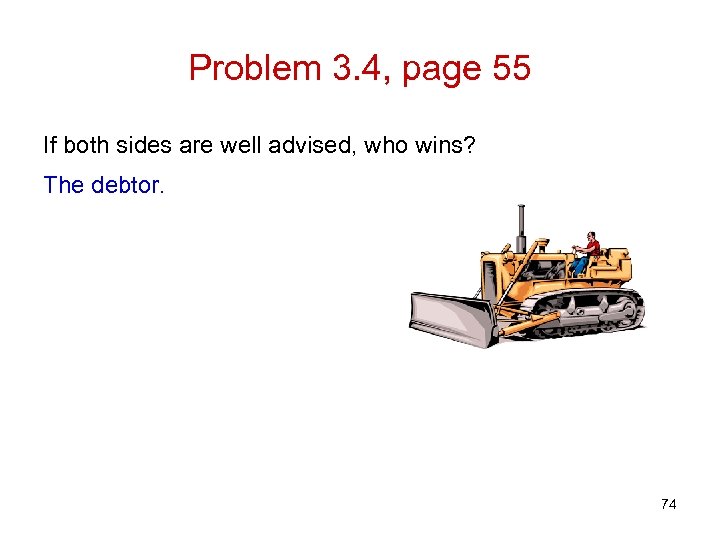 Problem 3. 4, page 55 If both sides are well advised, who wins? The debtor. 74
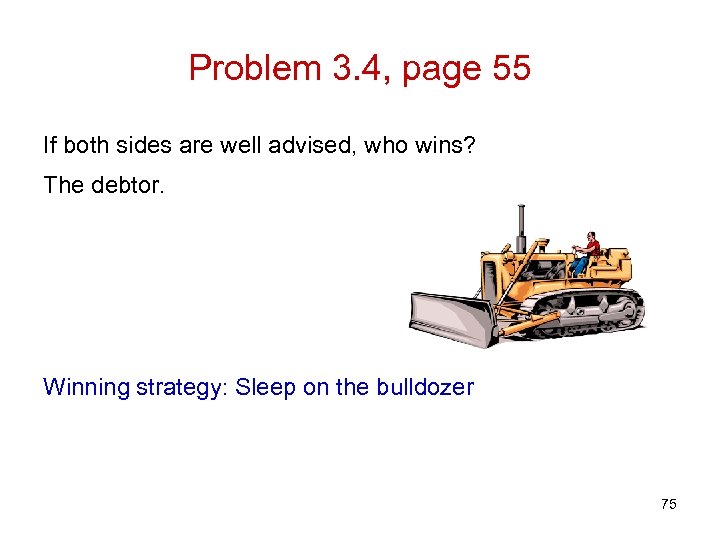 Problem 3. 4, page 55 If both sides are well advised, who wins? The debtor. Winning strategy: Sleep on the bulldozer 75
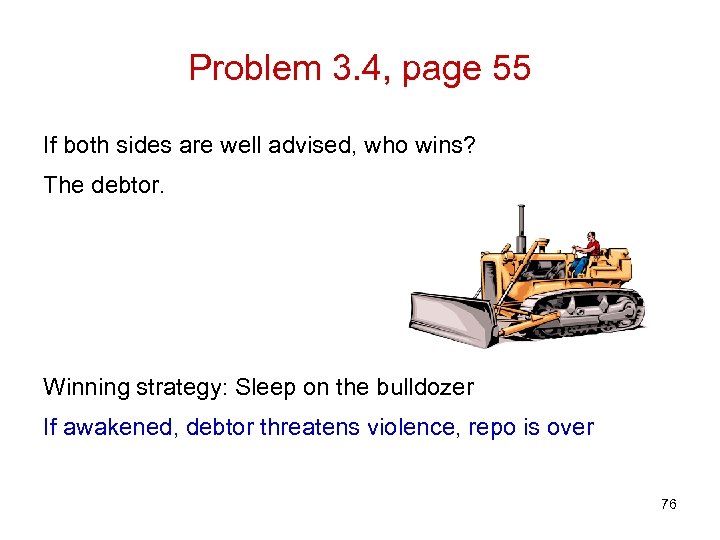 Problem 3. 4, page 55 If both sides are well advised, who wins? The debtor. Winning strategy: Sleep on the bulldozer If awakened, debtor threatens violence, repo is over 76
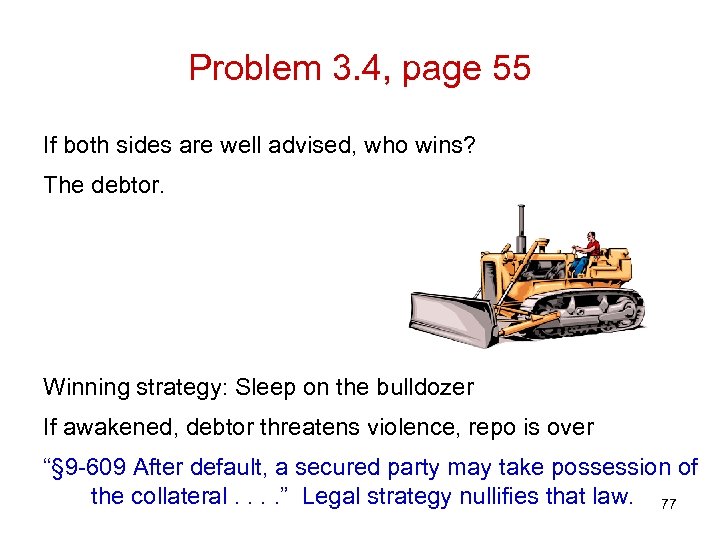 Problem 3. 4, page 55 If both sides are well advised, who wins? The debtor. Winning strategy: Sleep on the bulldozer If awakened, debtor threatens violence, repo is over “§ 9 -609 After default, a secured party may take possession of the collateral. . ” Legal strategy nullifies that law. 77
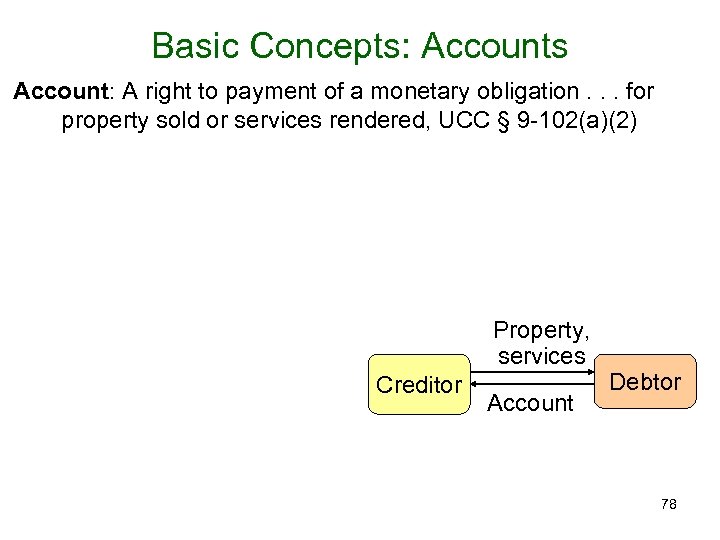 Basic Concepts: Accounts Account: A right to payment of a monetary obligation. . . for property sold or services rendered, UCC § 9 -102(a)(2) Property, services Creditor Account Debtor 78
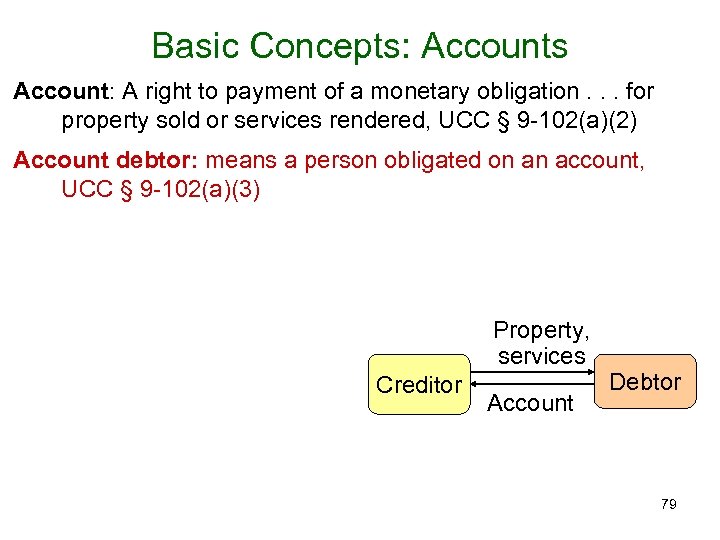 Basic Concepts: Accounts Account: A right to payment of a monetary obligation. . . for property sold or services rendered, UCC § 9 -102(a)(2) Account debtor: means a person obligated on an account, UCC § 9 -102(a)(3) Property, services Creditor Account Debtor 79
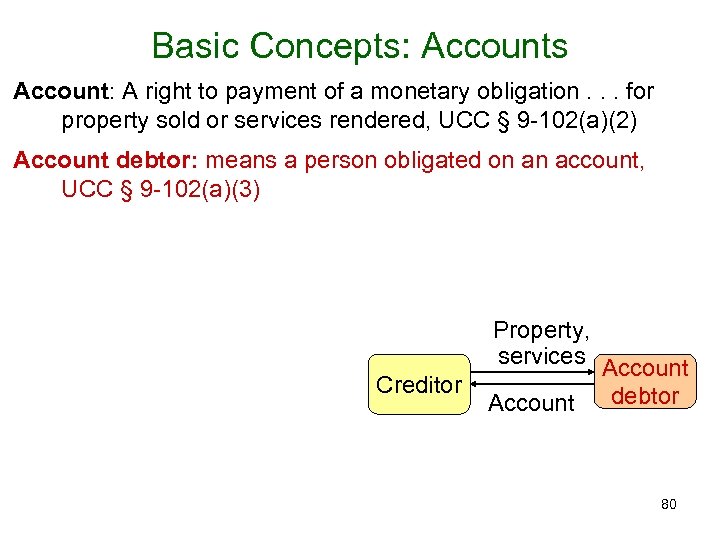 Basic Concepts: Accounts Account: A right to payment of a monetary obligation. . . for property sold or services rendered, UCC § 9 -102(a)(2) Account debtor: means a person obligated on an account, UCC § 9 -102(a)(3) Property, services Creditor Account debtor 80
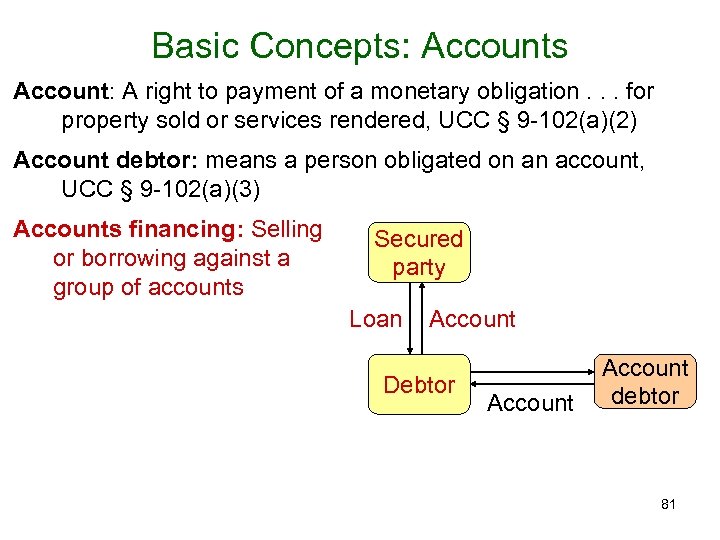 Basic Concepts: Accounts Account: A right to payment of a monetary obligation. . . for property sold or services rendered, UCC § 9 -102(a)(2) Account debtor: means a person obligated on an account, UCC § 9 -102(a)(3) Accounts financing: Selling or borrowing against a group of accounts Secured party Loan Account Debtor Account debtor 81
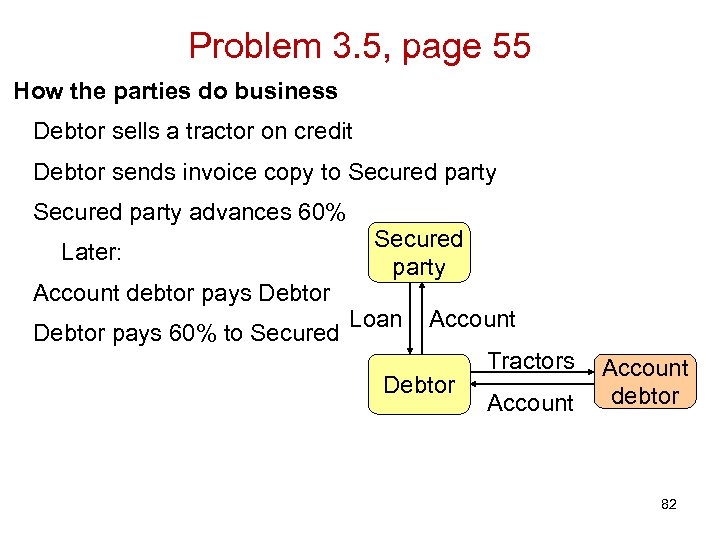 Problem 3. 5, page 55 How the parties do business Debtor sells a tractor on credit Debtor sends invoice copy to Secured party advances 60% Later: Account debtor pays Debtor pays 60% to Secured party Loan Account Debtor Tractors Account debtor 82
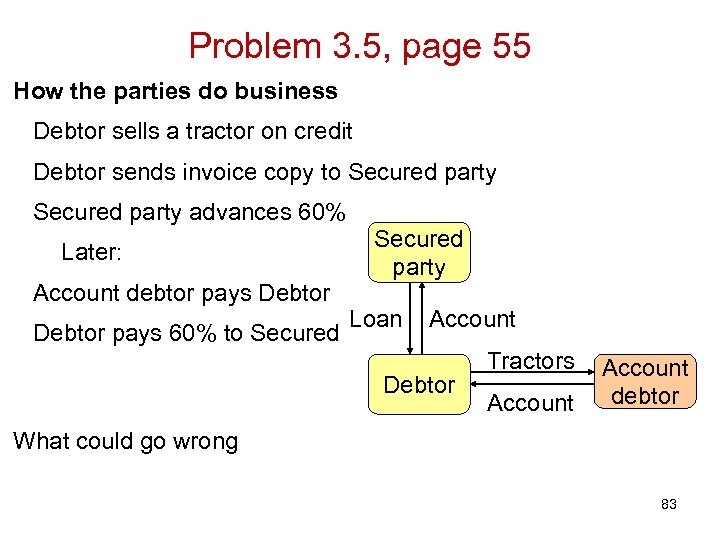 Problem 3. 5, page 55 How the parties do business Debtor sells a tractor on credit Debtor sends invoice copy to Secured party advances 60% Later: Account debtor pays Debtor pays 60% to Secured party Loan Account Debtor Tractors Account debtor What could go wrong 83
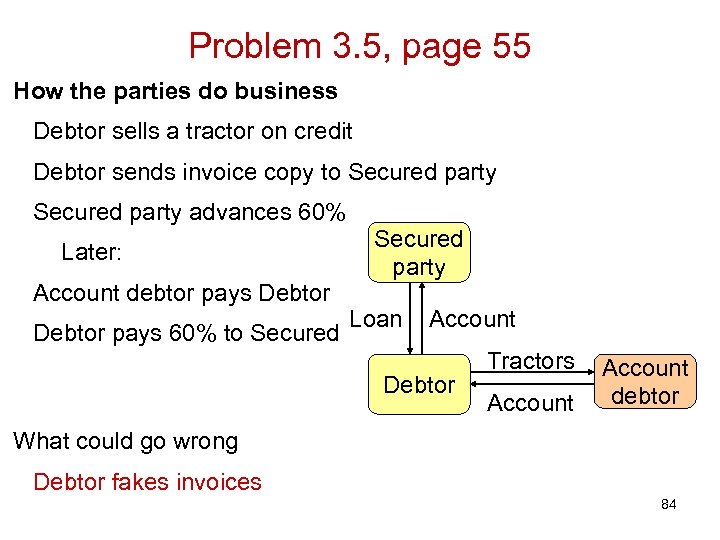 Problem 3. 5, page 55 How the parties do business Debtor sells a tractor on credit Debtor sends invoice copy to Secured party advances 60% Later: Account debtor pays Debtor pays 60% to Secured party Loan Account Debtor Tractors Account debtor What could go wrong Debtor fakes invoices 84
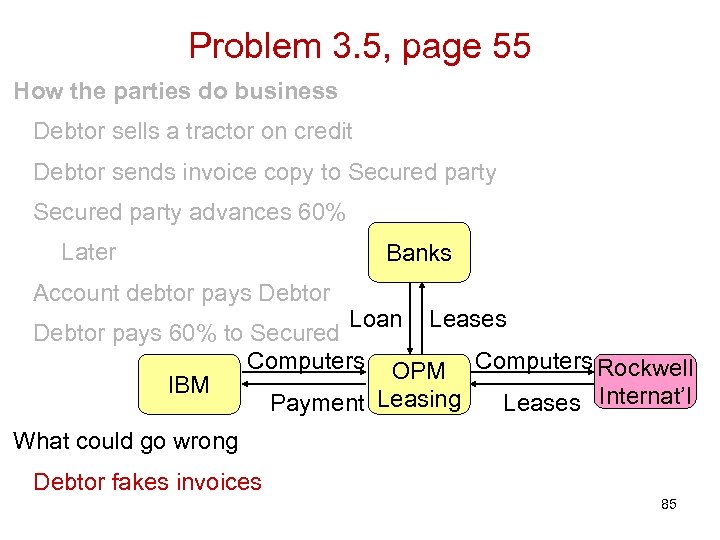 Problem 3. 5, page 55 How the parties do business Debtor sells a tractor on credit Debtor sends invoice copy to Secured party advances 60% Later Account debtor pays Debtor Banks Loan Leases Debtor pays 60% to Secured Computers OPM Computers Rockwell IBM Payment Leasing Leases Internat’l What could go wrong Debtor fakes invoices 85
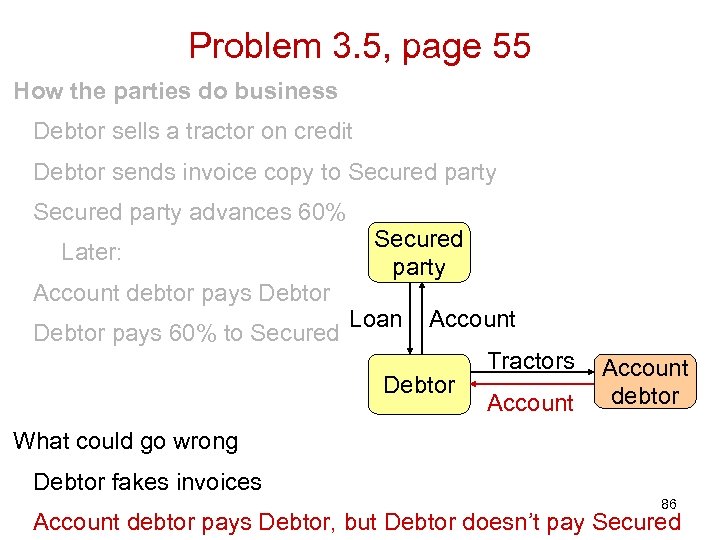 Problem 3. 5, page 55 How the parties do business Debtor sells a tractor on credit Debtor sends invoice copy to Secured party advances 60% Later: Account debtor pays Debtor pays 60% to Secured party Loan Account Debtor Tractors Account debtor What could go wrong Debtor fakes invoices 86 Account debtor pays Debtor, but Debtor doesn’t pay Secured
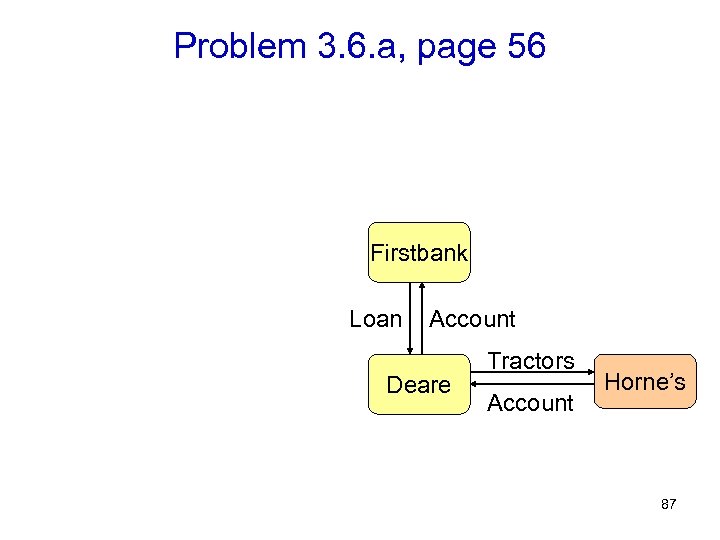 Problem 3. 6. a, page 56 Firstbank Loan Account Deare Tractors Account Horne’s 87
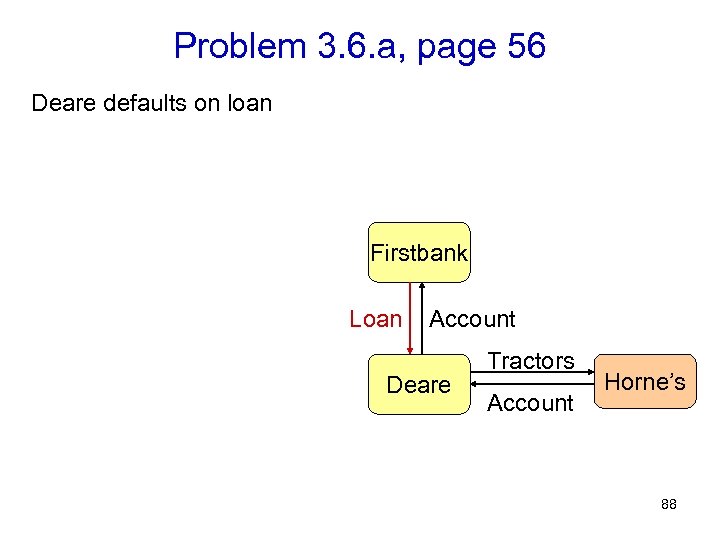 Problem 3. 6. a, page 56 Deare defaults on loan Firstbank Loan Account Deare Tractors Account Horne’s 88
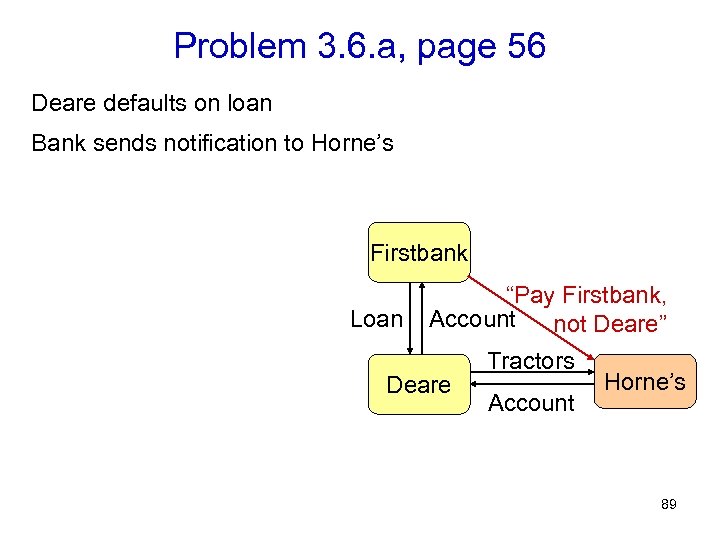 Problem 3. 6. a, page 56 Deare defaults on loan Bank sends notification to Horne’s Firstbank Loan “Pay Firstbank, Account not Deare” Deare Tractors Account Horne’s 89
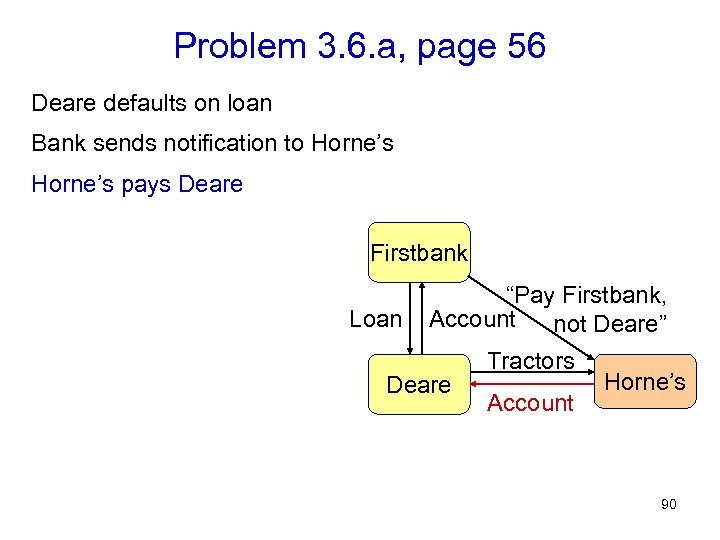 Problem 3. 6. a, page 56 Deare defaults on loan Bank sends notification to Horne’s pays Deare Firstbank Loan “Pay Firstbank, Account not Deare” Deare Tractors Account Horne’s 90
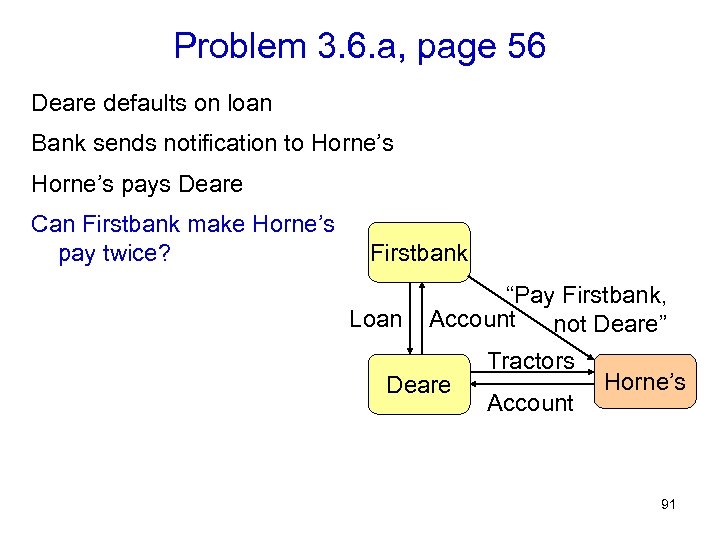 Problem 3. 6. a, page 56 Deare defaults on loan Bank sends notification to Horne’s pays Deare Can Firstbank make Horne’s pay twice? Firstbank Loan “Pay Firstbank, Account not Deare” Deare Tractors Account Horne’s 91
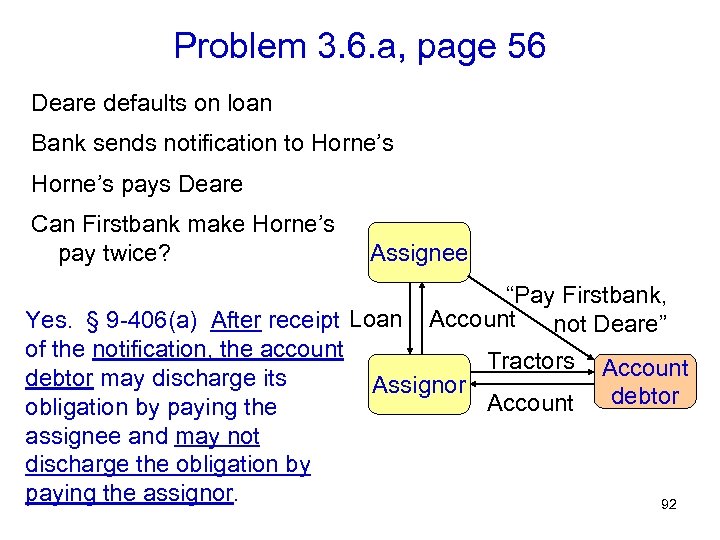 Problem 3. 6. a, page 56 Deare defaults on loan Bank sends notification to Horne’s pays Deare Can Firstbank make Horne’s pay twice? Assignee “Pay Firstbank, Account not Deare” Yes. § 9 -406(a) After receipt Loan of the notification, the account Tractors debtor may discharge its Assignor Account obligation by paying the assignee and may not discharge the obligation by paying the assignor. Account debtor 92
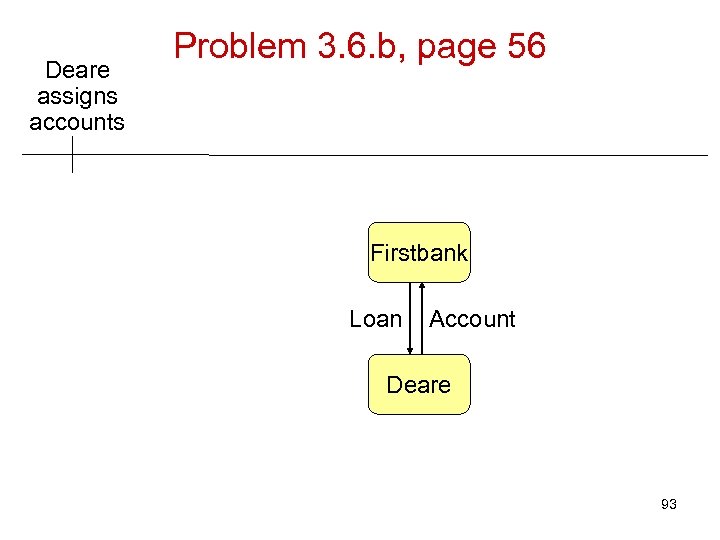 Deare assigns accounts Problem 3. 6. b, page 56 Firstbank Loan Account Deare 93
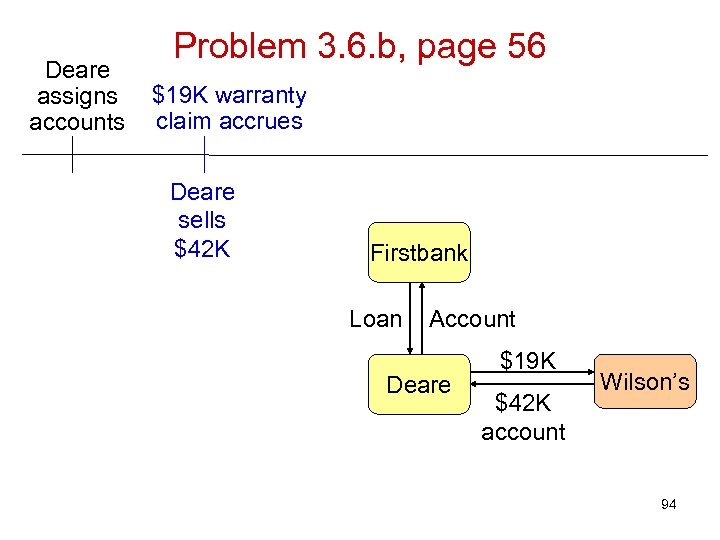 Deare assigns accounts Problem 3. 6. b, page 56 $19 K warranty claim accrues Deare sells $42 K Firstbank Loan Account Deare $19 K $42 K account Wilson’s 94
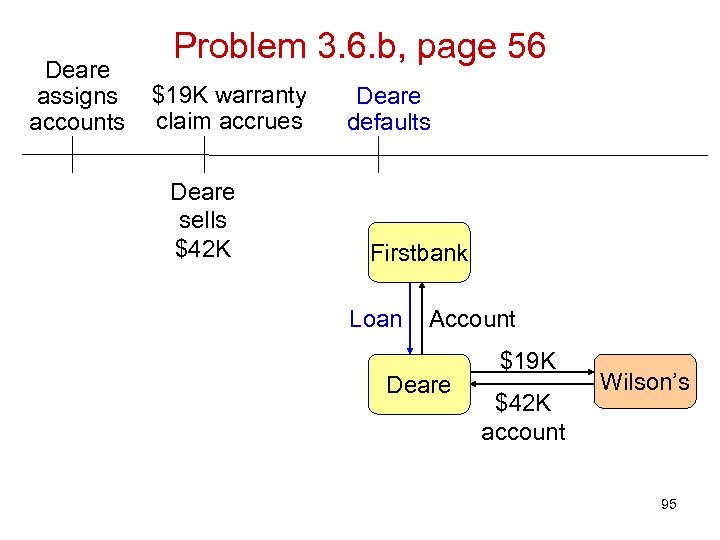 Deare assigns accounts Problem 3. 6. b, page 56 $19 K warranty claim accrues Deare sells $42 K Deare defaults Firstbank Loan Account Deare $19 K $42 K account Wilson’s 95
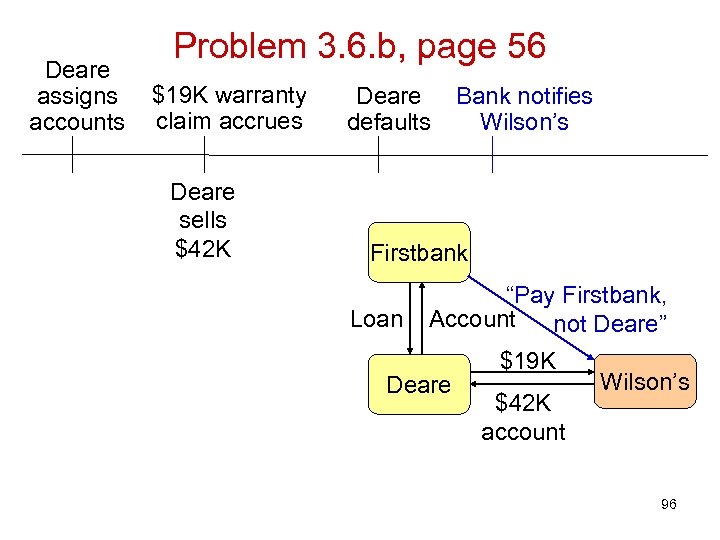 Deare assigns accounts Problem 3. 6. b, page 56 $19 K warranty claim accrues Deare sells $42 K Deare defaults Bank notifies Wilson’s Firstbank Loan “Pay Firstbank, Account not Deare” Deare $19 K $42 K account Wilson’s 96
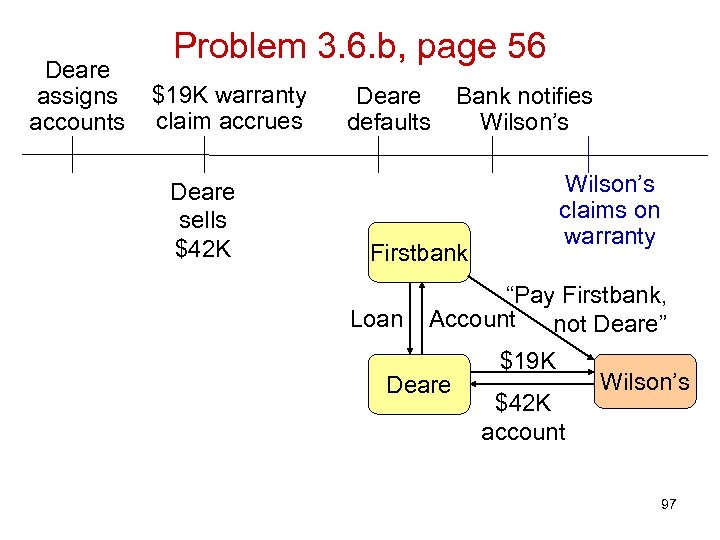 Deare assigns accounts Problem 3. 6. b, page 56 $19 K warranty claim accrues Deare sells $42 K Deare defaults Bank notifies Wilson’s claims on warranty Firstbank Loan “Pay Firstbank, Account not Deare” Deare $19 K $42 K account Wilson’s 97
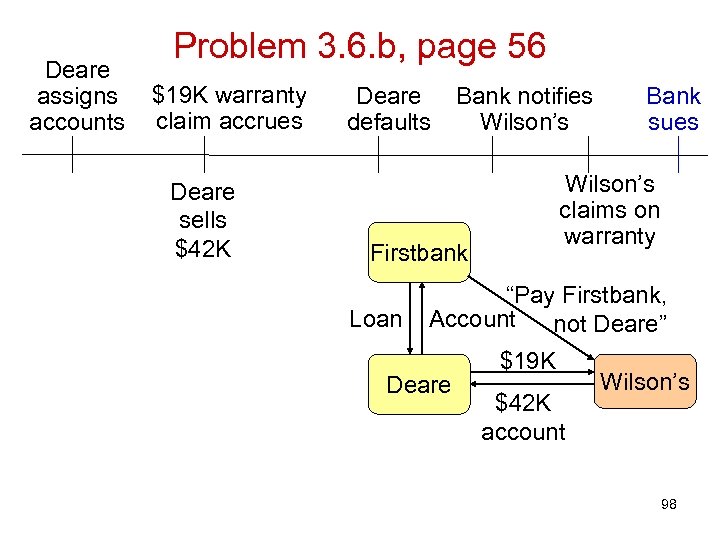 Deare assigns accounts Problem 3. 6. b, page 56 $19 K warranty claim accrues Deare sells $42 K Deare defaults Bank notifies Wilson’s claims on warranty Firstbank Loan Bank sues “Pay Firstbank, Account not Deare” Deare $19 K $42 K account Wilson’s 98
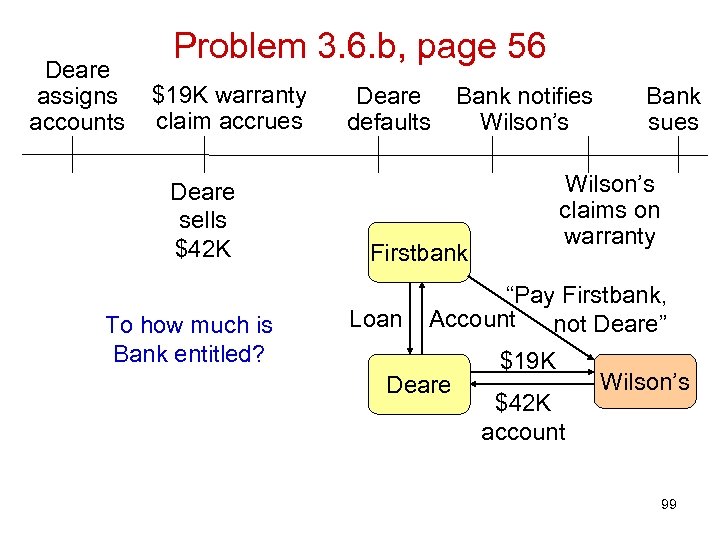 Deare assigns accounts Problem 3. 6. b, page 56 $19 K warranty claim accrues Deare sells $42 K To how much is Bank entitled? Deare defaults Bank notifies Wilson’s claims on warranty Firstbank Loan Bank sues “Pay Firstbank, Account not Deare” Deare $19 K $42 K account Wilson’s 99
![Problem 3. 6. b, page 56 UCC § 9 -404(a). [T]he rights of an](https://present5.com/presentation/a5d55fea1c667cbd494de7daa85c0d92/image-94.jpg "Problem 3. 6. b, page 56 UCC § 9 -404(a). [T]he rights of an") Problem 3. 6. b, page 56 UCC § 9 -404(a). [T]he rights of an assignee are subject to: (1) all terms of the agreement between the account debtor and assignor and any defense or claim in recoupment arising from the transaction that gave rise to the contract; and (2) any other. . . claim of the account debtor against the assignor which accrues before the account debtor receives a notification of the assignment. . . 100
Problem 3. 6. b, page 56 UCC § 9 -404(a). [T]he rights of an assignee are subject to: (1) all terms of the agreement between the account debtor and assignor and any defense or claim in recoupment arising from the transaction that gave rise to the contract; and (2) any other. . . claim of the account debtor against the assignor which accrues before the account debtor receives a notification of the assignment. . . 100
![Problem 3. 6. b, page 56 UCC § 9 -404(a). [T]he rights of an](https://present5.com/presentation/a5d55fea1c667cbd494de7daa85c0d92/image-95.jpg "Problem 3. 6. b, page 56 UCC § 9 -404(a). [T]he rights of an") Problem 3. 6. b, page 56 UCC § 9 -404(a). [T]he rights of an assignee are subject to: (1) all terms of the agreement between the account debtor and assignor and any defense or claim in recoupment arising from the transaction that gave rise to the contract; and (2) any other. . . claim of the account debtor against the assignor which accrues before the account debtor receives a notification of the assignment. . . 101
Problem 3. 6. b, page 56 UCC § 9 -404(a). [T]he rights of an assignee are subject to: (1) all terms of the agreement between the account debtor and assignor and any defense or claim in recoupment arising from the transaction that gave rise to the contract; and (2) any other. . . claim of the account debtor against the assignor which accrues before the account debtor receives a notification of the assignment. . . 101
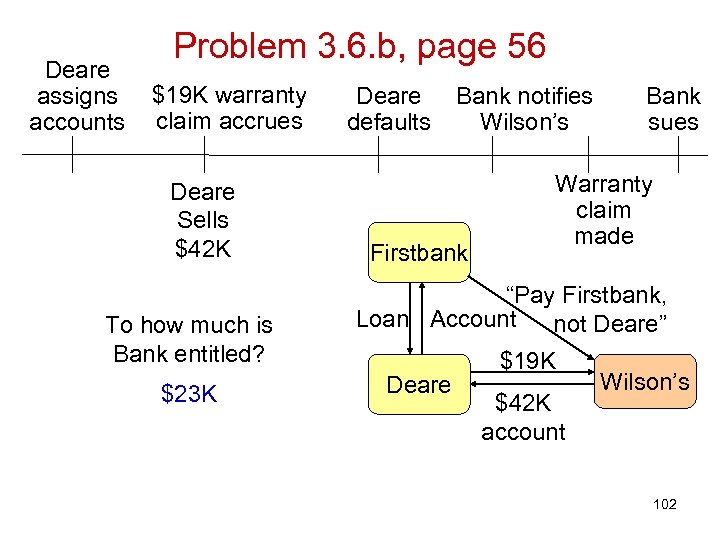 Deare assigns accounts Problem 3. 6. b, page 56 $19 K warranty claim accrues Deare Sells $42 K To how much is Bank entitled? $23 K Deare defaults Bank notifies Wilson’s Firstbank Bank sues Warranty claim made “Pay Firstbank, Loan Account not Deare” Deare $19 K $42 K account Wilson’s 102
 The policy in favor of account assignment 103
![The policy in favor of account assignment § 9 -406(d). [A] term in an](https://present5.com/presentation/a5d55fea1c667cbd494de7daa85c0d92/image-98.jpg "The policy in favor of account assignment § 9 -406(d). [A] term in an") The policy in favor of account assignment § 9 -406(d). [A] term in an agreement between an account debtor and an assignor. . . is ineffective to the extent that it: (1) prohibits, restricts, or requires the consent of the account debtor. . . to the assignment or transfer of. . . the account. . 104
The policy in favor of account assignment § 9 -406(d). [A] term in an agreement between an account debtor and an assignor. . . is ineffective to the extent that it: (1) prohibits, restricts, or requires the consent of the account debtor. . . to the assignment or transfer of. . . the account. . 104
![The policy in favor of account assignment § 9 -406(d). [A] term in an](https://present5.com/presentation/a5d55fea1c667cbd494de7daa85c0d92/image-99.jpg "The policy in favor of account assignment § 9 -406(d). [A] term in an") The policy in favor of account assignment § 9 -406(d). [A] term in an agreement between an account debtor and an assignor. . . is ineffective to the extent that it: (1) prohibits, restricts, or requires the consent of the account debtor. . . to the assignment or transfer of. . . the account. . Comment 5, example: “Buyer enters into an agreement with Seller to buy equipment. . Seller. . . agrees that it will not assign any of its rights under the sale agreement. . Seller’s anti-assignment agreement is ineffective under subsection (d). . If Secured Party notifies Buyer to make all future payments directly to Secured Party, buyer will be obligated to do so. . ” 105
The policy in favor of account assignment § 9 -406(d). [A] term in an agreement between an account debtor and an assignor. . . is ineffective to the extent that it: (1) prohibits, restricts, or requires the consent of the account debtor. . . to the assignment or transfer of. . . the account. . Comment 5, example: “Buyer enters into an agreement with Seller to buy equipment. . Seller. . . agrees that it will not assign any of its rights under the sale agreement. . Seller’s anti-assignment agreement is ineffective under subsection (d). . If Secured Party notifies Buyer to make all future payments directly to Secured Party, buyer will be obligated to do so. . ” 105
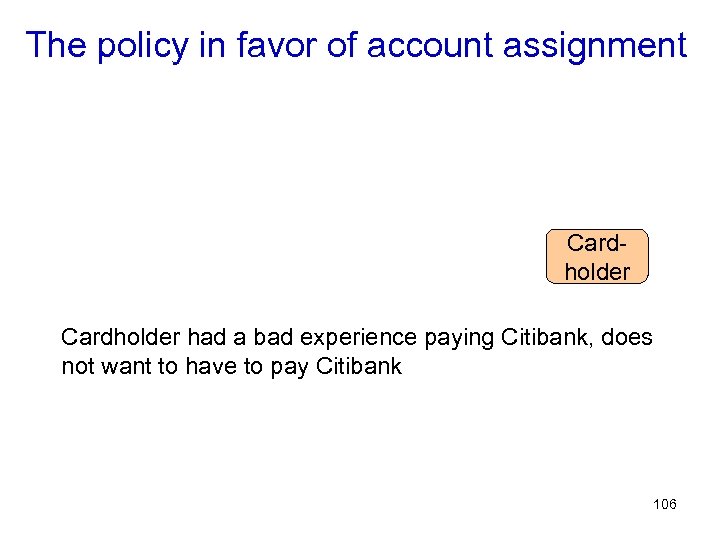 The policy in favor of account assignment Cardholder had a bad experience paying Citibank, does not want to have to pay Citibank 106
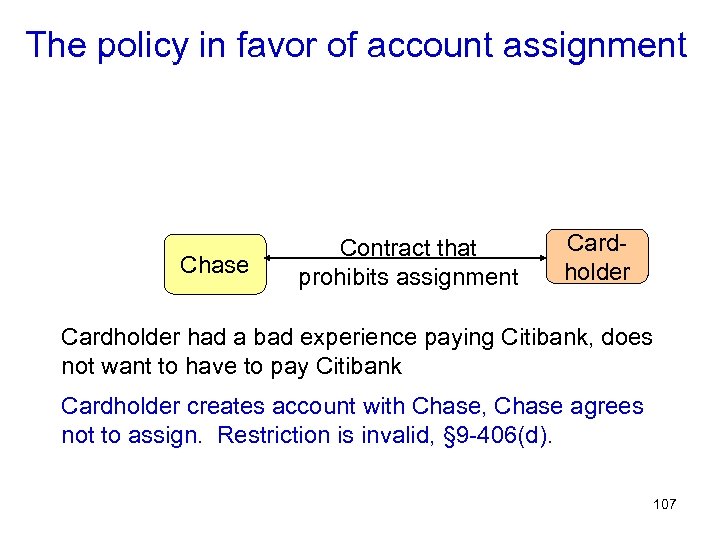 The policy in favor of account assignment Chase Contract that prohibits assignment Cardholder had a bad experience paying Citibank, does not want to have to pay Citibank Cardholder creates account with Chase, Chase agrees not to assign. Restriction is invalid, § 9 -406(d). 107
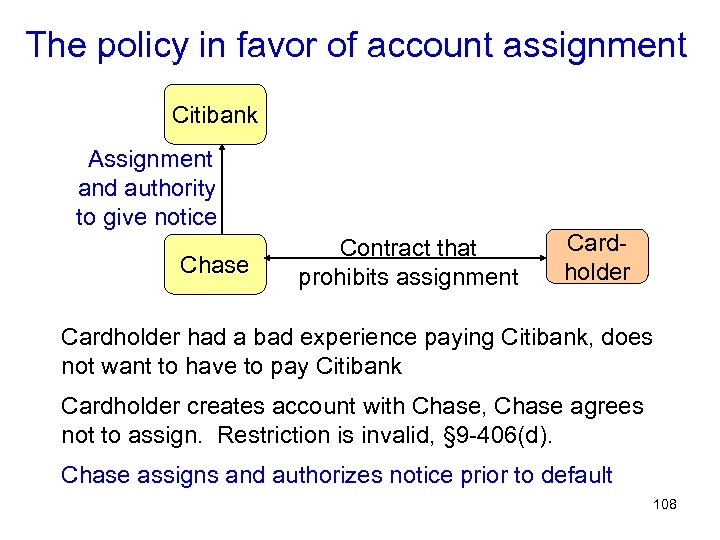 The policy in favor of account assignment Citibank Assignment and authority to give notice Chase Contract that prohibits assignment Cardholder had a bad experience paying Citibank, does not want to have to pay Citibank Cardholder creates account with Chase, Chase agrees not to assign. Restriction is invalid, § 9 -406(d). Chase assigns and authorizes notice prior to default 108
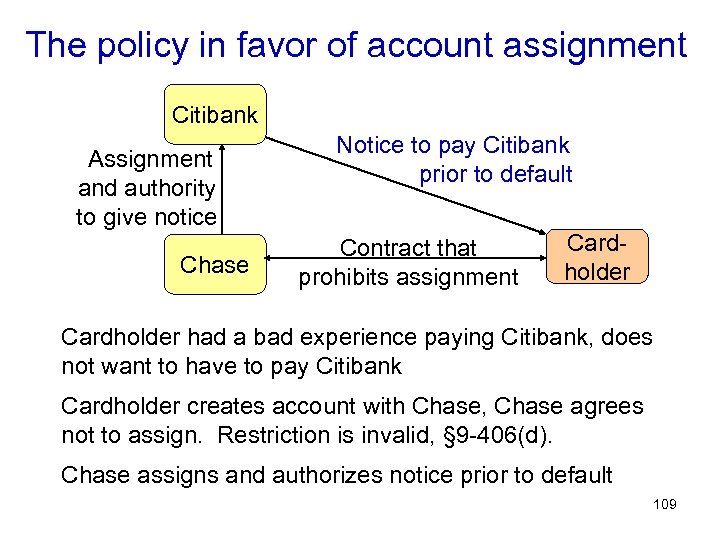 The policy in favor of account assignment Citibank Assignment and authority to give notice Chase Notice to pay Citibank prior to default Contract that prohibits assignment Cardholder had a bad experience paying Citibank, does not want to have to pay Citibank Cardholder creates account with Chase, Chase agrees not to assign. Restriction is invalid, § 9 -406(d). Chase assigns and authorizes notice prior to default 109
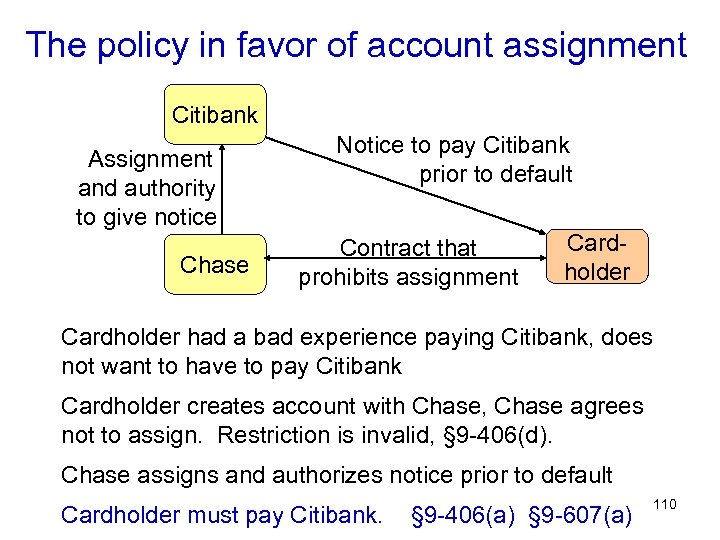 The policy in favor of account assignment Citibank Assignment and authority to give notice Chase Notice to pay Citibank prior to default Contract that prohibits assignment Cardholder had a bad experience paying Citibank, does not want to have to pay Citibank Cardholder creates account with Chase, Chase agrees not to assign. Restriction is invalid, § 9 -406(d). Chase assigns and authorizes notice prior to default Cardholder must pay Citibank. § 9 -406(a) § 9 -607(a) 110