


 Скачать презентацию Secure routing for structured peer -to-peer overlay networks
a6abad6b6cc8d1518e8d969f3a7678ae.ppt
- Количество слайдов: 16
 Secure routing for structured peer -to-peer overlay networks (by Castro et al. ) Shariq Rizvi CS 294 -4: Peer-to-Peer Systems Oct 6, 2003 CS 294 -4: Peer-to-Peer Systems
 The problem P 2 P systems: resilient but not secure l Malicious nodes: l ¡ ¡ ¡ fake IDs distort routing table entries prevent correct message delivery “Techniques to allow nodes to join, to maintain routing state, and to forward messages securely in presence of malicious nodes” Oct 6, 2003 CS 294 -4: Peer-to-Peer Systems 2
 In retrospect l Unlike Byzantine solutions ¡ specific to P 2 P systems ¡ no exact agreement needs to be reached l Unlike the Sybil attack ¡ resort Oct 6, 2003 to central authentication for IDs CS 294 -4: Peer-to-Peer Systems 3
 The model N nodes l Bound f on the fraction of faulty nodes l Bound c. N on the number of faulty nodes in coalition l Every node has a static IP address l “Secure routing ensures that when a non-faulty node sends a message to key k, the message reaches all non-faulty members is the set of replica roots Rk with very high probability” Oct 6, 2003 CS 294 -4: Peer-to-Peer Systems 4
 Sub-problems l Securely assigning IDs to nodes ¡ attacker may capture all replicas for an object ¡ attacker may target a particular victim l Securely maintaining routing tables ¡ attackers may populate with faulty entries ¡ most messages are routed to faulty nodes l Securely forwarding messages ¡ even with proper routing tables, faulty nodes can corrupt, drop, misroute messages Oct 6, 2003 CS 294 -4: Peer-to-Peer Systems 5
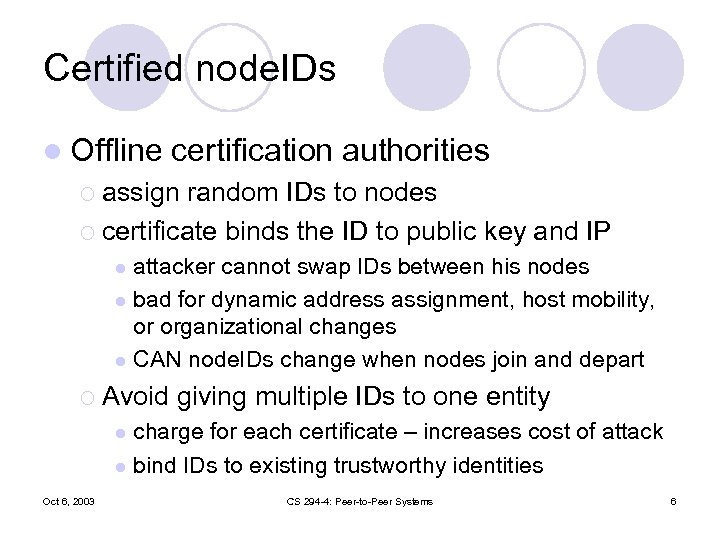 Certified node. IDs l Offline certification authorities ¡ assign random IDs to nodes ¡ certificate binds the ID to public key and IP attacker cannot swap IDs between his nodes l bad for dynamic address assignment, host mobility, or organizational changes l CAN node. IDs change when nodes join and depart l ¡ Avoid giving multiple IDs to one entity charge for each certificate – increases cost of attack l bind IDs to existing trustworthy identities l Oct 6, 2003 CS 294 -4: Peer-to-Peer Systems 6
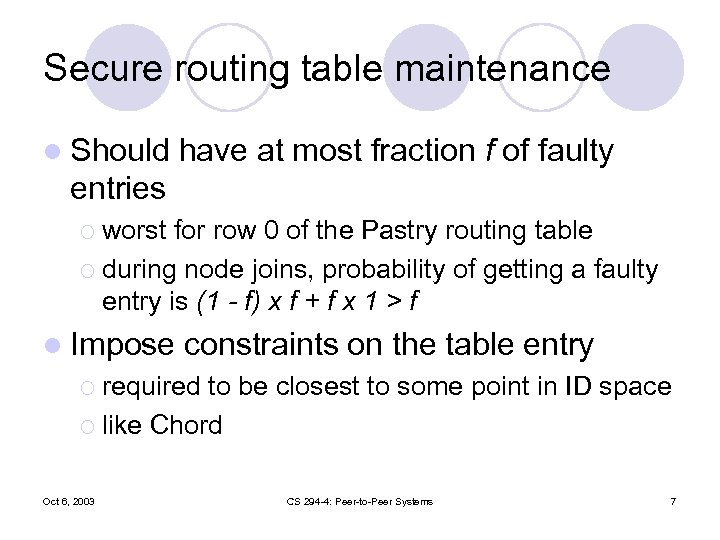 Secure routing table maintenance l Should have at most fraction f of faulty entries ¡ worst for row 0 of the Pastry routing table ¡ during node joins, probability of getting a faulty entry is (1 - f) x f + f x 1 > f l Impose constraints on the table entry ¡ required to be closest to some point in ID space ¡ like Chord Oct 6, 2003 CS 294 -4: Peer-to-Peer Systems 7
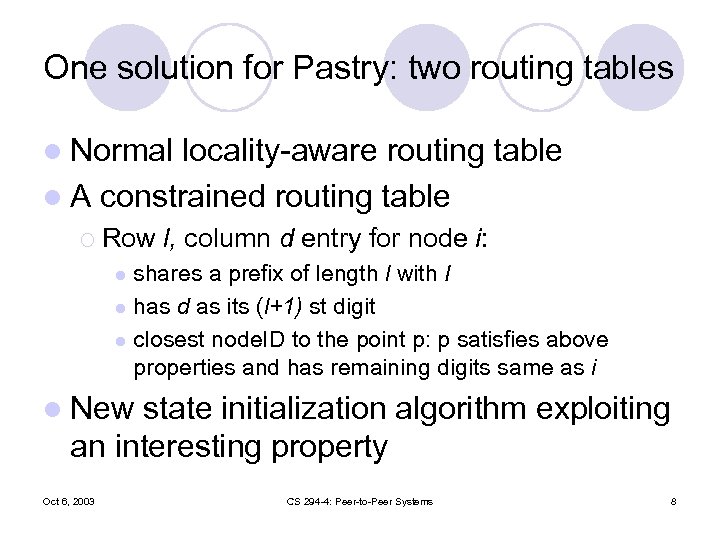 One solution for Pastry: two routing tables l Normal locality-aware routing table l A constrained routing table ¡ Row l, column d entry for node i: shares a prefix of length l with I l has d as its (l+1) st digit l closest node. ID to the point p: p satisfies above properties and has remaining digits same as i l l New state initialization algorithm exploiting an interesting property Oct 6, 2003 CS 294 -4: Peer-to-Peer Systems 8
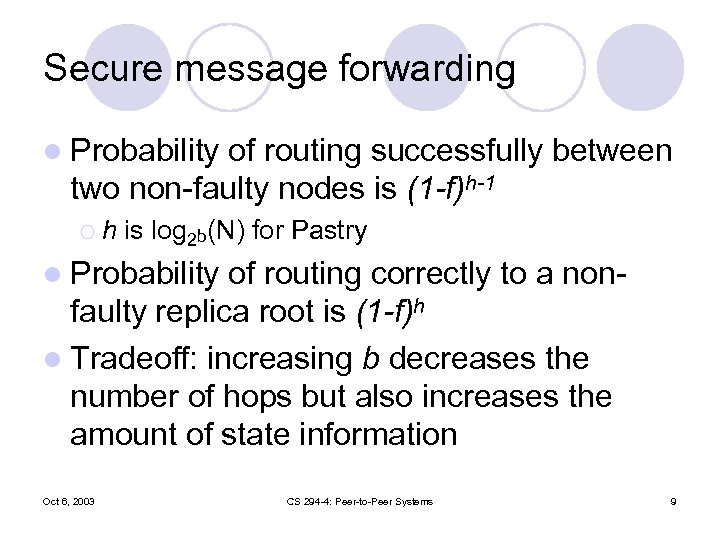 Secure message forwarding l Probability of routing successfully between two non-faulty nodes is (1 -f)h-1 ¡h is log 2 b(N) for Pastry l Probability of routing correctly to a nonfaulty replica root is (1 -f)h l Tradeoff: increasing b decreases the number of hops but also increases the amount of state information Oct 6, 2003 CS 294 -4: Peer-to-Peer Systems 9
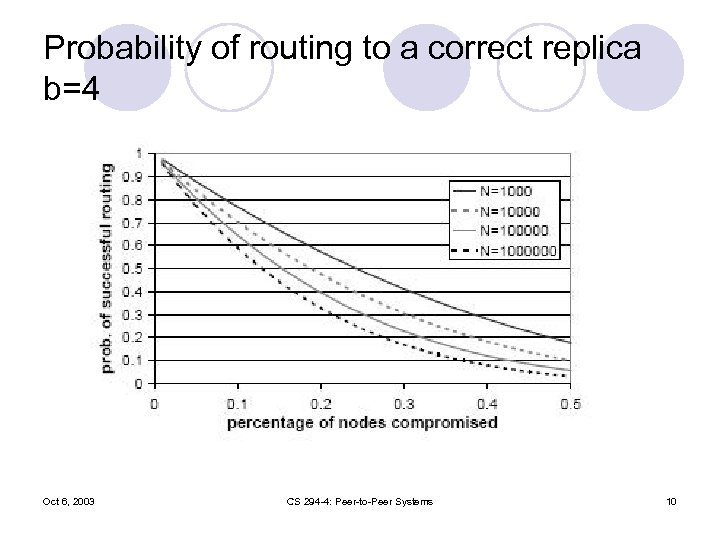 Probability of routing to a correct replica b=4 Oct 6, 2003 CS 294 -4: Peer-to-Peer Systems 10
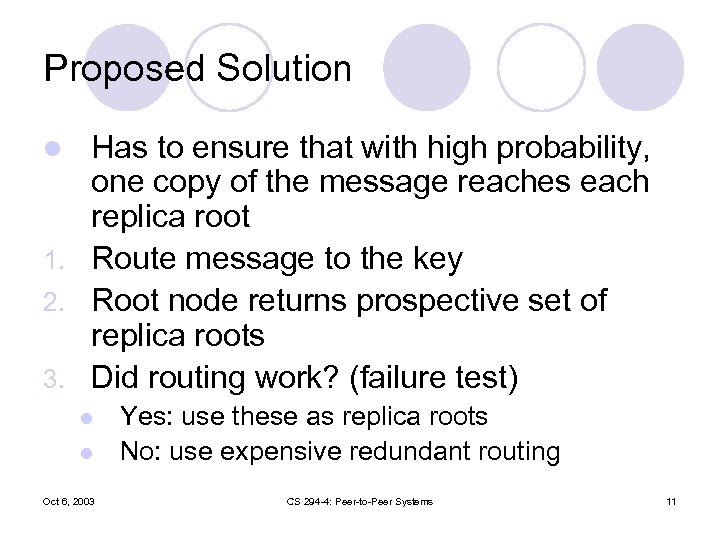 Proposed Solution Has to ensure that with high probability, one copy of the message reaches each replica root 1. Route message to the key 2. Root node returns prospective set of replica roots 3. Did routing work? (failure test) l l l Oct 6, 2003 Yes: use these as replica roots No: use expensive redundant routing CS 294 -4: Peer-to-Peer Systems 11
 Routing failure test Takes a key and the set of prospective replica roots l Returns negative if the set of roots is likely to be correct for the key; otherwise positive l If no set is returned, returns positive l Works by comparing the density of node. IDs in the sender’s neighborhood set with the density of node. IDs close to the replica roots of the destination key l Oct 6, 2003 CS 294 -4: Peer-to-Peer Systems 12
 The test for Pastry l l l In Pastry, the replica set is a subset of the neighbor set of the key’s root Let µp be the average numerical distance between the consecutive node. IDs in p’s neighbor set To test root neighbor set {id 0, id 1, …}, for a key x, p checks that: 1. 2. l All node. IDs in the set have valid certificates, the middle one is the closest node. ID to x, and the node. IDs satisfy the definition of a neighbor set The average numerical distance µrn between consecutive node. IDs in this set < µp x γ γ decides the tradeoff between false positives and false negatives Oct 6, 2003 CS 294 -4: Peer-to-Peer Systems 13
 Redundant routing If the failure test returns positive l Use constrained routing table l P sends the message to key x via different members of its neighborhood set l ¡ messages take diverse path (longer paths? ) Any non-faulty node that receives the message and has the root of x in its neighborhood set, sends its certificate to p l p collects such certificates in a list; sends the list to all nodes in the list. Process iterates upto 3 times l p computes the closest neighbor’s to x l Oct 6, 2003 CS 294 -4: Peer-to-Peer Systems 14
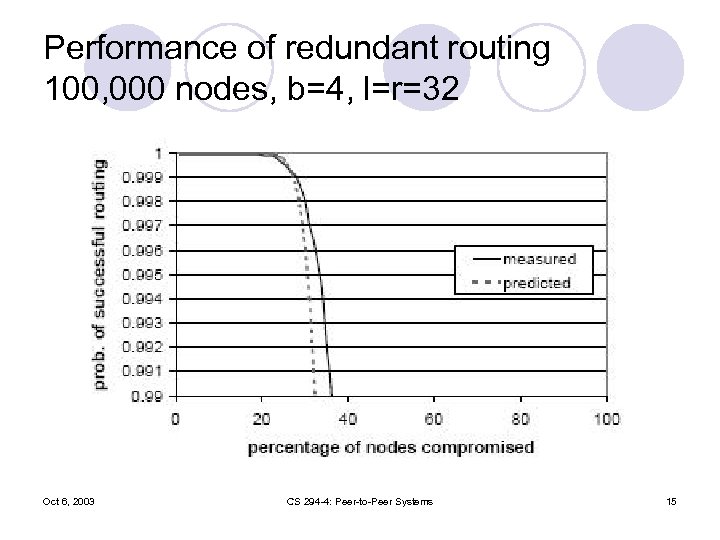 Performance of redundant routing 100, 000 nodes, b=4, l=r=32 Oct 6, 2003 CS 294 -4: Peer-to-Peer Systems 15
 Etc. l Tolerates upto 25% malicious nodes well l Self-certifying data – nodes can check the authenticity of returned objects ¡ reduces Oct 6, 2003 need for redundant routing CS 294 -4: Peer-to-Peer Systems 16