 Скачать презентацию SECURE HASHING ALGORITHM By Ruth Betcher Purpose
cf8647d6e95b915c343f6f83c810612e.ppt
- Количество слайдов: 16



SECURE HASHING ALGORITHM By: Ruth Betcher
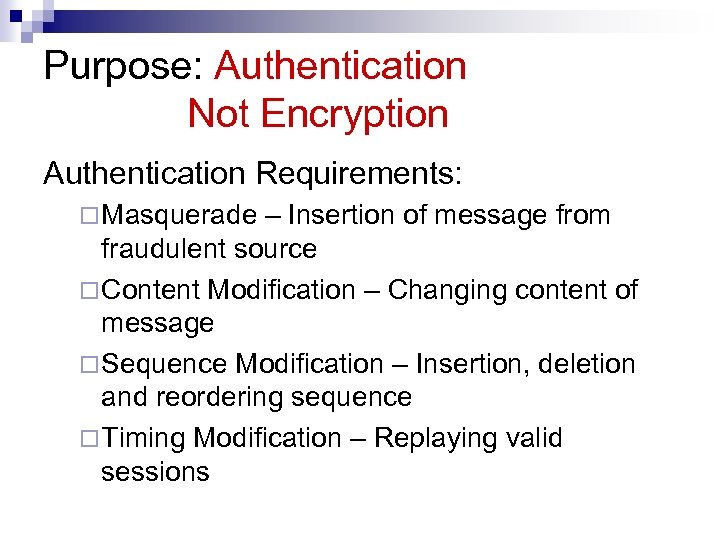
Purpose: Authentication Not Encryption Authentication Requirements: Masquerade – Insertion of message from fraudulent source Content Modification – Changing content of message Sequence Modification – Insertion, deletion and reordering sequence Timing Modification – Replaying valid sessions
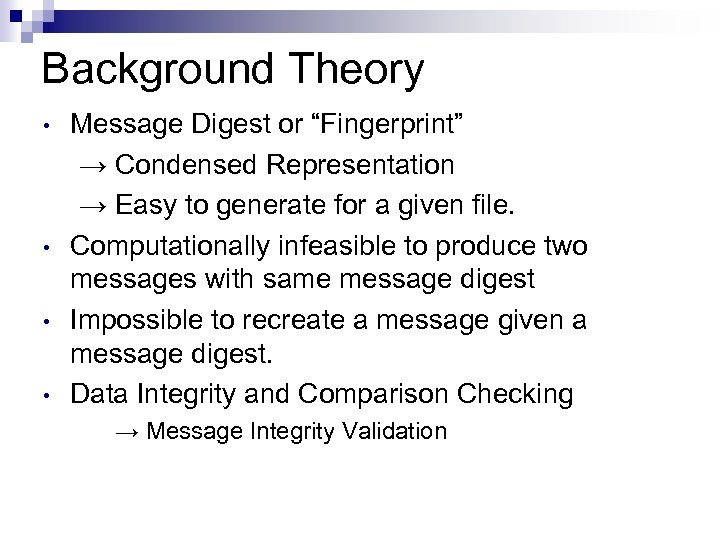
Background Theory • • Message Digest or “Fingerprint” → Condensed Representation → Easy to generate for a given file. Computationally infeasible to produce two messages with same message digest Impossible to recreate a message given a message digest. Data Integrity and Comparison Checking → Message Integrity Validation
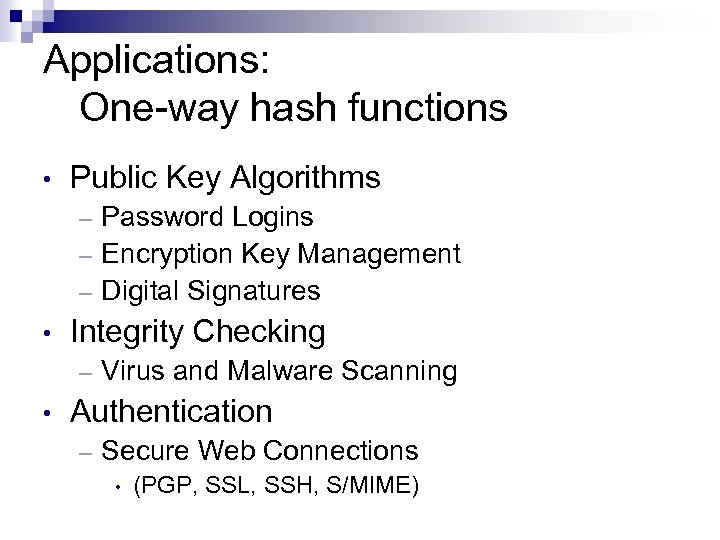
Applications: One-way hash functions • Public Key Algorithms Password Logins – Encryption Key Management – Digital Signatures – • Integrity Checking – • Virus and Malware Scanning Authentication – Secure Web Connections • (PGP, SSL, SSH, S/MIME)
Variants • • MD 4 and MD 5 by Ron Rivest (1990, 1994) SHA-0, SHA-1 by NSA (1993, 1995) RIPEMD-160 (1996) SHA-2 (2002 – 224, 256, 385, 512) Whirlpool Tiger GOST-3411 SHA-3 • Winner selected from solicitations in 2012
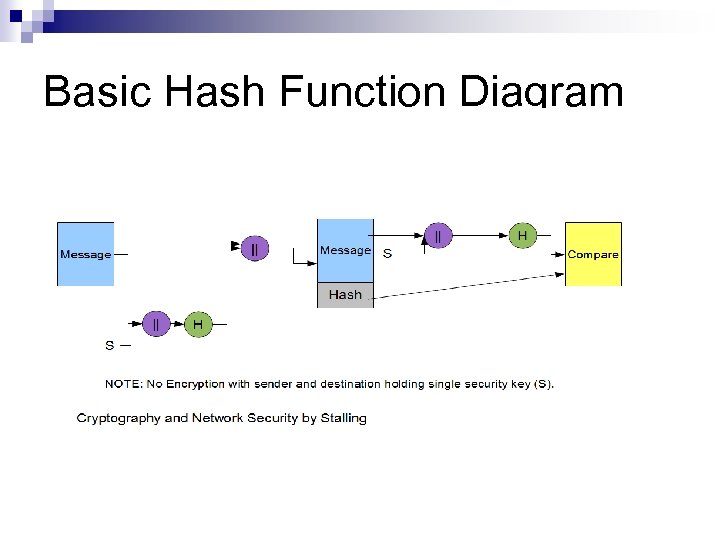
Basic Hash Function Diagram
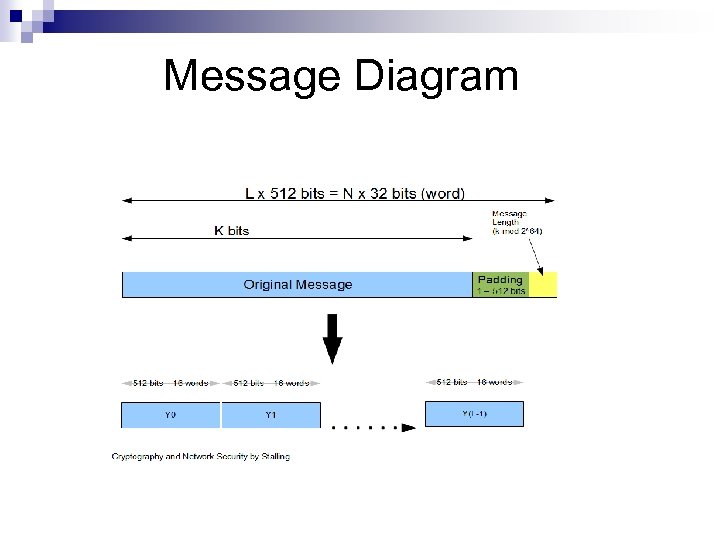
Message Diagram
SHA-1 (160 bit message) Algorithm Framework Step 1: Append Padding Bits…. Message is “padded” with a 1 and as many 0’s as necessary to bring the message length to 64 bits fewer than an even multiple of 512. Step 2: Append Length. . 64 bits are appended to the end of the padded message. These bits hold the binary format of 64 bits indicating the length of the original message. http: //www. herongyang. com f
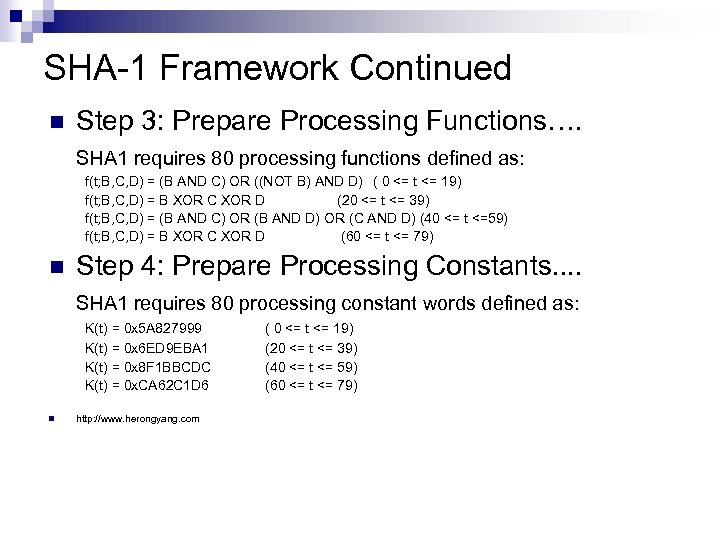
SHA-1 Framework Continued Step 3: Prepare Processing Functions…. SHA 1 requires 80 processing functions defined as: f(t; B, C, D) = (B AND C) OR ((NOT B) AND D) ( 0 <= t <= 19) f(t; B, C, D) = B XOR C XOR D (20 <= t <= 39) f(t; B, C, D) = (B AND C) OR (B AND D) OR (C AND D) (40 <= t <=59) f(t; B, C, D) = B XOR C XOR D (60 <= t <= 79) Step 4: Prepare Processing Constants. . SHA 1 requires 80 processing constant words defined as: K(t) = 0 x 5 A 827999 K(t) = 0 x 6 ED 9 EBA 1 K(t) = 0 x 8 F 1 BBCDC K(t) = 0 x. CA 62 C 1 D 6 http: //www. herongyang. com ( 0 <= t <= 19) (20 <= t <= 39) (40 <= t <= 59) (60 <= t <= 79)
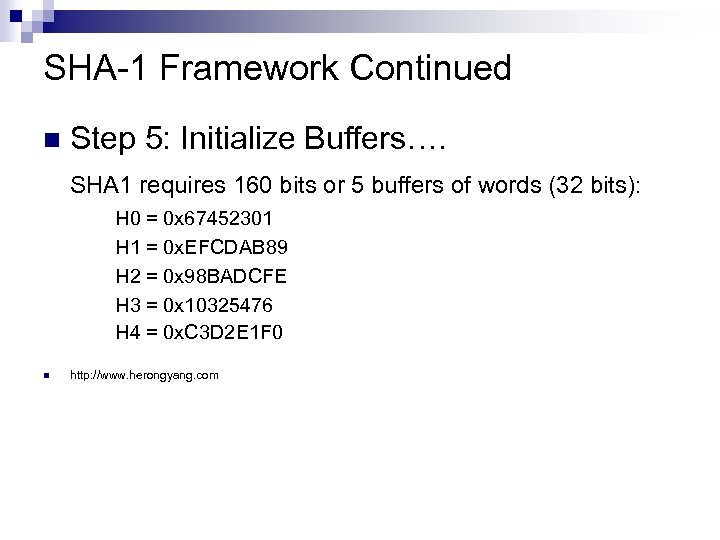
SHA-1 Framework Continued Step 5: Initialize Buffers…. SHA 1 requires 160 bits or 5 buffers of words (32 bits): H 0 = 0 x 67452301 H 1 = 0 x. EFCDAB 89 H 2 = 0 x 98 BADCFE H 3 = 0 x 10325476 H 4 = 0 x. C 3 D 2 E 1 F 0 http: //www. herongyang. com
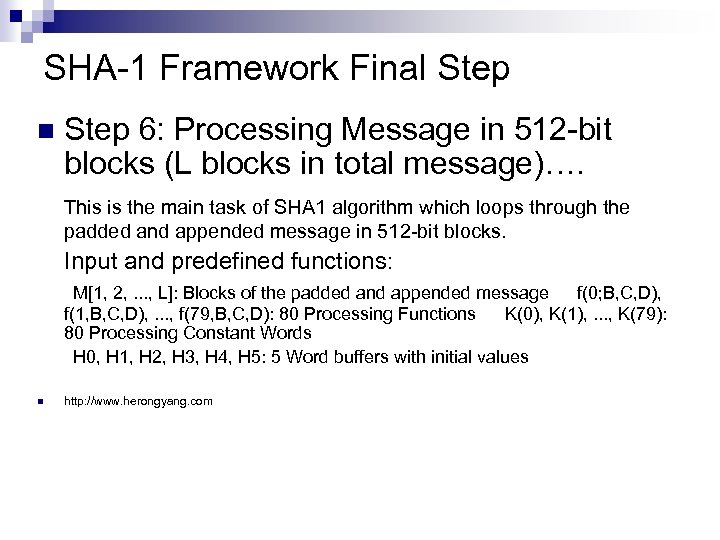
SHA-1 Framework Final Step 6: Processing Message in 512 -bit blocks (L blocks in total message)…. This is the main task of SHA 1 algorithm which loops through the padded and appended message in 512 -bit blocks. Input and predefined functions: M[1, 2, . . . , L]: Blocks of the padded and appended message f(0; B, C, D), f(1, B, C, D), . . . , f(79, B, C, D): 80 Processing Functions K(0), K(1), . . . , K(79): 80 Processing Constant Words H 0, H 1, H 2, H 3, H 4, H 5: 5 Word buffers with initial values http: //www. herongyang. com
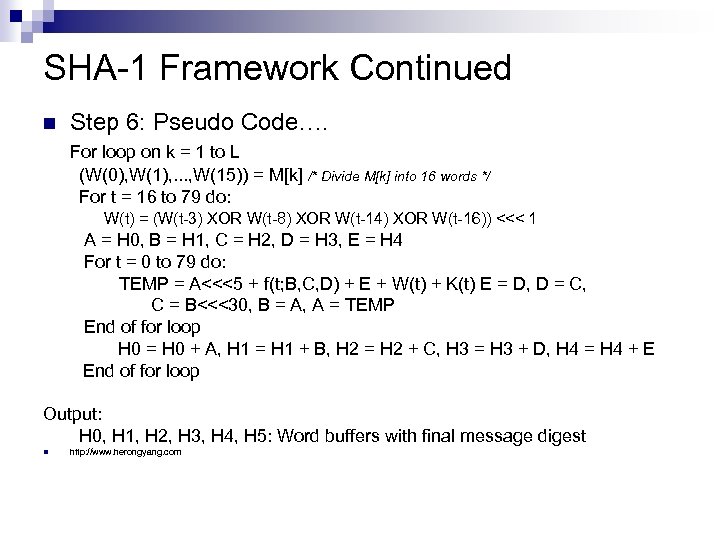
SHA-1 Framework Continued Step 6: Pseudo Code…. For loop on k = 1 to L (W(0), W(1), . . . , W(15)) = M[k] /* Divide M[k] into 16 words */ For t = 16 to 79 do: W(t) = (W(t-3) XOR W(t-8) XOR W(t-14) XOR W(t-16)) <<< 1 A = H 0, B = H 1, C = H 2, D = H 3, E = H 4 For t = 0 to 79 do: TEMP = A<<<5 + f(t; B, C, D) + E + W(t) + K(t) E = D, D = C, C = B<<<30, B = A, A = TEMP End of for loop H 0 = H 0 + A, H 1 = H 1 + B, H 2 = H 2 + C, H 3 = H 3 + D, H 4 = H 4 + E End of for loop Output: H 0, H 1, H 2, H 3, H 4, H 5: Word buffers with final message digest http: //www. herongyang. com
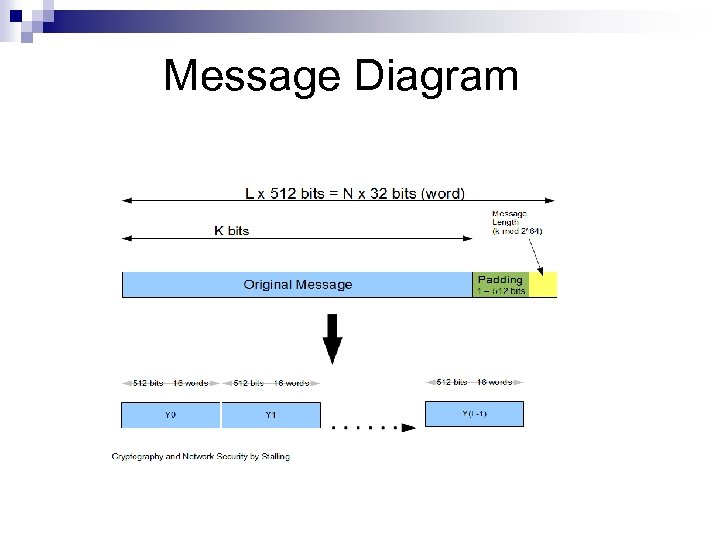
Message Diagram
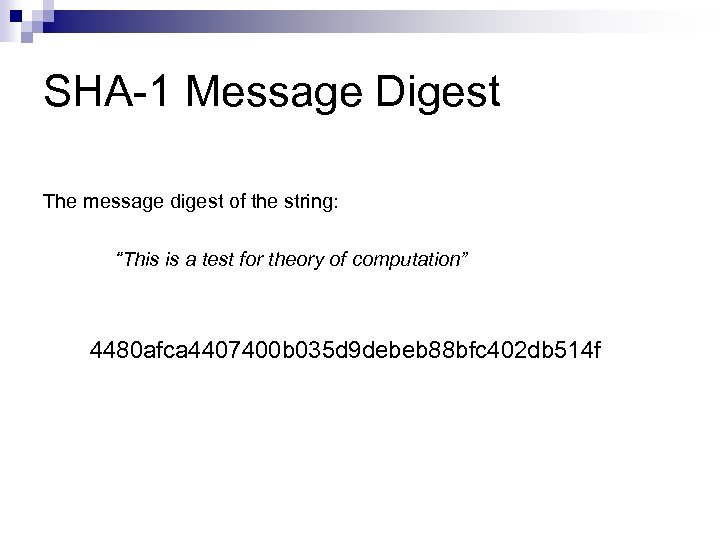
SHA-1 Message Digest The message digest of the string: “This is a test for theory of computation” 4480 afca 4407400 b 035 d 9 debeb 88 bfc 402 db 514 f
Cryptanalysis and Limitation • Key Premises for Hash Functions: 1. Impossible to re-create a message given a fingerprint 2. Collision Free • SHA-1 failure using brute force attack in 280 operations Collision failure found in 2005 in 233 operations •
Bibliography http: //www. herongyang. com http: //www. ipa. go. jp/security Salomon, David, Foundations of Computer Security Springer-Verlag London Limited 2006. Schneier, Bruce, “Opinion: Cryptanalysis of MD% and SHA: Time for a new standard”, Computer World, August 2004. Stallings, William, Cryptography and Network Security, Prentice Hall, 1999. Tanenbaum, Andrew, Computer Networks, Prentice Hall, 2003.
Скачать презентацию SECURE HASHING ALGORITHM By Ruth Betcher Purpose
cf8647d6e95b915c343f6f83c810612e.ppt