 Скачать презентацию Secure Electronic Commerce Prof Amir Herzberg Seminar 89
a0bbc186f78740ec535ee38e1a844065.ppt
- Количество слайдов: 46



Secure Electronic Commerce Prof. Amir Herzberg Seminar 89 -957, Wedn. 6 -8 pm CS Dept. , Bar Ilan University סמינר: אבטחת סחר אלקטרוני Lecture 1: Overview of security & crypto Network Security 1
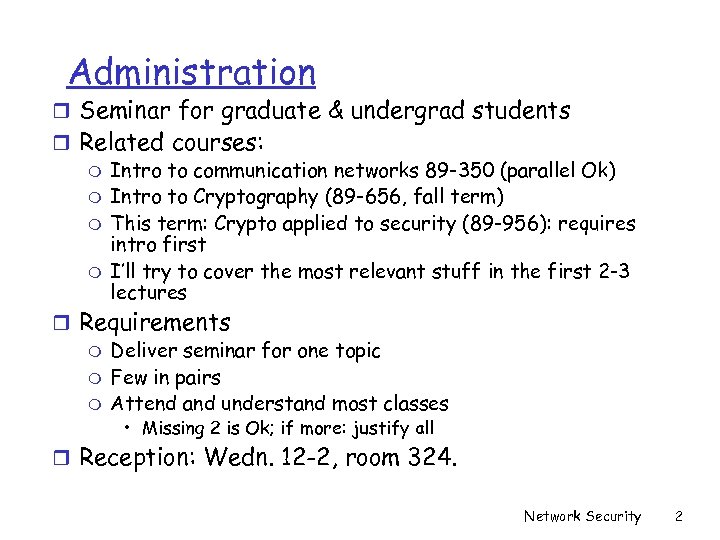
Administration r Seminar for graduate & undergrad students r Related courses: m Intro to communication networks 89 -350 (parallel Ok) m Intro to Cryptography (89 -656, fall term) m This term: Crypto applied to security (89 -956): requires intro first m I’ll try to cover the most relevant stuff in the first 2 -3 lectures r Requirements m Deliver seminar for one topic m Few in pairs m Attend and understand most classes • Missing 2 is Ok; if more: justify all r Reception: Wedn. 12 -2, room 324. Network Security 2
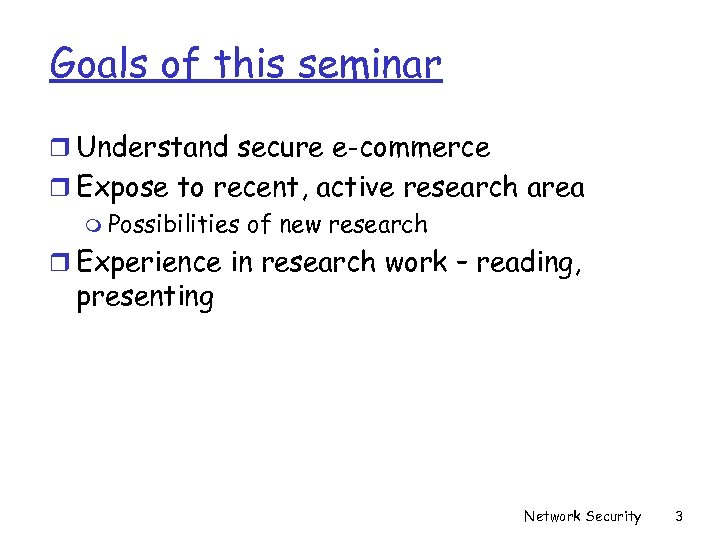
Goals of this seminar r Understand secure e-commerce r Expose to recent, active research area m Possibilities of new research r Experience in research work – reading, presenting Network Security 3
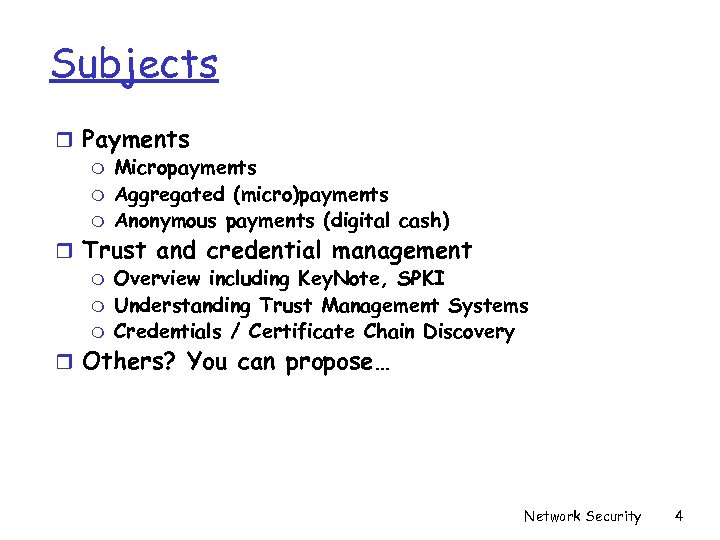
Subjects r Payments m Micropayments m Aggregated (micro)payments m Anonymous payments (digital cash) r Trust and credential management m Overview including Key. Note, SPKI m Understanding Trust Management Systems m Credentials / Certificate Chain Discovery r Others? You can propose… Network Security 4
What to do next? r Pick subject: m See site for subjects, papers and dates • Two pairs, few singles m m m Site: link from my homepage, http: //amir. herzberg. name/ Inform me of your choices (2 please) by e-mail Only if you’re going to deliver… `a honor commitment` r Read paper(s) carefully, prepare lecture, handouts m See related papers in http: //citeseer. org m Ask to change if you prefer another paper/topic m Use English or Hebrew, foils or PC (but write well!) m Give me a copy r We next give overview of crypto & security m You can leave if not interested (e. g. know already) Network Security 5
Security and Cryptography Overview Goals: r understand principles of network security: m cryptography and its many uses beyond “confidentiality” m authentication m message integrity m key distribution r security in practice: m firewalls m security in application, transport, network, link layers Network Security 6
What is network security? Confidentiality: only sender, intended receiver should “understand” message contents m sender encrypts message m receiver decrypts message m Privacy: hide `who is doing what with whom` Authentication: sender, receiver want to confirm identity of each other Message Integrity: sender, receiver want to ensure message not altered (in transit, or afterwards) without detection Access and Availability: services must be accessible and available to users Network Security 7
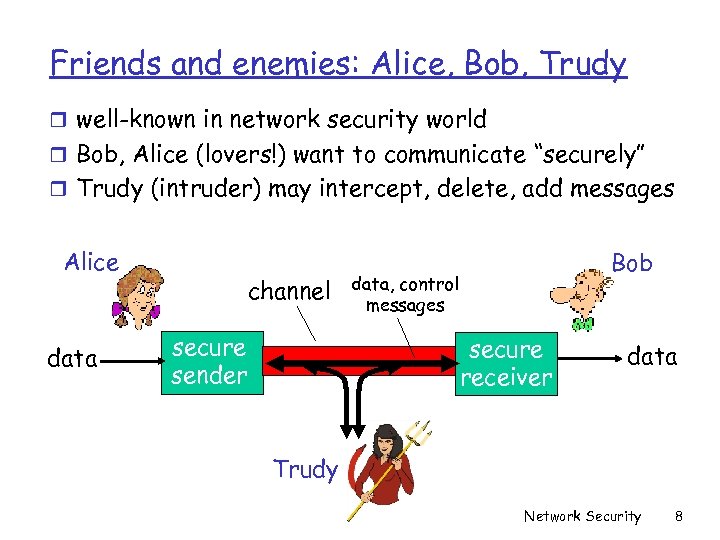
Friends and enemies: Alice, Bob, Trudy r well-known in network security world r Bob, Alice (lovers!) want to communicate “securely” r Trudy (intruder) may intercept, delete, add messages Alice data channel secure sender Bob data, control messages secure receiver data Trudy Network Security 8
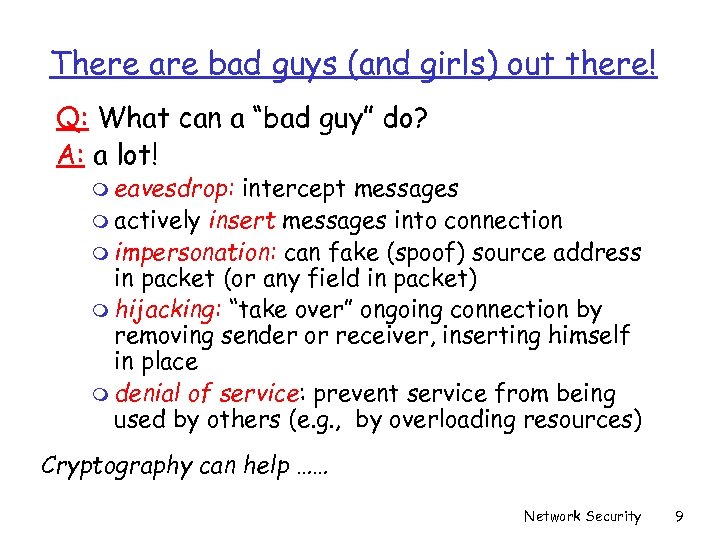
There are bad guys (and girls) out there! Q: What can a “bad guy” do? A: a lot! m eavesdrop: intercept messages m actively insert messages into connection m impersonation: can fake (spoof) source address in packet (or any field in packet) m hijacking: “take over” ongoing connection by removing sender or receiver, inserting himself in place m denial of service: prevent service from being used by others (e. g. , by overloading resources) Cryptography can help …… Network Security 9
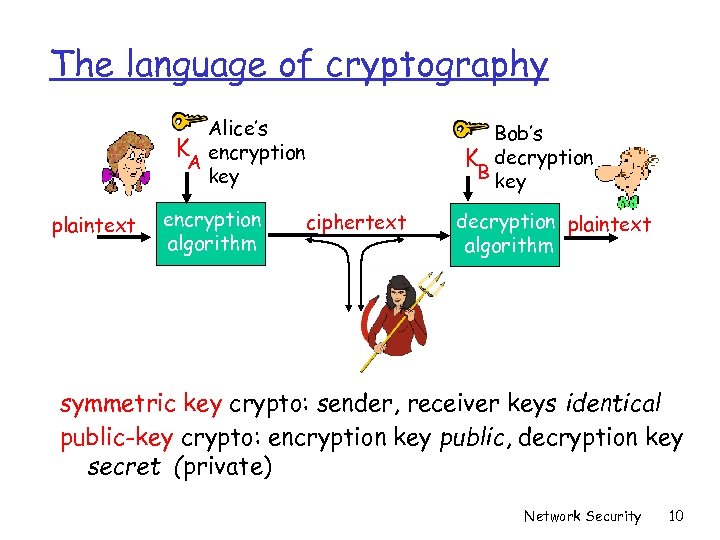
The language of cryptography Alice’s K encryption A key plaintext encryption algorithm Bob’s K decryption B key ciphertext decryption plaintext algorithm symmetric key crypto: sender, receiver keys identical public-key crypto: encryption key public, decryption key secret (private) Network Security 10
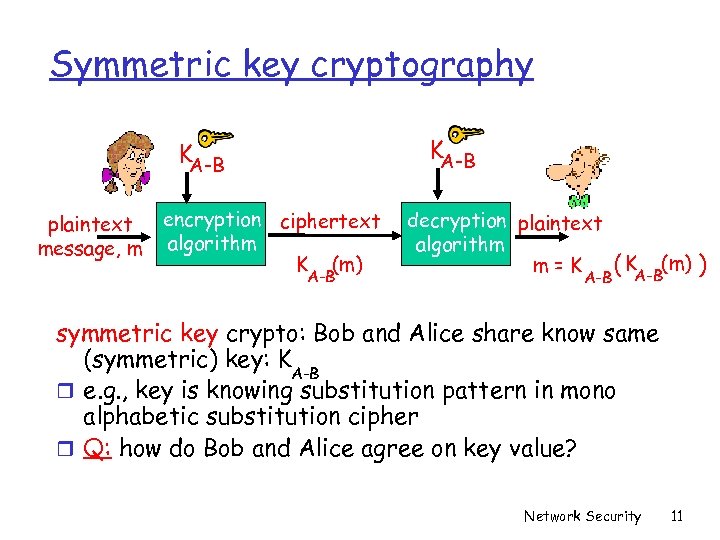
Symmetric key cryptography KA-B plaintext message, m encryption ciphertext algorithm K (m) A-B decryption plaintext algorithm m=K A-B ( KA-B(m) ) symmetric key crypto: Bob and Alice share know same (symmetric) key: K A-B r e. g. , key is knowing substitution pattern in mono alphabetic substitution cipher r Q: how do Bob and Alice agree on key value? Network Security 11
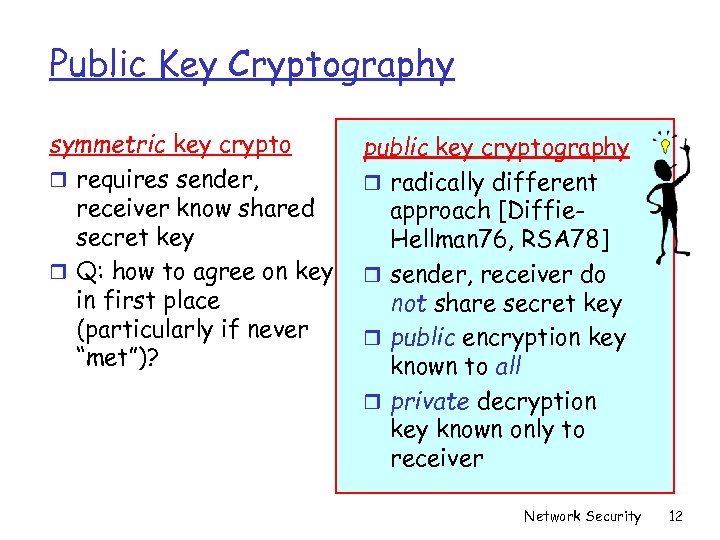
Public Key Cryptography symmetric key crypto r requires sender, receiver know shared secret key r Q: how to agree on key in first place (particularly if never “met”)? public key cryptography r radically different approach [Diffie. Hellman 76, RSA 78] r sender, receiver do not share secret key r public encryption key known to all r private decryption key known only to receiver Network Security 12
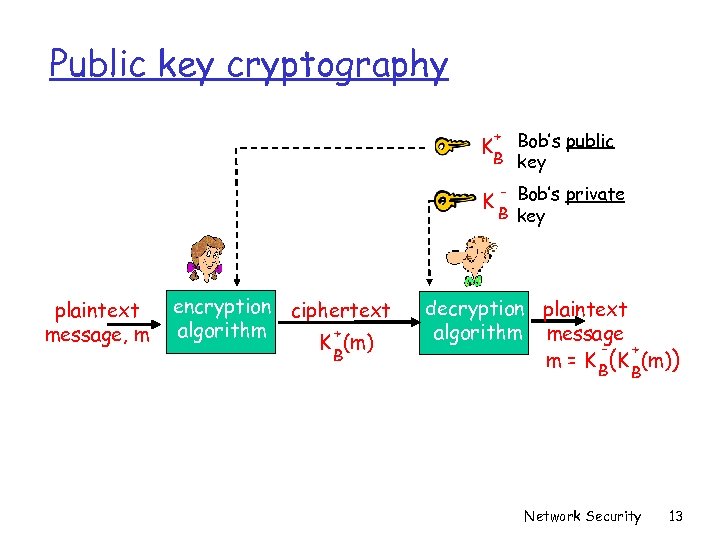
Public key cryptography + Bob’s public B key K K plaintext message, m encryption ciphertext algorithm + K (m) B - Bob’s private B key decryption plaintext algorithm message + m = K B(K (m)) B Network Security 13
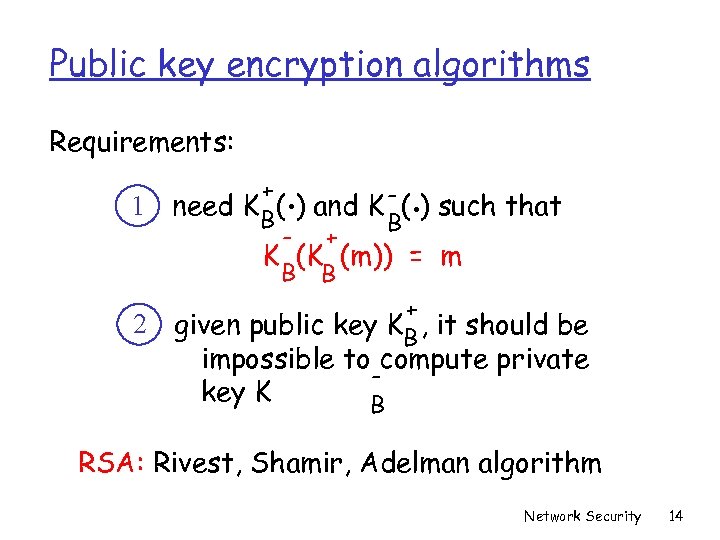
Public key encryption algorithms Requirements: 1 2 . . + need K B( ) and K - ( ) such that B - + K (K (m)) = m B B + given public key KB , it should be impossible to compute private key K B RSA: Rivest, Shamir, Adelman algorithm Network Security 14
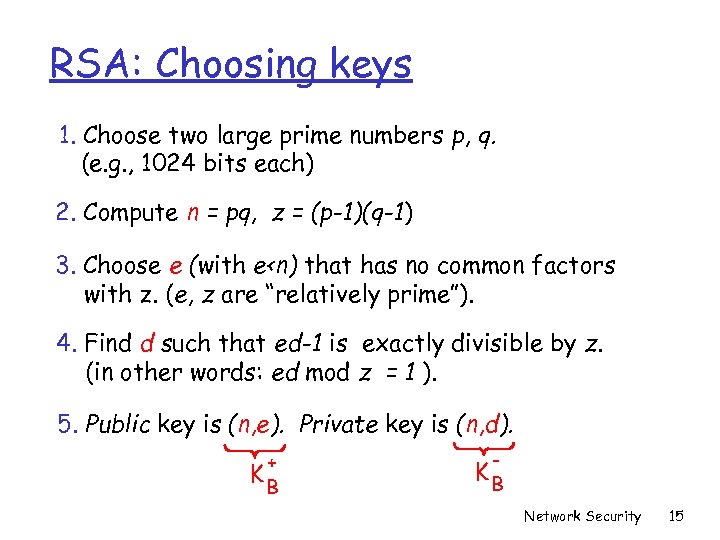
RSA: Choosing keys 1. Choose two large prime numbers p, q. (e. g. , 1024 bits each) 2. Compute n = pq, z = (p-1)(q-1) 3. Choose e (with e<n) that has no common factors with z. (e, z are “relatively prime”). 4. Find d such that ed-1 is exactly divisible by z. (in other words: ed mod z = 1 ). 5. Public key is (n, e). Private key is (n, d). + KB - KB Network Security 15
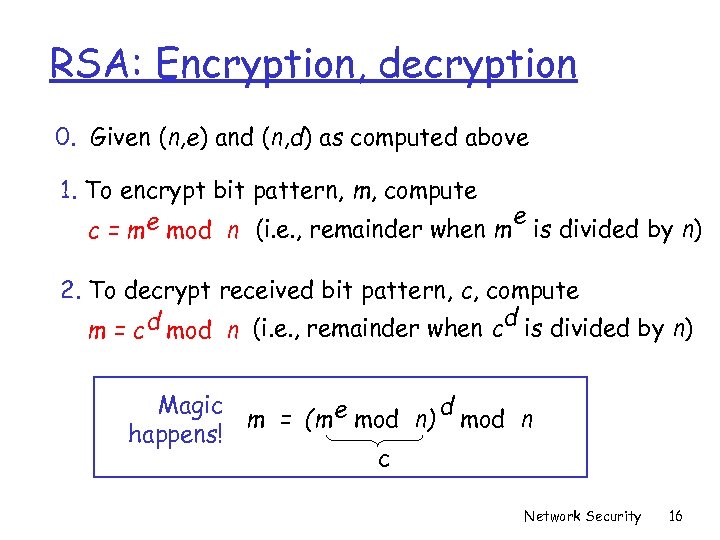
RSA: Encryption, decryption 0. Given (n, e) and (n, d) as computed above 1. To encrypt bit pattern, m, compute e mod n (i. e. , remainder when m e is divided by n) c=m 2. To decrypt received bit pattern, c, compute d m = c d mod n (i. e. , remainder when c is divided by n) Magic d m = (m e mod n) mod n happens! c Network Security 16
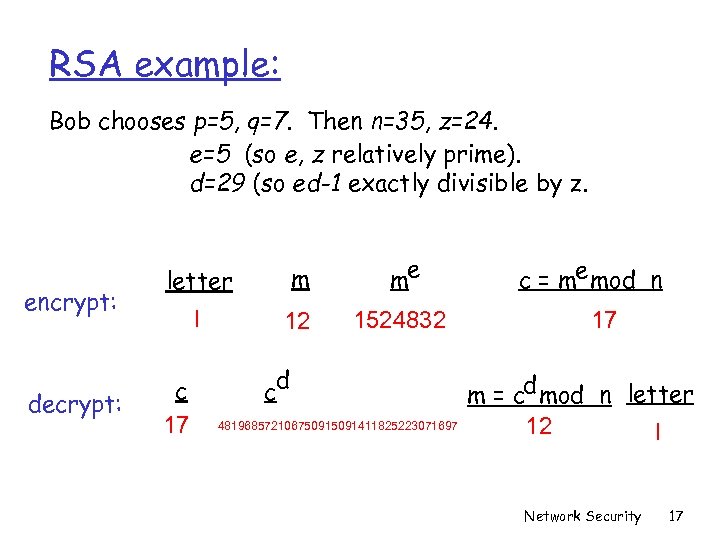
RSA example: Bob chooses p=5, q=7. Then n=35, z=24. e=5 (so e, z relatively prime). d=29 (so ed-1 exactly divisible by z. encrypt: decrypt: letter m me l 12 1524832 c 17 d c 48196857210675091411825223071697 c = me mod n 17 m = cd mod n letter 12 l Network Security 17
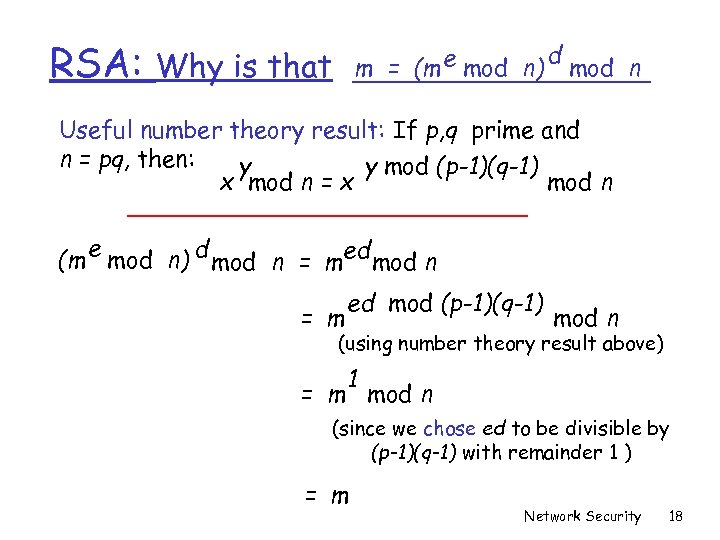
RSA: m = (m e mod n) Why is that d mod n Useful number theory result: If p, q prime and n = pq, then: y y mod (p-1)(q-1) x mod n = x mod n e (m mod n) d mod n = med mod n = m ed mod (p-1)(q-1) mod n (using number theory result above) 1 = m mod n (since we chose ed to be divisible by (p-1)(q-1) with remainder 1 ) = m Network Security 18
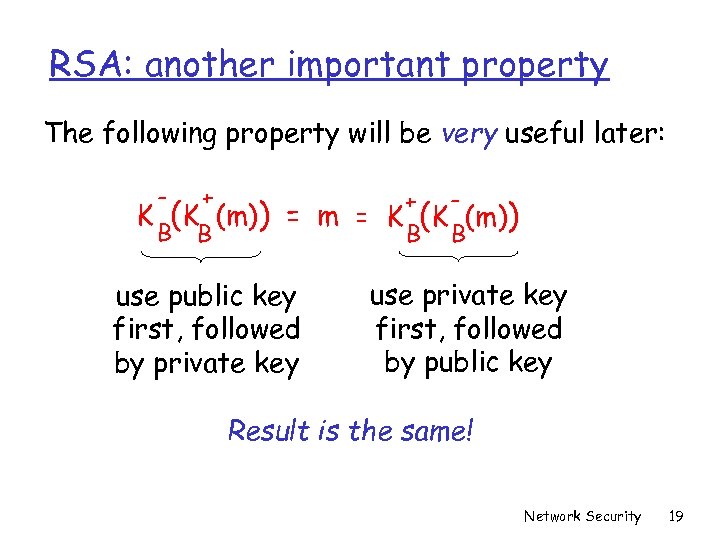
RSA: another important property The following property will be very useful later: - + B B K (K (m)) + = m = K (K (m)) B B use public key first, followed by private key use private key first, followed by public key Result is the same! Network Security 19
Roadmap. 1 What is network security? . 2 Principles of cryptography. 3 Authentication and integrity mechanisms. 4 Digital Signatures. 5 Key Distribution and certification. 6 Attacks and counter measures. 7 Access control: firewalls. 8 Security in many layers Network Security 20
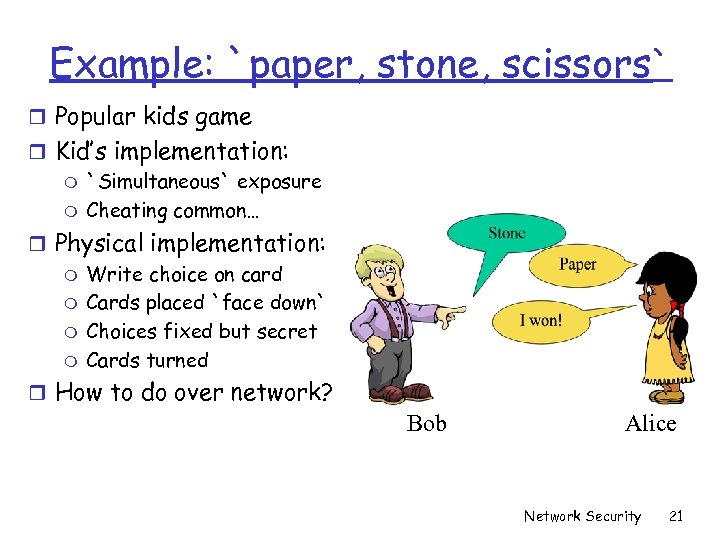
Example: `paper, stone, scissors` r Popular kids game r Kid’s implementation: m `Simultaneous` exposure m Cheating common… r Physical implementation: m Write choice on card m Cards placed `face down` m Choices fixed but secret m Cards turned r How to do over network? Bob Alice Network Security 21
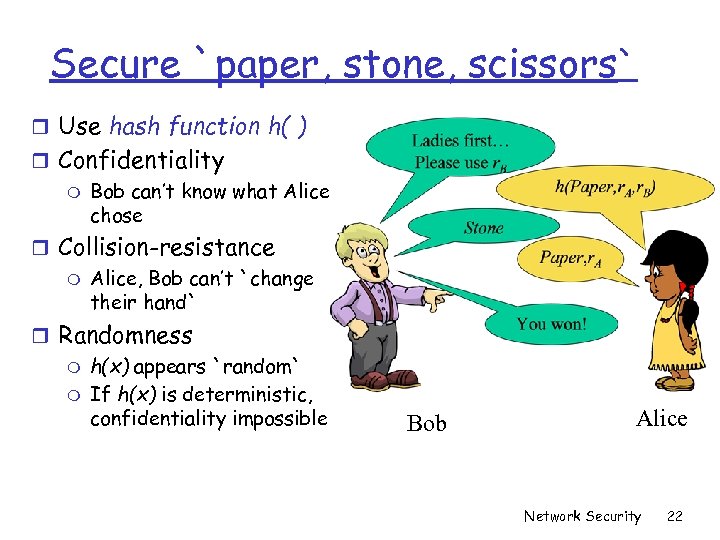
Secure `paper, stone, scissors` r Use hash function h( ) r Confidentiality m Bob can’t know what Alice chose r Collision-resistance m Alice, Bob can’t `change their hand` r Randomness m h(x) appears `random` m If h(x) is deterministic, confidentiality impossible Bob Alice Network Security 22
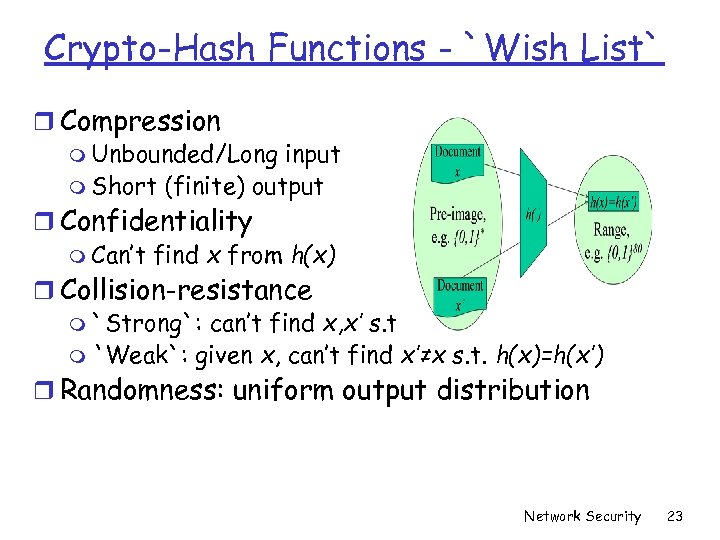
Crypto-Hash Functions - `Wish List` r Compression m Unbounded/Long input m Short (finite) output r Confidentiality m Can’t find x from h(x) r Collision-resistance m `Strong`: can’t find x, x’ s. t. h(x)=h(x’) m `Weak`: given x, can’t find x’≠x s. t. h(x)=h(x’) r Randomness: uniform output distribution Network Security 23
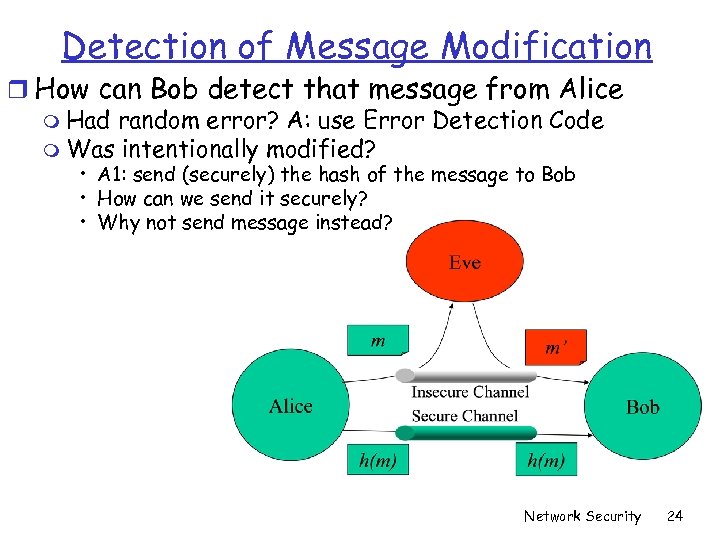
Detection of Message Modification r How can Bob detect that message from Alice m Had random error? A: use Error Detection Code m Was intentionally modified? • A 1: send (securely) the hash of the message to Bob • How can we send it securely? • Why not send message instead? Network Security 24
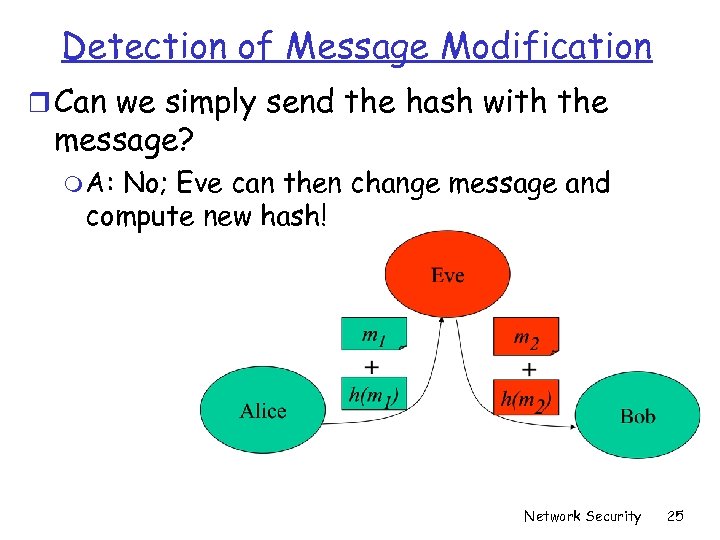
Detection of Message Modification r Can we simply send the hash with the message? m A: No; Eve can then change message and compute new hash! Network Security 25
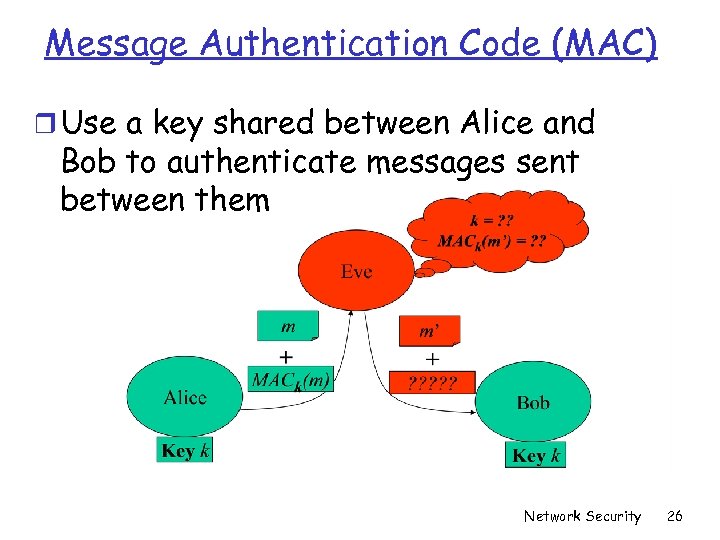
Message Authentication Code (MAC) r Use a key shared between Alice and Bob to authenticate messages sent between them Network Security 26
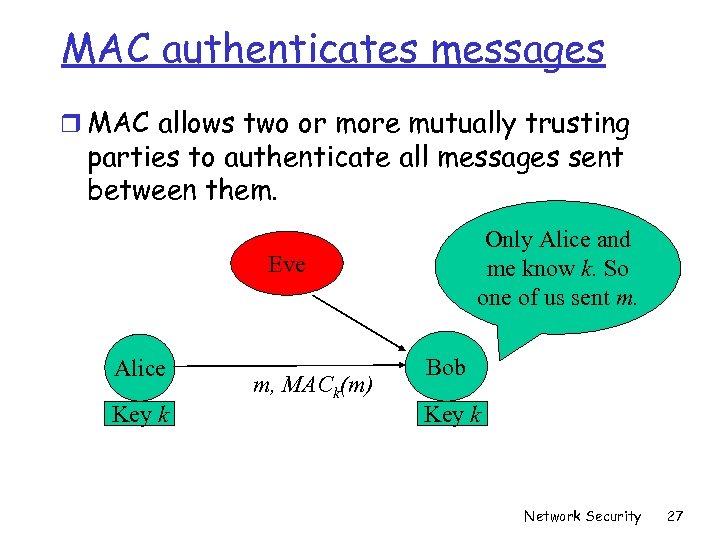
MAC authenticates messages r MAC allows two or more mutually trusting parties to authenticate all messages sent between them. Only Alice and me know k. So one of us sent m. Eve Alice Key k m, MACk(m) Bob Key k Network Security 27
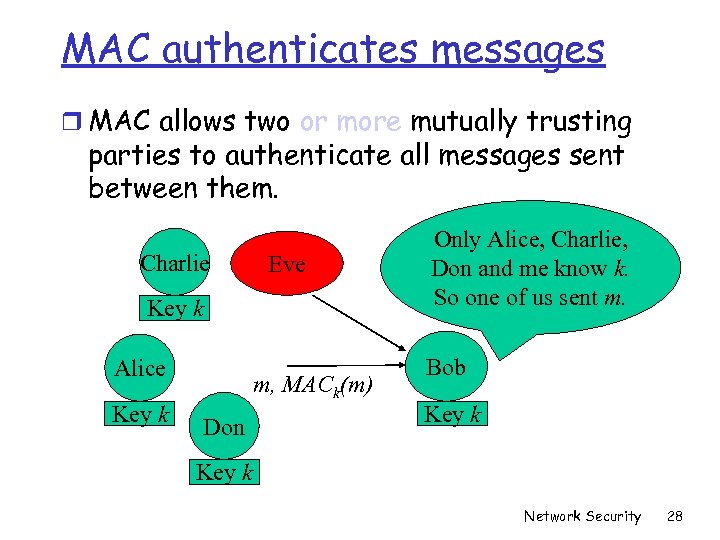
MAC authenticates messages r MAC allows two or more mutually trusting parties to authenticate all messages sent between them. Charlie Eve Key k Alice Key k m, MACk(m) Don Only Alice, Charlie, Don and me know k. So one of us sent m. Bob Key k Network Security 28
MAC Use Secret Key r Random or pseudo-random r Do not reveal to adversary r Do not use for anything except MAC m. E. g. use different key for encryption Network Security 29
Limitations of MAC r MACk(m) may expose information about m! m Example: Let MAC be any secure MAC. Define MAC’k(m)=LSb(m)||MACk(m), where LSb is least significant bit. r MAC only shows a key-holder computed it r Could be any key holder (e. g. recipient)… Specify sender, recipient in message r Could be re-transmission / replay… Add time/counter/random challenge to identify Network Security 30
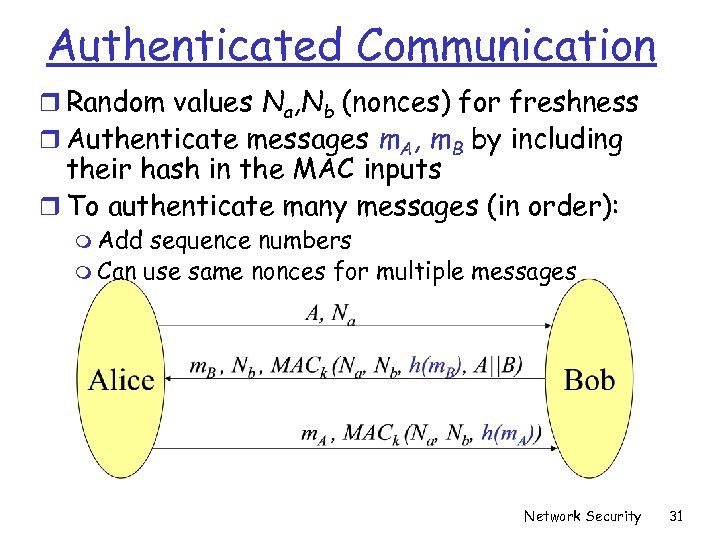
Authenticated Communication r Random values Na, Nb (nonces) for freshness r Authenticate messages m. A, m. B by including their hash in the MAC inputs r To authenticate many messages (in order): m Add sequence numbers m Can use same nonces for multiple messages Network Security 31
Non-repudiation r Non-repudiation: proof of authenticity that cannot be disputed by `signer` m m Long-lived Validation by multiple, arbitrary parties r Not ensured by MAC – key known to both! r Applications: m Contract/document//payment signing m Time-stamping of documents m Guaranteed/Certified Messaging Services r Main tool: digital signatures and certificates Network Security 32
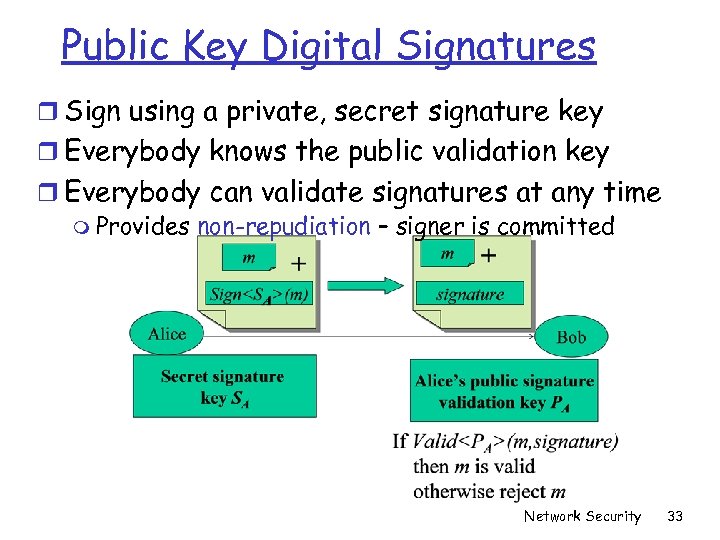
Public Key Digital Signatures r Sign using a private, secret signature key r Everybody knows the public validation key r Everybody can validate signatures at any time m Provides non-repudiation – signer is committed Network Security 33
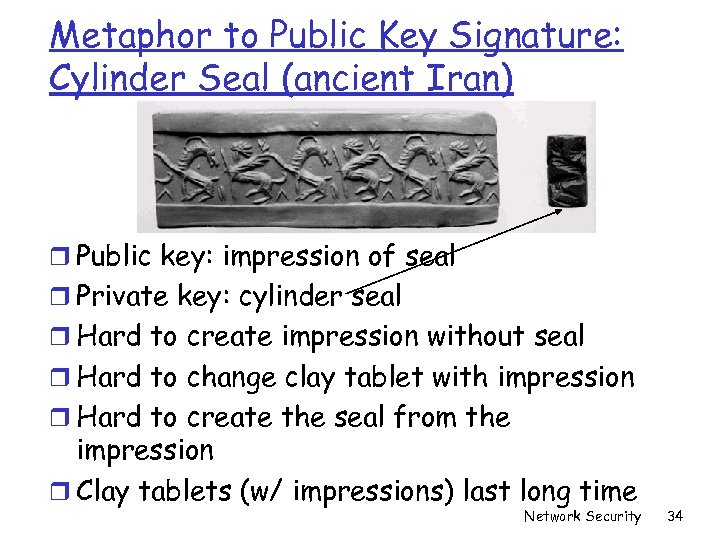
Metaphor to Public Key Signature: Cylinder Seal (ancient Iran) r Public key: impression of seal r Private key: cylinder seal r Hard to create impression without seal r Hard to change clay tablet with impression r Hard to create the seal from the impression r Clay tablets (w/ impressions) last long time Network Security 34
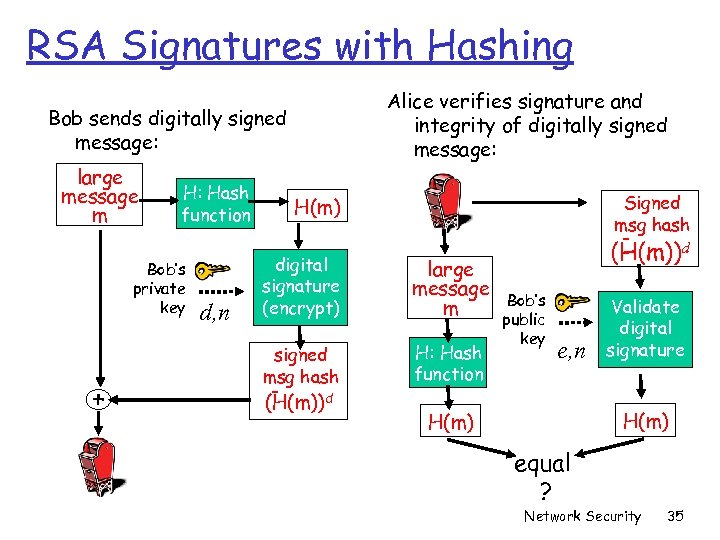
RSA Signatures with Hashing Alice verifies signature and integrity of digitally signed message: Bob sends digitally signed message: large message m H: Hash function Bob’s private key + d, n Signed msg hash H(m) - digital signature (encrypt) large message m signed msg hash H: Hash function (H(m))d Bob’s public key e, n Validate digital signature H(m) equal ? Network Security 35
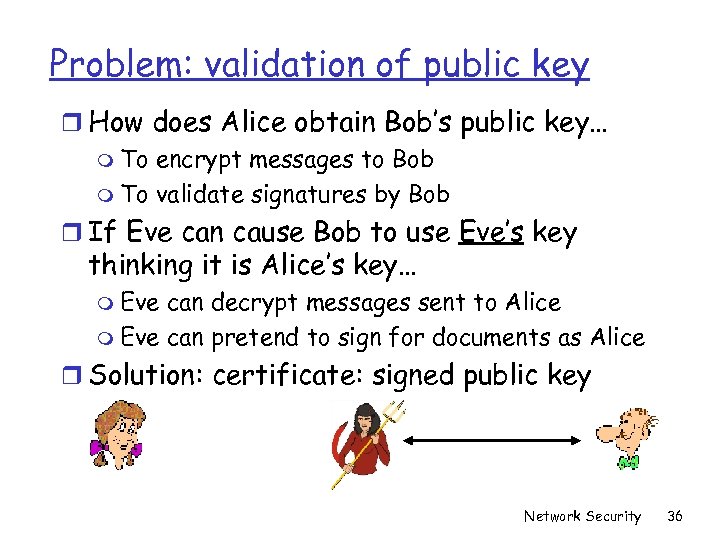
Problem: validation of public key r How does Alice obtain Bob’s public key… m To encrypt messages to Bob m To validate signatures by Bob r If Eve can cause Bob to use Eve’s key thinking it is Alice’s key… m Eve can decrypt messages sent to Alice m Eve can pretend to sign for documents as Alice r Solution: certificate: signed public key Network Security 36
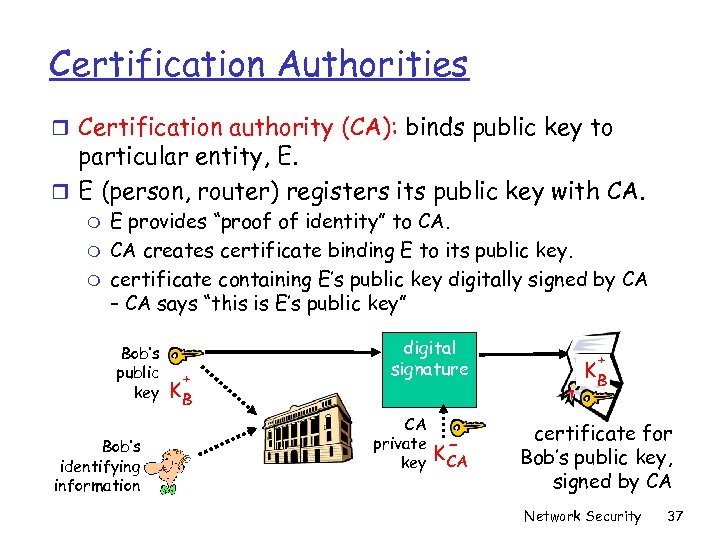
Certification Authorities r Certification authority (CA): binds public key to particular entity, E. r E (person, router) registers its public key with CA. m m m E provides “proof of identity” to CA. CA creates certificate binding E to its public key. certificate containing E’s public key digitally signed by CA – CA says “this is E’s public key” Bob’s public key Bob’s identifying information + KB digital signature CA private key K- CA + KB certificate for Bob’s public key, signed by CA Network Security 37
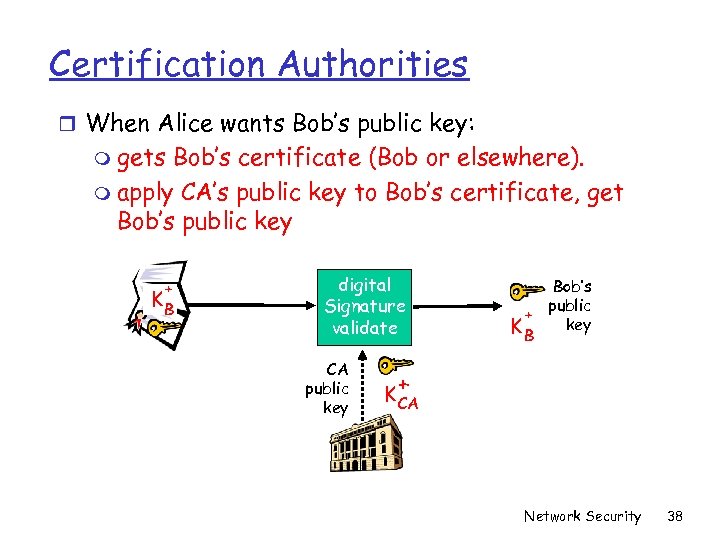
Certification Authorities r When Alice wants Bob’s public key: m gets Bob’s certificate (Bob or elsewhere). m apply CA’s public key to Bob’s certificate, get Bob’s public key + KB digital Signature validate CA public key Bob’s public + key KB + K CA Network Security 38
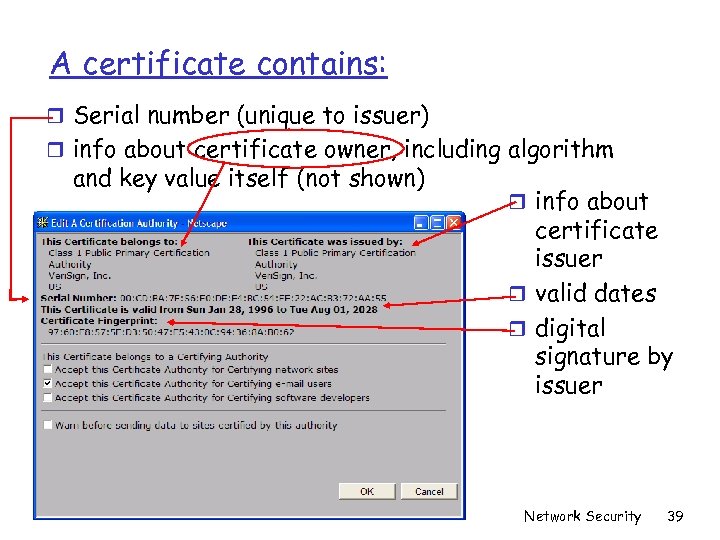
A certificate contains: r Serial number (unique to issuer) r info about certificate owner, including algorithm and key value itself (not shown) r info about certificate issuer r valid dates r digital signature by issuer Network Security 39
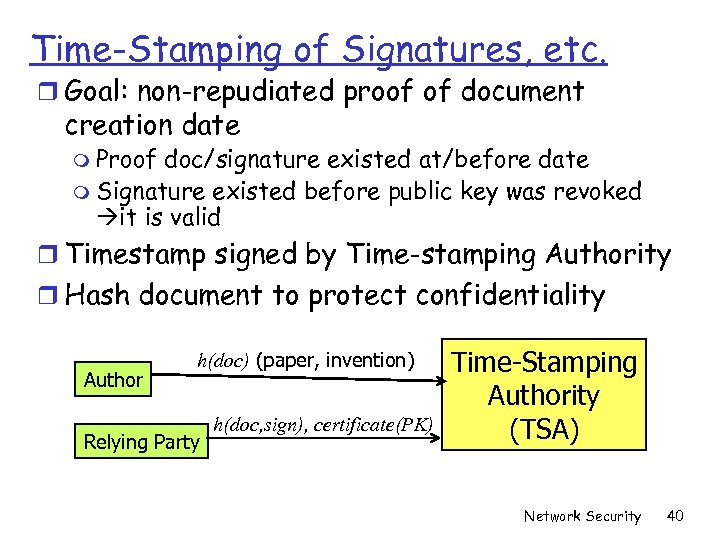
Time-Stamping of Signatures, etc. r Goal: non-repudiated proof of document creation date m Proof doc/signature existed at/before date m Signature existed before public key was revoked it is valid r Timestamp signed by Time-stamping Authority r Hash document to protect confidentiality Author h(doc) (paper, invention) Relying Party h(doc, sign), certificate(PK) Time-Stamping Authority (TSA) Network Security 40
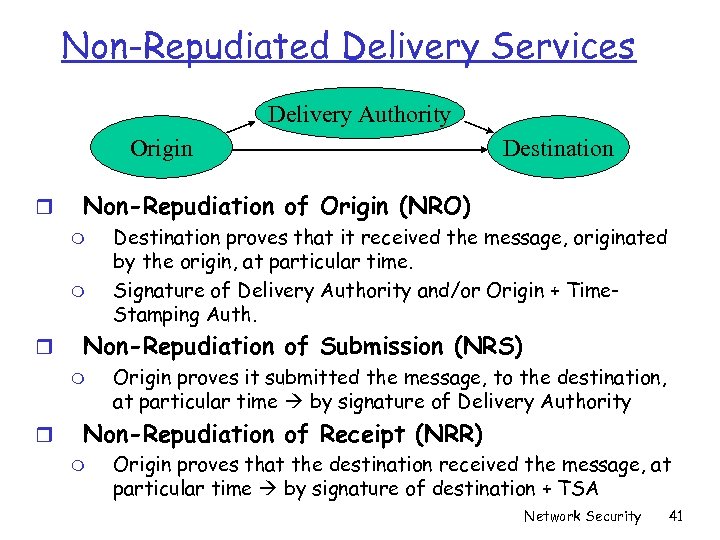
Non-Repudiated Delivery Services Delivery Authority Origin r Non-Repudiation of Origin (NRO) m m r Destination proves that it received the message, originated by the origin, at particular time. Signature of Delivery Authority and/or Origin + Time. Stamping Auth. Non-Repudiation of Submission (NRS) m r Destination Origin proves it submitted the message, to the destination, at particular time by signature of Delivery Authority Non-Repudiation of Receipt (NRR) m Origin proves that the destination received the message, at particular time by signature of destination + TSA Network Security 41
SSL / TLS in a Nutshell r SSL provides a `secure TCP tunnel from client to server`: m Confidentiality m Authentication of server, optionally also of client m Message and connection integrity r SSL: Secure Socket Layer m Since SSL (& TLS) operate on top of `standard` Sockets API r TLS: Transport Layer Security m Since TLS (& SSL) secure TCP (the transport layer) m IETF standard version of SSL m When we describe common aspects we usually say just SSL Network Security 42
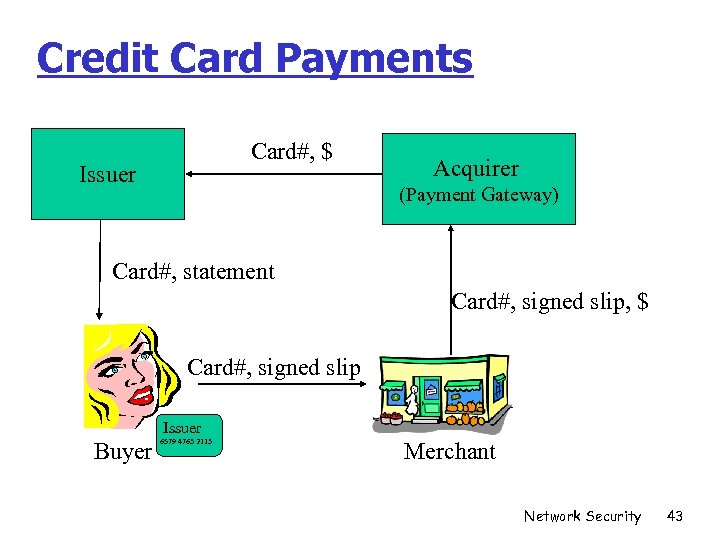
Credit Card Payments Card#, $ Issuer Acquirer (Payment Gateway) Card#, statement Card#, signed slip, $ Card#, signed slip Issuer Buyer 6579 4763 2113 Merchant Network Security 43
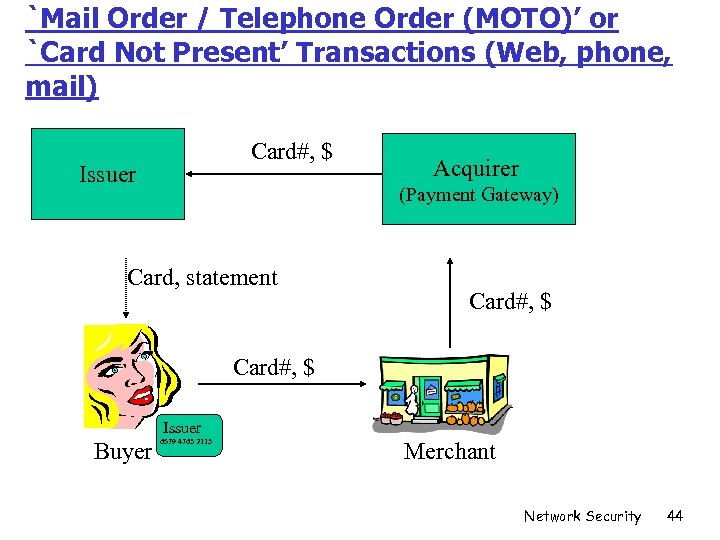
`Mail Order / Telephone Order (MOTO)’ or `Card Not Present’ Transactions (Web, phone, mail) Card#, $ Issuer Acquirer (Payment Gateway) Card, statement Card#, $ Issuer Buyer 6579 4763 2113 Merchant Network Security 44
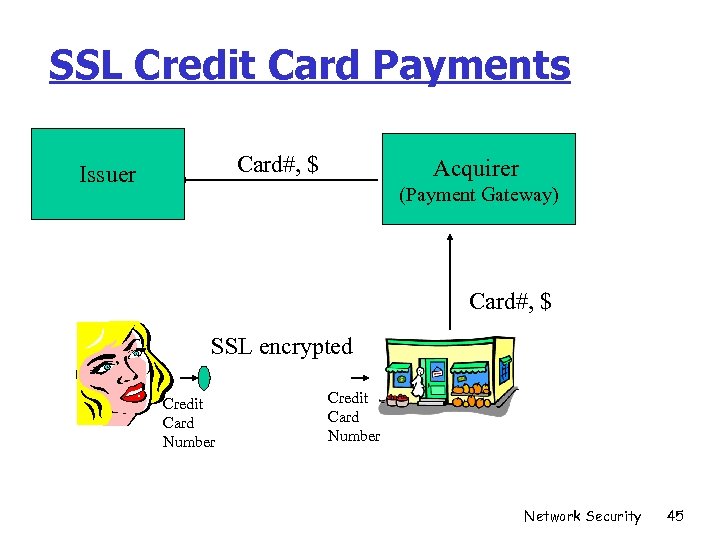
SSL Credit Card Payments Card#, $ Issuer Acquirer (Payment Gateway) Card#, $ SSL encrypted Credit Card Number Network Security 45
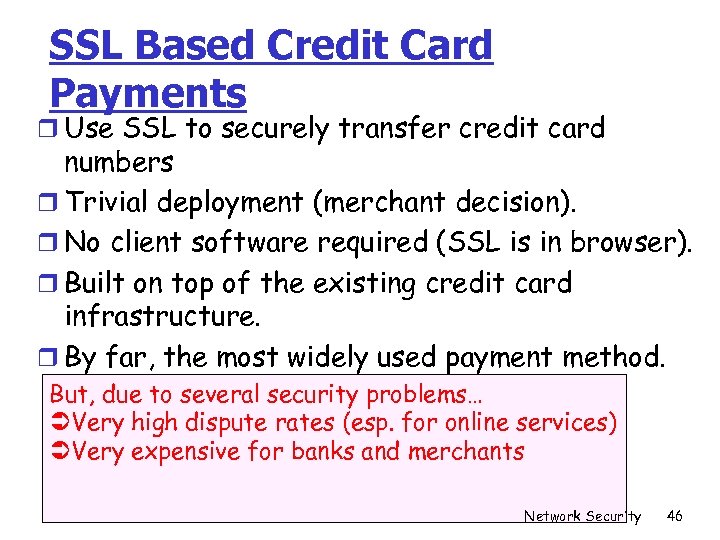
SSL Based Credit Card Payments r Use SSL to securely transfer credit card numbers r Trivial deployment (merchant decision). r No client software required (SSL is in browser). r Built on top of the existing credit card infrastructure. r By far, the most widely used payment method. But, due to several security problems… ÜVery high dispute rates (esp. for online services) ÜVery expensive for banks and merchants Network Security 46
Скачать презентацию Secure Electronic Commerce Prof Amir Herzberg Seminar 89
a0bbc186f78740ec535ee38e1a844065.ppt