


 Скачать презентацию Secure Digital Music Initiative Creating a Digital Music
f5e2f33d7daae431e1078f9ae17d183c.ppt
- Количество слайдов: 44
 Secure Digital Music Initiative Creating a Digital Music Marketplace
 What SDMI is: • A multi-industry forum to develop a voluntary open framework for playing, storing and distributing digital music to enable a new market to emerge. • A forum for dialogue
 Who has been involved? • Broad multi-industry participation • Over 120 companies and organizations blue-chips, start-ups, record companies, Internet companies, software companies, consumer electronics companies …. .
 SDMI Participants • • • 4 C Entity Adaptec AEI Music/Play. Media America Online Aris Technologies AT&T Audible, Inc. Audio Explosion Audio Matrix Audio Soft Audiohighway. com Aureal Semiconductor
 SDMI Participants • • • BMG Entertainment Bose Breaker Technology Canadian Audiotrack Casio CD World CDDB CDuctive. com Channelware Cinram International Compaq Comverse Info Systems
 SDMI Participants • • • Creative Technologies Dentsu Deutsche Telekom Diamond Multimedia Digimarc Digital On-Demand Digital River Digital Theater Systems DIVX Dolby Laboratories EMI Recorded Music Encoding. com
 SDMI Participants • • • Enso Audio Imaging Fraunhofer IIS General Instrument Good. Noise Hewlett Packard Hitachi HMV Group I 2 GO. COM IGUIDE Infineon Inter. Trust Technologies Intervu
 SDMI Participants • • • IOMEGA J. River J VWeb Kent Ridge Digital Labs Lexar Media LG Electronics Liquid Audio Lucent Technologies M. Ken Macro Vision MAGEX at Nat. West Matsushita
 SDMI Participants • • • MCOS Memory Media Fair Mediamatics MCY Music World Micronas Semiconductors Microsoft Multimedia Archives & Retrieval Systems Music. Marc Nippon Telegraphic & Telephone Nokia UK NTT Mobile Communications Network
 SDMI Participants • • • Packard Bell NEC Philips Pioneer Plug ‘n Pay Technologies Portal Player Pricewaterhouse Coopers QDesign QPICT Real. Networks Rights Exchange RPK Security Saehan Information Systems
 SDMI Participants • • • Sanyo North America Seca on behalf of Canal Plus Sharp Softlock Services Solana Technology Development Sonic Solutions Samsung Electronics San. Disk Corporation Sonopress (BMG Storage Media) Sony Music Entertainment Spectra. Net Communications - Throttle. Box
 SDMI Participants • • • Sphere Multimedia Technologies ST&Hilo, a subsidiary of Telefonica STMicroelectronics Sun Microsystems Supertracks TDK Electronics Telian Texas Instruments The Mitsubishi The Music Connection Thomson Consumer Electronics Tokyo Electron Device
 SDMI Participants • • • Toshiba Corporation Touch Tunes Digital Jukebox Universal Music Group Victor Co. of Japan Warner Music Group Wave Systems Waveless Radio Consortium Wave. Phore Xerox Yamaha
 The Path to SDMI • 1970’s: Tape recorders • 1980’s: DAT • 1990’s: – CD-R; CD-RW – Recordable DVD – Storage capacity – Small, portable, removable hard drives – Flash memory devices – MP 3 files
 Confrontation to Collaboration • Legal rights difficult to enforce • Need for technological solution • Need for collaboration to allow a legitimate market to emerge
 Benefits of Collaboration • New business models for music usage can develop • New products and services can be created to support these new uses • Consumers gain – easier access – to more music – in new, more enjoyable ways
 Pirate markets benefit no one • Piracy-based markets are short-term only; consumer frustration hurts everyone • If content loses value, technology driver is lost • Lost opportunity for e-commerce
 Legitimate markets benefit everyone • • • Easy access to music Easy to acquire Quality sound New ways to use music Interoperable devices
 Legitimate markets benefit everyone • Companies that make products • Artists who make music • Consumers who want both
 Goals of SDMI • To secure music in all forms, across all delivery channels • Brand music with indelible markings, at the source • Identifiers and usage rights data travel with music • All devices read and act on data in predictable ways.
 SDMI is commercially motivated • Not intended to reinvent • Intended to build on what has already been achieved and what is already available in the market
 Short term need: Portable Devices • Customer demand • Technology partners eager to join that market • Internet could otherwise turn into a permanent haven for pirated music • Therefore, portable device issue had to be addressed on a very fast track
 SDMI on concurrent tracks • Short term needs requiring prompt resolution: Portable devices on a fast track • Long term objective: Meta-level architecture
 SDMI’s Launch • February 26, 1999 • Executive Director - Leonardo Chiariglione – Chair of MPEG • Portable Device Working Group – Immediately tasked with focusing on Portable Devices – Jack Lacy, Chair – Met June 30, 1998 deadline for initial Portable Device Specification
 Portable Device Specification Version 1. 0 • Adopted June 28, 1999 • Released July 13, 1999, after technical review • Publicly available, along with overview and FAQ, at www. sdmi. org
 SDMI- Framework, Not Format • No intent to select a • Reasons: compression – Technology is continually developing technology (MP 3, and will improve. AAC, MSAudio, etc). – Encourage innovation • No intent to select an and competition. encryption technology. – Allow maximum flexibility. – Allow market to choose the best formats.
 PD Specification Covers • Application – Program that manages import of content, music libraries, playback and rights management • Portable Device (PD) – Device that stores protected content and plays it back • Portable Media (PM) – Media that stores protected content • Licensed Compliant Module (LCM) – Interfaces and/or translates communications between LCMs and PDs/PMs
 Core Principles • SDMI components must respect any “usage rules” - which describe how the content can be used - that may come in the content in the future. – Any artist, band or record label that chooses to permit unlimited copying will have that option. – Any artist, band or record label that chooses to limit copying of an original will have that option. – This is a general principle for future application (e. g. electronically distributed music), not current product.
 Core Principles • Any content to be used in an SDMI Portable Device must be protected at all times after it has been imported into the SDMI domain. • Subsequent storage, use within, or transfer between SDMI components must be done in a manner that protects the content.
 Core Principles • Content must be bound to a Portable Device or Portable Media. – This ensures that a copy on a PD or PM will not become the source for additional copies. – This does not limit consumer usage because consumers can make copies for any device they choose - and as many devices as they need - and portable media can be transferred among compatible devices.
 Core Principles SDMI components will accept both protected and unprotected music, e. g. MP 3 files. – Unknown, unprotected music will be converted into SDMI content and stored in protected form. – Music from unknown sources (garage bands, church choirs) will not be excluded.
 Core Principles • Legacy content (music on existing CDs) will not be technologically protected. • Reasons: - Effective protection is not possible. - Technological impediments would merely be minor speed bumps to copying. - Necessary in order to permit church choirs and garage bands to use SDMI. - Respects privacy rights.
 Core Principles • Future content (music on future CDs, DVD-A and EMD) must be protected against Internet piracy. – Mechanism for protection yet to be determined. – One way this could be done is through a Dual Watermark System. • Robust watermark - will not degrade when compressed. • Fragile watermark - will disappear when compressed. • All music from unknown source passes through screen in SDMI application. Screen only permits in content that either has both marks or no marks.
 Core Principles • Personal copying of CDs is permitted; Internet distribution without authorization is prevented. • Where “usage rules” are not found, SDMI components will only make 4 copies from every rip from the original. This allows personal copying - as much as necessary but impedes piracy.
 Core Principles • SDMI technology must be robust. – Security mechanisms must achieve certain requirements. – Tamper resistance in both software and hardware. – Content must be protected whenever exposed.
 Implementation • Devices to develop in 2 phases. • 1 st Phase – Screen music for a signal - time to upgrade to become a 2 nd Generation device. • 2 nd Phase – Dual Watermark or other system – Only upgraded phase 2 devices will play future releases.
 Compliance with the Standard • Compliance is a condition of obtaining a trademark license to use an SDMI mark. • Compliance is a condition of obtaining a technology license for the Aris/4 C watermark.
 Marketing Efforts • Logo and Tagline for SDMI Compliant products.
 Expectations • Some manufacturers have already announced plans for SDMI compliant products, and they should begin coming to market by January, 2000. • Goal and expectation is that SDMI compliant products will overtake noncompliant products within a few years.
 Announcements to Date • Portable Devices – Diamond, Creative, Matsushita (Panasonic), Toshiba, Mitsubishi, Lucent, Sanyo, Philips, Sony, Thomson (RCA), Audiovox • Portable Media – Texas Instruments, QDesign, Iomega, San. Disk, Matsushita, Toshiba
 Announcements to Date • Software – Microsoft, Intertrust, Reciprocal, WAVE, Music. Marc, Liquid Audio, Fraunhaufer, Nat. West • Content – BMG, EMI, Sony, Universal, Warner, Rock. com
 Future of SDMI - What’s Next? • Develop Functional Requirements • Issue Call for Proposals for implementation technologies • Develop specifications
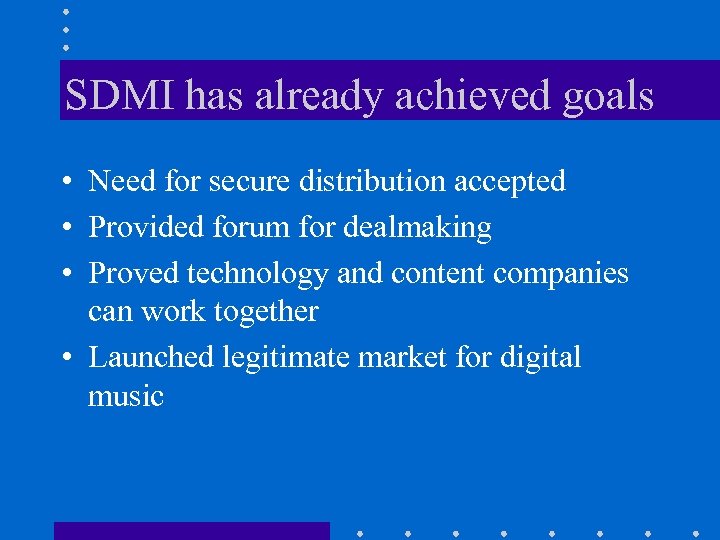 SDMI has already achieved goals • Need for secure distribution accepted • Provided forum for dealmaking • Proved technology and content companies can work together • Launched legitimate market for digital music
 Secure Digital Music Initiative