


 Скачать презентацию Sectionalism and Economies West North Tied
4d6f693b0e44d52c083dd8a7fe5b06c5.ppt
- Количество слайдов: 49
 Sectionalism and Economies
 West & North Tied Together By: n Transportation tied two sections together n Industry (raw materials/manufactured goods): 110, 000 factories by 1860 n Immigration n Reform Movements
 SOUTH: Effect of Slave System n All of their available capital is tied up in three things: land, slaves, and crops n There is much less internal transportation n Little industry (20, 000) n Few cities n No immigration n No reform movements
 NORTH & SOUTH: Two Ways of Life n North n Growing Industry, commercial trade, farming n Large population (immigration) n Cities: factories, workers n Roads, RR’s, harbors n South n Agrarian slave based society
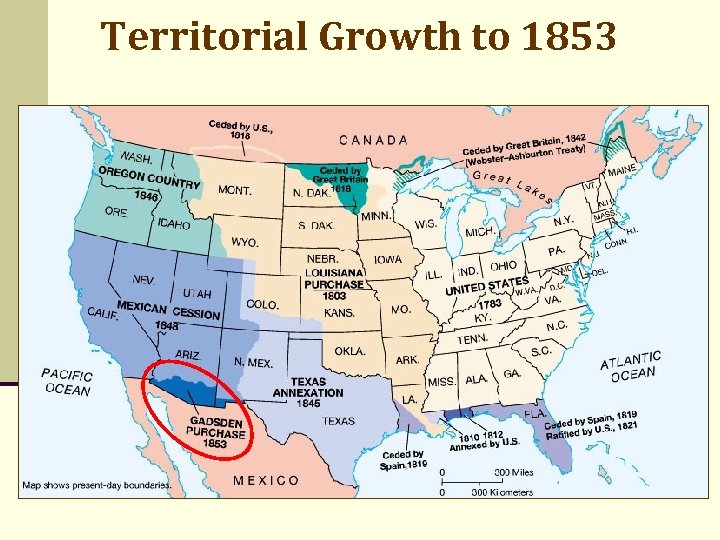
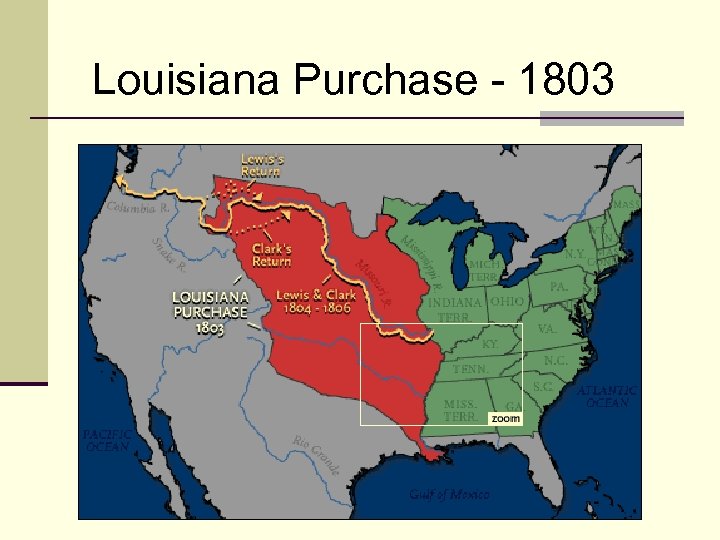 Louisiana Purchase - 1803
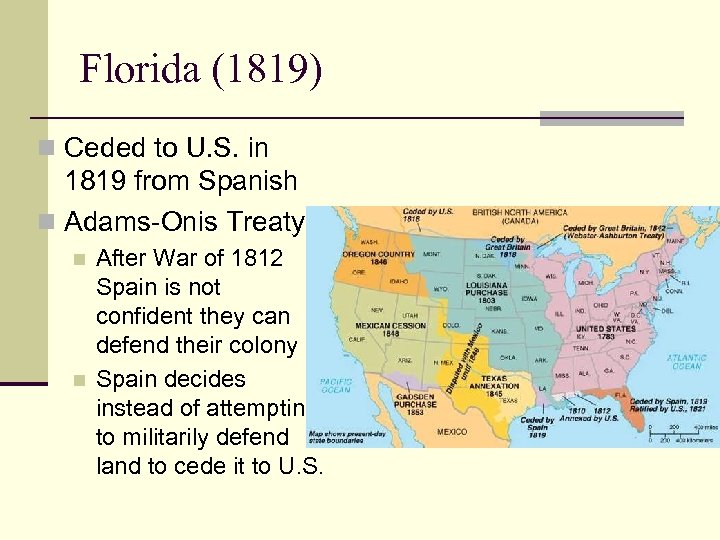 Florida (1819) n Ceded to U. S. in 1819 from Spanish n Adams-Onis Treaty n n After War of 1812 Spain is not confident they can defend their colony Spain decides instead of attempting to militarily defend land to cede it to U. S.
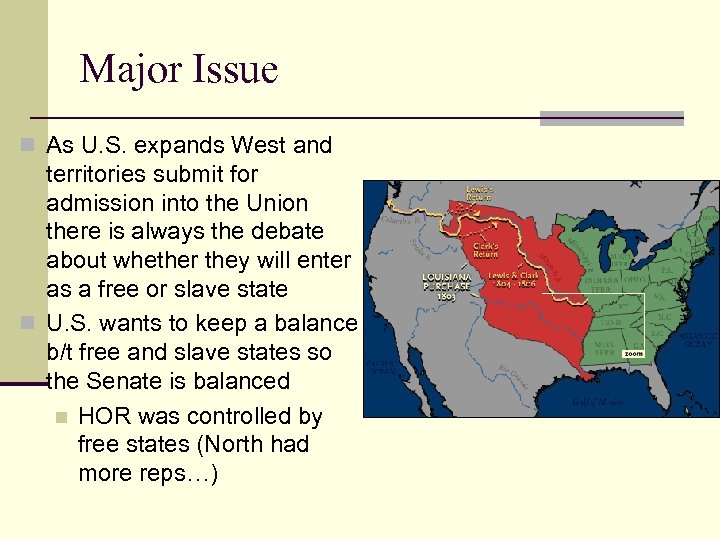 Major Issue n As U. S. expands West and territories submit for admission into the Union there is always the debate about whether they will enter as a free or slave state n U. S. wants to keep a balance b/t free and slave states so the Senate is balanced n HOR was controlled by free states (North had more reps…)
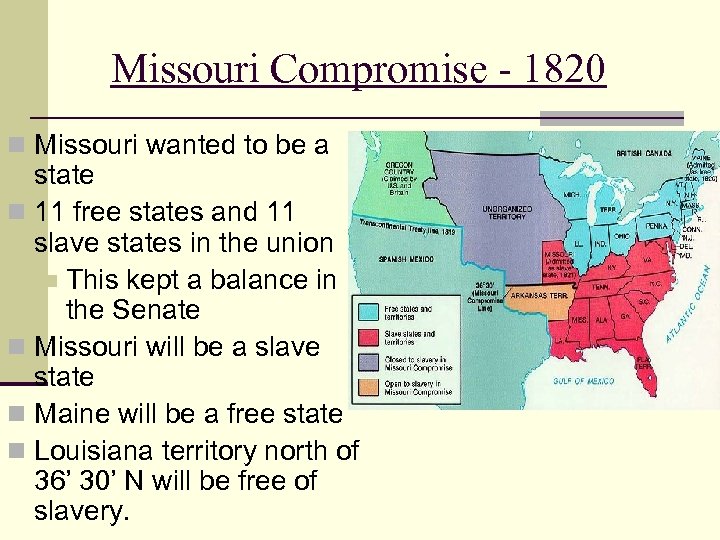 Missouri Compromise - 1820 n Missouri wanted to be a state n 11 free states and 11 slave states in the union n This kept a balance in the Senate n Missouri will be a slave state n Maine will be a free state n Louisiana territory north of 36’ 30’ N will be free of slavery.
 American Expansion “Manifest Destiny” 1836 – 1867 Texas Mexican – American War California Compromise of 1850 Oregon Alaska
 Manifest Destiny n First coined by newspaper editor, John O’Sullivan in 1845. n ". . the right of our manifest destiny to over spread and to possess the whole of the continent which Providence has given us for the development of the great experiment of liberty and development of self-government entrusted to us. It is right such as that of the tree to the space of air and the earth suitable for the full expansion of its principle and destiny of growth. " n A myth of the West as a land of romance and adventure emerged.
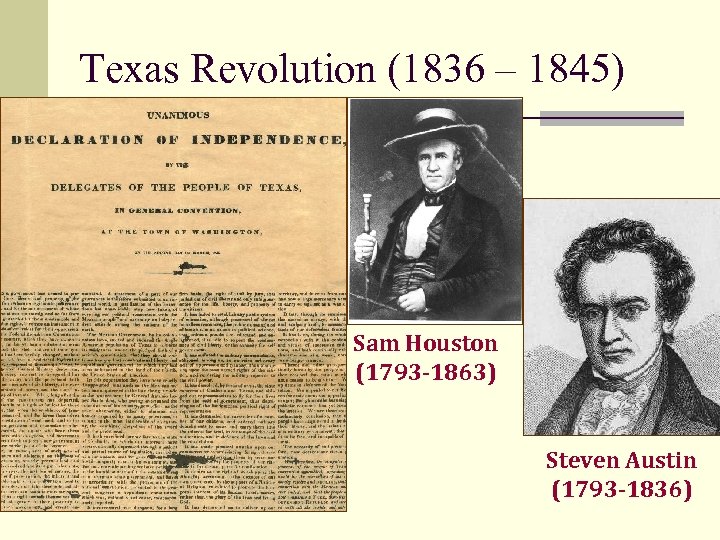 Texas Revolution (1836 – 1845) Sam Houston (1793 -1863) Steven Austin (1793 -1836)
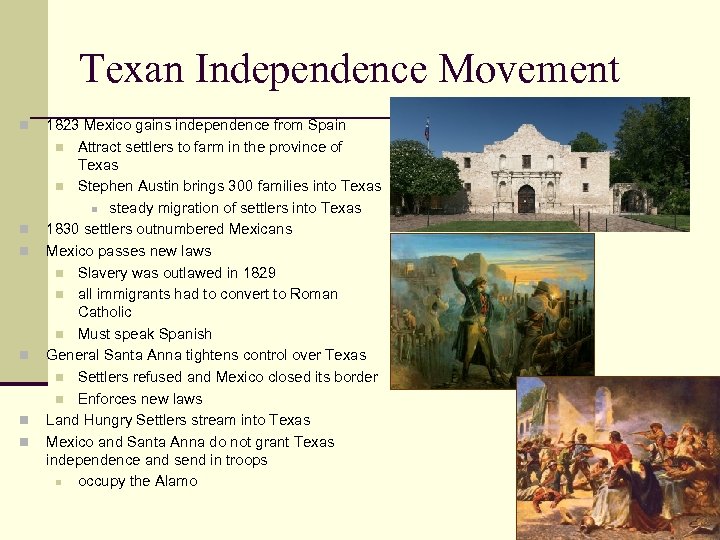 Texan Independence Movement n n n 1823 Mexico gains independence from Spain n Attract settlers to farm in the province of Texas n Stephen Austin brings 300 families into Texas n steady migration of settlers into Texas 1830 settlers outnumbered Mexicans Mexico passes new laws n Slavery was outlawed in 1829 n all immigrants had to convert to Roman Catholic n Must speak Spanish General Santa Anna tightens control over Texas n Settlers refused and Mexico closed its border n Enforces new laws Land Hungry Settlers stream into Texas Mexico and Santa Anna do not grant Texas independence and send in troops n Occupy the Alamo
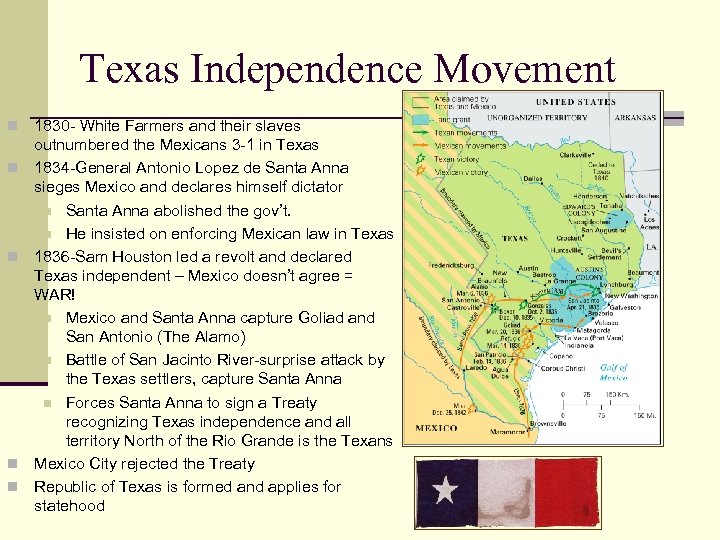 Texas Independence Movement n n n 1830 - White Farmers and their slaves outnumbered the Mexicans 3 -1 in Texas 1834 -General Antonio Lopez de Santa Anna sieges Mexico and declares himself dictator n Santa Anna abolished the gov’t. n He insisted on enforcing Mexican law in Texas 1836 -Sam Houston led a revolt and declared Texas independent – Mexico doesn’t agree = WAR! n Mexico and Santa Anna capture Goliad and San Antonio (The Alamo) n Battle of San Jacinto River-surprise attack by the Texas settlers, capture Santa Anna n Forces Santa Anna to sign a Treaty recognizing Texas independence and all territory North of the Rio Grande is the Texans Mexico City rejected the Treaty Republic of Texas is formed and applies for statehood
 Texas 1836 - 1845 n Texas applies for statehood = tension between the north and south n Upset the balance of states + extension of slavery n Texas gains international recognition n England France recognize Texas Independence and trade with new Republic n U. S. eyes other Mexican Territory – California n Annexation of Texas becomes an issue in election of 1844
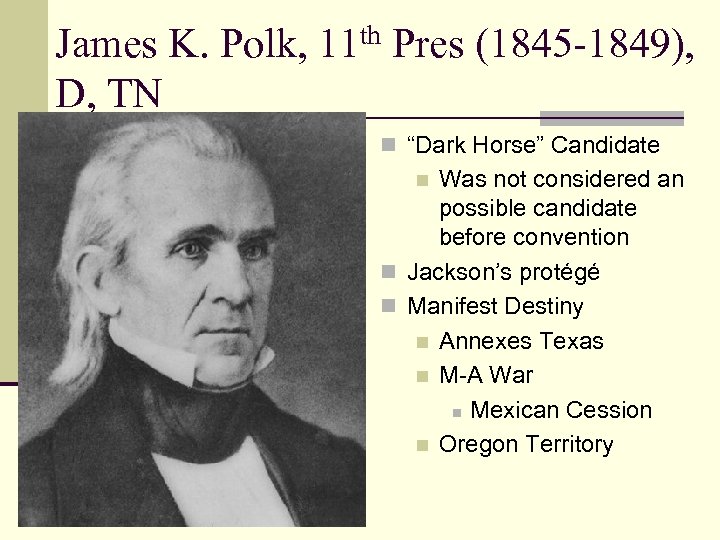 James K. Polk, 11 th Pres (1845 -1849), D, TN n “Dark Horse” Candidate Was not considered an possible candidate before convention n Jackson’s protégé n Manifest Destiny n Annexes Texas n M-A War n Mexican Cession n Oregon Territory n
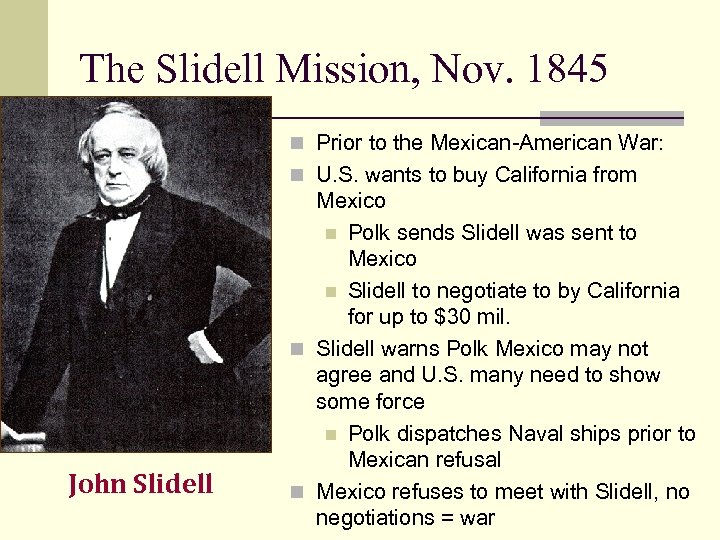 The Slidell Mission, Nov. 1845 n Prior to the Mexican-American War: n U. S. wants to buy California from John Slidell Mexico n Polk sends Slidell was sent to Mexico n Slidell to negotiate to by California for up to $30 mil. n Slidell warns Polk Mexico may not agree and U. S. many need to show some force n Polk dispatches Naval ships prior to Mexican refusal n Mexico refuses to meet with Slidell, no negotiations = war
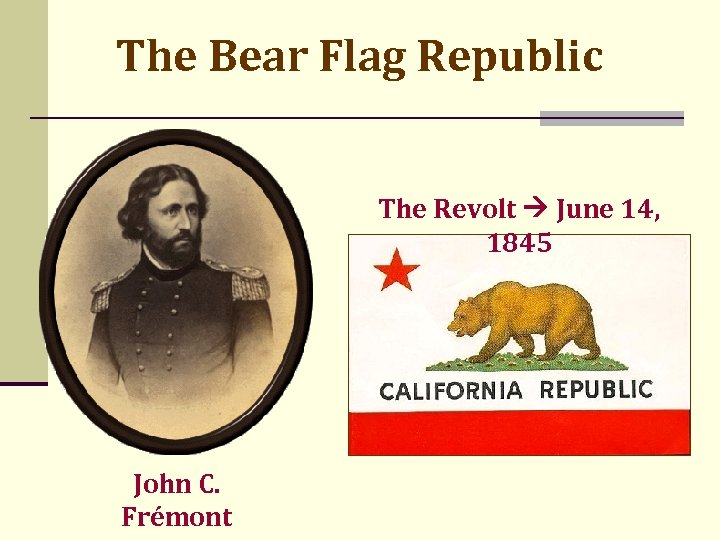 The Bear Flag Republic The Revolt June 14, 1845 John C. Frémont
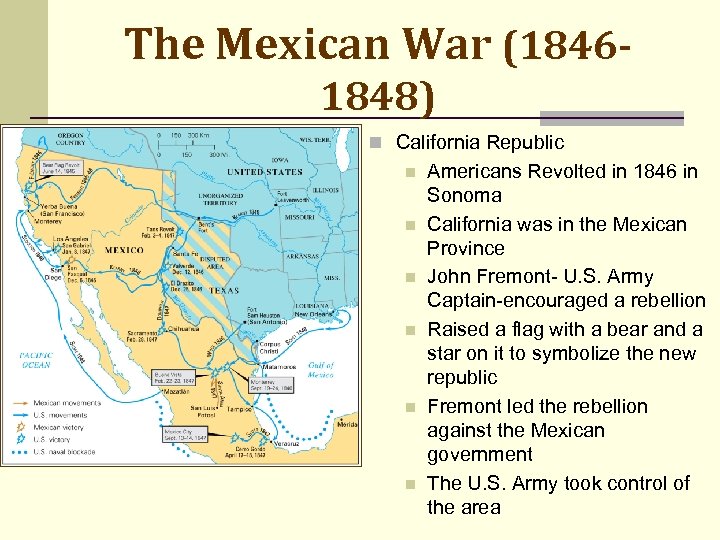 The Mexican War (18461848) n California Republic n n n Americans Revolted in 1846 in Sonoma California was in the Mexican Province John Fremont- U. S. Army Captain-encouraged a rebellion Raised a flag with a bear and a star on it to symbolize the new republic Fremont led the rebellion against the Mexican government The U. S. Army took control of the area
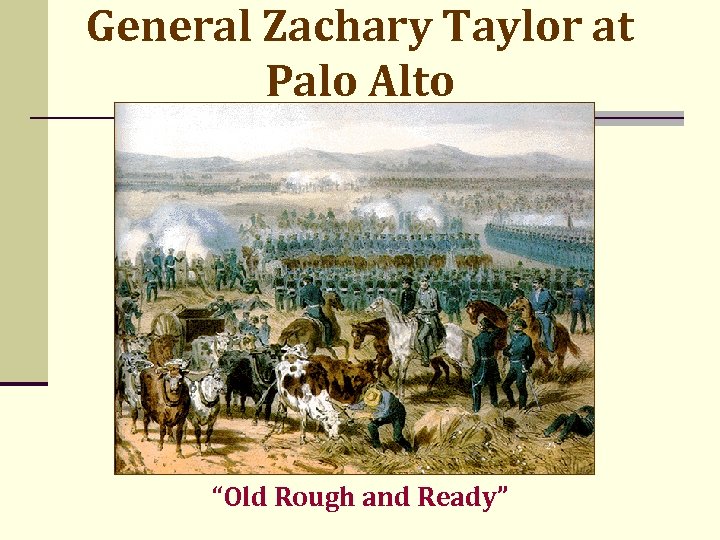 General Zachary Taylor at Palo Alto “Old Rough and Ready”
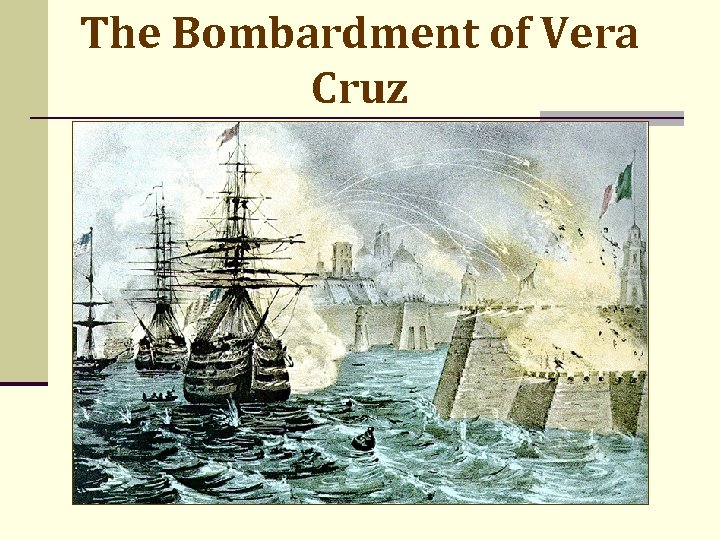 The Bombardment of Vera Cruz
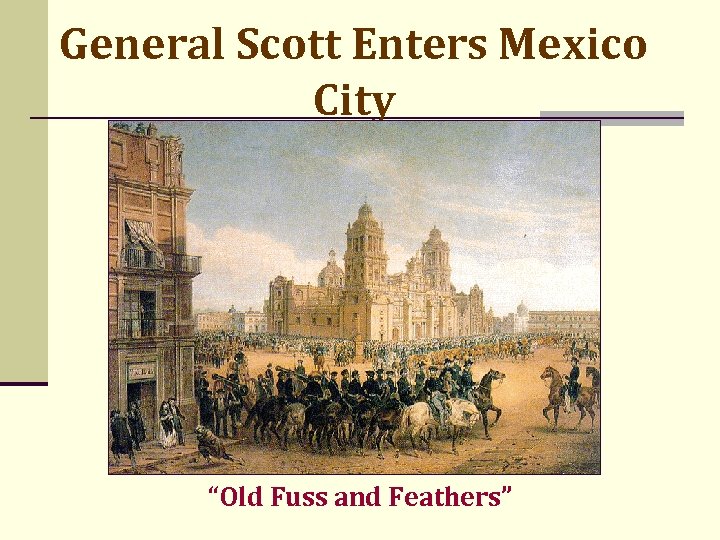 General Scott Enters Mexico City “Old Fuss and Feathers”
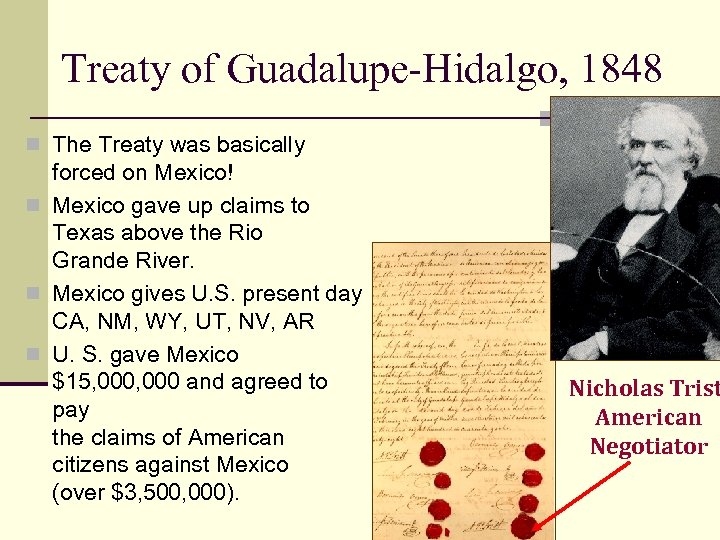 Treaty of Guadalupe-Hidalgo, 1848 n The Treaty was basically forced on Mexico! n Mexico gave up claims to Texas above the Rio Grande River. n Mexico gives U. S. present day CA, NM, WY, UT, NV, AR n U. S. gave Mexico $15, 000 and agreed to pay the claims of American citizens against Mexico (over $3, 500, 000). Nicholas Trist American Negotiator
 Results of the Mexican War? 1. The 17 -month war cost $100, 000 and 13, 000+ American lives (mostly of disease). 2. New territories were brought into the Union which forced the explosive issue of SLAVERY to the center of national politics. * Brought in 1 million sq. mi. of land (incl. TX) 3. These new territories would upset the balance of power between North and South. 4. Created two popular Whig generals who ran for President. 1. Winfield Scott 2. Zachary Taylor 5. Manifest Destiny partially realized.
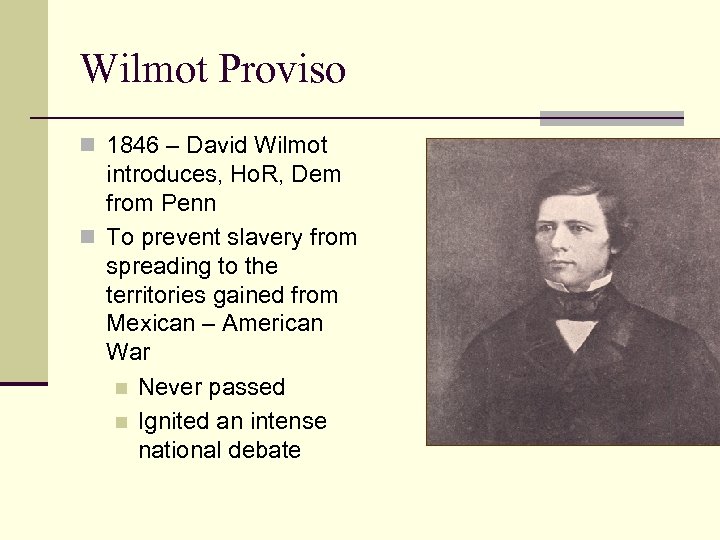 Wilmot Proviso n 1846 – David Wilmot introduces, Ho. R, Dem from Penn n To prevent slavery from spreading to the territories gained from Mexican – American War n Never passed n Ignited an intense national debate
 Tension Over Mexican War Treaty n “This was an immoral war to gain territory for spread of slavery”. (No. Whigs) n “So. should aim for more Mexican territory, maybe even central America, possibly Cuba? ? ? ” (So. expansionists) n Was this a “slavery conspiracy”? Facts: Polk offers to buy Cuba, several So. expeditions to take Cuba by force, n Secret negotiations to buy Cuba (Ostend Manifesto) revealed: outraged No. Attempts ended n
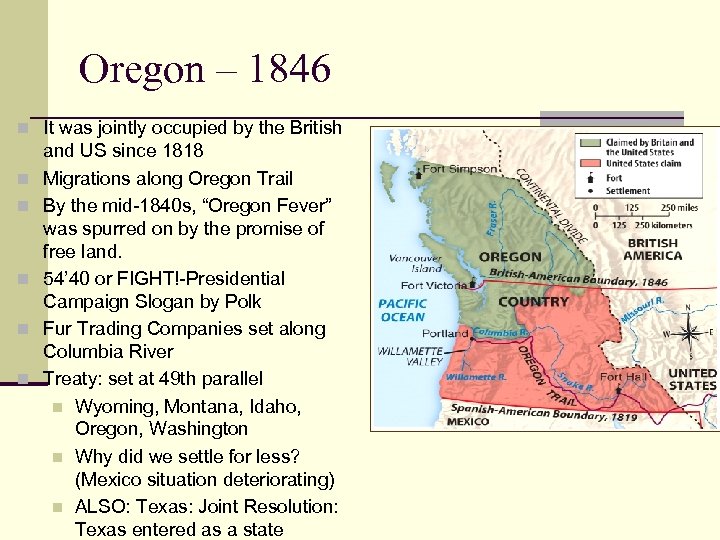 Oregon – 1846 n It was jointly occupied by the British n n n and US since 1818 Migrations along Oregon Trail By the mid-1840 s, “Oregon Fever” was spurred on by the promise of free land. 54’ 40 or FIGHT!-Presidential Campaign Slogan by Polk Fur Trading Companies set along Columbia River Treaty: set at 49 th parallel n Wyoming, Montana, Idaho, Oregon, Washington n Why did we settle for less? (Mexico situation deteriorating) n ALSO: Texas: Joint Resolution: Texas entered as a state
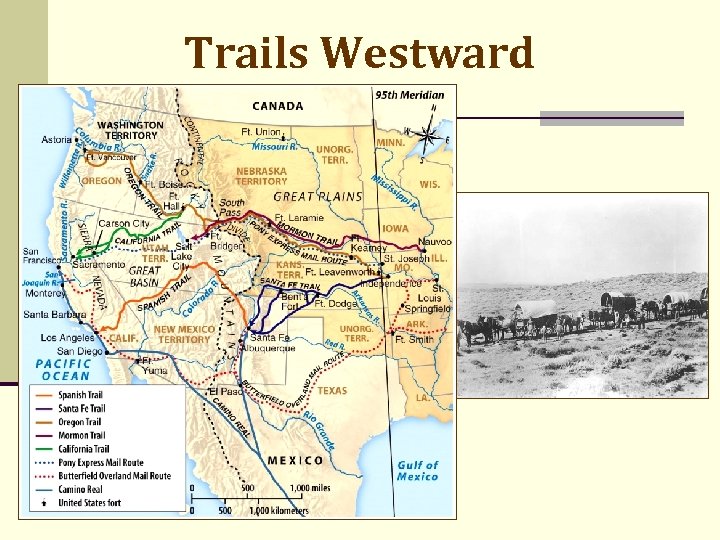 Trails Westward
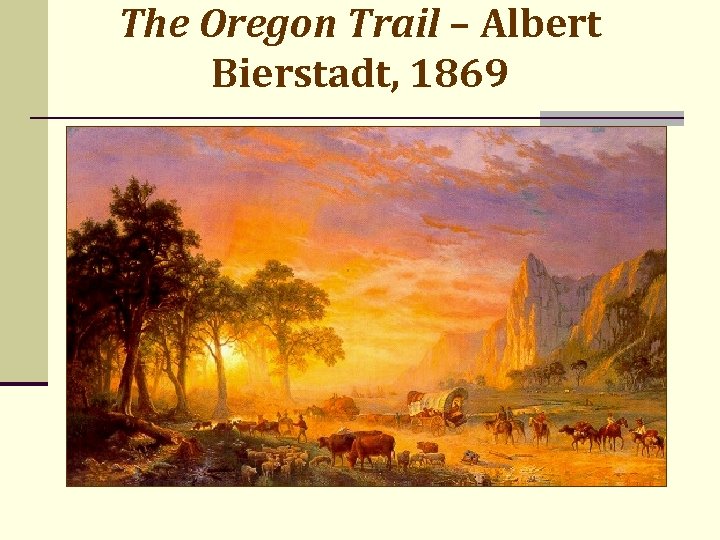 The Oregon Trail – Albert Bierstadt, 1869
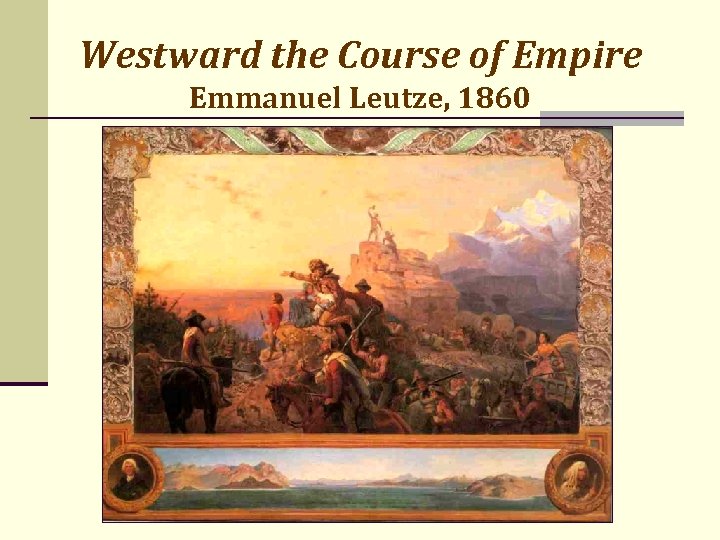 Westward the Course of Empire Emmanuel Leutze, 1860
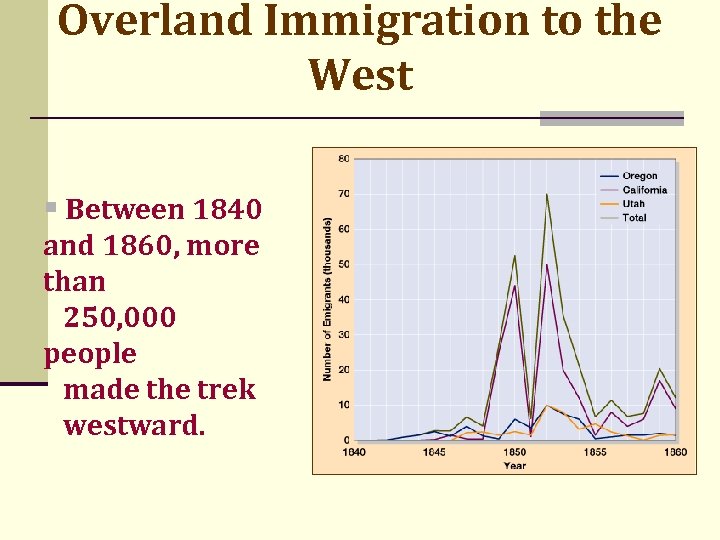 Overland Immigration to the West § Between 1840 and 1860, more than 250, 000 people made the trek westward.
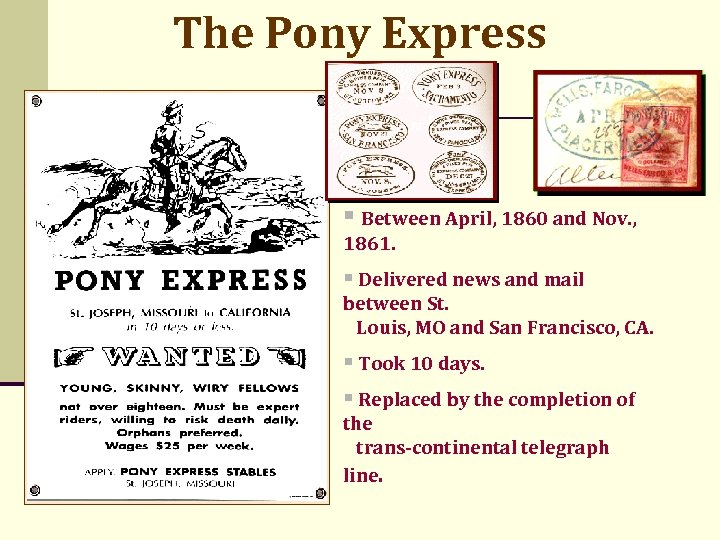 The Pony Express § Between April, 1860 and Nov. , 1861. § Delivered news and mail between St. Louis, MO and San Francisco, CA. § Took 10 days. § Replaced by the completion of the trans-continental telegraph line.
 After the Mexican – American War n Free Soil Party n Views of Expansion of Slavery n California Gold Rush n Compromise of 1850 n Gadsden Purchase n Seward’s Folly
 Free Soil Party n Not abolitionist but opposed to expansion of slavery in the territories n Free Soil! Free Speech! Free Labor! Free Men! n “Barnburners” – discontented northern Democrats. n Anti-slave members of the Liberty and Whig Parties. n Opposition to the extension of slavery in the new territories!
 After the Mexican War n Southern views: Slaves are “property” and the Constitution provides for protecting property (5 th Amendment) n ANY compromise restricts their constitutional rights n MODERATES: n Popular Sovereignty n North & South: let settlers decide for themselves n Intro’ed by Lewis Cass, Democratic Senator, Michigan n
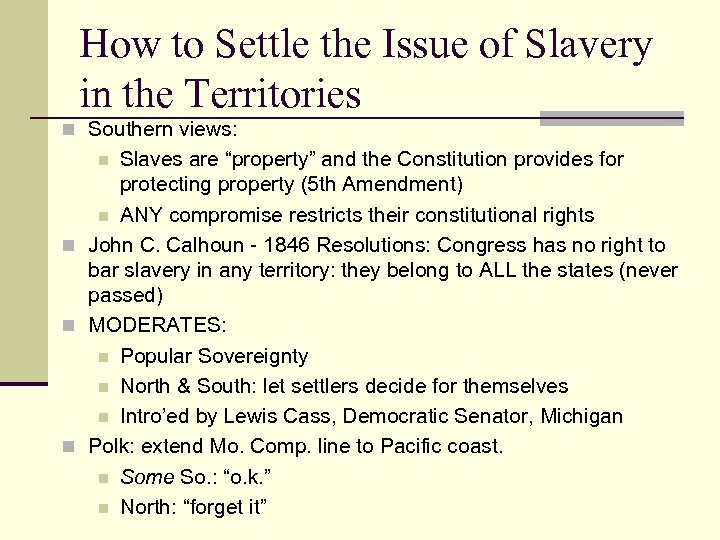 How to Settle the Issue of Slavery in the Territories n Southern views: Slaves are “property” and the Constitution provides for protecting property (5 th Amendment) n ANY compromise restricts their constitutional rights n John C. Calhoun - 1846 Resolutions: Congress has no right to bar slavery in any territory: they belong to ALL the states (never passed) n MODERATES: n Popular Sovereignty n North & South: let settlers decide for themselves n Intro’ed by Lewis Cass, Democratic Senator, Michigan n Polk: extend Mo. Comp. line to Pacific coast. n Some So. : “o. k. ” n North: “forget it” n
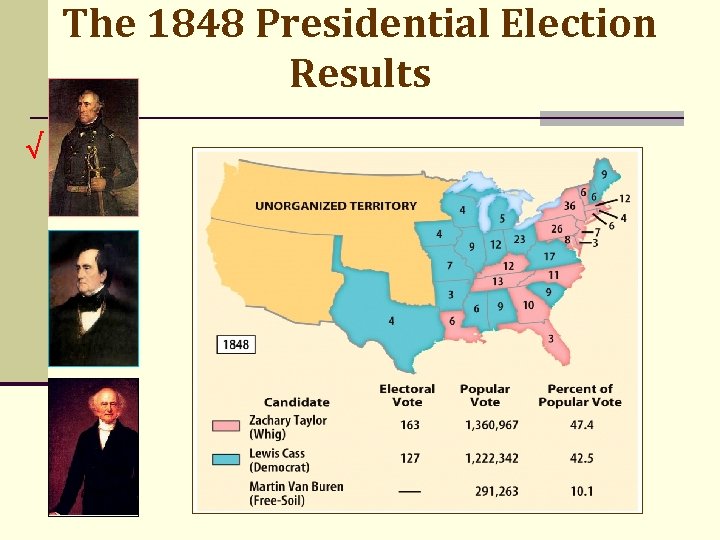 The 1848 Presidential Election Results √
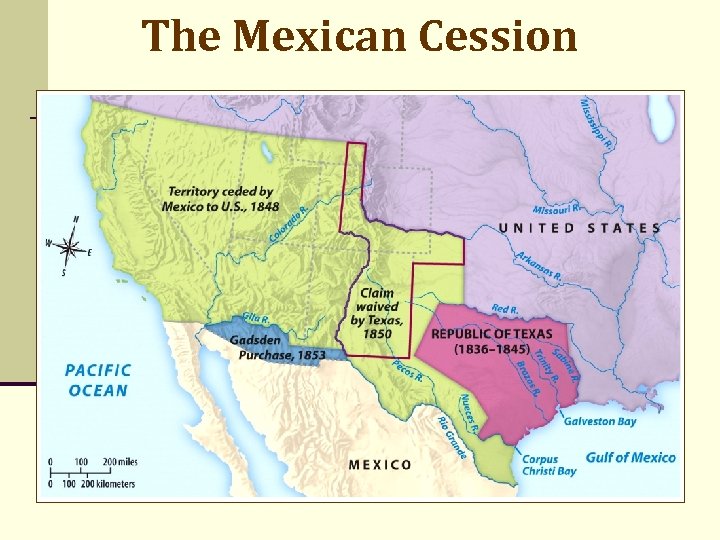 The Mexican Cession
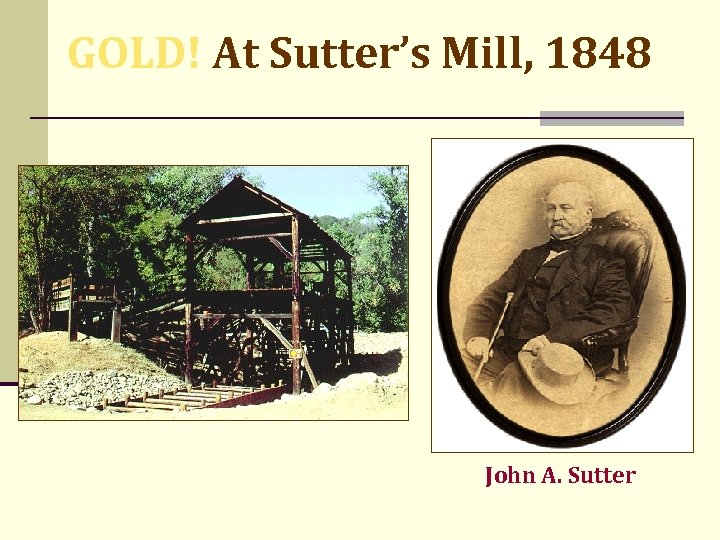 GOLD! At Sutter’s Mill, 1848 John A. Sutter
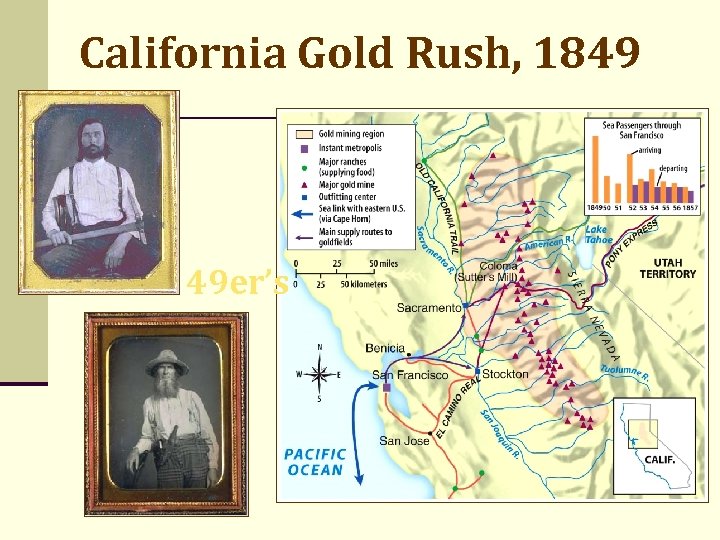 California Gold Rush, 1849 49 er’s
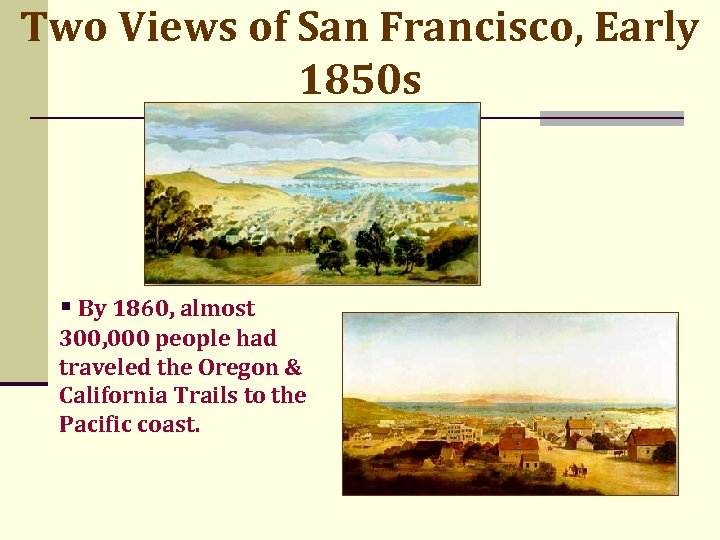 Two Views of San Francisco, Early 1850 s § By 1860, almost 300, 000 people had traveled the Oregon & California Trails to the Pacific coast.
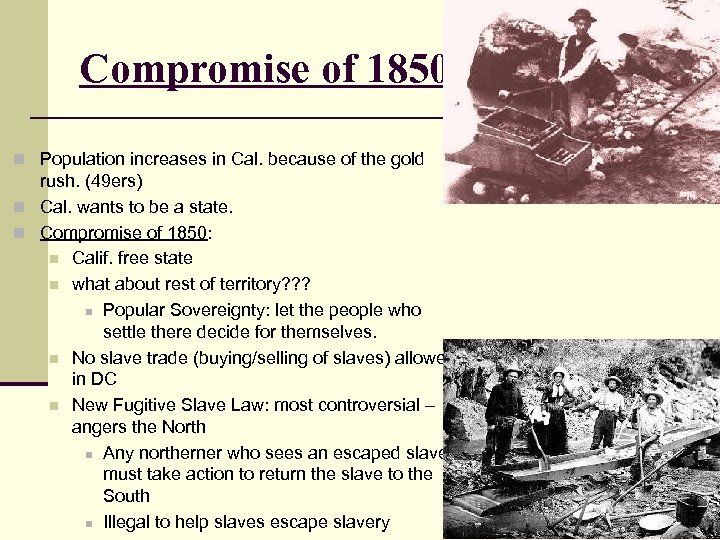 Compromise of 1850 n Population increases in Cal. because of the gold rush. (49 ers) n Cal. wants to be a state. n Compromise of 1850: n Calif. free state n what about rest of territory? ? ? n Popular Sovereignty: let the people who settle there decide for themselves. n No slave trade (buying/selling of slaves) allowed in DC n New Fugitive Slave Law: most controversial – angers the North n Any northerner who sees an escaped slave must take action to return the slave to the South n Illegal to help slaves escape slavery
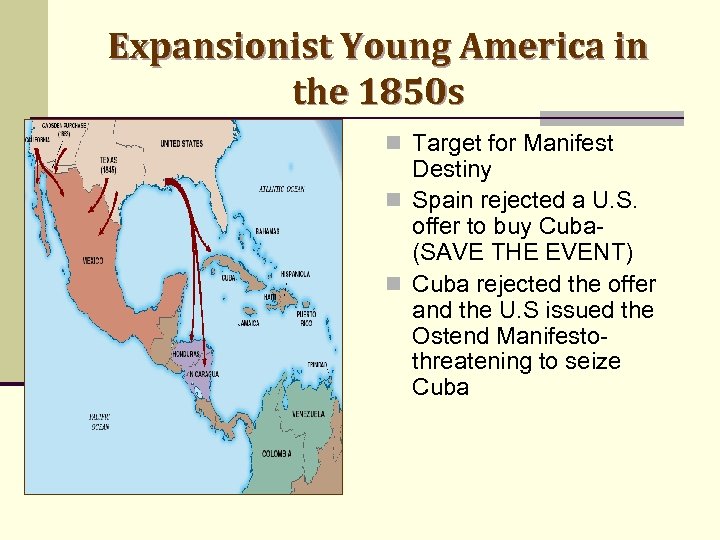 Expansionist Young America in the 1850 s n Target for Manifest Destiny n Spain rejected a U. S. offer to buy Cuba(SAVE THE EVENT) n Cuba rejected the offer and the U. S issued the Ostend Manifestothreatening to seize Cuba
 Territorial Growth to 1853
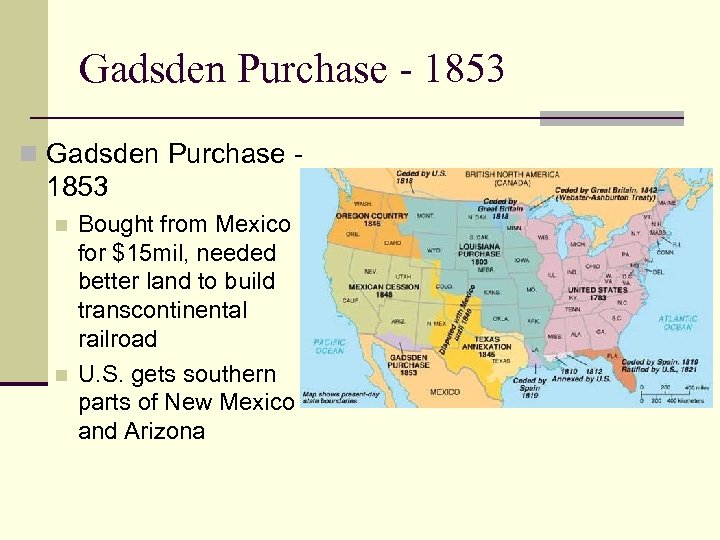 Gadsden Purchase - 1853 n n Bought from Mexico for $15 mil, needed better land to build transcontinental railroad U. S. gets southern parts of New Mexico and Arizona
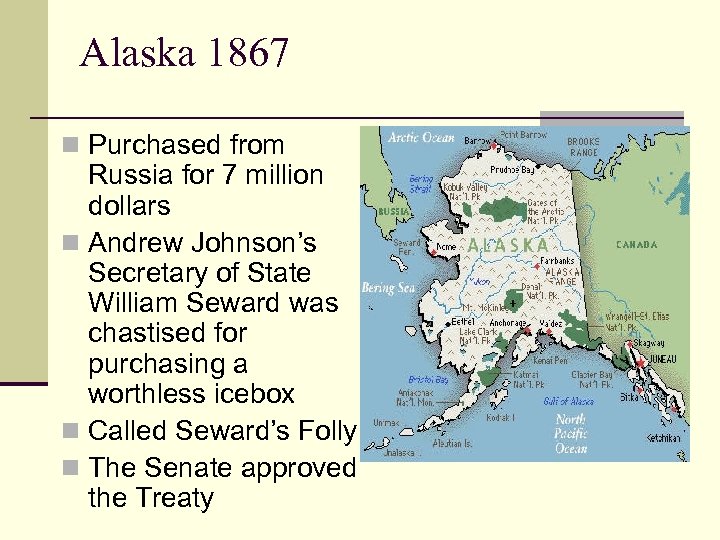 Alaska 1867 n Purchased from Russia for 7 million dollars n Andrew Johnson’s Secretary of State William Seward was chastised for purchasing a worthless icebox n Called Seward’s Folly n The Senate approved the Treaty
 Significance of Westward Expansion n Will slavery be allowed in the territories? n Who will decide that: Congress? Or the people of that territory? n Key Precedents: Northwest Territory: NW Ordinance 1787: “no” n Missouri: Missouri Compromise 1820 n Mexican Cession Territory: Compromise of 1850 n
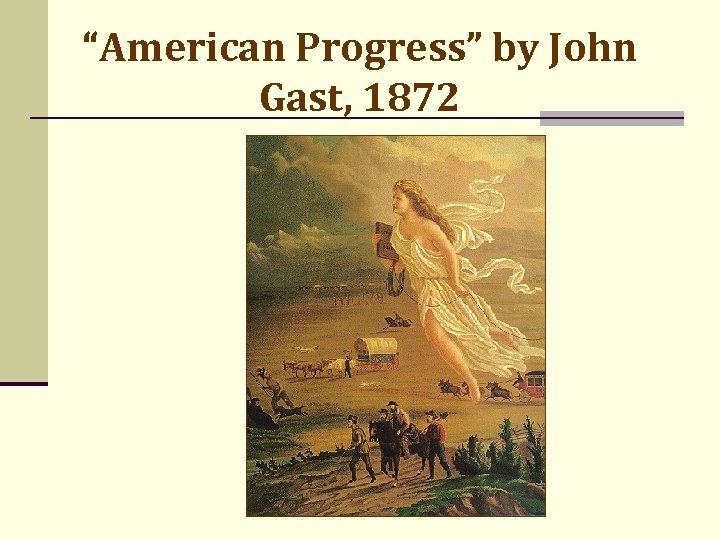 “American Progress” by John Gast, 1872