


 Скачать презентацию Section G Strategy Five Assess Progress and Strategy
fe46a7d3da5005072757101b93e82db6.ppt
- Количество слайдов: 22
 Section G Strategy Five: Assess Progress and Strategy Six: Provide Continual Assistance Southwest Educational Development Laboratory Austin, Texas
 Assess and Monitor Progress It’s important to… And ways to do that are: 1. ______________ 2. ______________ 3. ______________ 4. ______________ Southwest Educational Development Laboratory Austin, Texas Tp. G. 1
 What Leaders of Successful Change Do • Strategy One: C______ a c______ for c______ • Strategy Two: D______ and a______ a shared v______ • Strategy Three: P______ and p______ r______ • Strategy Four: I______ in t______ and p______ d____ • Strategy Five: Assess/monitor progress • Strategy Six: Provide continuous assistance Southwest Educational Development Laboratory Austin, Texas Tp. G. 2
 Assess and Monitor Progress Outcome 1: Participants will review Stages of Concern as a means to assess the progress of change in implementers. Outcome 2: Participants will relate the implementation dip to stages of concern. Outcome 3: Participants will review use of an Innovation Configuration matrix. Outcome 4: Participants will assess the use of an innovation through practice with Levels of Use. Southwest Educational Development Laboratory Austin, Texas Tp. G. 3 a
 Assess and Monitor Progress Outcome 5: Participants will identify methods for providing continual assistance to individuals who are implementing a change. Outcome 6: Participants will explore coaching as a model for providing continual assistance. Southwest Educational Development Laboratory Austin, Texas Tp. G. 3 b
 Stages of Concern: Typical Expressions of Concern about the Innovation Stages of concern Expressions of Concern 6 Collaboration I am concerned about relating what I am doing to what other Instructors are doing. Consequence How is my use affecting kids? 3 Management I seem to be spending all my time getting material ready. Personal How will using it affect me? 1 Informational I would like to know more about it. 0 S E L F 5 2 T A S K I have some ideas about something that would work even better. 4 I M P A C T Refocusing Awareness I am not concerned about it (the innovation). Developed by Research and Development Center for Teacher Education, The University of Texas at Austin. Available from Southwest Educational Development Laboratory, Austin, Texas. Southwest Educational Development Laboratory Austin, Texas Tp. G. 4
 Implementation Dip Where we are headed Where we started When NOT to get discouraged Southwest Educational Development Laboratory Austin, Texas Tp. G. 5
 Implementation Dip Where we are headed Introduce Change So. C 3 So. C 1 So. C 3 So. C 2 So. C 3 Southwest Educational Development Laboratory Austin, Texas Tp. G. 6
 Assess and Monitor Progress Two Basic Questions • Is it being used? • What is it? Southwest Educational Development Laboratory Austin, Texas Tp. G. 7
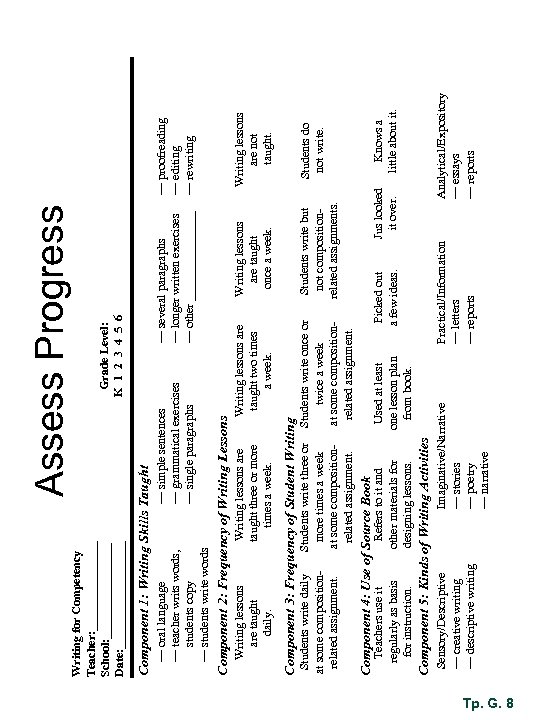 Tp. G. 8 Writing lessons are taught three or more times a week. Students write three or more times a week at some compositionrelated assignment. Refers to it and other materials for designing lessons. Sensory/Descriptive — creative writing — descriptive writing Used at least one lesson plan from book. Practical/Information — letters — reports Analytical/Expository — essays — reports Knows a little about it. Students do not write. Writing lessons are not taught. — proofreading — editing — rewriting Jus looked it over. Students write but not compositionrelated assignments. Writing lessons are taught once a week. Picked out a few ideas. Students write once or twice a week at some compositionrelated assignment. Writing lessons are taught two times a week. Imaginative/Narrative — stories — poetry — narrative Component 5: Kinds of Writing Activities Teachers use it regularly as basis for instruction. Component 4: Use of Source Book Students write daily at some compositionrelated assignment. Component 3: Frequency of Student Writing lessons are taught daily. — several paragraphs — longer written exercises — other ________ Grade Level: K 1 2 3 4 5 6 — simple sentences — grammatical exercises — single paragraphs Component 2: Frequency of Writing Lessons — oral language — teacher writs words, students copy — students write words Component 1: Writing Skills Taught Writing for Competency Teacher: ________ School: ________ Date: _________ Assess Progress
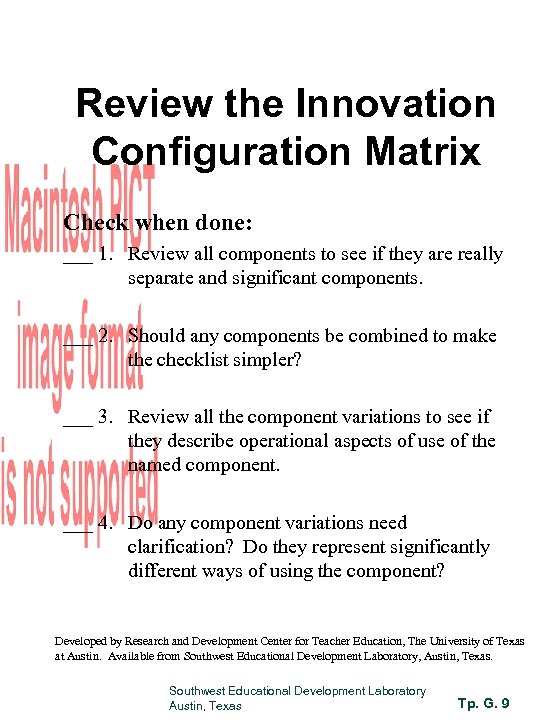 Review the Innovation Configuration Matrix Check when done: ___ 1. Review all components to see if they are really separate and significant components. ___ 2. Should any components be combined to make the checklist simpler? ___ 3. Review all the component variations to see if they describe operational aspects of use of the named component. ___ 4. Do any component variations need clarification? Do they represent significantly different ways of using the component? Developed by Research and Development Center for Teacher Education, The University of Texas at Austin. Available from Southwest Educational Development Laboratory, Austin, Texas. Southwest Educational Development Laboratory Austin, Texas Tp. G. 9
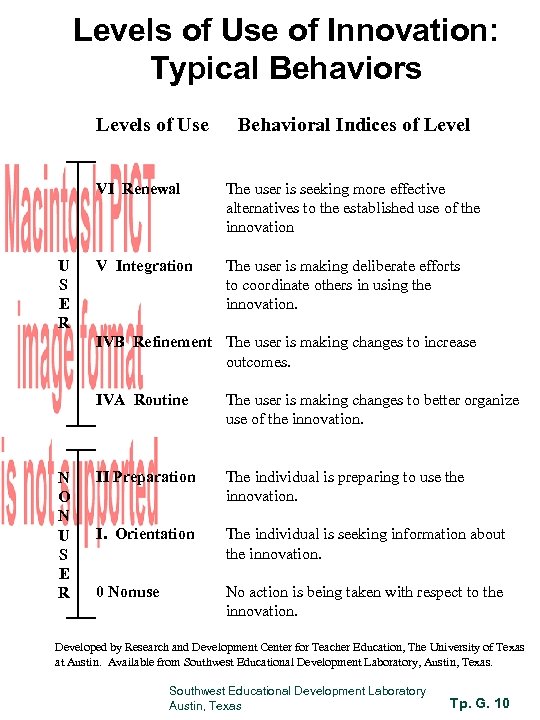 Levels of Use of Innovation: Typical Behaviors Levels of Use Behavioral Indices of Level VI Renewal U S E R The user is seeking more effective alternatives to the established use of the innovation V Integration The user is making deliberate efforts to coordinate others in using the innovation. IVB Refinement The user is making changes to increase outcomes. IVA Routine N O N U S E R The user is making changes to better organize use of the innovation. II Preparation The individual is preparing to use the innovation. I. Orientation The individual is seeking information about the innovation. 0 Nonuse No action is being taken with respect to the innovation. Developed by Research and Development Center for Teacher Education, The University of Texas at Austin. Available from Southwest Educational Development Laboratory, Austin, Texas. Southwest Educational Development Laboratory Austin, Texas Tp. G. 10
 Implementing Cooperative Learning: Irene and Levels of Use Irene was the “star” student teacher in her cohort of preservice preparation teachers. She knew a great deal about her content specialty and she had read about authentic assessment. Her college teacher prep program was a fairly traditional—and conservative—one, and Irene was not well versed in instructional strategies such as Cooperative Learning (CL). Thus, when she came on board in January as a beginning teacher, she did not pay much attention to the teachers who were beginning to use Cooperative Learning. She was too busy learning about being a real teacher. [Irene can be characterized as Level of Use( Lo. U) 0 Nonuse with respect to Cooperative Learning. ] After two months on the job, Irene happened to read an article about Cooperative Learning in Educational Leadership. The article struck her as interesting, so when she had a minute she went to Walter, the teacher next door, to ask him how he “did Cooperative Learning. [Now Irene has shifted Lo. U I Orientation with respect to Cooperative Learning. ] When the spring break came, Irene took this time to get better “squared away” in her classroom. Feeling more organized and “with it, ” Irene wondered if Cooperative Learning would be useful with her social studies class. After some reading of material Walter had given her, Irene decided in favor of Cooperative Learning. To get ready for using it in the fall, she signed up for a training program in the summer and began to visit Walter’s CL classroom every few weeks to get acquainted with it. [Irene is now Lo. U II Preparation. ] Irene’s summer was, in her estimation, very successful. The first four weeks she spent reviewing what she had done in that spring semester, making notes and revising plans and projects. Following that, she went on a backpacking trip in the Canadian Rockies. And then she attended the three-week CL training course. In the mornings, the teachers learned theory of CL, and in the afternoons they practiced using CL with students registered in summer school. [Irene is definitely Lo. U II Preparation]. School began in late August, and after a few weeks when things seemed somewhat stable, Irene began organizing and introducing CL into her social studies class. The first week was, in a word, chaotic. The timing was way off, “stuff” wasn’t ready, and the kids thought the objective was to be social. On Friday, with a sigh, she went to Walter to seek advice. After Irene poured out her story, Walter asked if she had taught the students how to work (rules, “regs, ” etc. ) in a CL setting. “Well, no, ” she said. “I thought I just needed to start doing it “ Walter suggested that she come sit in on his class of first-year students in American literature, with whom he was initiating CL strategies. She could see what he meant. [Is Irene at Lo. U III Mechanical Use? You bet!] Southwest Educational Development Laboratory Austin, Texas Tp. G. 11 a
 At spring vacation that year Irene had a chance to reflect on her progress in using CL with her class—and she was pleased. With a great deal of assistance from Walter, Irene had gotten her CL act together and things seemed to be functioning smoothly in social studies. The kids knew how it worked, and Irene could often predict problems ahead of time and consider how to avoid or solve them. Life in the classroom, thanks to Walter, seemed agreeable and productive. [Irene is at LOU IVA Routine. ] But, she thought, is there a way to benefit our kids even more with CL? If Walter and I integrated our efforts and our students, and did cross-discipline student cooperative projects, how much more powerful might that be in motivating the kids and increasing their academic and social skills? She went to Walter after spring break to talk with him and they made plans to use the large empty bandroom to house their two classes for a month and put their plans in action. [Irene and Walter are at Lo. U V Integration—did Irene skip a step—why didn’t she move to Lo. U IVB Refinement? Remember the levels are not lock-step hierarchical. ] This is not the end of Irene’s story. The following year she lost Walter, who moved into a principalship. In a conversation with environmentally concerned community people, Irene began to devise a new Cooperative Learning strategy: move her classroom into the community with community people, move the community people into her classroom—all work together on Cooperative Learning/Service Learning projects that would increase students’ understanding of how topography, climate, industrial/economic conditions, and their interaction affect a community’s quality of life. “Wow!” she thought, “I’ve got it—this is real l earning for living!” [Yes, she is at LOU VI Renewal. ] Irene is atypical—that is, the number of people who reach Lo. U VI are few, about 6% of the population studied by CBAM researchers. Southwest Educational Development Laboratory Austin, Texas Tp. G. 11 b
 Scoring Exercise A For Levels of Use of the Innovation Directions: For each statement indicate (a) the overall Level of Use (provide numeral and name of level) and (b) underline clues in the statement. 1. The teacher has made various attempts to get the new science equipment ready for the next day’s class without too much success. Next he’s going to experiment with a grocery cart so he doesn’t have to make so many trips around the room (Innovation: science program) 2. Her math modules are organized and she tested them out in class last year. She’ll use them just like she did then—they were quite successful. (Innovation: modules) 3. He’s quite excited—last month, for the first time ever, he and the teacher next door got together to “pool” their students. Now each of them offers a different social studies unit, so students can choose the one that interests them. (Innovation: social studies program) 4. Six weeks ago she constructed and began to use a selfchecking system for her spelling program so her pupils who can move more rapidly don’t have to wait for her. (Innovation: spelling program) 5. The principal says the school will not begin teaming until the spring, so this kindergarten teacher says he will think about it then. (Innovation: teaming). 6. He’s going to his first workshop next week to see a demonstration of inquiry learning, which the school is thinking of using. He’s going to find out what it’s all about. (Innovation: inquiry learning) Southwest Educational Development Laboratory Austin, Texas (a) ___ ___ ___ Tp. G. 12
 What Leaders of Successful Change Do • Strategy One: C______ a c______ for c______ • Strategy Two: D______ and a______ a shared v______ • Strategy Three: P______ and p______ r______ • Strategy Four: I______ in t______ and p______ d____ • Strategy Five: A_____ p______ • Strategy Six: Provide continual assistance Southwest Educational Development Laboratory Austin, Texas Tp. G. 13
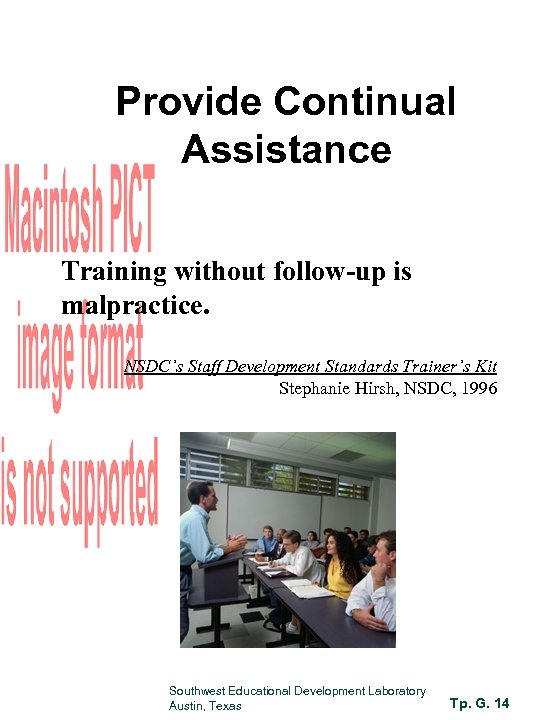 Provide Continual Assistance Training without follow-up is malpractice. NSDC’s Staff Development Standards Trainer’s Kit Stephanie Hirsh, NSDC, 1996 Southwest Educational Development Laboratory Austin, Texas Tp. G. 14
 Provide Continual Assistance Listen for. . . And ways to provide it are: 1. _______________ 2. _______________ 3. _______________ 4. _______________ Southwest Educational Development Laboratory Austin, Texas Tp. G. 15
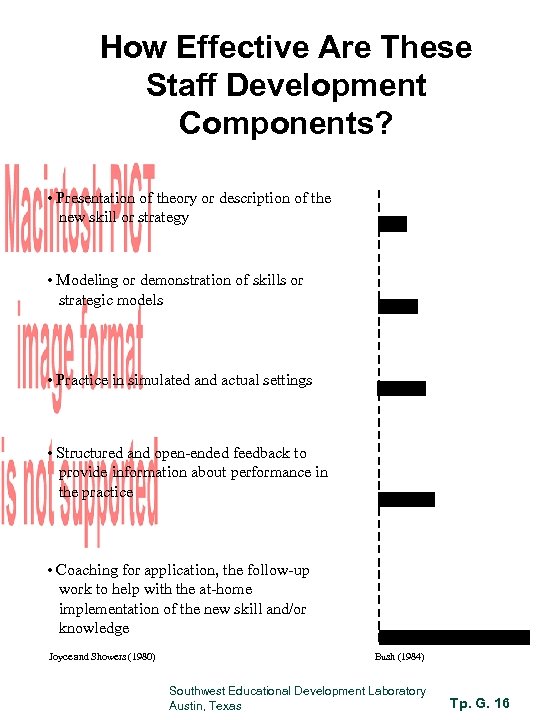 How Effective Are These Staff Development Components? • Presentation of theory or description of the new skill or strategy • Modeling or demonstration of skills or strategic models • Practice in simulated and actual settings • Structured and open-ended feedback to provide information about performance in the practice • Coaching for application, the follow-up work to help with the at-home implementation of the new skill and/or knowledge Joyce and Showers (1980) Bush (1984) Southwest Educational Development Laboratory Austin, Texas Tp. G. 16
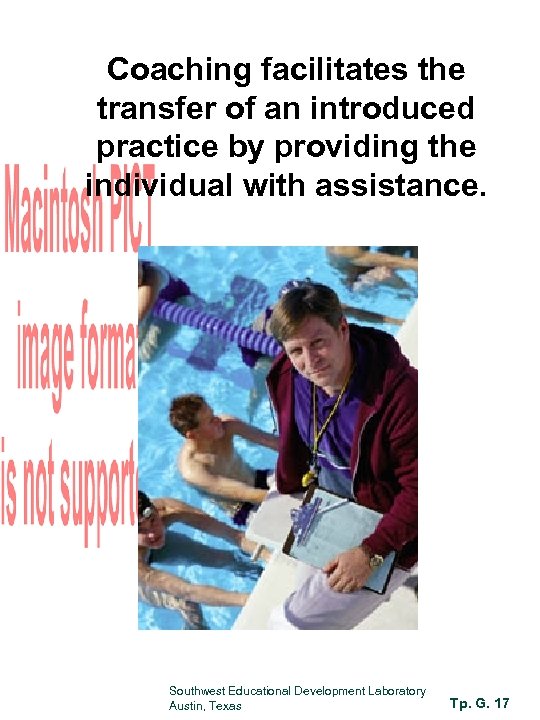 Coaching facilitates the transfer of an introduced practice by providing the individual with assistance. Southwest Educational Development Laboratory Austin, Texas Tp. G. 17
 What is Coaching? A process that facilitates the transfer of an introduced practice by providing assistance • Breaks down complex innovations into small learnable or workable units. • Provides a model of desired behaviors • Praises success • Reassures and supports efforts • Promotes appropriate independent use • Facilitates interchange with another person over a difficult process • Creates opportunities for sharing frustrations and successes • Elicits suggestions from facilitator on how to improve • Provides mutual reflection on progress Southwest Educational Development Laboratory Austin, Texas Tp. G. 18
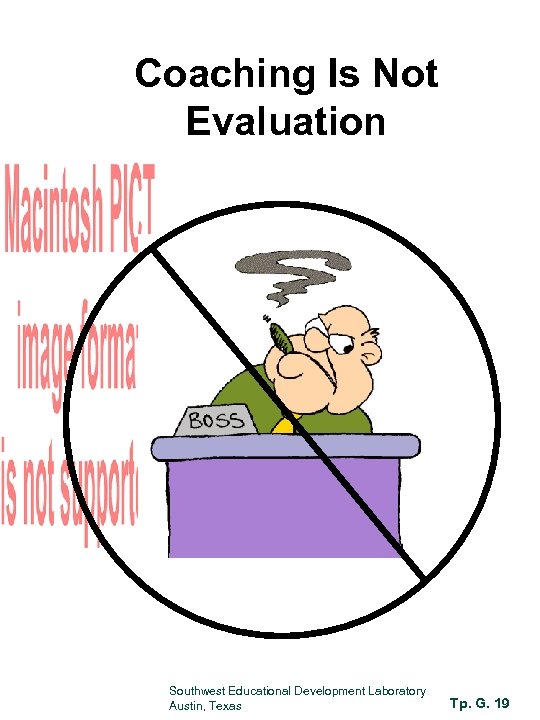 Coaching Is Not Evaluation Southwest Educational Development Laboratory Austin, Texas Tp. G. 19