


 Скачать презентацию Section 9 Deadlock CSC 321 9 Deadlock
d8de00f2010837f318372499e8fb7ff6.ppt
- Количество слайдов: 19
 Section 9 Deadlock CSC 321 § 9 Deadlock 1
 Deadlock: four necessary and sufficient conditions u Serially reusable resources: the processes involved share resources which they use under mutual exclusion. u. Incremental acquisition: processes hold on to resources already allocated to them while waiting to acquire additional resources. u. No pre-emption: once acquired by a process, resources cannot be pre-empted (forcibly withdrawn) but are only released voluntarily. u. Wait-for cycle: a circular chain (or cycle) of processes exists such that each process holds a resource which its successor in the cycle is waiting to acquire. CSC 321 § 9 Deadlock 2
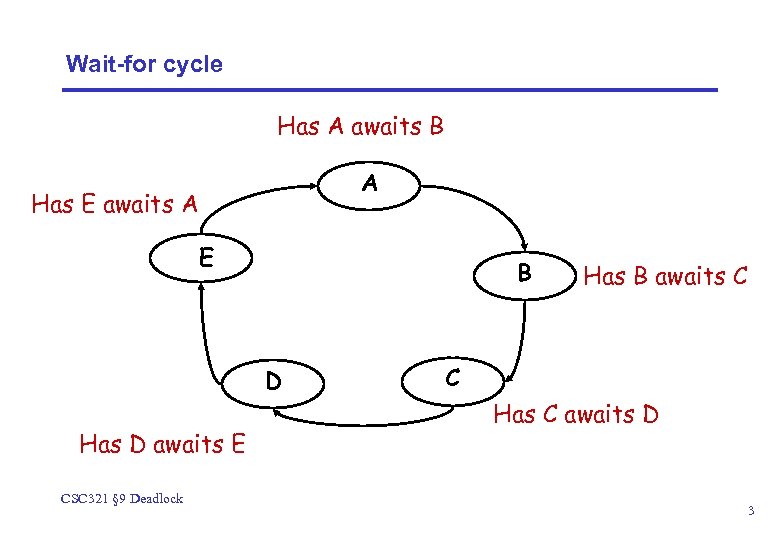 Wait-for cycle Has A awaits B A Has E awaits A E B D Has D awaits E CSC 321 § 9 Deadlock Has B awaits C C Has C awaits D 3
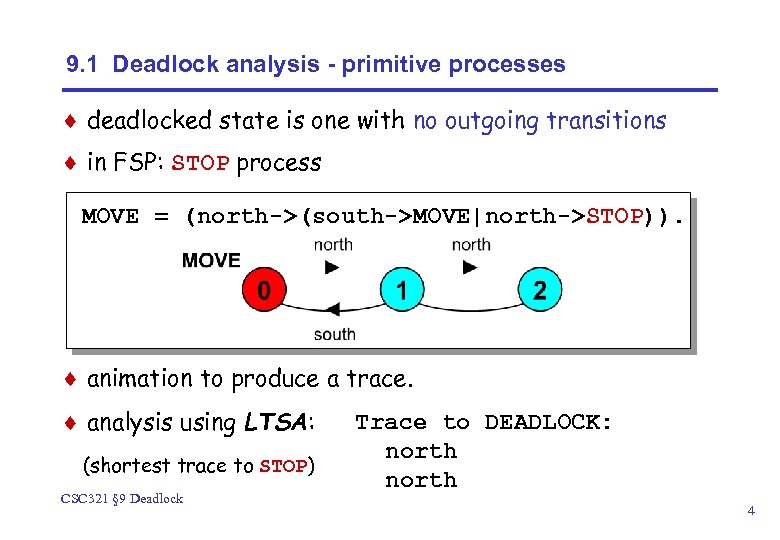 9. 1 Deadlock analysis - primitive processes ¨ deadlocked state is one with no outgoing transitions ¨ in FSP: STOP process MOVE = (north->(south->MOVE|north->STOP)). ¨ animation to produce a trace. ¨ analysis using LTSA: (shortest trace to STOP) CSC 321 § 9 Deadlock Trace to DEADLOCK: north 4
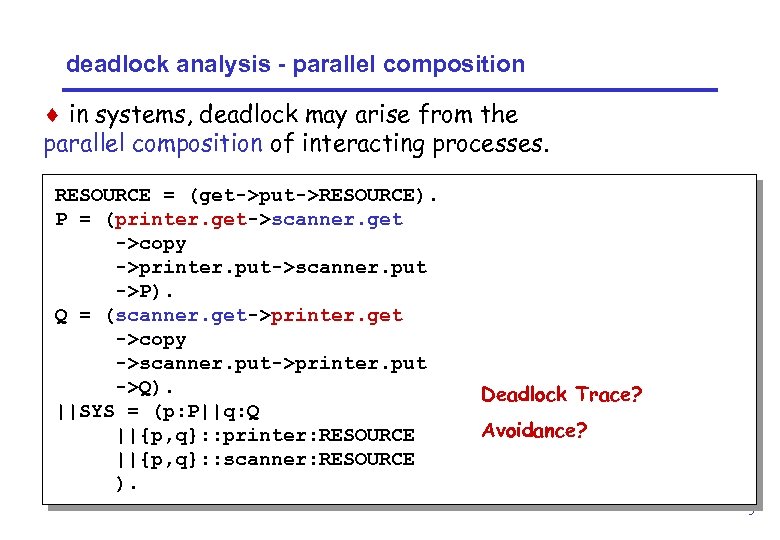 deadlock analysis - parallel composition ¨ in systems, deadlock may arise from the parallel composition of interacting processes. RESOURCE = (get->put->RESOURCE). P = (printer. get->scanner. get ->copy ->printer. put->scanner. put ->P). Q = (scanner. get->printer. get ->copy ->scanner. put->printer. put ->Q). ||SYS = (p: P||q: Q ||{p, q}: : printer: RESOURCE ||{p, q}: : scanner: RESOURCE ). CSC 321 § 9 Deadlock Trace? Avoidance? 5
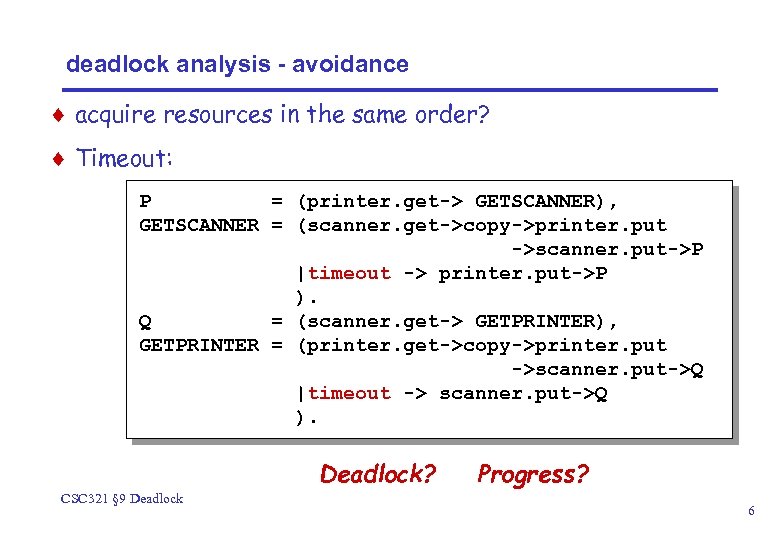 deadlock analysis - avoidance ¨ acquire resources in the same order? ¨ Timeout: P = (printer. get-> GETSCANNER), GETSCANNER = (scanner. get->copy->printer. put ->scanner. put->P |timeout -> printer. put->P ). Q = (scanner. get-> GETPRINTER), GETPRINTER = (printer. get->copy->printer. put ->scanner. put->Q |timeout -> scanner. put->Q ). Deadlock? CSC 321 § 9 Deadlock Progress? 6
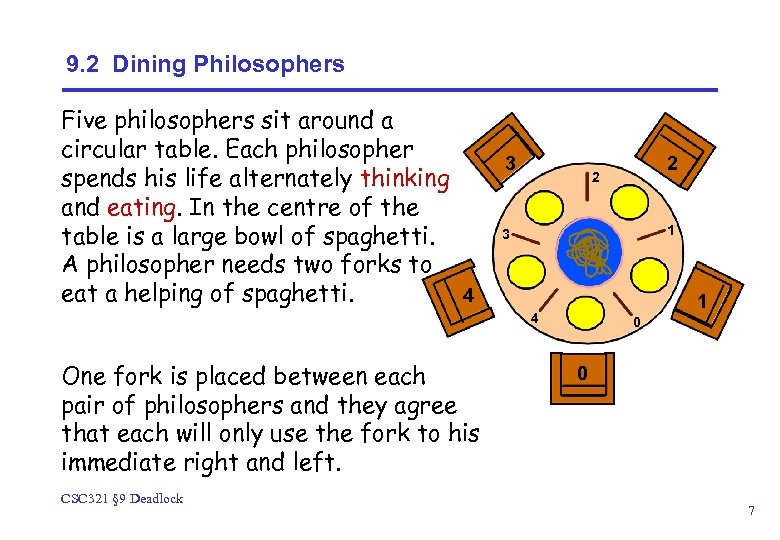 9. 2 Dining Philosophers Five philosophers sit around a circular table. Each philosopher spends his life alternately thinking and eating. In the centre of the table is a large bowl of spaghetti. A philosopher needs two forks to eat a helping of spaghetti. 4 3 1 4 One fork is placed between each pair of philosophers and they agree that each will only use the fork to his immediate right and left. CSC 321 § 9 Deadlock 2 2 0 0 7
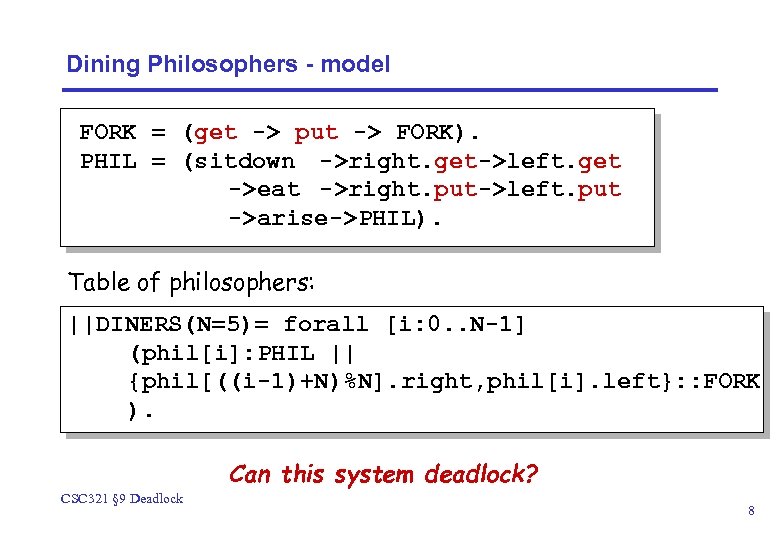 Dining Philosophers - model FORK = (get -> put -> FORK). PHIL = (sitdown ->right. get->left. get ->eat ->right. put->left. put ->arise->PHIL). Table of philosophers: ||DINERS(N=5)= forall [i: 0. . N-1] (phil[i]: PHIL || {phil[((i-1)+N)%N]. right, phil[i]. left}: : FORK ). Can this system deadlock? CSC 321 § 9 Deadlock 8
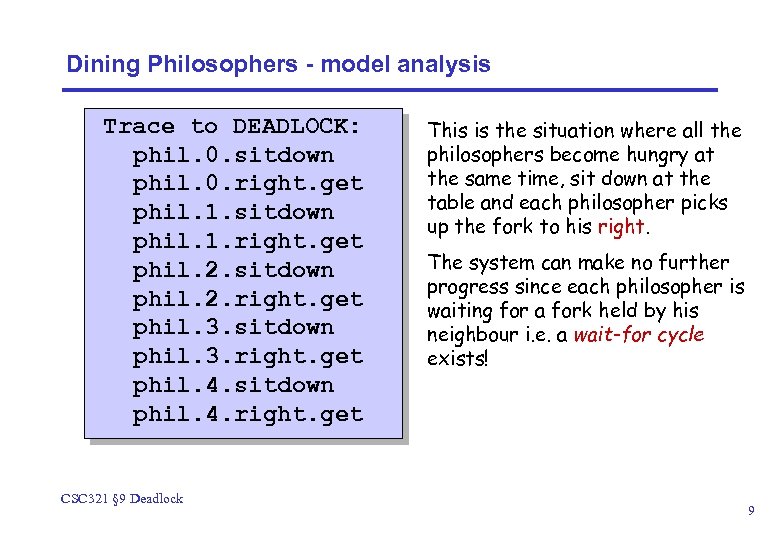 Dining Philosophers - model analysis Trace to DEADLOCK: phil. 0. sitdown phil. 0. right. get phil. 1. sitdown phil. 1. right. get phil. 2. sitdown phil. 2. right. get phil. 3. sitdown phil. 3. right. get phil. 4. sitdown phil. 4. right. get CSC 321 § 9 Deadlock This is the situation where all the philosophers become hungry at the same time, sit down at the table and each philosopher picks up the fork to his right. The system can make no further progress since each philosopher is waiting for a fork held by his neighbour i. e. a wait-for cycle exists! 9
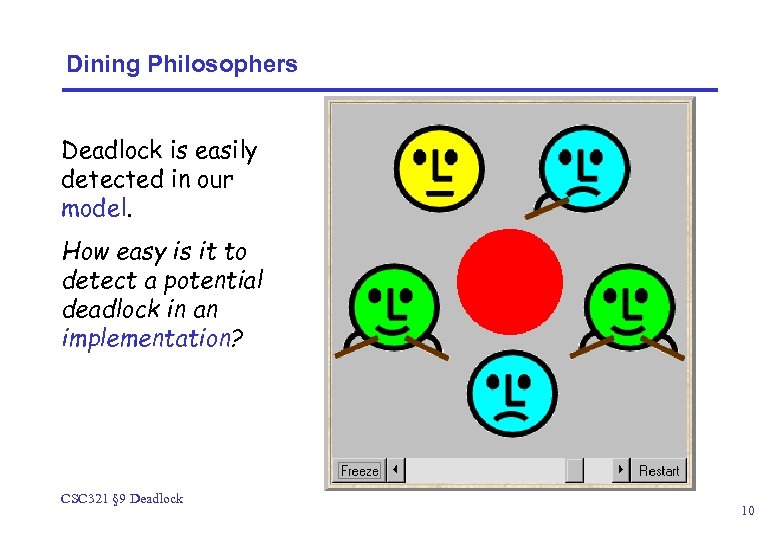 Dining Philosophers Deadlock is easily detected in our model. How easy is it to detect a potential deadlock in an implementation? CSC 321 § 9 Deadlock 10
 Dining Philosophers - implementation in Java ¨philosophers: active entities - implement as threads ¨forks: shared passive entities - implement as monitors CSC 321 § 9 Deadlock 11
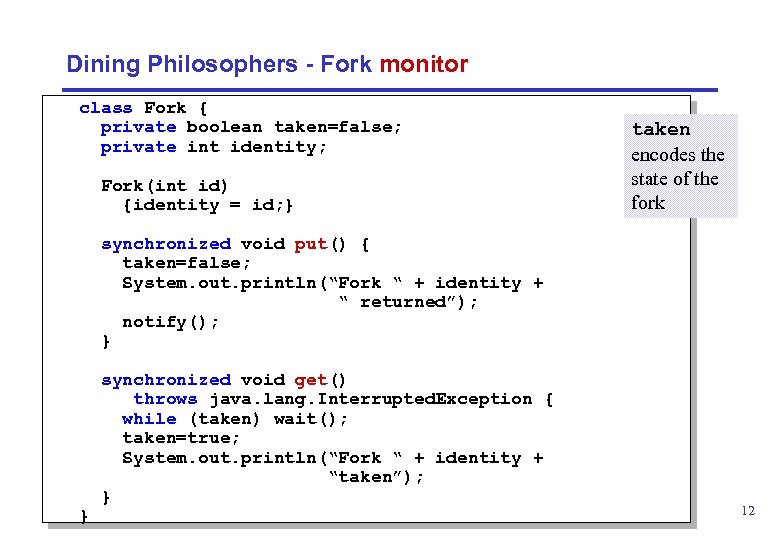 Dining Philosophers - Fork monitor class Fork { private boolean taken=false; private int identity; Fork(int id) {identity = id; } taken encodes the state of the fork synchronized void put() { taken=false; System. out. println(“Fork “ + identity + “ returned”); notify(); } synchronized void get() throws java. lang. Interrupted. Exception { while (taken) wait(); taken=true; System. out. println(“Fork “ + identity + “taken”); } CSC 321 § 9 Deadlock } 12
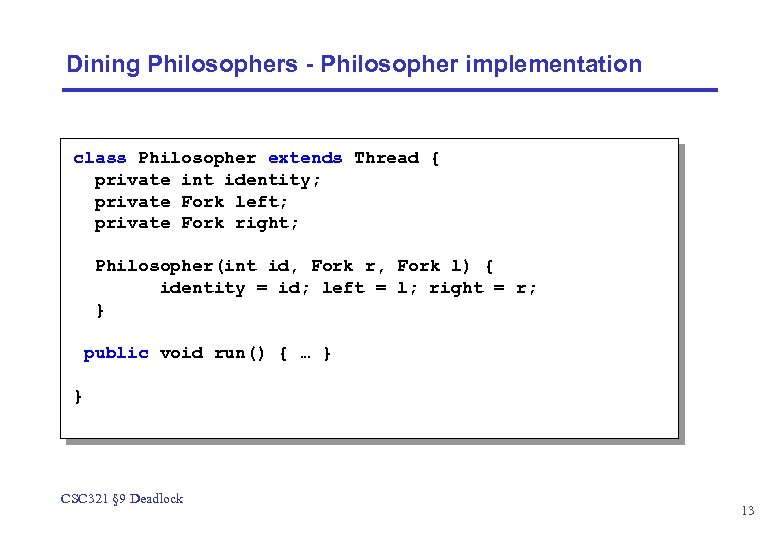 Dining Philosophers - Philosopher implementation class Philosopher extends Thread { private int identity; private Fork left; private Fork right; Philosopher(int id, Fork r, Fork l) { identity = id; left = l; right = r; } public void run() { … } } CSC 321 § 9 Deadlock 13
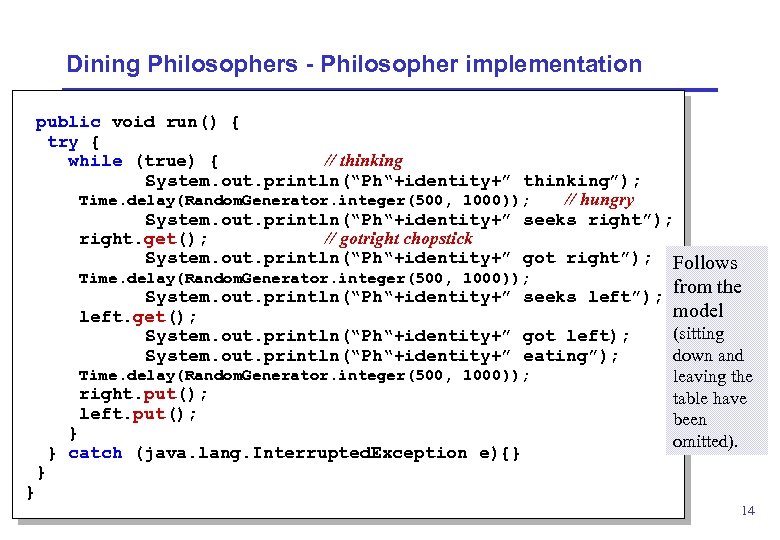 Dining Philosophers - Philosopher implementation public void run() { try { while (true) { // thinking System. out. println(“Ph“+identity+” thinking”); Time. delay(Random. Generator. integer(500, 1000)); // hungry System. out. println(“Ph“+identity+” seeks right”); right. get(); // gotright chopstick System. out. println(“Ph“+identity+” got right”); Follows Time. delay(Random. Generator. integer(500, 1000)); from the System. out. println(“Ph“+identity+” seeks left”); model left. get(); (sitting System. out. println(“Ph“+identity+” got left); down and System. out. println(“Ph“+identity+” eating”); Time. delay(Random. Generator. integer(500, 1000)); leaving the right. put(); table have left. put(); been } omitted). } catch (java. lang. Interrupted. Exception e){} } } CSC 321 § 9 Deadlock 14
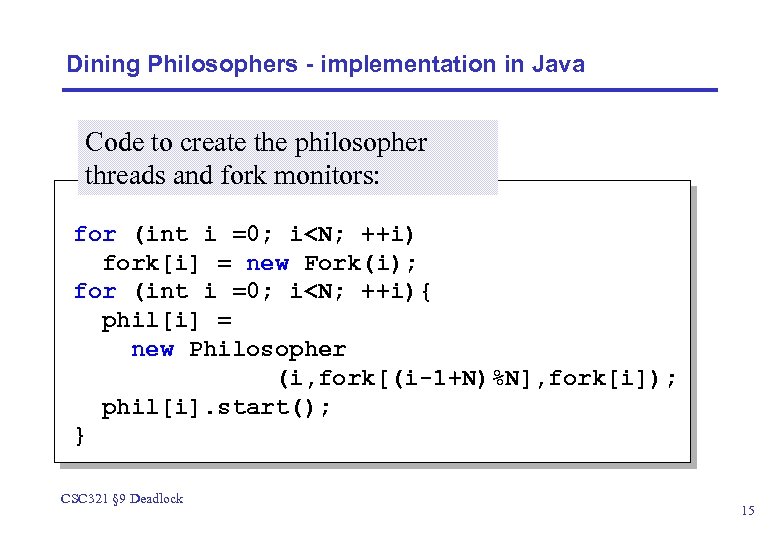 Dining Philosophers - implementation in Java Code to create the philosopher threads and fork monitors: for (int i =0; i
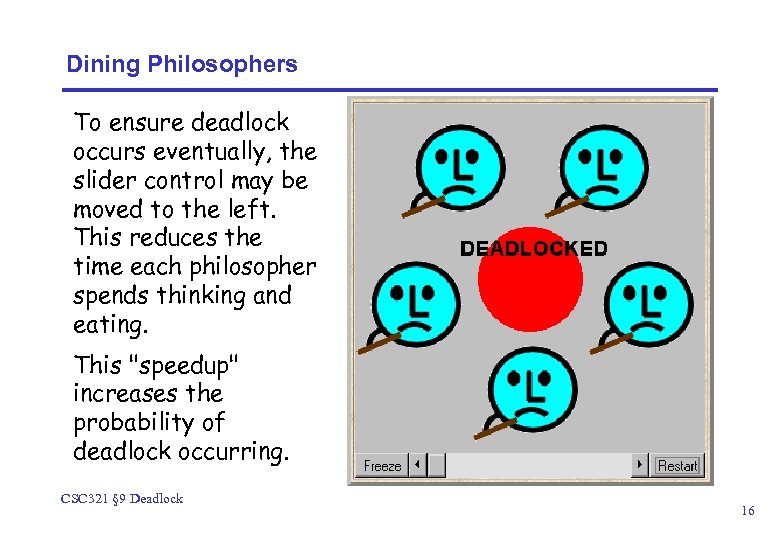 Dining Philosophers To ensure deadlock occurs eventually, the slider control may be moved to the left. This reduces the time each philosopher spends thinking and eating. This "speedup" increases the probability of deadlock occurring. CSC 321 § 9 Deadlock 16
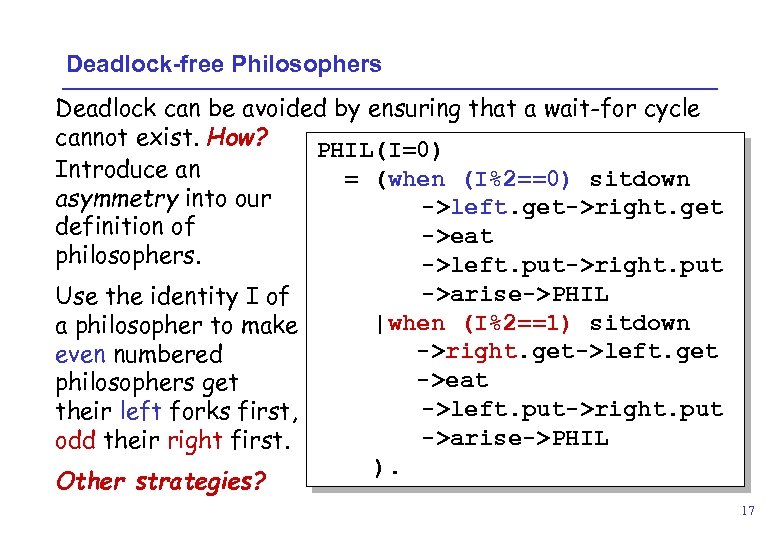 Deadlock-free Philosophers Deadlock can be avoided by ensuring that a wait-for cycle cannot exist. How? PHIL(I=0) Introduce an = (when (I%2==0) sitdown asymmetry into our ->left. get->right. get definition of ->eat philosophers. ->left. put->right. put Use the identity I of a philosopher to make even numbered philosophers get their left forks first, odd their right first. Other strategies? CSC 321 § 9 Deadlock ->arise->PHIL |when (I%2==1) sitdown ->right. get->left. get ->eat ->left. put->right. put ->arise->PHIL ). 17
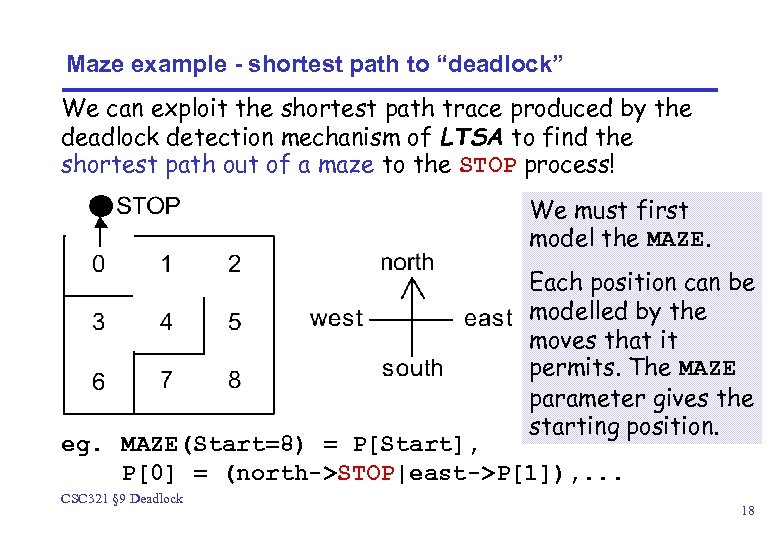 Maze example - shortest path to “deadlock” We can exploit the shortest path trace produced by the deadlock detection mechanism of LTSA to find the shortest path out of a maze to the STOP process! We must first model the MAZE. Each position can be modelled by the moves that it permits. The MAZE parameter gives the starting position. eg. MAZE(Start=8) = P[Start], P[0] = (north->STOP|east->P[1]), . . . CSC 321 § 9 Deadlock 18
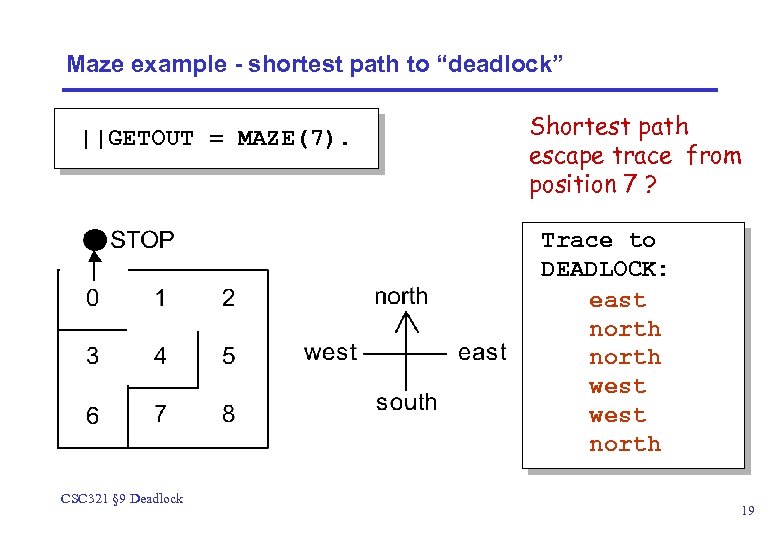 Maze example - shortest path to “deadlock” ||GETOUT = MAZE(7). Shortest path escape trace from position 7 ? Trace to DEADLOCK: east north west north CSC 321 § 9 Deadlock 19