 Скачать презентацию SECTION 8 RACKING BRACING AND SHEAR FORCES WEEK
3e66a442b215e1ba70f337f66c8bfc64.ppt
- Количество слайдов: 104



SECTION 8 RACKING (BRACING) AND SHEAR FORCES WEEK 13 AS 1684 SECTION 8 - RACKING AND SHEAR FORCES 1
8. 1 GENERAL Permanent bracing shall be provided to enable the roof, wall and floor framework to resist horizontal forces applied to the building (racking forces). Appropriate connection shall also be provided to transfer these forces through the framework and subfloor structure to the building’s foundation. AS 1684 SECTION 8 - RACKING AND SHEAR FORCES 2
8. 1 GENERAL Where required, bracing within the building, which normally occurs in vertical planes, shall be constructed into walls or subfloor supports and distributed evenly throughout. Where buildings are more than one storey in height, wall bracing shall be designed for each storey. AS 1684 SECTION 8 - RACKING AND SHEAR FORCES 3
FIGURE 8. 1 VARIOUS BRACING SYSTEMS CONNECTING HORIZONTAL DIAPHRAGMS AS 1684 SECTION 8 - RACKING AND SHEAR FORCES 4
NOTES to Figure 8. 1 1. The wind force on unclad frames may be equal to or greater than those on a completed clad or veneered house. AS 1684 SECTION 8 - RACKING AND SHEAR FORCES 5
NOTES to Figure 8. 1 2. Horizontal wind (racking) forces are applied to external surfaces that are supported by horizontal or near horizontal diaphragms. Diaphragms include roofs, ceilings and floor surfaces including their associated framing. AS 1684 SECTION 8 - RACKING AND SHEAR FORCES 6
NOTES to Figure 8. 1 3. Each horizontal diaphragm transfers racking forces to lower level diaphragms by connections and bracing. This continues down to the subfloor supports or concrete slab on the ground, where the forces are then resisted by the foundations. AS 1684 SECTION 8 - RACKING AND SHEAR FORCES 7
Wind produces horizontal loads on buildings that must be transmitted through the structure to the foundation. AS 1684 SECTION 8 - RACKING AND SHEAR FORCES 8
• In a conventionally constructed house these loads are transmitted to the ground by a complex interaction between the walls, ceiling/roof structure and floor structure. AS 1684 SECTION 8 - RACKING AND SHEAR FORCES 9
• The ceiling and floor form large horizontal diaphragms and normally play an important part in this action as most walls rely on support from this ceiling or floor diaphragm to prevent them blowing over. AS 1684 SECTION 8 - RACKING AND SHEAR FORCES 10
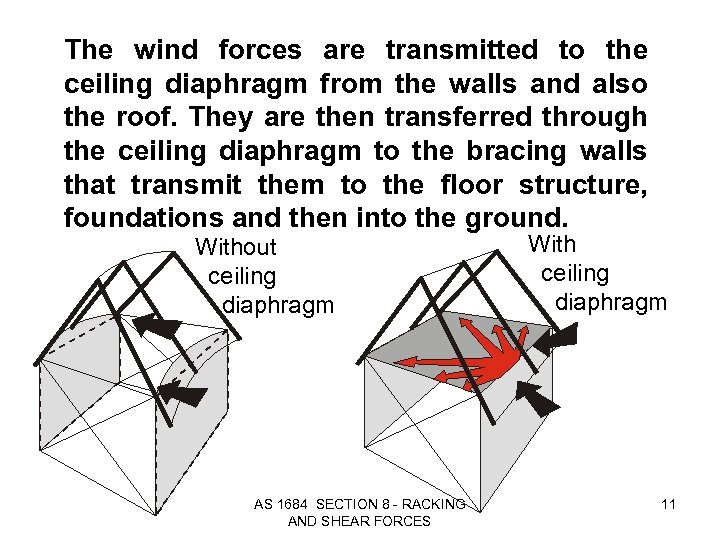
The wind forces are transmitted to the ceiling diaphragm from the walls and also the roof. They are then transferred through the ceiling diaphragm to the bracing walls that transmit them to the floor structure, foundations and then into the ground. Without ceiling diaphragm AS 1684 SECTION 8 - RACKING AND SHEAR FORCES With ceiling diaphragm 11
AS 1684 SECTION 8 - RACKING AND SHEAR FORCES 12
AS 1684 SECTION 8 - RACKING AND SHEAR FORCES 13
8. 2 TEMPORARY BRACING Temporary bracing shall be equivalent to at least 60% of permanent bracing required. Temporary bracing may form part of the installed permanent bracing. AS 1684 SECTION 8 - RACKING AND SHEAR FORCES 14
8. 3. 1 General Bracing shall be designed and provided for each storey of the house and for the subfloor, where required, in accordance with the following procedure: AS 1684 SECTION 8 - RACKING AND SHEAR FORCES 15
• Determine the wind classification • Determine the wind pressure • Determine area of elevation • Calculate racking force AS 1684 SECTION 8 - RACKING AND SHEAR FORCES 16
To calculate the number of braces required for wall bracing, the required racking force (k. N) is divided by the capacity of each brace. NOTE: AS 1684 SECTION 8 - RACKING AND SHEAR FORCES 17
The total capacity of each brace is equal to the length of the brace multiplied by its unit capacity (k. N/m) as given in Table 8. 18 (pg 141). AS 1684 SECTION 8 - RACKING AND SHEAR FORCES 18
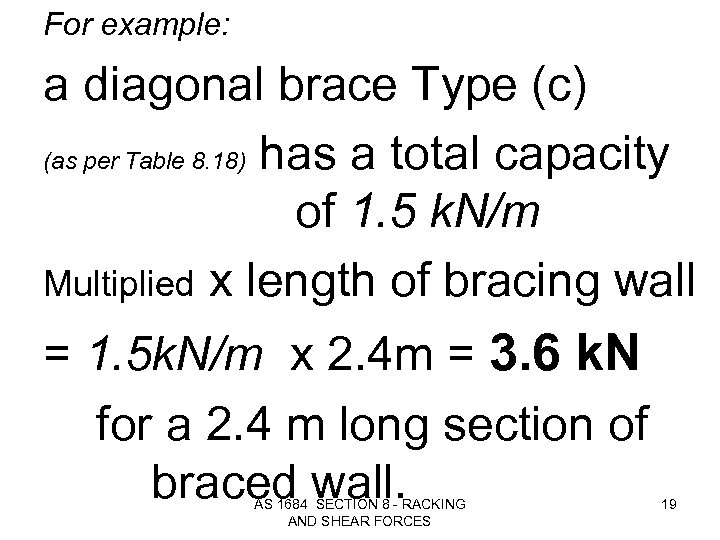
For example: a diagonal brace Type (c) (as per Table 8. 18) has a total capacity of 1. 5 k. N/m Multiplied x length of bracing wall = 1. 5 k. N/m x 2. 4 m = 3. 6 k. N for a 2. 4 m long section of braced wall. AS 1684 SECTION 8 - RACKING AND SHEAR FORCES 19
8. 3. 1 General (f) (g) Check even distribution and spacing Check connection of bracing to roof/ceilings and floors AS 1684 SECTION 8 - RACKING AND SHEAR FORCES 20
8. 3. 2 Wind pressure on the building Wind pressures on the surfaces of the building depend on the wind classification, width of building and roof pitch. Tables 8. 1 to 8. 5 give pressures depending on these variables. AS 1684 SECTION 8 - RACKING AND SHEAR FORCES 21
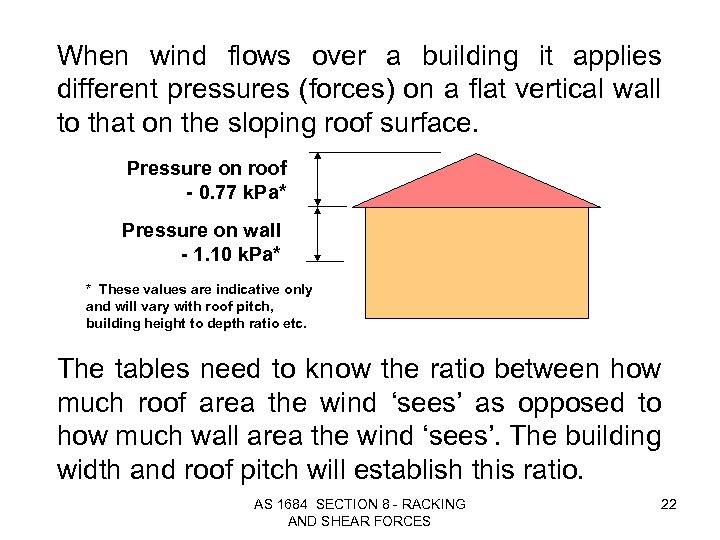
When wind flows over a building it applies different pressures (forces) on a flat vertical wall to that on the sloping roof surface. Pressure on roof - 0. 77 k. Pa* Pressure on wall - 1. 10 k. Pa* * These values are indicative only and will vary with roof pitch, building height to depth ratio etc. The tables need to know the ratio between how much roof area the wind ‘sees’ as opposed to how much wall area the wind ‘sees’. The building width and roof pitch will establish this ratio. AS 1684 SECTION 8 - RACKING AND SHEAR FORCES 22
8. 3. 2 Wind pressure on the building Pressures are given for single storey and upper storey of two storeys for both long wind at 90 O to the ridge and short wind parallel to the ridge sides of the building, and lower storey of two storeys or subfloor for both long wind at 90 O to the ridge and short wind parallel to the ridge sides of the building. AS 1684 SECTION 8 - RACKING AND SHEAR FORCES 23
8. 3. 3 Area of elevation The wind direction used shall be that resulting in the greatest load for the length and width of the building, respectively. As wind can blow from any direction, the elevation used shall be that for the worst direction. For example. . . AS 1684 SECTION 8 - RACKING AND SHEAR FORCES 24
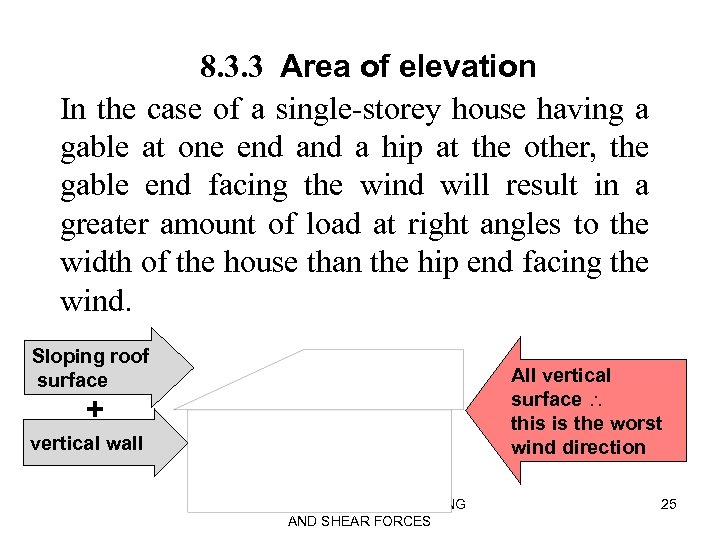
8. 3. 3 Area of elevation In the case of a single-storey house having a gable at one end a hip at the other, the gable end facing the wind will result in a greater amount of load at right angles to the width of the house than the hip end facing the wind. Sloping roof surface All vertical surface this is the worst wind direction + vertical wall AS 1684 SECTION 8 - RACKING AND SHEAR FORCES 25
For example, the relatively simple building shape shown in Figure 8. 2(A) must be broken into two parts (shapes) in Wind Direction 2 because gable ends are calculated using a different table. After calculating the separate bracing requirements for each part the bracing elements used must also be distributed accordingly. AS 1684 SECTION 8 - RACKING AND SHEAR FORCES 26
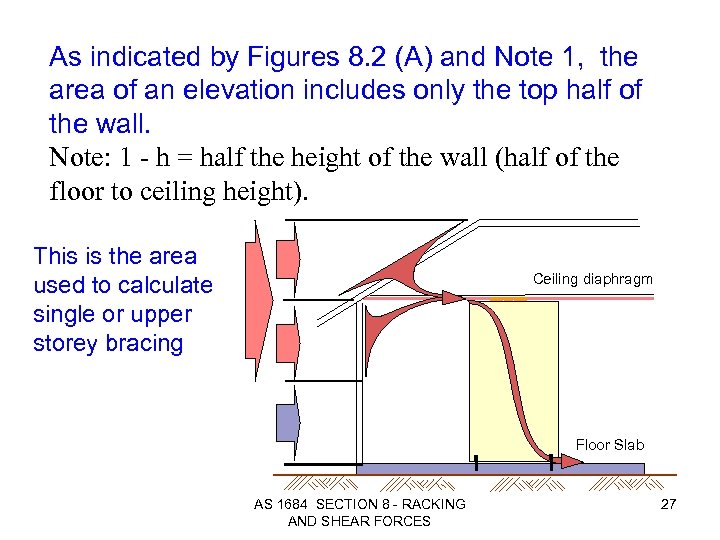
As indicated by Figures 8. 2 (A) and Note 1, the area of an elevation includes only the top half of the wall. Note: 1 - h = half the height of the wall (half of the floor to ceiling height). This is the area used to calculate single or upper storey bracing Ceiling diaphragm Floor Slab AS 1684 SECTION 8 - RACKING AND SHEAR FORCES 27
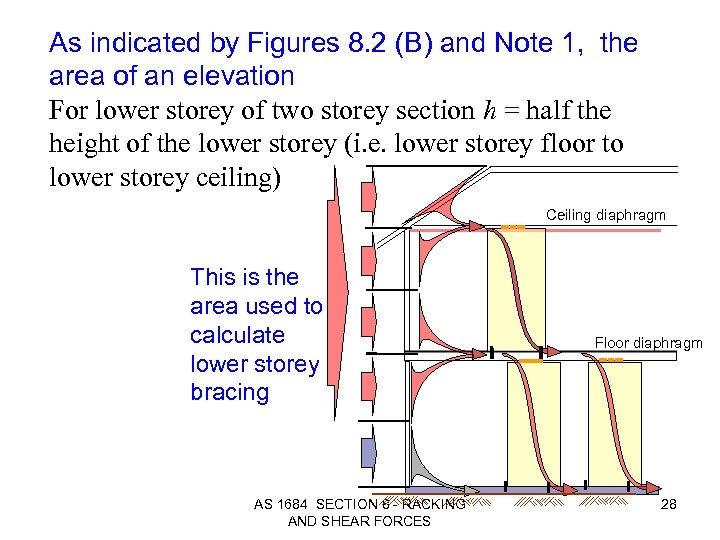
As indicated by Figures 8. 2 (B) and Note 1, the area of an elevation For lower storey of two storey section h = half the height of the lower storey (i. e. lower storey floor to lower storey ceiling) Ceiling diaphragm This is the area used to calculate lower storey bracing AS 1684 SECTION 8 - RACKING AND SHEAR FORCES Floor diaphragm 28
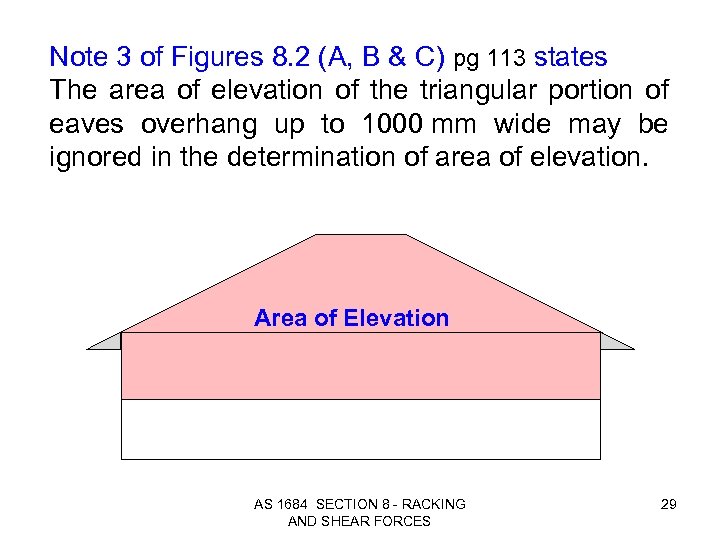
Note 3 of Figures 8. 2 (A, B & C) pg 113 states The area of elevation of the triangular portion of eaves overhang up to 1000 mm wide may be ignored in the determination of area of elevation. Area of Elevation AS 1684 SECTION 8 - RACKING AND SHEAR FORCES 29
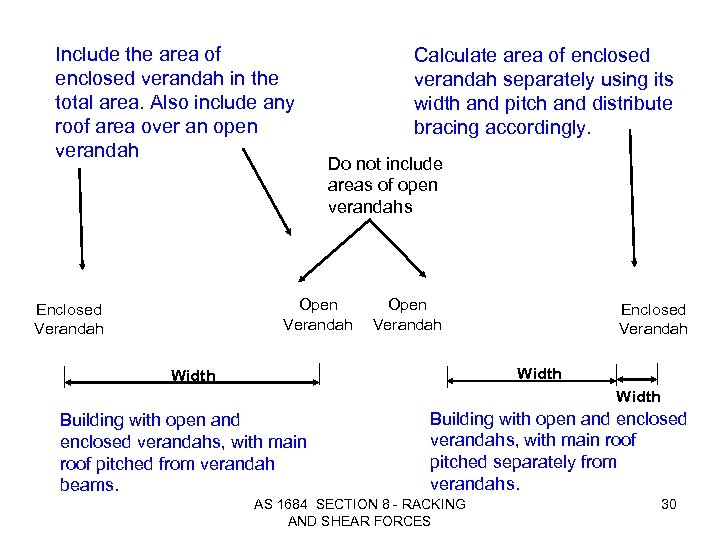
Include the area of enclosed verandah in the total area. Also include any roof area over an open verandah Calculate area of enclosed verandah separately using its width and pitch and distribute bracing accordingly. Do not include areas of open verandahs Open Verandah Enclosed Verandah Width Building with open and enclosed verandahs, with main roof pitched from verandah beams. Building with open and enclosed verandahs, with main roof pitched separately from verandahs. AS 1684 SECTION 8 - RACKING AND SHEAR FORCES 30
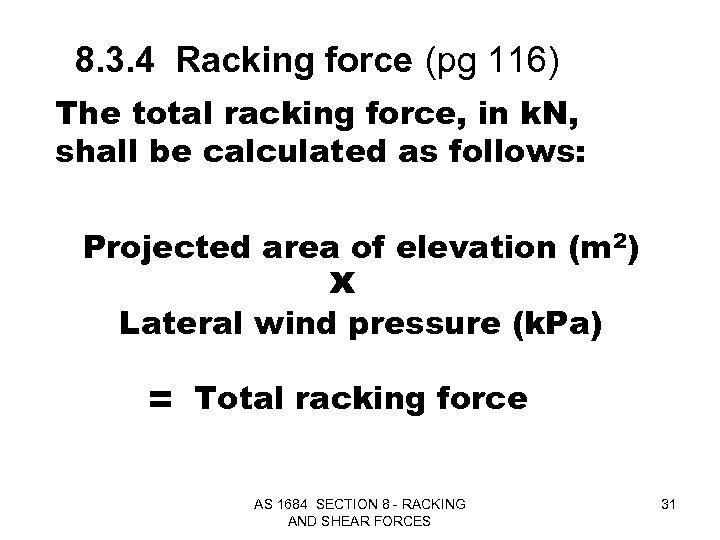
8. 3. 4 Racking force (pg 116) The total racking force, in k. N, shall be calculated as follows: Projected area of elevation (m 2) x Lateral wind pressure (k. Pa) = Total racking force AS 1684 SECTION 8 - RACKING AND SHEAR FORCES 31
TABLE 8. 1 (pg 116) • Gable ends and flat, vertical surfaces only AS 1684 SECTION 8 - RACKING AND SHEAR FORCES 32
AS 1684 SECTION 8 - RACKING AND SHEAR FORCES 33
Table 8. 2 is used for determining the pressure on single or upper storey elevations where the O wind direction is at 90 to the ridge and for wind speeds N 1, N 2, N 3 & N 4. AS 1684 SECTION 8 - RACKING AND SHEAR FORCES 34
continued WIND 90 O TO RIDGE A 3 N 2 AS 1684 SECTION 8 - RACKING AND SHEAR FORCES 35
Table 8. 3 is used for determining the pressure on lower storey elevations where the wind direction is at 90 O to a ridge and for wind speeds N 1, N 2, N 3 & N 4. AS 1684 SECTION 8 - RACKING AND SHEAR FORCES 36
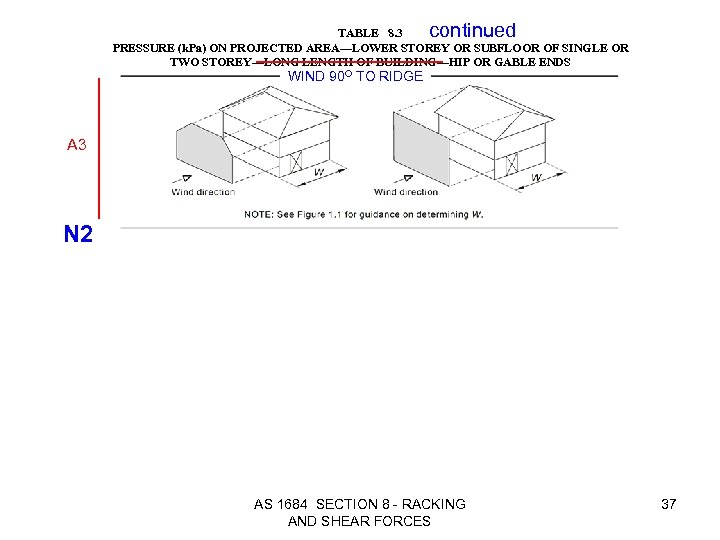
continued TABLE 8. 3 PRESSURE (k. Pa) ON PROJECTED AREA—LOWER STOREY OR SUBFLOOR OF SINGLE OR TWO STOREY—LONG LENGTH OF BUILDING—HIP OR GABLE ENDS WIND 90 O TO RIDGE A 3 N 2 AS 1684 SECTION 8 - RACKING AND SHEAR FORCES 37
Table 8. 4 is used for determining the pressure on single or upper storey elevations where the wind direction is parallel to a ridge and for wind speeds N 1, N 2, N 3 & N 4. AS 1684 SECTION 8 - RACKING AND SHEAR FORCES 38
WIND PARALLEL TO RIDGE A 3 N 2 AS 1684 SECTION 8 - RACKING AND SHEAR FORCES 39
Table 8. 5 is used for determining the pressure on lower storey elevations where the wind direction is parallel to a ridge and for wind speeds N 1, N 2, N 3 & N 4. AS 1684 SECTION 8 - RACKING AND SHEAR FORCES 40
WIND PARALLEL TO RIDGE A 3 N 2 AS 1684 SECTION 8 - RACKING AND SHEAR FORCES 41
8. 3. 6. 2 Nominal wall bracing (pg 140) Nominal wall bracing is wall framing lined with sheet materials such as plywood, plasterboard, fibre cement or hardboard, or the like, with the wall frames nominally fixed to the floor and the roof or ceiling frame. (table 9. 4 pg 167) AS 1684 SECTION 8 - RACKING AND SHEAR FORCES 42
The most common nominal bracing material used in houses is plasterboard wall linings. Plasterboard, fixed to the wall frame appropriately (to manufacturers specification) is given ‘structural bracing’ status with a reasonable strength rating. Fixed to the wall frame with nominal fixings, however, its bracing strength is much lower. AS 1684 SECTION 8 - RACKING AND SHEAR FORCES 43
8. 3. 6. 2 Nominal wall bracing The maximum amount that can be resisted by nominal wall bracing is 50% of the total racking forces determined from Clause 8. 3. 4. Nominal wall bracing shall be evenly distributed throughout the building. If this is not the case, the contribution of nominal bracing shall be ignored. The minimum length of nominal bracing walls shall be 450 mm. AS 1684 SECTION 8 - RACKING AND SHEAR FORCES 44
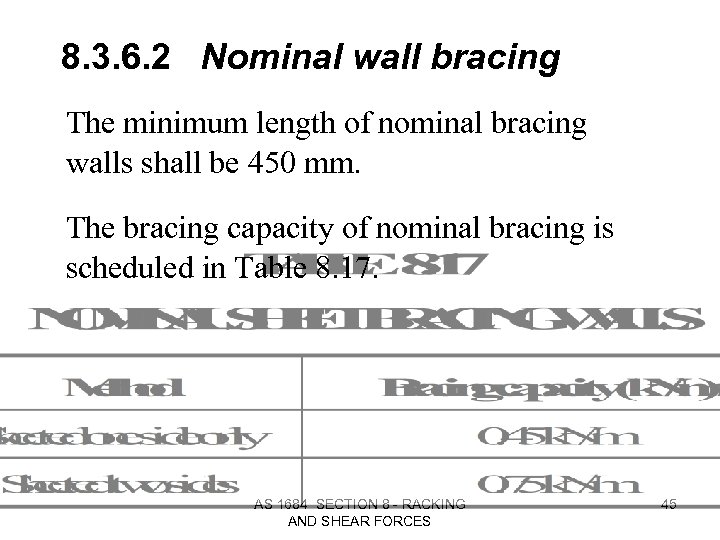
8. 3. 6. 2 Nominal wall bracing The minimum length of nominal bracing walls shall be 450 mm. The bracing capacity of nominal bracing is scheduled in Table 8. 17. AS 1684 SECTION 8 - RACKING AND SHEAR FORCES 45
Where sheet wall lining is placed over the top of a structural brace, the value of the sheet wall lining can not be given its nominal value for the section that overlaps the structural brace. AS 1684 SECTION 8 - RACKING AND SHEAR FORCES 46
8. 3. 6. 3 Structural wall bracing See TABLE 8. 18 pg 141 For sheet-braced walls, the sheeting shall be continuous from the top plate to the bottom plate Unless otherwise specified, sheetbracing walls shall be a minimum of 900 mm wide to satisfy the requirements of their nominated AS 1684 SECTION 8 - RACKING ratings. AND SHEAR FORCES 47

A 2 A 4 AS 1684 SECTION 8 - RACKING AND SHEAR FORCES 48
TABLE 8. 18 (continued) A 3 A 4 AS 1684 SECTION 8 - RACKING AND SHEAR FORCES 49
TABLE 8. 18 (continued) A 3 A 4 AS 1684 SECTION 8 - RACKING AND SHEAR FORCES 50
TABLE 8. 18 (continued) A 3 A 4 AS 1684 SECTION 8 - RACKING AND SHEAR FORCES 51
TABLE 8. 18 (continued) A 4 AS 1684 SECTION 8 - RACKING AND SHEAR FORCES 52
TABLE 8. 18 (continued) A 3 A 4 AS 1684 SECTION 8 - RACKING AND SHEAR FORCES 53
TABLE 8. 18 (continued) A 3 A 4 AS 1684 SECTION 8 - RACKING AND SHEAR FORCES 54
TABLE 8. 18 (continued) A 2 A 4 AS 1684 SECTION 8 - RACKING AND SHEAR FORCES 55
TABLE 8. 18 (continued) A 2 A 4 AS 1684 SECTION 8 - RACKING AND SHEAR FORCES 56
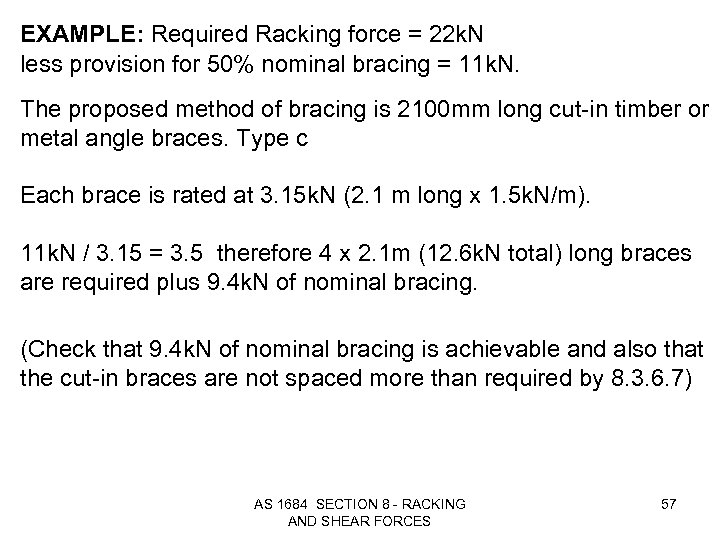
EXAMPLE: Required Racking force = 22 k. N less provision for 50% nominal bracing = 11 k. N. The proposed method of bracing is 2100 mm long cut-in timber or metal angle braces. Type c Each brace is rated at 3. 15 k. N (2. 1 m long x 1. 5 k. N/m). 11 k. N / 3. 15 = 3. 5 therefore 4 x 2. 1 m (12. 6 k. N total) long braces are required plus 9. 4 k. N of nominal bracing. (Check that 9. 4 k. N of nominal bracing is achievable and also that the cut-in braces are not spaced more than required by 8. 3. 6. 7) AS 1684 SECTION 8 - RACKING AND SHEAR FORCES 57
EXAMPLE: cont’d Of course there are other combinations for the above situation – 4 x 0. 9 long ply braces rated at 3. 4 k. N/m = 12. 24 k. N plus 9. 76 k. N of nominal bracing (type g) or 2 x 0. 9 long hardboard braces rated at 3. 4 k. N/m = 6. 12 k. N plus 2 x 2. 1 long metal angle = 6. 3 k. N plus 9. 58 k. N of nominal bracing. (type l) AS 1684 SECTION 8 - RACKING AND SHEAR FORCES 58
8. 3. 6. 4 Wall capacity and height modification pg 147 The capacity of bracing walls given in Table 8. 18 is appropriate to wall heights up to and including 2700 mm. For wall heights greater than 2700 mm the capacity shall be multiplied by the values given in Table 8. 19. AS 1684 SECTION 8 - RACKING AND SHEAR FORCES 59
8. 3. 6. 5 Length and capacity for plywood bracing walls Where the same structural plywood bracing system is fixed to both sides of the wall, the capacity of the wall will equal the combined capacity of the bracing system on each side. AS 1684 SECTION 8 - RACKING AND SHEAR FORCES 60
8. 3. 6. 6 Location and distribution of bracing Bracing shall be approximately evenly distributed and shall be provided in both directions (see Figure 8. 5). Bracing shall initially be placed in external walls and where possible at the corners of the building. AS 1684 SECTION 8 - RACKING AND SHEAR FORCES 61
FIGURE 8. 5 LOCATION OF BRACING AS 1684 SECTION 8 - RACKING AND SHEAR FORCES 62
A 3 8. 3. 6. 7 Spacing of bracing walls in single storey or upper storey of two storey construction For single or upper-storey construction, the maximum distance between braced walls at right angles to the building length or width shall not exceed 9000 mm for wind classifications up to N 2 (see Figure 8. 6). AS 1684 SECTION 8 - RACKING AND SHEAR FORCES 63
A 3 8. 3. 6. 7 Spacing of bracing walls in single storey or upper storey of two storey construction For wind classifications greater than N 2, spacing shall be in accordance with Table 8. 20 (pg 150) (N 3) and Table 8. 21 (N 4) for the relevant wind classification, ceiling depth and roof pitch. NOTE: Ceiling depth is measured parallel to the wind direction being considered. AS 1684 SECTION 8 - RACKING 64 AND SHEAR FORCES
N 3 NOTE: A ceiling depth of 16 m is to be used for all ceiling depths greater than 16 m. AS 1684 SECTION 8 - RACKING AND SHEAR FORCES 65
A 3 8. 3. 6. 7 Spacing of bracing walls in single storey or upper storey of two Where bracing cannot be placed in external walls because of openings or the like, a structural diaphragm ceiling can be used to transfer racking forces to bracing walls that can support the loads. Alternatively, wall frames may be designed for portal action. (This requires engineering advice) AS 1684 SECTION 8 - RACKING AND SHEAR FORCES 66
FIGURE 8. 6 SPACING OF BRACING AS 1684 SECTION 8 - RACKING AND SHEAR FORCES 67
The ceiling and floor diaphragms play important roles in the transfer of wind loads from the walls and roof to the braces. The ability of a ceiling or floor diaphragm to effectively transfer the wind load depends on the depth of the diaphragm. AS 1684 SECTION 8 - RACKING AND SHEAR FORCES 68
• Narrow or long diaphragms will not transfer the wind loads as effectively as a deeper diaphragm. The smaller the length to depth ratio the more effective the diaphragm. • For this reason the spacing of bracing walls in limited as per Clause 8. 3. 6. 7. AS 1684 SECTION 8 - RACKING AND SHEAR FORCES 69
The above diaphragm, has a large length to depth ratio, (the length being the distance between braces) will not transfer the wind loads effectively. AS 1684 SECTION 8 - RACKING AND SHEAR FORCES 70
By adding an intermediate brace, the diaphragm is broken into two. Individually they have a smaller length to depth ratio and will transfer the wind loads effectively AS 1684 SECTION 8 - RACKING AND SHEAR FORCES 71
The same diaphragm, with the wind from the other direction, will transfer loads very effectively because its length to depth ratio is small. AS 1684 SECTION 8 - RACKING AND SHEAR FORCES 72
8. 3. 6. 9 Fixing of top of bracing walls All internal bracing walls shall be fixed to the floor for lower storey bracing walls, the ceiling or roof frame, and/or the external wall frame, with structural connections of equivalent shear capacity to the bracing capacity of that particular bracing wall. AS 1684 SECTION 8 - RACKING AND SHEAR FORCES 73
8. 3. 6. 9 Fixing of top of bracing walls Nominal and other bracing walls with bracing capacity up to 1. 5 k. N/m require nominal fixing only, i. e. no additional fixing requirements. For typical details and shear capacities, see Table 8. 22. pg 152 AS 1684 SECTION 8 - RACKING AND SHEAR FORCES 74
Fixing of top of bracing walls Wind loads, transferred from the roof and walls to ceiling and floor diaphragms are then transferred through braces to the ground. These braces, however, can only transfer these loads if the brace is connected to the ceiling or floor above and the floor below. AS 1684 SECTION 8 - RACKING AND SHEAR FORCES 75
AS 1684 SECTION 8 - RACKING AND SHEAR FORCES 76
The strength of these connections must be at least equal to the load the brace can transfer e. g. a cut-in timber or metal brace 2. 4 m long can transfer a total of 3. 6 k. N (2. 4 x 1. 5 k. N/m) – a 3. 6 k. N connection to the diaphragm is required. or alternatively the strength of the brace can be reduced to equal the strength of the connection(s). e. g. if a 2. 8 k. N connection is used for the above brace, its bracing capacity will be reduced to 2. 8 k. N. AS 1684 SECTION 8 - RACKING AND SHEAR FORCES 77
Connection used equals the total brace capacity. Refer to table 8. 22 pg 155 AS 1684 SECTION 8 - RACKING AND SHEAR FORCES 78
Connections used equals the total brace capacity. Refer to table 8. 22 pg 153 AS 1684 SECTION 8 - RACKING AND SHEAR FORCES 79
AS 1684 SECTION 8 - RACKING AND SHEAR FORCES 80
AS 1684 SECTION 8 - RACKING AND SHEAR FORCES 81
AS 1684 SECTION 8 - RACKING AND SHEAR FORCES 82
A 3 A 4 AS 1684 SECTION 8 - RACKING AND SHEAR FORCES 83

(b) AS 1684 SECTION 8 - RACKING AND SHEAR FORCES 84
AS 1684 SECTION 8 - RACKING AND SHEAR FORCES 85
AS 1684 SECTION 8 - RACKING AND SHEAR FORCES 86
A 3 A 4 AS 1684 SECTION 8 - RACKING AND SHEAR FORCES 87
A 4 AS 1684 SECTION 8 - RACKING AND SHEAR FORCES 88
AS 1684 SECTION 8 - RACKING AND SHEAR FORCES 89
AS 1684 SECTION 8 - RACKING AND SHEAR FORCES 90
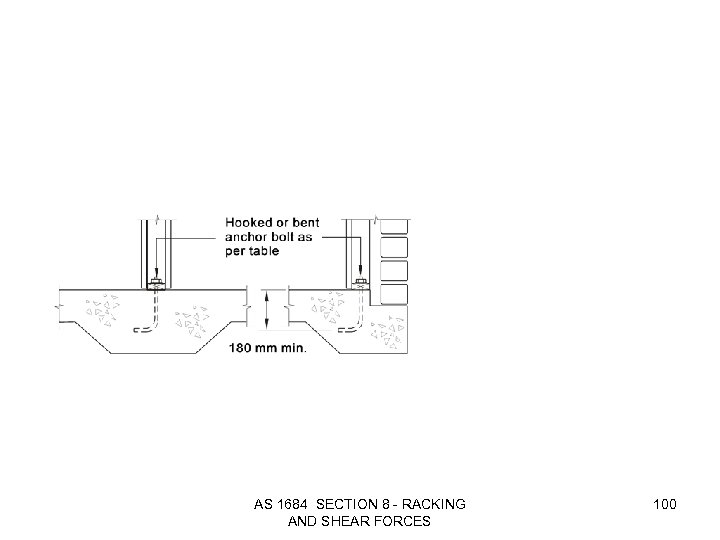
8. 3. 6. 10 Fixing of bottom of bracing walls pg 155 The bottom plate of timberframed bracing walls shall be fixed at the ends of the bracing panel and, if required, intermediately to the floor frame or concrete slab with connections determined from Table 8. 18. pg 141 AS 1684 SECTION 8 - RACKING AND SHEAR FORCES 91
8. 3. 6. 10 Fixing of bottom of bracing walls Where bottom plate fixing information is not given in Table 8. 18, the bottom plates shall be fixed at the ends of each bracing panel using tie-down fixings determined from Table 8. 23 and Table 8. 24. AS 1684 SECTION 8 - RACKING AND SHEAR FORCES 92
8. 3. 6. 10 Fixing of bottom of bracing walls For bracing wall systems of capacity 6 k. N/m or greater given in Table 8. 18, which do not specify intermediate bottom plate fixings, additional intermediate bottom plate fixings of a minimum of 1/M 10 bolt, or 2/No. 14 Type 17 screws, at max. 1200 mm centres shall be used. AS 1684 SECTION 8 - RACKING AND SHEAR FORCES 93
NOTES: 1 Some bracing wall systems require fixings to be full-length anchor rods, that is from the top plate to the floor frame or concrete slab. 2 The maximum tension load of 8. 5 k. N given in the Notes to Span Tables for studs in the Supplements is not applicable when considering the uplift force at the ends of bracing walls. 3 Where provided, the bottom plate tie-down details given in Table 8. 18 may be used in lieu of the details determined from Table 8. 23 and 8. 24. AS 1684 SECTION 8 - RACKING AND SHEAR FORCES 94
AS 1684 SECTION 8 - RACKING AND SHEAR FORCES 95
AS 1684 SECTION 8 - RACKING AND SHEAR FORCES 96
AS 1684 SECTION 8 - RACKING AND SHEAR FORCES 97
A 4 AS 1684 SECTION 8 - RACKING AND SHEAR FORCES 98
AS 1684 SECTION 8 - RACKING AND SHEAR FORCES 99
AS 1684 SECTION 8 - RACKING AND SHEAR FORCES 100
AS 1684 SECTION 8 - RACKING AND SHEAR FORCES 101
8. 3. 7 Roof Bracing pg 158 8. 3. 7. 1 Pitched roofs (coupled and noncoupled roofs) The following shall apply to the bracing of pitched roofs: (a) Hip roofs shall not require any specific bracing as they are restrained against longitudinal movement by hips, valleys and the like. AS 1684 SECTION 8 - RACKING AND SHEAR FORCES 102
8. 3. 7. 1 Pitched roofs (coupled and noncoupled roofs) (b) Gable roofs (including cathedral roofs) For wind classifications up to N 2 gable roof buildings with a roof pitch greater than 10° but less than 25°, shall be provided with roof bracing in accordance with Clause. Alternatively, for wind classifications up to N 4 and roof pitches to 35° bracing shall be in accordance with Table 8. 25, Table 8. 26, and the following: (i) Ridge to internal wall — minimum of two timber braces in opposing directions at approximately 45° (see Table 8. 25 and 8. 26). (ii) Diagonal metal bracing — single or double diagonal bracing shall be designed and installed in AS 1684 SECTION 8 - RACKING 103 accordance with engineering principles. AND SHEAR FORCES
FIGURE 8. 9 GABLE ROOF BRACING AS 1684 SECTION 8 - RACKING AND SHEAR FORCES 104
Скачать презентацию SECTION 8 RACKING BRACING AND SHEAR FORCES WEEK
3e66a442b215e1ba70f337f66c8bfc64.ppt