


 Скачать презентацию Section 5 1 Vectors in Multiple Dimensions The
4f64d5e5b67274aa63f48308263382a4.ppt
- Количество слайдов: 81
 Section 5. 1 Vectors in Multiple Dimensions The process for ______ vectors works even when the vectors do not point along the same straight line. If you are solving one of these two-dimensional problems graphically, you will need to use a _______, both to draw the ______ at the correct ______ and also to measure the _______ and ______ of the resultant vector.
 Vectors in Multiple Dimensions You can add vectors by placing them _______ and then drawing the _______ of the vector by connecting the _____ of the first vector to the ______ of the _____ vector.
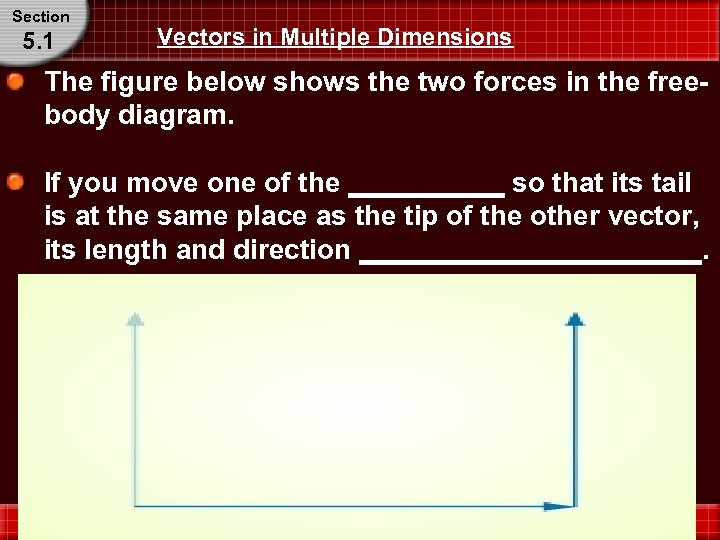 Section 5. 1 Vectors in Multiple Dimensions The figure below shows the two forces in the freebody diagram. If you move one of the _____ so that its tail is at the same place as the tip of the other vector, its length and direction ___________.
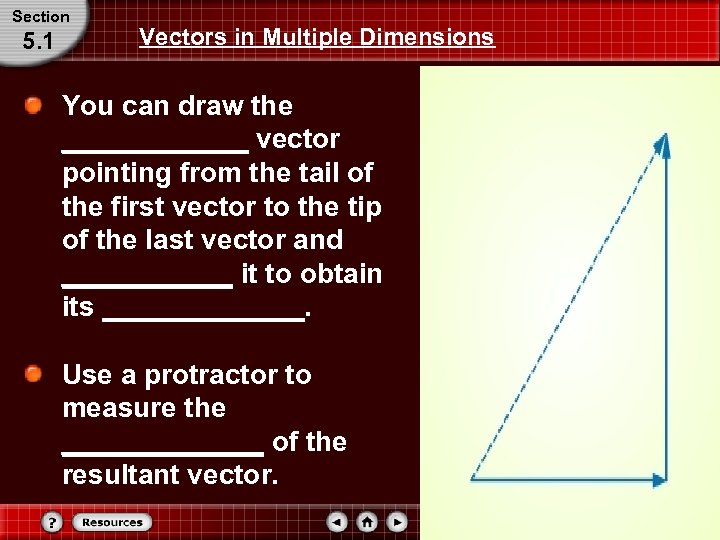 Section 5. 1 Vectors in Multiple Dimensions You can draw the ______ vector pointing from the tail of the first vector to the tip of the last vector and ______ it to obtain its _______. Use a protractor to measure the _______ of the resultant vector.
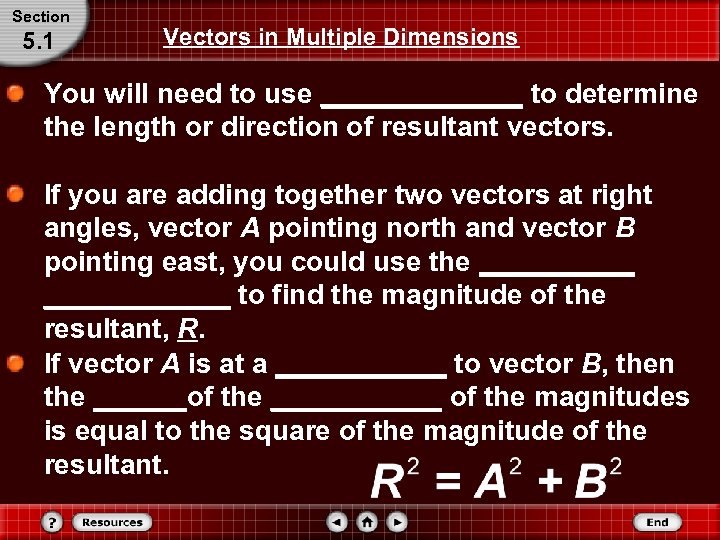 Section 5. 1 Vectors in Multiple Dimensions You will need to use _______ to determine the length or direction of resultant vectors. If you are adding together two vectors at right angles, vector A pointing north and vector B pointing east, you could use the ____________ to find the magnitude of the resultant, R. If vector A is at a ______ to vector B, then the ______of the ______ of the magnitudes is equal to the square of the magnitude of the resultant.
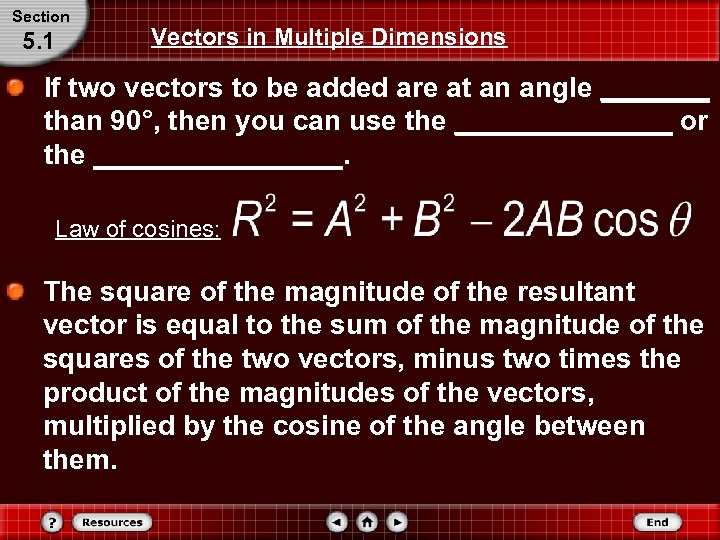 Section 5. 1 Vectors in Multiple Dimensions If two vectors to be added are at an angle _______ than 90°, then you can use the _______ or the ________. Law of cosines: The square of the magnitude of the resultant vector is equal to the sum of the magnitude of the squares of the two vectors, minus two times the product of the magnitudes of the vectors, multiplied by the cosine of the angle between them.
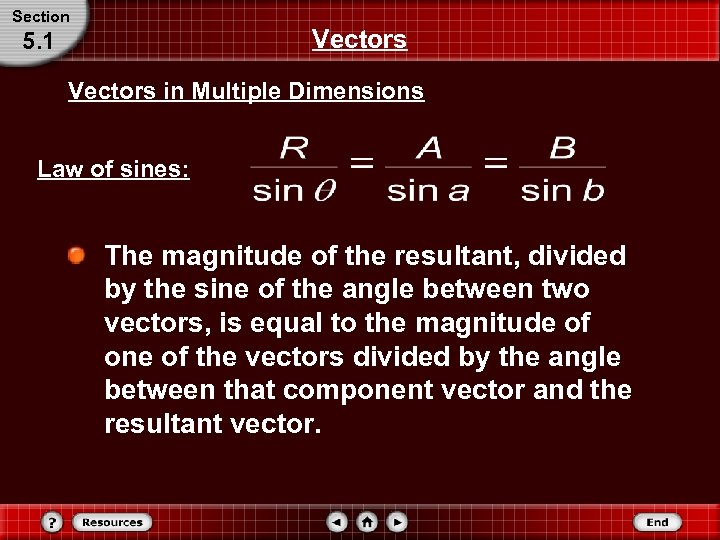 Section Vectors 5. 1 Vectors in Multiple Dimensions Law of sines: The magnitude of the resultant, divided by the sine of the angle between two vectors, is equal to the magnitude of one of the vectors divided by the angle between that component vector and the resultant vector.
 Section 5. 1 Vectors Finding the Magnitude of the Sum of Two Vectors Find the magnitude of the sum of a 15 -km displacement and a 25 -km displacement when the angle between them is 90° and when the angle between them is 135°.
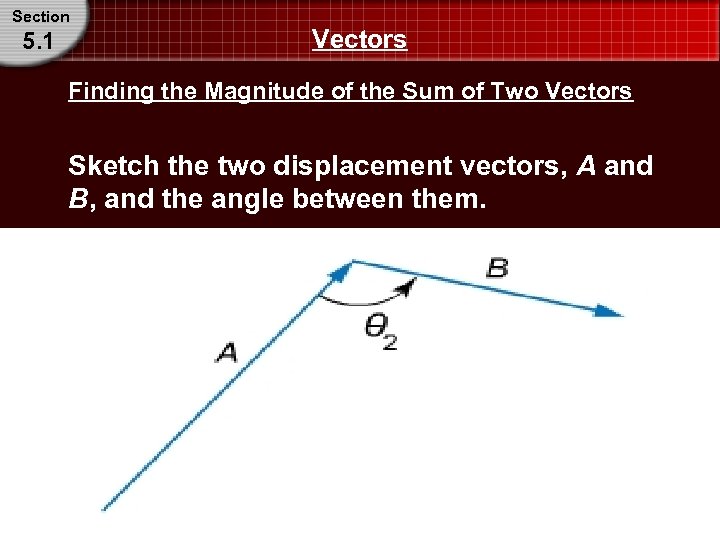 Section 5. 1 Vectors Finding the Magnitude of the Sum of Two Vectors Sketch the two displacement vectors, A and B, and the angle between them.
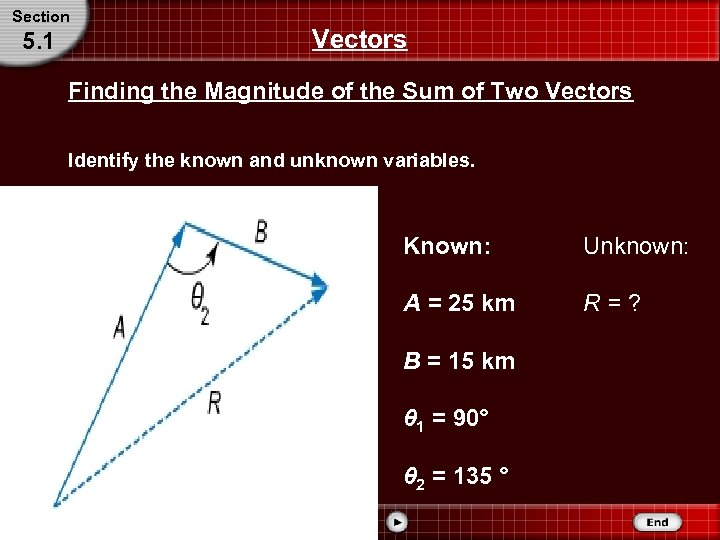 Section 5. 1 Vectors Finding the Magnitude of the Sum of Two Vectors Identify the known and unknown variables. Known: Unknown: A = 25 km R=? B = 15 km θ 1 = 90° θ 2 = 135 °
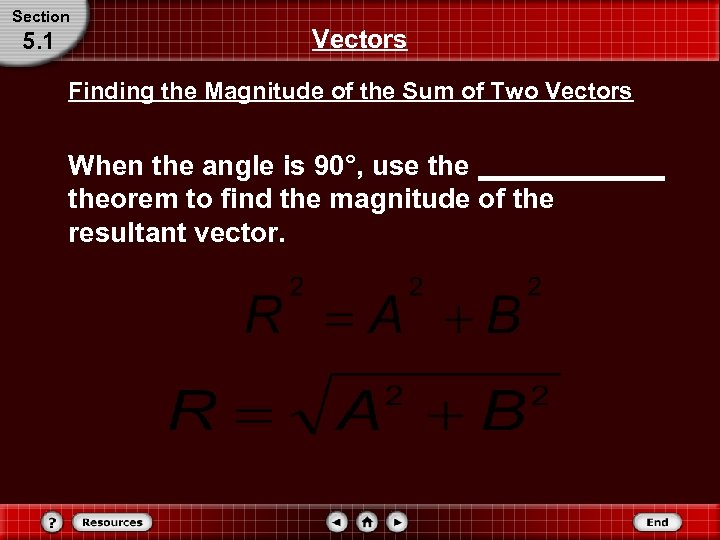 Section 5. 1 Vectors Finding the Magnitude of the Sum of Two Vectors When the angle is 90°, use the ______ theorem to find the magnitude of the resultant vector.
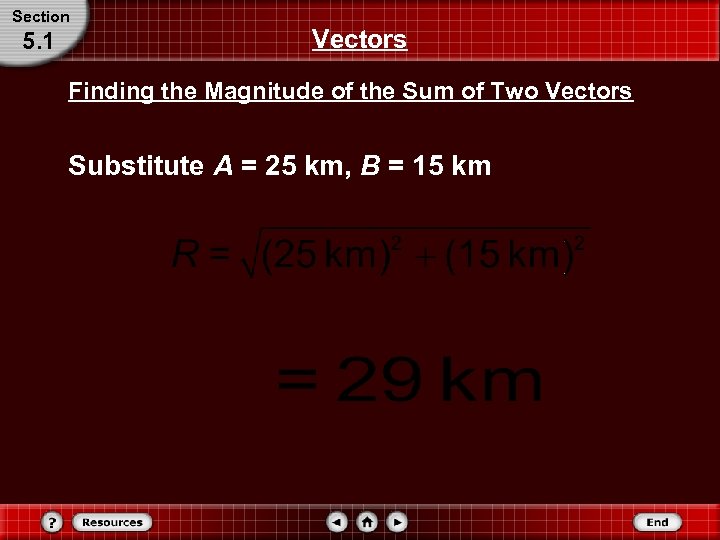 Section 5. 1 Vectors Finding the Magnitude of the Sum of Two Vectors Substitute A = 25 km, B = 15 km
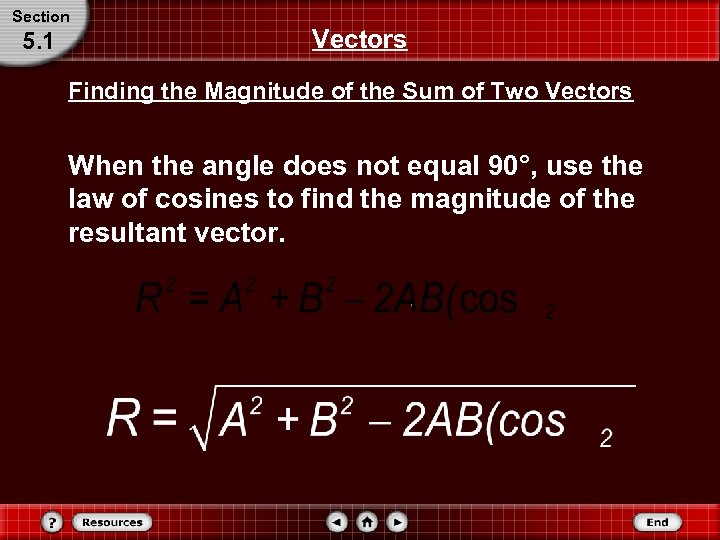 Section 5. 1 Vectors Finding the Magnitude of the Sum of Two Vectors When the angle does not equal 90°, use the law of cosines to find the magnitude of the resultant vector.
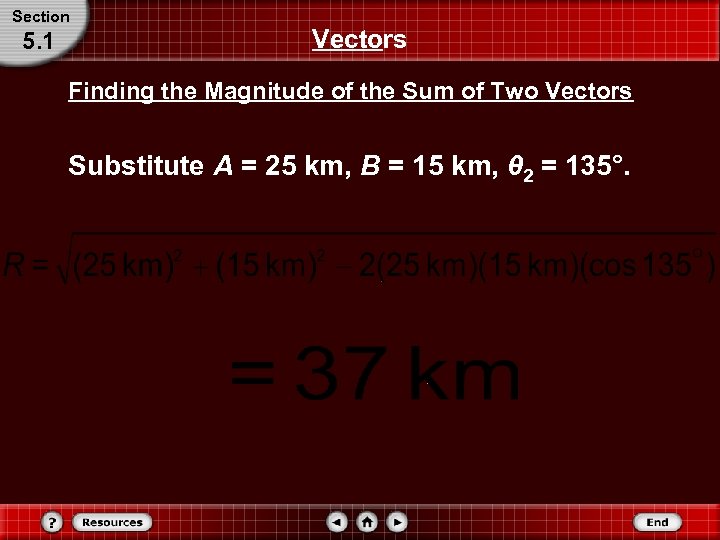 Section 5. 1 Vectors Finding the Magnitude of the Sum of Two Vectors Substitute A = 25 km, B = 15 km, θ 2 = 135°.
 Section 5. 1 Vectors Finding the Magnitude of the Sum of Two Vectors Are the magnitudes realistic? The magnitudes are in the same range as the two combined vectors, but longer. This is because each resultant is the side opposite an _______ angle. The second answer is ______ than the first, which agrees with the graphical representation.
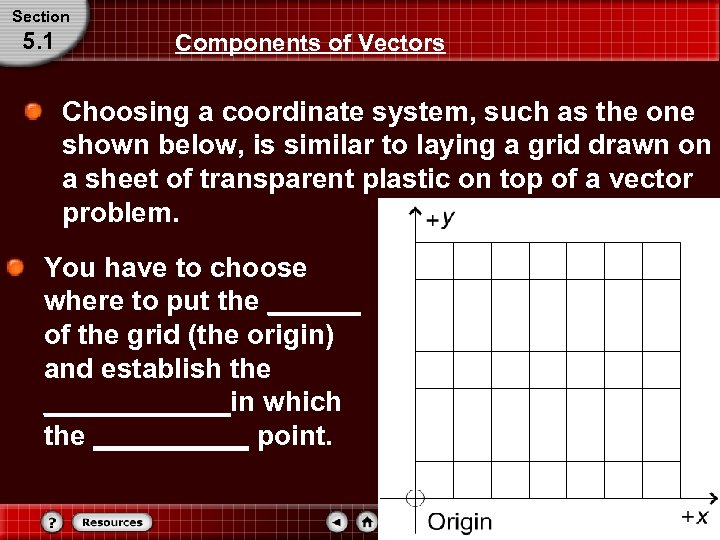 Section 5. 1 Components of Vectors Choosing a coordinate system, such as the one shown below, is similar to laying a grid drawn on a sheet of transparent plastic on top of a vector problem. You have to choose where to put the ______ of the grid (the origin) and establish the ______in which the _____ point.
 Section 5. 1 Components of Vectors When the motion you are describing is confined to the _____ of _____, it is often convenient to have the _____ point E and the ______ point N. When the motion involves an object moving through the air, the positive x-axis is often chosen to be ________ and the positive y-axis ______ (upward). If the motion is on a hill, it’s convenient to place the positive _____ in the ____ of the motion and the y-axis perpendicular to the _____.
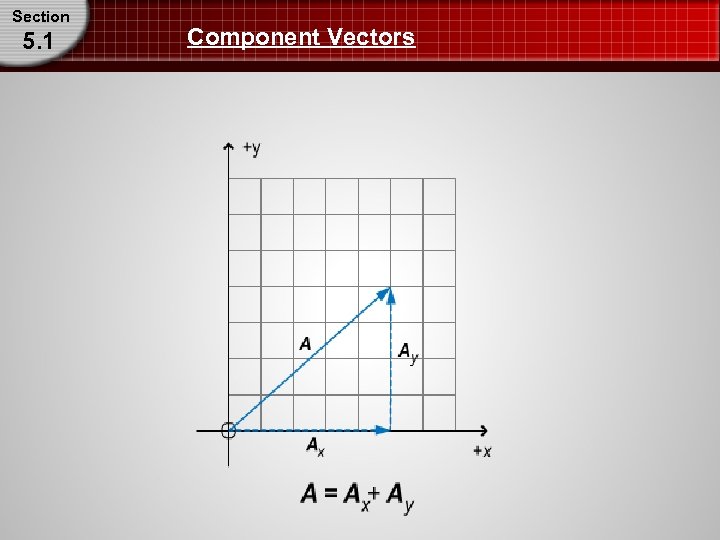 Section 5. 1 Component Vectors
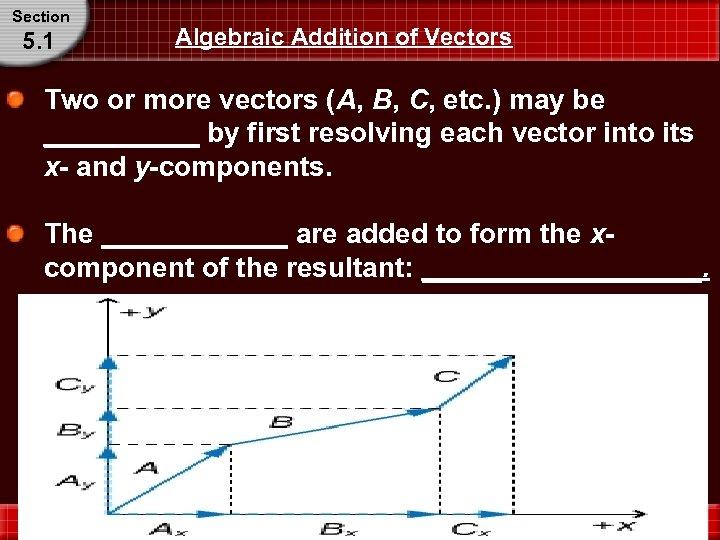 Section 5. 1 Algebraic Addition of Vectors Two or more vectors (A, B, C, etc. ) may be _____ by first resolving each vector into its x- and y-components. The ______ are added to form the xcomponent of the resultant: _________.
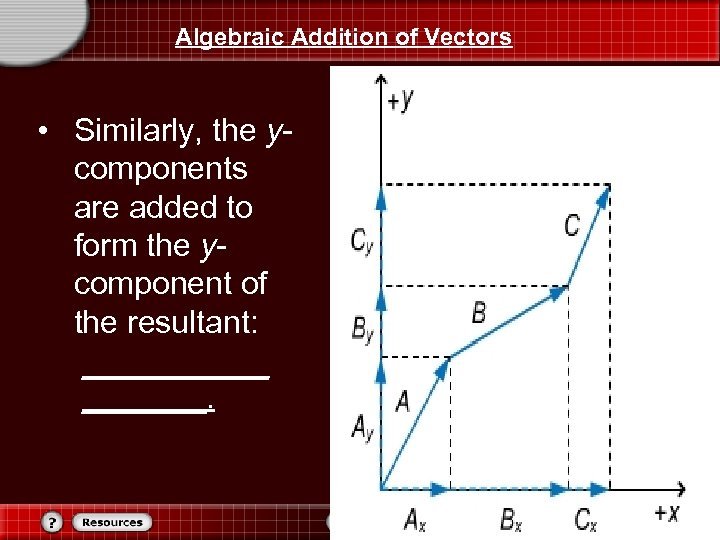 Algebraic Addition of Vectors • Similarly, the ycomponents are added to form the ycomponent of the resultant: ______.
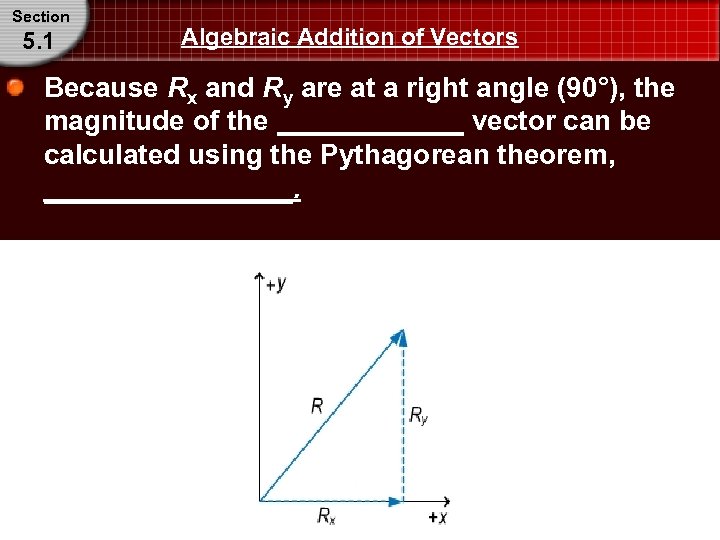 Section 5. 1 Algebraic Addition of Vectors Because Rx and Ry are at a right angle (90°), the magnitude of the ______ vector can be calculated using the Pythagorean theorem, ________.
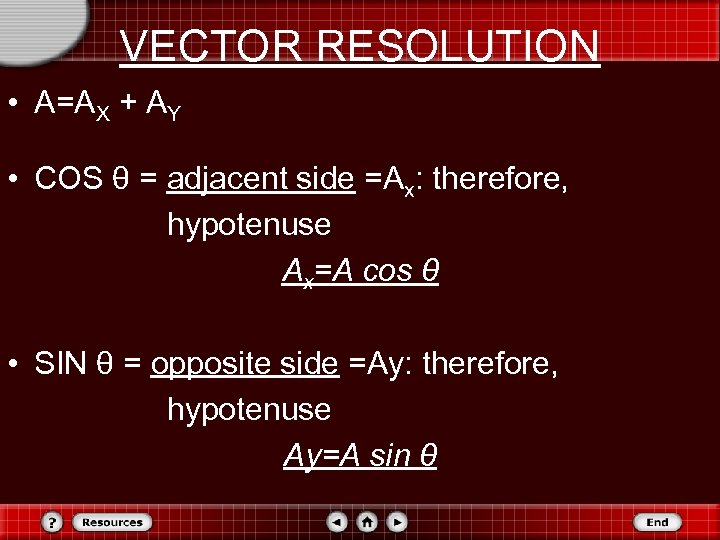 VECTOR RESOLUTION • A=AX + AY • COS θ = adjacent side =Ax: therefore, hypotenuse Ax=A cos θ • SIN θ = opposite side =Ay: therefore, hypotenuse Ay=A sin θ
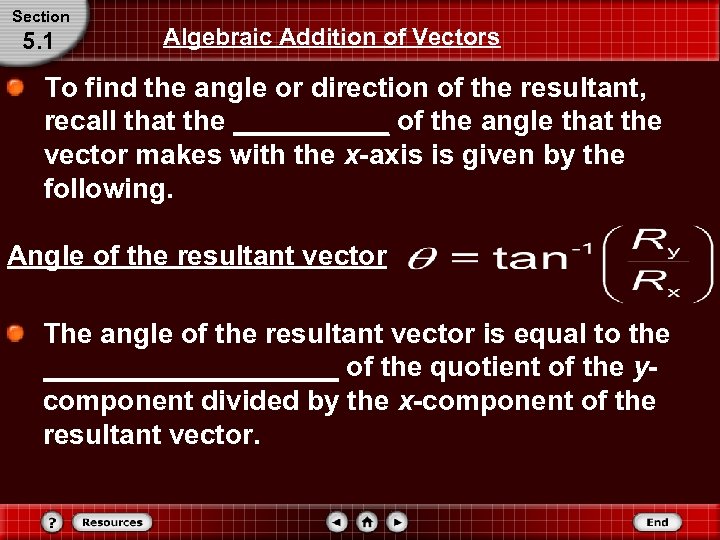 Section 5. 1 Algebraic Addition of Vectors To find the angle or direction of the resultant, recall that the _____ of the angle that the vector makes with the x-axis is given by the following. Angle of the resultant vector The angle of the resultant vector is equal to the __________ of the quotient of the ycomponent divided by the x-component of the resultant vector.
 Section 5. 1 Algebraic Addition of Vectors You can find the angle by using the ______ on your calculator. Note that when ______, most calculators give the angle between 0° and 90°, and when tan θ < 0, the angle is reported to be between 0° and − 90°.
 Section 5. 1 Section Check Question 1 Jeff moved 3 m due north, and then 4 m due west to his friends house. What is the displacement of Jeff? A. 3 + 4 m B. 4 – 3 m C. 32 + 42 m D. 5 m
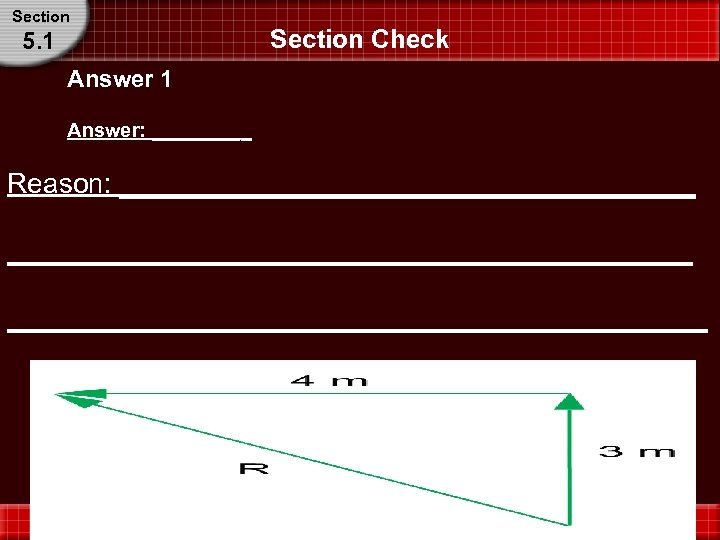 Section 5. 1 Section Check Answer 1 Answer: _____ Reason: ____________________________________________
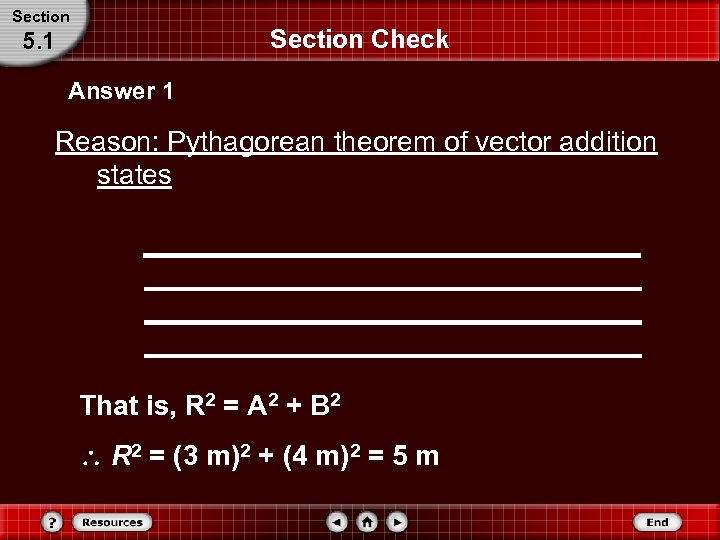 Section Check 5. 1 Answer 1 Reason: Pythagorean theorem of vector addition states ________________________________ That is, R 2 = A 2 + B 2 R 2 = (3 m)2 + (4 m)2 = 5 m
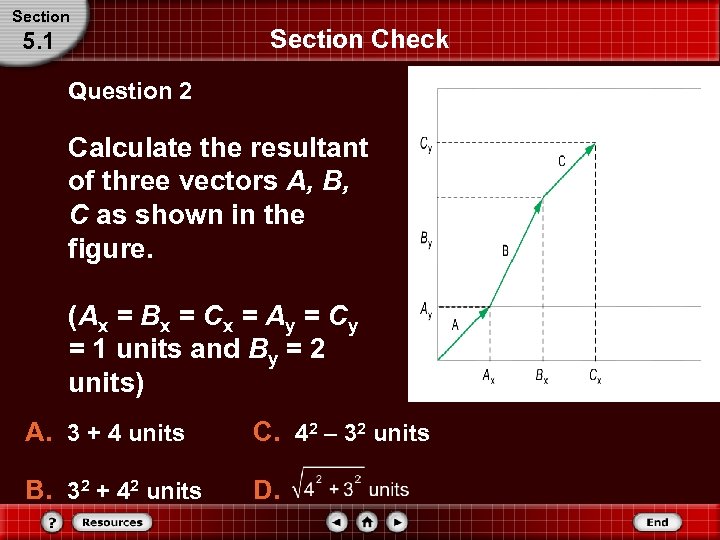 Section 5. 1 Section Check Question 2 Calculate the resultant of three vectors A, B, C as shown in the figure. (Ax = Bx = Cx = Ay = Cy = 1 units and By = 2 units) A. 3 + 4 units C. 42 – 32 units B. 32 + 42 units D.
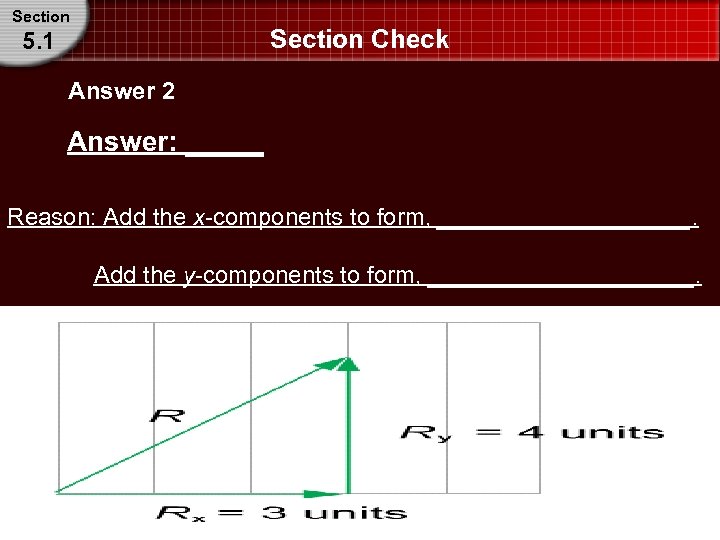 Section Check 5. 1 Answer 2 Answer: _____ Reason: Add the x-components to form, __________. Add the y-components to form, __________.
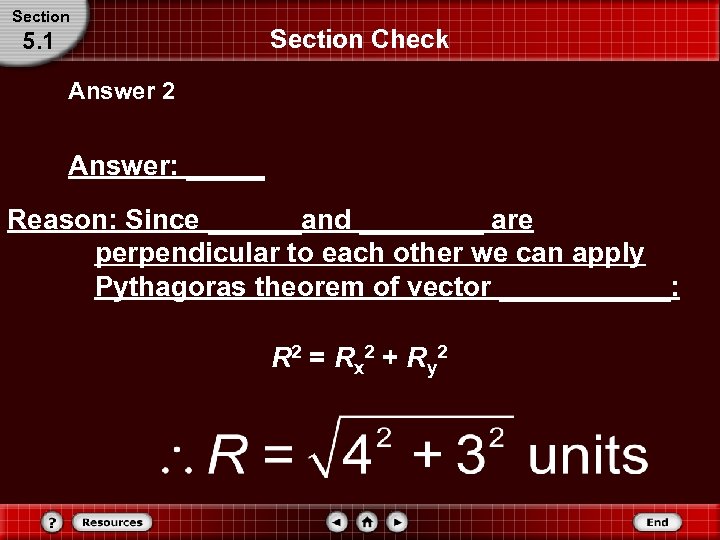 Section 5. 1 Section Check Answer 2 Answer: _____ Reason: Since ______and ____ are perpendicular to each other we can apply Pythagoras theorem of vector ______: R 2 = R x 2 + R y 2
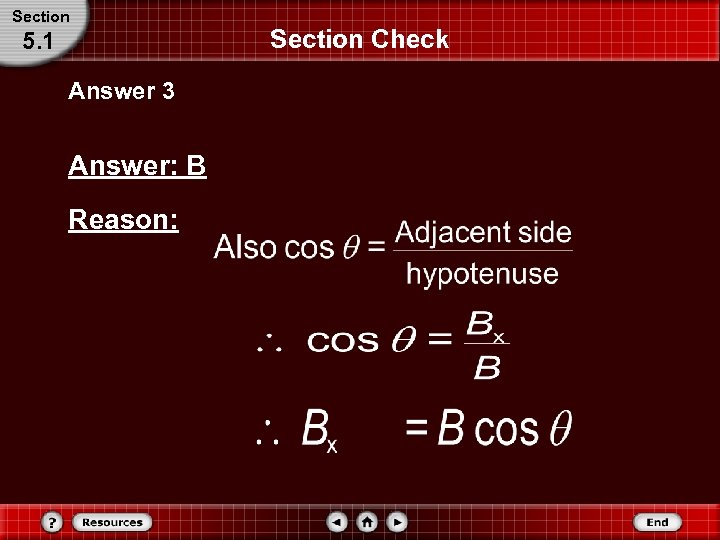
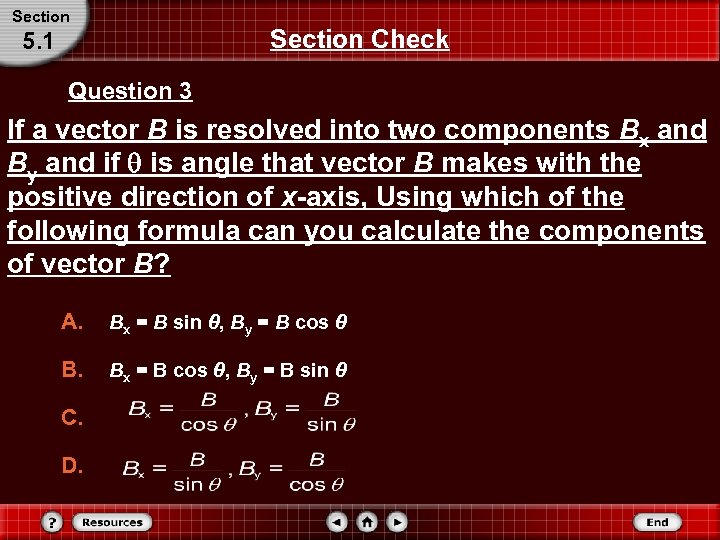 Section Check 5. 1 Question 3 If a vector B is resolved into two components Bx and By and if is angle that vector B makes with the positive direction of x-axis, Using which of the following formula can you calculate the components of vector B? A. Bx = B sin θ, By = B cos θ B. Bx = B cos θ, By = B sin θ C. D.
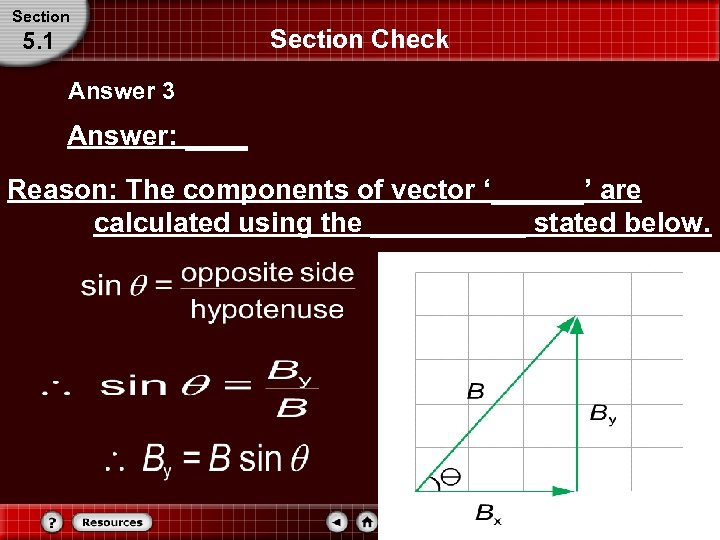 Section 5. 1 Section Check Answer 3 Answer: ____ Reason: The components of vector ‘______’ are calculated using the _____ stated below.
 Section 5. 1 Answer 3 Answer: B Reason: Section Check
 Section 5. 2 Static and Kinetic Friction Push your hand across your desktop and feel the force called friction opposing the motion. 2 types of friction, and both always oppose motion. Pushing a book across the desk, experiences a type of friction that acts on moving objects. This force is _______, and it is exerted on one surface by another when the two surfaces ______ against each other because ______ of them are _____.
 Section 5. 2 Static and Kinetic Friction To understand the other kind of friction, imagine trying to push a heavy couch across the floor. You give it a push, but it does not move. Because it does not move, Newton’s laws tell you that there must be a _____ horizontal force acting on the couch, one that _____ your force and is ______ in size. This force is _______, which is the force exerted on one surface by another when there is __________ between the two surfaces.
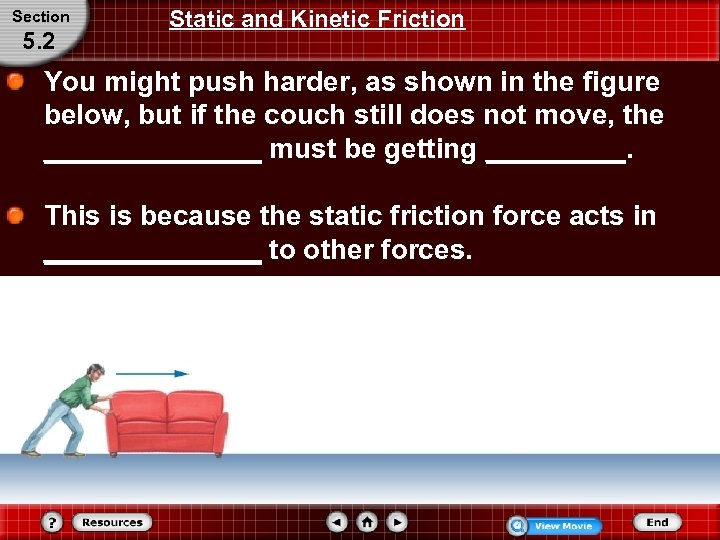 Section 5. 2 Static and Kinetic Friction You might push harder, as shown in the figure below, but if the couch still does not move, the _______ must be getting _____. This is because the static friction force acts in _______ to other forces.
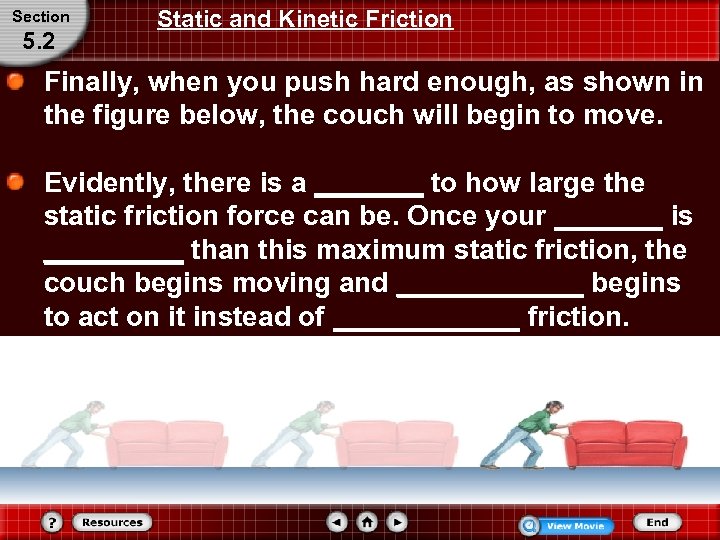 Section 5. 2 Static and Kinetic Friction Finally, when you push hard enough, as shown in the figure below, the couch will begin to move. Evidently, there is a _______ to how large the static friction force can be. Once your _______ is _____ than this maximum static friction, the couch begins moving and ______ begins to act on it instead of ______ friction.
 Section 5. 2 Static and Kinetic Friction _________ depends on the materials that the surfaces are made of. For example, there is more friction between skis and concrete than there is between skis and snow. The ______ force between the two objects also matters. The _____ one object is pushed against the other, the _______ the ______ of friction that results.
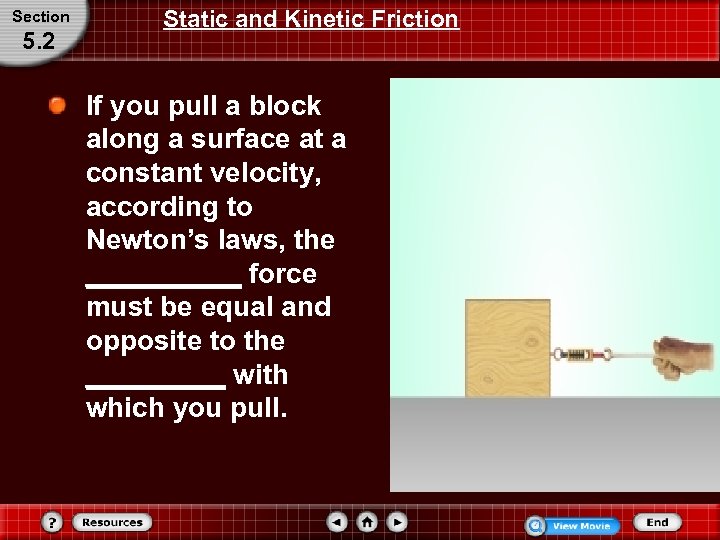 Section 5. 2 Static and Kinetic Friction If you pull a block along a surface at a constant velocity, according to Newton’s laws, the _____ force must be equal and opposite to the _____ with which you pull.
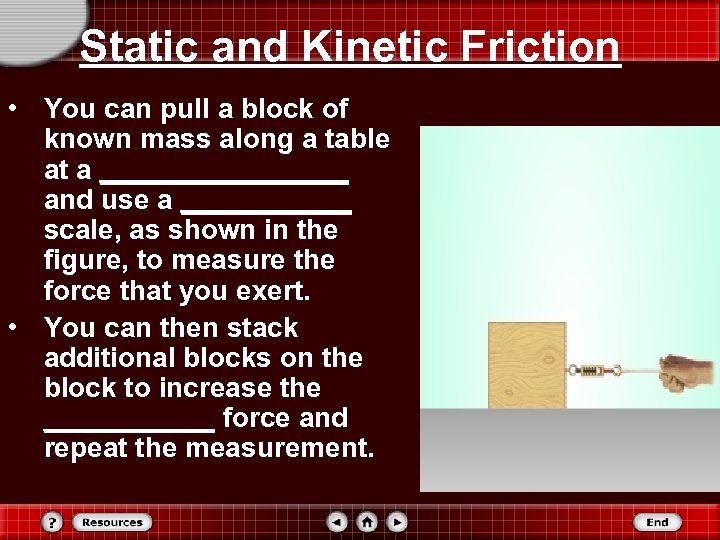 Static and Kinetic Friction • You can pull a block of known mass along a table at a ________ and use a ______ scale, as shown in the figure, to measure the force that you exert. • You can then stack additional blocks on the block to increase the ______ force and repeat the measurement.
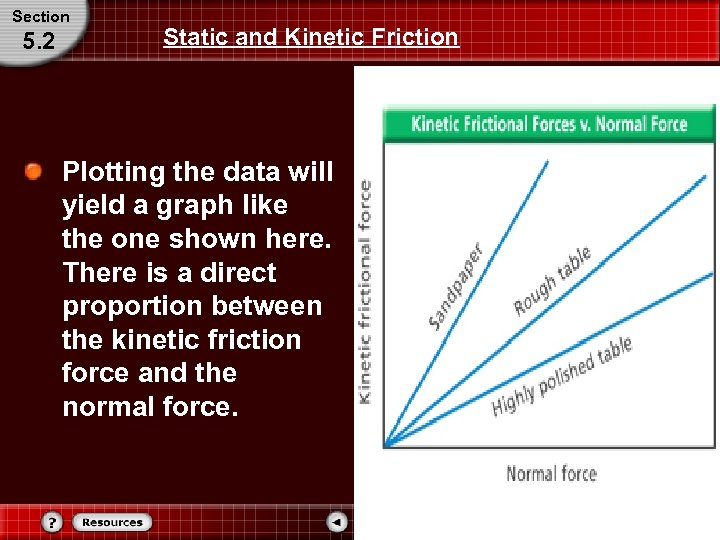 Section 5. 2 Static and Kinetic Friction Plotting the data will yield a graph like the one shown here. There is a direct proportion between the kinetic friction force and the normal force.
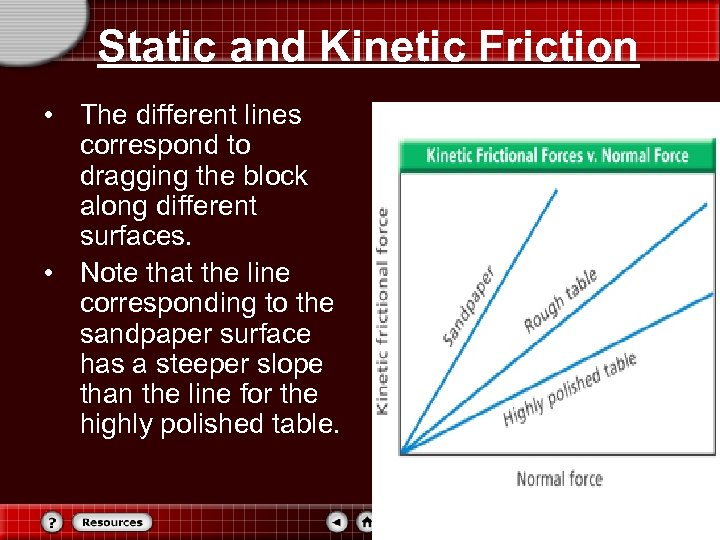 Static and Kinetic Friction • The different lines correspond to dragging the block along different surfaces. • Note that the line corresponding to the sandpaper surface has a steeper slope than the line for the highly polished table.
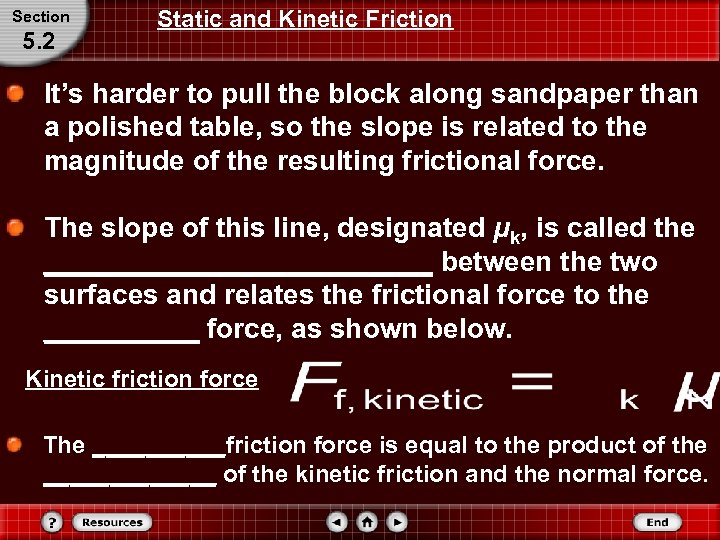 Section 5. 2 Static and Kinetic Friction It’s harder to pull the block along sandpaper than a polished table, so the slope is related to the magnitude of the resulting frictional force. The slope of this line, designated μk, is called the _____________ between the two surfaces and relates the frictional force to the _____ force, as shown below. Kinetic friction force The _____friction force is equal to the product of the _______ of the kinetic friction and the normal force.
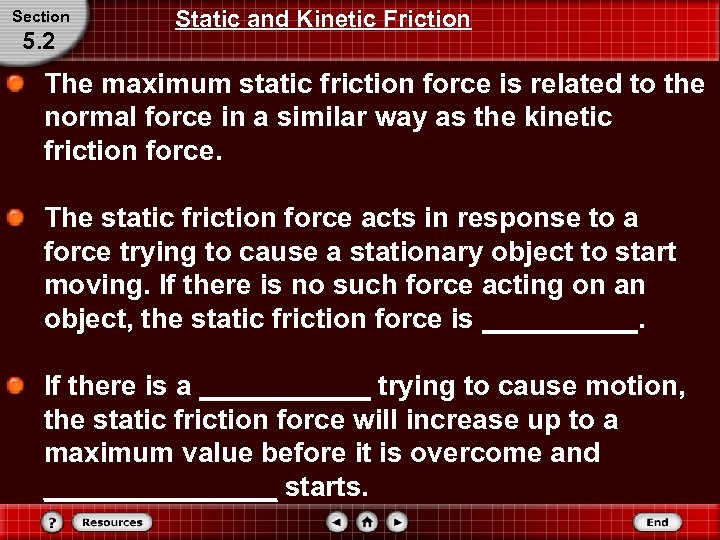 Section 5. 2 Static and Kinetic Friction The maximum static friction force is related to the normal force in a similar way as the kinetic friction force. The static friction force acts in response to a force trying to cause a stationary object to start moving. If there is no such force acting on an object, the static friction force is _____. If there is a ______ trying to cause motion, the static friction force will increase up to a maximum value before it is overcome and ________ starts.
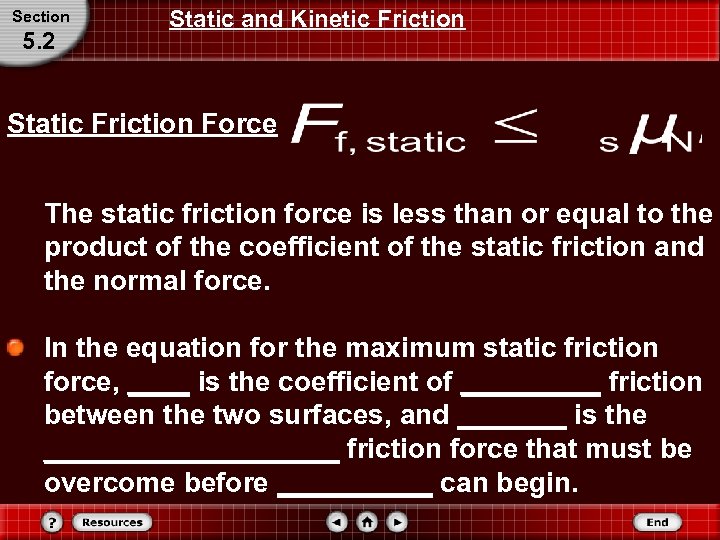 Section 5. 2 Static and Kinetic Friction Static Friction Force The static friction force is less than or equal to the product of the coefficient of the static friction and the normal force. In the equation for the maximum static friction force, ____ is the coefficient of _____ friction between the two surfaces, and _______ is the __________ friction force that must be overcome before _____ can begin.
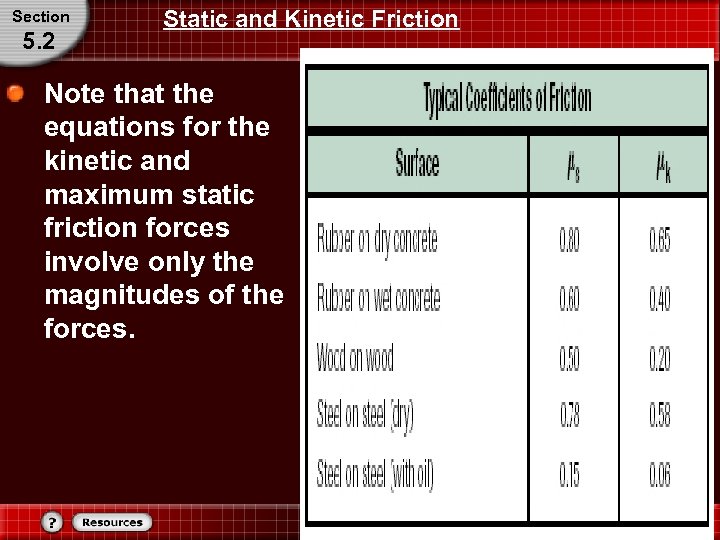 Section 5. 2 Static and Kinetic Friction Note that the equations for the kinetic and maximum static friction forces involve only the magnitudes of the forces.
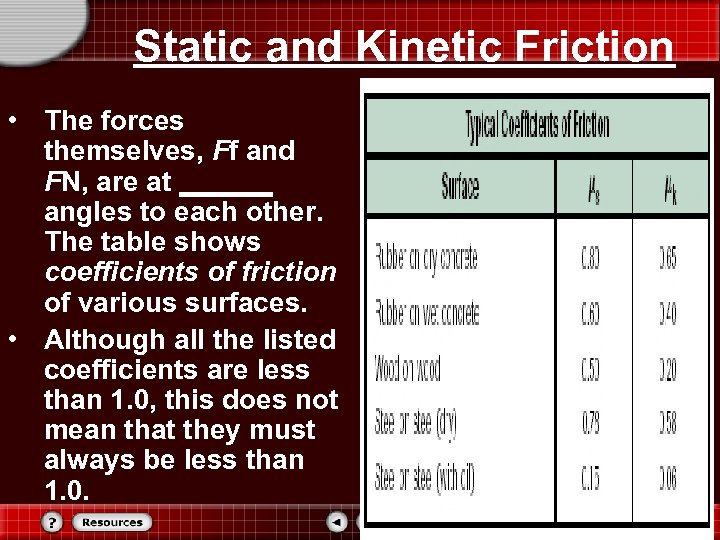 Static and Kinetic Friction • The forces themselves, Ff and FN, are at ______ angles to each other. The table shows coefficients of friction of various surfaces. • Although all the listed coefficients are less than 1. 0, this does not mean that they must always be less than 1. 0.
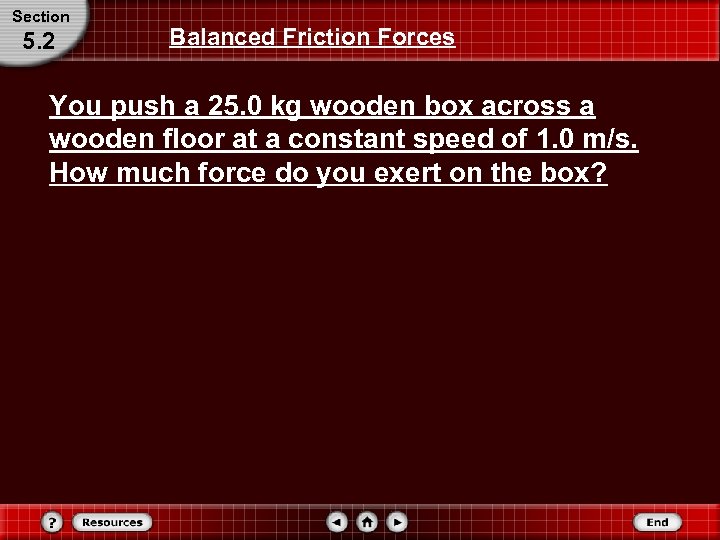 Section 5. 2 Balanced Friction Forces You push a 25. 0 kg wooden box across a wooden floor at a constant speed of 1. 0 m/s. How much force do you exert on the box?
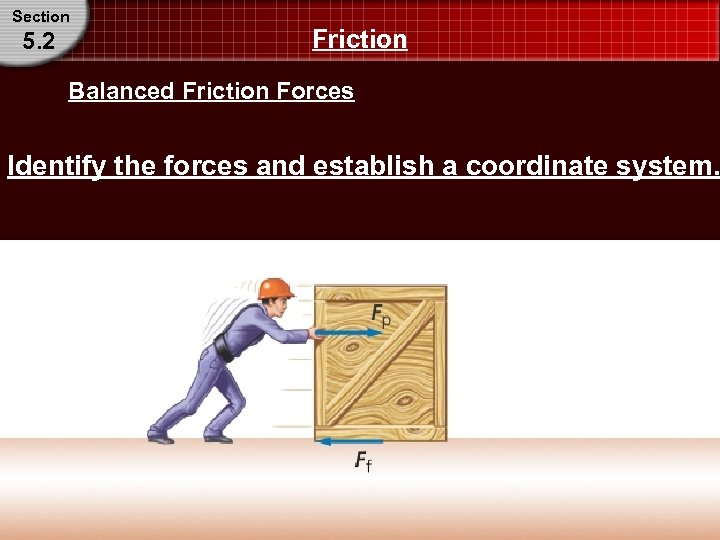 Section 5. 2 Friction Balanced Friction Forces Identify the forces and establish a coordinate system.
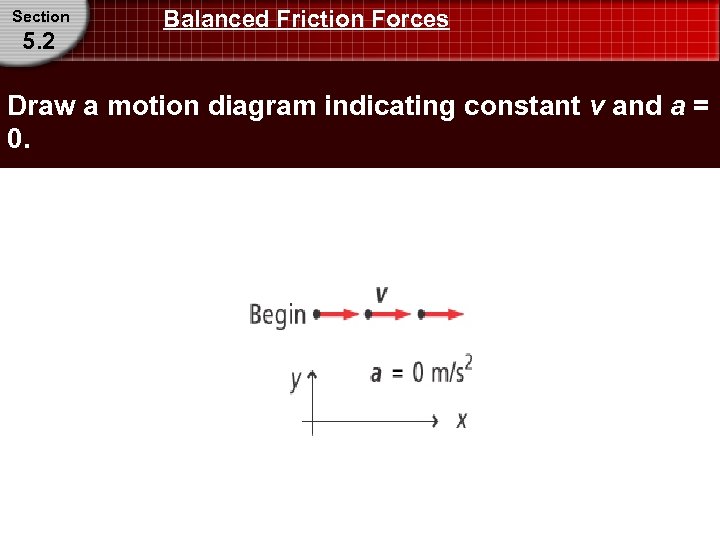 Section 5. 2 Balanced Friction Forces Draw a motion diagram indicating constant v and a = 0.
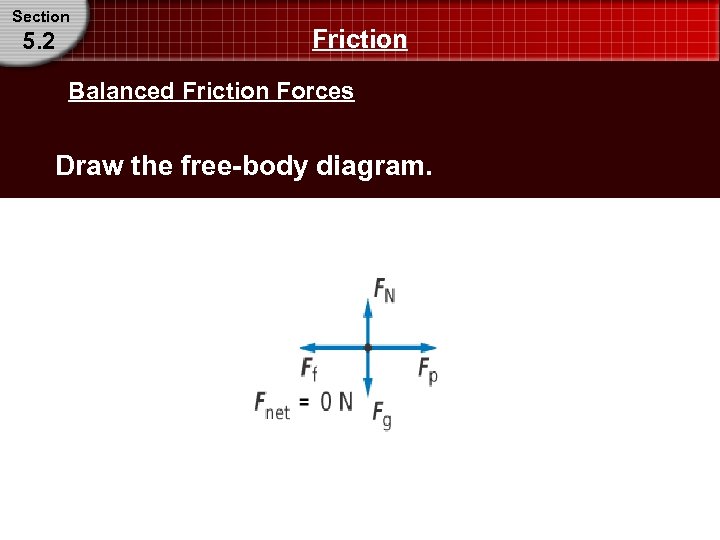 Section 5. 2 Friction Balanced Friction Forces Draw the free-body diagram.
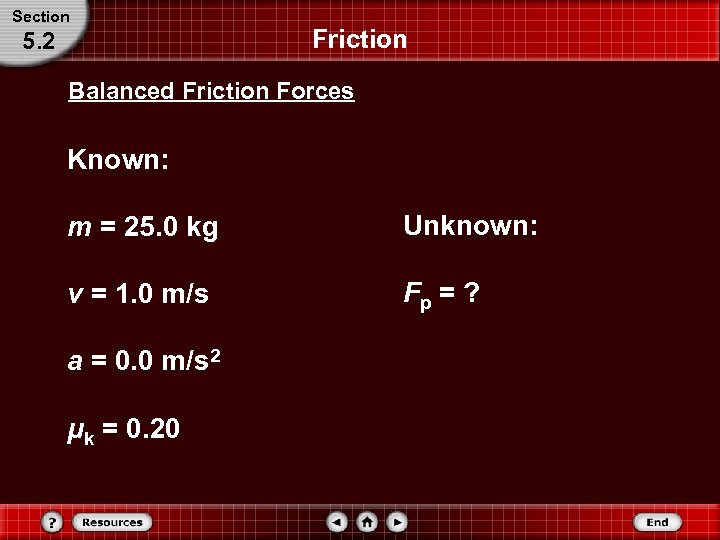 Section 5. 2 Friction Balanced Friction Forces Known: m = 25. 0 kg Unknown: v = 1. 0 m/s Fp = ? a = 0. 0 m/s 2 μk = 0. 20
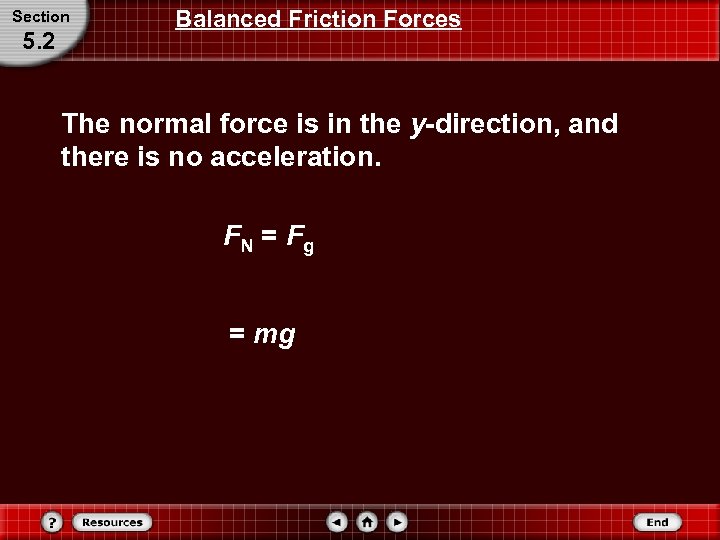 Section 5. 2 Balanced Friction Forces The normal force is in the y-direction, and there is no acceleration. FN = Fg = mg
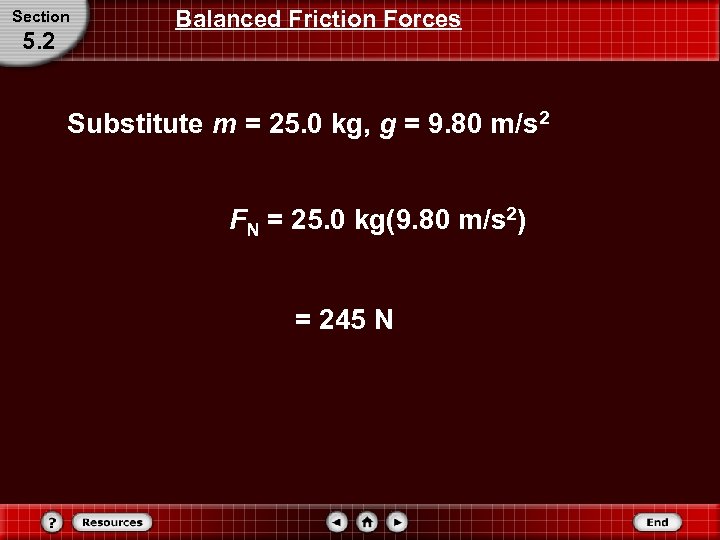 Section 5. 2 Balanced Friction Forces Substitute m = 25. 0 kg, g = 9. 80 m/s 2 FN = 25. 0 kg(9. 80 m/s 2) = 245 N
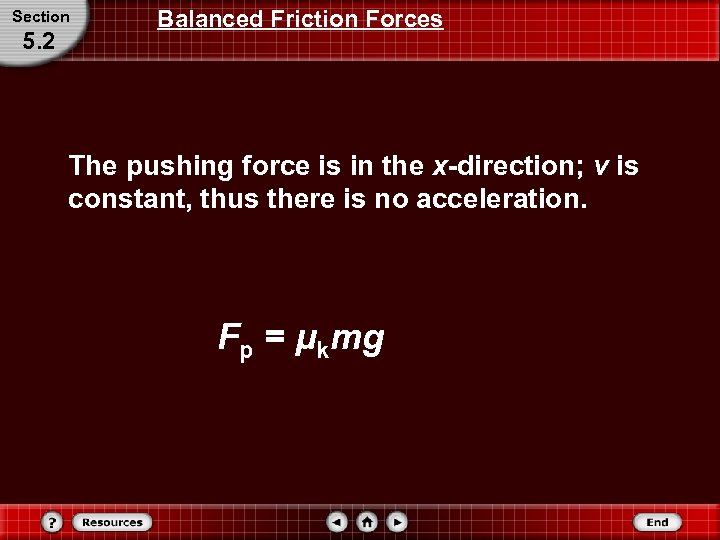 Section 5. 2 Balanced Friction Forces The pushing force is in the x-direction; v is constant, thus there is no acceleration. Fp = μkmg
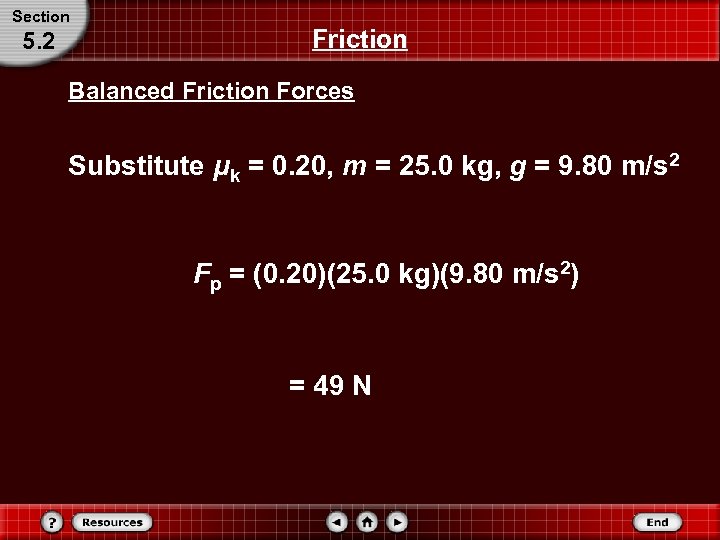 Section 5. 2 Friction Balanced Friction Forces Substitute μk = 0. 20, m = 25. 0 kg, g = 9. 80 m/s 2 Fp = (0. 20)(25. 0 kg)(9. 80 m/s 2) = 49 N
 Section 5. 2 Balanced Friction Forces The steps covered were: Step 2: Solve for the unknown – The normal force is in the y-direction, and there is no acceleration. – The pushing force is in the x-direction; v is constant, thus there is no acceleration.
 Section 5. 2 Section Check Question 1 Define friction force. A ____ that opposes motion is called friction force. There are two types of _____ force: 1) _______ —exerted on one surface by another when the surfaces rub against each other because one or both of them are moving. 2) ________ —exerted on one surface by another when there is no motion between the two surfaces.
 Section 5. 2 Section Check Question 2 Juan tried to push a huge refrigerator from one corner of his home to another, but was unable to move it at all. When Jason accompanied him, they where able to move it a few centimeter before the refrigerator came to rest. Which force was opposing the motion of the refrigerator? A. Static friction B. Kinetic friction C. Before the refrigerator moved, static friction opposed the motion. After the motion, kinetic friction opposed the motion. D. Before the refrigerator moved, kinetic friction opposed the motion. After the motion, static friction opposed the motion.
 Section 5. 2 Section Check Answer 2 Answer: ____ Reason: Before the refrigerator started moving, the ____ friction, which acts when there is no motion between the two surfaces, was opposing the motion. But static friction has a limit. Once the ____ is greater than this maximum static friction, the refrigerator begins moving. Then, _____ friction, the force acting between the surfaces in relative motion, begins to act instead of static friction.
 Section 5. 2 Section Check Question 3 On what does a friction force depends? A. The material that the surface are made of B. The surface area C. Speed of the motion D. The direction of the motion
 Section 5. 2 Section Check Answer 3 Answer: ____ Reason: The materials that the surfaces are made of play a role. For example, there is more friction between skis and concrete than there is between skis and snow.
 Section 5. 2 Section Check Question 4 A player drags three blocks in a drag race, a 50 -kg block, a 100 -kg block, and a 120 -kg block with the same velocity. Which of the following statement is true about the kinetic friction force acting in each case? A. Kinetic friction force is greater while dragging 50 -kg block. B. Kinetic friction force is greater while dragging 100 -kg block. C. Kinetic friction force is greater while dragging 120 -kg block. D. Kinetic friction force is same in all the three cases.
 Section 5. 2 Section Check Answer 4 Answer: _____ Reason: _____ friction force is directly proportional to the normal force, and as the mass increases the normal force also increases. Hence, the kinetic friction force will hit its _____while dragging the maximum weight.
 Section 5. 3 Force and Motion in Two Dimensions Equilibrium Revisited Now you will use your skill in adding vectors to analyze situations in which the forces acting on an object are at angles other than 90°. Recall that when the _______ force on an object is zero, the object is in _________. According to Newton’s laws, the object will not accelerate because there is no net force acting on it; an object in equilibrium is motionless or moves with constant velocity.
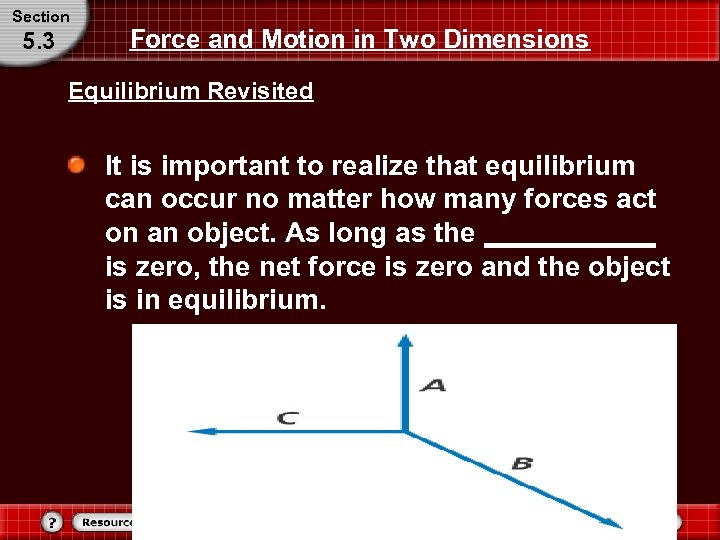 Section 5. 3 Force and Motion in Two Dimensions Equilibrium Revisited It is important to realize that equilibrium can occur no matter how many forces act on an object. As long as the ______ is zero, the net force is zero and the object is in equilibrium.
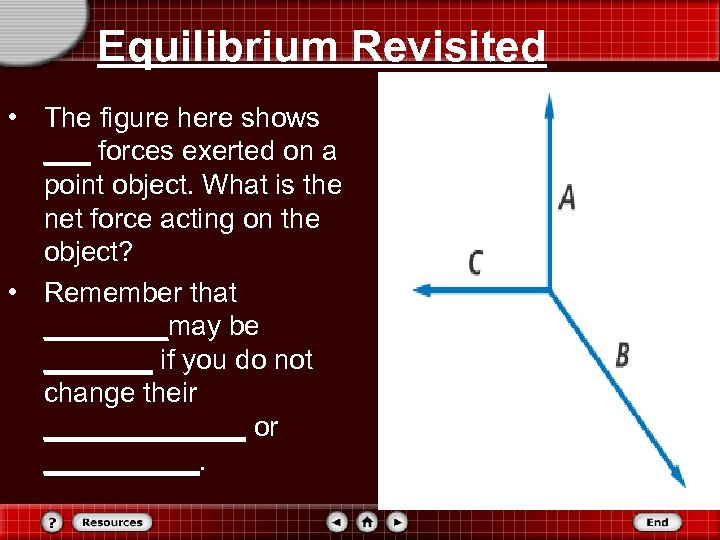 Equilibrium Revisited • The figure here shows ___ forces exerted on a point object. What is the net force acting on the object? • Remember that ____may be _______ if you do not change their _______ or _____.
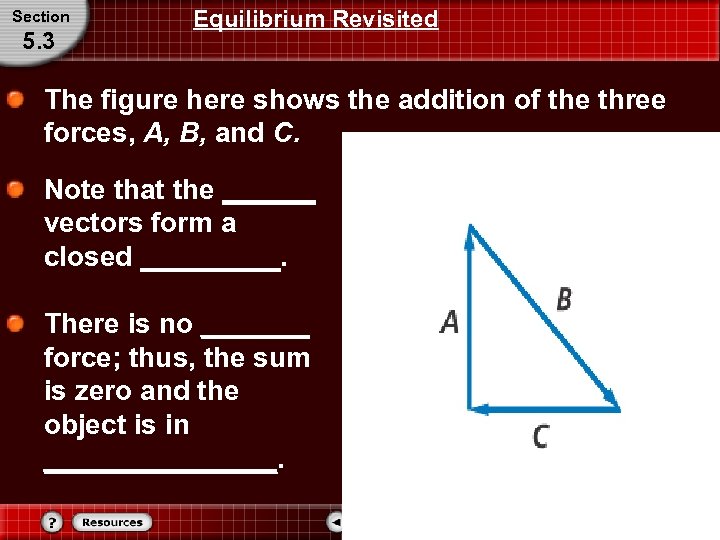 Section 5. 3 Equilibrium Revisited The figure here shows the addition of the three forces, A, B, and C. Note that the ______ vectors form a closed _____. There is no _______ force; thus, the sum is zero and the object is in ________.
 Section 5. 3 Equilibrium Revisited Suppose that two forces are exerted on an object and the sum is not zero. How could you find a third force that, when added to the other two, would add up to zero, and therefore cause the object to be in equilibrium? To find this force, first find the ____ of the two forces already being exerted on the object. This single force that produces the same effect as the two individual forces added together, is called the resultant force.
 Section 5. 3 Force and Motion in Two Dimensions Equilibrium Revisited The _____ that you need to find is one with the same magnitude as the resultant force, but in the ______direction. A force that puts an object in equilibrium is called an _________.
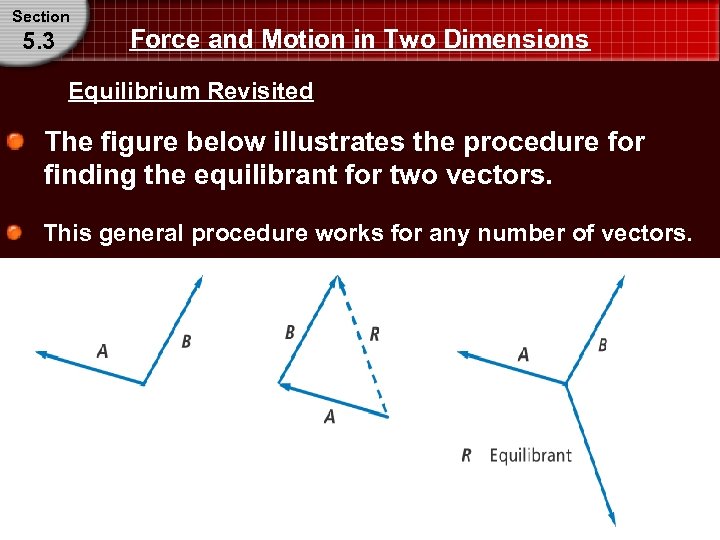 Section 5. 3 Force and Motion in Two Dimensions Equilibrium Revisited The figure below illustrates the procedure for finding the equilibrant for two vectors. This general procedure works for any number of vectors.
 Section 5. 3 Force and Motion in Two Dimensions Motion Along an Inclined Plane
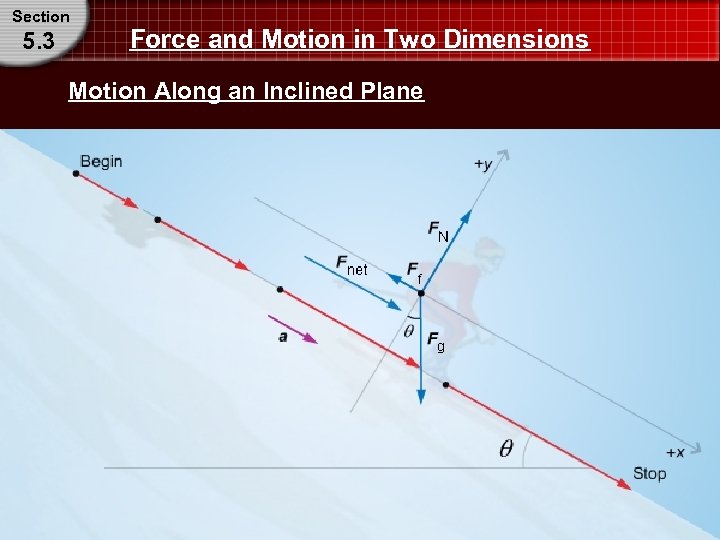
 Section 5. 3 Motion Along an Inclined Plane Because an object’s ________ is usually _____ to the slope, one axis, usually the x____, should be in that direction. The _______ is ______to the ____ and perpendicular to the surface of the slope. With this coordinate system, there are two forces —______ and _____ forces. These forces are in the direction of the ________ axes. However, the weight is not.
 Motion Along an Inclined Plane This means that when an object is placed on an _______ plane, the magnitude of the _______ force between the object and the plane will usually _____ be equal to the object’s ____.
 Section 5. 3 Motion Along an Inclined Plane You will need to apply Newton’s laws once in the ______ and once in the ________. Because the _____ does not point in either of these directions, you will need to break this vector into its x- and y-components before you can sum your forces in these _____ directions.
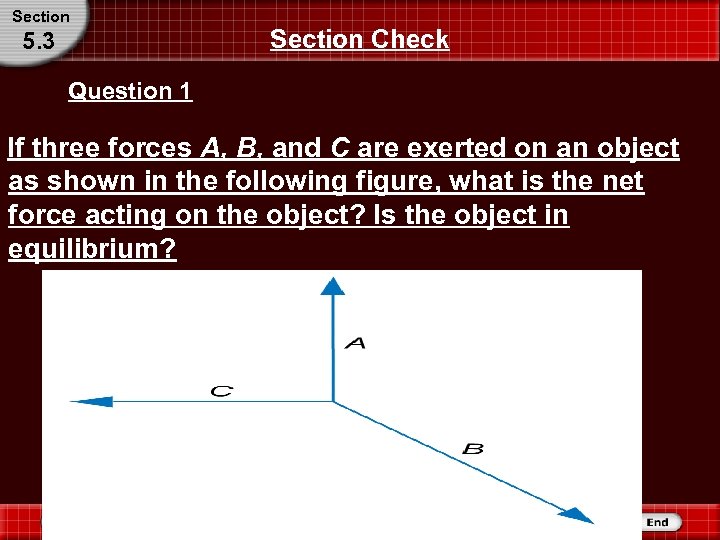 Section 5. 3 Section Check Question 1 If three forces A, B, and C are exerted on an object as shown in the following figure, what is the net force acting on the object? Is the object in equilibrium?
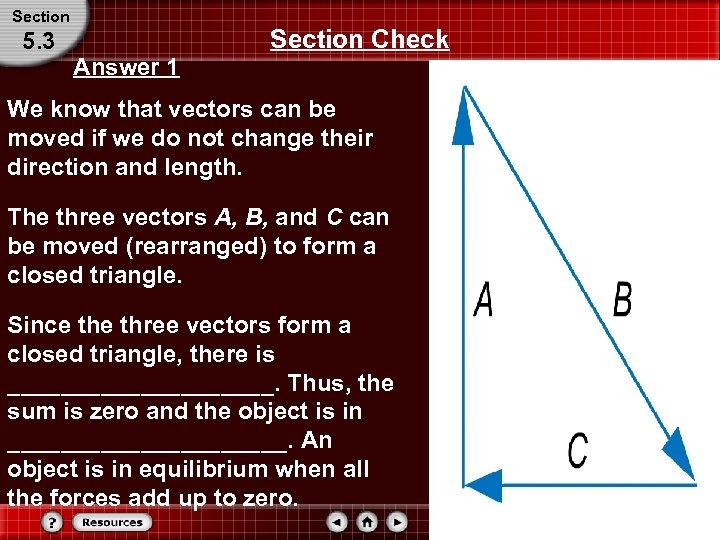 Section 5. 3 Section Check Answer 1 We know that vectors can be moved if we do not change their direction and length. The three vectors A, B, and C can be moved (rearranged) to form a closed triangle. Since three vectors form a closed triangle, there is __________. Thus, the sum is zero and the object is in ___________. An object is in equilibrium when all the forces add up to zero.
 Section 5. 3 Section Check Question 2 How do you decide the coordinate system when the motion is along a slope? Is the normal force between the object and the plane the object’s weight?
 Section 5. 3 Section Check Answer 2 An object’s acceleration is usually parallel to the _______. One axis, usually the x-axis, should be in that direction. The y-axis is perpendicular to the x-axis and perpendicular to the surface of the slope. With these coordinate systems, you have two forces—the _______force and the __________force. Both are in the direction of the coordinate axes. However, the weight is not. This means that when an object is placed on an inclined plane, the magnitude of the normal force between the object and the plane will ______________________.
 Section 5. 3 Section Check Question 3 A skier is coming down the hill. What are the forces acting parallel to the slope of the hill? A. Normal force and weight of the skier. B. Frictional force and component of weight of the skier along the slope. C. Normal force and frictional force. D. Frictional force and weight of the skier.
 Section 5. 3 Section Check Answer 3 Answer: _______ Reason: ______________________________________ _____.