 Скачать презентацию Section 4 Objectives Describe the efforts of
36461db7978bace66a36bcaf5958ab21.ppt
- Количество слайдов: 16



Section 4 Objectives • Describe the efforts of President Truman and the House of Representatives to fight communism at home. • Explain how domestic spy cases increased fears of communist influence in the U. S. government. • Analyze the rise and fall of Senator Joseph Mc. Carthy and the methods of Mc. Carthyism. The Cold War at Home War Begins
Section 4 Terms and People • Red Scare − American reaction to the fear that communists were working to destroy American life • Smith Act − law making it illegal to teach about or advocate the violent overthrow of the U. S. government • HUAC − House Un-American Activities Committee; congressional committee that investigated possible subversive activities within the United States The Cold War at Home War Begins
Section 4 Terms and People (continued) • Hollywood Ten − group of writers, directors, and producers who refused to answer HUAC questions about possible communist ties • blacklist − list of people banned from certain jobs because of suspected communist ties • Alger Hiss − U. S. government official accused of being a communist spy and convicted of perjury • Julius and Ethel Rosenberg − American couple executed for passing atomic secrets to Soviet agents The Cold War at Home War Begins
Section 4 Terms and People (continued) • Joseph R. Mc. Carthy − U. S. Senator who falsely accused Americans of having communist ties • Mc. Carthyism − negative catchword for extreme, reckless charges of disloyalty The Cold War at Home War Begins
Section 4 How did fear of domestic communism affect American society during the Cold War? As Cold War tensions mounted, the United States became gripped by a Red Scare. Many feared that communists were infiltrating the country, attempting to destroy the American way of life. The Cold War at Home War Begins
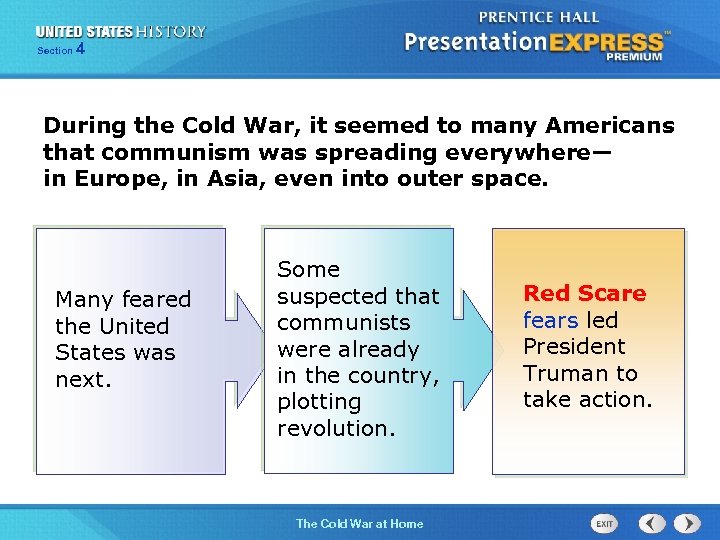
Section 4 During the Cold War, it seemed to many Americans that communism was spreading everywhere— in Europe, in Asia, even into outer space. Many feared the United States was next. Some suspected that communists were already in the country, plotting revolution. The Cold War at Home War Begins Red Scare fears led President Truman to take action.
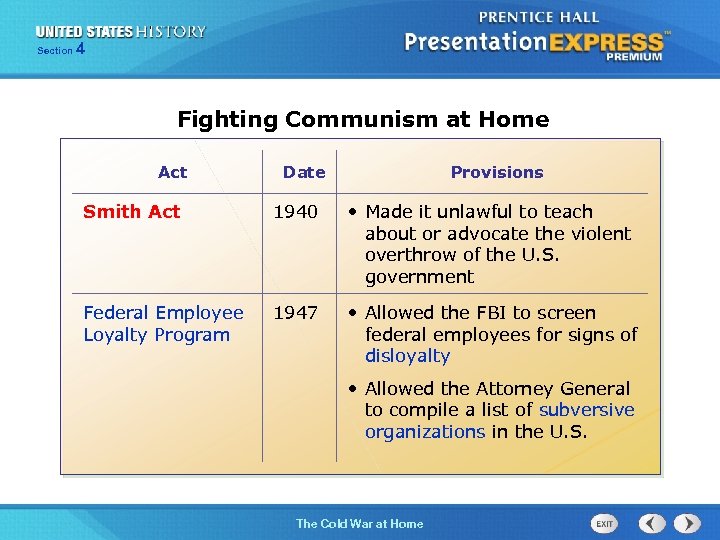
Section 4 Fighting Communism at Home Act Date Provisions Smith Act 1940 • Made it unlawful to teach about or advocate the violent overthrow of the U. S. government Federal Employee Loyalty Program 1947 • Allowed the FBI to screen federal employees for signs of disloyalty • Allowed the Attorney General to compile a list of subversive organizations in the U. S. The Cold War at Home War Begins
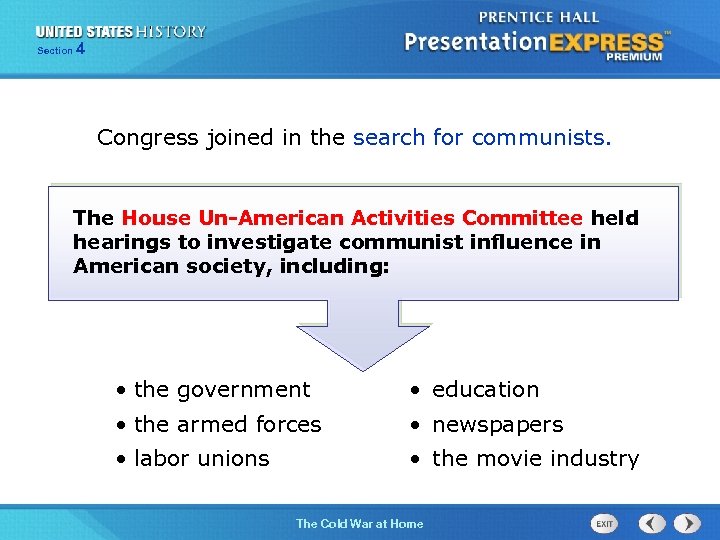
Section 4 Congress joined in the search for communists. The House Un-American Activities Committee held hearings to investigate communist influence in American society, including: • the government • education • the armed forces • newspapers • labor unions • the movie industry The Cold War at Home War Begins
Section 4 HUAC hearings were highly charged and widely publicized. The Hollywood Ten refused to testify and eventually were jailed. Blacklists were created. People from all walks of life were accused of being disloyal. The Cold War at Home War Begins Careers were shattered.
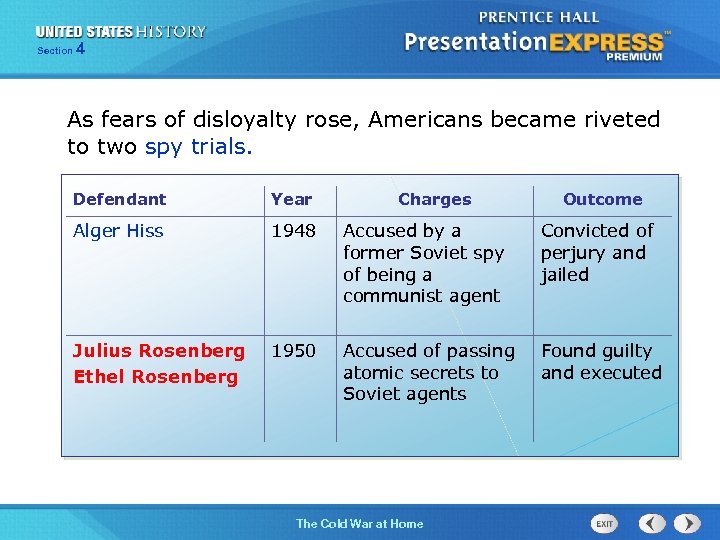
Section 4 As fears of disloyalty rose, Americans became riveted to two spy trials. Defendant Year Charges Alger Hiss 1948 Accused by a former Soviet spy of being a communist agent Convicted of perjury and jailed Julius Rosenberg Ethel Rosenberg 1950 Accused of passing atomic secrets to Soviet agents Found guilty and executed The Cold War at Home War Begins Outcome
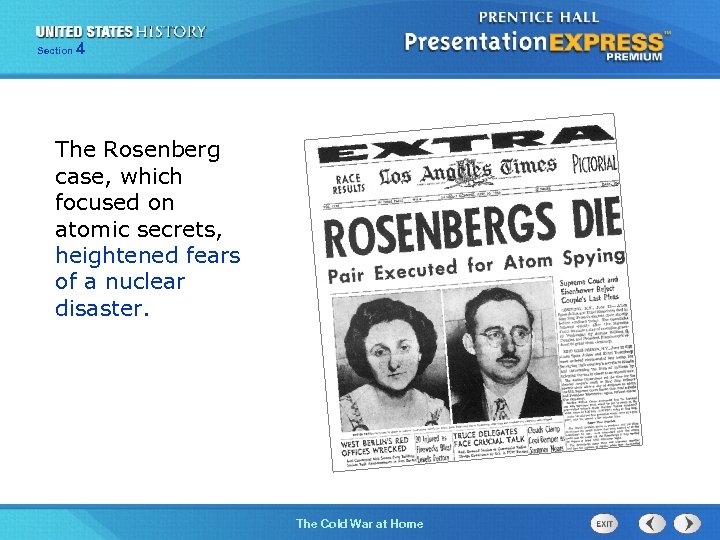
Section 4 The Rosenberg case, which focused on atomic secrets, heightened fears of a nuclear disaster. The Cold War at Home War Begins
Section 4 As Americans worried about the nation’s security, a little-known leader burst onto the national scene. Senator Joseph Mc. Carthy charged that communist agents had infiltrated the highest levels of government. He claimed to have lists of Americans who were secretly communists and had betrayed their country. The Cold War at Home War Begins
Section 4 Mc. Carthy could not prove his charges, but they grabbed the public’s attention. He consolidated power by making baseless allegations and opening endless investigations. Few protested, for fear they would be accused. Those branded as communist sympathizers lost their jobs, their reputations ruined. The Cold War at Home War Begins
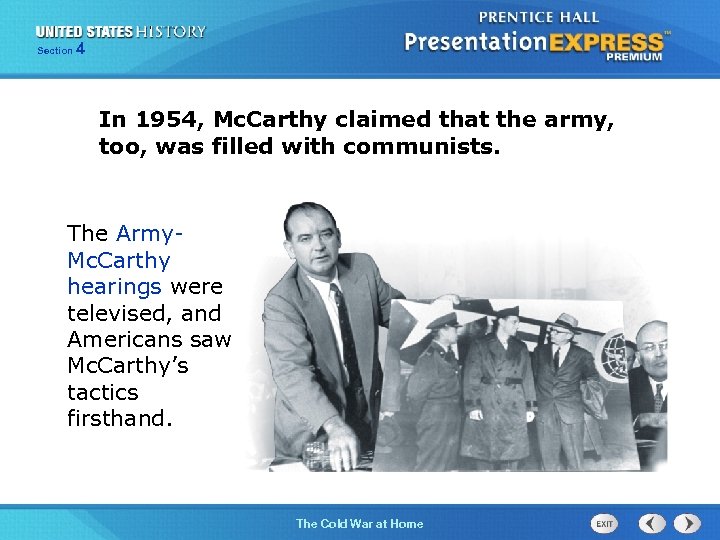
Section 4 In 1954, Mc. Carthy claimed that the army, too, was filled with communists. The Army. Mc. Carthy hearings were televised, and Americans saw Mc. Carthy’s tactics firsthand. The Cold War at Home War Begins
Section 4 The public was horrified to see Mc. Carthy bullying witnesses, making reckless accusations, and twisting the truth. Today, such irresponsible actions are known as Mc. Carthyism. By the time the hearings ended, Mc. Carthy had lost much of his support. He was formally censured by the Senate. The Cold War at Home War Begins
Section 4 Mc. Carthy’s downfall marked the decline of the Red Scare. In an attempt to protect the nation from communism, free speech had been threatened. In the end, both the nation and free speech survived. Today, the U. S. still struggles with balancing the nation’s security with the civil liberties of its citizens. The Cold War at Home War Begins
Скачать презентацию Section 4 Objectives Describe the efforts of
36461db7978bace66a36bcaf5958ab21.ppt