


 Скачать презентацию SECTION 4 ELECTRIC MOTORS UNIT 17 TYPES OF
066e5d5b96f978ecd9bbf904f2f75001.ppt
- Количество слайдов: 58
 SECTION 4 ELECTRIC MOTORS UNIT 17: TYPES OF ELECTRIC MOTORS
 UNIT OBJECTIVES After studying this unit, the reader should be able to • Describe the different types of open single-phase motors used to drive fans, compressors, and pumps. • Describe the applications of the various types of motors. • State which motors have high starting torque. • List the components that cause a motor to have a higher starting torque. • Describe a multispeed permanent split-capacitor motor and indicate how the different speeds are obtained.
 UNIT OBJECTIVES After studying this unit, the reader should be able to • Explain the operation of a three-phase motor. • Describe a motor used for a hermetic compressor. • Explain the motor terminal connections in various compressors. • Describe the different types of compressors that use hermetic motors. • Describe the use of variable-speed motors.
 USES OF ELECTRIC MOTORS • Used to turn fans, pumps and compressors • Facilitate the circulation of air, water, refrigerant and other fluids • Motors are designed for particular applications • The correct motor must always be used • Most motors operate on similar principles
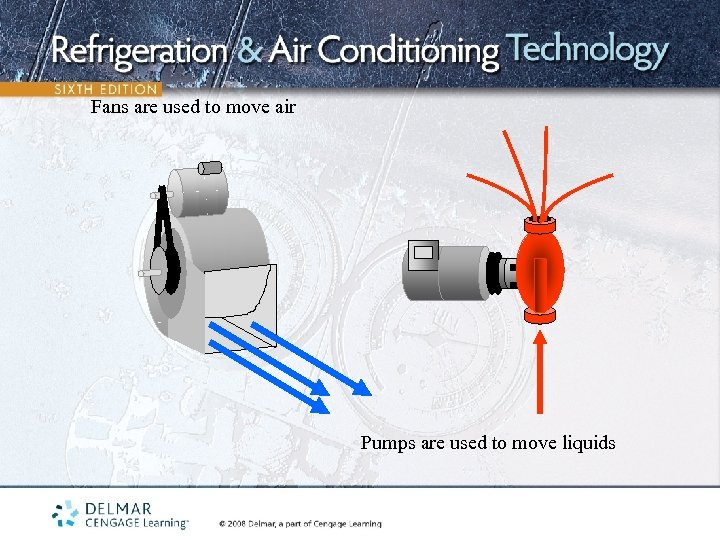 Fans are used to move air Pumps are used to move liquids
 PARTS OF AN ELECTRIC MOTOR • Stator with motor windings – Stationary portion of the motor • Rotor – Rotating portion of the motor • Bearings – Allow free rotation of the motor shaft • End bells – Supports the bearings and/or shaft • Housing – Holds all motor components together and facilitates motor mounting
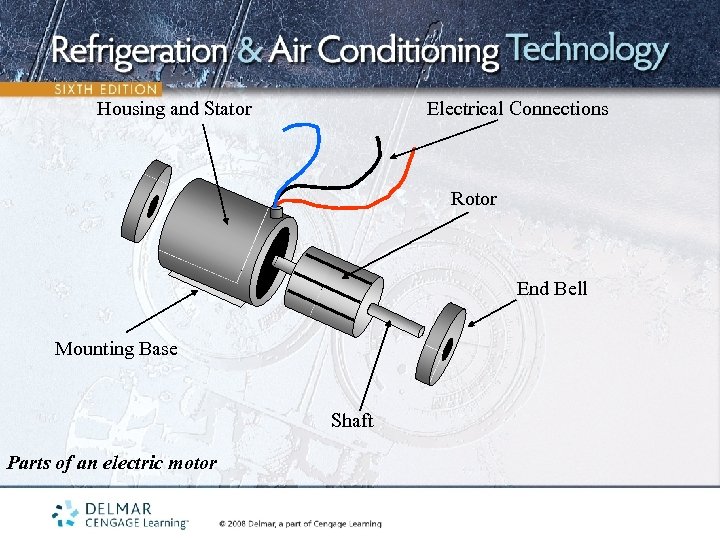 Housing and Stator Electrical Connections Rotor End Bell Mounting Base Shaft Parts of an electric motor
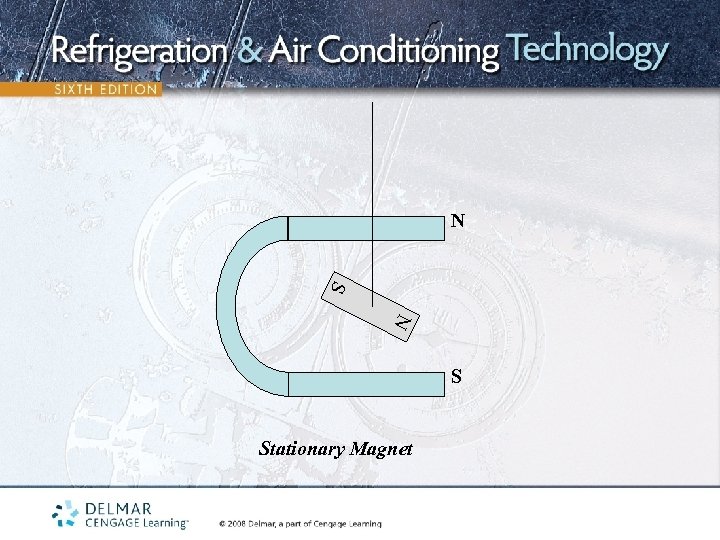
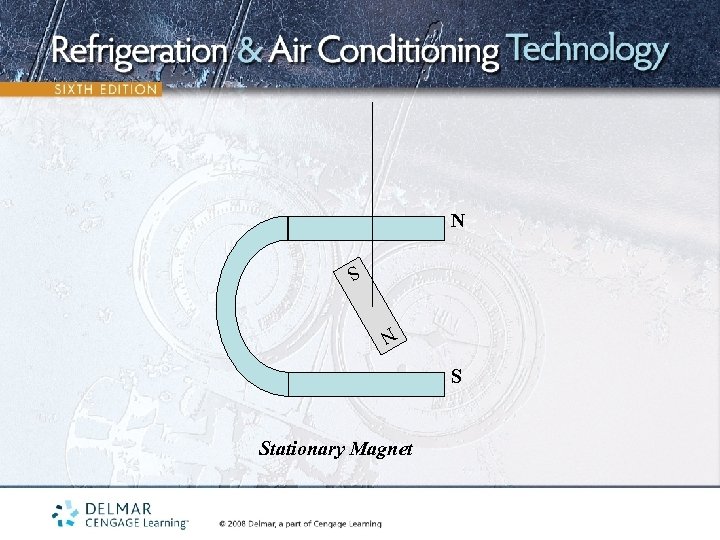
 ELECTRIC MOTORS AND MAGNETISM • Electricity and magnetism are used to create rotation • Stator has insulated windings called run windings • Rotor may be constructed of bars – Squirrel cage rotor – Positioned between the run windings • Rotor turns within the magnetic field
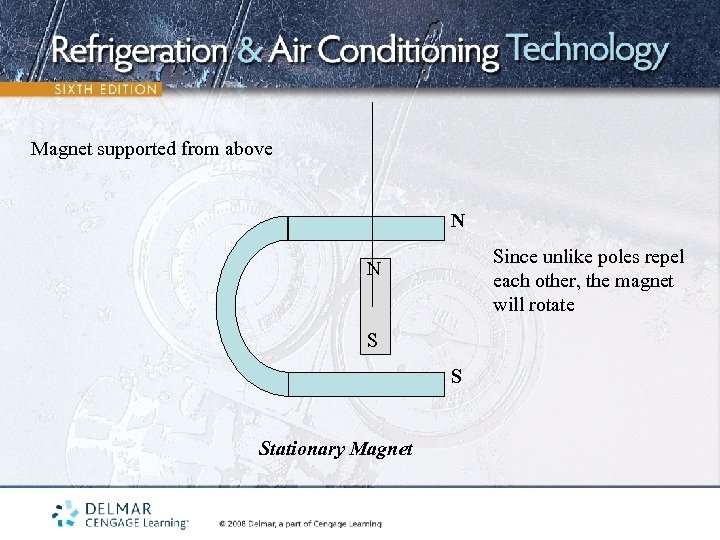 Magnet supported from above N Since unlike poles repel each other, the magnet will rotate N S S Stationary Magnet
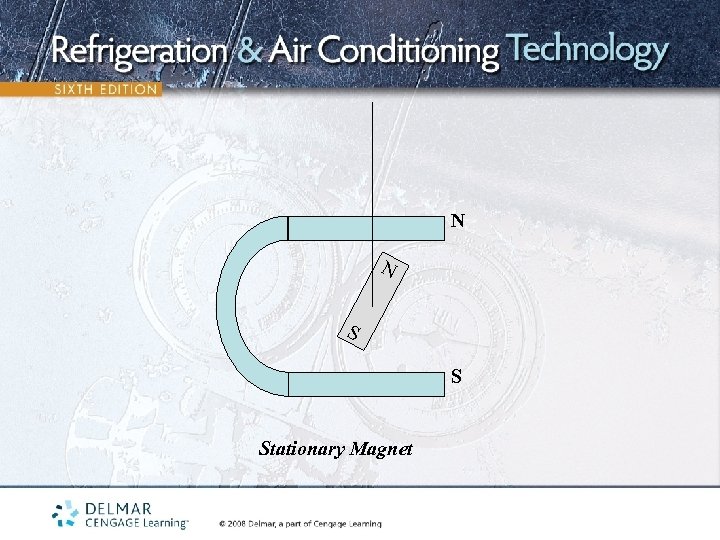 N N S S Stationary Magnet
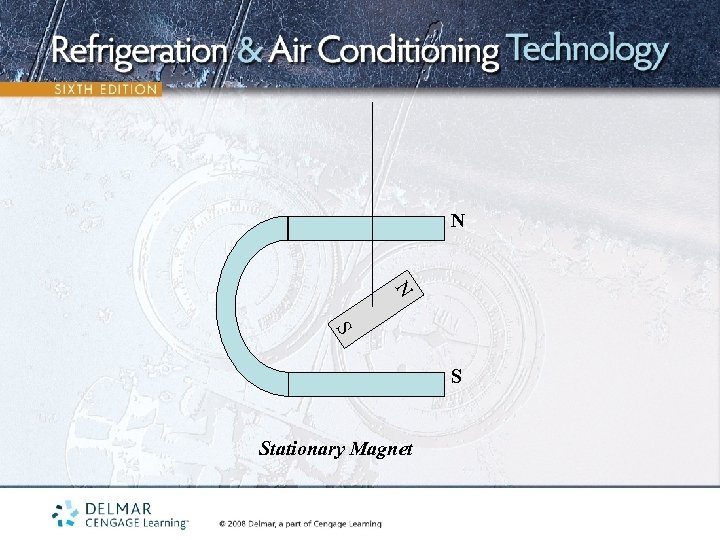 N N S S Stationary Magnet
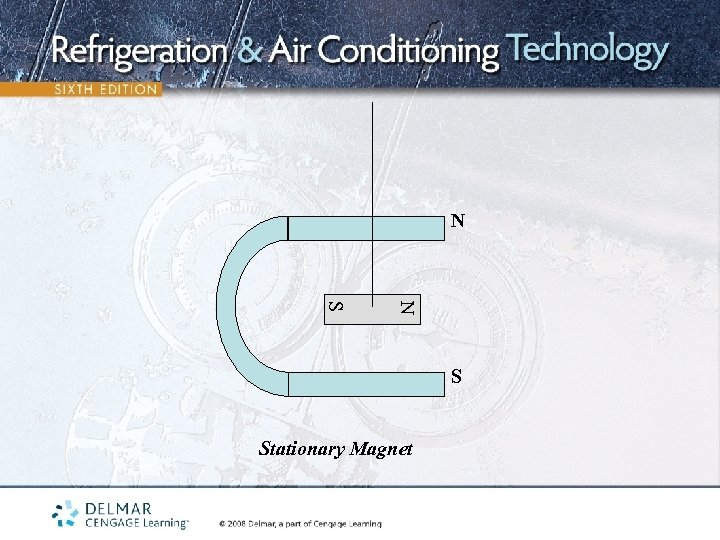 N N S S Stationary Magnet
 N S Stationary Magnet
 N S Stationary Magnet
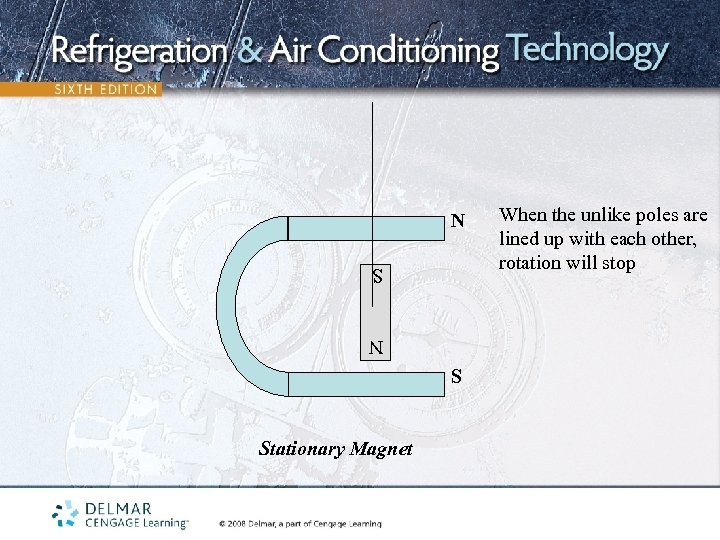 N S Stationary Magnet When the unlike poles are lined up with each other, rotation will stop
 DETERMINING MOTOR SPEED • • As the number of poles increases, the motor speed decreases Motor Speed (rpm) = Frequency x 120 ÷ # of poles In the United States the frequency is 60 Hz For example, a 2 pole motor will turn at a speed of 60 x 120 ÷ 2 = 7200 ÷ 2 = 3600 rpm • The motor will turn at a speed that is lower than the calculated value • Slip = difference between calculated and actual motor speed
 THE START WINDING • Enables the motor to start and in the right direction • Start winding has higher resistance than the run winding • Wound with more turns than the run winding • Wound with smaller diameter wire than the run winding • Removed from the active circuit once the motor starts
 • • STARTING AND RUNNING CHARACTERISTICS Refrigeration compressors have high starting torque Starting torque – twisting force that starts the motor Locked Rotor Amperage (LRA) Full Load Amperage (FLA) Rated Load Amperage (RLA) Motor may start with unequal pressures across it Small fans do not require much starting torque
 ELECTRICAL POWER SUPPLIES • • Residences are furnished with single-phase power Houses can be supplied power from the transformer Power feeds into circuit breaker panel or fuse box Circuit breakers protect each individual circuit Power is distributed throughout the house Typical residential panels provide 115 and 230 volts Commercial and industrial facilities require three-phase power
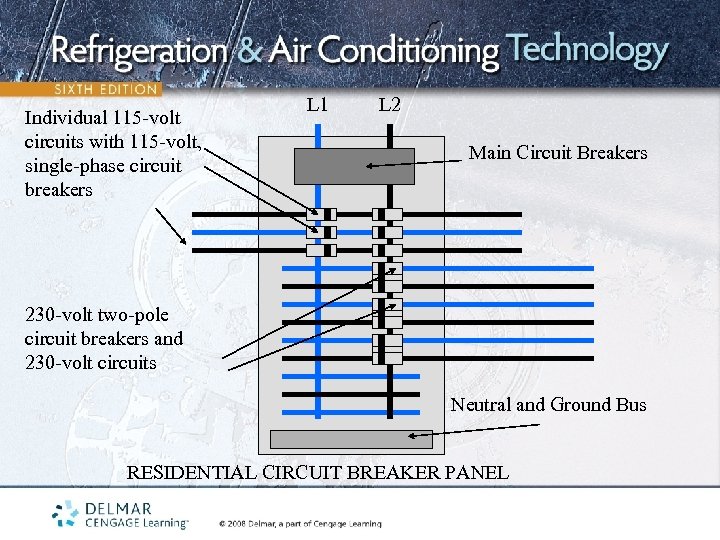 Individual 115 -volt circuits with 115 -volt, single-phase circuit breakers L 1 L 2 Main Circuit Breakers 230 -volt two-pole circuit breakers and 230 -volt circuits Neutral and Ground Bus RESIDENTIAL CIRCUIT BREAKER PANEL
 SINGLE-PHASE OPEN MOTORS • Residential motors operate at 115, 208 or 230 V • Commercial motors operate at voltages up to 460 V • Some motors are designed to operate at one of two different voltage (dual voltage motors) • Dual voltage motors are wired differently for each voltage • Some motors have reversible rotations
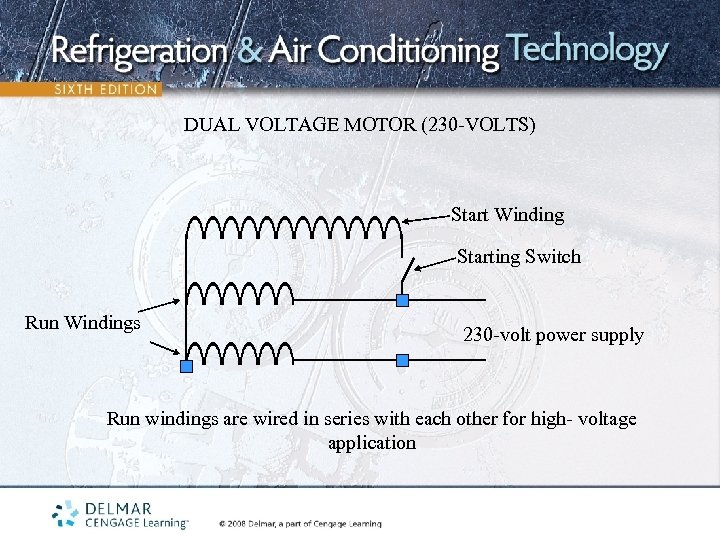 DUAL VOLTAGE MOTOR (230 -VOLTS) Start Winding Starting Switch Run Windings 230 -volt power supply Run windings are wired in series with each other for high- voltage application
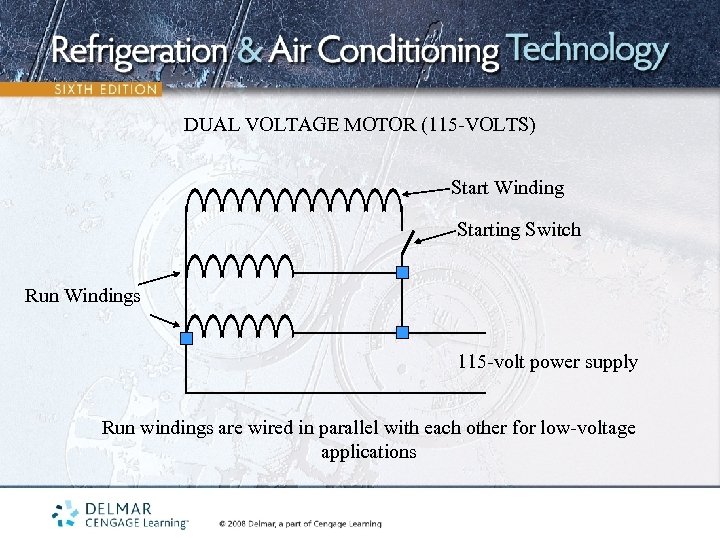 DUAL VOLTAGE MOTOR (115 -VOLTS) Start Winding Starting Switch Run Windings 115 -volt power supply Run windings are wired in parallel with each other for low-voltage applications
 SPLIT-PHASE MOTORS • • • Two separate motor windings Good running efficiency Medium amount of starting torque Speed typically ranges from 1800 – 3600 rpm Motor speed is determined by the number of poles • Slip is the difference between the calculated and actual motor speeds
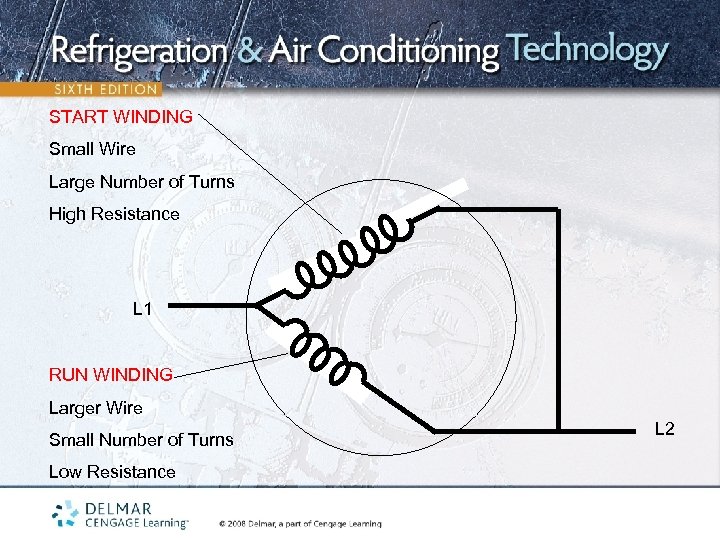 START WINDING Small Wire Large Number of Turns High Resistance L 1 RUN WINDING Larger Wire Small Number of Turns Low Resistance L 2
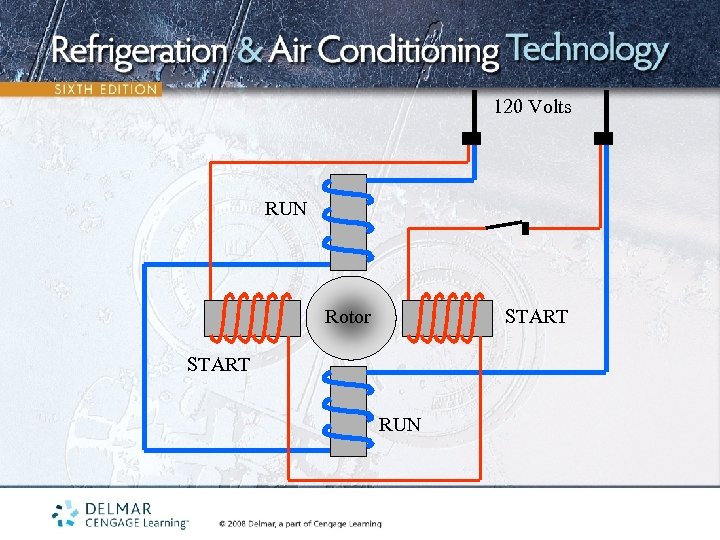 120 Volts RUN Rotor START RUN
 THE CENTRIFUGAL SWITCH • Commonly used on open motors to deenergize the start winding • Opens its contacts when the motor reaches about 75% of its rated speed • When the contacts open and close, a spark is created (arcing) • Not used in a refrigerant atmosphere
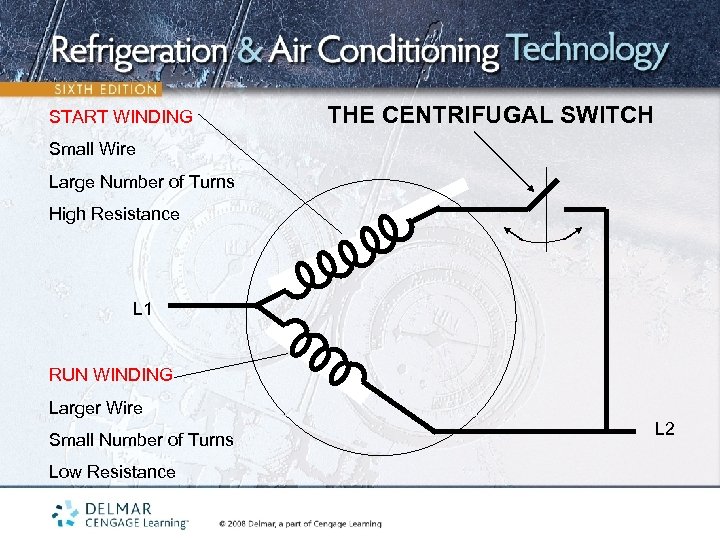 START WINDING THE CENTRIFUGAL SWITCH Small Wire Large Number of Turns High Resistance L 1 RUN WINDING Larger Wire Small Number of Turns Low Resistance L 2
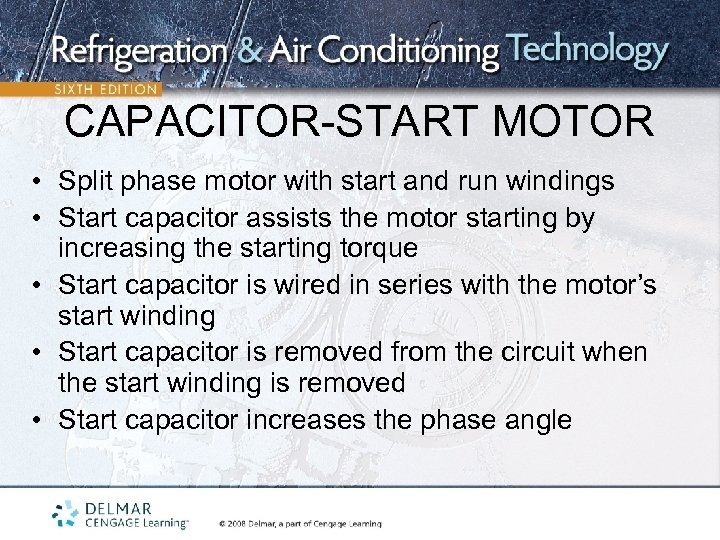 CAPACITOR-START MOTOR • Split phase motor with start and run windings • Start capacitor assists the motor starting by increasing the starting torque • Start capacitor is wired in series with the motor’s start winding • Start capacitor is removed from the circuit when the start winding is removed • Start capacitor increases the phase angle
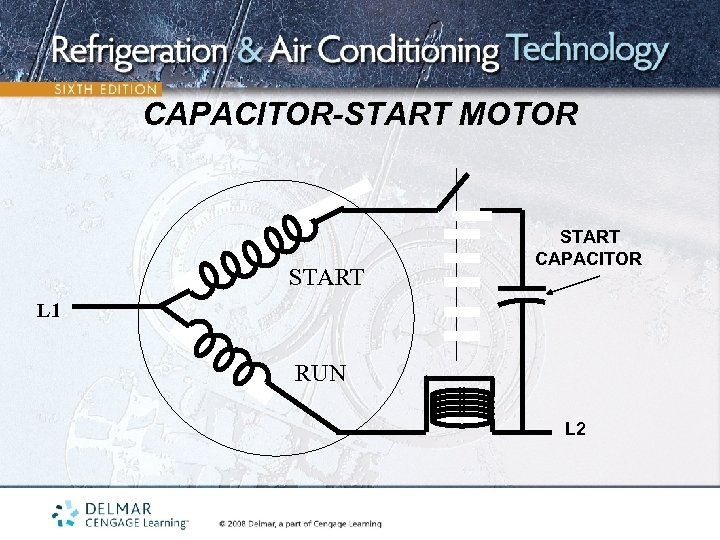 CAPACITOR-START MOTOR START CAPACITOR L 1 RUN L 2
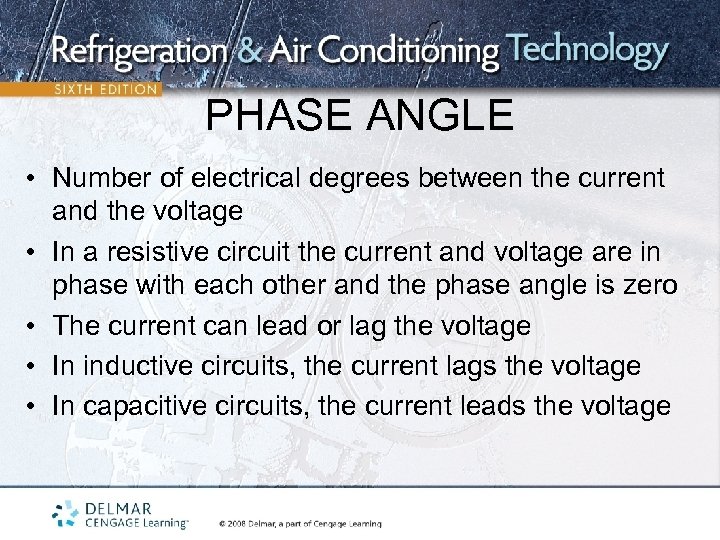 PHASE ANGLE • Number of electrical degrees between the current and the voltage • In a resistive circuit the current and voltage are in phase with each other and the phase angle is zero • The current can lead or lag the voltage • In inductive circuits, the current lags the voltage • In capacitive circuits, the current leads the voltage
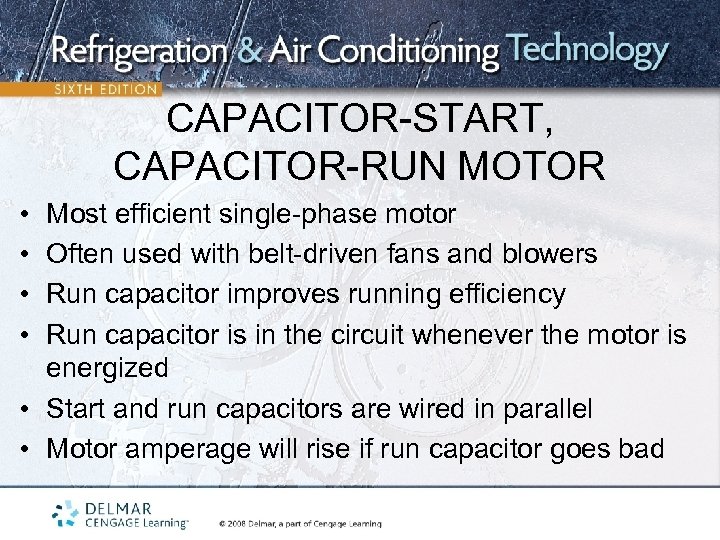 CAPACITOR-START, CAPACITOR-RUN MOTOR • • Most efficient single-phase motor Often used with belt-driven fans and blowers Run capacitor improves running efficiency Run capacitor is in the circuit whenever the motor is energized • Start and run capacitors are wired in parallel • Motor amperage will rise if run capacitor goes bad
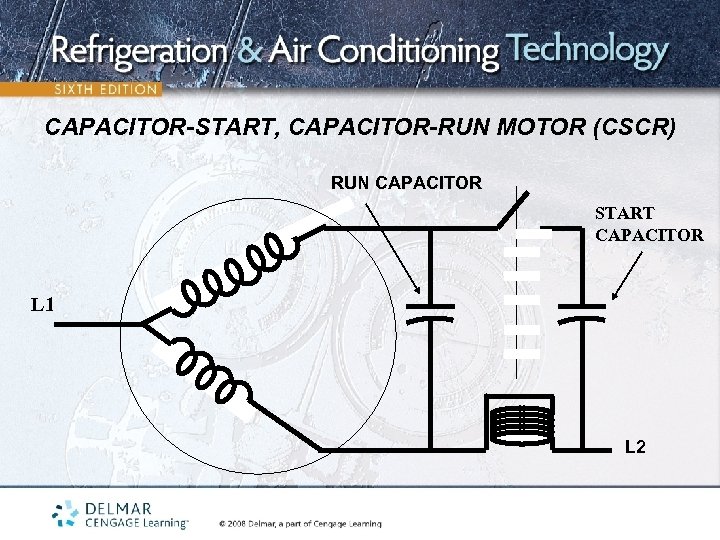 CAPACITOR-START, CAPACITOR-RUN MOTOR (CSCR) RUN CAPACITOR START CAPACITOR L 1 L 2
 PERMANENT SPLIT CAPACITOR (PSC) MOTOR • • Simplest split-phase motor Only a run capacitor is used Low starting torque and good running efficiency Can be single or multispeed motors Multispeed motors have leads for each speed As the resistance decreases, motor speed increases As the resistance increases, motor speed decreases
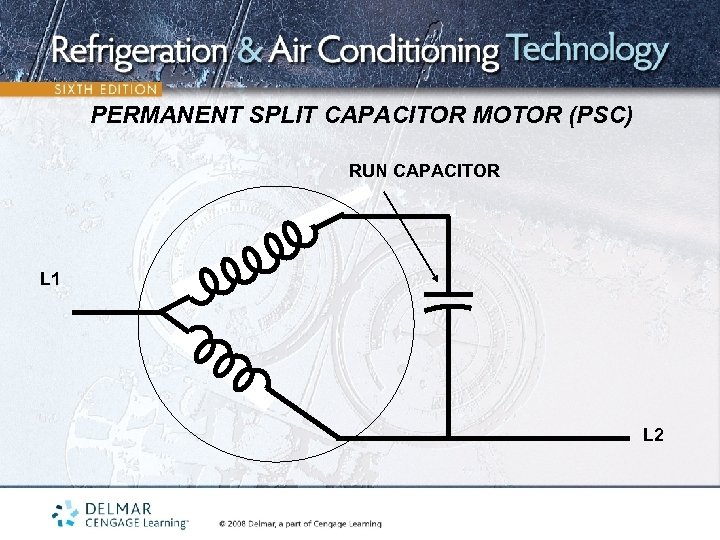 PERMANENT SPLIT CAPACITOR MOTOR (PSC) RUN CAPACITOR L 1 L 2
 SHADED-POLE MOTOR • Very low starting torque • Not as efficient as the PSC motor • A portion of the run winding is shaded to provide the imbalance in magnetic field that allows the motor to start • Heavy copper wire or bands are used to shade the run winding • Manufactured in the fractional horsepower range
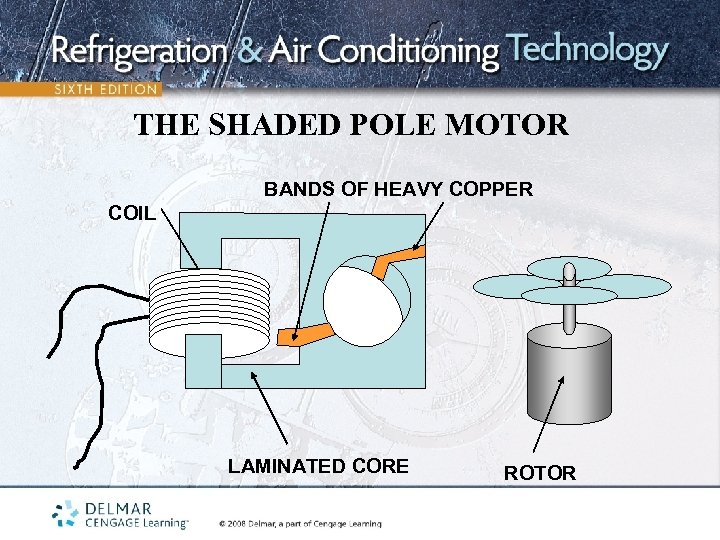 THE SHADED POLE MOTOR BANDS OF HEAVY COPPER COIL LAMINATED CORE ROTOR
 THREE-PHASE MOTOR • • • Normally used on commercial applications Must have a three-phase power supply Powered by three single-phase power supply legs Has no start winding or capacitors Very high starting torque Rotation of motor can be changes by switching any two power legs
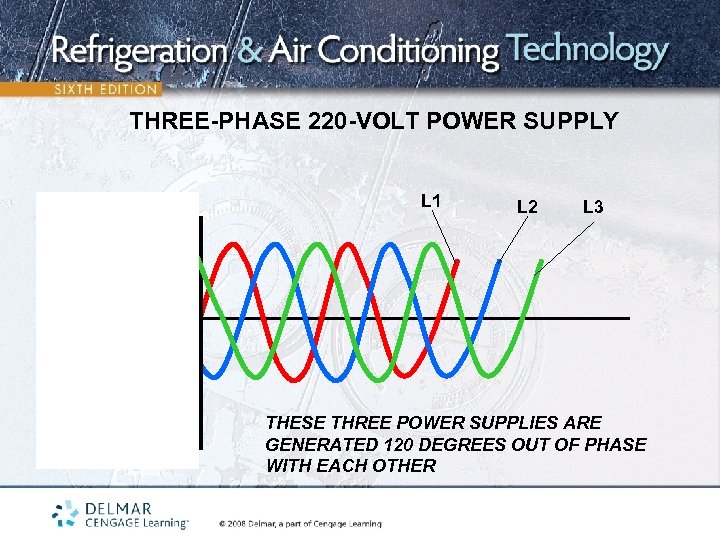 THREE-PHASE 220 -VOLT POWER SUPPLY L 1 L 2 L 3 THESE THREE POWER SUPPLIES ARE GENERATED 120 DEGREES OUT OF PHASE WITH EACH OTHER
 SINGLE-PHASE HERMETIC MOTORS • • Hermetically sealed from outside air Similar to single-phase motors Use relays to remove start winding from circuit They do not use centrifugal switches Often use run capacitors for increased efficiency Designed to operate in a refrigerant atmosphere Motor terminals identified as common, start & run
 THE POTENTIAL RELAY • • Used on motors requiring high starting torque Coil with very high resistance Normally closed contacts Relay operates on the induced voltage across the start winding • The contacts open when the induced voltage rises • When the motor turns off, the induced voltage drops and the relay contacts close
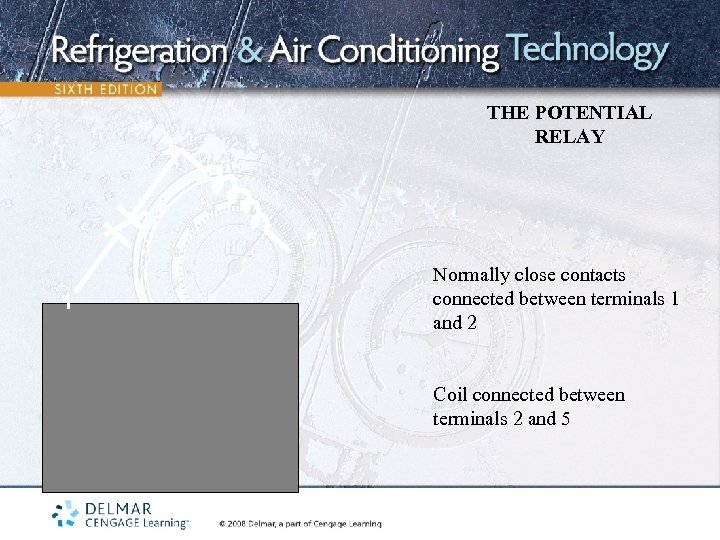 THE POTENTIAL RELAY 2 5 1 Normally close contacts connected between terminals 1 and 2 Coil connected between terminals 2 and 5
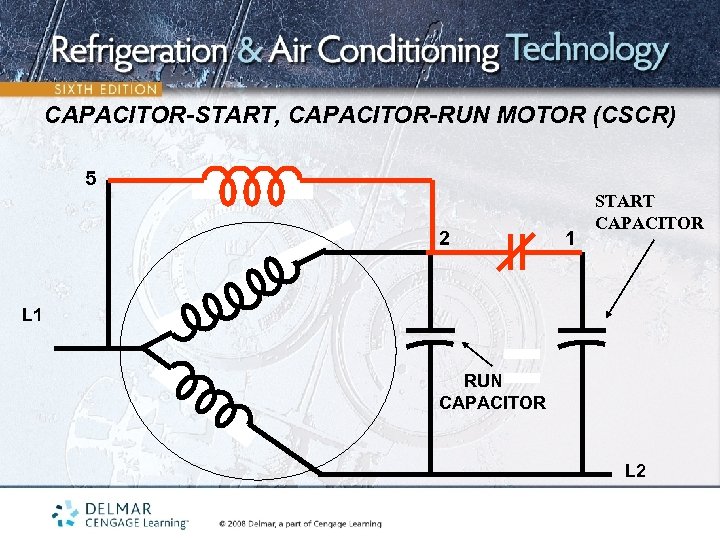 CAPACITOR-START, CAPACITOR-RUN MOTOR (CSCR) 5 2 1 START CAPACITOR L 1 RUN CAPACITOR L 2
 THE CURRENT RELAY • • • Used on fractional horsepower motors Used with fixed-orifice metering devices Low resistance coil in series with the run winding Normally open contacts in series with start winding Upon startup only the run winding is energized The motor draws locked rotor amperage The increased amperage closes the relay contacts The start winding is energized and the motor starts The amperage drops and the relay contacts open
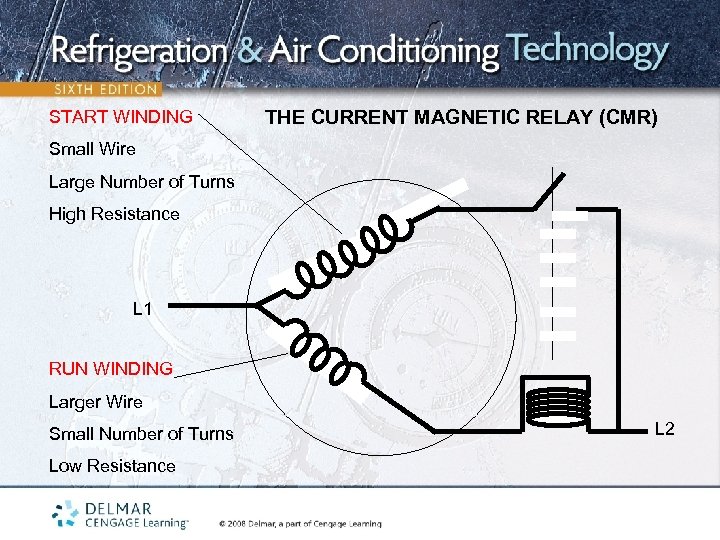 START WINDING THE CURRENT MAGNETIC RELAY (CMR) Small Wire Large Number of Turns High Resistance L 1 RUN WINDING Larger Wire Small Number of Turns Low Resistance L 2
 POSITIVE TEMPERATURE COEFFICIENT (PTC) START DEVICE • Thermistors change resistance with changes in temperature • During startup, the resistance of the PTC is about 4 to 10 ohms • As the motor operates, current flow generates heat that causes the resistance to increase • Resistance can increase to 10, 000 to 12, 000 ohms
 TWO-SPEED COMPRESSOR MOTORS • • • Used to control the capacity of compressors Speed changes are obtained by wiring changes The thermostat controls the wiring changes Considered to be two compressors in one housing One motor turns at 1800 rpm, the other at 3600 Two-speed compressors have more than three motor terminals
 SPECIAL APPLICATION MOTORS • Some single-speed motors have more than three motor terminals • Some have auxiliary compressor windings to increase the motor efficiency • Some motors have winding thermostats wired through the compressor shell • Three-phase motors have one thermostat for each winding • The winding thermostats are wired in series
 THREE-PHASE COMPRESSOR MOTORS • • • Used in large commercial/industrial applications Normally have three motor terminals No capacitors are required Resistance across each winding is the same Three-phase motors have high starting torque Some larger three-phase compressor motors operate as dual voltage device
 VARIABLE SPEED MOTORS • • Motor speed decreases during low load conditions Voltage and frequency determine motor speed New motors are controlled by electronic circuits Variable speed direct current (dc) motors Electronically commutated (ECM) dc motors Motors can ramp up or down to reduce motor wear AC current can be converted to DC using rectifiers
 DC CONVERTERS (RECTIFIERS) • Phase-controlled rectifier – Converts ac power to dc power – Uses silicon controlled rectifiers and transistors – Capacitors smooth out the dc voltage • Diode bridge rectifier – Does not regulate the dc voltage – Diodes are not controllable – Voltage and frequency are adjusted at the inverter
 INVERTERS • Vary the frequency to obtain the desired speed • Six-step inverter – Receives voltage from the converter – Can control the voltage or the current • Pulse width modulator (PWM) – Receives fixed dc voltage from the converter – Voltage is pulsed to the motor – Short pulses at low speed, long pulses at high speed
 ELECTRONICALLY COMMUTATED MOTORS (ECM) • • Used on open drive fans less than 1 hp Armature is commutated with permanent magnets Motors are factory calibrated Two-piece motor: motor section and controls Motor can be checked with an ohmmeter Controls can be checked with a test module Defective controls can be replaced
 COOLING ELECTRIC MOTORS • • All motors must be cooled Hermetic compressor motor are cooled by air and refrigerant Open motors are cooled by air Open motors must be located where there is a good supply of air • Some very large motors are cooled by water
 UNIT SUMMARY - 1 • Motors facilitate the circulation of air, water, refrigerant and other fluids • Some applications require high starting torque • Motor components include the housing, rotor, stator, end bells, bearings and motor mount • Electricity and magnetism create motor rotation • Motor speed is determined by the number of poles • The start winding has higher resistance than the run winding • Important motor amperage are LRA, FLA and RLA
 UNIT SUMMARY - 2 • Residences are supplied with single-phase power • Some motors are designed to operate at more than one voltage • Split phase motors have a medium amount of starting torque and good running efficiency • The centrifugal switch opens and closes its contacts depending on the speed of the motor • The current relay opens and closes its contacts depending on the current flow through the run winding
 UNIT SUMMARY - 3 • The potential relay opens and closes its contacts depending on the induced voltage across the start winding • Capacitor start motors use start capacitors to increase the starting torque of the motor • The start winding and start capacitor are removed from the circuit after the motor starts • Capacitor start, capacitor run motors use both start and run capacitors • Run capacitors help increase the motor’s running efficiency
 UNIT SUMMARY - 4 • • The PSC motor uses only a run capacitor The shaded pole motor has very low starting torque Three-phase motors are used for commercial and industrial applications The PTC and NTC are electronic device that change their resistance as the sensed temperature changes • Variable speed motors ramp up and down, often using dc converters, inverters and rectifiers • ECM motors are commutate with permanent magnets