


 Скачать презентацию Section 3 Setting Up the Mill for Fortification
f1e467f645c9c6e64407fbe9923166ce.ppt
- Количество слайдов: 34
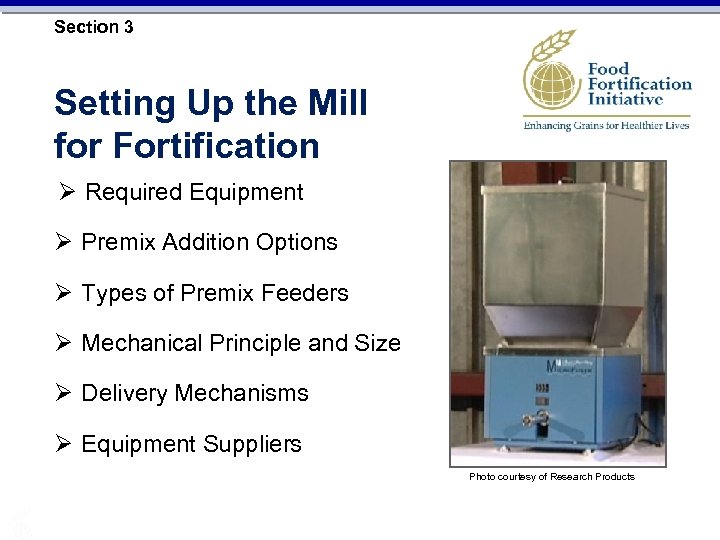 Section 3 Setting Up the Mill for Fortification Ø Required Equipment Ø Premix Addition Options Ø Types of Premix Feeders Ø Mechanical Principle and Size Ø Delivery Mechanisms Ø Equipment Suppliers Photo courtesy of Research Products
 Required Equipment Premix Feeder • Measures correct amount of premix • Position at appropriate place in production line Mixing Mechanism • Can be done during normal flour transport or with special equipment • Assures that premix is uniformly added to flour
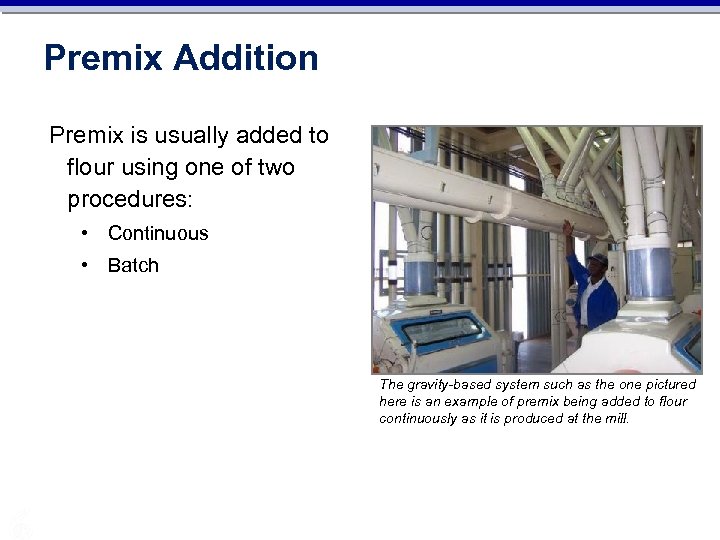 Premix Addition Premix is usually added to flour using one of two procedures: • Continuous • Batch The gravity-based system such as the one pictured here is an example of premix being added to flour continuously as it is produced at the mill.
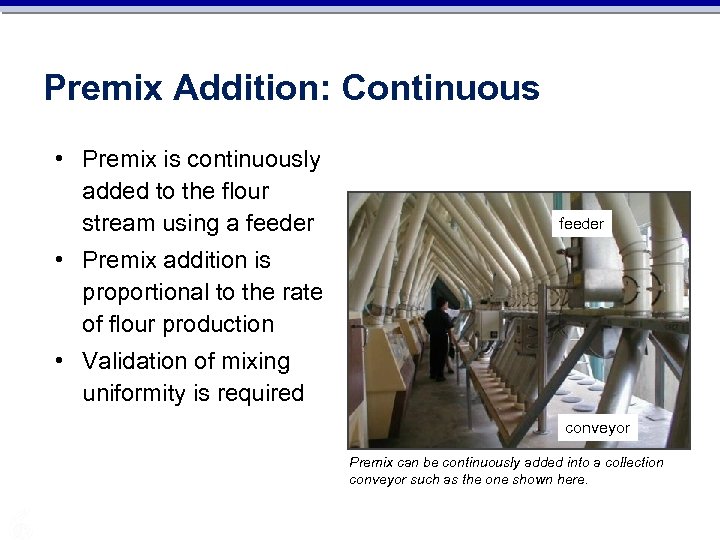 Premix Addition: Continuous • Premix is continuously added to the flour stream using a feeder • Premix addition is proportional to the rate of flour production • Validation of mixing uniformity is required conveyor Premix can be continuously added into a collection conveyor such as the one shown here.
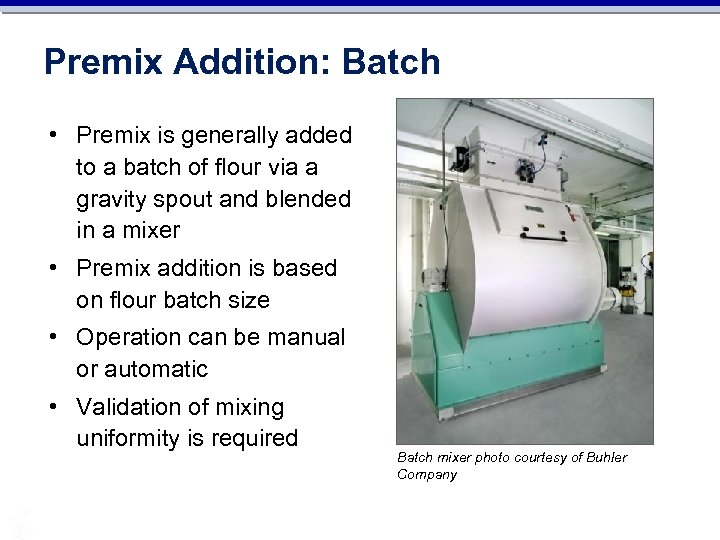 Premix Addition: Batch • Premix is generally added to a batch of flour via a gravity spout and blended in a mixer • Premix addition is based on flour batch size • Operation can be manual or automatic • Validation of mixing uniformity is required Batch mixer photo courtesy of Buhler Company
 All Feeders Require Anti-bridging With continuous or batch, use feeders with anti-bridging devices to provide consistent premix flow. Two product flow issues resulting in flow stoppage include: • Bridging occurs when product discharges above the outlet but no premix flows in to fill the void. Looking into the top of the feeder hopper, it appears to contain premix across the entire hopper. • Tunneling is a form of bridging where the product falls directly through the outlet but premix remains on the sides of the hopper. Looking into the feeder hopper, the discharge point is visible but the sides of the hopper remain covered with a wall of premix. See the troubleshooting pages of section 4, Operations, for more information.
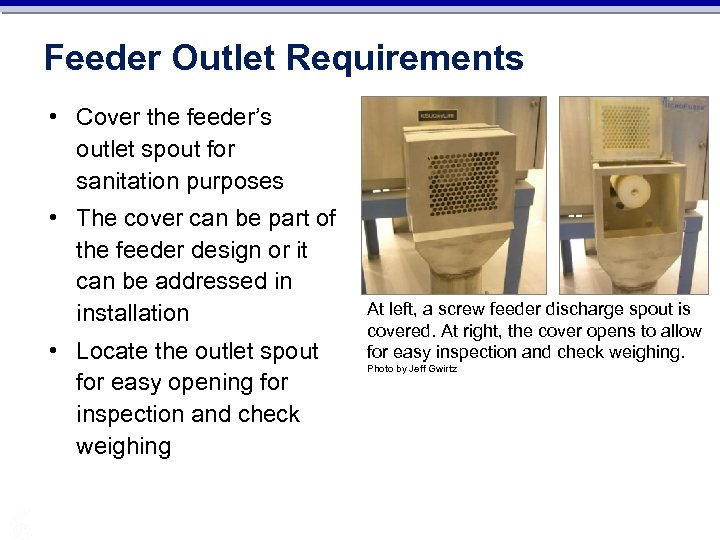 Feeder Outlet Requirements • Cover the feeder’s outlet spout for sanitation purposes • The cover can be part of the feeder design or it can be addressed in installation • Locate the outlet spout for easy opening for inspection and check weighing At left, a screw feeder discharge spout is covered. At right, the cover opens to allow for easy inspection and check weighing. Photo by Jeff Gwirtz
 Control Systems for Premix Addition • Control systems selected should match the technical capability of the plant operation and maintenance program. • Systems range from manual systems, to those with basic and advanced interlocking to fully automated systems. • All systems presented achieve the basic needs of a fortification program.
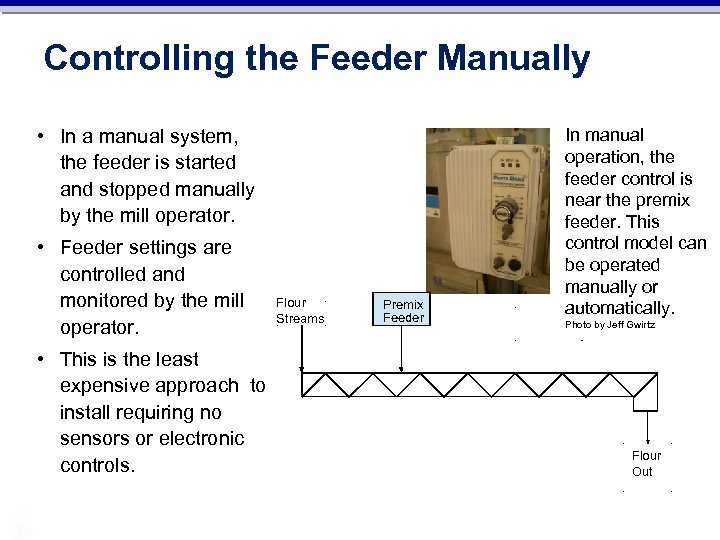 Controlling the Feeder Manually • In a manual system, the feeder is started and stopped manually by the mill operator. • Feeder settings are controlled and monitored by the mill operator. • This is the least expensive approach to install requiring no sensors or electronic controls. Flour Streams In manual operation, the feeder control is near the premix feeder. This control model can be operated manually or automatically. Premix Feeder Photo by Jeff Gwirtz Flour Out
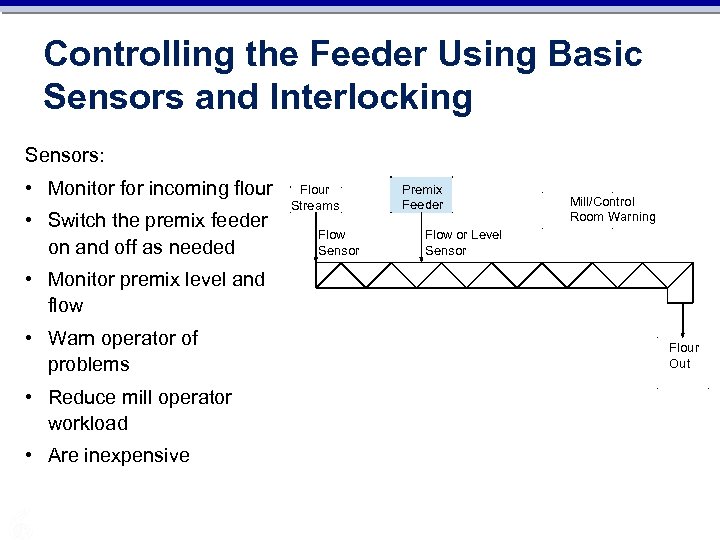 Controlling the Feeder Using Basic Sensors and Interlocking Sensors: • Monitor for incoming flour • Switch the premix feeder on and off as needed Flour Streams Flow Sensor Premix Feeder Mill/Control Room Warning Flow or Level Sensor • Monitor premix level and flow • Warn operator of problems • Reduce mill operator workload • Are inexpensive Flour Out
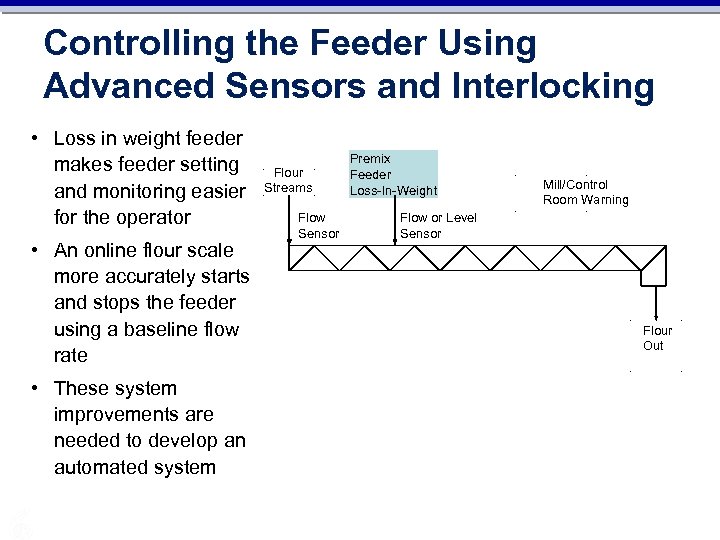 Controlling the Feeder Using Advanced Sensors and Interlocking • Loss in weight feeder makes feeder setting and monitoring easier for the operator • An online flour scale more accurately starts and stops the feeder using a baseline flow rate • These system improvements are needed to develop an automated system Flour Streams Flow Sensor Premix Feeder Loss-In-Weight Mill/Control Room Warning Flow or Level Sensor Flour Out
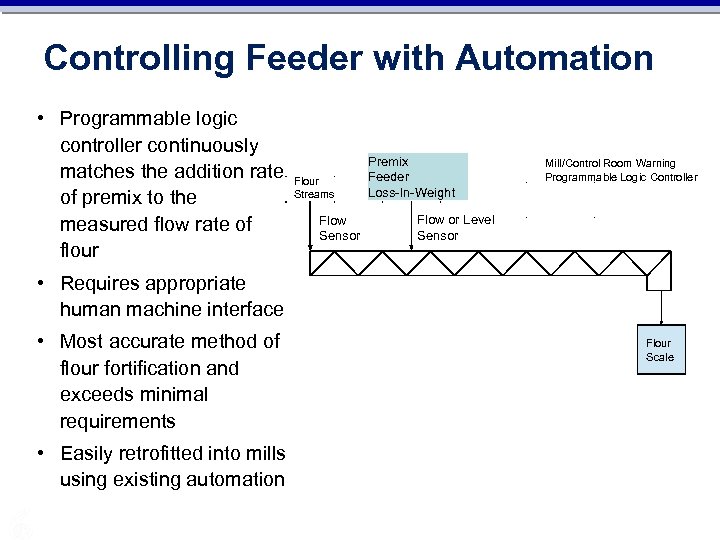 Controlling Feeder with Automation • Programmable logic controller continuously matches the addition rate Flour Streams of premix to the Flow measured flow rate of Sensor flour Premix Feeder Loss-In-Weight Flow or Level Sensor Mill/Control Room Warning Programmable Logic Controller • Requires appropriate human machine interface • Most accurate method of flour fortification and exceeds minimal requirements • Easily retrofitted into mills using existing automation Flour Scale
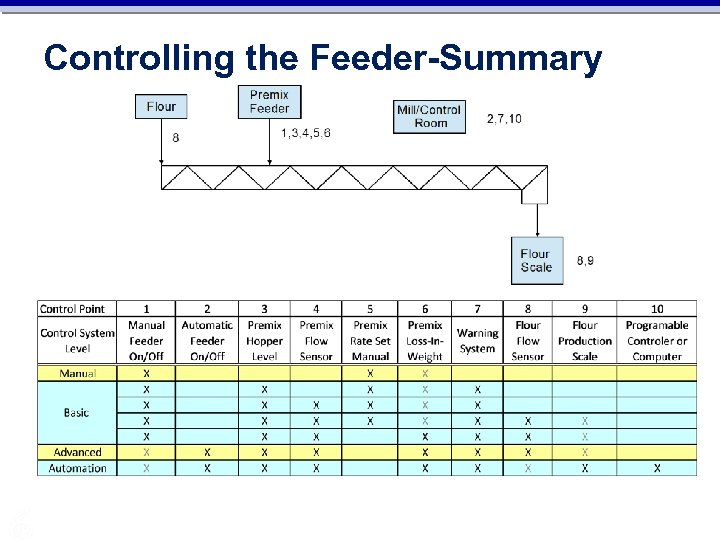 Controlling the Feeder-Summary
 Mechanical Principles Two ways feeders control amount of premix added to flour: Gravimetric Volumetric • Also known as “loss in weight” • Most commonly used by screw feeders • Continuously weighs premix • Similar to using a measuring cup • Requires greater volume of premix than generally used • Minimum error of measurement is +2% • More complex and expensive than required in most cereal milling
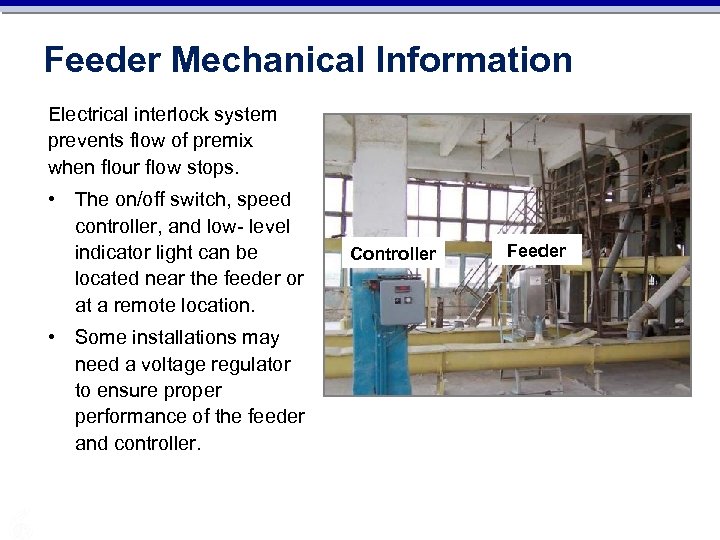 Feeder Mechanical Information Electrical interlock system prevents flow of premix when flour flow stops. • The on/off switch, speed controller, and low- level indicator light can be located near the feeder or at a remote location. • Some installations may need a voltage regulator to ensure proper performance of the feeder and controller. Controller Feeder
 Feeder Mechanical Information • The electrical interlock system be installed between the feeder motor and the motor driving the flour collection conveyor. • In pneumatic delivery systems, an interlock should be made between the feeder and the blower to ensure that the feeder cannot be turned on without the blower operating. This prevents buildup of premix in pneumatic lines followed by over-treatment of flour once the blower is turned on. • An alternative is an automatic shut-off switch on the feeder that is hooked up to a flour flow indicator or a pressure indicator in a pneumatic system.
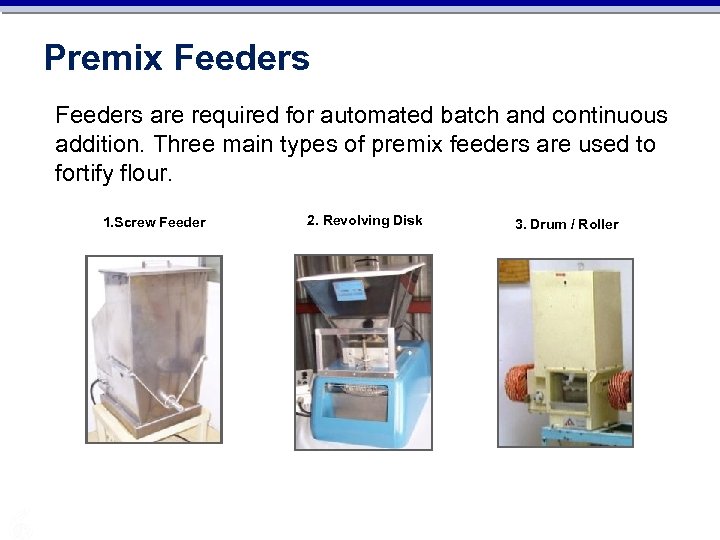 Premix Feeders are required for automated batch and continuous addition. Three main types of premix feeders are used to fortify flour. 1. Screw Feeder 2. Revolving Disk 3. Drum / Roller
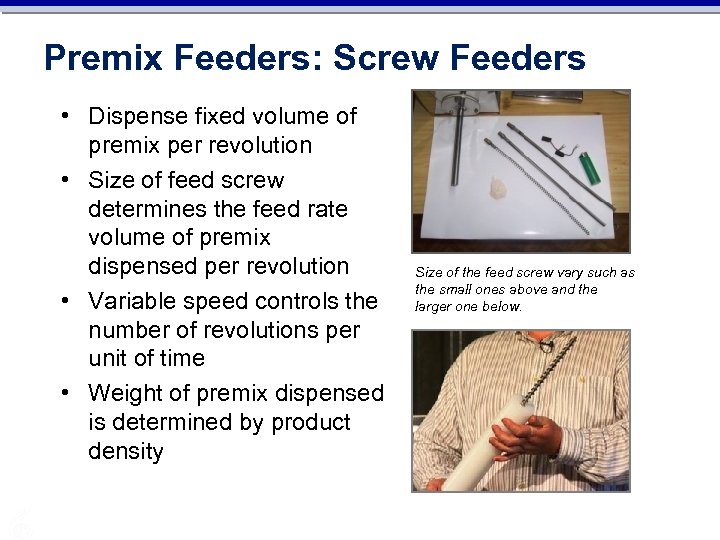 Premix Feeders: Screw Feeders • Dispense fixed volume of premix per revolution • Size of feed screw determines the feed rate volume of premix dispensed per revolution • Variable speed controls the number of revolutions per unit of time • Weight of premix dispensed is determined by product density Size of the feed screw vary such as the small ones above and the larger one below.
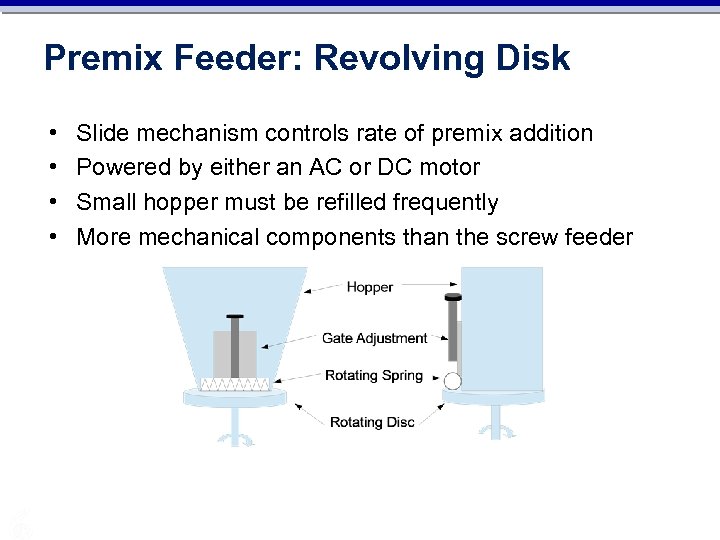 Premix Feeder: Revolving Disk • • Slide mechanism controls rate of premix addition Powered by either an AC or DC motor Small hopper must be refilled frequently More mechanical components than the screw feeder
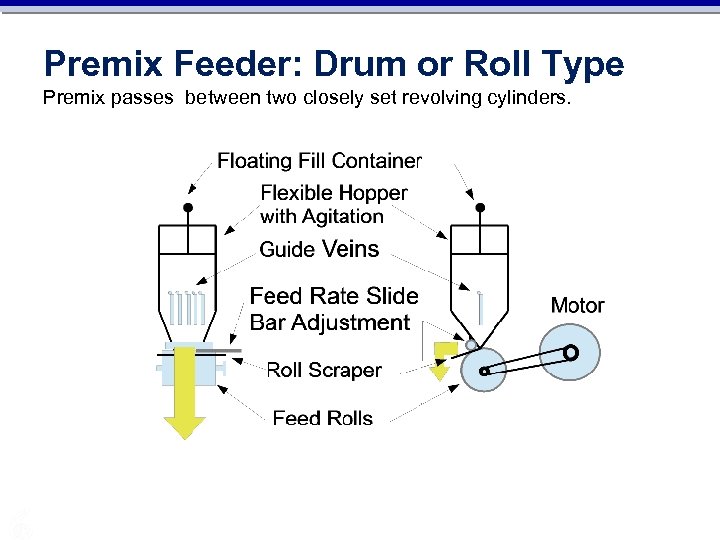 Premix Feeder: Drum or Roll Type Premix passes between two closely set revolving cylinders.
 Premix Feeder: Drum or Roll Type • Used for decades and many are still in use • Can be volumetric, gravimetric or loss of weight feeders • Either a DC or AC motor for power • Pulley system controls the rotation speed • Pulleys and wheels of differing diameters make gross adjustments in the feed rate. An adjustable gate is used to make fine adjustments • Require more parts and more maintenance • Shear pins in the drive mechanism break if large objects (bolts, plastic) get stuck between the rolls • In some newer models, a variable speed DC drive motor allows addition rate to be adjusted electronically rather than mechanically • Variable speed AC drive motors are also available
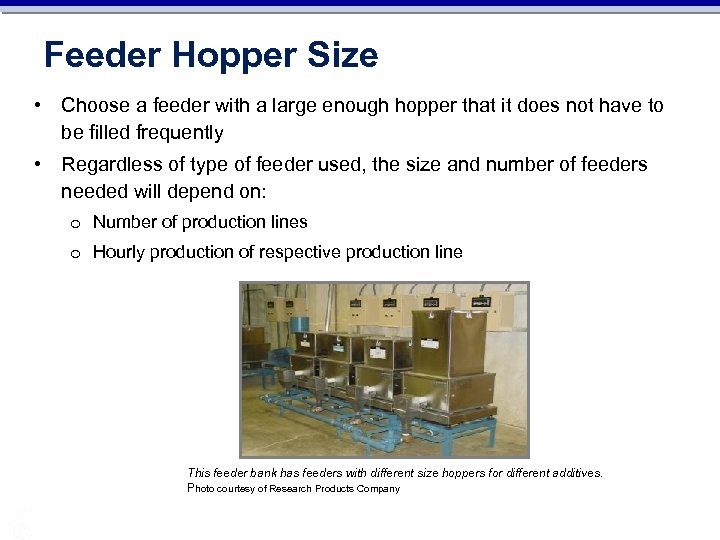 Feeder Hopper Size • Choose a feeder with a large enough hopper that it does not have to be filled frequently • Regardless of type of feeder used, the size and number of feeders needed will depend on: o Number of production lines o Hourly production of respective production line This feeder bank has feeders with different size hoppers for different additives. Photo courtesy of Research Products Company
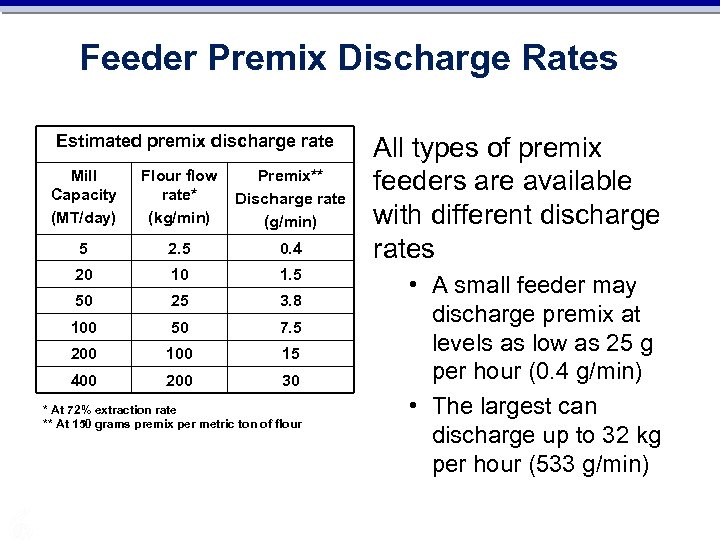 Feeder Premix Discharge Rates Estimated premix discharge rate Mill Capacity (MT/day) Flour flow rate* (kg/min) Premix** Discharge rate (g/min) 5 2. 5 0. 4 20 10 1. 5 50 25 3. 8 100 50 7. 5 200 15 400 200 30 * At 72% extraction rate ** At 150 grams premix per metric ton of flour All types of premix feeders are available with different discharge rates • A small feeder may discharge premix at levels as low as 25 g per hour (0. 4 g/min) • The largest can discharge up to 32 kg per hour (533 g/min)
 Continuous Premix Delivery Systems With continuous feeding, two types of premix delivery are possible. Location of the feeder depends on the type used. Gravity Pneumatic • Feeder is placed above the flour collection conveyor • Can be located at several places in the mill • Premix drops directly into flour as it flows through the conveyor • Premix drops into a venturi tube • Premix is blown into the flour collection conveyor
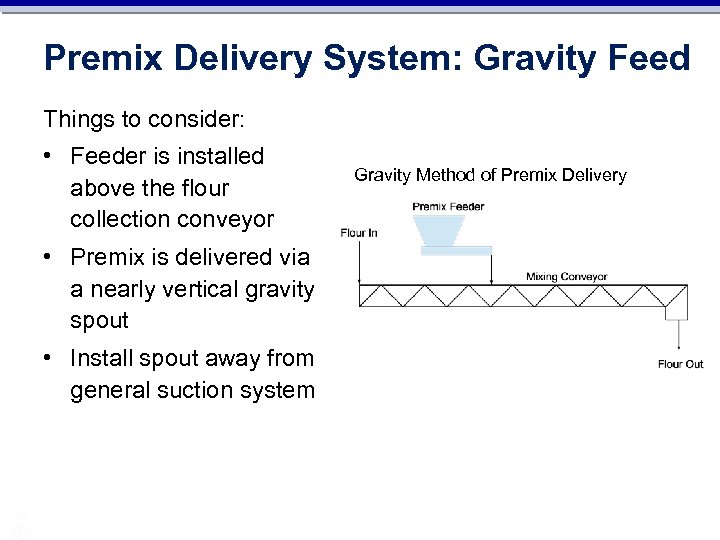 Premix Delivery System: Gravity Feed Things to consider: • Feeder is installed above the flour collection conveyor • Premix is delivered via a nearly vertical gravity spout • Install spout away from general suction system Gravity Method of Premix Delivery
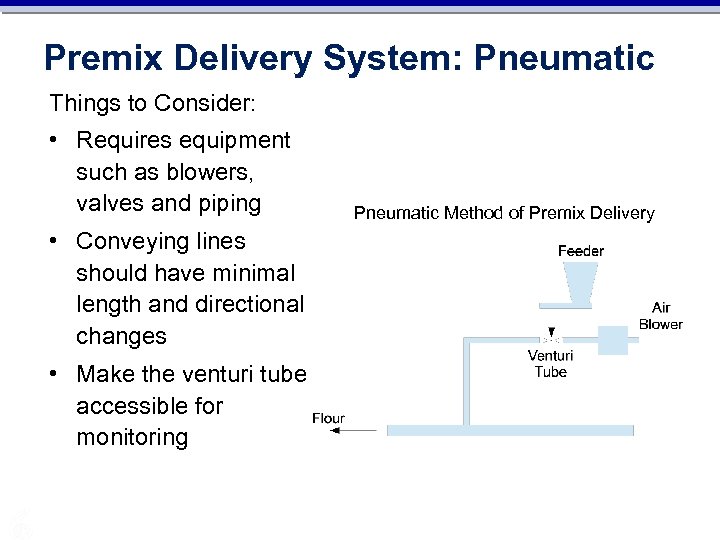 Premix Delivery System: Pneumatic Things to Consider: • Requires equipment such as blowers, valves and piping • Conveying lines should have minimal length and directional changes • Make the venturi tube accessible for monitoring Pneumatic Method of Premix Delivery
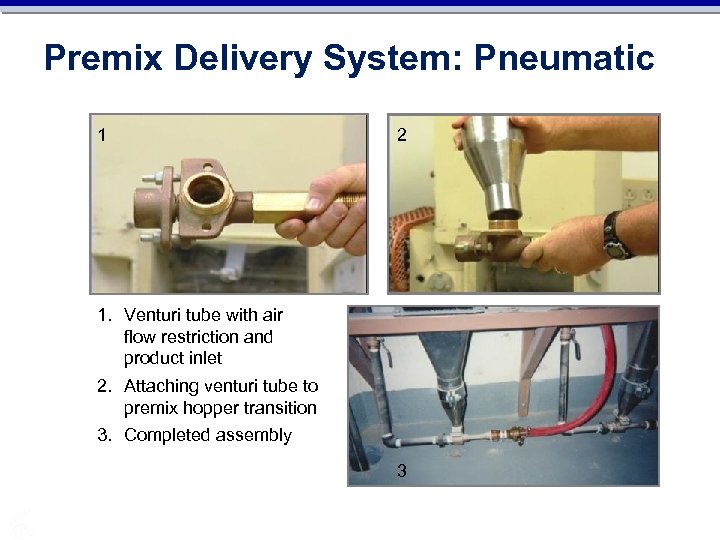 Premix Delivery System: Pneumatic 1 2 1. Venturi tube with air flow restriction and product inlet 2. Attaching venturi tube to premix hopper transition 3. Completed assembly 3
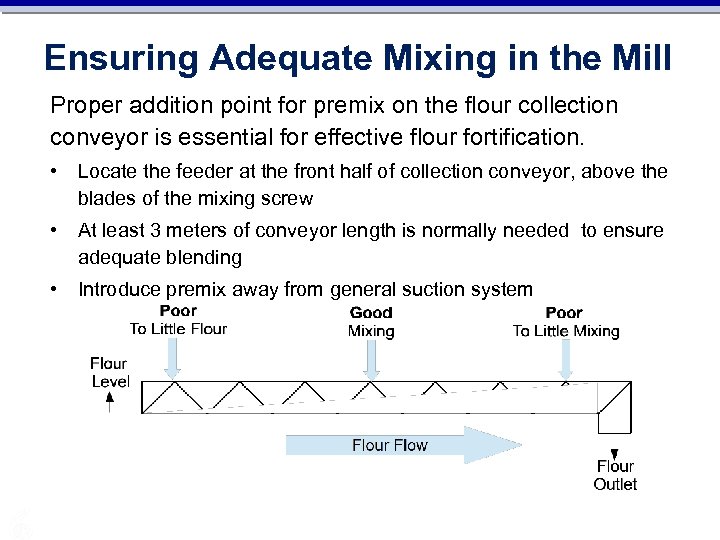 Ensuring Adequate Mixing in the Mill Proper addition point for premix on the flour collection conveyor is essential for effective flour fortification. • Locate the feeder at the front half of collection conveyor, above the blades of the mixing screw • At least 3 meters of conveyor length is normally needed to ensure adequate blending • Introduce premix away from general suction system
 Ensure Adequate Mixing In Packaging If premix addition cannot be accomplished in mill, consider this option: • Install mixing conveyor between holding bin and packout bin • The premix is discharged into the start of this special conveyor • At least 3 meters of conveyor length is normally needed to ensure adequate blending • Introduce premix away from general suction system
 Equipment Recommendations When considering equipment, look for these specifications: • Directions for installation and maintenance available in desired language or can be translated • All surfaces in contact with premix are food-grade and non-corrosive • Adjustable delivery control, calibrated from 0 to 100% of feeder capacity • 220 volt ± 10% 50/60 Hz single phase power • Anti-bridging design to prevent bridging or tunneling of premix in hopper • Capable of delivering from 0. 04 to 8 L/hr with ± 5% accuracy over full range • Hopper capacity of 8 liter minimum • Easy accessibility for operator to check hopper and flow rate
 System Recommendations When considering equipment, look for these specifications: • Directions for installation, maintenance, and system operation available in desired language or can be translated • Automatic shut off / warning capability o Feeder shuts off when flour flow stops o Warning if feeder is empty or premix fails to discharge • Place feeder on load cells to aid in monitoring premix usage or use loss-in-weight feeder • If possible, use electronic control loop to balance feeder discharge to flour production scales
 Vendor Expectations Millers should expect the following from equipment and system vendors: • At least two references from mills where equipment and systems have been in operation for at least one year • Installation and operating instruction manual that explains in words and diagrams the installation, calibration and maintenance of the equipment and system • Technical support for installation, training, calibration, and maintenance • Recommended spare parts inventory for items with life span of less than three years • Identified lead time for parts delivery and commitment to maintain parts inventory support
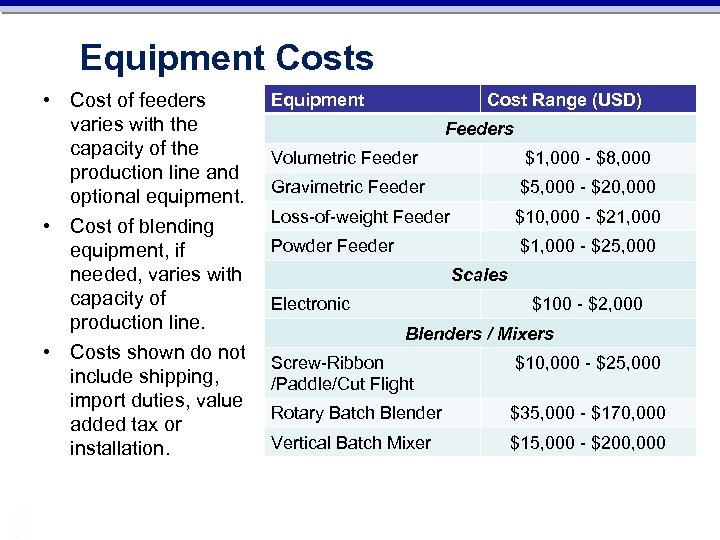 Equipment Costs • Cost of feeders varies with the capacity of the production line and optional equipment. • Cost of blending equipment, if needed, varies with capacity of production line. • Costs shown do not include shipping, import duties, value added tax or installation. Equipment Cost Range (USD) Feeders Volumetric Feeder $1, 000 - $8, 000 Gravimetric Feeder $5, 000 - $20, 000 Loss-of-weight Feeder $10, 000 - $21, 000 Powder Feeder $1, 000 - $25, 000 Scales Electronic $100 - $2, 000 Blenders / Mixers Screw-Ribbon /Paddle/Cut Flight $10, 000 - $25, 000 Rotary Batch Blender $35, 000 - $170, 000 Vertical Batch Mixer $15, 000 - $200, 000
 More Information About Mill Set-up Contact FFI at info@ffinetwork. org