


 Скачать презентацию Section 3 1 Statements and Logical Connectives Copyright
455bc24ffe8821ce4660bd9c50b6feb3.ppt
- Количество слайдов: 37
 Section 3. 1 Statements and Logical Connectives Copyright 2013, 2010, 2007, Pearson, Education, Inc.
 What You Will Learn Statements, quantifiers, and compound statements Statements involving the words not, and, or, if … then, and if and only if 3. 1 -2 Copyright 2013, 2010, 2007, Pearson, Education, Inc.
 HISTORY—The Greeks: Aristotelian logic: The ancient Greeks were the first people to look at the way humans think and draw conclusions. Aristotle (384 -322 B. C. ) is called the father of logic. This logic has been taught and studied for more than 2000 years. 3. 1 -3 Copyright 2013, 2010, 2007, Pearson, Education, Inc.
 Mathematicians Gottfried Wilhelm Leibniz (1646 -1716) believed that all mathematical and scientific concepts could be derived from logic. He was the first to seriously study symbolic logic. In this type of logic, written statements use symbols and letters. 3. 1 -4 Copyright 2013, 2010, 2007, Pearson, Education, Inc.
 Mathematicians George Boole (1815 – 1864) is said to be the founder of symbolic logic because he had such impressive work in this area. Charles Dodgson, better known as Lewis Carroll, incorporated many interesting ideas from logic into his books. 3. 1 -5 Copyright 2013, 2010, 2007, Pearson, Education, Inc.
 Logic and the English Language Connectives - words such as and, or, if, then Exclusive or - one or the other of the given events can happen, but not both Inclusive or - one or the other or both of the given events can happen 3. 1 -6 Copyright 2013, 2010, 2007, Pearson, Education, Inc.
 Statements and Logical Connectives Statement - A sentence that can be judged either true or false. Labeling a statement true or false is called assigning a truth value to the statement. 3. 1 -7 Copyright 2013, 2010, 2007, Pearson, Education, Inc.
 Statements and Logical Connectives Simple Statements - A sentence that conveys only one idea and can be assigned a truth value. Compound Statements - Sentences that combine two or more simple statements and can be assigned a truth value. 3. 1 -8 Copyright 2013, 2010, 2007, Pearson, Education, Inc.
 Negation of a Statement Negation of a statement – change a statement to its opposite meaning. The negation of a false statement is always a true statement. The negation of a true statement is always a false statement. 3. 1 -9 Copyright 2013, 2010, 2007, Pearson, Education, Inc.
 Quantifiers - words such as all, none, no, some, etc… Be careful when negating statements that contain quantifiers. 3. 1 -10 Copyright 2013, 2010, 2007, Pearson, Education, Inc.
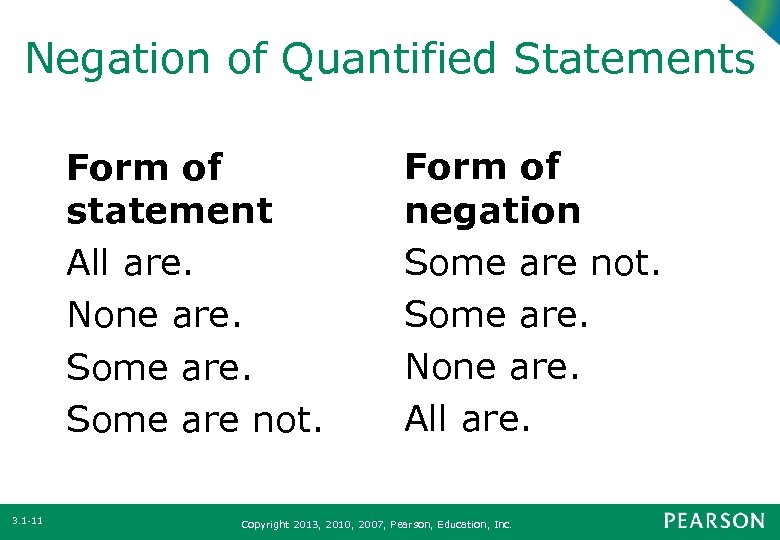 Negation of Quantified Statements Form of statement All are. None are. Some are not. 3. 1 -11 Form of negation Some are not. Some are. None are. All are. Copyright 2013, 2010, 2007, Pearson, Education, Inc.
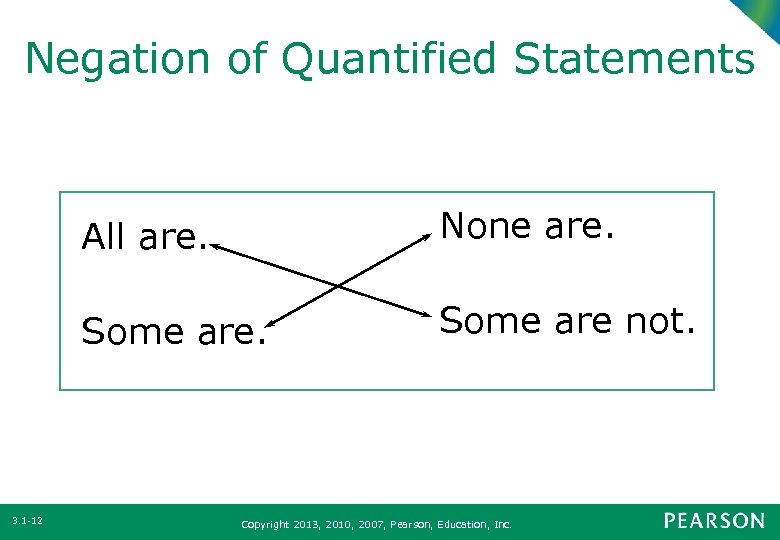 Negation of Quantified Statements All are. Some are. 3. 1 -12 None are. Some are not. Copyright 2013, 2010, 2007, Pearson, Education, Inc.
 Example 1: Write Negations Write the negation of the statement. Some telephones can take photographs. Solution Since some means “at least one” this statement is true. The negation is “No telephones can take photographs, ” which is a false statement. 3. 1 -13 Copyright 2013, 2010, 2007, Pearson, Education, Inc.
 Example 1: Write Negations Write the negation of the statement. All houses have two stories. Solution This is a false statement, since some houses have one story, some three or more. The negation “Some houses do not have two stories” or “Not all houses have two stories” or “At least one house does not have two stories” are all true statements. 3. 1 -14 Copyright 2013, 2010, 2007, Pearson, Education, Inc.
 Compound Statements consisting of two or more simple statements are called compound statements. The connectives often used to join two simple statements are and, or, if…then…, and if and only if. 3. 1 -15 Copyright 2013, 2010, 2007, Pearson, Education, Inc.
 Not Statements (Negation) The symbol used in logic to show the negation of a statement is ~. It is read “not”. The negation of p is: ~ p. 3. 1 -16 Copyright 2013, 2010, 2007, Pearson, Education, Inc.
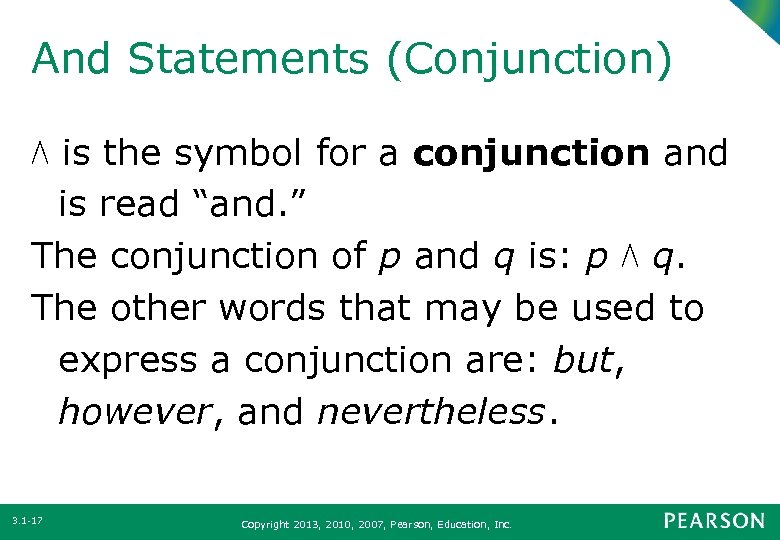 And Statements (Conjunction) ⋀ is the symbol for a conjunction and is read “and. ” The conjunction of p and q is: p ⋀ q. The other words that may be used to express a conjunction are: but, however, and nevertheless. 3. 1 -17 Copyright 2013, 2010, 2007, Pearson, Education, Inc.
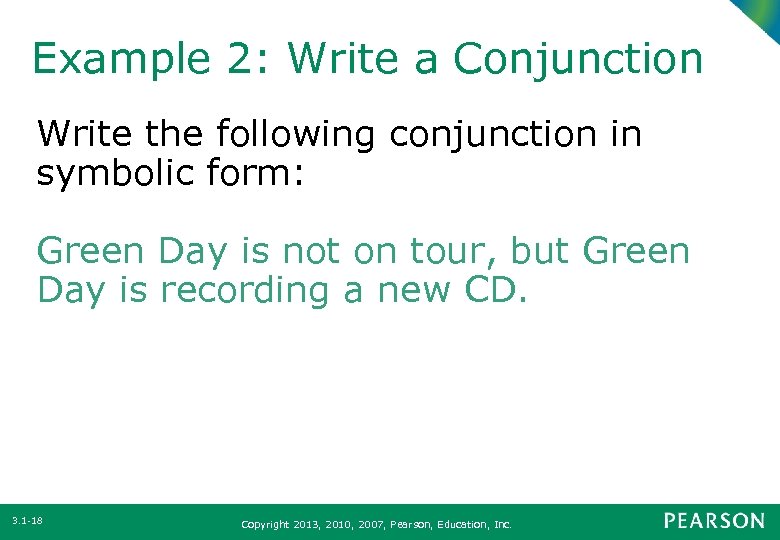 Example 2: Write a Conjunction Write the following conjunction in symbolic form: Green Day is not on tour, but Green Day is recording a new CD. 3. 1 -18 Copyright 2013, 2010, 2007, Pearson, Education, Inc.
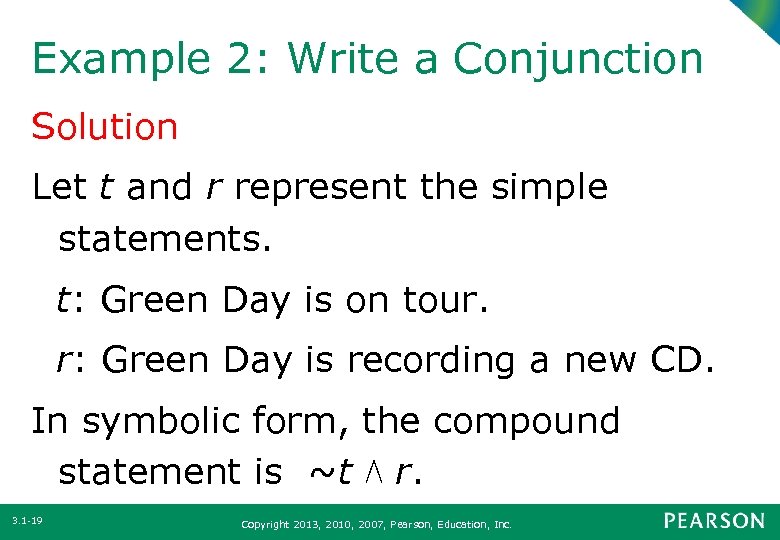 Example 2: Write a Conjunction Solution Let t and r represent the simple statements. t: Green Day is on tour. r: Green Day is recording a new CD. In symbolic form, the compound statement is ~t ⋀ r. 3. 1 -19 Copyright 2013, 2010, 2007, Pearson, Education, Inc.
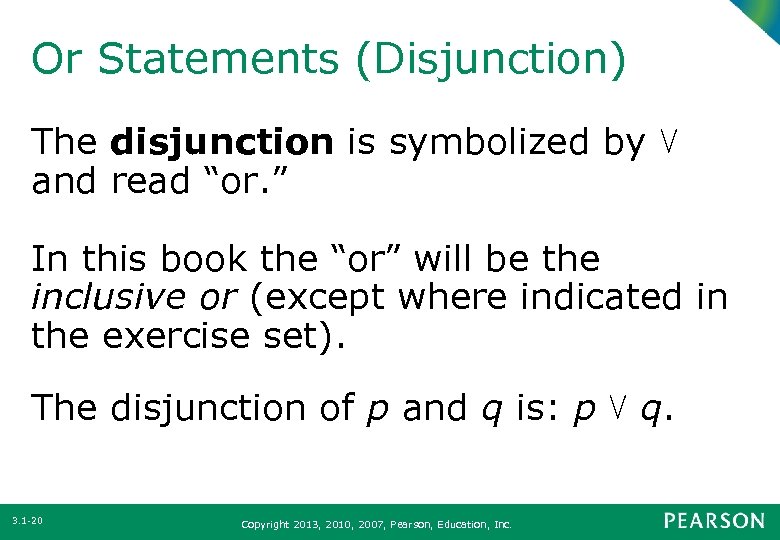 Or Statements (Disjunction) The disjunction is symbolized by ⋁ and read “or. ” In this book the “or” will be the inclusive or (except where indicated in the exercise set). The disjunction of p and q is: p ⋁ q. 3. 1 -20 Copyright 2013, 2010, 2007, Pearson, Education, Inc.
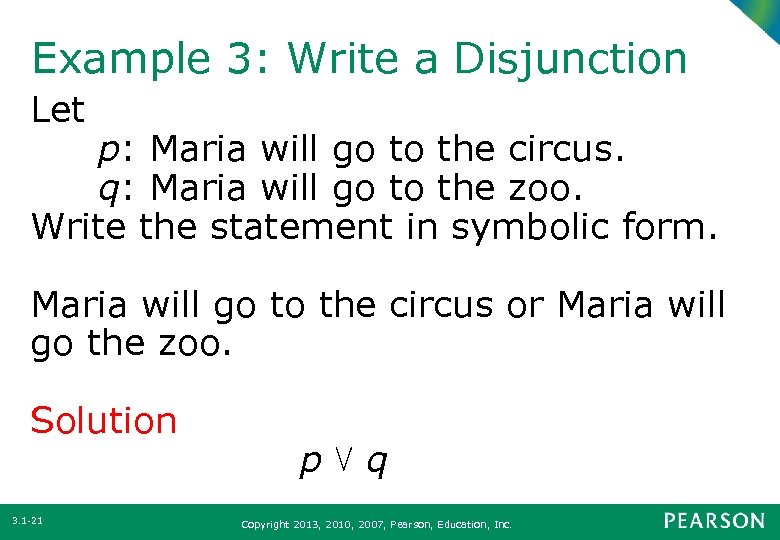 Example 3: Write a Disjunction Let p: Maria will go to the circus. q: Maria will go to the zoo. Write the statement in symbolic form. Maria will go to the circus or Maria will go the zoo. Solution 3. 1 -21 p⋁q Copyright 2013, 2010, 2007, Pearson, Education, Inc.
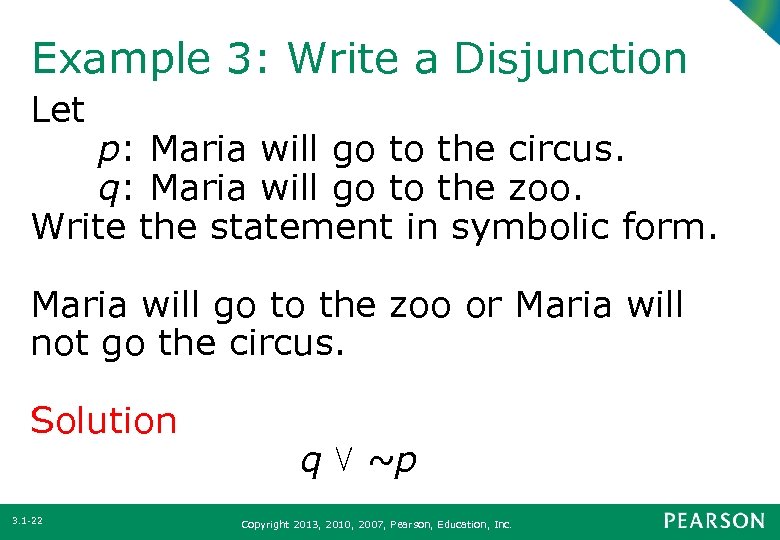 Example 3: Write a Disjunction Let p: Maria will go to the circus. q: Maria will go to the zoo. Write the statement in symbolic form. Maria will go to the zoo or Maria will not go the circus. Solution 3. 1 -22 q ⋁ ~p Copyright 2013, 2010, 2007, Pearson, Education, Inc.
 Compound Statements When a compound statement contains more than one connective, a comma can be used to indicate which simple statements are to be grouped together. When we write the compound statement symbolically, the simple statements on the same side of the comma are to be grouped together within parentheses. 3. 1 -23 Copyright 2013, 2010, 2007, Pearson, Education, Inc.
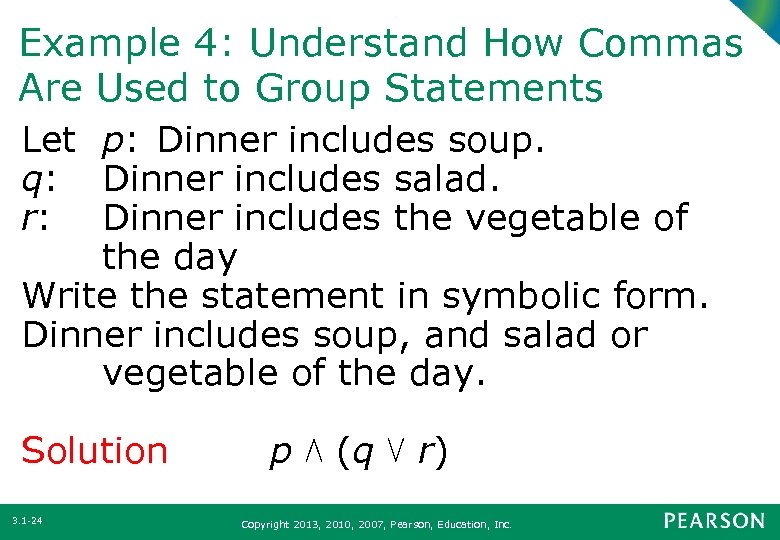 Example 4: Understand How Commas Are Used to Group Statements Let p: Dinner includes soup. q: Dinner includes salad. r: Dinner includes the vegetable of the day Write the statement in symbolic form. Dinner includes soup, and salad or vegetable of the day. Solution 3. 1 -24 p ⋀ (q ⋁ r) Copyright 2013, 2010, 2007, Pearson, Education, Inc.
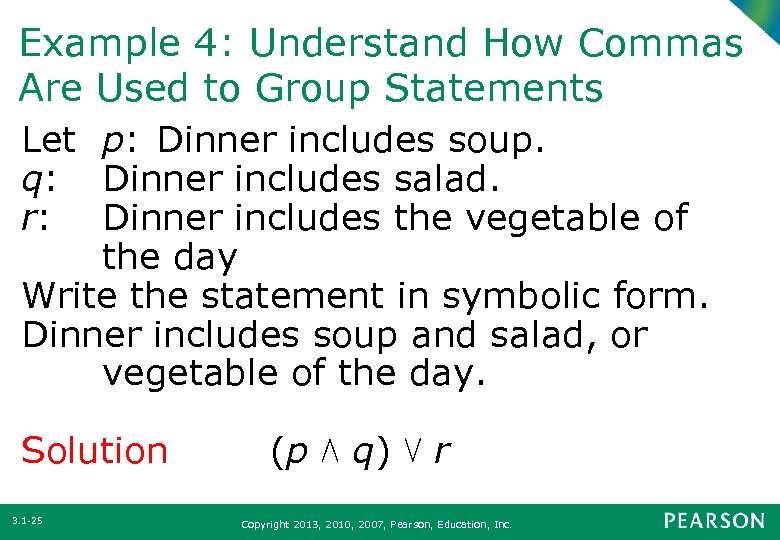 Example 4: Understand How Commas Are Used to Group Statements Let p: Dinner includes soup. q: Dinner includes salad. r: Dinner includes the vegetable of the day Write the statement in symbolic form. Dinner includes soup and salad, or vegetable of the day. Solution 3. 1 -25 (p ⋀ q) ⋁ r Copyright 2013, 2010, 2007, Pearson, Education, Inc.
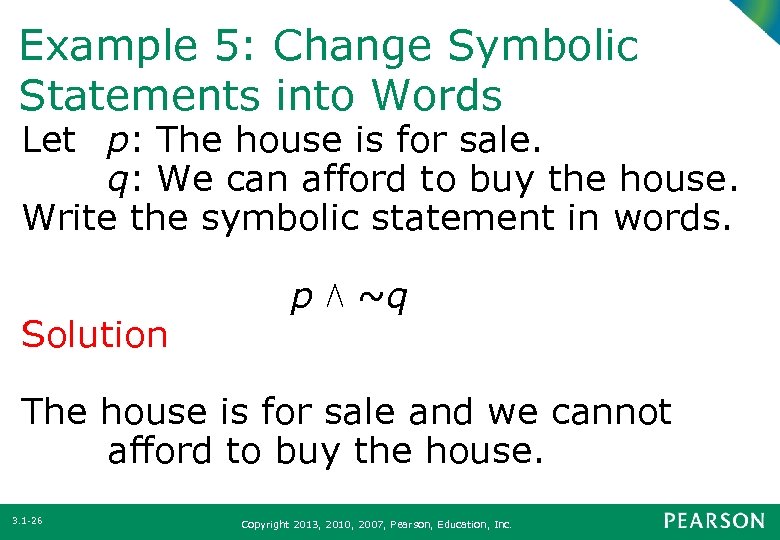 Example 5: Change Symbolic Statements into Words Let p: The house is for sale. q: We can afford to buy the house. Write the symbolic statement in words. Solution p ⋀ ~q The house is for sale and we cannot afford to buy the house. 3. 1 -26 Copyright 2013, 2010, 2007, Pearson, Education, Inc.
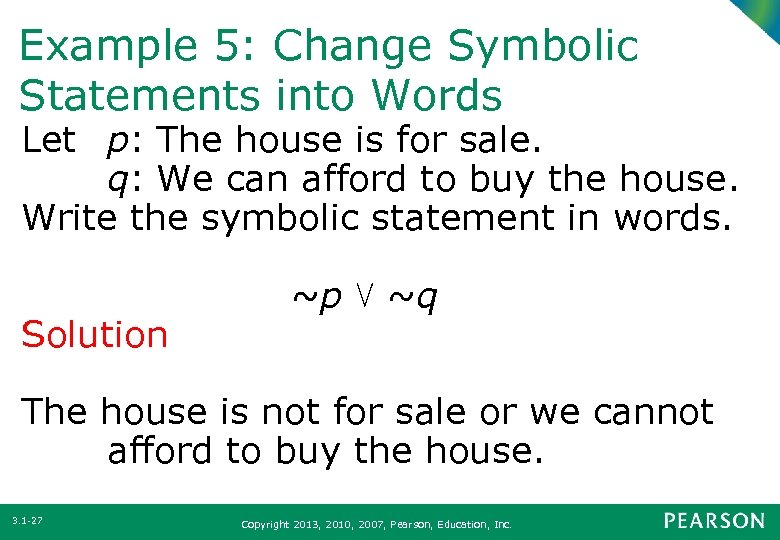 Example 5: Change Symbolic Statements into Words Let p: The house is for sale. q: We can afford to buy the house. Write the symbolic statement in words. Solution ~p ⋁ ~q The house is not for sale or we cannot afford to buy the house. 3. 1 -27 Copyright 2013, 2010, 2007, Pearson, Education, Inc.
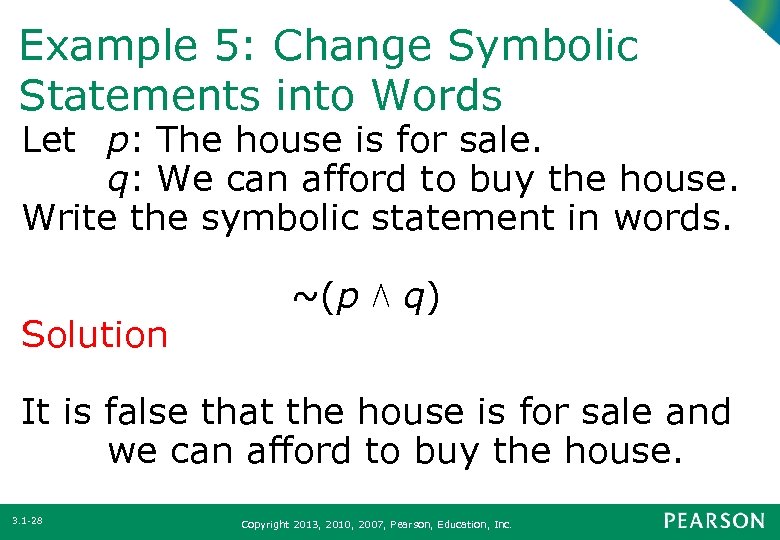 Example 5: Change Symbolic Statements into Words Let p: The house is for sale. q: We can afford to buy the house. Write the symbolic statement in words. Solution ~(p ⋀ q) It is false that the house is for sale and we can afford to buy the house. 3. 1 -28 Copyright 2013, 2010, 2007, Pearson, Education, Inc.
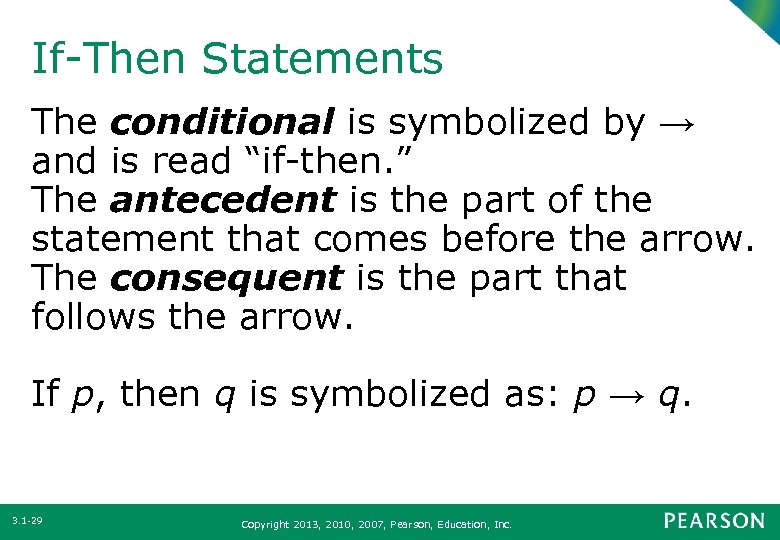 If-Then Statements The conditional is symbolized by → and is read “if-then. ” The antecedent is the part of the statement that comes before the arrow. The consequent is the part that follows the arrow. If p, then q is symbolized as: p → q. 3. 1 -29 Copyright 2013, 2010, 2007, Pearson, Education, Inc.
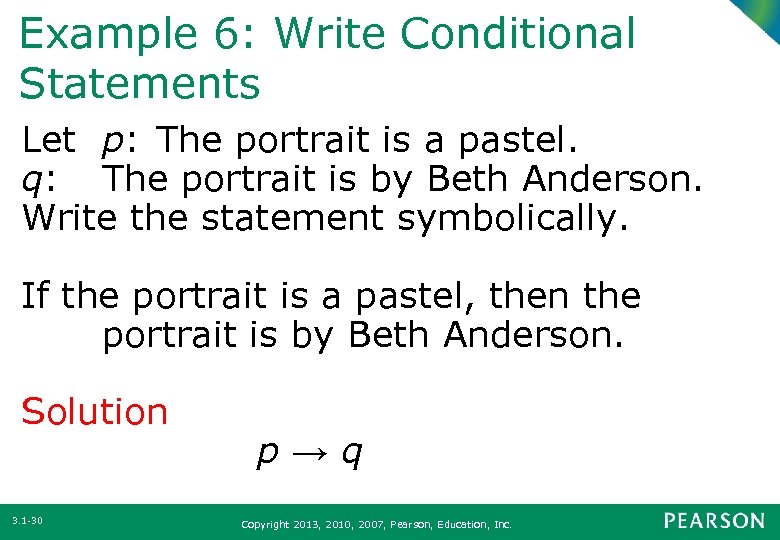 Example 6: Write Conditional Statements Let p: The portrait is a pastel. q: The portrait is by Beth Anderson. Write the statement symbolically. If the portrait is a pastel, then the portrait is by Beth Anderson. Solution 3. 1 -30 p→q Copyright 2013, 2010, 2007, Pearson, Education, Inc.
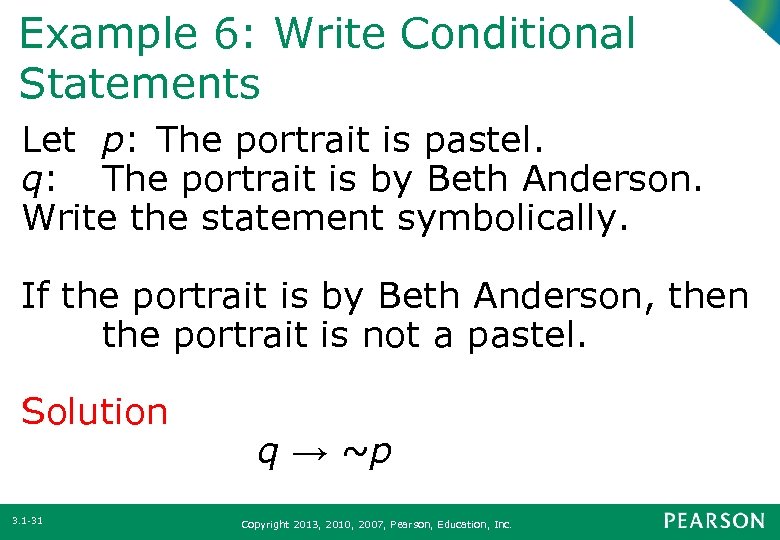 Example 6: Write Conditional Statements Let p: The portrait is pastel. q: The portrait is by Beth Anderson. Write the statement symbolically. If the portrait is by Beth Anderson, then the portrait is not a pastel. Solution 3. 1 -31 q → ~p Copyright 2013, 2010, 2007, Pearson, Education, Inc.
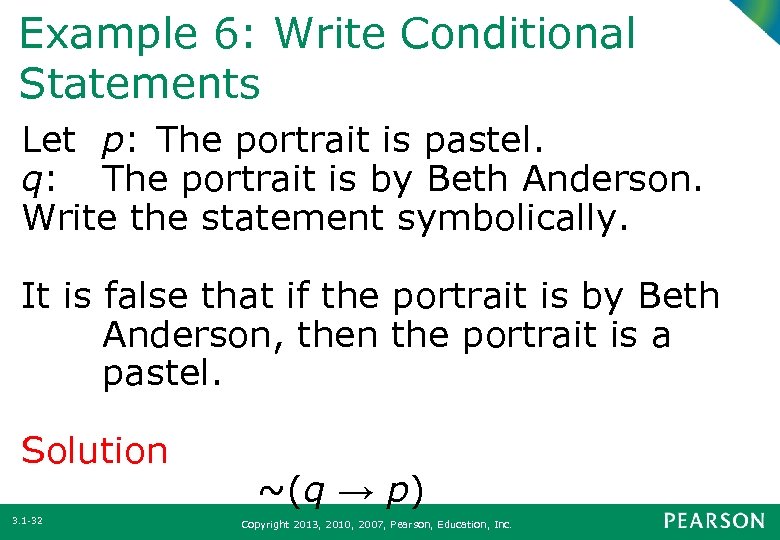 Example 6: Write Conditional Statements Let p: The portrait is pastel. q: The portrait is by Beth Anderson. Write the statement symbolically. It is false that if the portrait is by Beth Anderson, then the portrait is a pastel. Solution 3. 1 -32 ~(q → p) Copyright 2013, 2010, 2007, Pearson, Education, Inc.
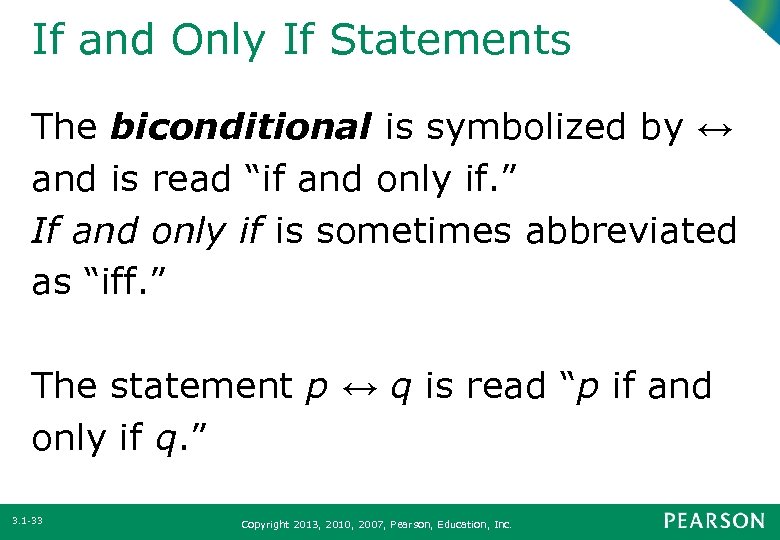 If and Only If Statements The biconditional is symbolized by ↔ and is read “if and only if. ” If and only if is sometimes abbreviated as “iff. ” The statement p ↔ q is read “p if and only if q. ” 3. 1 -33 Copyright 2013, 2010, 2007, Pearson, Education, Inc.
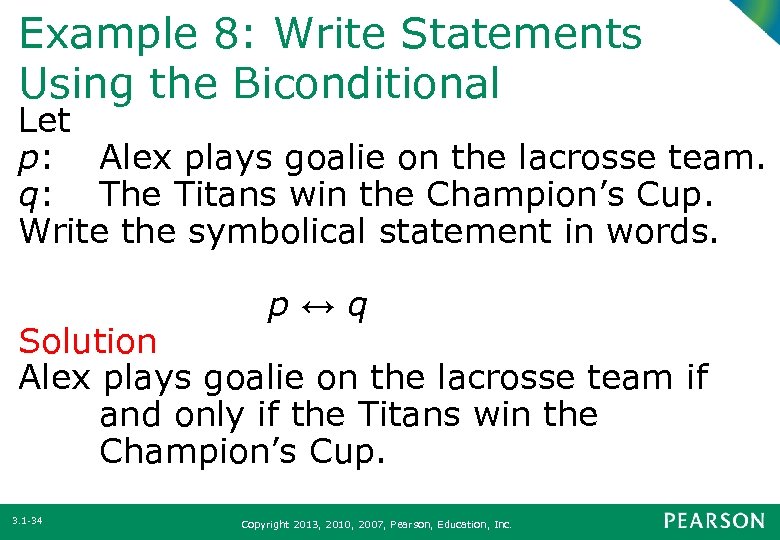 Example 8: Write Statements Using the Biconditional Let p: Alex plays goalie on the lacrosse team. q: The Titans win the Champion’s Cup. Write the symbolical statement in words. p↔q Solution Alex plays goalie on the lacrosse team if and only if the Titans win the Champion’s Cup. 3. 1 -34 Copyright 2013, 2010, 2007, Pearson, Education, Inc.
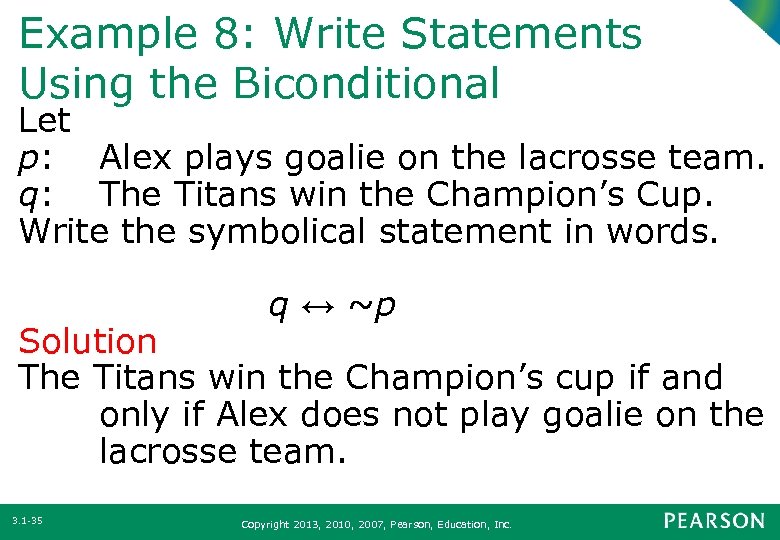 Example 8: Write Statements Using the Biconditional Let p: Alex plays goalie on the lacrosse team. q: The Titans win the Champion’s Cup. Write the symbolical statement in words. q ↔ ~p Solution The Titans win the Champion’s cup if and only if Alex does not play goalie on the lacrosse team. 3. 1 -35 Copyright 2013, 2010, 2007, Pearson, Education, Inc.
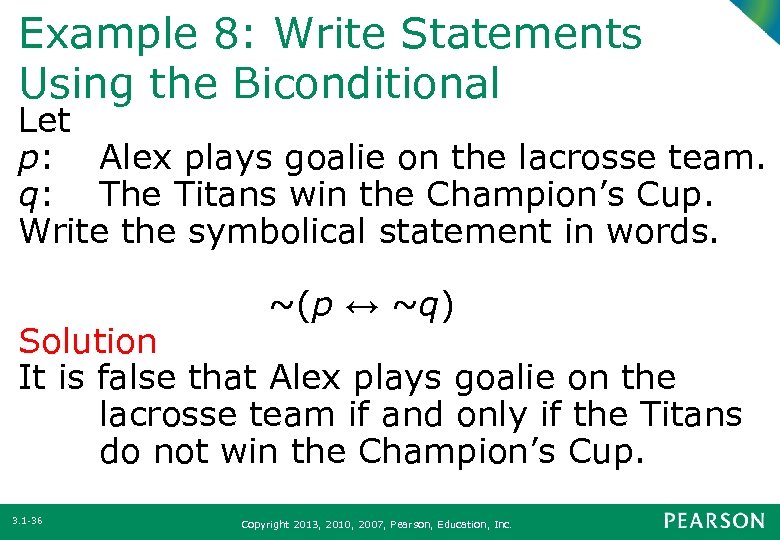 Example 8: Write Statements Using the Biconditional Let p: Alex plays goalie on the lacrosse team. q: The Titans win the Champion’s Cup. Write the symbolical statement in words. ~(p ↔ ~q) Solution It is false that Alex plays goalie on the lacrosse team if and only if the Titans do not win the Champion’s Cup. 3. 1 -36 Copyright 2013, 2010, 2007, Pearson, Education, Inc.
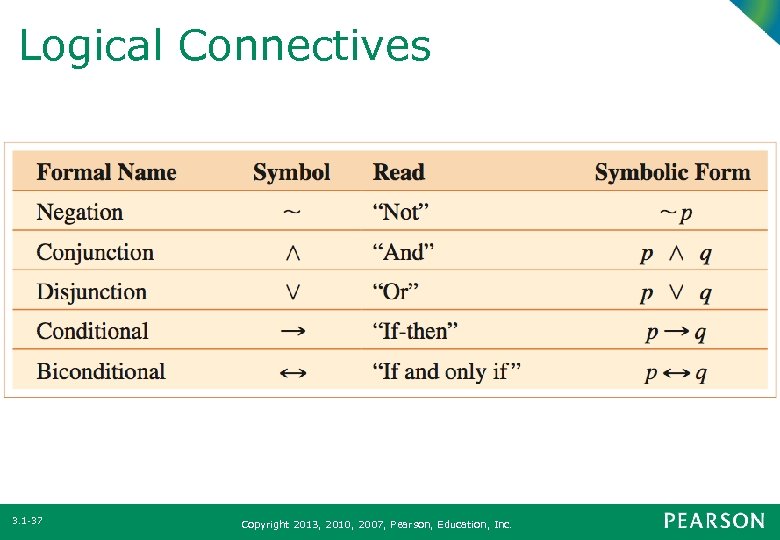 Logical Connectives 3. 1 -37 Copyright 2013, 2010, 2007, Pearson, Education, Inc.