 Скачать презентацию Section 1 Burden of diabetes The diabetes
d0fa2353acf8c9287c20030e28ed5476.ppt
- Количество слайдов: 20




Section 1: Burden of diabetes • The diabetes epidemic • Burden of diabetes complications • Association with major psychological distress/quality of life • The burden of diabetes on healthcare systems
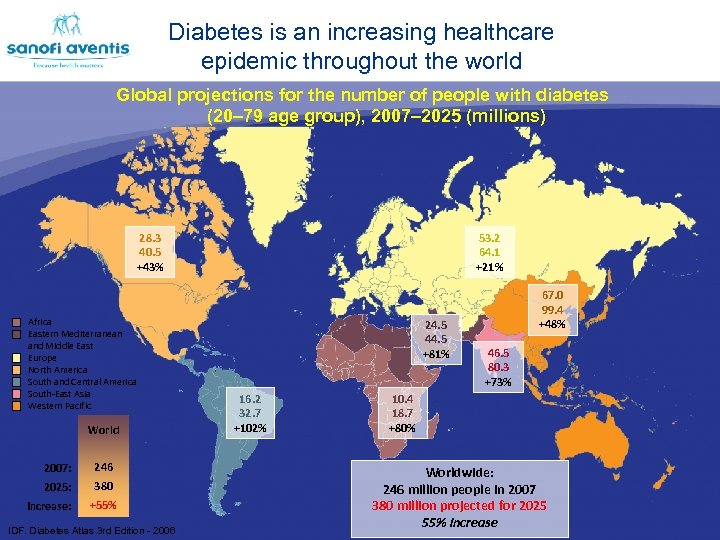
• The diabetes epidemic Diabetes is an increasing healthcare epidemic throughout the world Global projections for the number of people with diabetes (20– 79 age group), 2007– 2025 (millions) 28. 3 40. 5 +43% Africa Eastern Mediterranean and Middle East Europe North America South and Central America South-East Asia Western Pacific World 2007: 246 2025: 380 Increase: +55% IDF. Diabetes Atlas 3 rd Edition - 2006 53. 2 64. 1 +21% 24. 5 44. 5 +81% 16. 2 32. 7 +102% 67. 0 99. 4 +48% 46. 5 80. 3 +73% 10. 4 18. 7 +80% Worldwide: 246 million people in 2007 380 million projected for 2025 55% increase
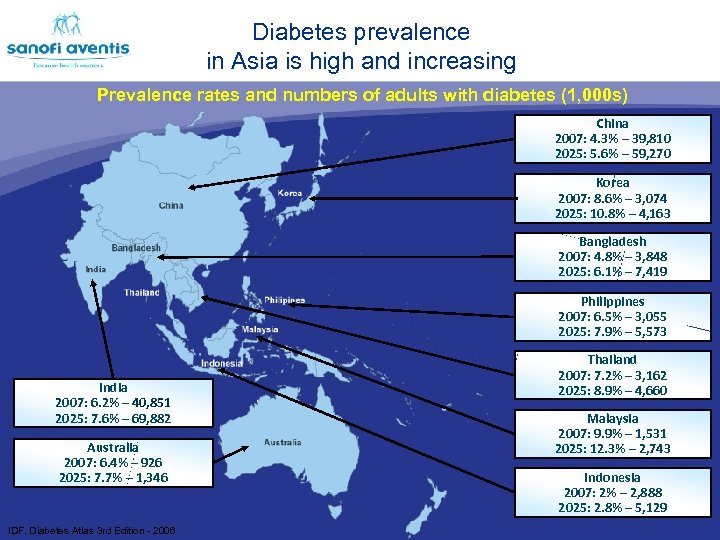
• The diabetes epidemic Diabetes prevalence in Asia is high and increasing Prevalence rates and numbers of adults with diabetes (1, 000 s) China 2007: 4. 3% – 39, 810 2025: 5. 6% – 59, 270 Korea 2007: 8. 6% – 3, 074 2025: 10. 8% – 4, 163 Bangladesh 2007: 4. 8% – 3, 848 2025: 6. 1% – 7, 419 Philippines 2007: 6. 5% – 3, 055 2025: 7. 9% – 5, 573 India 2007: 6. 2% – 40, 851 2025: 7. 6% – 69, 882 Australia 2007: 6. 4% – 926 2025: 7. 7% – 1, 346 IDF. Diabetes Atlas 3 rd Edition - 2006 Thailand 2007: 7. 2% – 3, 162 2025: 8. 9% – 4, 660 Malaysia 2007: 9. 9% – 1, 531 2025: 12. 3% – 2, 743 Indonesia 2007: 2% – 2, 888 2025: 2. 8% – 5, 129
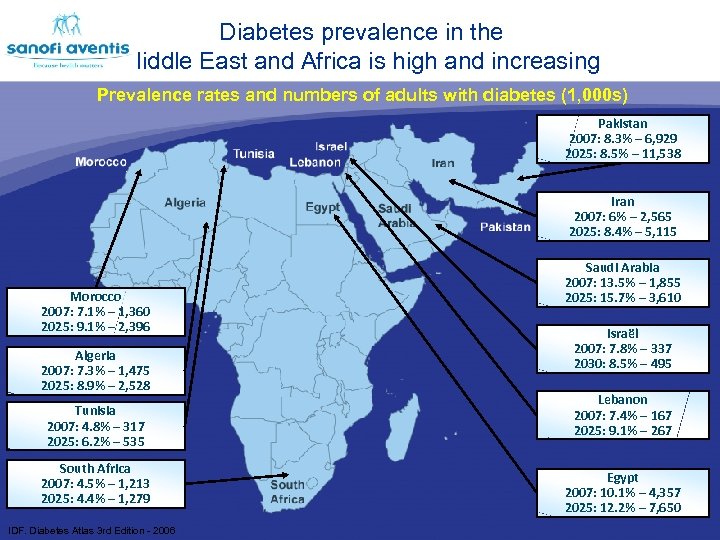
• The diabetes epidemic Diabetes prevalence in the Middle East and Africa is high and increasing Prevalence rates and numbers of adults with diabetes (1, 000 s) Pakistan 2007: 8. 3% – 6, 929 2025: 8. 5% – 11, 538 Iran 2007: 6% – 2, 565 2025: 8. 4% – 5, 115 Morocco 2007: 7. 1% – 1, 360 2025: 9. 1% – 2, 396 Algeria 2007: 7. 3% – 1, 475 2025: 8. 9% – 2, 528 Tunisia 2007: 4. 8% – 317 2025: 6. 2% – 535 South Africa 2007: 4. 5% – 1, 213 2025: 4. 4% – 1, 279 IDF. Diabetes Atlas 3 rd Edition - 2006 Saudi Arabia 2007: 13. 5% – 1, 855 2025: 15. 7% – 3, 610 Israël 2007: 7. 8% – 337 2030: 8. 5% – 495 Lebanon 2007: 7. 4% – 167 2025: 9. 1% – 267 Egypt 2007: 10. 1% – 4, 357 2025: 12. 2% – 7, 650
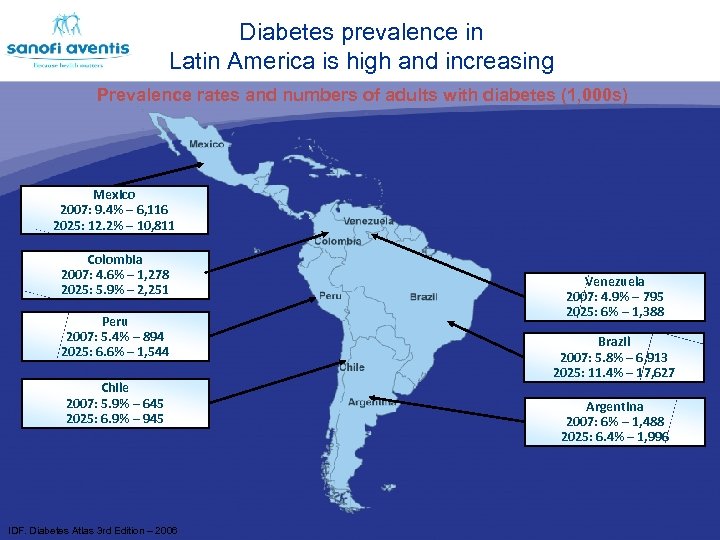
• The diabetes epidemic Diabetes prevalence in Latin America is high and increasing Prevalence rates and numbers of adults with diabetes (1, 000 s) Mexico 2007: 9. 4% – 6, 116 2025: 12. 2% – 10, 811 Colombia 2007: 4. 6% – 1, 278 2025: 5. 9% – 2, 251 Peru 2007: 5. 4% – 894 2025: 6. 6% – 1, 544 Chile 2007: 5. 9% – 645 2025: 6. 9% – 945 IDF. Diabetes Atlas 3 rd Edition – 2006 Venezuela 2007: 4. 9% – 795 2025: 6% – 1, 388 Brazil 2007: 5. 8% – 6, 913 2025: 11. 4% – 17, 627 Argentina 2007: 6% – 1, 488 2025: 6. 4% – 1, 996
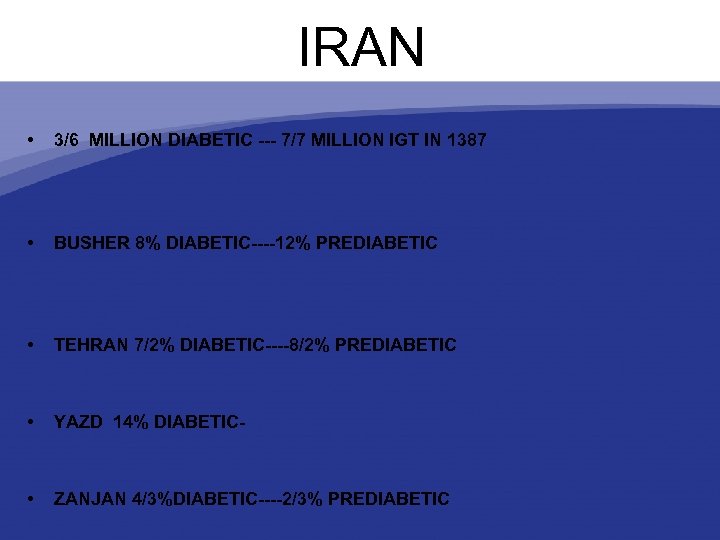
IRAN • 3/6 MILLION DIABETIC --- 7/7 MILLION IGT IN 1387 • BUSHER 8% DIABETIC----12% PREDIABETIC • TEHRAN 7/2% DIABETIC----8/2% PREDIABETIC • YAZD 14% DIABETIC- • ZANJAN 4/3%DIABETIC----2/3% PREDIABETIC
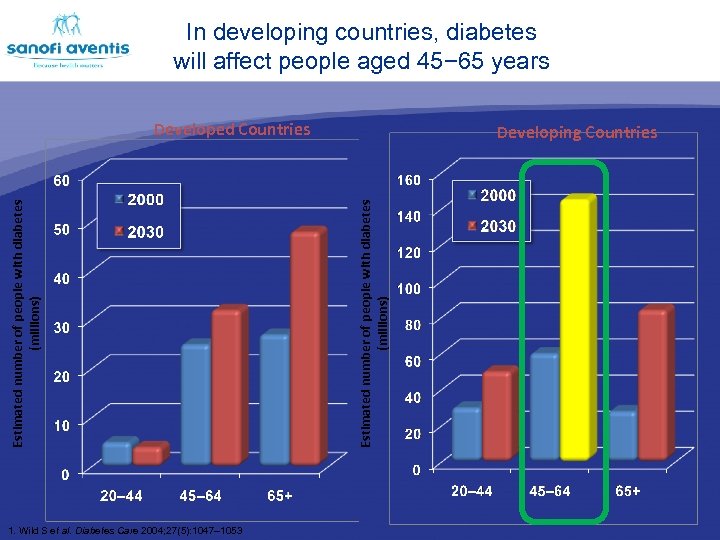
• The diabetes epidemic In developing countries, diabetes will affect people aged 45− 65 years 1. Wild S et al. Diabetes Care 2004; 27(5): 1047– 1053 Developing Countries Estimated number of people with diabetes (millions) Developed Countries
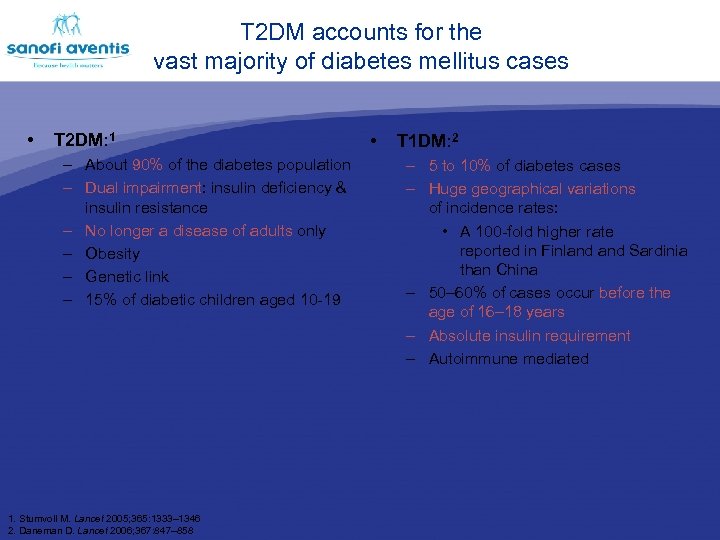
• The diabetes epidemic T 2 DM accounts for the vast majority of diabetes mellitus cases • T 2 DM: 1 – About 90% of the diabetes population – Dual impairment: insulin deficiency & insulin resistance – No longer a disease of adults only – Obesity – Genetic link – 15% of diabetic children aged 10 -19 1. Stumvoll M. Lancet 2005; 365: 1333– 1346 2. Daneman D. Lancet 2006; 367: 847– 858 • T 1 DM: 2 – 5 to 10% of diabetes cases – Huge geographical variations of incidence rates: • A 100 -fold higher rate reported in Finland Sardinia than China – 50– 60% of cases occur before the age of 16– 18 years – Absolute insulin requirement – Autoimmune mediated
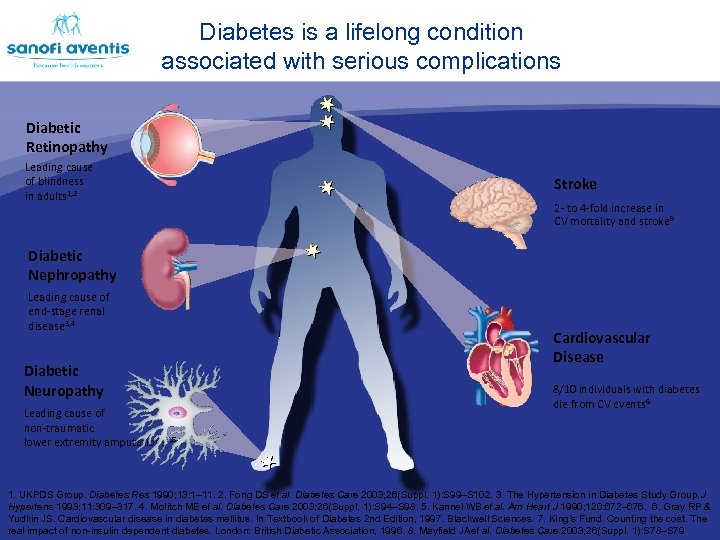
• Burden of diabetes complications Diabetes is a lifelong condition associated with serious complications Diabetic Retinopathy Leading cause of blindness in adults 1, 2 Stroke 2 - to 4 -fold increase in CV mortality and stroke 5 Diabetic Nephropathy Leading cause of end-stage renal disease 3, 4 Diabetic Neuropathy Leading cause of non-traumatic lower extremity amputations 7, 8 Cardiovascular Disease 8/10 individuals with diabetes die from CV events 6 1. UKPDS Group. Diabetes Res 1990; 13: 1– 11. 2. Fong DS et al. Diabetes Care 2003; 26(Suppl. 1): S 99–S 102. 3. The Hypertension in Diabetes Study Group. J Hypertens 1993; 11: 309– 317. 4. Molitch ME et al. Diabetes Care 2003; 26(Suppl. 1): S 94–S 98. 5. Kannel WB et al. Am Heart J 1990; 120: 672– 676. 6. Gray RP & Yudkin JS. Cardiovascular disease in diabetes mellitus. In Textbook of Diabetes 2 nd Edition, 1997. Blackwell Sciences. 7. King’s Fund. Counting the cost. The real impact of non-insulin dependent diabetes. London: British Diabetic Association, 1996. 8. Mayfield JAet al. Diabetes Care 2003; 26(Suppl. 1): S 78–S 79
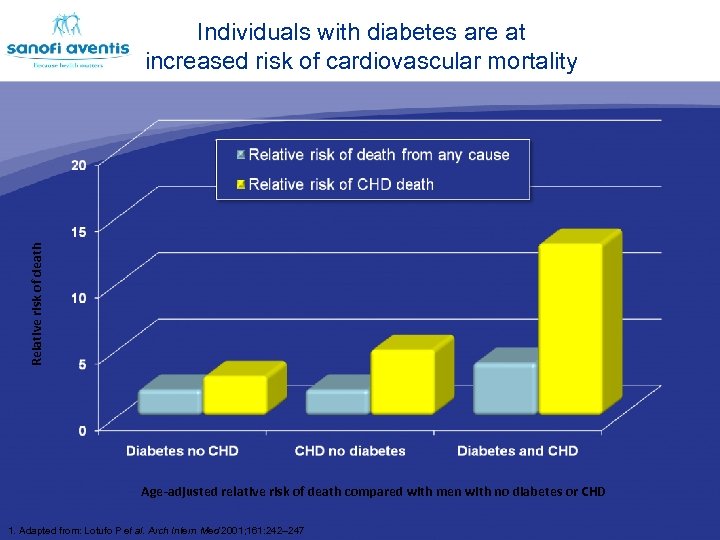
• Burden of diabetes complications Relative risk of death Individuals with diabetes are at increased risk of cardiovascular mortality Age-adjusted relative risk of death compared with men with no diabetes or CHD 1. Adapted from: Lotufo P et al. Arch Intern Med 2001; 161: 242– 247
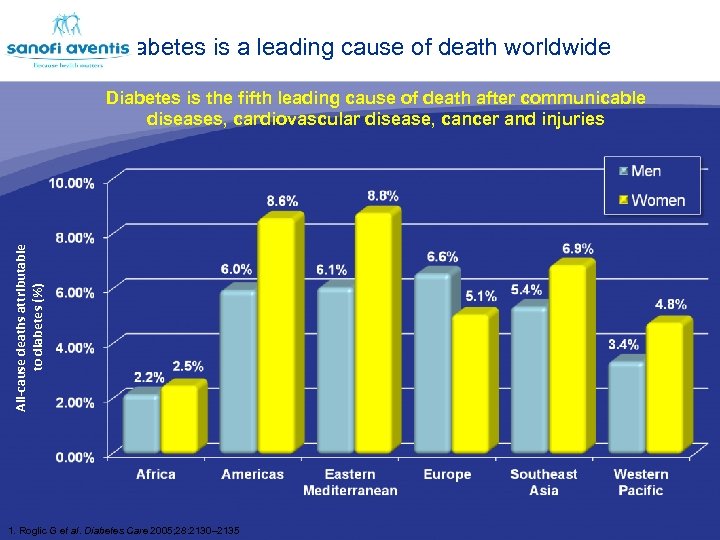
• Burden of diabetes complications Diabetes is a leading cause of death worldwide All-cause deaths attributable to diabetes (%) Diabetes is the fifth leading cause of death after communicable diseases, cardiovascular disease, cancer and injuries 1. Roglic G et al. Diabetes Care 2005; 28: 2130– 2135
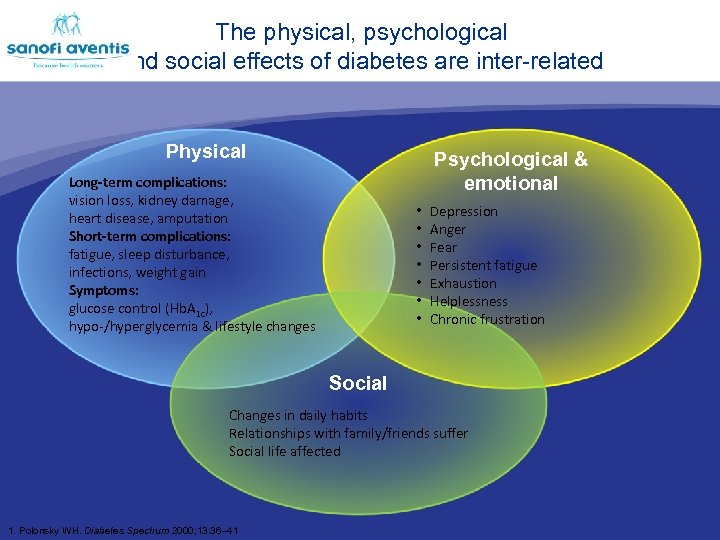
• Association with major psychological distress/quality of life The physical, psychological and social effects of diabetes are inter-related Physical Psychological & emotional Long-term complications: vision loss, kidney damage, heart disease, amputation Short-term complications: fatigue, sleep disturbance, infections, weight gain Symptoms: glucose control (Hb. A 1 c), hypo-/hyperglycemia & lifestyle changes • • Depression Anger Fear Persistent fatigue Exhaustion Helplessness Chronic frustration Social Changes in daily habits Relationships with family/friends suffer Social life affected 1. Polonsky WH. Diabetes Spectrum 2000; 13: 36– 41
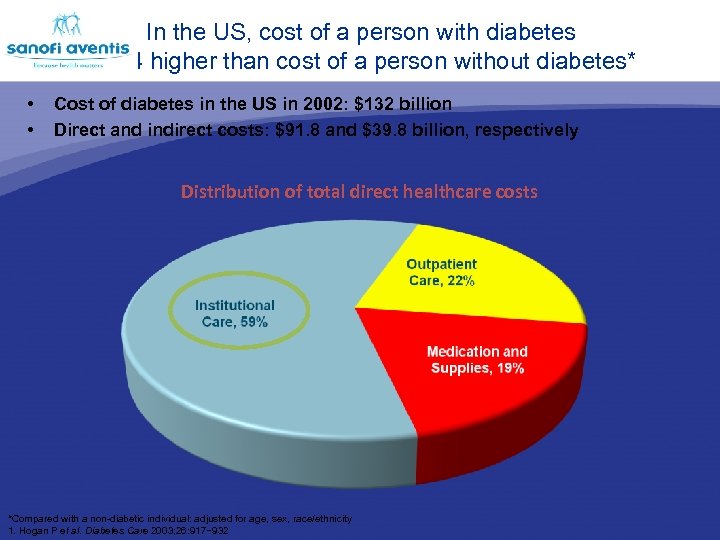
• The burden of diabetes on healthcare systems In the US, cost of a person with diabetes is 2. 4 higher than cost of a person without diabetes* • • Cost of diabetes in the US in 2002: $132 billion Direct and indirect costs: $91. 8 and $39. 8 billion, respectively Distribution of total direct healthcare costs *Compared with a non-diabetic individual: adjusted for age, sex, race/ethnicity 1. Hogan P et al. Diabetes Care 2003; 26: 917− 932
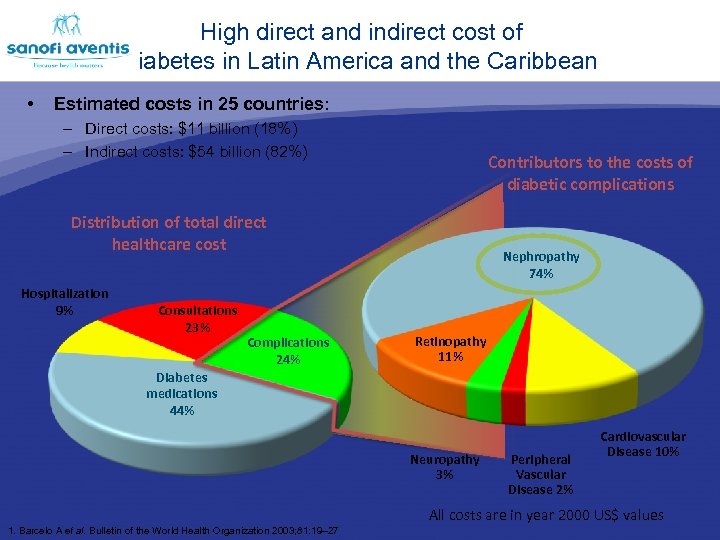
• The burden of diabetes on healthcare systems High direct and indirect cost of diabetes in Latin America and the Caribbean • Estimated costs in 25 countries: – Direct costs: $11 billion (18%) – Indirect costs: $54 billion (82%) Contributors to the costs of diabetic complications Distribution of total direct healthcare cost Hospitalization 9% Consultations 23% Complications 24% Nephropathy 74% Retinopathy 11% Diabetes medications 44% Neuropathy 3% Peripheral Vascular Disease 2% Cardiovascular Disease 10% All costs are in year 2000 US$ values 1. Barcelo A et al. Bulletin of the World Health Organization 2003; 81: 19– 27
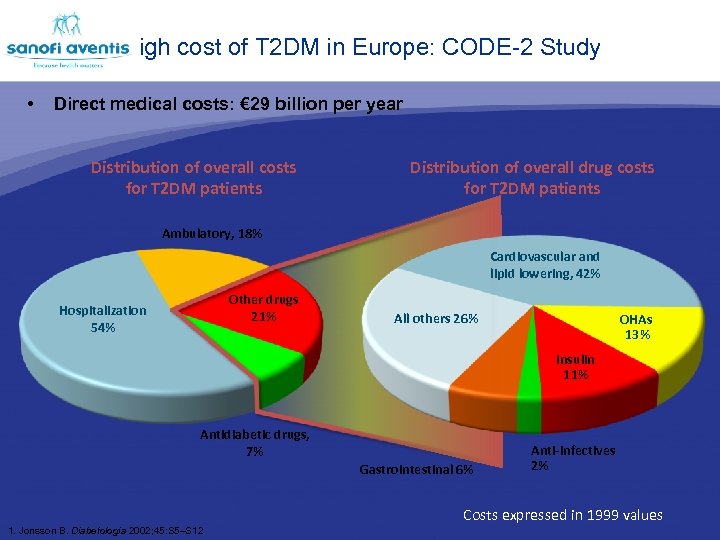
• The burden of diabetes on healthcare systems High cost of T 2 DM in Europe: CODE-2 Study • Direct medical costs: € 29 billion per year Distribution of overall costs for T 2 DM patients Distribution of overall drug costs for T 2 DM patients Ambulatory, 18% Cardiovascular and lipid lowering, 42% Other drugs 21% Hospitalization 54% All others 26% OHAs 13% Insulin 11% Antidiabetic drugs, 7% Gastrointestinal 6% Anti-infectives 2% Costs expressed in 1999 values 1. Jonsson B. Diabetologia 2002; 45: S 5–S 12
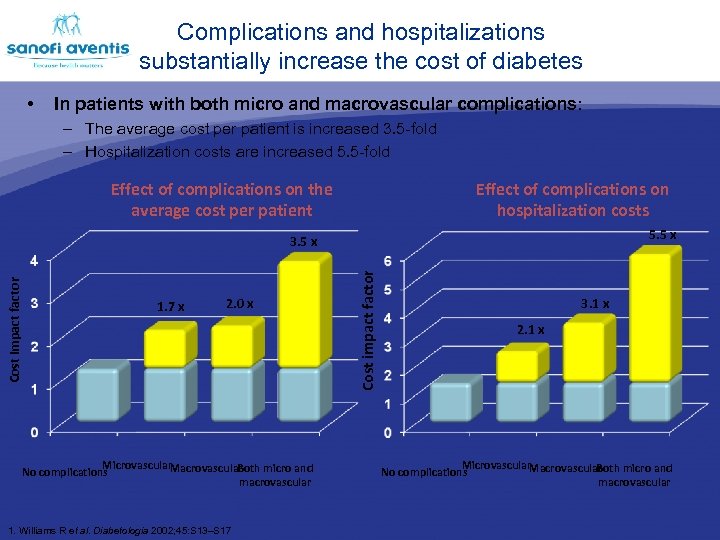
• The burden of diabetes on healthcare systems Complications and hospitalizations substantially increase the cost of diabetes • In patients with both micro and macrovascular complications: – The average cost per patient is increased 3. 5 -fold – Hospitalization costs are increased 5. 5 -fold Effect of complications on the average cost per patient Effect of complications on hospitalization costs 5. 5 x 1. 7 x 2. 0 x Microvascular Macrovascular Both micro and No complications macrovascular 1. Williams R et al. Diabetologia 2002; 45: S 13–S 17 Cost impact factor 3. 5 x 3. 1 x 2. 1 x Microvascular Macrovascular Both micro and No complications macrovascular
• The burden of diabetes on healthcare systems Cost of diabetes represents a significant share of healthcare resources Medical expenditures for people with diabetes are 2– 3 times higher than those without diabetes 1 • Costs increase with progression of complications 2 • Diabetes costs represent a significant share of total healthcare expenditures per country: * – – Italy: 6. 6%, Germany: 6. 5%, Netherlands: 1. 6%3 US: 11%4 Taiwan: 11. 5%5 Israel: 6. 9% (HMO budget; MHS)6 *Costs attributable to diabetes – Costs incurred by people with diabetes would represent a higher percentage; e. g. 19% for US MHS: Maccabi Healthcare Services 1. Rubin RJ et al. J Clin Endocrinol Metab 1994; 78: 809 A− 809 F 2. Brown JB et al. Arch Intern Med 1999; 159: 1873− 1880 3. Jonsson B et al. Diabetologia 2002; 45: S 5−S 12 4. Hogan P et al. Diabetes Care 2003; 26: 917− 932 5. Lin T et al. Diabetes Res Clin Pract 2001; 54(Suppl 1): 43− 46 6. Chodick G et al. Eur J Health Econ 2005; Vol 6(2): 166− 171
Burden of diabetes – summary (1) • Diabetes is an increasing epidemic worldwide: 1 – By 2030 the number of people with diabetes globally will exceed 438 million 1 – In developing countries, it will affect people aged 45− 65 years 1 • Diabetes is a lifelong condition with devastating consequences: – – – 1. 2. 3. 4. 5. 6. 7. 8/10 persons with diabetes die from CV events 4 The leading cause of blindness in adults 2, 3 The fifth leading cause of death worldwide 5 A disease associated with major psychological distress 6 A reduced quality of life 7 Wild S et al. Diabetes Care 2004; 27(5): 1047– 1053 UKPDS Group. Diabetes Res 1990; 13: 1– 11. Fong DS et al. Diabetes Care 2003; 26(Suppl. 1): S 99–S 102 Gray RP & Yudkin JS. Textbook of Diabetes 2 nd Edition, 1997. Blackwell Sciences Roglic G et al. Diabetes Care 2005; 28: 2130– 2135 Skovlund S et al. Diabetes Spectrum 2005; 18: 136– 142 Koopmanschap M. Diabetologia 2002; 45: S 18–S 22
Burden of diabetes – summary (2) • An increasing burden on healthcare systems: – Medical expenditures for people with diabetes are 2– 3 times higher than those without diabetes 1 – Diabetes costs represent a significant share of total healthcare expenditures per country – Costs increase with progression of complications 2 • Worsening glycemic control results in substantial cost increases: – For each 1% increase in Hb. A 1 c above 6%, the costs of diabetes increase by approximately 4, 10, 20 and 30%3 • Costs of lost production are at least as high as direct costs 1 1. http: //www. eatlas. idf. org/Costs_of_diabetes/ Last accessed 121206 – Diabetes Atlas second edition – IDF 2. Brown JB et al. Arch Intern Med 1999; 159: 1873− 1880 3. Gilmer et al. Diabetes Care 1997; 20(12): 1847– 1853
Скачать презентацию Section 1 Burden of diabetes The diabetes
d0fa2353acf8c9287c20030e28ed5476.ppt