 Скачать презентацию Secrets of Mobile Game Development Martin J Wells
78d199517903a8eb79a091568cee6452.ppt
- Количество слайдов: 31



Secrets of Mobile Game Development Martin J. Wells CTO, Tasman Studios Author, “J 2 ME Game Programming” (Premier Press 2004)
Overview Mobile Game Design n Game Production n Commercialisation n Post-mortem Comparison (Hyper-Gate vs. Club Soccer) n
Part 1 Mobile Game Design
Target Platform n Know your target platform n n n Embrace the limitations (be realistic) n n n Buy lots of phones Play lots of games Small screen size Limited content (graphics, sound) Slow performance Poor input Limited RAM (limited code) Base design on Nokia Series 40 (64 KB, MIDP 1, Colour)
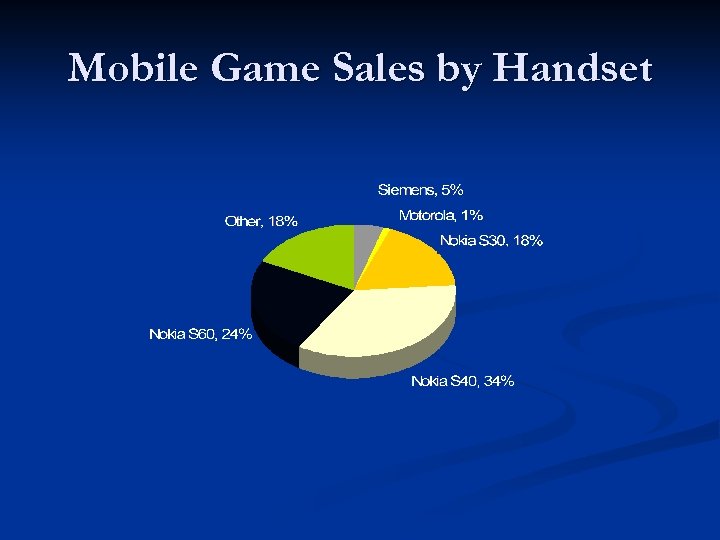
Mobile Game Sales by Handset
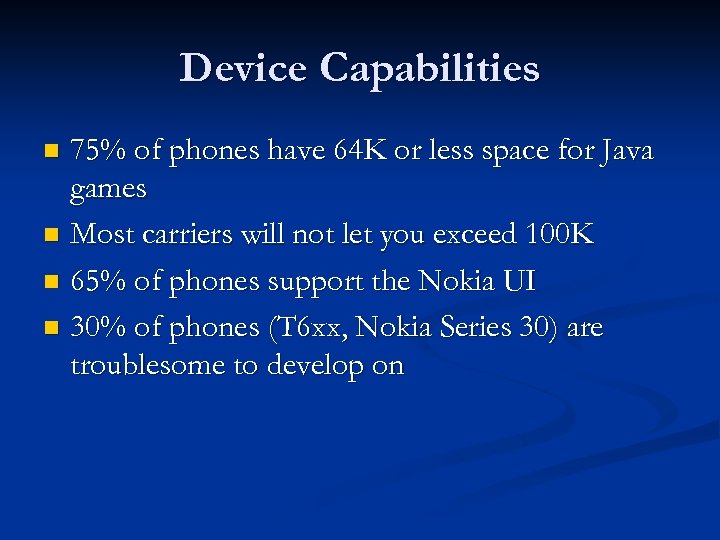
Device Capabilities 75% of phones have 64 K or less space for Java games n Most carriers will not let you exceed 100 K n 65% of phones support the Nokia UI n 30% of phones (T 6 xx, Nokia Series 30) are troublesome to develop on n
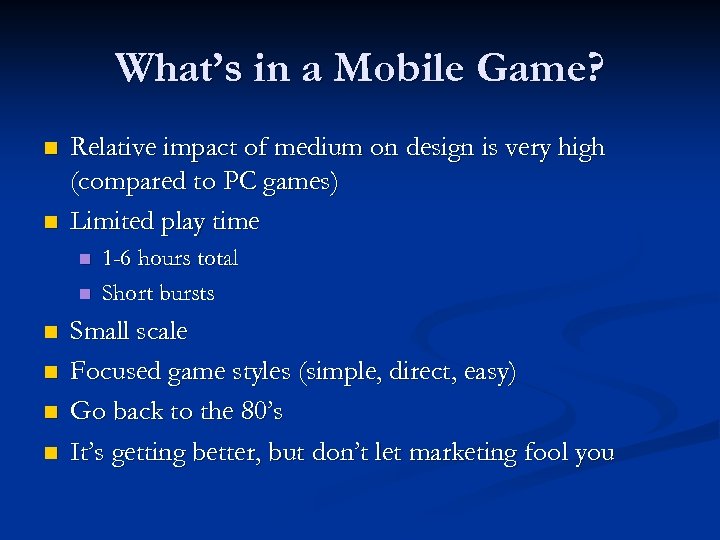
What’s in a Mobile Game? n n Relative impact of medium on design is very high (compared to PC games) Limited play time n n n 1 -6 hours total Short bursts Small scale Focused game styles (simple, direct, easy) Go back to the 80’s It’s getting better, but don’t let marketing fool you
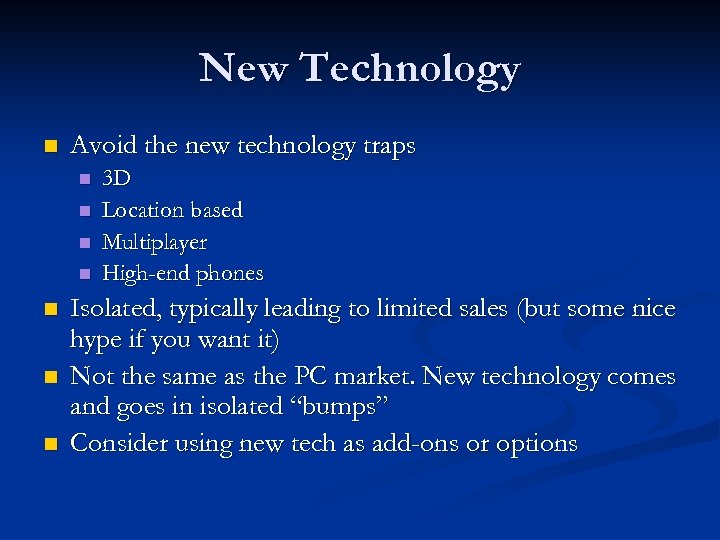
New Technology n Avoid the new technology traps n n n n 3 D Location based Multiplayer High-end phones Isolated, typically leading to limited sales (but some nice hype if you want it) Not the same as the PC market. New technology comes and goes in isolated “bumps” Consider using new tech as add-ons or options
Multiplayer? Yes, but not on your first game n Use an existing system n Mophun n Red Star n Terraplay n Bigger revenue, but smaller market n On-going n
The Secret to Mobile Game Design? Keep it simple
Part 2 Game Production
Development Time n Typical development time is 3 -4 months n n n Staff required: n n Devil is in the details Porting/testing can take 30% of dev time (up to 80% first time around) 1 programmer (full-time) 1 artist (half-time) Ad-hoc producer, designer, sound (depends on the final game) A small studio can produce 3 -5 games per year
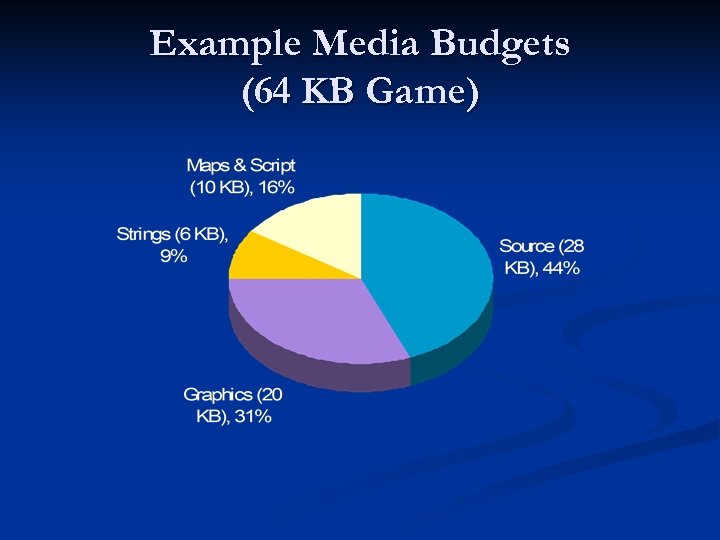
Example Media Budgets (64 KB Game)
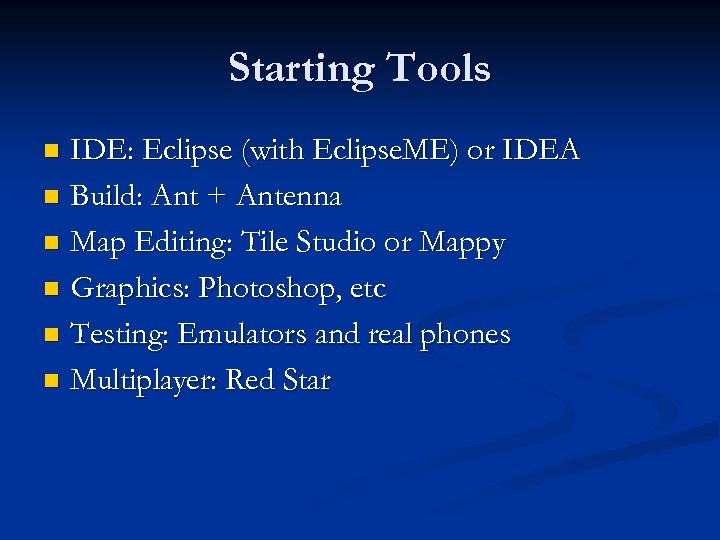
Starting Tools IDE: Eclipse (with Eclipse. ME) or IDEA n Build: Ant + Antenna n Map Editing: Tile Studio or Mappy n Graphics: Photoshop, etc n Testing: Emulators and real phones n Multiplayer: Red Star n
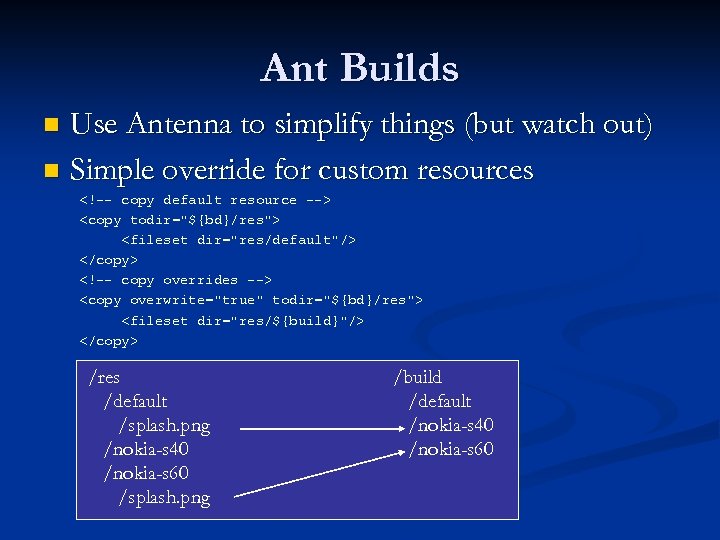
Ant Builds Use Antenna to simplify things (but watch out) n Simple override for custom resources n <!-- copy default resource --> <copy todir="${bd}/res"> <fileset dir="res/default"/> </copy> <!-- copy overrides --> <copy overwrite="true" todir="${bd}/res"> <fileset dir="res/${build}"/> </copy> /res /default /splash. png /nokia-s 40 /nokia-s 60 /splash. png /build /default /nokia-s 40 /nokia-s 60
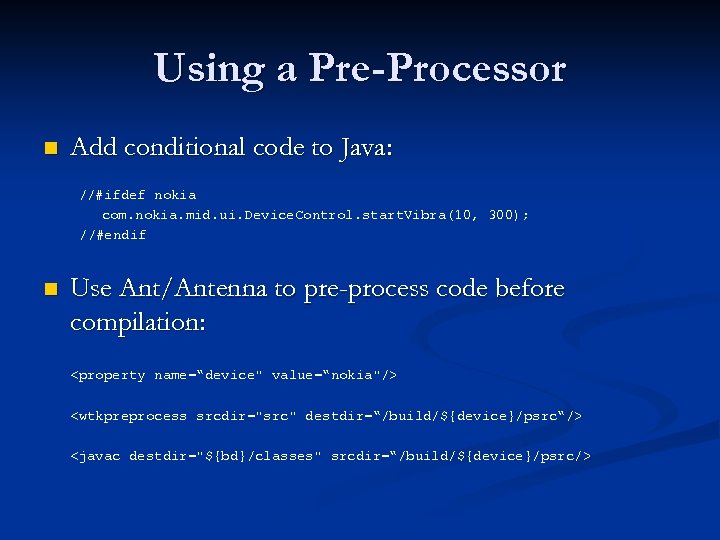
Using a Pre-Processor n Add conditional code to Java: //#ifdef nokia com. nokia. mid. ui. Device. Control. start. Vibra(10, 300); //#endif n Use Ant/Antenna to pre-process code before compilation: <property name=“device" value=“nokia"/> <wtkpreprocess srcdir="src" destdir=“/build/${device}/psrc“/> <javac destdir="${bd}/classes" srcdir=“/build/${device}/psrc/>
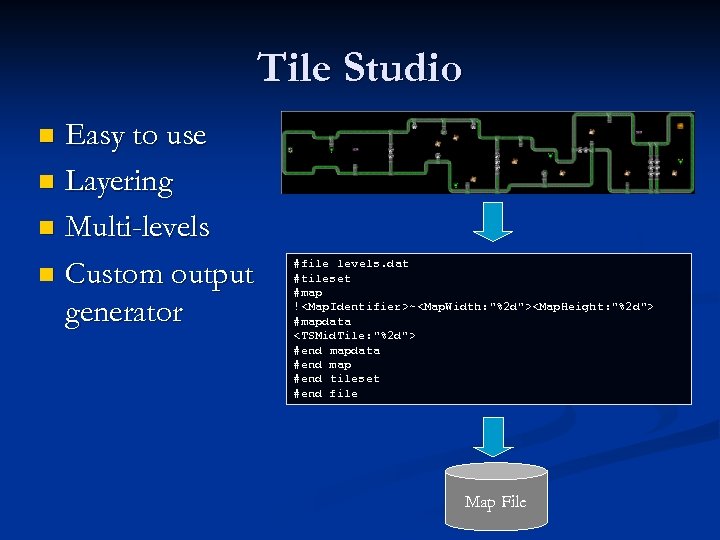
Tile Studio Easy to use n Layering n Multi-levels n Custom output generator n #file levels. dat #tileset #map !<Map. Identifier>~<Map. Width: "%2 d"><Map. Height: "%2 d"> #mapdata <TSMid. Tile: "%2 d"> #end mapdata #end map #end tileset #end file Map File
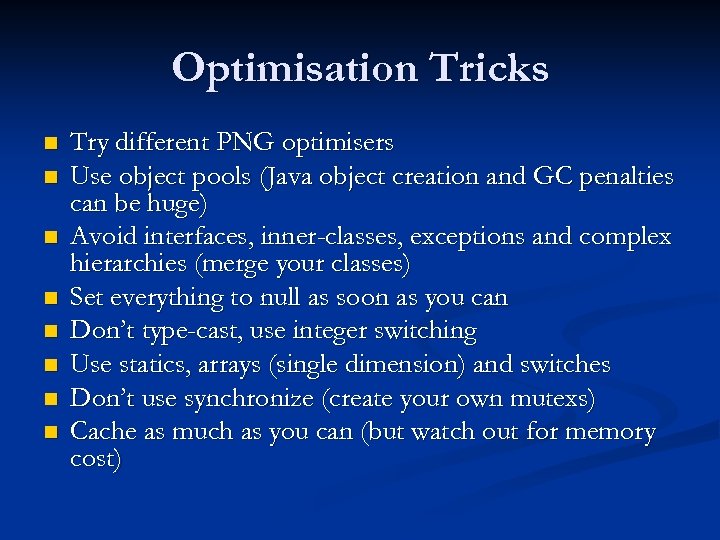
Optimisation Tricks n n n n Try different PNG optimisers Use object pools (Java object creation and GC penalties can be huge) Avoid interfaces, inner-classes, exceptions and complex hierarchies (merge your classes) Set everything to null as soon as you can Don’t type-cast, use integer switching Use statics, arrays (single dimension) and switches Don’t use synchronize (create your own mutexs) Cache as much as you can (but watch out for memory cost)
The Secret to Mobile Game Development? Test using real devices
Part 3 Commercialisation
Channels to Market n n n Carrier (direct handset) sales dominates the market You can no longer go direct, use publishers Lots of publishers (and lots of developers) n n Fifth Axis, Air. G, Digital Bridges, MForma, Tira Wireless, JAMDAT, Unplugged, … Portals/distributors can be supplements, but they wont earn you a living High inventory turnover means games only last in any single market for 1 -4 months Big, complex, market filled with islands of success
Expected Revenues n Expected revenue (first year): n Single player game: n Unbranded: n Branded: $10 K to $30 K $20 K to $80 K Multiplayer can add $10 K-40 K in ongoing revenue n Block-buster games (mega-brand, heavy promotion, all the right channels) $100 K to $500 K n
The Secret to Mobile Game Marketing? Get more than one publisher
Part 4 Hyper-Gate vs. Club Soccer
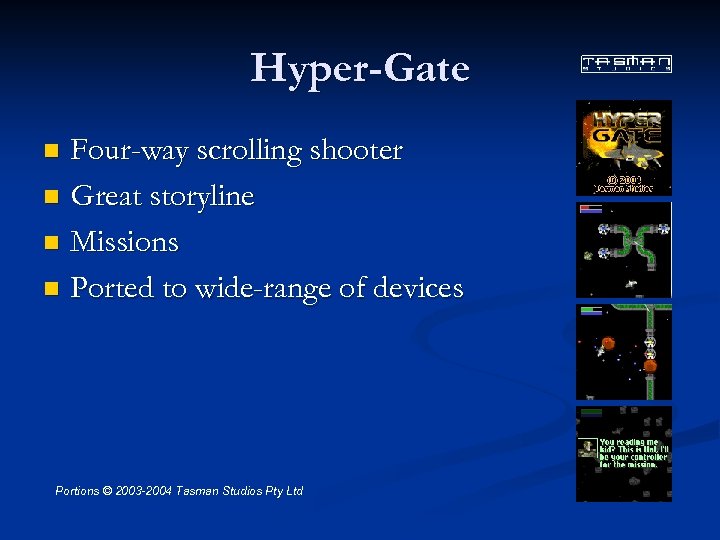
Hyper-Gate Four-way scrolling shooter n Great storyline n Missions n Ported to wide-range of devices n Portions © 2003 -2004 Tasman Studios Pty Ltd
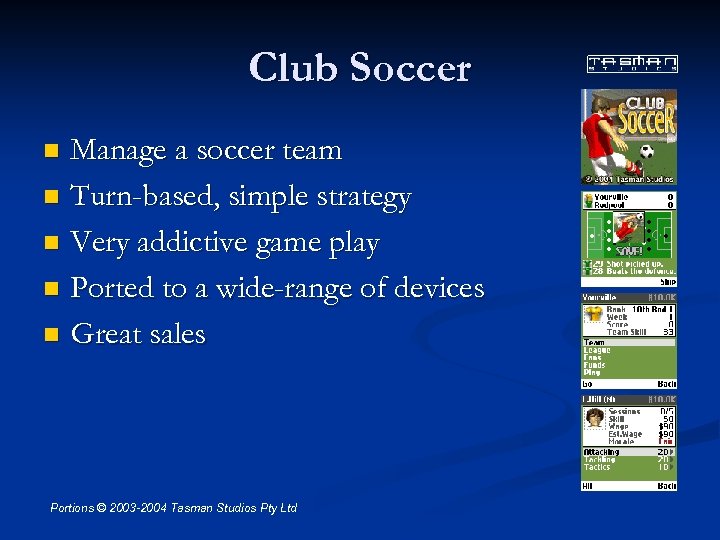
Club Soccer Manage a soccer team n Turn-based, simple strategy n Very addictive game play n Ported to a wide-range of devices n Great sales n Portions © 2003 -2004 Tasman Studios Pty Ltd
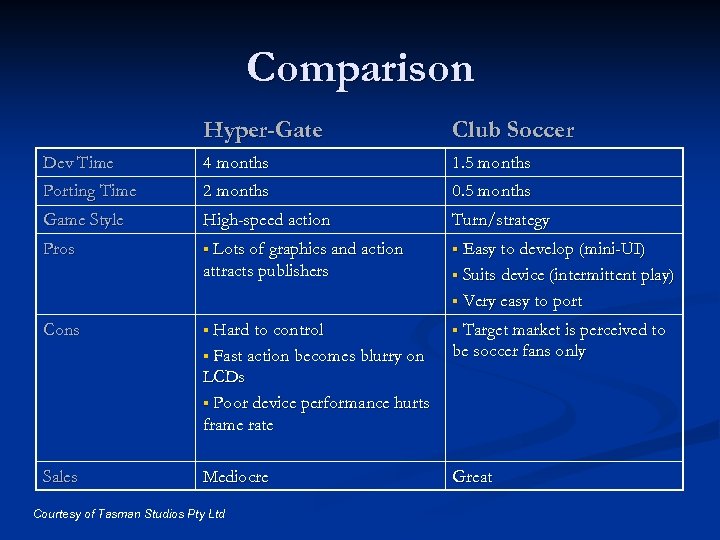
Comparison Hyper-Gate Club Soccer Dev Time 4 months 1. 5 months Porting Time 2 months 0. 5 months Game Style High-speed action Turn/strategy Pros § Lots of graphics and action attracts publishers § Cons § Hard to control § Fast action becomes blurry on LCDs § Poor device performance hurts frame rate § Sales Mediocre Great Courtesy of Tasman Studios Pty Ltd Easy to develop (mini-UI) § Suits device (intermittent play) § Very easy to port Target market is perceived to be soccer fans only
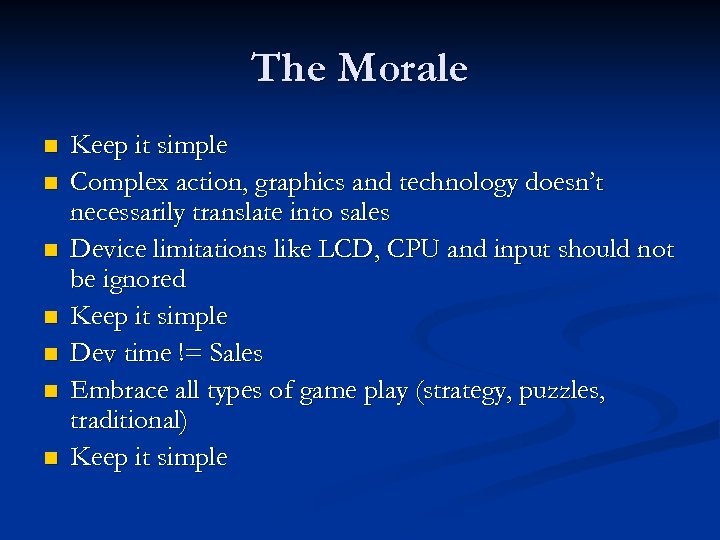
The Morale n n n n Keep it simple Complex action, graphics and technology doesn’t necessarily translate into sales Device limitations like LCD, CPU and input should not be ignored Keep it simple Dev time != Sales Embrace all types of game play (strategy, puzzles, traditional) Keep it simple
The (Ultimate) Secret to Mobile Game Development?
Play mobile games… no really
Thanks Questions?
Скачать презентацию Secrets of Mobile Game Development Martin J Wells
78d199517903a8eb79a091568cee6452.ppt