


 Скачать презентацию Secondary tertiary transitions and the MIT Tertiary High
0422f2d43bc97b103c80c0d366c5242a.ppt
- Количество слайдов: 41
 Secondary tertiary transitions and the MIT Tertiary High School Stuart Middleton Manukau Institute of Technology, NZ
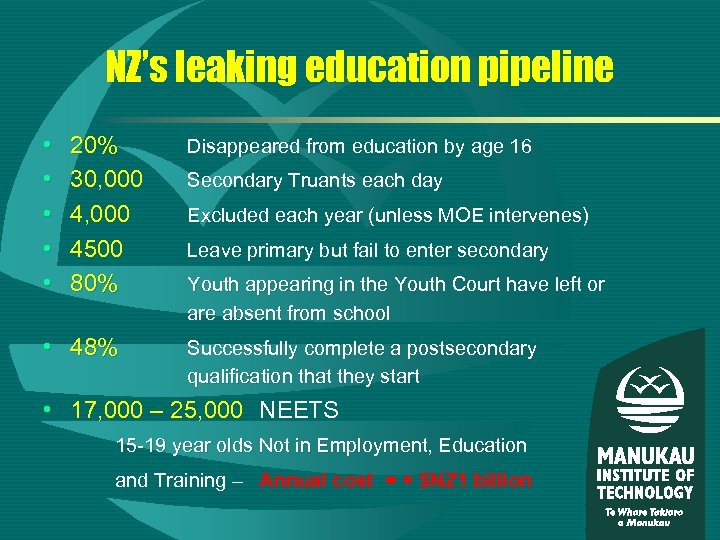 NZ’s leaking education pipeline • • • 20% 30, 000 4500 80% • 48% Disappeared from education by age 16 Secondary Truants each day Excluded each year (unless MOE intervenes) Leave primary but fail to enter secondary Youth appearing in the Youth Court have left or are absent from school Successfully complete a postsecondary qualification that they start • 17, 000 – 25, 000 NEETS 15 -19 year olds Not in Employment, Education and Training – Annual cost = + $NZ 1 billion
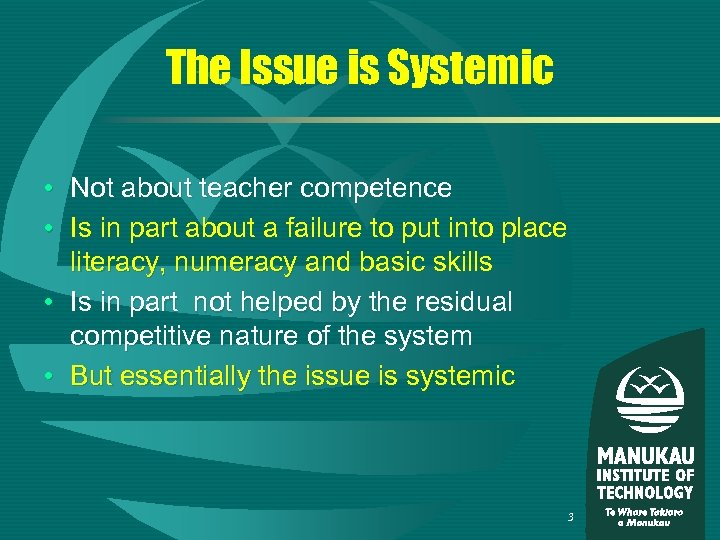 The Issue is Systemic • Not about teacher competence • Is in part about a failure to put into place literacy, numeracy and basic skills • Is in part not helped by the residual competitive nature of the system • But essentially the issue is systemic 3
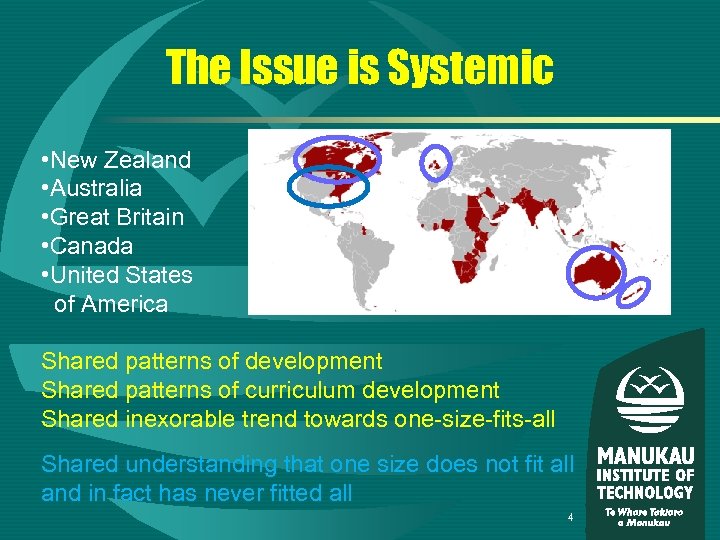 The Issue is Systemic • New Zealand • Australia • Great Britain • Canada • United States of America Shared patterns of development Shared patterns of curriculum development Shared inexorable trend towards one-size-fits-all Shared understanding that one size does not fit all and in fact has never fitted all 4
 Students But who are we successful with? Students who are: • White • English speaking • Middle class • Academically well-prepared by K-12 system • From homes with experience with HE • etc And more recently…. . • The equivalent groups from other countries 5
 Students And who do we find to be a challenge? Students who are: • From low SES status • Have NESB backgrounds • From recent migrant groups • Are first-in-family / first generation students • Lack adequate academic preparation (K-12) • Second chance students • Older age groups • Part-time students 6
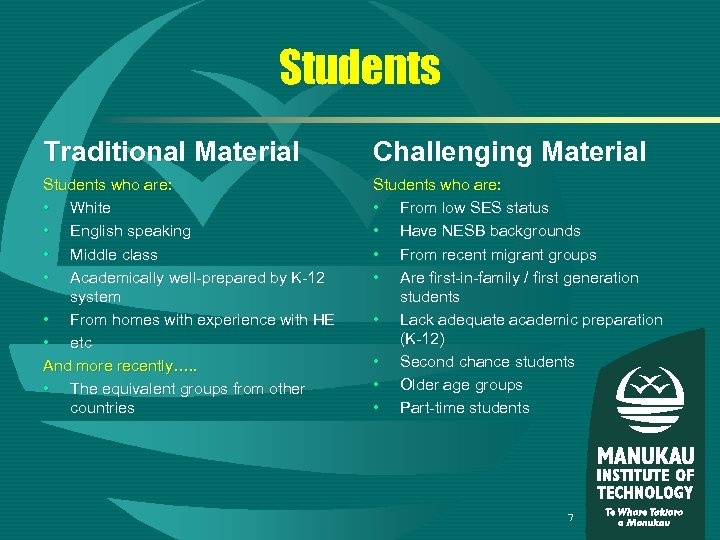 Students Traditional Material Challenging Material Students who are: • White • English speaking • Middle class • Academically well-prepared by K-12 system • From homes with experience with HE • etc And more recently…. . • The equivalent groups from other countries Students who are: • From low SES status • Have NESB backgrounds • From recent migrant groups • Are first-in-family / first generation students • Lack adequate academic preparation (K-12) • Second chance students • Older age groups • Part-time students 7
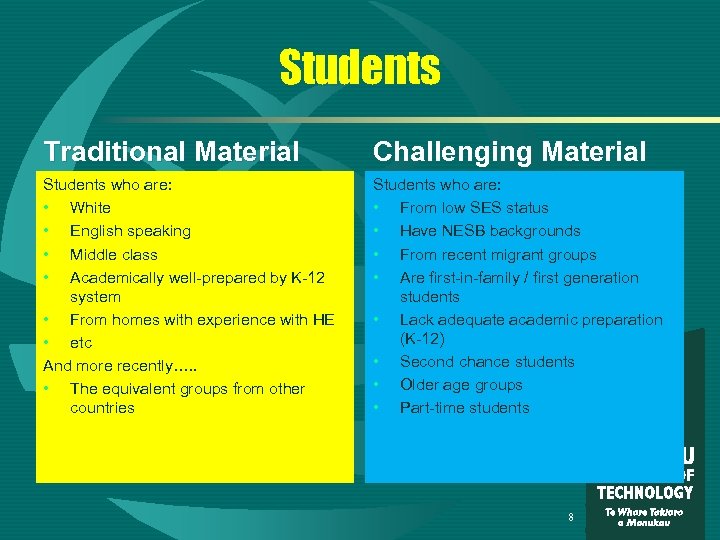 Students Traditional Material Challenging Material Students who are: • White • English speaking • Middle class • Academically well-prepared by K-12 system • From homes with experience with HE • etc And more recently…. . • The equivalent groups from other countries Students who are: • From low SES status • Have NESB backgrounds • From recent migrant groups • Are first-in-family / first generation students • Lack adequate academic preparation (K-12) • Second chance students • Older age groups • Part-time students 8
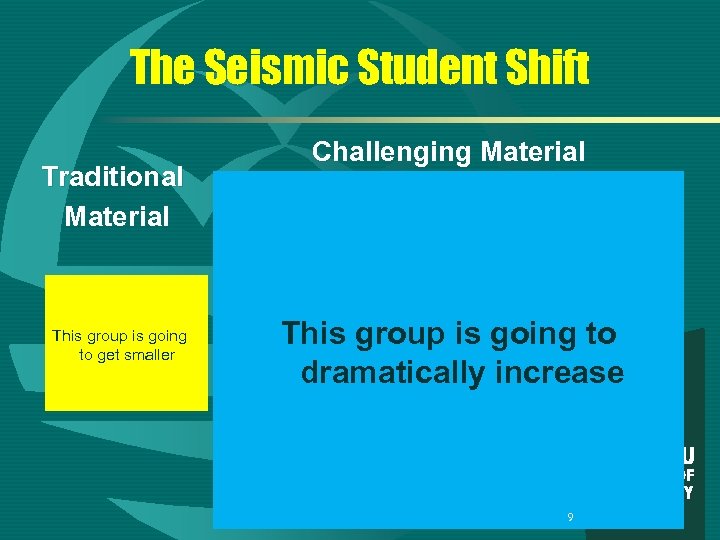 The Seismic Student Shift Traditional Material This group is going to get smaller Challenging Material This group is going to dramatically increase 9
 The key challenges The education system is going to have to learn: • to work with a student body that will require higher levels of maintenance; • To bring success to students who currently get disproportionate levels of failure; • to work in ways that maximise connection between providers, communities and the workplace. 10
 The key challenges • We are going to have to rethink the notion of sectors • We are going to have to get used to the idea that we no longer “own” students because of their ages • We are going to have to free up ideas of students being “in” school in order to be “at” school 11
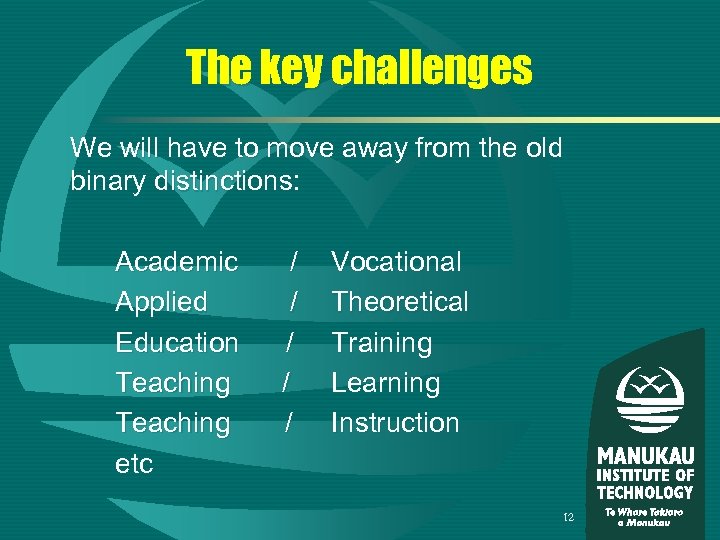 The key challenges We will have to move away from the old binary distinctions: Academic Applied Education Teaching etc / / / Vocational Theoretical Training Learning Instruction 12
 The map we will increasingly work to will have the following features. . – Enabling programmes – Use of devices such as scorecards to chart progress and performance – Increased focus on a diversity of activity in Campus Life Programmes – New approaches to recruitment that reach into new “markets” – Increased consideration of learning communities 13
 The map we will increasingly work to will have the following features. . All levels of the education system will be required to greatly increase performance on addressing: – – – Pathway confusion Isolation / alienation Financial hardship Academic preparation Quality of K-12 schooling The seamless jagged edge 14
 Opportunities Removed • Unemployment • On-the-job training • Exit points decrease • “Night Class” became recreational • Apprenticeships disappeared • Targetted schemes disappear • Technology impacts • Unskilled and low skilled employment devalued Therefore • Early school leavers with nowhere to go • Educational failure becomes explicit and a threat to well-being.
 Those who ignore history. . . This all happened in a specific period of time 1960 - 1990 16
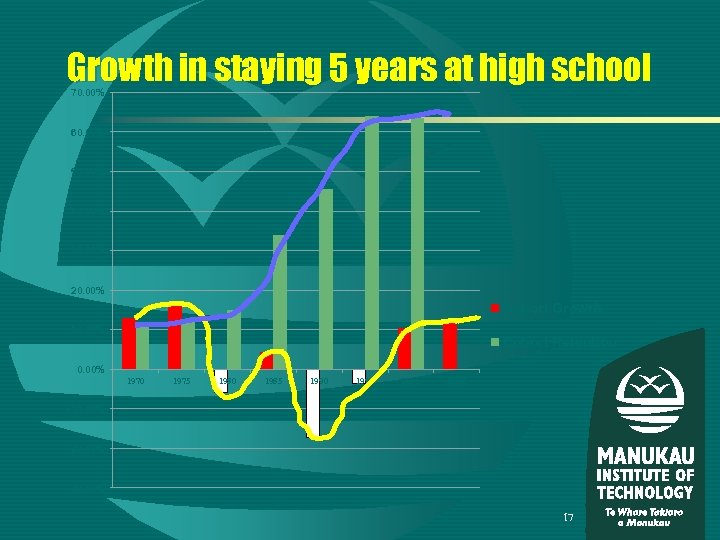 Growth in staying 5 years at high school 70. 00% 60. 00% 50. 00% 40. 00% 30. 00% 20. 00% Cohort Growth 10. 00% Cohort Retention 0. 00% 1970 1975 1980 1985 1990 1995 2000 2005 -10. 00% -20. 00% -30. 00% 17
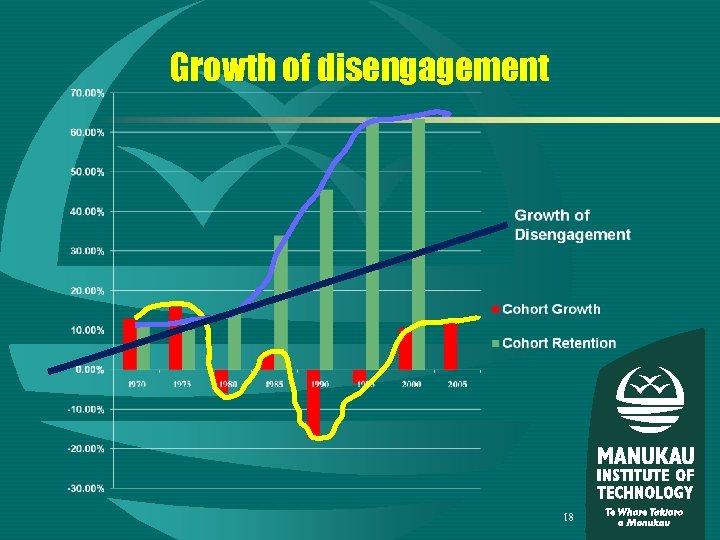 Growth of disengagement 18
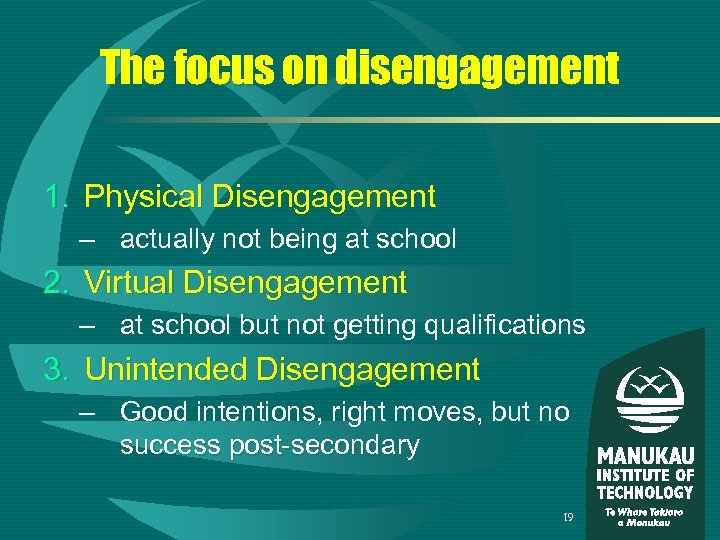 The focus on disengagement 1. Physical Disengagement – actually not being at school 2. Virtual Disengagement – at school but not getting qualifications 3. Unintended Disengagement – Good intentions, right moves, but no success post-secondary 19
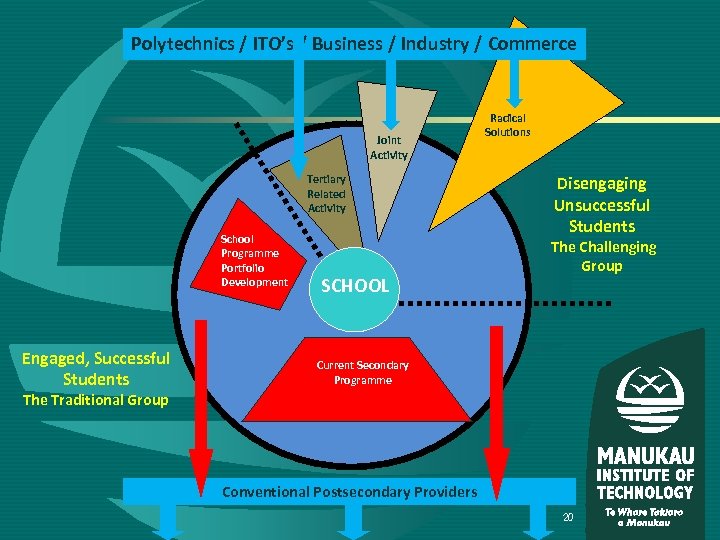 Polytechnics / ITO’s / Business / Industry / Commerce Joint Activity Tertiary Related Activity School Programme Portfolio Development Engaged, Successful Students SCHOOL Radical Solutions Disengaging Unsuccessful Students The Challenging Group Current Secondary Programme The Traditional Group Conventional Postsecondary Providers 20
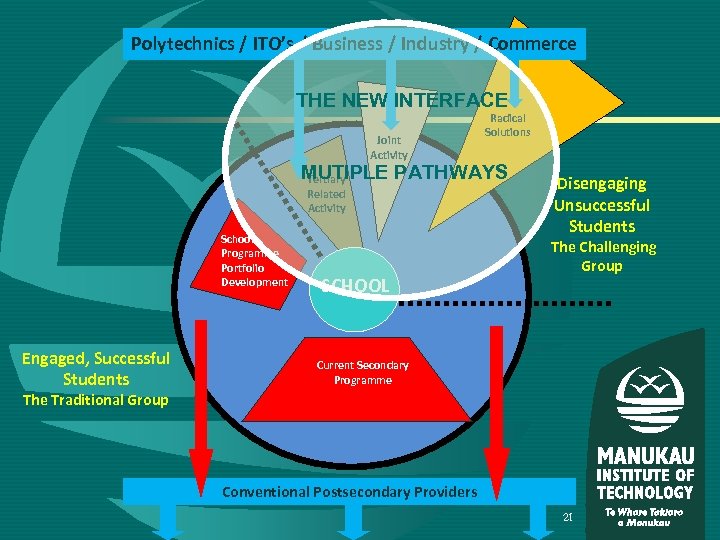 Polytechnics / ITO’s / Business / Industry / Commerce THE NEW INTERFACE Joint Activity Radical Solutions MUTIPLE PATHWAYS Tertiary Related Activity School Programme Portfolio Development Engaged, Successful Students SCHOOL Disengaging Unsuccessful Students The Challenging Group Current Secondary Programme The Traditional Group Conventional Postsecondary Providers 21
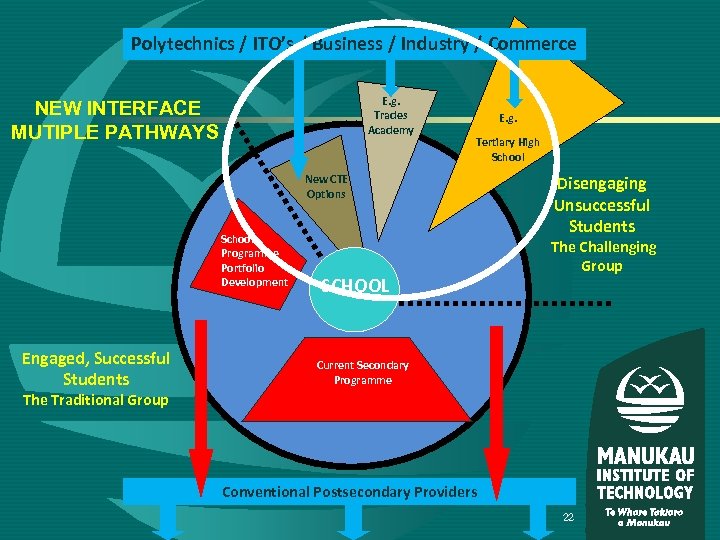 Polytechnics / ITO’s / Business / Industry / Commerce E. g. Trades Academy NEW INTERFACE MUTIPLE PATHWAYS E. g. Tertiary High School New CTE Options School Programme Portfolio Development Engaged, Successful Students SCHOOL Disengaging Unsuccessful Students The Challenging Group Current Secondary Programme The Traditional Group Conventional Postsecondary Providers 22
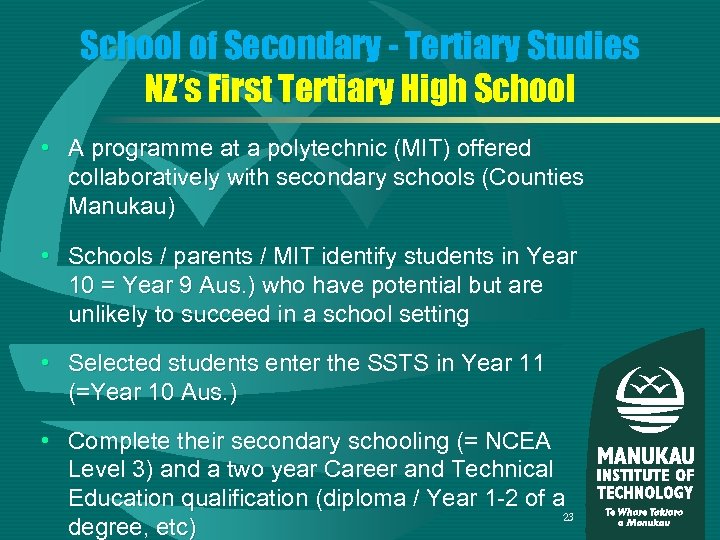 School of Secondary - Tertiary Studies NZ’s First Tertiary High School • A programme at a polytechnic (MIT) offered collaboratively with secondary schools (Counties Manukau) • Schools / parents / MIT identify students in Year 10 = Year 9 Aus. ) who have potential but are unlikely to succeed in a school setting • Selected students enter the SSTS in Year 11 (=Year 10 Aus. ) • Complete their secondary schooling (= NCEA Level 3) and a two year Career and Technical Education qualification (diploma / Year 1 -2 of a 23 degree, etc)
 Students targeted for the programme are likely to be: • • • underperforming and likely to fail at school; pose a potential threat of disengagement; likely to finish school with little or no qualifications; at risk educationally but not yet in risk interested in a career path that is appropriate to an institute of technology; • Will be reflective of the communities of Counties Manukau i. e. Maori, Pasifika etc. • from a low decile school and/or a low income family; • first-in-family to undertake tertiary education and training. 24
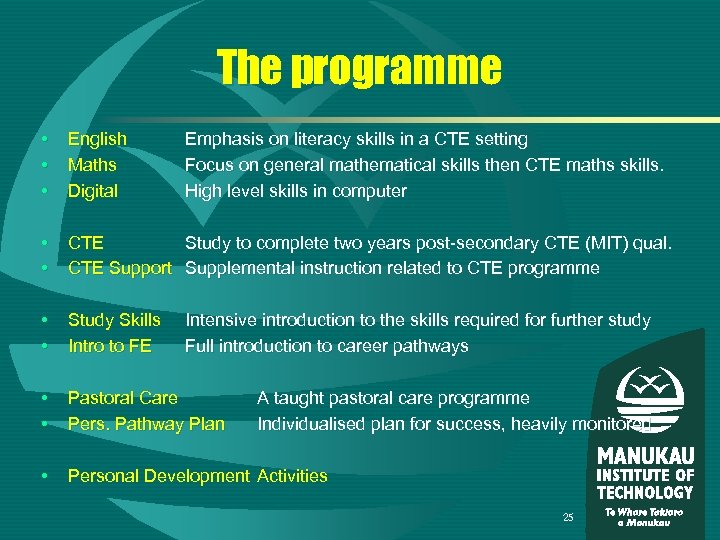 The programme • • • English Maths Digital • • CTE Study to complete two years post-secondary CTE (MIT) qual. CTE Support Supplemental instruction related to CTE programme • • Study Skills Intro to FE • • Pastoral Care Pers. Pathway Plan • Personal Development Activities Emphasis on literacy skills in a CTE setting Focus on general mathematical skills then CTE maths skills. High level skills in computer Intensive introduction to the skills required for further study Full introduction to career pathways A taught pastoral care programme Individualised plan for success, heavily monitored 25
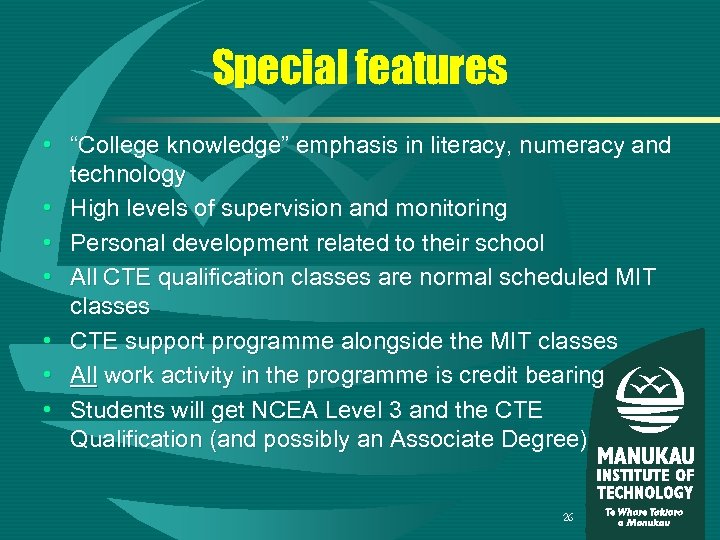 Special features • “College knowledge” emphasis in literacy, numeracy and technology • High levels of supervision and monitoring • Personal development related to their school • All CTE qualification classes are normal scheduled MIT classes • CTE support programme alongside the MIT classes • All work activity in the programme is credit bearing • Students will get NCEA Level 3 and the CTE Qualification (and possibly an Associate Degree) 26
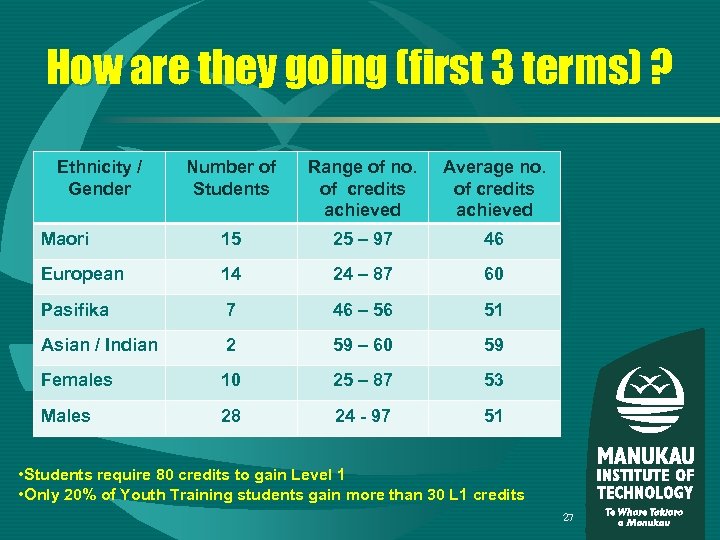 How are they going (first 3 terms) ? Ethnicity / Gender Number of Students Range of no. of credits achieved Average no. of credits achieved Maori 15 25 – 97 46 European 14 24 – 87 60 Pasifika 7 46 – 56 51 Asian / Indian 2 59 – 60 59 Females 10 25 – 87 53 Males 28 24 - 97 51 • Students require 80 credits to gain Level 1 • Only 20% of Youth Training students gain more than 30 L 1 credits 27
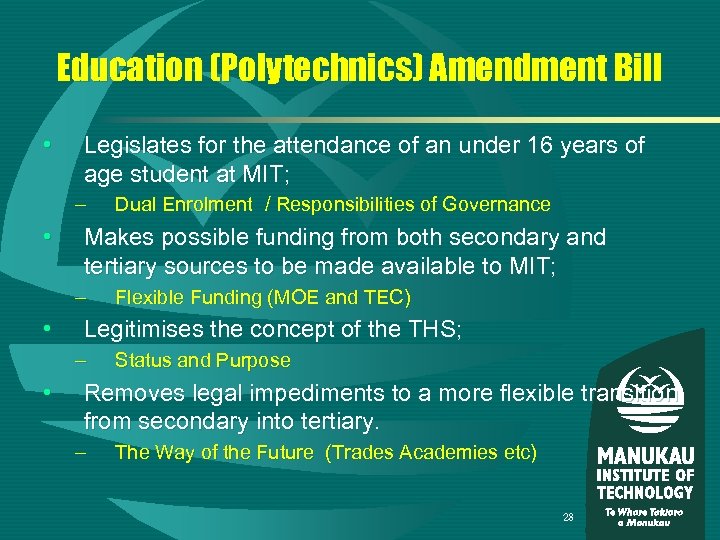 Education (Polytechnics) Amendment Bill • Legislates for the attendance of an under 16 years of age student at MIT; – • Makes possible funding from both secondary and tertiary sources to be made available to MIT; – • Flexible Funding (MOE and TEC) Legitimises the concept of the THS; – • Dual Enrolment / Responsibilities of Governance Status and Purpose Removes legal impediments to a more flexible transition from secondary into tertiary. – The Way of the Future (Trades Academies etc) 28
 Nostalgia is History without the Pain The THS is not re-inventing Technical High Schools. Rather it is. . . – Offering new purpose to students likely to disengage through early identification of vocational and career pathways; – Removing E. N. O. R. – Bridges to Nowhere – Wrapping holistic support around the programme – Socializing younger students into a postsecondary environment – Not taking students out of school but keeping them in school but not at school 29
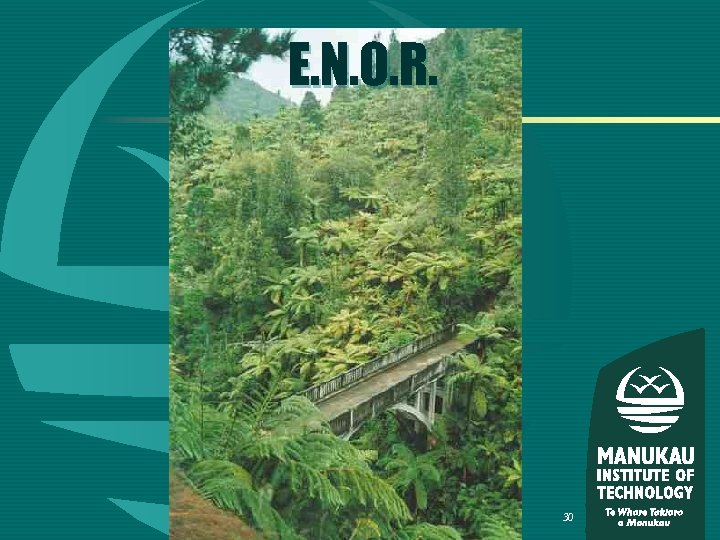 E. N. O. R. 30
 Nostalgia is History without the Pain The THS is not re-inventing Technical High Schools. Rather it is. . . – Offering new purpose to students likely to disengage through early identification of vocational and career pathways; – Removing E. N. O. R. – Bridges to Nowhere – Wrapping holistic support around the programme – Socializing younger students into a postsecondary environment – Not taking students out of school but keeping them in school but not at school 31
 What does the THS challenge? • The usefulness of the notion of sectors • Ownership of students based on age • The ability of the system to replace hard boundaries with porous transition points • Represents a vehicle for expressing Youth Guarantee (but not the only one) 32
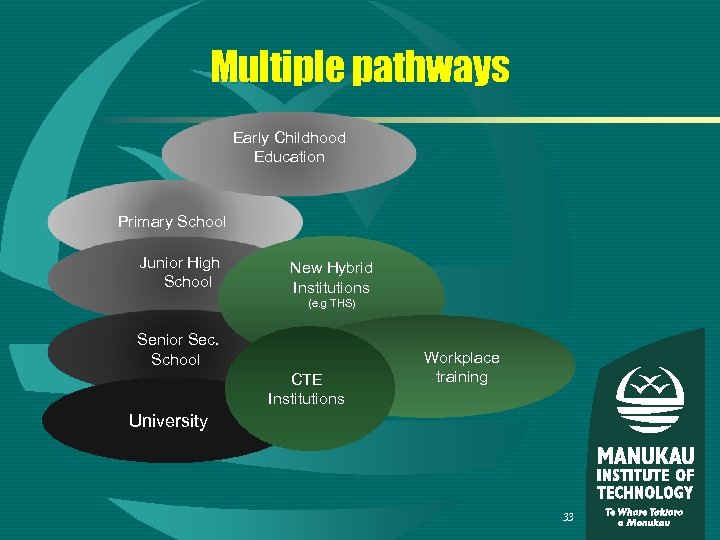 Multiple pathways Early Childhood Education Primary School Junior High School New Hybrid Institutions (e. g THS) Senior Sec. School CTE Institutions Workplace training University 33
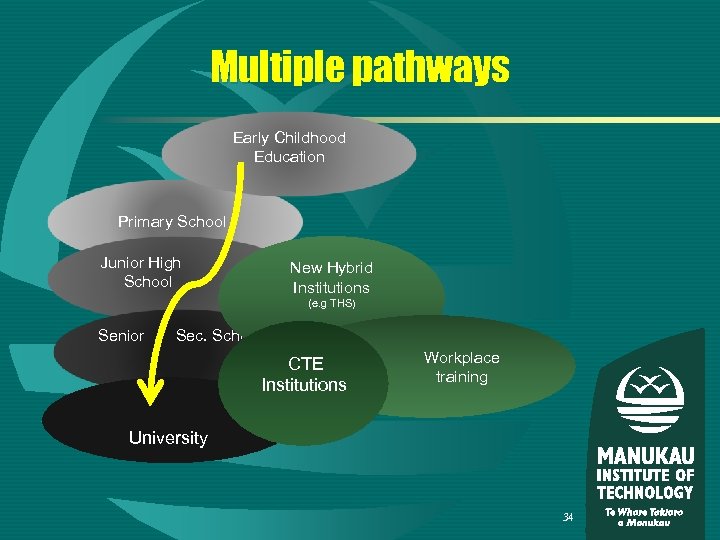 Multiple pathways Early Childhood Education Primary School Junior High School New Hybrid Institutions (e. g THS) Senior Sec. School CTE Institutions Workplace training University 34
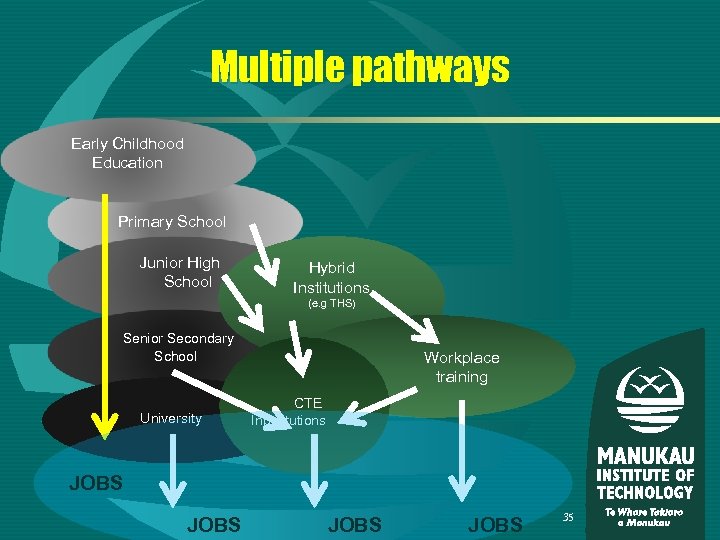 Multiple pathways Early Childhood Education Primary School Junior High School Hybrid Institutions (e. g THS) Senior Secondary School University Workplace training CTE Inbstitutions JOBS 35
 The Challenge is Global • The international fixation with increasing the number of conventional degree graduates will not meet the skill needs of the economies • All of us will have to work differently, with different groups of students in different kinds of ways in different spaces and for different purposes. 36
 The way ahead • Multiple pathways will be the focus of the future • The pathways will be both academic and vocational • The pathways will require porous boundaries between providers, flexible options for learners, and agreed shared outcomes for students • We will need to develop a new parity of esteem between providers of different kinds at different levels • It will require all of us to tackle the issues with one focus (the student) – funding, credentials, crossboundary credits, tracking students, supporting students and so on. It will not be easy. 37
 MIT Centre for Studies in Multiple Pathways • The purpose of the CSMP is: – To be a centre committed to understanding the pathways between secondary and post-secondary education; – To act as a clearhing house for information, research findings and developments(NZ and international) related to pathways; – To develop networks and partnerships ( NZ and international); – To promote events, seminars and conferences bringing together people engaged in best practice in this field; – To maintain a clear focus on practical responses to issues. • 38
 Why we do it ! To engage in critical post-modern research is to take part in a process of critical world making, guided by the shadowed outline of a dream of a world less conditioned by misery, suffering and the politics of deceit. It is, in short, a pragmatics of hope in an age of cynical reason. Kincheloe and Mc. Laren 39
 Simply by sailing in a new direction You could enlarge the world……. …… Who reaches A future down for us from the high shelf Of spiritual daring? Curnow 40
 Dr Stuart Middleton Diirector External Relations Manukau Institute of Technology stuart. middleton@manukau. ac. nz www. stuartmiddleton. co. nz www. edtalknz. com 41