


 Скачать презентацию SECONDARY INTERVENTIONS TRAINING Teri Lewis Oregon State University
6df97eec2a1f0205f08923e42319d3a0.ppt
- Количество слайдов: 151
 SECONDARY INTERVENTIONS TRAINING Teri Lewis Oregon State University
 INTRODUCTION
 The Challenge • Students come to school without skills to respond to instructional and behavioral expectations (Sprague, Sugai & Walker, 1998). • Teachers report that “uncivil” behavior is increasing and is a threat to effective learning (Skiba and Peterson, 2000). • Students who display severe problem behavior are at-risk for segregated placement (Reichle, 1990).
 The Challenge Exclusion and punishment are the most common responses to severe problem behavior in schools (Lane & Murakami, 1987; Patterson, Reid & Dishon, 1992). Exclusion and punishment are ineffective at producing long-term reduction in problem behavior (Costenbader & Markson, 1998; Walker et al. , 1996).
 The Challenge Punishing problem behaviors, without a proactive support system, is associated with increases in: • Aggression • Vandalism • Truancy • Dropping out
 The Response • Need a prevention focus “Schools that are safe, effective, and controlled are not accidents. ” (Sugai, Sprague, Horner & Walker, 2000) • Need to build school capacity to support all students • Need a continuum of behavior support • Level and intensity of intervention matches severity of problem
 “Positive Behavior Support” PBS is a broad range of systemic & individualized strategies for achieving important social & learning outcomes while preventing problem behavior with all students.
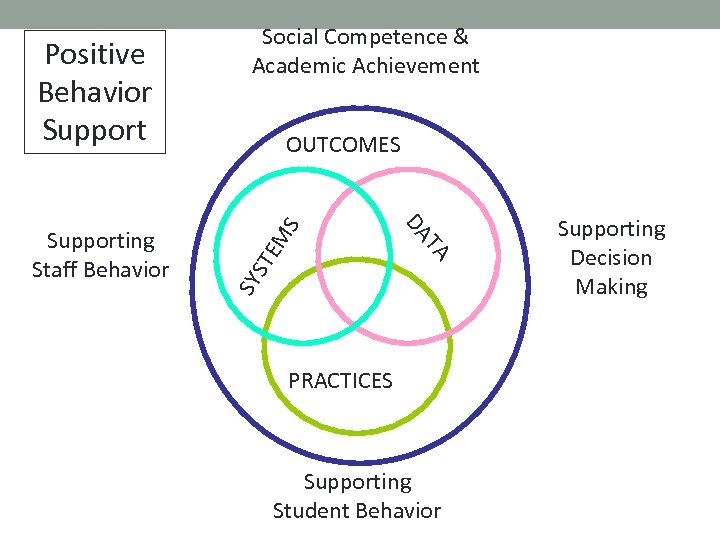 S EM ST A T DA Supporting Staff Behavior OUTCOMES SY Positive Behavior Support Social Competence & Academic Achievement PRACTICES Supporting Student Behavior Supporting Decision Making
 Prerequisites • Effective & proactive School-wide system in place • Team-based problem solving • Local behavioral capacity • Functional assessment-based behavior support planning • Social skills programming • Behavioral interventions • Administrator participation
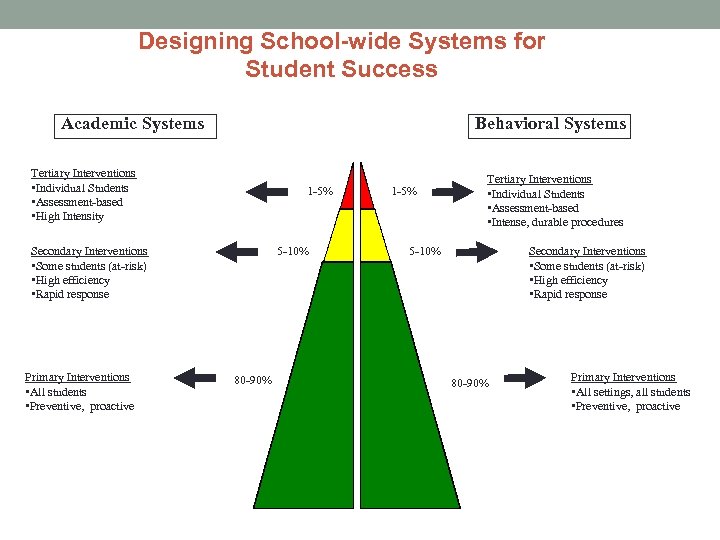 Designing School-wide Systems for Student Success Academic Systems Behavioral Systems Tertiary Interventions • Individual Students • Assessment-based • High Intensity 1 -5% Secondary Interventions • Some students (at-risk) • High efficiency • Rapid response Primary Interventions • All students • Preventive, proactive 5 -10% 80 -90% 1 -5% Tertiary Interventions • Individual Students • Assessment-based • Intense, durable procedures 5 -10% Secondary Interventions • Some students (at-risk) • High efficiency • Rapid response 80 -90% Primary Interventions • All settings, all students • Preventive, proactive
 School-wide discipline is… 1. Identify a common purpose and approach to discipline 2. Define a clear set of positive expectations and behaviors 3. Implement procedures for teaching expected behavior 4. Differentiate supports from a continuum of procedures for encouraging expected behavior 5. Differentiate supports from a continuum of procedures for discouraging inappropriate behavior 6. Implement procedures for on-going monitoring and evaluation
 Training Objectives Review fundamentals of systems approach Understand elements of secondary interventions Identify components of secondary intervention process Develop action plan as to how secondary interventions will be implemented
 OVERVIEW OF INDIVIDUAL STUDENT SYSTEMS (ISS)
 Purpose To describe considerations & procedures for developing & sustaining individual student systems
 Factors & Challenges to ISS 1. Problem behaviors are high intensity &/or frequency. 2. Too many students display significant problem behavior at any one time. 3. Problem behaviors are disrupting learning & teaching environments. 4. Problem behaviors are difficult to understand. 5. Interventions are ineffective.
 Factors & Challenges to ISS 6. Insufficient number of minutes to collect information, conduct meetings, implement & monitor plans. 7. Administrative leadership & support is lacking, unavailable, or underdeveloped. 8. Staff are unable or untrained to implement interventions, & lack opportunities for continuous & applied professional development.
 Factors & Challenges to ISS 9. Overemphasis on form, policy, or regulation rather than on process. 10. Lack of continuum of positive behavior support.
 Requirements for ISS • Behavior must be considered within context in which it is observed. • As intensity of problem behavior increases, so must intensity & complexity of functional behavioral assessment & behavior support planning process.
 Requirements for ISS • Individuals who develop & implement behavior support plans must be behaviorally competent & able to… • conduct fluently functional behavioral assessment- based behavior intervention planning. • facilitate efficient development, implementation, evaluation of behavior support plans. • collect & analyze student performance data. • develop academic & social behavior support plans that are based on research validated practices.
 Requirements for ISS • Decisions regarding effectiveness & efficiency of implementation of behavior support plan must be based in data. • Efficiency & effectiveness of implementation system of individual student support are related directly to effectiveness & efficiency of school-wide behavior support systems for all students, staff, & settings.
 Requirements for ISS • The longer problem behavior has been occurring, the more resistant it may be to intervention. • Staff need sustained & effective support to respond effectively & efficiently to significant problem behavior. • Efficient team-based approach & process to problem solving must be in place.
 Universal Interventions • School-wide discipline system for all students, staff, & settings that is effective for “ 80%” of students. • • • Clearly & positively stated expectations. Procedures for teaching expectations. Continuum of procedures for encouraging expectations. Continuum of procedures for discouraging rule violations. Procedures for monitoring & modifying procedures.
 Targeted Group Interventions (Secondary) Specialized group administered system for students who display high-risk problem behavior & are unresponsive to universal interventions. • • Functional assessment based intervention decisions. Daily behavioral monitoring. Regular & frequent opportunities for positive reinforcement. Home-school connection. Individualized academic accommodations for academic success. Planned social skills instruction. Behaviorally based interventions.
 Individual Interventions Specialized individually administered system for students who display most challenging problem behavior & are unresponsive to targeted group interventions. • • • Simple request for assistance. Immediate response (24 -48 hours). Functional behavioral assessment-based behavior support planning. Team-based problem solving process. Data-based decision making. Comprehensive service delivery derived from a wraparound process.
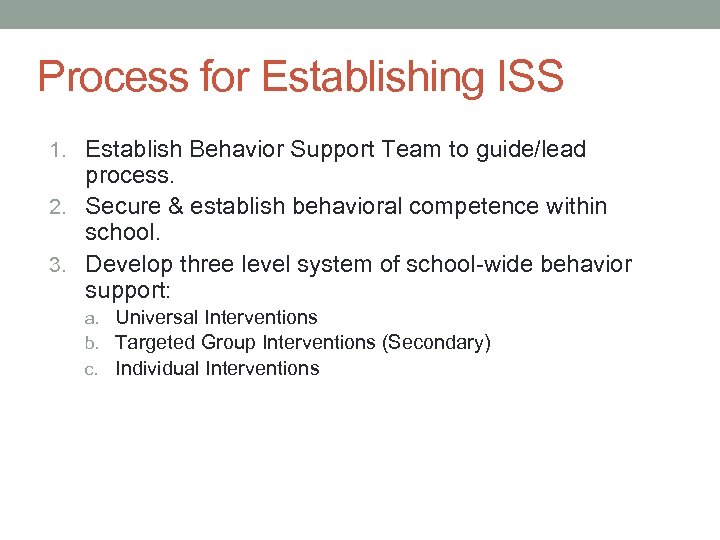 Process for Establishing ISS 1. Establish Behavior Support Team to guide/lead process. 2. Secure & establish behavioral competence within school. 3. Develop three level system of school-wide behavior support: a. Universal Interventions b. Targeted Group Interventions (Secondary) c. Individual Interventions
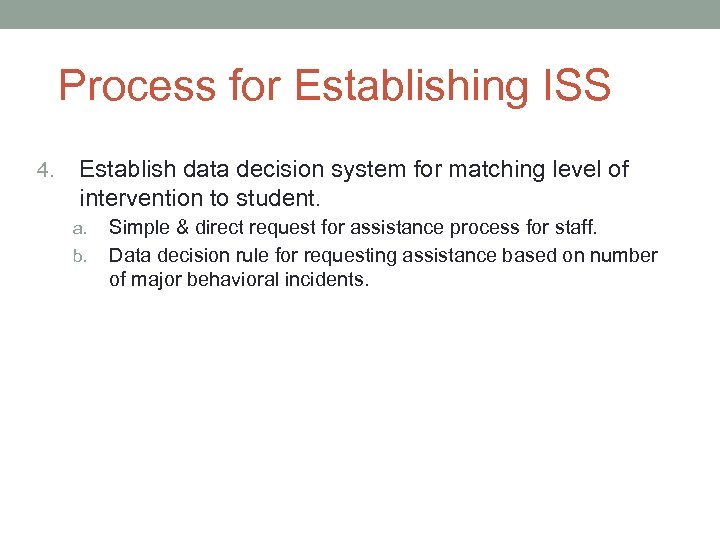 Process for Establishing ISS 4. Establish data decision system for matching level of intervention to student. a. b. Simple & direct request for assistance process for staff. Data decision rule for requesting assistance based on number of major behavioral incidents.
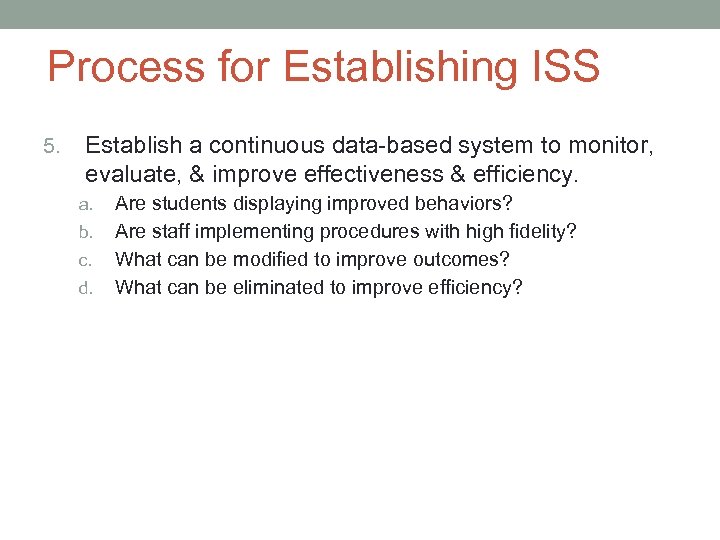 Process for Establishing ISS 5. Establish a continuous data-based system to monitor, evaluate, & improve effectiveness & efficiency. a. b. c. d. Are students displaying improved behaviors? Are staff implementing procedures with high fidelity? What can be modified to improve outcomes? What can be eliminated to improve efficiency?
 OVERVIEW OF SECONDARY INTERVENTIONS Function-based Strategies to Support At-risk Students
 Acknowledgements • OSEP National PBIS Center • Northwest PBIS Network • Rob Horner, Leanne Hawken, Rob March • Fern Ridge Middle School, Clear Lake Elementary, Templeton Elementary, …
 Purpose Develop specialized, group system for addressing needs of students with atrisk or significant problem behaviors
 Prerequisites • Effective & proactive universal system as foundation • Systems to support implementation • Evidence Based Practices • preferred or promising • On-going data-based decision-making • Identification, students monitoring, implementation fidelity, program evaluation • Teach basic (general case) before specialized skills
 Important Themes - Review: Tim Lewis • Part of a continuum – must link to school-wide PBS system • Efficient and effective way to identify students • Assessment = simple sort • Intervention matched to presenting problem but not highly individualized
 However, • There is a difference between how to teach and what to teach • How = EBP guidelines • Social skills, self-management, daily monitoring • What = skill identification, types and range of groups/programs
 Secondary Interventions - Review Tim Lewis Consider • Not fixed group • Student’s needs vary across continuum over time and within academic/social area • Least intrusive but matched to student need • Effective and efficient
 Group-based Programming Requirements Targeted, individualized, small group interventions • based on functional behavior assessment information • social skills instruction • behavioral programming • multiple opportunities for high rates of academic success
 Group-based Programming Requirements Daily behavioral monitoring • self- and/or adult Regular, frequent opportunities for positive reinforcement • tangible to social • external to internal • predictable to unpredictable • frequent to infrequent Home-school connection
 Other Strategies Behavioral contracts Adult mentor/monitor Targeted social skills instruction • problem solving • conflict management Self-management programming Academic restructuring
 Critical Features Intervention is continuously available Rapid access to intervention (less than a week) Very low effort by teachers Positive system of support • Students agree to participate Implemented by all staff/faculty in a school Flexible intervention based on assessment • Functional behavioral assessment
 Critical Features Adequate resources allocated (admin, team) Continuous monitoring for decision-making Administrative support • Time & money allocated No major changes in school climate • e. g. , teacher strikes, administrative turnover, major changes in funding Plan implementation a top priority
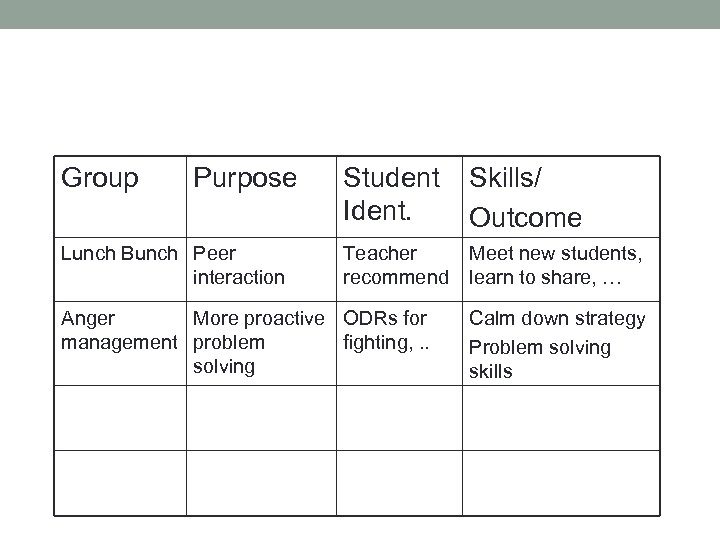 Group Purpose Lunch Bunch Peer interaction Student Ident. Skills/ Outcome Teacher recommend Meet new students, learn to share, … Anger More proactive ODRs for management problem fighting, . . solving Calm down strategy Problem solving skills
 Horner & Todd (2002)
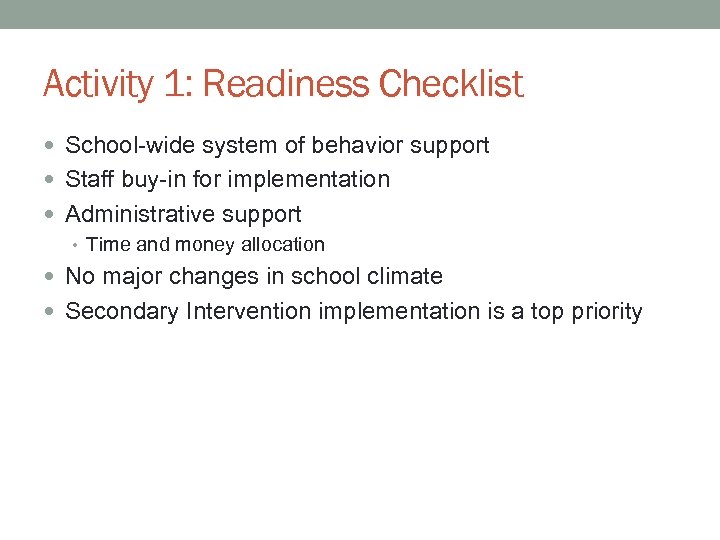 Activity 1: Readiness Checklist School-wide system of behavior support Staff buy-in for implementation Administrative support • Time and money allocation No major changes in school climate Secondary Intervention implementation is a top priority
 Example: Behavior Education Program (BEP) (March & Horner, 1998) Need • 7% of students with chronic problem behavior • Targeted, group based intervention needed • Expected to work for most but not all students • Interventions must be functional assessment based 24 students at Fern Ridge participated in Secondary Interventions
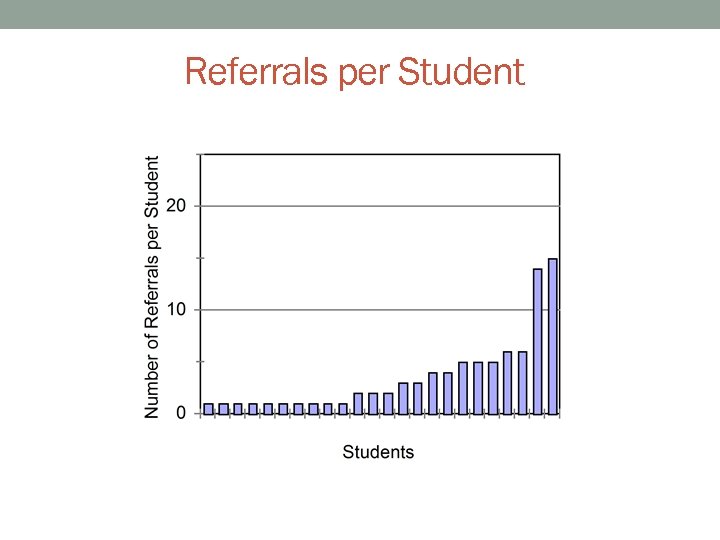 Referrals per Student
 BEP Features Students identified with multiple office referrals Student-parent-school contract formed Connection to school-wide expectations Individualized, daily monitoring
 BEP Set-up Teach students, teachers, & parents routines Establish school & home reinforcers Establish data collection system Conduct abbreviated FBAs
 BEP Daily Cycle 1. Check in office at arrival to school • Reminder binder • Pre-corrections • Turn in previous days signed Daily Progress Report (DPR) form • Pick-up new DPR form • Review daily goals
 BEP Daily Cycle 2. At each class • Student completes DPR card • Teacher checks & initials 3. Check out at end of day • Review the points & goals for the day • Receive reinforcer if goal met • Take successful day card home • Pre-corrections
 BEP Daily Cycle 4. Give successful day card to parent(s) • receive reinforcer from parent • have parent sign card 5. Return signed card next day
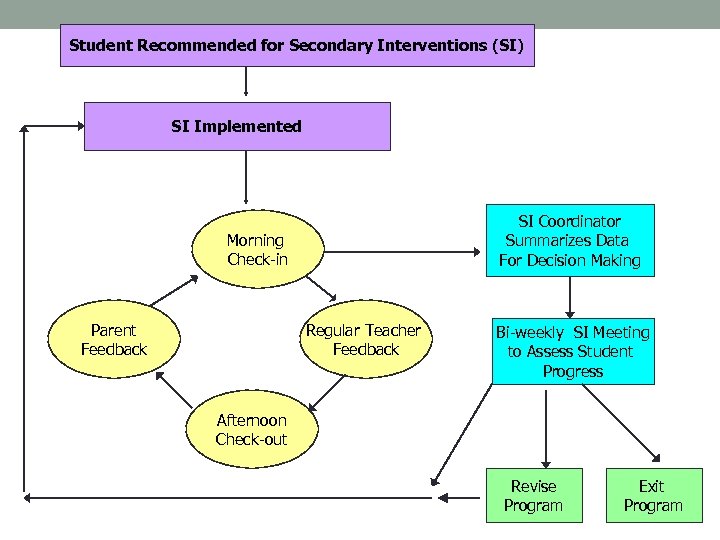 Student Recommended for Secondary Interventions (SI) SI Implemented SI Coordinator Summarizes Data For Decision Making Morning Check-in Parent Feedback Regular Teacher Feedback Bi-weekly SI Meeting to Assess Student Progress Afternoon Check-out Revise Program Exit Program
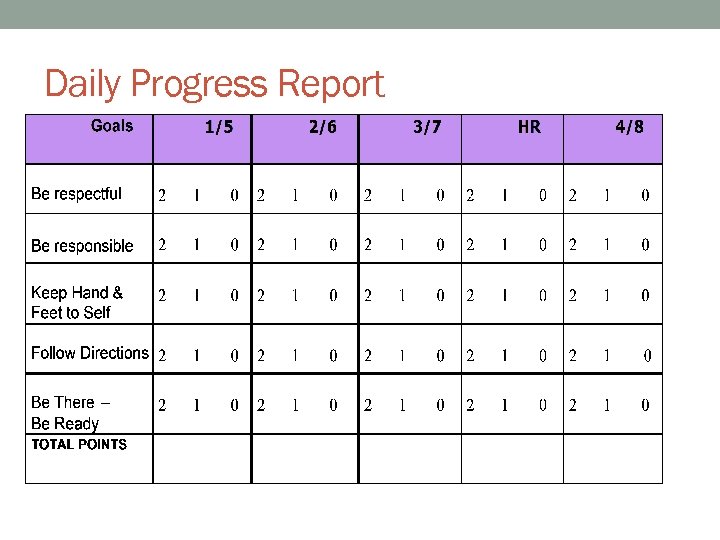 Daily Progress Report
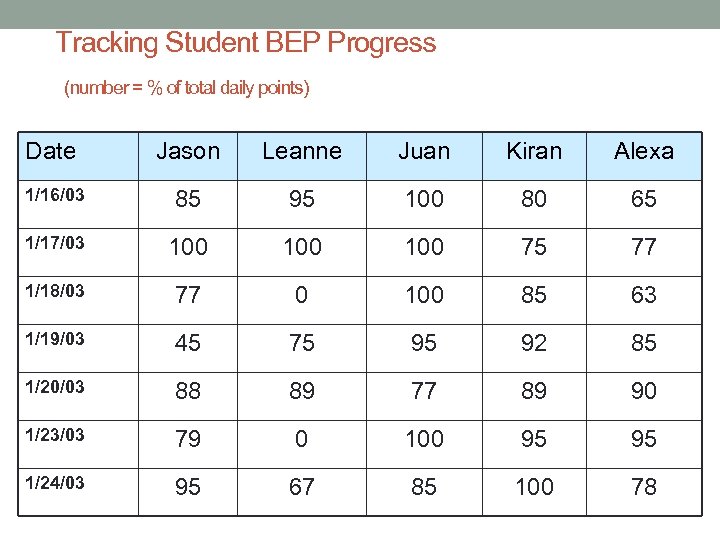 Tracking Student BEP Progress (number = % of total daily points) Date Jason Leanne Juan Kiran Alexa 1/16/03 85 95 100 80 65 1/17/03 100 100 75 77 1/18/03 77 0 100 85 63 1/19/03 45 75 95 92 85 1/20/03 88 89 77 89 90 1/23/03 79 0 100 95 95 1/24/03 95 67 85 100 78
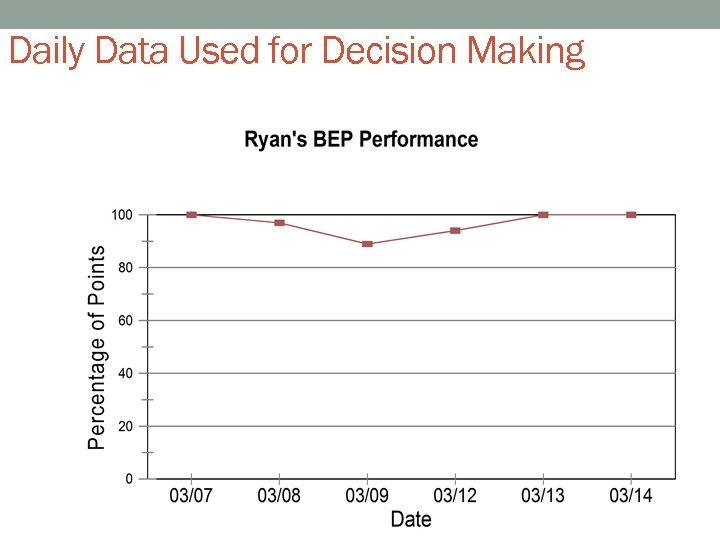 Daily Data Used for Decision Making
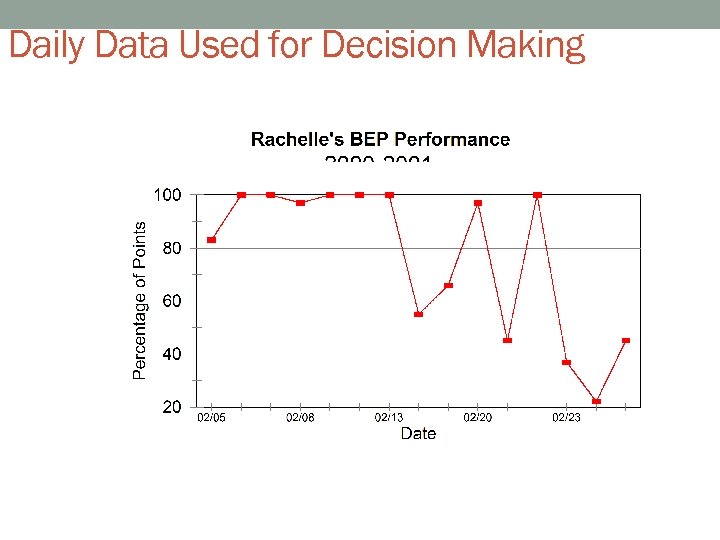 Daily Data Used for Decision Making
 Big Ideas Schools need different systems to deal with different levels of problem behavior in schools. Targeted group interventions are efficient systems for supporting students at-risk for more severe forms of problem behavior. Up to 30 students (depending on school size/resources) can be served using a targeted group intervention. Some students are going to need more intensive support than the plan can provide.
 GETTING STARTED IN YOUR SCHOOL
 Purpose To examine the elements needed to begin Secondary Interventions and begin the planning process for implementing Secondary Interventions in your school
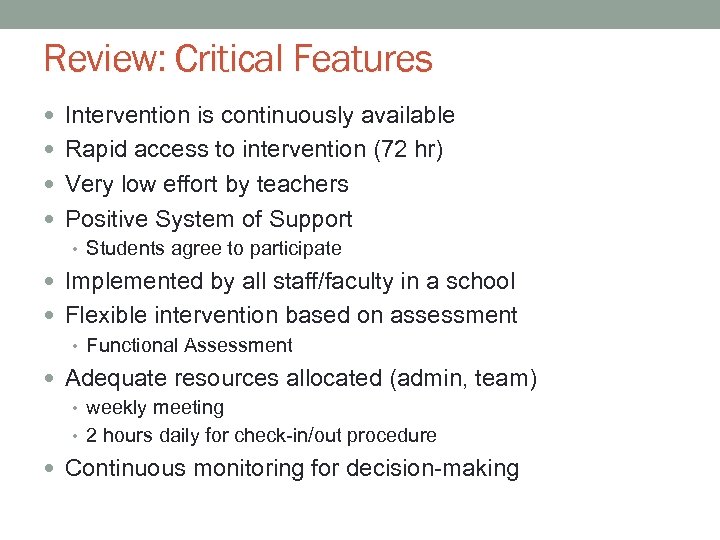 Review: Critical Features Intervention is continuously available Rapid access to intervention (72 hr) Very low effort by teachers Positive System of Support • Students agree to participate Implemented by all staff/faculty in a school Flexible intervention based on assessment • Functional Assessment Adequate resources allocated (admin, team) • weekly meeting • 2 hours daily for check-in/out procedure Continuous monitoring for decision-making
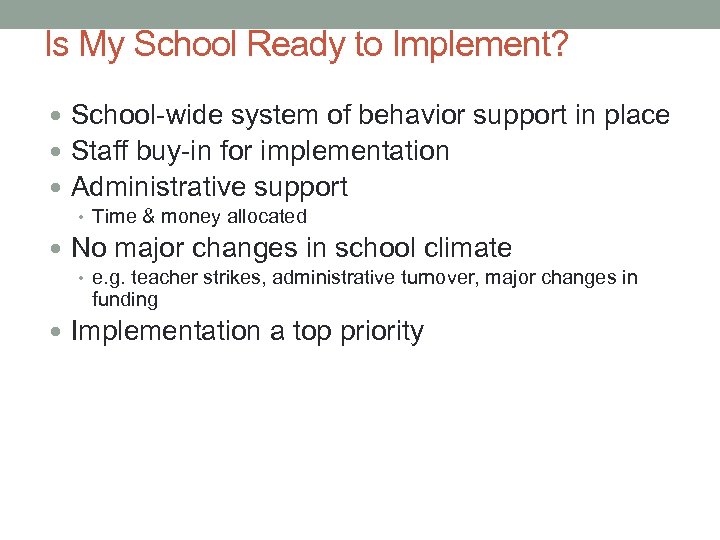 Is My School Ready to Implement? School-wide system of behavior support in place Staff buy-in for implementation Administrative support • Time & money allocated No major changes in school climate • e. g. teacher strikes, administrative turnover, major changes in funding Implementation a top priority
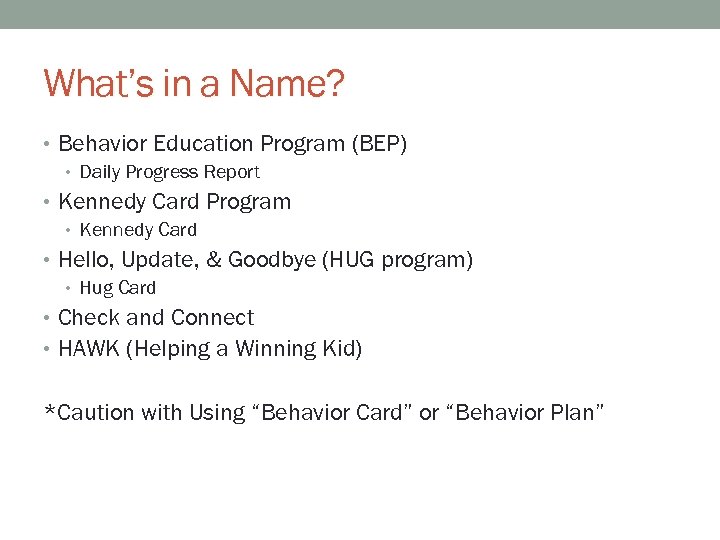 What’s in a Name? • Behavior Education Program (BEP) • Daily Progress Report • Kennedy Card Program • Kennedy Card • Hello, Update, & Goodbye (HUG program) • Hug Card • Check and Connect • HAWK (Helping a Winning Kid) *Caution with Using “Behavior Card” or “Behavior Plan”
 Resources: Time and Money Adequate time scheduled for coach, coordinator and team meetings Forms • Daily Progress Report (DPR) • Request for Assistance (RFA) • Functional Assessment • Parent permission • Student contract School supplies for participants Reinforcements for participants
 Secondary Intervention Team Coordinator Check-In, Check-Out Coach(es) Recorder Team members for decision making support
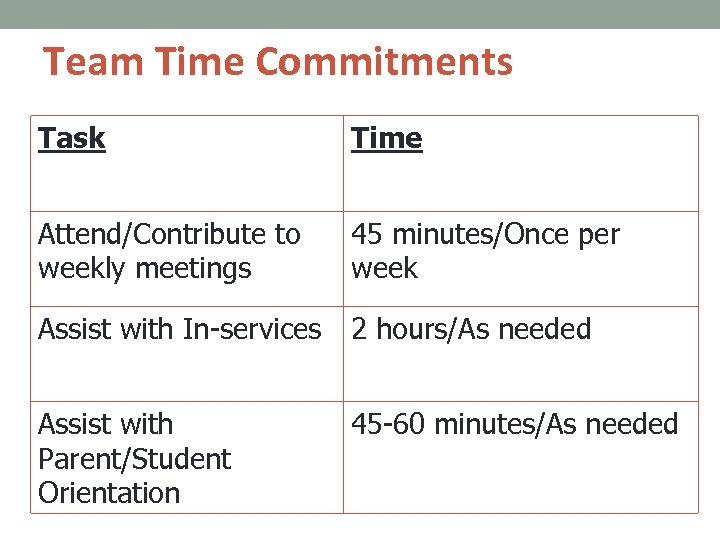 Team Time Commitments Task Time Attend/Contribute to weekly meetings 45 minutes/Once per week Assist with In-services 2 hours/As needed Assist with Parent/Student Orientation 45 -60 minutes/As needed
 Personnel: Coordinator • Take care of requests for assistance • Make placement decision based on program requirements if meeting is not in next 24 to 48 hours • Organize and maintain records • Gather supplemental information for meetings • Prioritize students for team meetings • Schedule parent/student orientation • Update teachers on student’s identified goals and progress (initial, during , exiting) • Collaborate with coach outside of team meetings
 Personnel: Coach(es) Flexibility within job responsibility (e. g. , educational assistant, counselor, behavior health aide) Maintain check-in/out procedure Collect and record daily progress goal Create graphs that reflect students daily goal percentage weekly Collaborate with Coordinator outside of team meetings
 Personnel: Recorder Records information at team meetings • Functional assessment • Discussion of agenda items
 Team Members for Decision-Making Support • Contribute to decision making for students • Help conduct “Orientation to System” meetings • Gather supplemental information • Contribute to student/staff development workshops • Contribute to feedback sessions • Complete any assigned tasks from meeting
 Staff Training • 1 -3 hour in-service; explain teacher’s role in process • Explain mission, culture, process, forms • Candidates for program • Program capacity, prioritizing, time to placement • Rating students’ behavior (Completing the Daily Progress Report) • Giving effective feedback during and after class • Graduating from the program • Opportunities to practice, review forms • Booster sessions
 Action Plan Purpose • Identifies critical elements of Secondary Interventions implementation • Acts as a “to-do” list of what elements need to be completed, a timeline for completion, and when it will be evaluated • It is a “living document”-action plan will be utilized and updated consistently as a team evaluates and modifies their Secondary Interventions process
 Activity 2 – Establishing a Team Purpose: Determine team member roles, answer logistical questions key to a well functioning team, and assess other secondary interventions that may be in place. 1 a - PBS Secondary Interventions Team Information • • • Record contact information for school and team members Establish meeting times Determine team member roles Establish a team goal/purpose Create your program name
 INITIAL IMPLEMENTATION
 Purpose To examine the elements that need to be in place so effective decision making can occur regarding student identification and placement on Secondary Interventions.
 BEP vs. Secondary Interventions The Behavior Education Program (Crone, Horner, Hawken, 2004) is the model of secondary interventions used for this training.
 Behavior Education Program (BEP) = Secondary Interventions (SI) Secondary Interventions is based on three “big ideas” from behavior research: • At risk students benefit from clearly defined expectations, frequent feedback, consistency, and positive reinforcement that is contingent on meeting goals. • Problem behavior and academic success are often linked. • Behavior support begins with the development of effective adult-student relationships.
 Secondary Interventions Big Ideas Connection to school-wide expectations Collaboration with student-parent-school Individualized, daily monitoring
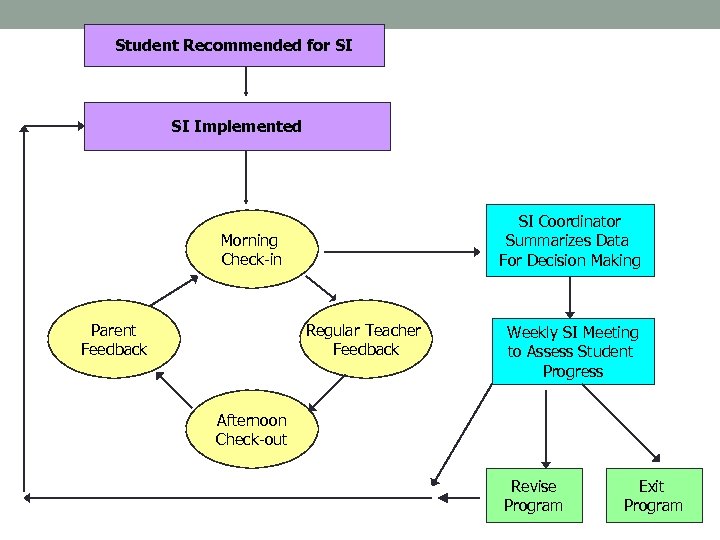 Student Recommended for SI SI Implemented SI Coordinator Summarizes Data For Decision Making Morning Check-in Parent Feedback Regular Teacher Feedback Weekly SI Meeting to Assess Student Progress Afternoon Check-out Revise Program Exit Program
 Research That Supports Secondary Interventions Collectively, three research studies on the effectiveness of Secondary Interventions demonstrated the following outcomes: 1. Typical schools are able to implement the BEP successfully. 2. Use of the BEP is functionally related to reduced levels of problem behavior, and, for some students, increased levels of academic engagement
 Research that Supports Secondary Interventions 3. The BEP is likely to be effective with 60 -75% of at risk students. 4. Students who do not find adult attention rewarding appear least likely to respond successfully to the BEP.
 Activity 3 – Training Staff to Use the System Purpose: Creating a detailed plan as to how, when, why and what will be presented to your staff as to educate them in Secondary Interventions. 2 - Planning your in-service on Secondary Interventions – When will you train staff? Who will train them? What materials will you use, hand-out, etc.
 STUDENT IDENTIFICATION
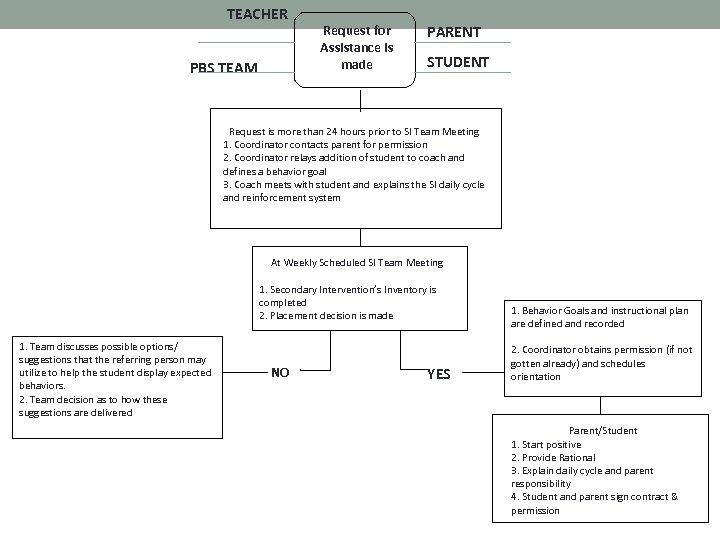 TEACHER PBS TEAM Request for Assistance is made PARENT STUDENT Request is more than 24 hours prior to SI Team Meeting 1. Coordinator contacts parent for permission 2. Coordinator relays addition of student to coach and defines a behavior goal 3. Coach meets with student and explains the SI daily cycle and reinforcement system At Weekly Scheduled SI Team Meeting 1. Secondary Intervention’s Inventory is completed 2. Placement decision is made 1. Team discusses possible options/ suggestions that the referring person may utilize to help the student display expected behaviors. 2. Team decision as to how these suggestions are delivered NO YES 1. Behavior Goals and instructional plan are defined and recorded 2. Coordinator obtains permission (if not gotten already) and schedules orientation Parent/Student 1. Start positive 2. Provide Rational 3. Explain daily cycle and parent responsibility 4. Student and parent sign contract & permission
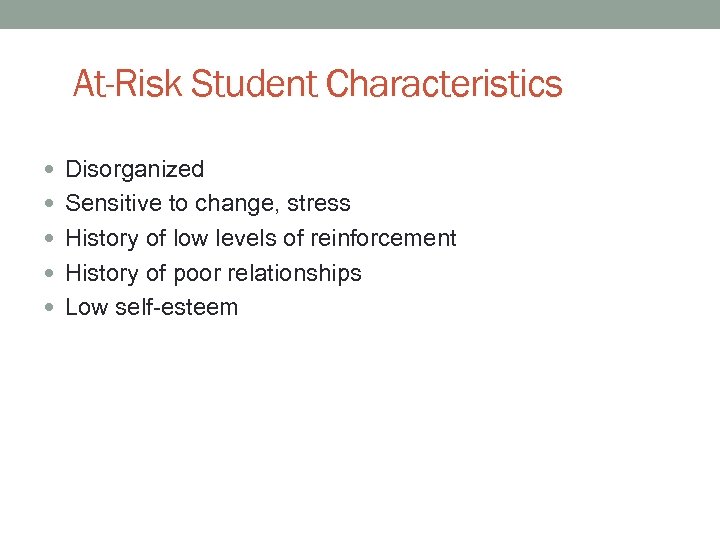 At-Risk Student Characteristics Disorganized Sensitive to change, stress History of low levels of reinforcement History of poor relationships Low self-esteem
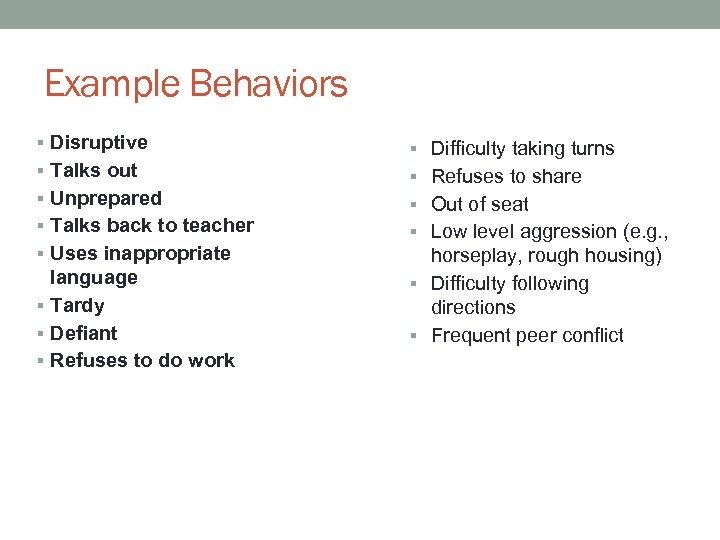 Example Behaviors Disruptive Talks out Unprepared Talks back to teacher Uses inappropriate language Tardy Defiant Refuses to do work Difficulty taking turns Refuses to share Out of seat Low level aggression (e. g. , horseplay, rough housing) Difficulty following directions Frequent peer conflict
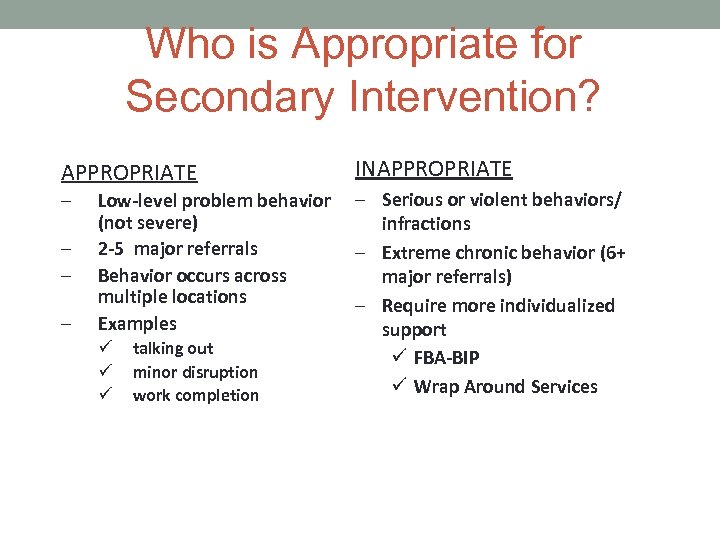 Who is Appropriate for Secondary Intervention? APPROPRIATE – – INAPPROPRIATE Low-level problem behavior – Serious or violent behaviors/ (not severe) infractions 2 -5 major referrals – Extreme chronic behavior (6+ Behavior occurs across major referrals) multiple locations – Require more individualized Examples support ü talking out ü FBA-BIP ü minor disruption ü Wrap Around Services ü work completion
 Do Not Include: Dangerous/violent students Students who bring a weapon to school Students who injure/may injure themselves Students with a high number of major referrals Students with referrals from only one setting, teacher, or time Students who find adult attention aversive (secondary interventions may be able to be modified for this type of student)
 When Office Discipline Referrals May Not Be Enough • May miss students in special education settings with persistent or violent behavior who may not generate office referrals • May not identify students with severe “internalizing” behaviors • May not identify students with many “minors” but few “majors” • May not reflect that some teachers refer and some do not
 Identifying Students of Concern Internalizing • Behaviors displayed inwardly toward self • Typically self-imposed, do not occur frequently enough, appear to allow the student to avoid social events • Examples include: • not interacting with other people, overly shy or timid, withdrawing or avoiding social situations, fearful; and not standing up for one’s self
 Identifying Students of Concern Externalizing Behaviors displayed outwardly by child towards an external social event in the environment Typically occur too often or too much Examples include: • aggression towards people, animals or things; arguing; defiance; out of seat; calling out; tantrums; non-compliance; hyperactivity; stealing; not following directions
 Who can Identify Students? • Teacher referral • Self-Identification • Parent referral • Administration • Universal Team • Absences and tardies • In school detentions (lunch time or after school) • Time out/”Think Time”
 What a Request for Assistance (RFA) Form Should Have • Student’s Name • Date • Name of Referring Person • Reason for Referral • Description of problem behavior • Hypothesized reason for the behavior (what does the student gain by misbehaving) • Behavior strategies already tried
 Activity 4: RFA Purpose: To design a Request for Assistance form that is functional and fits the needs of your school. Activity: As a team, review the RFA examples provided. There also electronic versions provided for you. Highlight the information that your team feels would be useful for your school’s RFA. Once you have identified all the required information, design your own RFA form.
 Adding Students to Secondary Interventions Team uses information on referral and Secondary Interventions Inventory to determine if Secondary Interventions are appropriate for the student
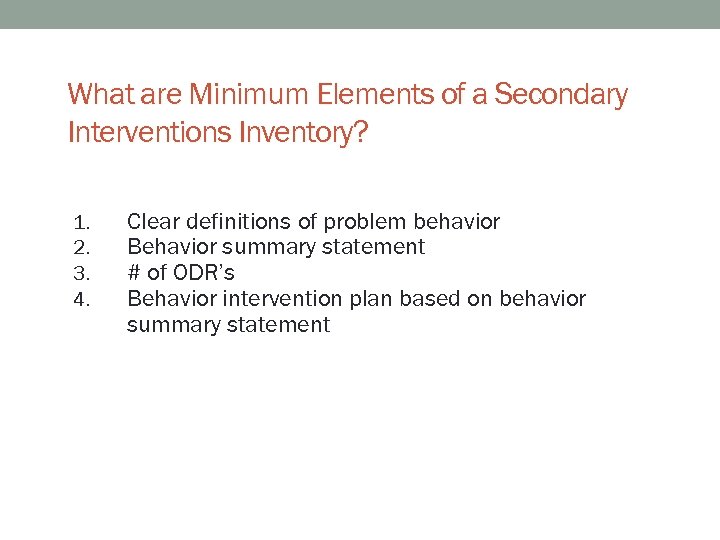 What are Minimum Elements of a Secondary Interventions Inventory? 1. 2. 3. 4. Clear definitions of problem behavior Behavior summary statement # of ODR’s Behavior intervention plan based on behavior summary statement
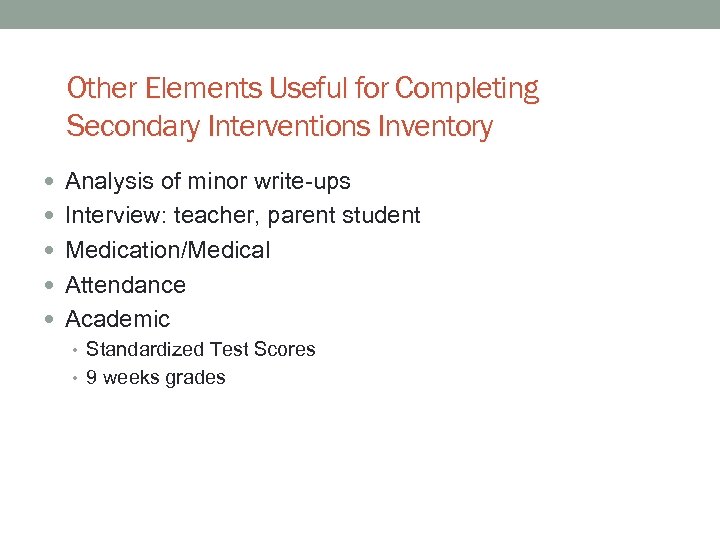 Other Elements Useful for Completing Secondary Interventions Inventory Analysis of minor write-ups Interview: teacher, parent student Medication/Medical Attendance Academic • Standardized Test Scores • 9 weeks grades
 Activity 4 – Brief FBA Purpose: To construct a generic functional behavior assessment that meets the requirements needed to assess if a student is appropriate for secondary interventions Activity: Using the functional behavior assessment examples, highlight what your team agrees would best suit your functional assessment. These examples are also provided electronically. Once you have identified the elements, construct your own on the template provided.
 Parent/Student Introduction Purpose: Explain Daily Cycle Process and DPR For all parents Positive Collaborative Brief Opportunity to refer
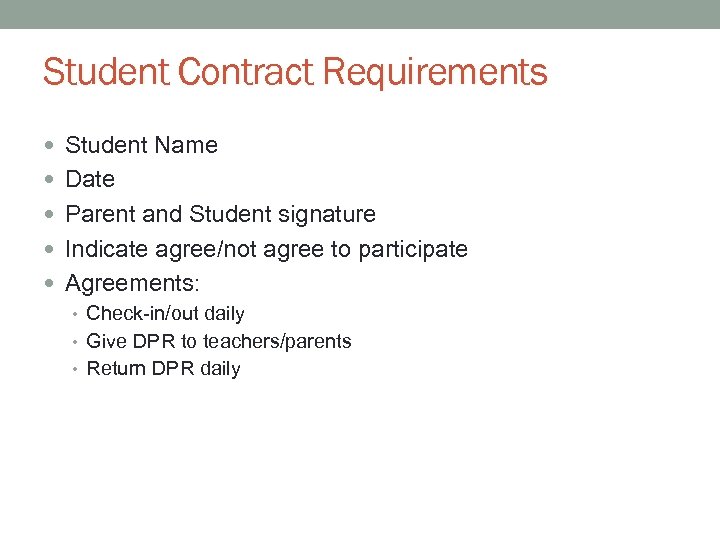 Student Contract Requirements Student Name Date Parent and Student signature Indicate agree/not agree to participate Agreements: • Check-in/out daily • Give DPR to teachers/parents • Return DPR daily
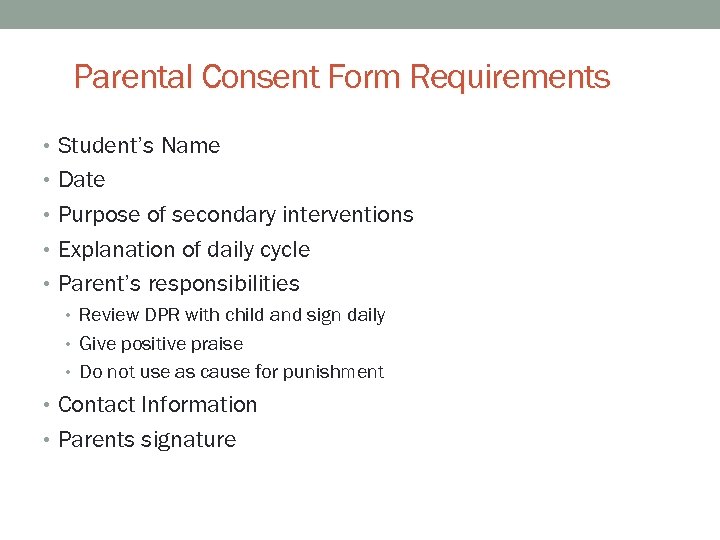 Parental Consent Form Requirements • Student’s Name • Date • Purpose of secondary interventions • Explanation of daily cycle • Parent’s responsibilities • Review DPR with child and sign daily • Give positive praise • Do not use as cause for punishment • Contact Information • Parents signature
 Activity 5: Parent/Student Forms Purpose: To create a parent permission form and student contract that effectively conveys what secondary interventions are, the daily cycle progress, and responsibilities of all involved Activity: Use the templates provided to construct your parent permission form and student contract. Examples are provided on hard copy as well as electronically.
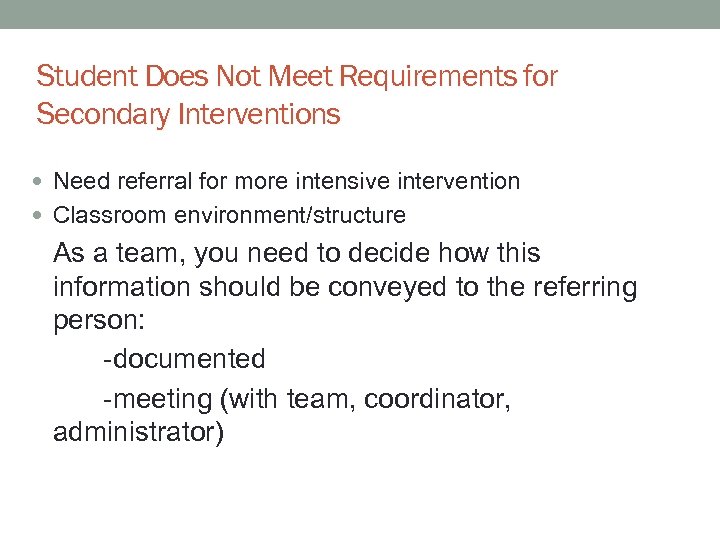 Student Does Not Meet Requirements for Secondary Interventions Need referral for more intensive intervention Classroom environment/structure As a team, you need to decide how this information should be conveyed to the referring person: -documented -meeting (with team, coordinator, administrator)
 DAILY CYCLE
 Purpose To examine the elements of the daily cycle and create required materials needed for the daily cycle process.
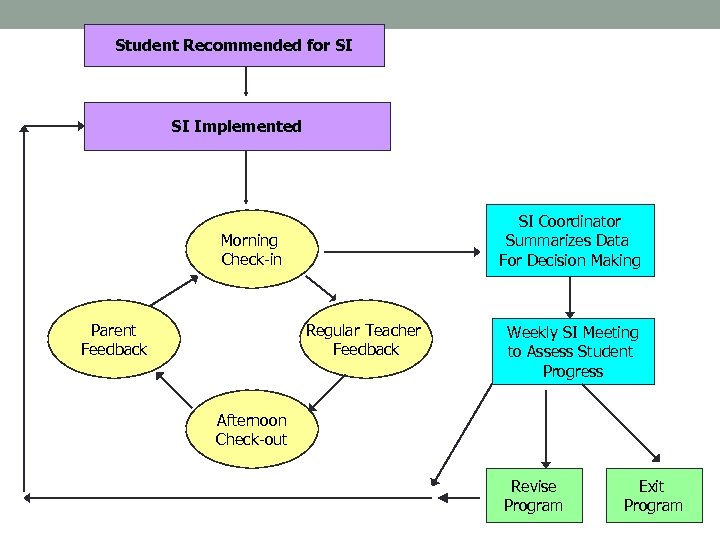 Student Recommended for SI SI Implemented SI Coordinator Summarizes Data For Decision Making Morning Check-in Parent Feedback Regular Teacher Feedback Weekly SI Meeting to Assess Student Progress Afternoon Check-out Revise Program Exit Program
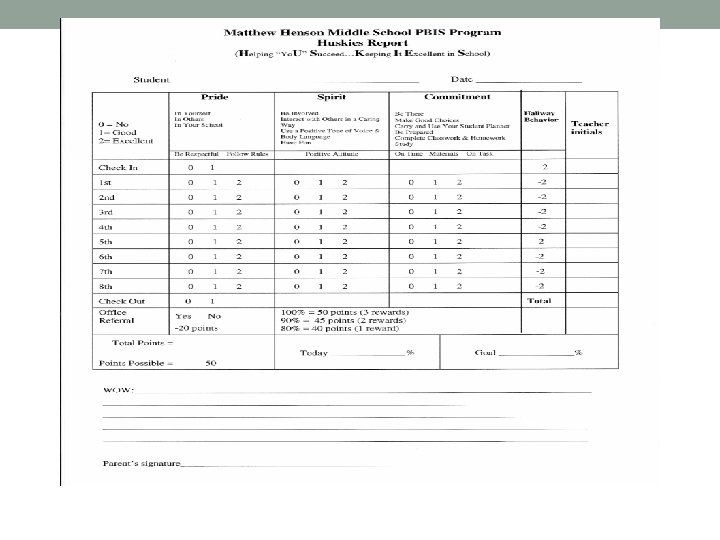
 Daily Progress Report ( DPR ) • Portable • Correlates with school-wide expectations and student’s identified behavior goals • Reflect all areas of campus • Reflect all activities/time periods • Clear, concise, understandable for students, families and staff
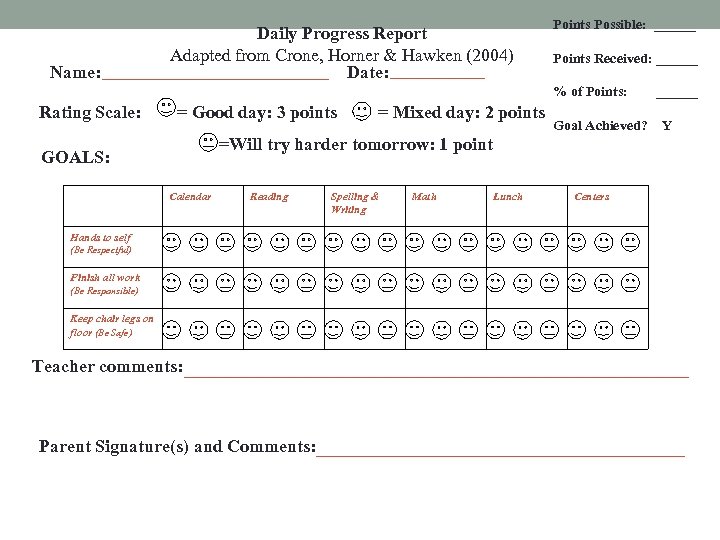 Name: Daily Progress Report Adapted from Crone, Horner & Hawken (2004) Date: Points Possible: ______ Points Received: ______ % of Points: ______ Rating Scale: = Good day: 3 points = Mixed day: 2 points Goal Achieved? Y =Will try harder tomorrow: 1 point GOALS: Calendar Reading Hands to self (Be Respectful) Finish all work (Be Responsible) Keep chair legs on floor (Be Safe) Teacher comments: Parent Signature(s) and Comments: Spelling & Writing Math Lunch Centers
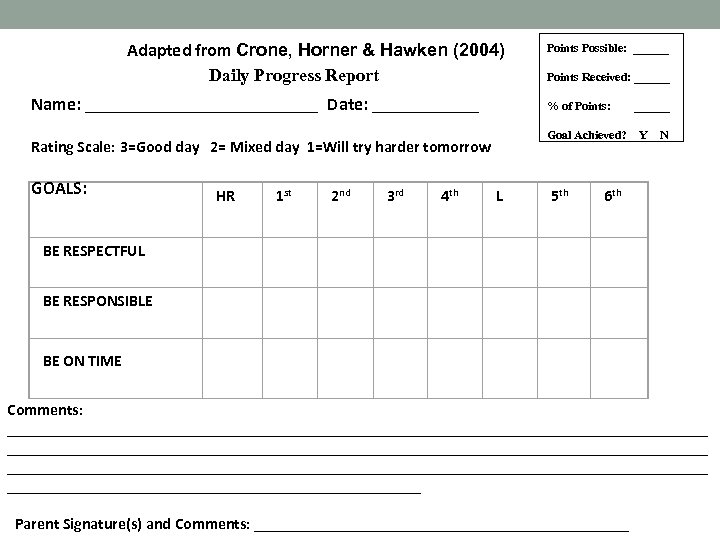 Adapted from Crone, Horner & Hawken (2004) Daily Progress Report Name: _____________ Date: ______ Rating Scale: 3=Good day 2= Mixed day 1=Will try harder tomorrow GOALS: Points Possible: ______ Points Received: ______ % of Points: ______ Goal Achieved? Y N HR 1 st 2 nd 3 rd 4 th L 5 th 6 th BE RESPECTFUL BE RESPONSIBLE BE ON TIME Comments: ________________________________________________________________________________________ __________________________ Parent Signature(s) and Comments: ________________________
 SWIS Requirements • SWIS schools wanting to use the CICO need to comply with readiness checklist -for example… • SWIS facilitator w/ CICO training • Implementing SW-PBS • Coach or Coordinator for tech. assistance • In-school process • DPR
 SWIS - DPR Form Up to 10 check-in periods Up to 5 expectations/goal Up to 3 point rating scale
 Establishing goals First few days of reporting is baseline score 80% of total points possible is daily goal • May be adjusted for some students • During introductory meeting (or after any changes), let students know what their target point total should be *Check for understanding
 Check in • Central location • Greet students • Collect yesterday’s signed DPR • Check bags/backpacks • Provide supplies • Record names, preparedness, yesterday’s DPR • Reward for completing requirements • Prompt to have a good day
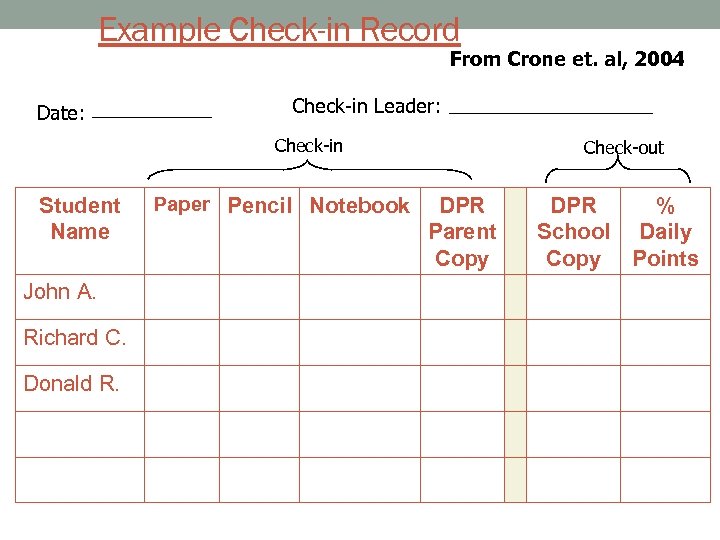 Example Check-in Record From Crone et. al, 2004 Date: Check-in Leader: Check-in Student Name John A. Richard C. Donald R. Paper Pencil Notebook Check-out DPR Parent Copy DPR % School Daily Copy Points
 Classroom Teacher’s Role • Review and explain DPR ratings calmly and objectively • Be specific • Do not engage student in debates over ratings • Acknowledge concerns/feelings, then re-direct to next day’s/period’s/activity’s potential for more points. • End conversation immediately • Prompt appropriate behavior by saying, “Tomorrow, let’s work on…”
 Check Out Move quickly Recognize student for choosing to come to check out Collect a copy of the DPR Reward if daily goal has been met Prompt for a good day tomorrow
 Student Rewards PRAISE, PRAISE Positive Adult Attention
 Student Rewards • Small reward for successful check-in • • On time Returned signed DPR Has all materials Filled out new DPR • Small reward from teacher (SW currency, early out, etc…) for perfect periods • Small reward/snack for successful check-out • Being there in time to make bus • Having DPR • Met daily goal • Additional incentives for weekly, monthly achievements (announcements, treat, store credit, etc…)
 Parent Responsibility Review Daily DPR Give praise for positive Sign Give support for a positive next day **Do not use DPR to assign punishment
 Activity 6: DPR Form Purpose: To create a DPR form that has all the required elements and fits the needs of our school Activity: As a team, review the DPR form examples. Highlight the information that your team feels would be useful for your DPR. These examples are also provided electronically. Create your own DPR form that reflects the needs of your school.
 MONITORING AND DECISION-MAKING
 Purpose To examine the criteria that determines student’s progression on Secondary Interventions
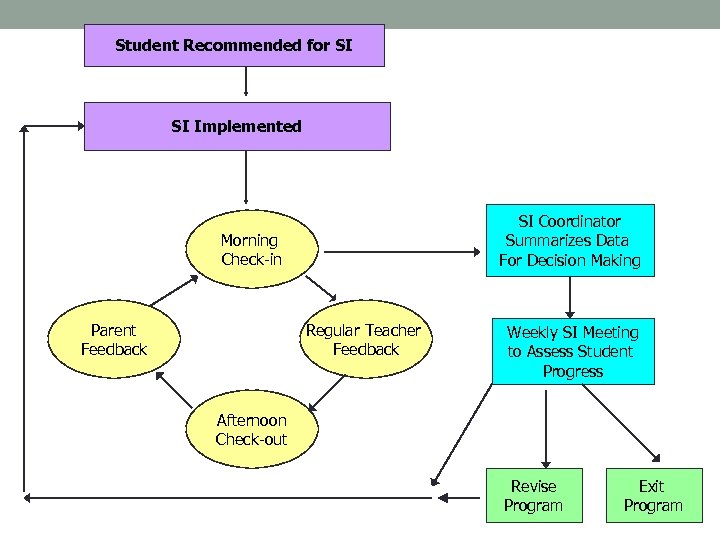 Student Recommended for SI SI Implemented SI Coordinator Summarizes Data For Decision Making Morning Check-in Parent Feedback Regular Teacher Feedback Weekly SI Meeting to Assess Student Progress Afternoon Check-out Revise Program Exit Program
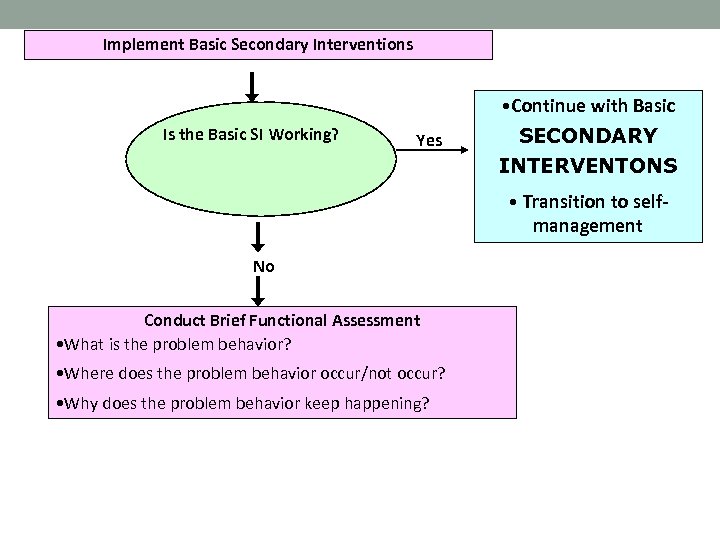 Implement Basic Secondary Interventions • Continue with Basic Is the Basic SI Working? Yes SECONDARY INTERVENTONS • Transition to self- management No Conduct Brief Functional Assessment • What is the problem behavior? • Where does the problem behavior occur/not occur? • Why does the problem behavior keep happening?
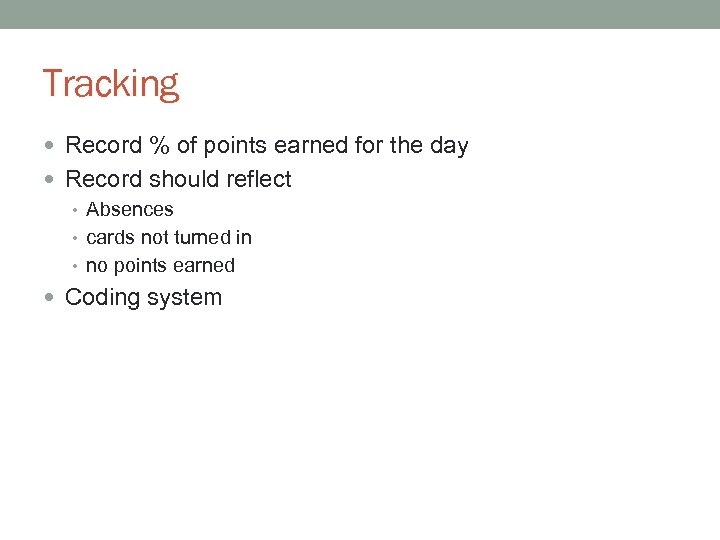 Tracking Record % of points earned for the day Record should reflect • Absences • cards not turned in • no points earned Coding system
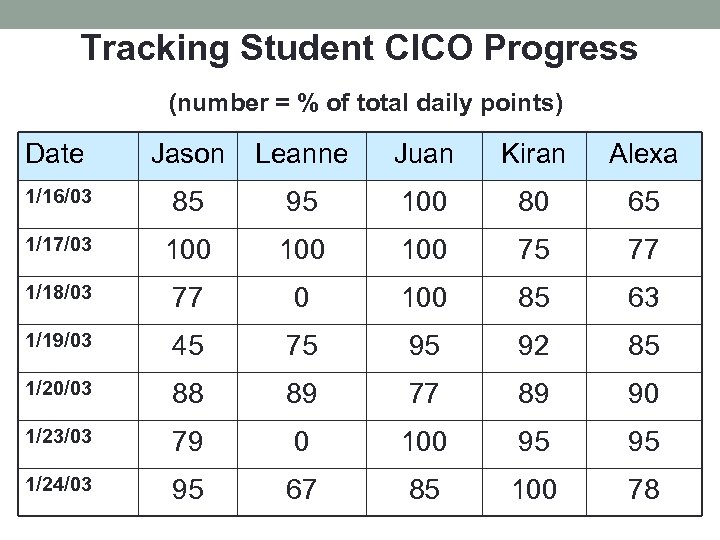 Tracking Student CICO Progress (number = % of total daily points) Date Jason Leanne Juan Kiran Alexa 1/16/03 85 95 100 80 65 1/17/03 100 100 75 77 1/18/03 77 0 100 85 63 1/19/03 45 75 95 92 85 1/20/03 88 89 77 89 90 1/23/03 79 0 100 95 95 1/24/03 95 67 85 100 78
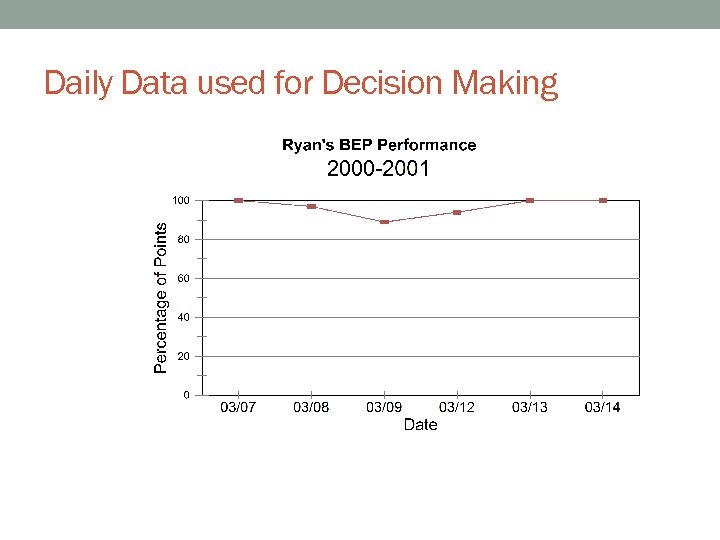 Daily Data used for Decision Making
 Graduating from the Program 80% or better for at least 4 weeks, on a daily basis Consult with teacher(s), team Meet with student to introduce graduation process • Show data • Explain how to use rating card/how to judge own behavior • CELEBRATE! Talk with parent about graduation, how they can continue to support their child
 Graduating from the Program Shift to self-management • Teacher ratings = Student ratings • Rewards for honesty and accuracy Rewards become contingent on good behavior • Fade teacher ratings, rewards (not as much) Fade data collection
 After “Graduation” from CICO Continue to monitor student behavior through discipline referrals & teacher report • Celebrate continued success – Some schools hold a monthly celebration for students who are maintaining success after Graduating from CICO • Monthly “Alumni Club” Lunch
 Monitor Student is making and maintaining progress but needs to stay on the intervention (4 to 6 weeks) to ensure correct behavior will be displayed once check-in/check-out is faded
 How Do We Handle A Decrease? More frequent reinforcement More powerful reinforcers for daily goal • Contracting Academic interventions • Modify target behaviors Self-monitoring/self-reinforcement (when needs more attention) Use DPR points as currency for rewards
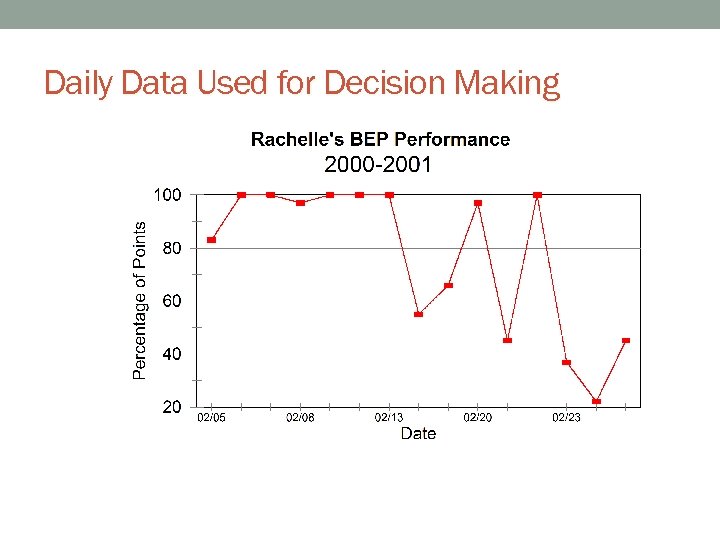 Daily Data Used for Decision Making
 How do we Handle a Significant Decrease? Functional Behavior Assessment that requires teacher observation Increase desirable reinforcers Specialized intervention (function based)
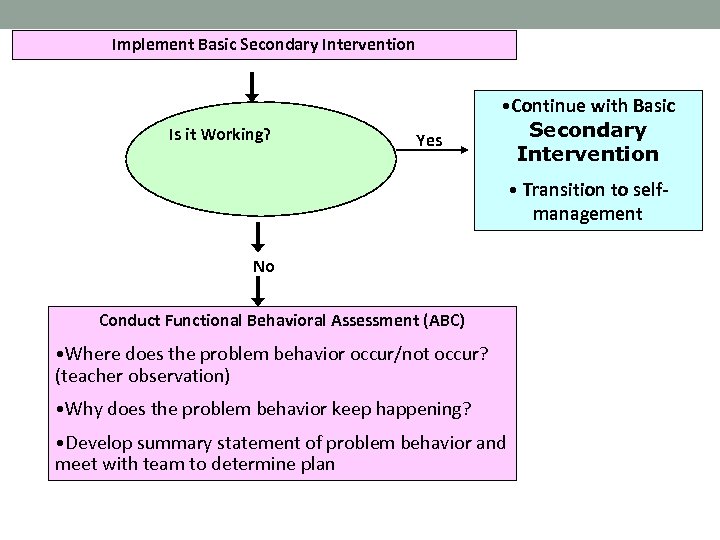 Implement Basic Secondary Intervention Is it Working? Is Yes • Continue with Basic Secondary Intervention • Transition to self- management No Conduct Functional Behavioral Assessment (ABC) • Where does the problem behavior occur/not occur? (teacher observation) • Why does the problem behavior keep happening? • Develop summary statement of problem behavior and meet with team to determine plan
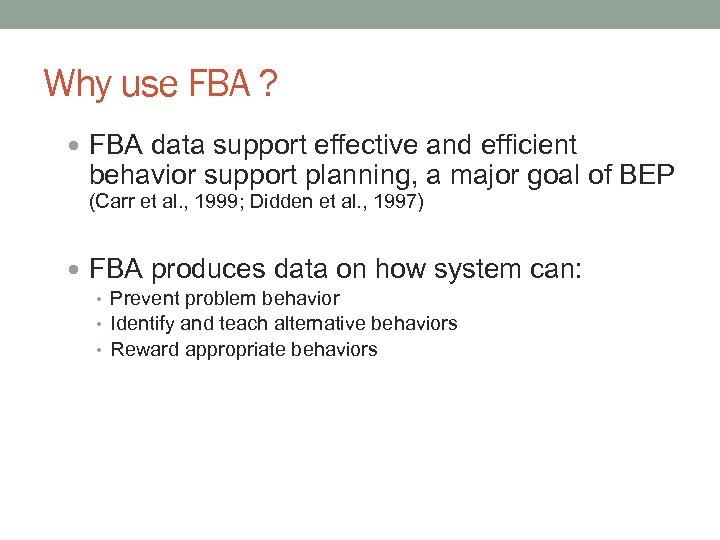 Why use FBA ? FBA data support effective and efficient behavior support planning, a major goal of BEP (Carr et al. , 1999; Didden et al. , 1997) FBA produces data on how system can: • Prevent problem behavior • Identify and teach alternative behaviors • Reward appropriate behaviors
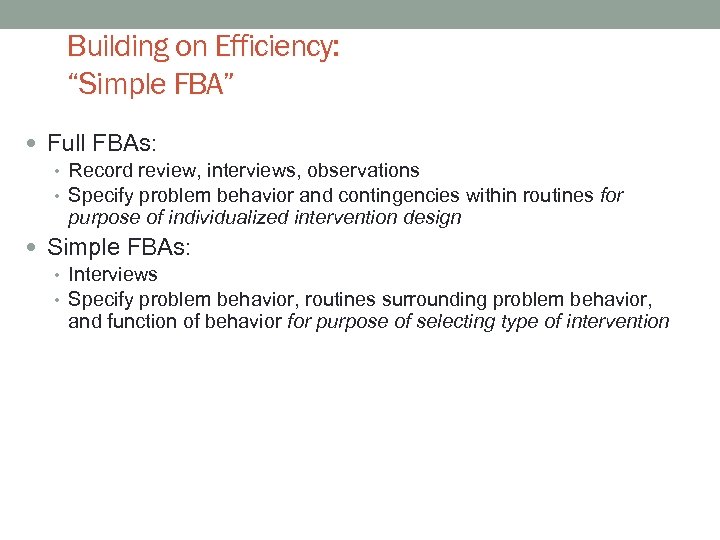 Building on Efficiency: “Simple FBA” Full FBAs: • Record review, interviews, observations • Specify problem behavior and contingencies within routines for purpose of individualized intervention design Simple FBAs: • Interviews • Specify problem behavior, routines surrounding problem behavior, and function of behavior for purpose of selecting type of intervention
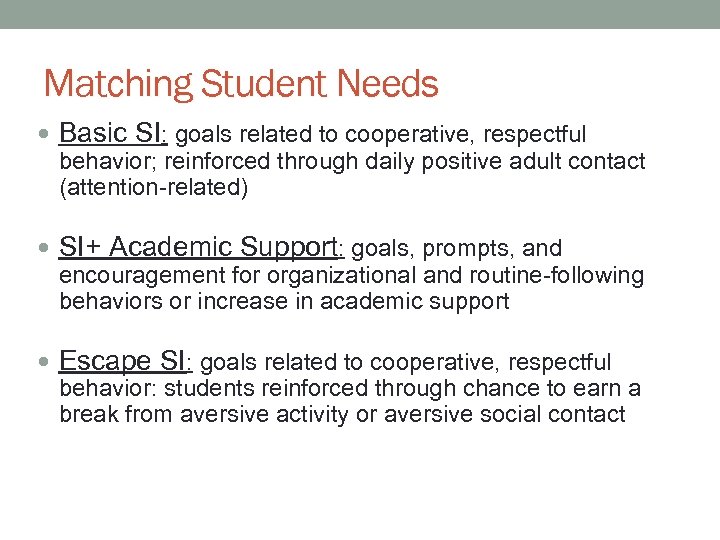 Matching Student Needs Basic SI: goals related to cooperative, respectful behavior; reinforced through daily positive adult contact (attention-related) SI+ Academic Support: goals, prompts, and encouragement for organizational and routine-following behaviors or increase in academic support Escape SI: goals related to cooperative, respectful behavior: students reinforced through chance to earn a break from aversive activity or aversive social contact
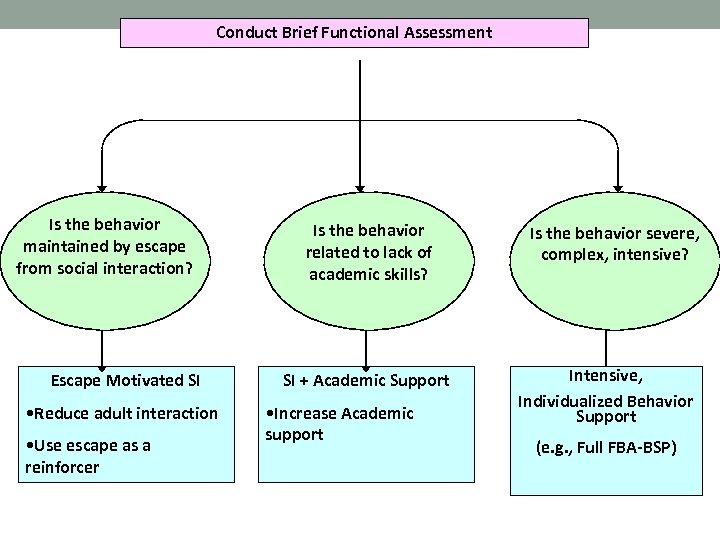 Conduct Brief Functional Assessment Is the behavior maintained by escape from social interaction? Escape Motivated SI • Reduce adult interaction • Use escape as a reinforcer Is the behavior related to lack of academic skills? SI + Academic Support • Increase Academic support Is the behavior severe, complex, intensive? Intensive, Individualized Behavior Support (e. g. , Full FBA-BSP)
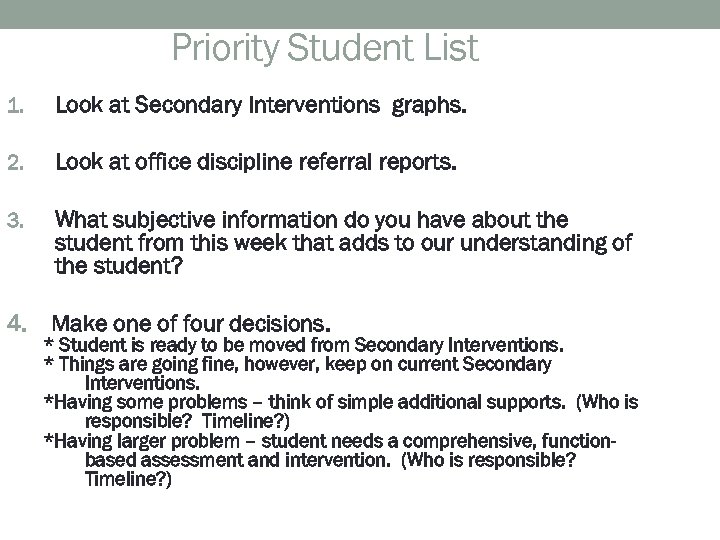 Priority Student List 1. Look at Secondary Interventions graphs. 2. Look at office discipline referral reports. 3. What subjective information do you have about the student from this week that adds to our understanding of the student? 4. Make one of four decisions. * Student is ready to be moved from Secondary Interventions. * Things are going fine, however, keep on current Secondary Interventions. *Having some problems – think of simple additional supports. (Who is responsible? Timeline? ) *Having larger problem – student needs a comprehensive, functionbased assessment and intervention. (Who is responsible? Timeline? )
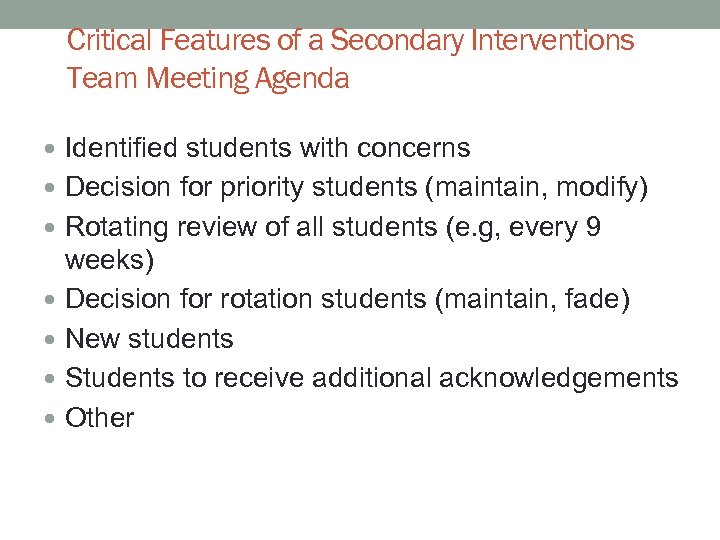 Critical Features of a Secondary Interventions Team Meeting Agenda Identified students with concerns Decision for priority students (maintain, modify) Rotating review of all students (e. g, every 9 weeks) Decision for rotation students (maintain, fade) New students Students to receive additional acknowledgements Other
 Activity 7: Meeting Agenda Purpose: To create a framework of prioritizing students for decision making purposes Activity: Use the template provided to create a meeting agenda that reflects high priority students. An example is provided electronically as well as a hard copy.
 TROUBLESHOOTING
 Purpose To give guidance to potential barriers of Secondary Interventions
 Obstacles to Implementation • • • Administrator not on the team that develops the plan and looks at data for decision making Plan used as punishment rather than prevention program Plan coordinator lacks skills to implement the program (e. g. , behavior intervention, computer) Schools expecting plan to solve all behavior problems Fitting plan and data evaluation into existing teams
 Trouble shooting Not checking in • Deliver DPR to student • Find out if he/she wants to participate in program. *May need to increase motivation with reinforcers (selection, contracting) • If student refuses to participate, probably need FBA
 Trouble shooting Not checking out • When student does not checkout nor bring card back next day, give “ 0” points for the day • Coordinator asks what happened and reminds student to checkout • Teachers can prompt student to checkout
 Trouble shooting Not checking in/out consistently • Make sure they understand routine • Make sure teachers are cooperating • Can get teacher, friends to remind student to check out • Can escort student at beginning to help him/her learn routine. • Provide reinforcements (lottery ticket, weekly drawing) contingent on just showing up. • Make sure Secondary Interventions has a positive, important profile in school, coordinator is well-liked
 Trouble shooting Student loses Daily Progress Report • Get new one right away • If chronic, find out how school can improve program (more salient rewards) • Check for home response to poor DPRs
 Trouble shooting Staff not implementing Secondary Interventions correctly • Preventative, provide in-service prior to implementation • Some teacher may need additional training on BEP • Provide space on DPR for positive statements • Provide staff feedback (at least quarterly) on effect of BEP on students
 Trouble shooting Parent or caregivers not following through or use Secondary Interventions punitively • Parent should give permission for student to participate • Students can still participate if parents do not follow through • May need to use “surrogate parent” to provide feedback • Have counselor or principal address punishment issue with parent
 Contacts • www. pbisnetwork. org • teri. lewis@oregonstate. edu
 Resouces • www. pbis. org • www. pbisnetwork. org • www. pbiswashington. pbworks. com