


 Скачать презентацию Second WHO consultation on International Reference Preparation for
a5ee6ea98bb08801952716c1d23426b1.ppt
- Количество слайдов: 38
 Second WHO consultation on International Reference Preparation for Chagas Diagnostic Tests January 27 & 28 January, 2009 TESTS USED IN BLOOD SCREENING Dr Azzedine ASSAL French Blood Services (EFS)
 Background • The choice of a Chagas disease screening assay or strategy for TT prevention is far from straightforward • Recommendation of the PAHO (1994): parallel use of at least 2 different serological tests in Chagas disease screening in blood donations (Lack of sensitivity and specificity). • Recommendations of WHO, 2002: one ELISA is recommended for blood bank screening
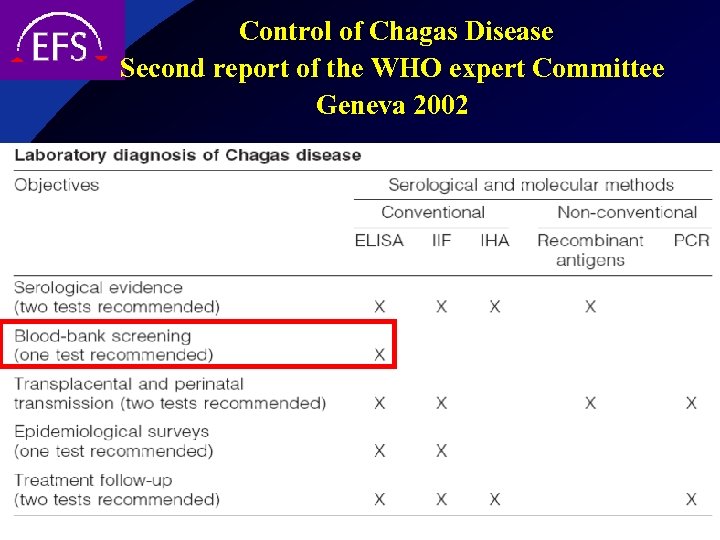 Control of Chagas Disease Second report of the WHO expert Committee Geneva 2002
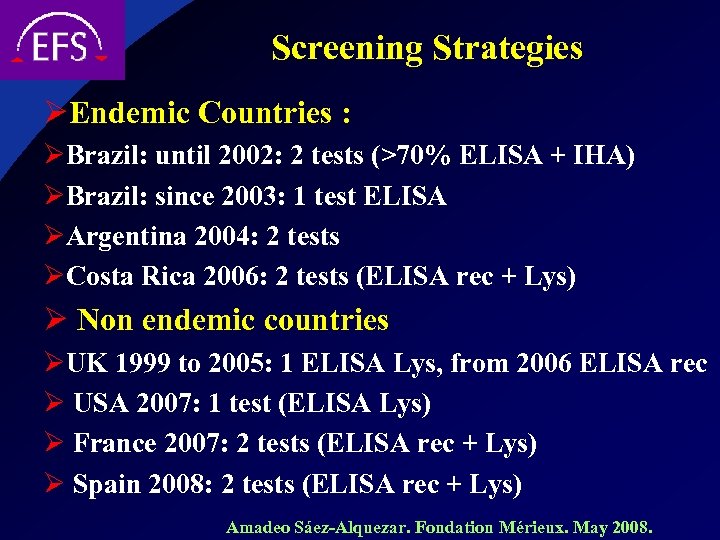 Screening Strategies ØEndemic Countries : ØBrazil: until 2002: 2 tests (>70% ELISA + IHA) ØBrazil: since 2003: 1 test ELISA ØArgentina 2004: 2 tests ØCosta Rica 2006: 2 tests (ELISA rec + Lys) Ø Non endemic countries ØUK 1999 to 2005: 1 ELISA Lys, from 2006 ELISA rec Ø USA 2007: 1 test (ELISA Lys) Ø France 2007: 2 tests (ELISA rec + Lys) Ø Spain 2008: 2 tests (ELISA rec + Lys) Amadeo Sáez-Alquezar. Fondation Mérieux. May 2008.
 Ideal screening serological test Ø 100 % sensitivity Ø 100 % specificity Ø Reproducible Ø Easy to perform Ø Fast and automated Ø Non subjective reading Ø Not expensive The ideal test does not exist
 Different strategies for blood banks Ø Using only one test Ø High sensitivity test (Ig. G + Ig. M) Ø Use a whole parasite Lysate test (mixture of parasite antigens) Ø Using 2 tests Ø 1 Lysate ELISA + 1 rec ELISA Ø IFI + ELISA
 French Screening Strategy ü Commercial assays available : IHA or other agglutination tests, ELISA, IFA. ü French strategy: Screening based on 2 parallel ELISAs (Crude and recombinant antigens). ü IFA as an alternative test (“confirmation”) test in case of positivity or discrepancy between the 2 ELISAs.
 EVALUATED ASSAYS 1) ELISAs • Recombinant ELISAs Bioelisa Chagas (Biokit, Spain). CE mark. • Crude ELISAs Ø ELISA Cruzi (Bio. Mérieux). No CE mark. Ø Chagatek Elisa (Lemos, Argentina), No CE mark. Ø T. cruzi ELISA Test System– 1 (OCD). CE mark. Ø EIAgen Trypanosoma Cruzi Ab (manufactured by Adaltis and distributed by Ingen, France). CE mark. 2) IFA § Immunofluor Chagas (Biocientifica. Argentina). CE mark.
 EVALUATED FEATURES ü FEASIBILITY ü CLINICAL SENSITIVITY üSPECIFICITY ü REPRODUCIBILITY
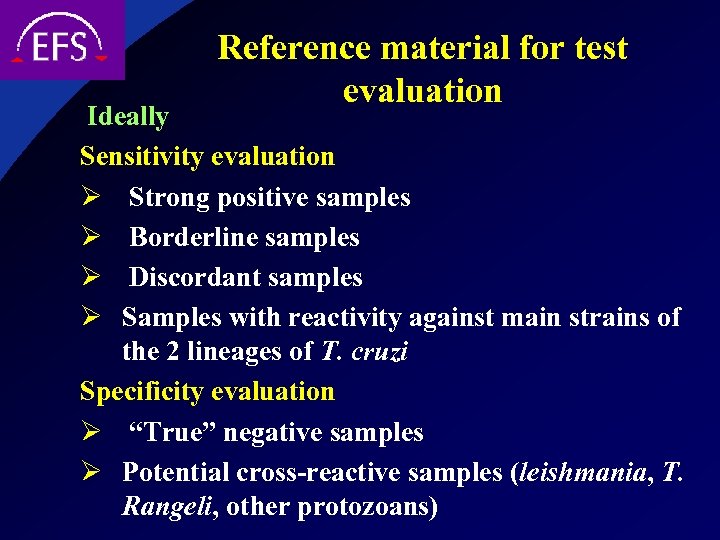 Reference material for test evaluation Ideally Sensitivity evaluation Ø Strong positive samples Ø Borderline samples Ø Discordant samples Ø Samples with reactivity against main strains of the 2 lineages of T. cruzi Specificity evaluation Ø “True” negative samples Ø Potential cross-reactive samples (leishmania, T. Rangeli, other protozoans)
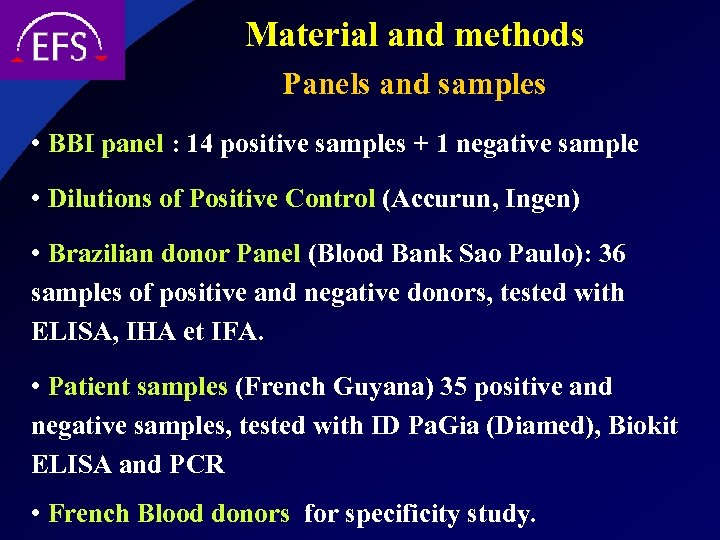 Material and methods Panels and samples • BBI panel : 14 positive samples + 1 negative sample • Dilutions of Positive Control (Accurun, Ingen) • Brazilian donor Panel (Blood Bank Sao Paulo): 36 samples of positive and negative donors, tested with ELISA, IHA et IFA. • Patient samples (French Guyana) 35 positive and negative samples, tested with ID Pa. Gia (Diamed), Biokit ELISA and PCR • French Blood donors for specificity study.
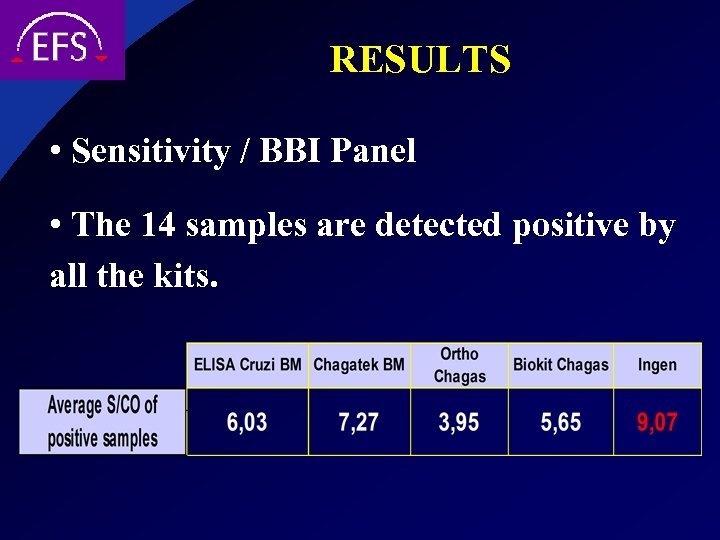 RESULTS • Sensitivity / BBI Panel • The 14 samples are detected positive by all the kits.
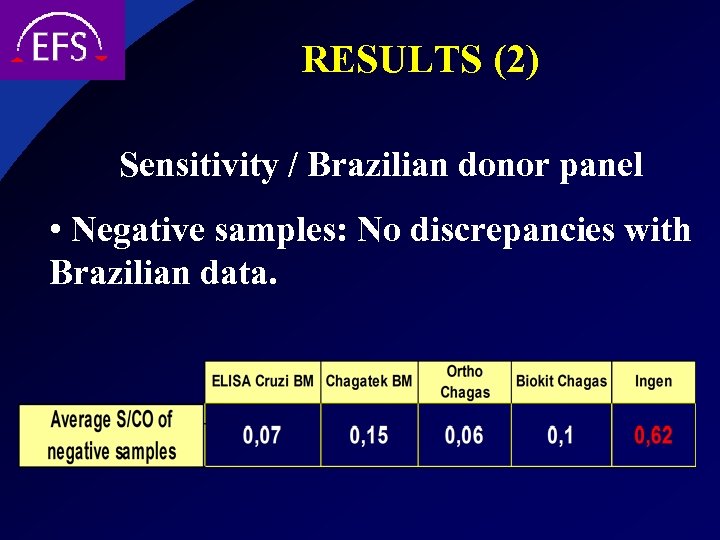 RESULTS (2) Sensitivity / Brazilian donor panel • Negative samples: No discrepancies with Brazilian data.
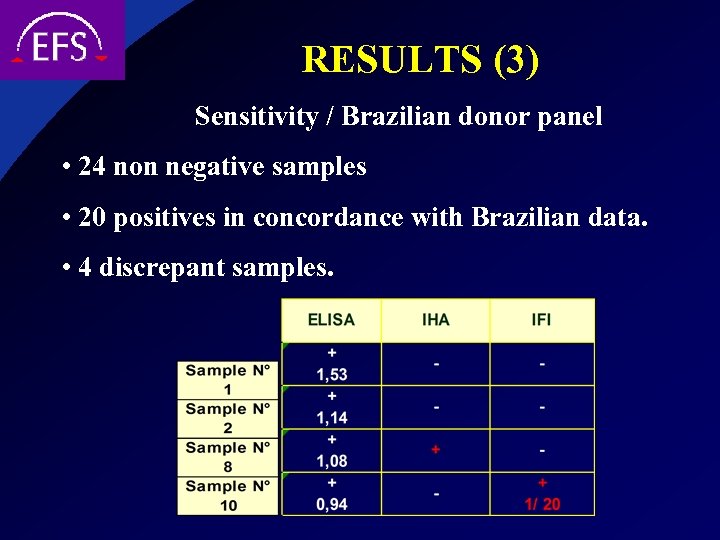 RESULTS (3) Sensitivity / Brazilian donor panel • 24 non negative samples • 20 positives in concordance with Brazilian data. • 4 discrepant samples.
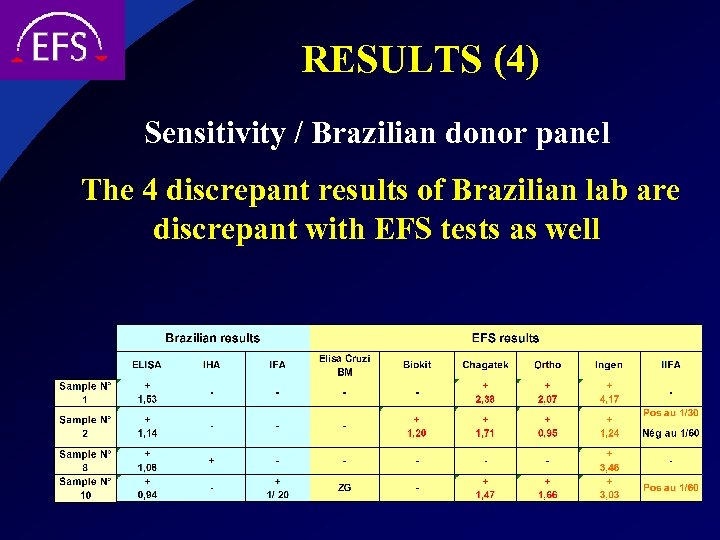 RESULTS (4) Sensitivity / Brazilian donor panel The 4 discrepant results of Brazilian lab are discrepant with EFS tests as well
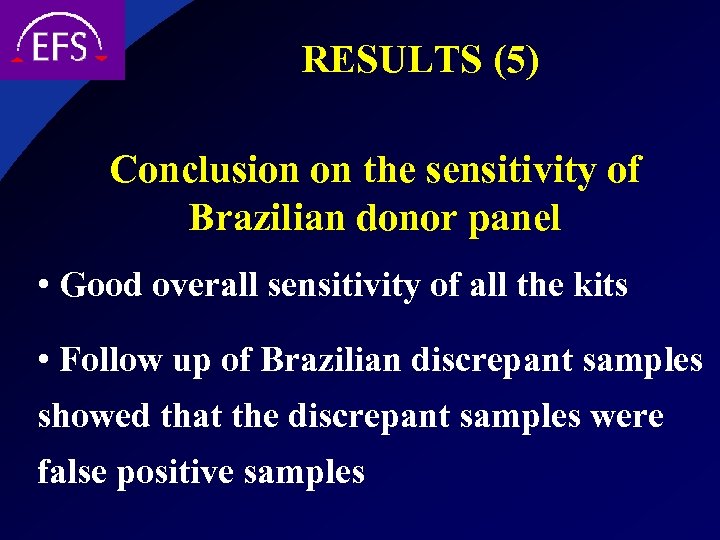 RESULTS (5) Conclusion on the sensitivity of Brazilian donor panel • Good overall sensitivity of all the kits • Follow up of Brazilian discrepant samples showed that the discrepant samples were false positive samples
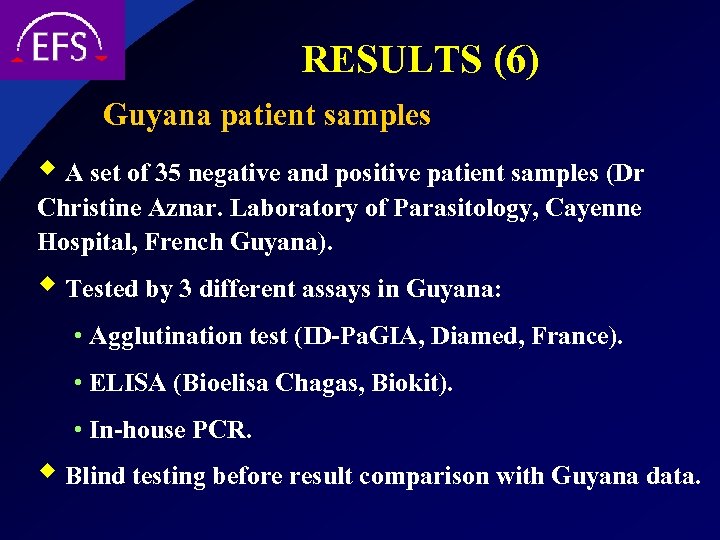 RESULTS (6) Guyana patient samples w A set of 35 negative and positive patient samples (Dr Christine Aznar. Laboratory of Parasitology, Cayenne Hospital, French Guyana). w Tested by 3 different assays in Guyana: • Agglutination test (ID-Pa. GIA, Diamed, France). • ELISA (Bioelisa Chagas, Biokit). • In-house PCR. w Blind testing before result comparison with Guyana data.
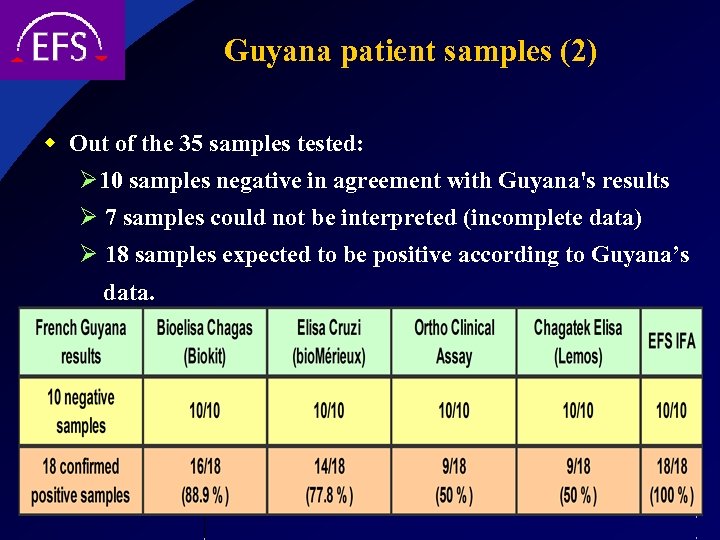 Guyana patient samples (2) w Out of the 35 samples tested: Ø 10 samples negative in agreement with Guyana's results Ø 7 samples could not be interpreted (incomplete data) Ø 18 samples expected to be positive according to Guyana’s data.
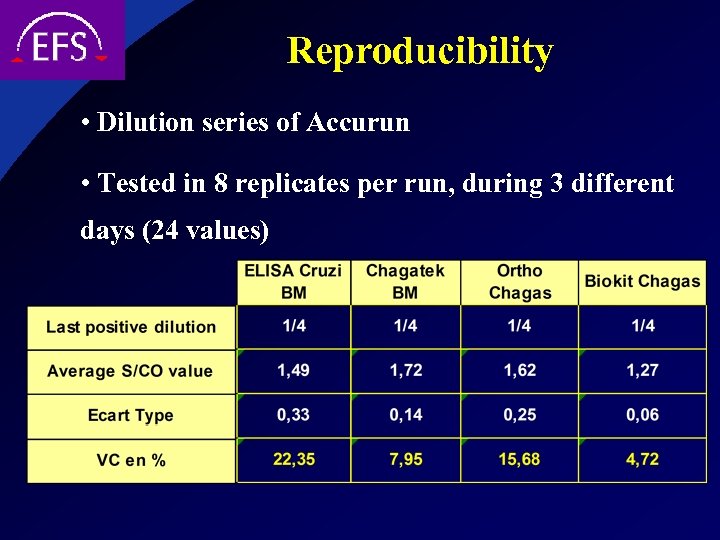 Reproducibility • Dilution series of Accurun • Tested in 8 replicates per run, during 3 different days (24 values)
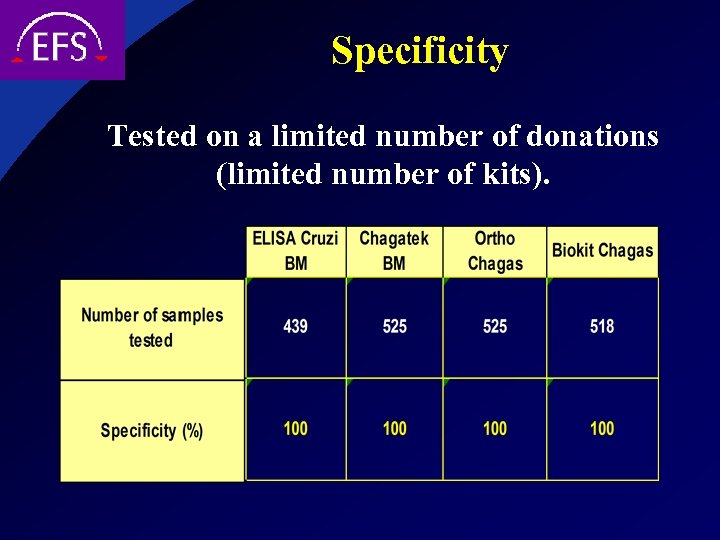 Specificity Tested on a limited number of donations (limited number of kits).
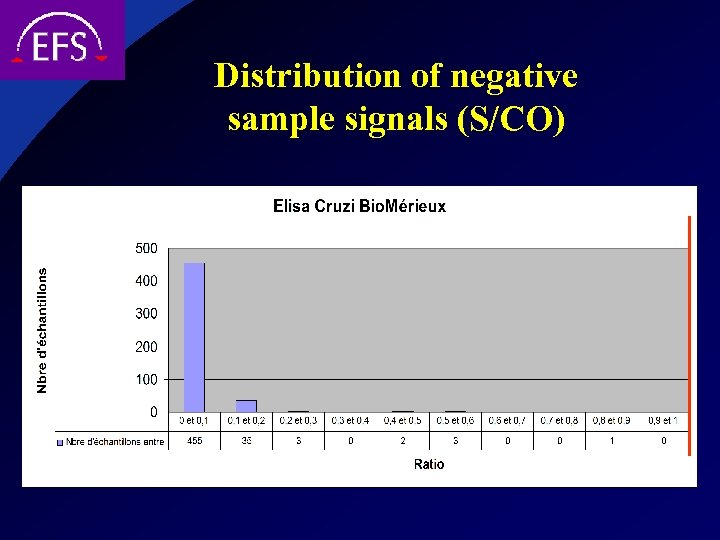 Distribution of negative sample signals (S/CO)
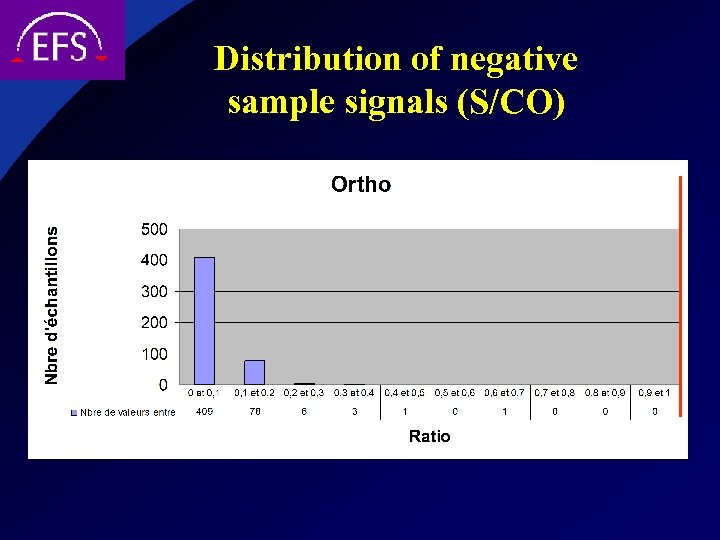 Distribution of negative sample signals (S/CO)
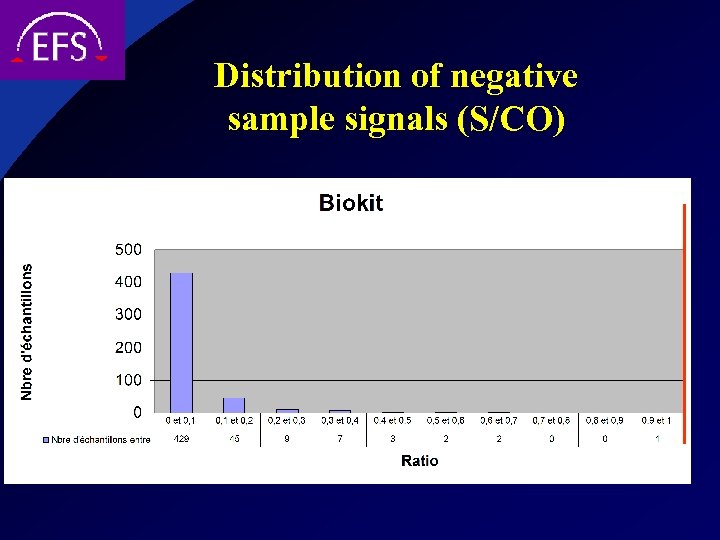 Distribution of negative sample signals (S/CO)
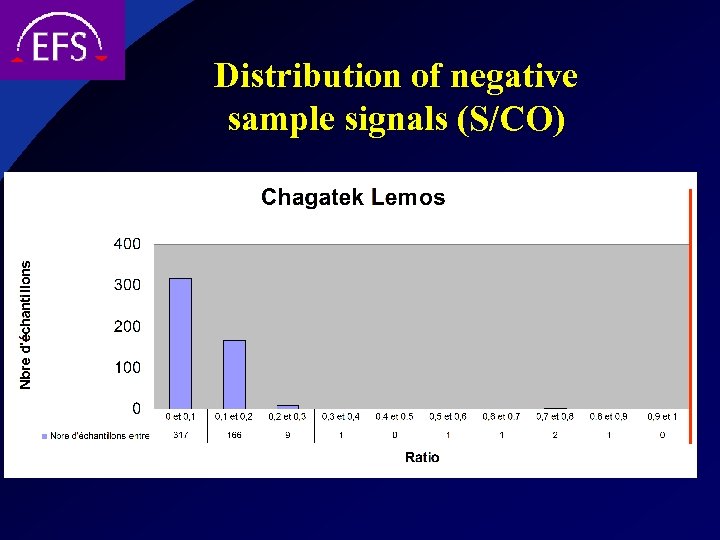 Distribution of negative sample signals (S/CO)
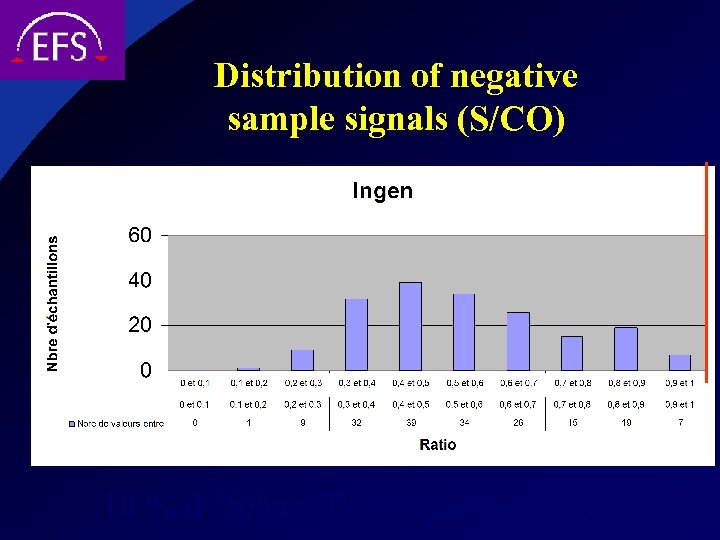 Distribution of negative sample signals (S/CO) 10 % d ’échantillons réactifs initiaux
 SELECTED TESTS • ELISA assays • Bioelisa Chagas (Biokit, Spain). • ELISA Cruzi (Bio. Mérieux, Brazil). • Immunofluorescence Assay Immunofluor Chagas (Biocientifica, Argentine). • Implementation date: May 2 nd, 2007.
 Measures taken to prevent T. cruzi Transfusion transmitted infections. • Temporary deferral, for 4 months of travelers or residents returning from endemic areas. • Screening for antibodies to T. cruzi in targeted at risk blood donors.
 At risk blood donors • Donors born in endemic areas • Travelers and residents returning from endemic areas • Donors born in France from a mother born in risk areas • Donors who underwent blood transfusion
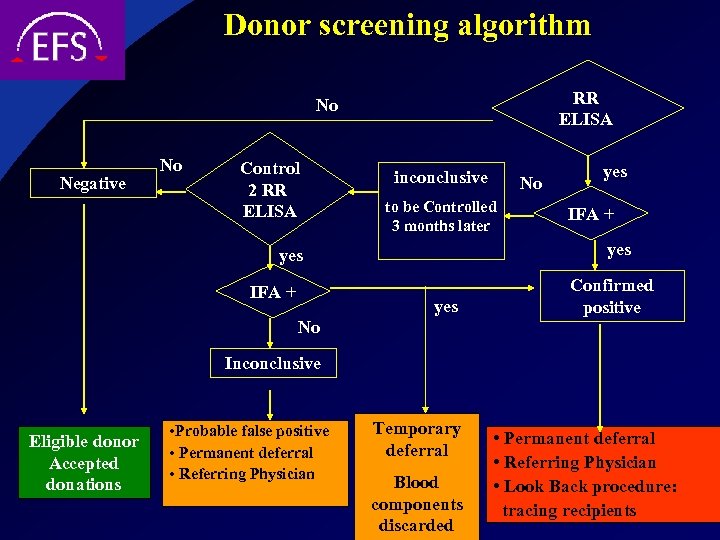 Donor screening algorithm RR ELISA No Negative No Control 2 RR ELISA inconclusive to be Controlled 3 months later yes IFA + No yes Confirmed positive No Inconclusive Eligible donor Accepted donations • Probable false positive • Permanent deferral • Referring Physician Temporary deferral Blood components discarded • Permanent deferral • Referring Physician • Look Back procedure: tracing recipients
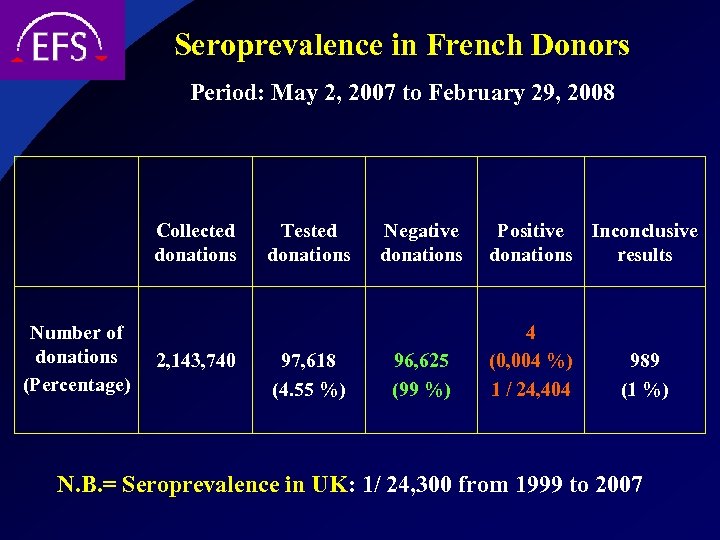 Seroprevalence in French Donors Period: May 2, 2007 to February 29, 2008 Collected donations Number of donations (Percentage) 2, 143, 740 Tested donations 97, 618 (4. 55 %) Negative donations 96, 625 (99 %) Positive Inconclusive donations results 4 (0, 004 %) 1 / 24, 404 989 (1 %) N. B. = Seroprevalence in UK: 1/ 24, 300 from 1999 to 2007
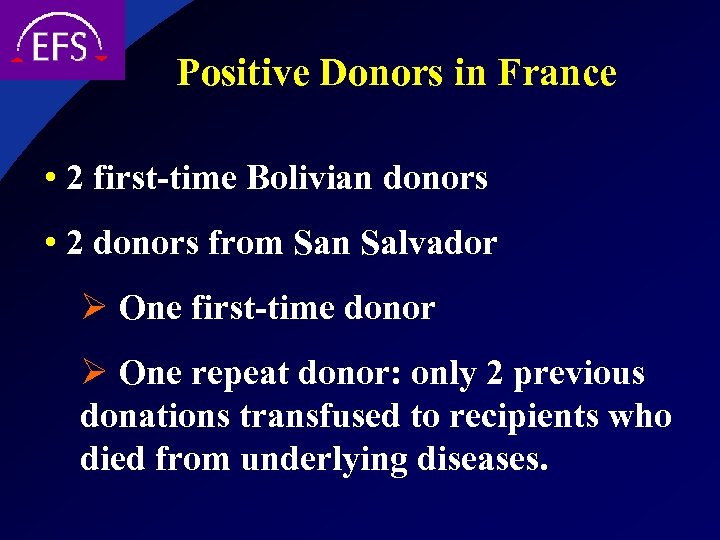 Positive Donors in France • 2 first-time Bolivian donors • 2 donors from San Salvador Ø One first-time donor Ø One repeat donor: only 2 previous donations transfused to recipients who died from underlying diseases.
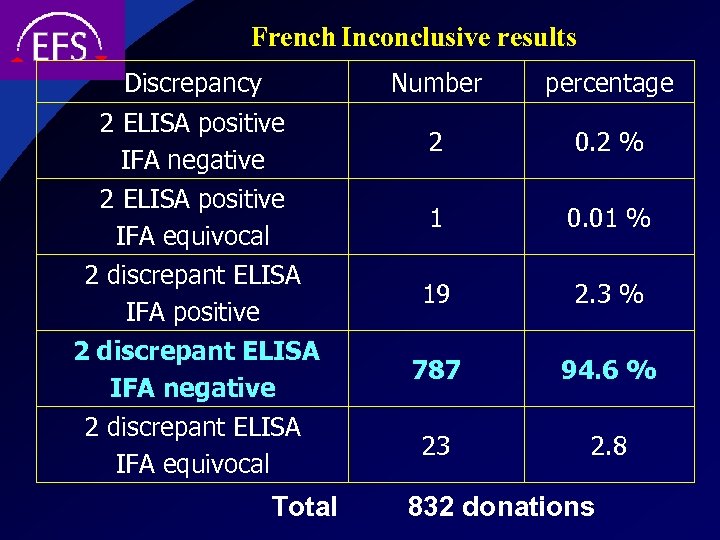 French Inconclusive results Discrepancy Number 2 ELISA positive IFA negative 2 ELISA positive IFA equivocal 2 discrepant ELISA IFA positive 2 discrepant ELISA IFA negative 2 discrepant ELISA IFA equivocal Total percentage 2 0. 2 % 1 0. 01 % 19 2. 3 % 787 94. 6 % 23 2. 8 832 donations
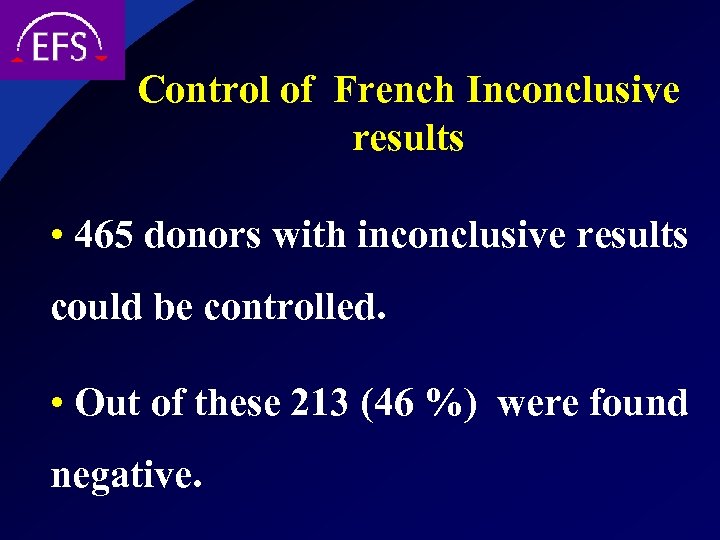 Control of French Inconclusive results • 465 donors with inconclusive results could be controlled. • Out of these 213 (46 %) were found negative.
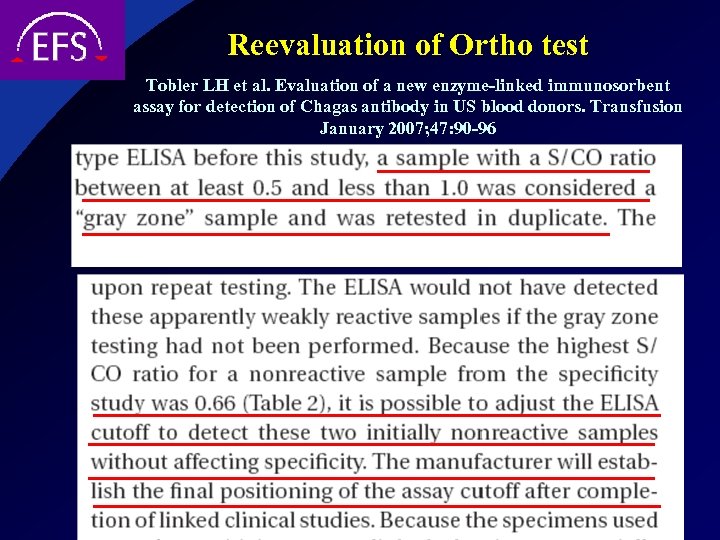 Reevaluation of Ortho test Tobler LH et al. Evaluation of a new enzyme-linked immunosorbent assay for detection of Chagas antibody in US blood donors. Transfusion January 2007; 47: 90 -96
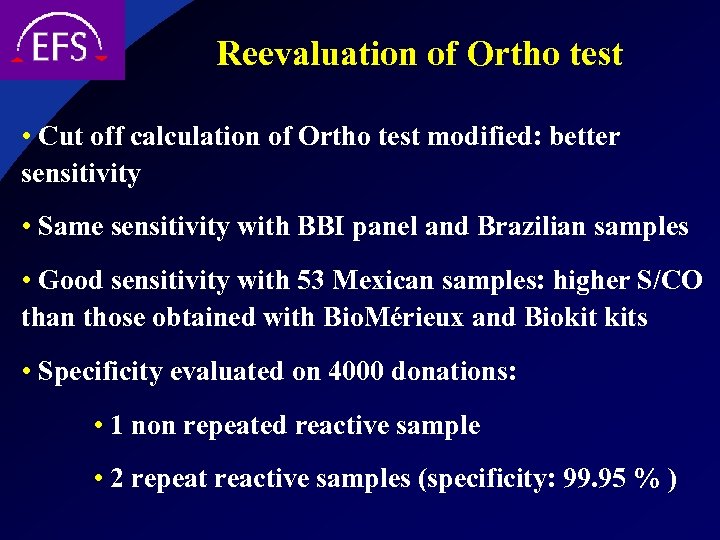 Reevaluation of Ortho test • Cut off calculation of Ortho test modified: better sensitivity • Same sensitivity with BBI panel and Brazilian samples • Good sensitivity with 53 Mexican samples: higher S/CO than those obtained with Bio. Mérieux and Biokit kits • Specificity evaluated on 4000 donations: • 1 non repeated reactive sample • 2 repeat reactive samples (specificity: 99. 95 % )
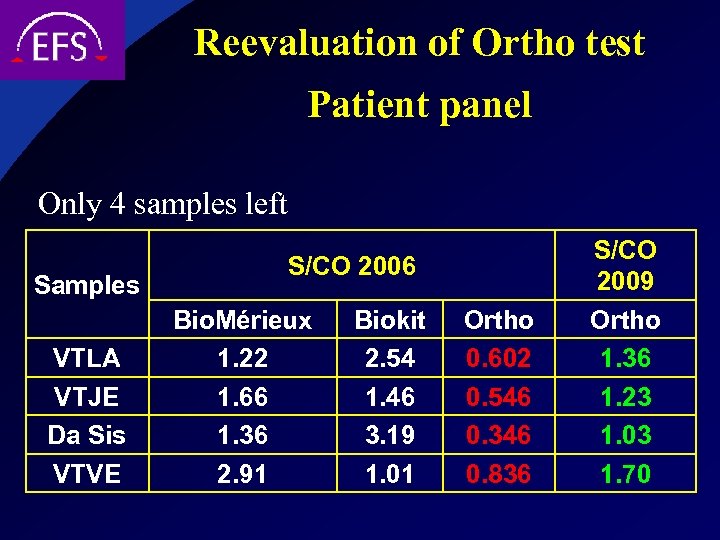 Reevaluation of Ortho test Patient panel Only 4 samples left Samples VTLA VTJE Da Sis VTVE S/CO 2006 Bio. Mérieux 1. 22 1. 66 1. 36 2. 91 Biokit 2. 54 1. 46 3. 19 1. 01 Ortho 0. 602 0. 546 0. 346 0. 836 S/CO 2009 Ortho 1. 36 1. 23 1. 03 1. 70
 Conclusions • Current serological tests (ELISAs) have good performance • Performance continuously improved by manufactures under stringent Quality Control procedures • Current screening strategy results in Large number of Indeterminate results (false positive ? ).
 Conclusions (2) • Revision of screening strategy in France • Screening strategy should be simplified ü Screening with a single ELISA sufficient ü Replace IFA by true confirmatory assays (Western Blot, immunoblot , RIPA, …)